Questions

[5 Mark Question Answer]

🎯

Test yourself on this topic

5 questions · timed · auto-graded

Question 15 Marks
What is nuclear energy? Name the process used for producing electricity using the nuclear energy.
Answer
When a heavy nucleus is bombarded with slow neutrons, it splits into two nearly equal light nuclei with a release of tremendous amount of energy. In this process of nuclear fission, the total sum of masses of products is less than the total sum of masses of reactants. This lost mass gets converted into energy. The energy so released is called nuclear energy.

Principle: The heat energy released due to the controlled chain reaction of nuclear fission of uranium-235 in a nuclear reactor is absorbed by the coolant which then passes through the coils of a heat exchanger containing water. The water in heat exchanger gets heated and converts into steam. The steam is used to rotate the turbine which in turn rotates the armature of a generator in a magnetic field and thus produces electricity.
View full question & answer
Question 25 Marks
State two advantages and two limitations of producing electricity from solar energy.
Answer
Advantages of using solar panels:
  1. They do not cause any pollution in the environment.
  2. Running cost of solar panel is almost zero.
  3. They last over a long period of time.
  4. They do not require any maintenance.
  5. They are suitable for remote and inaccessible places where electricity power lines cannot be laid.

Disadvantages of using solar panels:

  1. The initial cost of a solar panel is sufficiently high.
  2. The efficiency of conversion of solar energy to electricity is low.
  3. A solar panel produces d.c. electricity which cannot be directly used for many household purposes.
View full question & answer
Question 35 Marks
What is a solar cell? State two uses of solar cells. State whether a solar cell produces a.c. or dc. Give one disadvantage of using a solar cell.
Answer
A solar cell is an electrical device that converts light energy directly into electricity with the help of photovoltaic effect. Solar cells are usually made from semiconductors like silicon and gallium with some impurity added to it. When sunlight is made incident on a solar cell, a potential difference is produced between its surface, due to which a current flows in the circuit connected between the opposite faces of the semiconductor.

Two uses of solar cells are as listed below:

  1. They do not require maintenance and last over a long period of time at zero running cost.
  2. They are very useful for remote, inaccessible and isolated places where electric power lines cannot be laid. A solar cell produces d.c. (direct current).

One disadvantage of solar cell is listed below:

(i) The initial cost of a solar panel is sufficiently high.

View full question & answer
Question 45 Marks
Describe the energy flow in an ecosystem.
Answer
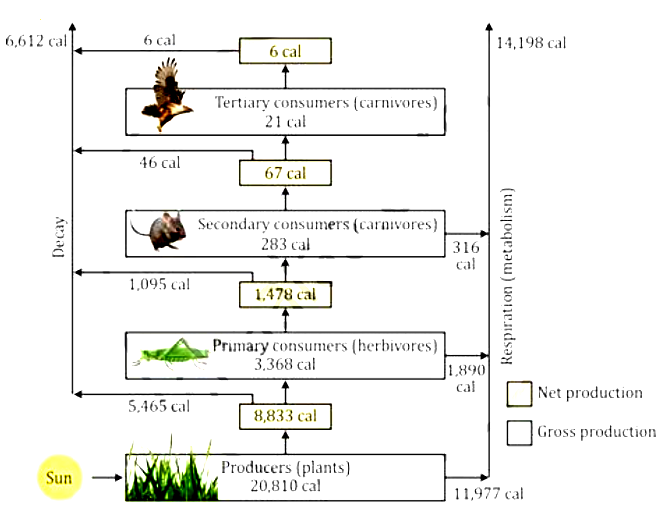
Ecosystems maintain themselves by cycling energy and nutrients obtained from external sources. At the first trophic level, primary producers (plants, algae, and some bacteria) use solar energy to produce organic plant material through photosynthesis. Herbivores-animals that feed solely on plants-make up the second trophic level. Predators that eat herbivores comprise the third trophic level; if larger predators are present, they represent still higher trophic levels. Decomposers, which include bacteria, fungi etc. break down wastes and dead organisms and return nutrients to the soil.

On average about 10 percent of net energy production at one trophic level is passed on to the next level. Processes that reduce the energy transferred between trophic levels include respiration, growth and reproduction, defecation, and non-predatory death. The low rate of energy transfer between trophic levels makes decomposers generally more important than producers in terms of energy flow. Decomposers process large amounts of organic material and return nutrients to the ecosystem in inorganic forms, which are then taken up again by primary producers.
View full question & answer
Question 55 Marks
Describe an experiment to show that water has maximum density at $4^\circ C.$
What important consequences follow this peculiar property of water? Discuss the importance of this phenomenon in nature.
Answer
Hope's experiment to demonstrate that water has maximum density at $4^\circ C :$


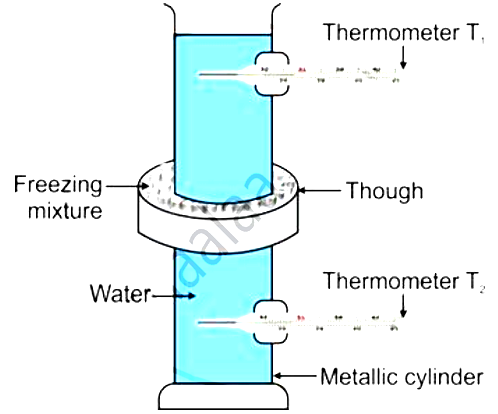
Hope's apparatus consists of a tall metallic cylinder provided with two side openings P and $Q , P$ near the top and Q near the bottom, fitted with thermometers $T_1$ and $T_2$ in them. The central part of the cylinder is surrounded with a cylindrical trough containing a freezing mixture of ice and salt. The cylinder is fitted with pure water at room temperature.

Observations: (i) Initially, both thermometers $T_1$ and $T_2$ are at the same temperature.
(ii) First, the temperature recorded by the lower thermometer $T_2$ starts decreasing and finally it becomes steady at $4^{\circ} C$, while the temperature recorded in the upper thermometer $T _1$ remains almost unchanged during this time.
(iii) Then, the temperature recorded by the lower thermometer $T_2$ remains constant at $4^{\circ} C$ and upper thermometer $T_1$ records a continuous fall in temperature up to $0^{\circ} C$ and then it becomes steady. Thus, finally, the temperature recorded by the upper thermometer is $0^{\circ} C$ and that by the lower thermometer is $4^{\circ} C$.

As the freezing mixture cools water in the central portion of the cylinder, water contracts and its density increases, consequently it sinks to the bottom, thereby causing the reading of the lower thermometer $T_2$ to fall rapidly. The reading of the upper thermometer $T_1$ does not change as the temperature of water in the upper part does not change. This continues till the entire water below the central portion reaches $4^{\circ} C$. On cooling further below 4 , due to anomalous expansion, the water of the central portion expands, so its density decreases and hence it rises up. As a result, reading of the upper thermometer $T _1$ falls rapidly to $0^{\circ} C$ and water freezes to form ice at $0^{\circ} C$ near the top. This proves that water has a maximum density at $4^{\circ} C$.

This anomalous expansion of water helps in preserving the aquatic life during the very cold weather. In winters, when the temperature falls, the top layer of water in a pond contract, becomes denser and sinks to the bottom. A circulation is thus set up until the entire water in the pond reaches its maximum density at $4^{\circ} C$. If the temperature falls further, then the top layer expands and remains on the top till it freezes. Thus, even though the upper layers are frozen the water near the bottom is at $4^{\circ} C$ and the fishes can survive in it easilv.
View full question & answer