Question
Describe an experiment to show that water has maximum density at $4^\circ C.$
What important consequences follow this peculiar property of water? Discuss the importance of this phenomenon in nature.
Answer

Hope's experiment to demonstrate that water has maximum density at $4^\circ C :$


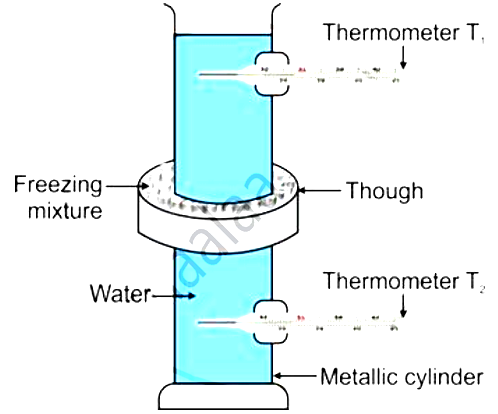
Hope's apparatus consists of a tall metallic cylinder provided with two side openings P and $Q , P$ near the top and Q near the bottom, fitted with thermometers $T_1$ and $T_2$ in them. The central part of the cylinder is surrounded with a cylindrical trough containing a freezing mixture of ice and salt. The cylinder is fitted with pure water at room temperature.

Observations: (i) Initially, both thermometers $T_1$ and $T_2$ are at the same temperature.
(ii) First, the temperature recorded by the lower thermometer $T_2$ starts decreasing and finally it becomes steady at $4^{\circ} C$, while the temperature recorded in the upper thermometer $T _1$ remains almost unchanged during this time.
(iii) Then, the temperature recorded by the lower thermometer $T_2$ remains constant at $4^{\circ} C$ and upper thermometer $T_1$ records a continuous fall in temperature up to $0^{\circ} C$ and then it becomes steady. Thus, finally, the temperature recorded by the upper thermometer is $0^{\circ} C$ and that by the lower thermometer is $4^{\circ} C$.

As the freezing mixture cools water in the central portion of the cylinder, water contracts and its density increases, consequently it sinks to the bottom, thereby causing the reading of the lower thermometer $T_2$ to fall rapidly. The reading of the upper thermometer $T_1$ does not change as the temperature of water in the upper part does not change. This continues till the entire water below the central portion reaches $4^{\circ} C$. On cooling further below 4 , due to anomalous expansion, the water of the central portion expands, so its density decreases and hence it rises up. As a result, reading of the upper thermometer $T _1$ falls rapidly to $0^{\circ} C$ and water freezes to form ice at $0^{\circ} C$ near the top. This proves that water has a maximum density at $4^{\circ} C$.

This anomalous expansion of water helps in preserving the aquatic life during the very cold weather. In winters, when the temperature falls, the top layer of water in a pond contract, becomes denser and sinks to the bottom. A circulation is thus set up until the entire water in the pond reaches its maximum density at $4^{\circ} C$. If the temperature falls further, then the top layer expands and remains on the top till it freezes. Thus, even though the upper layers are frozen the water near the bottom is at $4^{\circ} C$ and the fishes can survive in it easilv.

Need a full question paper?

Generate a complete, print-ready paper with questions like this in minutes — across 16+ boards, with answer keys.

Start Generating Free

Similar questions

Complete the following diagrams in Figure by drawing the reflected rays for the incident rays 1 and 2.
What do you understand by the following terms as applied to micrometre screw gauge?
1. Sleeve cylinder
2. Sleeve scale
3. Thimble
4. Thimble scale
5. Base line.
From diagram given below calculate
1. velocity of $P$ and $Q$
2. frequency of $P$, when frequency of $Q$ is 512 Hz .
Assume that both wave are travelling in same medium.
Image
A bullet of mass 30 g , and moving with a velocity x hits a wooden target with a force of 187.5 N . If the bullet penetrates 80 cm , find the value of $x$
What do you understand by the following terms as applied to screw gauge?
(a) Zero error
(b) Positive zero error
(c) Negative zero error.
A block of wood of mass $24$ kg floats on water. The volume of wood is $0.032 m^3$. Find :(a) the volume of block below the surface of water,
(b) the density of wood.
(Density of water $=1000 kg m ^{-3}$ )
A seconds pendulum is taken to a place where acceleration due to the gravity falls to one-fourth. How is the time period of the pendulum affected, if at all? Give reasons. What will be its new time period?
In the following figure, the pitch of the screw is $1\ mm.$ Calculate :
$(i)$ the least count of screw gauge and
$(ii)$ the reading represented in the figure.
Two bodies $P$ and $Q$, of same masses m and 2m are moving with velocities 2 v and v respectively. Compare their
(i) Inertia, (ii) Momentum, and (iii) The force required to stop them in the same time.
A ball is thrown vertically upwards from the top of a tower with an initial velocity of $19.6 m s ^{-1}$. The ball reaches the ground after 5 s . Calculate:
(i) The height of the tower, (ii) The velocity of the ball on reaching the ground. Take $g =9.8 ms^{-2}$.