Questions

[2 Mark Question Answer]

🎯

Test yourself on this topic

45 questions · timed · auto-graded

Question 12 Marks
What are the expected effects of global warming?
Answer
Harmful effects of global warming are:
(a). The atmospheric temperature of the earth would increase thereby making it difficult for a living being to survive.
(b). It would melt down the polar caps thus increasing the size of the ocean and leading to floods, tsunami, etc.
(c). The increase in temperature would affect climate and rainfall thus affecting flora and fauna.
(d). Human beings would be vulnerable to diseases as microbes would get warmth to grow.
View full question & answer
Question 22 Marks
What are greenhouse gases?
Answer
The greenhouse is a glasshouse constructed to keep delicate and rare plants that require warmth and protection from the weather. It is constructed by panels of glass. The temperature in a green house rises because heat enters the house through the glass but cannot escape out, because the glass reflects the heat back to the inside of the house. This makes the glasshouse warmer than the outside environment. This phenomenon is called the greenhouse effect.
View full question & answer
Question 32 Marks
Describe an experiment to show that a blackened surface is a better emitter of heat than a polished surface.
Answer
Take two sheets of tin plates, one blackened and the other is polished brightly. Fix some drawing pins on the outer side of both sheets using wax. Fix these plates vertically at a very short distance apart. Place a Bunsen burner midway between them. When you light the burner you will observe that the pins from the black painted sheet start dropping while the pins on the polished surface remain in the same position for a much longer time.
Thus, we can conclude that the black surface is a better absorber of heat than the polished one.
View full question & answer
Question 42 Marks
Draw a labeled diagram of a vacuum flask and explain how the heat transfer minimized in it.
Answer
The flask consists of a double-walled glass container with a vacuum between the walls A and B. The inner side of A and the outer side of B are silvered. It has a narrow mouth which is closed by a non-conducting rubber stopper.
If a hot liquid is placed inside the flask, it cannot lose heat by conduction or convection, as there is no air between the walls. The small amount of heat lost from the liquid by radiation is reflected back into the liquid by silvering of the inner wall A and any radiation striking the outer wall B, is reflected back and prevented from reaching the liquid.
View full question & answer
Question 52 Marks
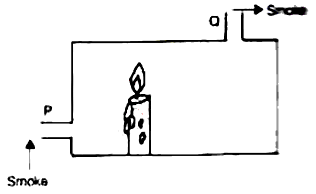
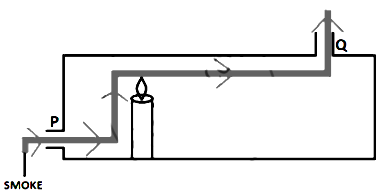
The following figure shows a container in which a lighted candle has been kept. The container has two openings, p, and Q. Which way the smoke from an external source placed near P moves when it reaches P and leaves from Q. Give a reason for your answer.
Answer

Smoke is entering into the box from tube Pandas smoke reaches near the candle its temperature increase and smoke become lighter and leaves out from tube Q.
View full question & answer
Question 62 Marks
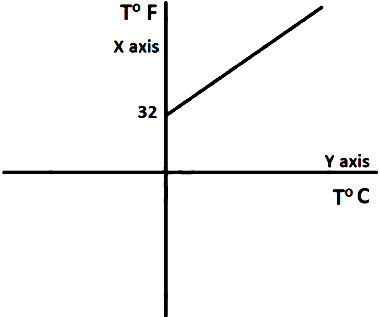
Plot a graph taking °C on the Y-axis and the corresponding °F along the X-axis.
Answer
We know C/100 = (F - 32)/180.
C =5/9 (F- 32 )
9/SC + 32 = F
F = 9/ SC + 32.
The graph between T°F and T°C is a straight line having a slope of 9/5 and the intercept on Y-axis is 32.
View full question & answer
Question 72 Marks
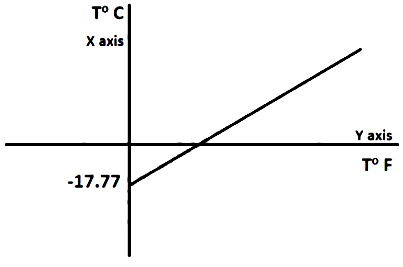
Plot a graph taking °C on the Y-axis and the corresponding °F along the X-axis.
Answer
We know C/100 = (F - 32)/180.
C =5/9(F - 32)
C = 5/9F - 17.77.
The graph between T°C and T°F is a straight line having a slope of 5/9 and the intercept on the Y-axis is-17.77.
View full question & answer
Question 82 Marks
The temp. of two bodies differ by $1^{\circ} C$. What is the difference on the Fahrenheit scale of temperature?
Answer
The difference in temperature of two bodies in the Celsius scale $= 1^oC.$
We know $C/100 = (F - 32)/180.$
$C =5/9(F- 32)$
$9/5C + 32 =F$
$F = 9/5C + 32.$
So, the difference of $1^{\circ}$ in the Celsius scale is equal to the difference of $9 / 5^{\circ}$ in the Fahrenheit scale. Thus, the Difference of $1^{\circ} C$ of the temperature of two bodies in the Celsius scale is equal to the difference of $1.8^{\circ}$ in the Fahrenheit scale.
View full question & answer
Question 92 Marks
What is absolute zero on the Celsius Scale?
Answer
The absolute zero of temperature is $0^oK.$
The temperature in Kelvin To K = Temperature in Celsius To $C + 273.$
$0^oK = To C +273.$
To $C = -273^oC.$
Absolute zero of temperature on the Celsius scale is $-273^oC.$
View full question & answer
Question 102 Marks
Convert -$15^\circ C$ on the Fahrenheit scale.
Answer
We know$ C/100 = (F - 32)/180.$
$C =5/9(F- 32)$
$9/5C + 32 =F$
$F = 9/5C + 32.$
Temperature given in Celsius $= -15^oC.$
$F = 9/5 X (-15) +32$
$F = -27 +32$
$F = 5^oF.$
View full question & answer
Question 112 Marks
The temperature of a body rises through $1^\circ C$. What is the corresponding rise on an absolute scale?
Answer
The absolute scale of temperature is the Kelvin scale.
Conversion of temperature from Celsius to Kelvin scale is
The temperature in Kelvin To K = Temperature in Celsius To$ C +273 .$
So a rise of temperature of $1^{\circ} C$ in the Celsius scale is equal to the rise of $1^{\circ} K$ in the Kelvin scale.
View full question & answer
Question 122 Marks
The body temperature of a healthy person is $98.4^\circ F$. Find the corresponding temperature on the Celsius scale.
Answer
The body temperature of a healthy person is $98.4^oF.$
We know $C/100 = (F - 32)/180.$
$C =5/9(F- 32)$
$C = 5/9(98.4 - 32)$
$C = 5/9 X66.4$
$C =36.88^oC$
The temperature of the body of a healthy man is $36.88^oC.$
View full question & answer
Question 132 Marks
State three advantages of using mercury in a thermometer liquid.
Answer
Three advantages of using mercury as a thermometric liquid:
(i) Mercury is a good conductor of heat.
(ii) Mercury has a high coefficient of expansion thus is sensitive to the smallest change in temperature.
(iii) Freezing points is very low and the boiling point is high.
View full question & answer
Question 142 Marks
State three properties of a liquid which make it suitable to be used in a thermometer.
Answer
Three properties of a liquid which make it suitable to be used in a thermometer are:
(i) The substance should have a high coefficient of expansion so that it is sensitive to the smallest change in temperature
(ii) The substance should have uniform expansion all over its entire volume
(iii) The substance should have minimum specific heat so that it absorbs minimum heat from the body under measurement.
View full question & answer
Question 152 Marks
Give reasons for the following:
When boiling water is poured into a glass bottle, it generally cracks.
Answer
When boiling water is poured into a glass bottle, it generally cracks because on pouring hot water in the bottle the inner surface heats up and expands more as compared to its outer surface. This unequal expansion between the two surfaces causes a strain and the bottle cracks.
View full question & answer
Question 162 Marks
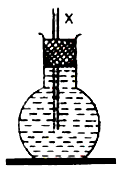
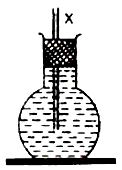
A round bottom flask containing coloured water, filtered with a stopper and a narrow glass tube is shown in the following diagram. What will happen to the water level X marked in the tube when it is placed in a hot water bath? Give a reason for your answer.
Answer

The level will rise above X when the flask is kept in a hot water bath because the water in the flask will heat up and expand in volume thus raising the level of water in the tube above X
View full question & answer
Question 172 Marks
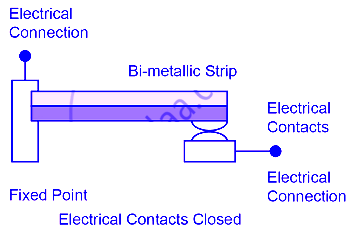
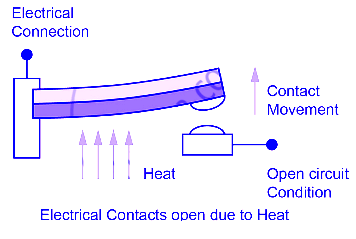
A bimetal strip is shown in the below diagram before heating. Draw a diagram to show how it bends on heating and on cooling.
Answer
The diagram is to show how the given strip bends and cools. Due to heating, the copper bends more than invar due to the high coefficient of linear expansion of copper.
View full question & answer
Question 182 Marks
What is the criterion of choosing the two metals for a bimetal strip?
Answer
Two different metals are used for regulating temperature in an electrical device as the strip bends due to different coefficients of expansion on excessive heating due to current, thus breaking the electrical circuit until the strip cools down to a preset point.
View full question & answer
Question 192 Marks
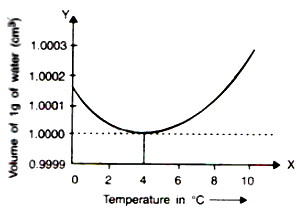
State the volume changes that you will observe when a given mass of water is heated from 0°C to 10°C. Sketch a temperature-volume graph to show the behavior.
Answer
It can be seen from the graph that the volume of the water decrease from 0°C to 4°C and the volume is minimum at 4°C. After 4°C, the volume increases with the increase in temperature.
View full question & answer
Question 202 Marks
State the relation between the three types of expansion.
Answer
If the Coefficient of Linear expansion is denoted by α
Coefficient of superficial expansion is denoted by β
And Coefficient of volume expansion is denoted by γ
Then the relation between α, β and γ is stated as
β = 2 α and γ = 3 α
α : β : γ : : 1 : 2 : 3
View full question & answer
Question 212 Marks
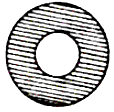
The following figure shows a copper washer. Explain, giving reasons, whether the following characteristics of the washer increase, decrease, or remain the same when it is heated.

(a) Internal diameter
(b) Volume
(c) Mass
(d) Density
(e) External diameter
Answer
On heating the copper washer
(a). Its internal diameter will increase as the copper washer expands outwards
(b). Volume will increase as the size of the metal expands on heating
(c). Mass will remain the same as the mass does not change with change in temperature
(d). Density will decrease as the volume of the washer increases on heating and density is inversely proportional to volume
(e). External diameter will increase because the copper washer expands outwards
View full question & answer
Question 222 Marks
Why does a hot glass chimney often crack when a drop of waterfalls on it?
Answer
A hot glass chimney often crack when a drop of water falls on it because the glass of the chimney expands due to constant heating by the flame of the chimney but as a cooler water drop falls on the glass, the outer surface contracts more than the inner side of the glass. This unequal contraction between the two surfaces causes a strain and the glass cracks.
View full question & answer
Question 232 Marks
Equal volumes of alcohol and mercury are heated uniformly in identical containers separately from 10°C to 50°C. Will both the liquids occupy the same volume? Give reason.
Answer
No, both liquids i.e. mercury and alcohol will not have the same volume on heating as they have a different coefficients of expansions, thus they expand differently on heating at the same temperature range. Alcohol expands more than mercury.
View full question & answer
Question 242 Marks
What is meant by apparent expansion and real expansion of a liquid?
Answer
When a liquid is heated in a flask. Due to heat, the flask expands along with the liquid, thus providing more space for the liquid. Hence the level of the liquid falls. Thus this dropped level shows the apparent expansion of the liquid. The actual expansion of the liquid, when heated, is the real expansion.
View full question & answer
Question 252 Marks
Distinguish between heat and temperature.
Answer
HeatTemperature
It is a form of energy.The physical state decides the direction of heat flow.
Addition of heat causes a change in the temperature of a body.It is the effect of addition of heat
It is measured in joule or calorieIt is measured in Kelvin or Celsius
Measuring devices are calorimeterMeasuring device is a thermometer
View full question & answer
Question 262 Marks
What are the harmful effects of global warming?
Answer
Harmful effects of global warming are
(a). The atmospheric temperature of the earth would increase thereby making it difficult for a living being to survive
(b). It would melt down the polar caps thus increasing the size of the ocean and leading to floods, tsunami, etc.
(c). The increase in temperature would affect climate and rainfall thus affecting flora and fauna.
(d). Human beings would be vulnerable to diseases as microbes would get warmth to grow.
View full question & answer
Question 272 Marks
On a faulty thermometer, a lower fixed point is marked at 10°C and upper fixed point is marked as 130°C. What will be the reading on this thermometer when it is placed in a liquid which is actually at 40°C?
Answer
Lower fixed point = 10°C
Upper fixed point =130°C
Range of thermometer= 130°C - 10°C
= 120°C
No of divisions = 100
So least count = 120/100 = 1.2°C
On actual thermometer 40°C would have 40 divisions
So, on this thermometer, it would show
= 40 x LC = 48°C
View full question & answer
Question 282 Marks
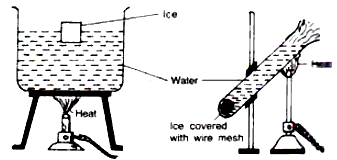
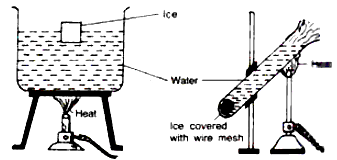
Study the following diagrams and write down your observations.
Answer

In the diagram, it is clear that the ice will melt faster in the flask than in the test tube because water is a bad conductor of heat and the transfer of heat in liquid through convection is from bottom to top.
View full question & answer
Question 292 Marks
Water at 0°C is heated to 10°C. Sketch a temperature-volume graph to show the behavior of heating.
Answer
It can be seen from the graph that the volume of the water decrease from 0°C to 4°C and the volume Is minimum at 4°C. After 4°C, the volume increases with the increase In temperature.

Variation of the volume of water with temperature
View full question & answer
Question 302 Marks
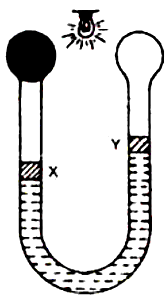
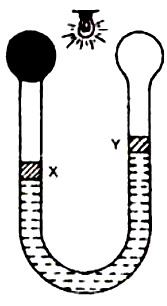
The diagram in the following shows two air filled bulbs connected by a U-tube containing mercury kept equidistant from a glassing bulb.
(i) Explain, how will the level X and Y change? (ii) Give a reason for your answer.
Answer

The level Y will rise and level X will drop because the air in blackened bulb is heated more than clear bulb; hence the air expands and pushes the mercury to the other limb.
View full question & answer
Question 312 Marks
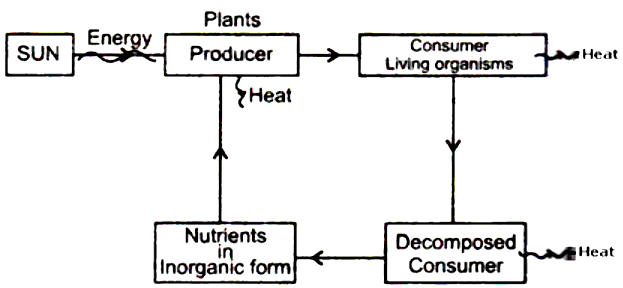
Draw a flow chart to establish that the transfer of the sun's energy in a sun-eco system combination is not cyclic.
Answer

The heat produced in various conversion processes like production, consumption, etc is not returned to the sun. Thus the energy flow of the sun-eco system is not cyclic.
View full question & answer
Question 322 Marks
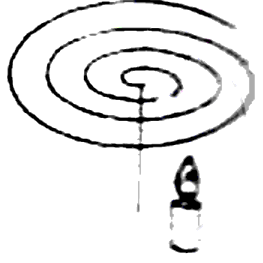
A spiral cut from a thick chart paper is pivoted at 0 and is held slightly above a burning candle You will notice that the spiral starts moving. Explain.
Answer
The spiral starts moving because due to the flame of the candle the spiral heats up and expands. While expanding, the spiral tries to create space for the extension in length, and an outward pull is created which causes the spiral to move.
View full question & answer
Question 332 Marks
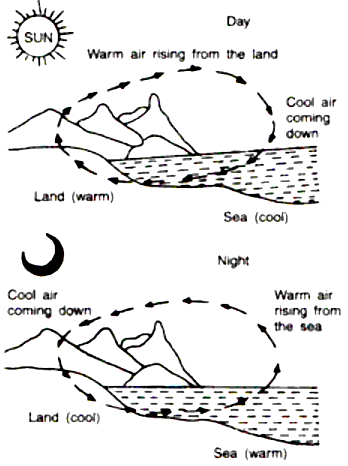
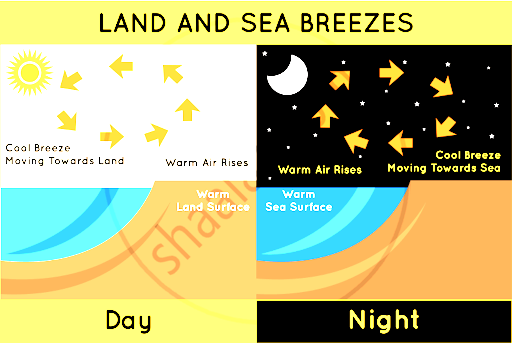
Write a short note on Land Breeze and Sea Breeze.
Answer
The cold air that blows from the land towards the sea during the night, is called a land breeze The cold air that blows from the sea towards the land during the day is known as the sea breeze. These breezes are examples of a natural convection current.
Natural convection currents
View full question & answer
Question 342 Marks
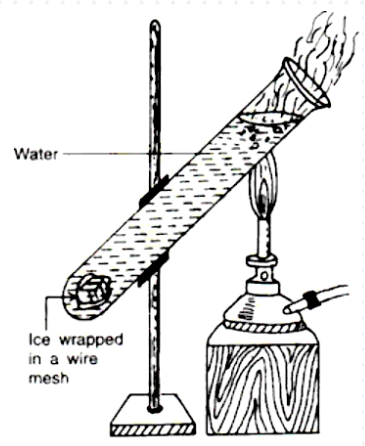
With the help of a diagram, show that water is a bad conductor of heat.
Answer
Image
Water is a bad conductor of heat
An ice cube is wrapped into a wire mesh and is put at the bottom of the glass test tube. The test tube is then heated near the top of the water. It will be noticed that though the water at the top starts boiling, the ice at the bottom does not melt. This clearly shows that water is a poor conductor of heat. "
View full question & answer
Question 352 Marks
Explain the three modes of transfer of heat.
Answer
Three modes of heat transfer are
(a). Conduction involves the transfer of heat from the hot end to the cold end from particle to particle of the medium.
(b). Convection is the transfer of heat from one body to another by the actual movement of the particles of the medium
(c). Radiation is the transfer of heat from one body to another without the need of an intervening material medium
View full question & answer
Question 362 Marks
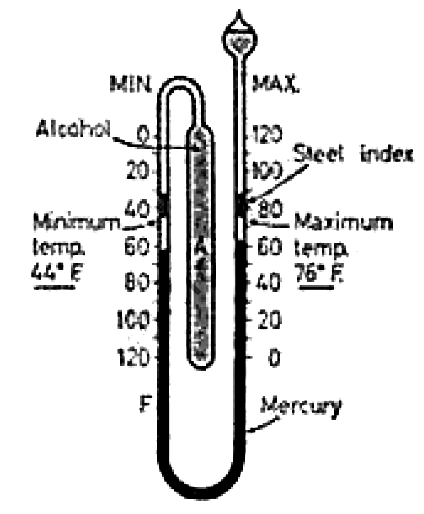
Draw a neat and labeled diagram of a Six's maximum and minimum thermometer. Explain briefly, the working of this thermometer. Give a use of this thermometer.
Answer
Diagram of six's maximum and minimum thermometer

Six's thermometer is a thermometer which can measure the maximum and minimum temperatures reached over a period of time, usually during a day. It is commonly used wherever a simple way is needed to measure the extremes of temperature at a locat ion, for instance in meteorology and horticulture
View full question & answer
Question 372 Marks
Which is the temperature that is common in the Celsius and the Fahrenheit scale?
Answer
The temperature that is common in both clinical and Fahrenheit scale is $-40^oC$
Derivation is as follows
Let the temperature be $x$
$C/100= (F - 32)/180$
$x/100 = (x-32)/180$
$x X 180/100 = x-32$
$9/5x = x-32$
$-4/5x =32$
$X = - 40$
View full question & answer
Question 382 Marks
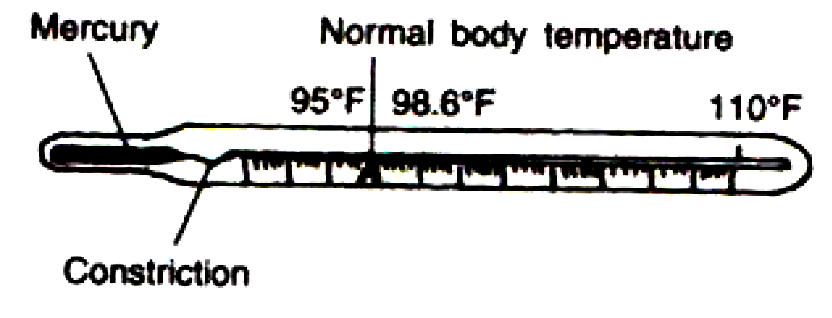
Draw a neat and labeled diagram of a clinical thermometer
Answer

A clinical thermometer is used to measure body temperature. The capillary tube has a constriction above the bulb preventing mercury to fall back once it has risen
View full question & answer
Question 392 Marks
What is meant by the lower and upper fixed points of a thermometer?
Answer
Lower point of a thermometer is the temperature at which ice starts melting at normal atmospheric pressure i.e. $0^oC$
Upper point of a thermometer is the temperature at which water just starts boiling at normal atmospheric pressure i.e. $100^oC.$
View full question & answer
Question 402 Marks
State three main characteristics of a thermometric substance.
Answer
The main characteristics of the thermometric substances are
(a). The substance should have a high coefficient of expansion so that it is sensitive to the smallest change in temperature
(b). The substance should have uniform expansion all over its entire volume
(c). The substance should have minimum specific heat so that it absorbs minimum heat from the body under measurement.
View full question & answer
Question 412 Marks
Is it possible to heat a liquid or gas from above? Explain your answer.
Answer
No, it is not possible to heat a liquid or gas from above because the transfer of heat through convection takes place vertically upwards in liquids and gases. So if they are heated from above, the liquid or gas at the top will only be heated because most liquids and gases are themselves bad conductors of heat so they cannot conduct heat from the top layer to the bottom layer.
View full question & answer
Question 422 Marks
Why are bridges made of steel girders put on rollers?
Answer
The beams of the bridges expand maximum during the summer days and contract maximum during the winter nights. If the beams are fixed at both ends on the pillars, they may develop crack due to expansion and contraction. To avoid this, beams are made to rest on rollers on the pillars to provide space for expansion.
View full question & answer
Question 432 Marks
What are land and sea breezes? Explain with the help of a labeled diagram.
Answer
The cold air that blows from the land towards the sea during night, is called a land breeze. The cold air that blows from the sea towards the land during the day is known as the sea breeze. These breezes are examples of a natural convection current.
View full question & answer
Question 442 Marks
Do all substances expand on heating? Give examples.
Answer
Not all substances expand on heating. Some examples of substances which do not expand on heating are plastics, polythene and rubber.
View full question & answer
Question 452 Marks
State the types of thermal expansion. What is the relation between α and γ?
Answer
There are three types of thermal expansions:
a. Linear expansion
b. Superficial expansion
c. Cubical expansion
Coefficient of linear expansion be a Coefficient of cubical expansion be γ The relation between them is V = 3 α
View full question & answer
[2 Mark Question Answer] - PHYSICS STD 9 Questions - Vidyadip