Questions

[3 Mark Question Answer]

🎯

Test yourself on this topic

24 questions · timed · auto-graded

Question 13 Marks
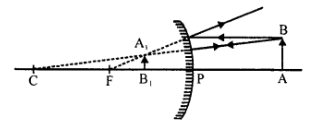
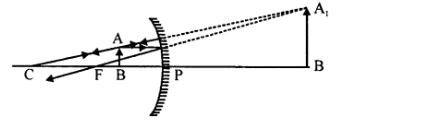
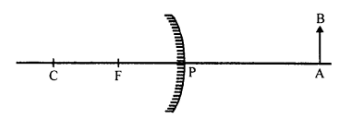
Copy the figure and complete it, by drawing two rays to show the formation of the image of the object AB . State the size, position and nature of image formed.
Image
Answer

Image
- Nature: Image formed is virtual and erect.
- Position : Image is formed between principal focus (F) and pole.
- Size : Image formed is diminished.
View full question & answer
Question 23 Marks
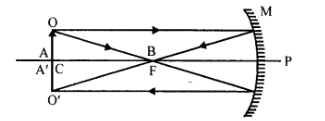
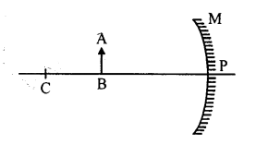
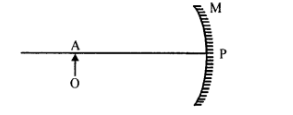
In the figure is shown a concave mirror. A is a point on the principal axis. If an object O is kept at A, image is formed on A itself. Copy the diagram. Draw the image in the diagram. Is the image real or virtual?
Image
Measure the distance PA and write it in the diagram. What is the distance PA called? Mark a point B on the principal axis, at which, if a point source of light is kept, the rays travel parallel to principal axis after reflection from M. What is point B called?
Answer
As the object is placed at A and its image is also formed at A, so object must be at centre of curvature (C).
Image
PA is called radius of curvature and on measuring PA = 4.8 cm. Point B marked on principal axis is called principal focus.
View full question & answer
Question 33 Marks
1. What is a real image?
2. What type of mirror is used to obtain a real image-of an object?
3. Does the mirror named by you above give real images for all locations of object?
Answer
1. Real image: When the rays of light diverging from a point, after reflection of refraction, actually converge at some point, then that point is the real image of the object.
2. Concave mirror is used to obtain the real image of an object.
3. Concave mirror can not give real image for all the locations of object.
View full question & answer
Question 43 Marks
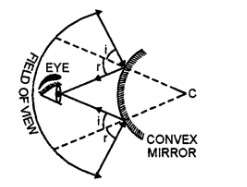
1. Why does a driver use a convex mirror as a rear view mirror?
2. Illustrate your answer with the help of ray diagram.
Answer
self
View full question & answer
Question 53 Marks
Compare the characteristics of an image formed by a convex mirror and a concave mirror, when object is beyond centre of curvature, but not at infinity.
Answer
Characteristics of the image formed by concave mirror when object is beyond centre of curvature, but not at infinity are :
1. Image formed is real.
2. Image formed is inverted.
3. Image formed is diminished.
4. Image is formed between centre of curvature (C) and principal focus ( $F$ ), in front of the concave mirror.
Characteristics of the image formed by convex mirror when object is beyond centre of curvature, but not at infinity are :
1. Image formed is virutal.
2. Image formed is erect.
3. Image formed is diminished.
4. Image is always formed between pole and principal focus and behind the convex mirror.
View full question & answer
Question 63 Marks
You are provided a convex mirror, a concave mirror and a plane mirror. How will you distinguish between them, without touching or using any other apparatus?
Answer
We can identify convex mirror, concave mirror and a plane mirror by looking at them one by one.
1. If the size of the image of an object is of the same size as that of the object, then that mirror is a plane mirror.
2. If the size of image of an object increases as the object is brought closer to the mirror and size of the image of the object decreases when the object is taken away from the mirror, then that mirror is a concave mirror.
3. If the size of the iamge of an object remains diminished, either the object is moved away from the mirror or moved towards the mirror, then that mirror is a convex mirror.
View full question & answer
Question 73 Marks
Give two uses of
1. convex mirror
2. concave mirror.
Answer
(i) Two uses of convex mirror are:
(a) It is used as a rear view mirror in automobile to see the traffic behind.
(b) It is used as reflector for street light bulbs.
(ii) Two uses of concave mirror are:
(a) Concave mirror is used as A Reflector in head lights of cars and in search light. The source of light (bulb) is placed at the principal focus and the reflector forms parallel beam of light.
(b) For doctors to examine throat, ear, nose and eyes, light is focused with the help of concave mirror.
View full question & answer
Question 83 Marks
Why do automobile drivers prefer convex mirror as a rear view mirror? Illustrate your answer.
Answer
A convex mirror always forms a small and upright image between pole and focus. That means in small area of mirror driver can see all the traffic coming from behind.
Image
View full question & answer
Question 93 Marks
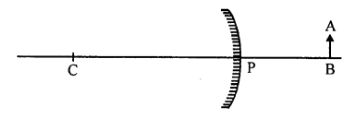
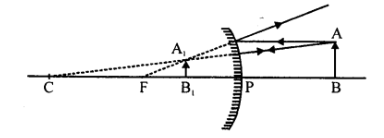
Copy the figure. By taking two rays from point A , show the formation of image. State four characteristics of the image.
Image
Answer

Image
Characteristics of image:
1. Image formed is virutal.
2. Image formed is erect.
3. Image formed is diminished.
4. Image is always formed between pole and principal focus, behind the convex mirror.
View full question & answer
Question 103 Marks
Draw a neat two ray diagram to illustrate how a concave mirror is used as a shaving mirror.
Answer
We know that when an object is placed between P and F of a concave mirror, it forms a virtual and enlarged image. Thus, by using concave mirror we can have a proper shave, as the tiny hairs are clearly visible.
Image
View full question & answer
Question 113 Marks
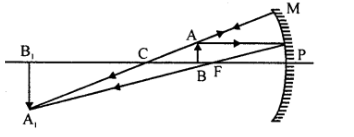
Copy the figure. By taking two rays from point A , show the formation of image. State four characteristics of the image.
Image
Answer

Image

Characteristics of the image:
1. Image formed is real.
2. Image formed is inverted.
3. Image formed is enlarged.
4. Image is formed beyond centre of curvature in front of concave mirror.
View full question & answer
Question 123 Marks
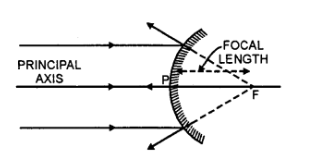
(a) Define the term principal focus in case of convex mirror. Draw a convex mirror and show its principal focus and focal length clearly.
(b) What is the relation between focal length and radius of curvature of a concave mirror?
Answer
(a) Focal length is the distance between pole (P) and focus ( $F$ )
Image
(F) Focus is a point on principal axis where rays of light appear to meet.
(b) Focal length of a spherical mirror is equal to half of the radius of curvature of spherical mirror.
$
\begin{aligned}
\text { Focal length } & =\frac{\text { Radius of curvature }}{2} \\
f & =\frac{R}{2}
\end{aligned}
$
View full question & answer
Question 133 Marks
Define the following terms :
1. spherical mirror
2. convex mirror
3. concave mirror
Answer
1. Spherical mirror : "A mirror which is made from a part of a hollow sphere is called Spherical Mirror.
2. Convex mirror: "A mirror made by silvering the inner surface such that reflection takes place from the bulging surface" is called Convex Mirror. Centre of curvature is towards the silvered surface.
3. Concave mirror : "A mirror made by silvering the outer or the bulging surface such that the reflection takes place from the concave surface." Centre of curvature is towards the reflecting surface.
View full question & answer
Question 143 Marks
An object is placed 2 cm from a plane mirror. If the object is moved by 1 cm towards the mirror, what will be the distance between the object and its new image?
Answer
Distance of the object from plane mirror $=2 cm$
If object is moved by 1 cm towards the mirror, then distance between the object and plane mirror $=u=1 cm$
We know in case of plane mirror,
Distance of object from plane mirror = Distance of the image of the object from plane mirror
$
\Rightarrow v=u=1 cm
$
$\therefore$ Distance between its object and new image $= u + v =1+1=2 cm$
View full question & answer
Question 153 Marks
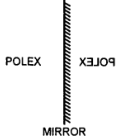
(a) Write down the letters of the word 'POLEX' as seen in a plane mirror, held parallel to the plane of this paper.
(b) Distinguish between real and virtual image.
Answer
(a)
Image
(b) Real image :
1. Can be taken on the screen.
2. It is inverted.
3. It is formed when light rays after reflection (or refraction) actually meet.
Virtual image :
1. Cannot be taken on screen.
2. It is erect.
3. It is formed when rays of light after reflection (or refraction) appear to meet.
View full question & answer
Question 163 Marks
How many images will be formed when an object is placed between two parallel plane mirrors with their reflecting surfaces facing each other? Why do more distant images appear fainter?
Answer
Angle between two mirrors facing each other $=\theta=0^{\circ}$
No. of images formed $=n=\frac{360^{\circ}}{\theta}=\frac{360^{\circ}}{0}=\infty$
So, infinite number of images are formed when an object is placed between two parallel plane mirrors with their reflecting surfaces facing each other.
More distant images appear fainter when two plane mirror with their reflecting surfaces facing each other because,
After every successive reflection, some amount of light energy is absorbed. Thus luminosity of images goes on decreasing and hence they appear fainter.
View full question & answer
Question 173 Marks
(i) Parallel rays are incident:
1. on regular surface and
2. on irregular surface. In what respect do reflected rays in (1) differ from those of (2)?
(ii) Write down four characteristics of image formed in a plane mirror.
Answer
(i) Parallel rays of light after reflection from a regular surface. goes in a particular direction while after reflection from irregular surface go in different directions.
(ii) Characteristics of Image formed by a Plane Mirror.
(a) Image is of the same size as that of object.
(b) Image is laterally inverted.
(c) It is upright.
(d) It is virtual.
(e) Image formed is as far behind the mirror as the object in front of the mirror.
View full question & answer
Question 183 Marks
(i) Draw a diagram to show reflection of a ray of light using plane mirror. In the diagram label the incident ray, the reflected ray, the normal, the angle of incidence and angle of reflection. (ii) State the laws of reflection.
Answer
self
View full question & answer
Question 193 Marks
An insect is sitting in front of a plane mirror at a distance of one metre from it.
1. Where is the image of insect formed?
2. What is the distance between insect and its image?
3. State any two characteristics of image formed in a plane mirror.
Answer
(i) Distance of insect from plane mirror $= u =1 m$
We know in case of plane mirror, distance of object from plane mirror is equal to distance of image of the object from the plane mirror.
$\therefore$ Distance of the image of insect from plane mirror $= v = u -1 m$
(ii) Distance between insect and its image $=u+v=1+1=2 m$
(iii) Characteristics of the image formed by a plane mirror :
(a) Image formed is virtual.
(b) Image formed is erect.
(c) Image formed is of same size as that of the object.
View full question & answer
Question 203 Marks
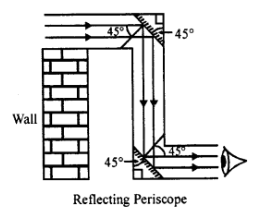
(a) Draw a neat diagram of reflecting periscope.
(b) State two advantages and two disadvantages of the reflecting periscope.
Answer
(a)
Image
(b) Advantages of Reflecting Periscope:
1. It is used to see above the head of crowds.
2. It is used by soldiers in trench warfare.
Disadvantages of Reflecting Periscope:
1. The final images is not brightly illuminated as light energy is absorbed due to two successive reflections.
2. Any deposition of moisture of dust on the mirror reduces the reflection almost to nil, and hence, the periscope cannot be used in places where there is a lot of dust or moisture

View full question & answer
Question 213 Marks
(a) State four characteristics of the image formed in a plane mirror.
(b) State three ways in which the image formed in a plane mirror differs from the image formed in a pin hole camera.
Answer
(a) Characteristics of Image formed by a Plane Mirror.
1. Image is of the same size as that of object.
2. Image is laterally inverted.
3. It is upright.
4. It is virtual.
5. Image formed is as far behind the mirror as the object infront of the mirror.
(b) Image formed by plane mirror:
1. Image formed by plane mirror is virtual.
2. It can not be obtained on the screen.
3. Size of image is same as that of the object.
4. Image appears to be inverted only on the vertical axis.
Image formed by Pinhole camera:
1. Image formed by pinhole camera is real.
2. It can be obtained on the screen.
3. Size of the image is smaller than the object.
4. Image appears to be inverted on both the vertical axis and horizontal axis.
View full question & answer
Question 223 Marks
(a) State the mirror formula for the formation of total number of images formed in two plane mirrors, held at an angle.
(b) Calculate the number of images formed in two plane mirrors, when they are held at the angle of (i) $72^{\circ}$ (ii) $36^{\circ}$.
View full question & answer
Question 233 Marks
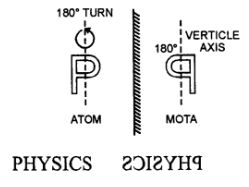
(a) What do you understand by the term lateral inversion?
(b) A printed card has letters PHYSICS. By drawing the diagram show the appearance of the letters. (No ray diagram is required).
Answer
(a) Lateral Inversion. The phenomenon due to which the image of an object turns through an angle of $180^{\circ}$ through verticle axis rather the horizontal axis, such that right side of image appears as left or vice-versa is called Lateral Inversion. During lateral inversion the left side of object appears as right side of image and vice-versa. In a way the image turns through the angle of $180^{\circ}$ about vertical axis.
Image
View full question & answer
Question 243 Marks
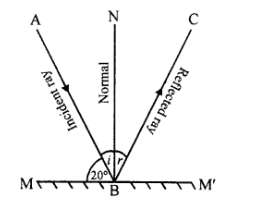
A ray of light strikes a plane mirror, such that angle with the mirror is $20^{\circ}$. What is value of angle of reflection? What is the angle between the incident ray and the reflected ray?
Answer
$
\begin{array}{l}
\because \text { Light ray makes an angle of } 20^{\circ} \text { with the mirror } \\
\therefore \angle ABM=20^{\circ} \\
\text { Angle of incidence }=\angle i=90^{\circ}-20^{\circ} \\
\angle i=70^{\circ} \\
\because \angle i=r \therefore \angle r=70^{\circ}
\end{array}
$
Image
$
\text { Angle between incident ray and reflected ray }=\angle i+\angle r=70^{\circ}+70^{\circ}=140^{\circ}
$
View full question & answer
[3 Mark Question Answer] - PHYSICS STD 9 Questions - Vidyadip