Question types

Light question types

50 questions across 4 question groups — pick any mix to generate a PHYSICS paper with step-by-step answer keys.

50
Questions
4
Question groups
5
Question types
Sample Questions

Light questions

One sample from each question group in this chapter. Select any group above to see the full set with answer keys.

Q 1MCQ1 Mark
Which mirror is used in periscope?
  • A
    Convex mirror
  • B
    Concave mirror
  • Plane mirror
  • D
    Parabolic mirror

Answer: C.

View full solution
Q 2MCQ1 Mark
Looking into a mirror one finds her image diminished, the mirror is :
  • A
    concave
  • convex
  • C
    cylindrical
  • D
    parabolic

Answer: B.

View full solution
Q 3MCQ1 Mark
In case of concave mirror, the minimum distance between an object and its real image is :
  • A
    f
  • B
    $2 f$
  • C
    4 f
  • zero

Answer: D.

View full solution
Q 4MCQ1 Mark
If an incident ray passes through the centre of curvature of a spherical mirror, the reflected ray will:
  • A
    pass through its pole
  • retraces its path
  • C
    pass through its focus
  • D
    be parallel to principal axis

Answer: B.

View full solution
Q 5MCQ1 Mark
A ray of light is incident on a concave mirror. If it is parallel to principal axis, the reflected ray will:
  • pass through its principal focus
  • B
    pass through its centre of curvature
  • C
    pass through its pole
  • D
    retraces its path

Answer: A.

View full solution
(a) What do you understand by the term real image?
(b) What type of mirror is used to obtain a real image?
(c) Does the mirror named by your form real image for all locations? Give reason for your answer.
(d) Is real image always inverted?
View full solution
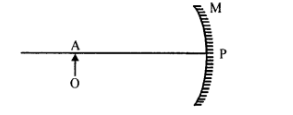
In the figure is shown a concave mirror. A is a point on the principal axis. If an object O is kept at A, image is formed on A itself. Copy the diagram. Draw the image in the diagram. Is the image real or virtual?
Image
Measure the distance PA and write it in the diagram. What is the distance PA called? Mark a point B on the principal axis, at which, if a point source of light is kept, the rays travel parallel to principal axis after reflection from M. What is point B called?
View full solution
1. What is a real image?
2. What type of mirror is used to obtain a real image-of an object?
3. Does the mirror named by you above give real images for all locations of object?
View full solution
An object forms a virtual image which is $1 / 8$ th of the size of the object. If the object is placed at a distance of 40 cm from the convex mirror, calculate:
1. the position of the image
2. the focal length of the convex mirror.
View full solution
An object 5 cm high forms a virtual image of 1.25 cm high, when placed in front of a convex mirror at a distance of 24 cm . Calculate:
1. the position of the image
2. the focal length of the convex mirror.
View full solution
A converging mirror, forms a three times magnified virtual image when an object is placed at a distance of 8 cm from it. Calculate:
1. the position of the image
2. the focal length of the mirror.
View full solution
An object 1.5 cm high when placed in front of a concave . mirror, produces a virtual image 3 cm high. If the object is placed at a distance of 6 cm from the pole of the mirror, calculate:
1. the position of the image
2. the focal length of the mirror.
View full solution

Generate a Light paper free

Pick question groups from the list above, set marks and difficulty, and export a branded PDF with step-by-step answer keys. First 3 chapters free — no signup.

Download App