Questions

[5 Mark Question Answer]

🎯

Test yourself on this topic

14 questions · timed · auto-graded

Question 14 Marks
Define the following terms in relation to concave mirror.
1. Pole
2. Centre of curvature
3. Principal axis
4. Principal focus
5. Focal length
6. Radius of curvature
7. Aperture
Answer
1. Pole : Pole "is the mid-point of the mirror".
2. Centre of curvature: The centre of hollow sphere of which the mirror forms a part, is called centre of curvature.
3. Principal axis: An imaginary line passing through the pole and the centre of curvature of a spherical mirror is called principal axis
4. Principal focus: It is a point on the principal axis, where a beam of light, parallel to principal axis, after reflection actually meet.
5. Focal length: The linear distance between the pole and the principal focus is called focal length.
6. Radius of curvature: The linear distance between the pole and the centre of curvature is called radius of curvature.
7. Aperture: The diameter of a spherical mirror is called its aperture.
View full question & answer
Question 24 Marks
An object forms a virtual image which is $1 / 8$ th of the size of the object. If the object is placed at a distance of 40 cm from the convex mirror, calculate:
1. the position of the image
2. the focal length of the convex mirror.
Answer
Let size of the object $=h_0=x$
Size of the image $h_i=\frac{x}{8}=+1.25 cm$
Distance of the object from the convex mirror $=u=-40 cm$
Distance of the image from the convex mirror $=v=$ ?
(i) Magnification $=m=\frac{h_i}{h_0}=-\frac{v}{u}$
$
\begin{array}{l}
\frac{x / 8}{x}=-\frac{v}{-40} \\
v=\frac{x}{8 x} \times 40=5 cm
\end{array}
$
(ii) Using mirror formula :
$
\frac{1}{u}+\frac{1}{v}=\frac{1}{f}
$
We have,
$
\begin{aligned}
& \frac{1}{-40}+\frac{1}{5}=\frac{1}{f} \\
& \frac{1}{f}=-\frac{1}{40}+\frac{1}{5} \\
& \frac{1}{f}=\frac{-1+8}{40}=\frac{7}{40} \\
\Rightarrow & f=\frac{40}{7}=5.71 cm
\end{aligned}
$
View full question & answer
Question 34 Marks
An object 5 cm high forms a virtual image of 1.25 cm high, when placed in front of a convex mirror at a distance of 24 cm . Calculate:
1. the position of the image
2. the focal length of the convex mirror.
Answer
Size of the object $=h_0=5 cm$
Size of the image $=h_1=+1.25 cm$
Distance of the object from mirror $= u =-24 cm$
Distance of the image from the mirror $= v =$ ?
Focal length of the concave mirror $= f =$ ?
(i)
$
\begin{array}{l}
\text { Magnification }=m=\frac{h_i}{h_0}=-\frac{v}{u} \\
\frac{1.25}{5}=\frac{-v}{-24} \\
v=\frac{24 \times 0.25}{5} \\
v=24 \times 0.25 \\
v=6 cm
\end{array}
$
(ii) Using mirror formula:
$
\frac{1}{u}+\frac{1}{v}=\frac{1}{f}
$
We have,
$
\begin{aligned}
& \frac{1}{-24}+\frac{1}{6}=\frac{1}{f} \\
& \frac{1}{f}=-\frac{1}{24}+\frac{1}{6}=\frac{-1+4}{24}=\frac{3}{24}=\frac{1}{8} \\
\Rightarrow & f=8 cm
\end{aligned}
$
View full question & answer
Question 44 Marks
A converging mirror, forms a three times magnified virtual image when an object is placed at a distance of 8 cm from it. Calculate:
1. the position of the image
2. the focal length of the mirror.
Answer
Let size of the object $= h _{ 0 }= x$
Size of image $=h_1=+3 \times$ (Virtual image)
Distance of the object from the mirror $= u =-8 cm$
Distance of the image from the mirror $= v =$ ?
Focal length of the mirror $=f=$ ?
(i) Magnification $=m=\frac{h_i}{h_0}=-\frac{v}{u}$
$
\begin{array}{l}
\Rightarrow \quad \frac{3 x}{x}=\frac{-v}{-8} \\
v=8 \times 3=24 cm
\end{array}
$
(ii) Using mirror formula :
$
\begin{aligned}
& \frac{1}{u}+\frac{1}{v}=\frac{1}{f} \\
& \frac{1}{-8}+\frac{1}{24}=\frac{1}{f} \\
& \frac{1}{f}=-\frac{1}{8}+\frac{1}{24} \\
& \frac{1}{f}=\frac{-3+1}{24}=\frac{-2}{24}=-\frac{1}{12} \\
\Rightarrow & f=-12 cm
\end{aligned}
$
View full question & answer
Question 54 Marks
An object 1.5 cm high when placed in front of a concave . mirror, produces a virtual image 3 cm high. If the object is placed at a distance of 6 cm from the pole of the mirror, calculate:
1. the position of the image
2. the focal length of the mirror.
Answer
Size of object $=h_0=1.5 cm$
Size of image $=h_i=+3 cm$
[Image formed by a concave mirror is virtual]
Distance of the object from the pole of the mirror $=u=-6 cm$
(i) Distance of the image from the pole of mirror $=v=$ ?
$
\text { Linear magnification }=m=\frac{h_i}{h_0}=-\frac{v}{u}
$
$
\begin{array}{l}
\frac{+3}{1.5}=-\frac{v}{-6} \\
v=+\frac{6 \times 3}{1.5} \\
v=+12 cm
\end{array}
$
So, image is formed at a distance of 12 cm behind the concave mirror.
(ii) Focal length of the concave mirror $=f=$ ?
Using mirror formula :
$
\frac{1}{u}+\frac{1}{v}=\frac{1}{f}
$
$
\begin{aligned}
& \frac{1}{-6}+\frac{1}{+12}=\frac{1}{f} \\
& \frac{1}{f}=-\frac{1}{6}+\frac{1}{12}=\frac{-2+1}{12}=\frac{-1}{12} \\
\Rightarrow & f=-12 cm
\end{aligned}
$
View full question & answer
Question 64 Marks
An object 3 cm high produces a real image 4.5 cm high, when placed at a distance of 20 cm from a concave mirror. Calculate :
1. the position of image
2. focal length of the concave mirror.
Answer
Size of object $=h_0=3 cm$
Size of image $=h_1=-4.5 cm$ [Image formed is real]
Distance of the object from the concave mirror $= u =-20 cm$
Distance of the image from the concave mirror $= v =$ ?
Focal length of the concave mirror $=f=$ ?
Linear magnification $=m=\frac{h_1}{h_0}=-\frac{v}{u}$
$
\begin{array}{l}
\frac{-4.5}{3}=\frac{v}{-20} \\
v=\frac{-20 \times 4.5}{3}=-30 cm
\end{array}
$
Now, using mirror formula:
$
\frac{1}{u}+\frac{1}{v}=\frac{1}{f}
$
$
\begin{aligned}
& \frac{1}{-20}+\frac{1}{-30}=\frac{1}{f} \\
& \frac{1}{f}=-\frac{1}{20}-\frac{1}{30} \\
& \frac{1}{f}=\frac{-3-2}{60}=-\frac{5}{60}=-\frac{1}{12} \\
\Rightarrow & f=-12 cm
\end{aligned}
$
View full question & answer
Question 74 Marks
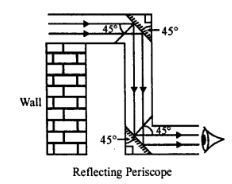
(a) Describe the principle of simple periscope through an outline ray diagram. Give one of its uses.
(b) Draw diagrams to show difference between regular and irregular reflection.
Answer
(a) Simple periscope is based upon the principle of reflection. It consists of a cardboard or wooden tube, bent twice at right angles and is provided with two openings as shown in figure. Two plane mirrors are fixed at the bends of the tube at an angle $45^{\circ}$ to the framework, such that the mirrors face each other. The tube is completely blackened from inside to avoid any reflection from its sides.
Image
The parallel rays coming from an object at a higher plane, strike the plane mirror at an angle of $45^{\circ}$ and hence are reflected through an angle of $45^{\circ}$.
These reflected rays strike the second mirror at an angle of $45^{\circ}$ and hence are further reflected through an angle of $45^{\circ}$. These reflected rays on reaching the eye form the image on retina.
Use of periscope : It is used by soldiers in trench warfare.
Image
View full question & answer
Question 84 Marks
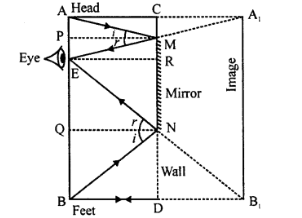
What must be the minimum length of a plane mirror in which a person can see himself full length? Draw a diagram to justify your answer. Does the distance of person from the mirror affect the above answer?
View full question & answer
Question 94 Marks
(a) What should be the minimum size of a plane mirror, so that a person 182 cm high can see himself completely?
(b) A boy stands 4 m away from plane mirror. If the boy moves $1 / 2 m$ towards mirror, what is now the distance between the boy and his image? Give a reason for your answer.
Answer
(a) Size (height) of a person = 182 cm
We know to see the full length image of a person, we need a plane mirror of size as half of the size of the person.
So, size of plane mirror required = Height of person/2 = 182/2 = 91 cm
(b) Distance of boy from the plane mirror $=u=4 m$ When boy moves $1 / 2 m$ towards the mirror.
Then, distance between boy and mirror $=4-1 / 2=7 / 2 m$
We know, in a plane mirror, the image formed is as behind the mirror as the object is in front of it.
So, distance between the mirror and image of boy $=7 / 2 m$
Distance between the boy and his image
$=$ Distance of boy from mirror + Distance of image of boy from mirror
$
=\frac{7}{2}+\frac{7}{2}=\frac{7+7}{2}=\frac{14}{2}=7 m
$
View full question & answer
Question 104 Marks
Draw a neat two ray diagram for the formation of images in two plane mirrors, when mirrors are
1. at right angles to each other
2. facing each other.
Answer
(a) When two mirrors are inclined at right angles
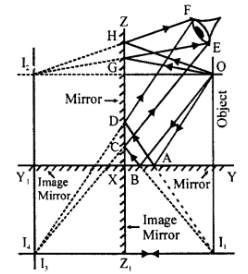
' O ' is an object placed in between two mirrors XY and $X Z$, inclined at an angle of $90^{\circ}$. (See figure)
Image
Formation of images in two mirrors at right angles
Taking normal incidence, $I _1$ and $I _2$ are the images formed in the plane mirror $X Y$ and $X Z$ respectively as far behind the mirrors, as point ' $O$ ' is in front of them.
However, image $I_1$ acts as a virtual object for image mirror $X Z_1$ and forms an image $I_2$. Similarly, image $I_2$ acts as a virtual object for the image mirror $X Y$, and forms the image $I _4$. The images $I _3$ and $I _4$ overlap to form a very bright image. Thus, on the whole three images are seen. In order to draw two-ray diagrams, from the position FE of the eye, draw two rays meeting at $I_2, l_c$ such that these ray intersect the mirror $X Z$ at $D$ and $C$. Now draw two rays from point I , to join C and D intersecting mirror XY at A and B . Join O with A and B .
Similarly, in order to show image $I _2$, draw two rays from $I _2$ to the position of eye FE , such that they intersect at H and G Join H and G to ' O ' so as to form incident beam.
(b) When two mirrors are parallel to each other
Image
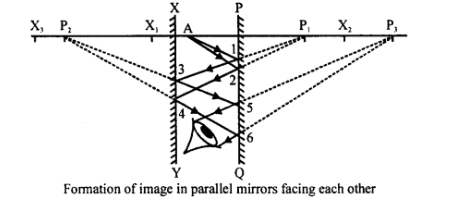
Consider two plane mirrors XY and PQ facing each other and ' A ' as an object situated anywhere between them (See figure).
It is clear that mirror $X Y$ forms its image in mirror PQ and vice versa. These images by themsleves will act as image mirror or virtual mirrors.
Let us consider the normal incidence towards the mirror XY for the object A. First of all an image $X_1$ is formed as far behind, as the object is in front of it. This image $X$, will fall in front of mirror PQ, and hence, forms an image $X_2$. The image $X_2$ falls in front of mirror XY and hence, forms an image $X _2$. Thus, it continues and infinite images can be formed. Similarly, taking normal incidence for mirror $P Q$ image $P_1, P_2, P_2$ etc. are formed. In order to draw ray diagram, from point A, draw a divergent beam, meeting mirror PQ at points 1 and 2 . With $P_1$ as reference point, draw rays 1, 3 and 2, 4 meeting mirror $X Y$. With $P_2$ as reference point draw rays, such that they enter the eye.

View full question & answer
Question 114 Marks
Prove geometrically that when plane mirror turns through a certain angle, the reflected ray turns through twice the angle.
Answer
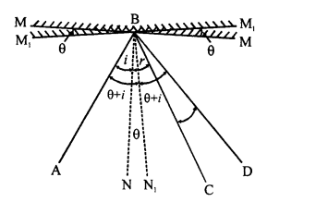
Consider a ray of light $A B$, incident on plane mirror in position $MM ^{\prime}$, such that BC is the reflected ray and BN is the normal.
$
\begin{array}{l}
\angle ABM=\angle CBN=\angle i \\
\angle ABC=2 \angle i \ldots(i)
\end{array}
$
Let the mirror be rotated through an angle ' 0 ' about point $B$, such that $M_1 M_1$, is the new position of the mirror and $BN _1$ is the new position of normal. As the position of the incident ray remains same, therefore new angle of the incidence is $\angle A B N$, whose magnitude is $(i+\theta)$. Let BD be the reflected ray, such that $\angle DNB { }_1$ is the new angle of reflection.
Image

$
\begin{aligned}
\angle ABD & =\angle ABN_1+\angle DBN_1 \\
& =\angle(i+\theta)+\angle(i+\theta) \\
& =2 \angle i+2 \angle \theta\quad \quad \ldots \ldots(ii)
\end{aligned}
$
Subtracting (i) from (ii),
$
\begin{array}{l}
\angle ABD-\angle ABC=2 \angle i+2 \angle \theta-2 \angle i \\
\therefore \angle CBD=2 \angle \theta
\end{array}
$
Thus, for a given incident ray, if the plane mirror is rotated through a certain angle, then the reflected ray rotates through twice the angle.
View full question & answer
Question 124 Marks
Prove experimentally that images are formed as far behind in a plane mirror as the object is in front of it.
View full question & answer
Question 134 Marks
By drawing a neat diagram define the following:
1. Mirror
2. Incident ray
3. Reflected ray
4. Angle of incidence
5. Angle of reflection
6. Normal
Answer
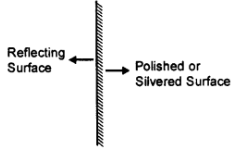
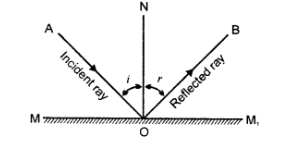
1. Mirror is a highly polished and smooth surface which reflects almost the entire light falling on it. A plane mirror is made by silvering one side of a glass plate as shown in figure.
Image
Representation of a plane mirror
2. Incident ray: The light ray striking a reflecting surface is called the incident ray.
3. Reflected ray: The light ray obtained after reflection from the surface, in the same medium in which the incident ray is travelling, is called the reflected ray.
4. Angle of incidence: The angle which the incident ray makes with the normal at the point of incidence is called the angle of incidence. It is denoted by the letter "i".
5. Angle of reflection: The angle which the reflected ray makes with the normal at point of incidence, is called the angle of reflection. It is denoted by the letter "r".
Image
Diagram showing reflection at a plane surface
6. Normal: The perpendicular drawn at the point of incidence, to the surface of mirror is called normal.
View full question & answer
Question 144 Marks
(a) What do you understand by the following terms?
1. Light
2. Diffused light
(b) By giving one example and one use explain or define
1. Regular reflection
2. Irregular reflection.
Answer
(a)
(i) Light : Light is a form of energy which produces in us sensation of seeing.
(ii) Diffused light: Light obtained after reflection from rough surface is known as diffused light.
It is a soft light with neither the intensity nor the glare of direct light. It is scattered and comes from all directions. It does not cause harsh shadows.
(b)
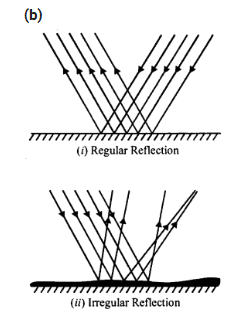
(i) Regular reflection: The phenomenon due to which a parallel beam of light travelling through a certain medium, on striking some polished surface, bounces off from it, as parallel beam, in some other direction is called regular reflection.
For example : Reflection taking place from the objects like looking glass, still water, oil, highly polished metals is regular reflection.
Regular reflection is useful in the formation of images. We can see our face in a mirror only due to regular reflection.
(ii) Irregular reflection or Diffused reflection: The phenomenon due to which a parallel beam of light, travelling through some medium, gets reflected in various possible directions, on striking some rough surface is called irregular reflection.
For example : Reflection taking place from ground, walls, trees, suspended particles in air is irregular reflection.
Use: It helps in the general illumination of places and helps us to see things around us.
View full question & answer
[5 Mark Question Answer] - PHYSICS STD 9 Questions - Vidyadip