Questions

[3 Mark Question Answer]

🎯

Test yourself on this topic

19 questions · timed · auto-graded

Question 13 Marks
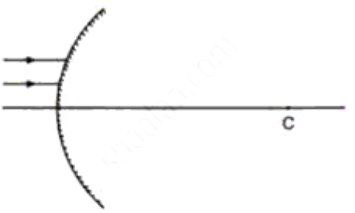
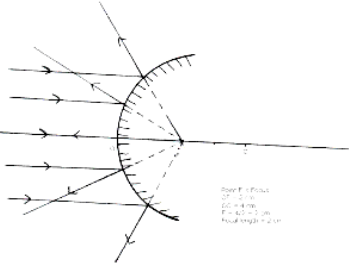
Explain with a suitable diagram, the converging of a parallel beam of light rays by a concave mirror.
Answer
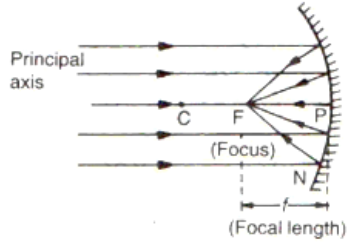
Image
The parallel beam of light on reflection by a concave mirror converges at a point on the principal axis, midway between pole and the centre of curvature. This point is called the principal focus
View full question & answer
Question 33 Marks
Write down four characteristics of light.
Answer
Four characteristics of light are:-
(a). Light waves can travel through a vacuum
(b). Light waves are transverse waves
(c). The wavelength of light waves is short so that their length is measured in cents-microns.
(d). The velocity of light in a vacuum is $3 \times 10^8 m/s.$
View full question & answer
Question 43 Marks
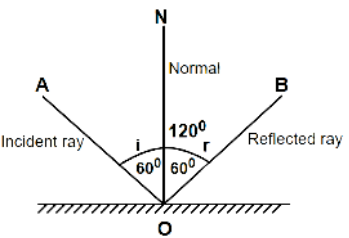
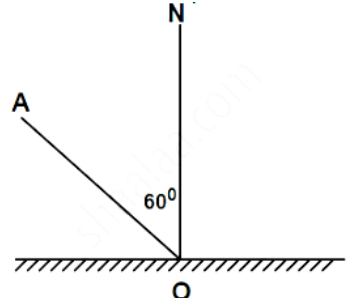
Show an incident ray AO and the normal ON a plan mirror. draw the reflected ray and then find the angle between the incident and reflected rays.
Image
Answer
Image
Since the angle of incidence = 60°.
From the diagram, the Angle of reflection to the normal = angle of incidence to the normal = 60°.
So, the angle between the incident ray and reflected ray = Angle of incidence + Angle of reflection = 60° + 60° = 120°.
View full question & answer
Question 53 Marks
A boy is standing in front of a plane mirror at a distance of 3 m from it.
(i) What is the distance between the boy and his image?
(ii) If the boy moves 1 m backward, find the distance between the image and the boy.
Answer
Given, a distance of boy from the mirror = 3 m
(a). The distance of the image from mirror = distance of boy from the mirror = 3 m
Distance between a boy and his image = distance of boy from the mirror + distance of the image from mirror = 3+3 = 6 m
(b). Now, a distance of boy from the mirror = 4 m
The distance of the image from mirror = 4 m
Distance between a boy and his image = distance of boy from the mirror + distance of the image from mirror = 4+4 = 8 m.
View full question & answer
Question 63 Marks
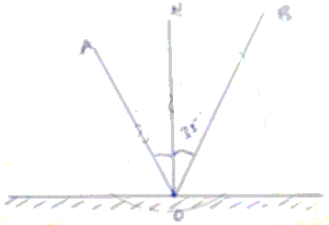
The angle between the incident ray and the normal to the surface at the point of incidence is called the angle of incidence.
Answer
Angle of reflection to the normal = angle of incidence to the normal = 20°
So the angle between incident ray and reflected ray = Angle of incidence + Angle of reflection = 20 + 20 = 40°
Image
View full question & answer
Question 73 Marks
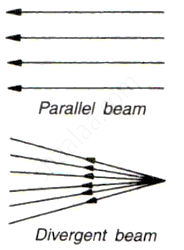
Draw diagrams to illustrate the parallel, convergent, and divergent beam of light.
Answer
A parallel beam of light is the beam in which rays of light travel parallel to each other. A divergent beam of light is the beam of light in which rays of light diverge from each other as the beam progresses
Image
View full question & answer
Question 83 Marks
An object is placed at a long distance in front of a convex mirror of radius of curvature 20 cm. State the position of the image.
Answer
The image of an object placed at a long distance in front of a convex mirror is formed at principal focus. The radius of the curvature of convex mirror is 20 cm.
The focal length of the convex mirror = radius of curvature/2.
Focal length of convex mirror = 20/2 = 10 cm.
So the image will form at a principal focus 10 cm away from the pole.
View full question & answer
Question 93 Marks
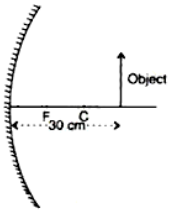
The diagram below shows the parallel rays incident on a convex mirror. C is the centre of the curvature of the mirror. By drawing the paths of the reflected rays, label the focus F and hence find the focal length of the mirror.
Image
Answer
Image
We know when the incident ray is parallel to the principal axis then they appear to diverge from a point F.
Geometrically we can find this value and this comes to 2 cm. Centre of curvature = 4 cm.
Focal length = centre of curvature/2.
View full question & answer
Question 103 Marks
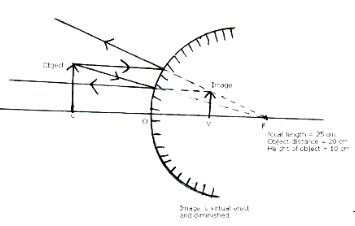
An object 10 cm high is placed at a distance of 20 cm in front of a spherical mirror of focal length 25 cm. By scale drawing find the nature, position, and magnification of the image in the following case:
Convex mirror
Answer
Focal length =25 cm.
Object distance = 20 cm.
Height o f object = 10 cm.
Image
The image is virtual, erect, and diminished.
View full question & answer
Question 113 Marks
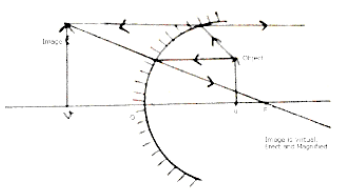
An object 10 cm high is placed at a distance of 20 cm in front of a spherical mirror of focal length 25 cm. By scale drawing find the nature, position, and magnification of the image in the following case:
Concave mirror
Answer
Focal length =25 cm.
Object distance = 20 cm.
Height o f object = 10 cm.
Image
Image is virtual, erect, and magnified.
View full question & answer
Question 123 Marks
Draw a neat and labeled ray diagram of a simple periscope. Give two uses of a periscope.
Answer
Image
Periscope is used to see over the top of an obstacle. It is also used in submarines for observing for movement of ships. It can be used from the trenches for observing the movement on the surface of the earth.
View full question & answer
Question 133 Marks
A boy is standing in front of a plane mirror at a distance of 3 m from it.
(i) What is the distance between the boy and his image?
(ii) If the boy moves 1 m backward, find the distance between the image and the boy.
Answer
Given, a distance of boy from the mirror = 3 m
(a). The distance of the image from mirror = distance of boy from the mirror = 3 m
Distance between a boy and his image = distance of boy from the mirror + distance of the image from mirror = 3+3 = 6 m
(b). Now, a distance of boy from the mirror = 4 m
The distance of the image from mirror = 4 m
Distance between a boy and his image = distance of boy from the mirror + distance of the image from mirror = 4+4 = 8 m.
View full question & answer
Question 143 Marks
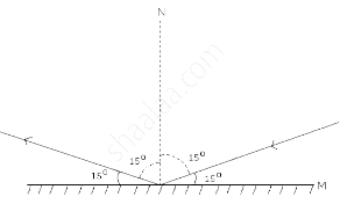
When a ray of light strikes a plane mirror at an angle of 150 with the mirror, what will be the angle through which the ray will deviate? Illustrate with a ray diagram in the following figure.
Image
Answer
Reflection obeys the following two laws.
a. The incident ray, the reflected ray, and the normal at the point of incidence, all lie in the same plane.
b. The angle of incidence and the angle of reflection are always equal. According to these two laws, this ray will deviate like this:
Image
View full question & answer
Question 153 Marks
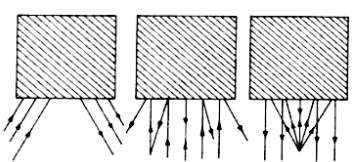
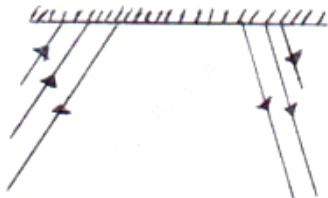
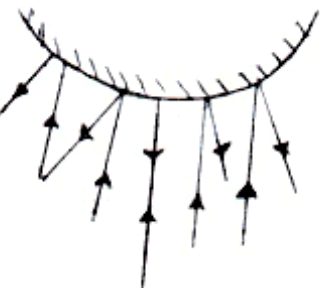
The boxes in figure (a, b, c) represent mirrors; insert a mirror which will reflect the incident ray as shown in the diagram.
Image
Answer
a. Plane Mirror
Image
b. Convex Mirror
Image
c. Concave Mirror
Image
View full question & answer
Question 163 Marks
How can you distinguish between a convex mirror and a concave mirror? Explain.
Answer
You can distinguish between a concave mirror and a convex mirror without touching them. When you look into these mirrors by bringing your face close to each mirror, they will produce an image of your face of different types.
A concave mirror will produce a magnified image of your face.
A convex mirror will produce a Diminished image of your face.
View full question & answer
Question 173 Marks
How will you distinguish between a plane mirror, a concave mirror and a convex mirror without touching them?
Answer
You can distinguish between a plane mirror, a concave mirror, and a convex mirror without touching them. When you look into these mirrors by bringing your face close to each mirror, they will produce an image of your face of different types.
A plane mirror will produce an image of the same size as your face.
A concave mirror will produce a magnified image of your face.
A convex mirror will produce a Diminished image of your face.
View full question & answer
Question 183 Marks
Define linear magnification. Does it have any units? Write down a formula for the magnification produced by a concave mirror in terms of image distance and object distance.
Answer
Linear magnification is defined as the ratio of the height of the image to the height of the object. It is taken to be positive for an image to be virtual and erect and negative when the image is real and inverted.
Magnification produced by a concave mirror is:
Magnification = height of image / height of object.
It is a pure ratio and does not have any units.
View full question & answer
Question 193 Marks
Define linear magnification of a mirror.
Answer
Linear magnification is defined as the ratio of the height of the image to the height of the object. It is taken to be positive for an image to be virtual and erect and negative when image is real and inverted.
Magnification = height of image / height of object.
View full question & answer
[3 Mark Question Answer] - PHYSICS STD 9 Questions - Vidyadip