Question
How will you distinguish between a plane mirror, a concave mirror and a convex mirror without touching them?

Answer

You can distinguish between a plane mirror, a concave mirror, and a convex mirror without touching them. When you look into these mirrors by bringing your face close to each mirror, they will produce an image of your face of different types.
A plane mirror will produce an image of the same size as your face.
A concave mirror will produce a magnified image of your face.
A convex mirror will produce a Diminished image of your face.

Need a full question paper?

Generate a complete, print-ready paper with questions like this in minutes — across 16+ boards, with answer keys.
Start Generating Free

Similar questions

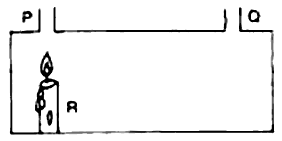
The following figure shows a rectangular box with two tubes P and Q at the top. A burning candle R is placed under the tube P. The candle burns brightly.

Explain: (i) How is the air in the box circulating?
(ii) What will happen if the opening Q is closed?
A girl had designed a clap switch for a science exhibition that enabled her to switch on or off an alarm just with clapping of hands. While testing her device in a hall, she noticed that once the alarm has sounded it followed with another one due to echo of the clap, that is, the sound reflected by the walls. She recorded the two soundings of alarm with her tape recorder and found out that time difference in between them is $0.1 \ s$. If the distance of the walls be $15 \ m$, calculate the speed of sound.
What do you understand by the terms
1. rest
2. motion? Support your answer by giving two examples each
What do you understand by the term acceleration? When is the acceleration
1. positive
2. negative?
How is weight affected in the following cases, when initially the body is weighed in Delhi with a spring balance?
1. Body is taken to Moscow.
2. Body is taken to Ceylon.
3. Body is taken to sea level.
4. Body is taken to a high mountain.
5. Body is taken deep inside a mine.
A force of $4 \ N$ gives a mass $m_1$ an acceleration of $8 ms^{-2} $and a mass $m_2$ an acceleration of $20 ms^{-2}​​​​​​​$. What would be the acceleration if the same force acts on both the masses tied together?
Draw a diagram to show the motion of a body whose speed remains constant, but velocity changes continuously.
What are the factors on which the pressure of a liquid depends?
Calculate the length of a seconds pendulum at a place where $g = 9.8 ms^{-2}.$
The acceleration of a moving body is constant in magnitude and direction. Must the path of the body be a straight line?
If not, given an example.