Questions

[3 Mark Question Answer]

🎯

Test yourself on this topic

27 questions · timed · auto-graded

Question 13 Marks
(a) What do you understand by the term constant of proportionality?
(b) How can proportionality constant be determined from the best fit straight line graph?
Answer
(a) Constant of proportionality : If a quantity say X is directly proportional to another quantity Y , then X is written as $X = KY$, where K is called constant of proportionality.
(b) Constant of proportionality : can be determined from the best fit straight line by calculating the slope of graph by using the formula. Slope of graph
Difference between the co-ordinates on $y$-axis
$
=\frac{\text { for any two points on the graph line }}{\text { Difference between the co-ordinates on } x-a x i s}
$
for any two points on the graph line
View full question & answer
Question 23 Marks
(a) State how will you choose a scale for the graph.
(b) State the two ratios of a scale, which are suitable for plotting points.
(c) State the two ratios of a scale, which are not suitable for plotting points.
Answer
(a) We can choose any convenient scale to represent a given variable on a given axis, such that the whole range of variations are well spread out on the whole graph paper, to give the graph line a suitable size.
For this a round number, nearest to or slightly less than minimum value should be taken as origin and a round number nearest to or slightly more than the maximum value should be taken at the far end of the respective axis for a given variable.
(b) Two ratios of a scale suitable for ploting points are 1: 2 and 1:4.
(c) Two ratios of a scale not suitable for plotting points are 1:3 and 1: 7. Because such scales are impractical and pose difficulty in plotting intermediate points.
View full question & answer
Question 33 Marks
(a) What do you understand by the term graph?
(b) What do you understand by the terms (i) independent variable, (ii) dependent variable?
(c) Amongst the independent variable and dependent variable, which is plotted on X- axis?
Answer
(a) Graph: A pictorial representation of two physical variables, recorded by ah experimenter is called graph.
(b)
1. Independent variable: A variable whose variation does not depend on that of another is known as independent variable.
2. ependent variable: A variable whose variation depends upon another variable is known as dependent variable.
(c) The independent variable is always plotted on x - axis.
View full question & answer
Question 43 Marks
(a) What is a second's pendulum?
(b) A second's pendulum is taken on the surface of moon where acceleration due to gravity is $l / 6$ th of that of earth. Will the time period of pendulum remain same or increase or decrease? Give a reason.
Answer
(a) Seconds' pendulum : "A pendulum which has time period of two seconds" is called seconds' pendulum.
OR
Seconds' pendulum may also be defined as "a pendulum which completes one oscillation in two seconds."
(b) We know time period of a simple pendulum is inversely proportional to the square root of acceleration due to gravity
$
\text { i.e. } T \propto \frac{1}{\sqrt{g}}
$
As acceleration due to gravity on the surface of the moon decreases as compared to that of the earth
$\because \quad g_{\text {moon }} < g_{\text {earth }}$ $\therefore T_{\text {moon }}>T_{\text {earth }}
$
$\Rightarrow$ The time period of second's pendulum increases when it is taken to the surface of the moon.
View full question & answer
Question 53 Marks
Calculate the length of second's pendulum on the surface of moon when acceleration due to gravity on moon is $1.63 ms^{-2}$.
Answer
Length of second's pendulum = I = ?
Acceleration due to gravity on surface of moon
$
=g_m=1.63 ms^{-2}
$
Time period $= T =2 s$
$
\begin{array}{l}
T=2 \pi \sqrt{\frac{l}{g}} \\
2=2 \times \frac{22}{7} \times \sqrt{\frac{l}{1.63}} \\
\sqrt{\frac{l}{1.63}}=\frac{7}{22}
\end{array}
$
Squaring both sides
$
\begin{array}{l}
\frac{l}{1.63}=\frac{49}{484} \\
l=\frac{49}{484} \times 1.63 \\
l=0.165 m
\end{array}
$
View full question & answer
Question 63 Marks
Length of second's pendulum is 100 cm . Find the length of another pendulum whose time period is 2.4 s .
Answer
We know time period of second's pendulum is 2 s .
$
\begin{array}{ll}
\therefore T_1=2 s & l_2=100 cm \\
T_2=2.4 s & l_2=? \\
\frac{T_1}{T_2}=\sqrt{\frac{l_1}{l_2}} & \\
\frac{2}{2.4}=\sqrt{\frac{100}{l_2}} & \\
\frac{1}{1.2}=\sqrt{\frac{100}{l_2}} &
\end{array}
$
Squaring both sides,
$
\begin{array}{l}
\frac{1}{1.44}=\frac{100}{l_2} \\
l_2=100 \times 1.44=144 cm
\end{array}
$
View full question & answer
Question 73 Marks
Calculate the time period of simple pendulum of length 1.44 m on the surface of moon. The acceleration due to gravity on the surface of moon is $1 / 6$ the acceleration due to gravity on earth, [ $\left.g =9.8 ms^{-2}\right]$
Answer
Length of simple pendulum $= I =1.44 m$
Time period $(T)=$ ?
$
\begin{array}{l}
\text { Acceleration due to gravity on the surface of moon }\\
\begin{aligned}
& =g^{\prime}=\frac{1}{6} \times g \\
g & =\frac{9.8}{6} \\
T & =2 \pi \sqrt{\frac{1}{g^{\prime}}}: T=2 \times \frac{22}{7} \times \sqrt{\frac{1.44 \times 6}{9.8}} \\
i & =\frac{14}{7} \times 0.9389=5.90 s
\end{aligned}
\end{array}
$
View full question & answer
Question 83 Marks
A measuring cylinder is filled with water upto a level of 30 ml . A solid body is immersed in it so that the level of water rises to 37 ml . Now solid body is tied with a cork and then immersed in water so that the water level rises to 40 ml . Find the volume of solid body and the cork.
Answer
Level of water in measuring cylinder $= V _1=30 ml$
Level of water in measuring cylinder when a solid body is immersed in it $V _2=37 ml$
Level of water in measuring cylinder when a cork tied with the solid is immersed in water $= V _3=40 ml$
Volume of solid body $= V _2- V _1=37-30=7 ml$ or $7 cm^3$
Volume or cork $= V _3- V _2=40-37$
$=3 ml$ or $3 cm^3\left[\because 1 ml =1 cm^3\right]$
View full question & answer
Question 93 Marks
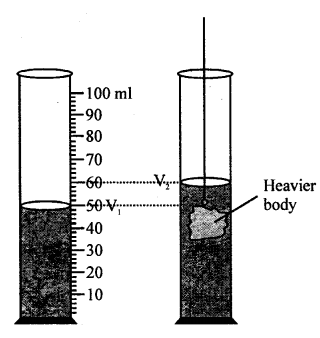
Explain the method in steps to find the volume of an irregular solid with the help of measuring cylinder.
Answer
Volume of an irregular solid
Image
1. Take a measuring cylinder and fill water up to certain level. Note down the level of water in measuring cylinder. Let it be $V _1$.
2. Tie the irregular solid body with a thin and strong thread and lower the body gently so that the solid body is completely immersed in the water. The level of water rises. Solid body displaces water of its own volume. Note down the new level of water. Let it be $V _2$.
3. Take the difference of two level of water, i.e., $\left( V _2- V _1\right)$. This will give the volume of irregular solid body.
View full question & answer
Question 103 Marks
How is SI system of unit of volume is related to 1 litre? Explain.
View full question & answer
Question 113 Marks
State the formula for calculating
1. pitch of screw
2. least count of screw.
Answer
(i) Pitch of screw
$
=\frac{\text { Distance moved by thimble on main scale }}{\text { Number of rotations of thimble }}$
E.g. If 5 mm is the distance moved by the thimble on the main scale in 5 rotations then,
$
\text { Pitch }=\frac{5 mm}{5}=1 mm
$
(ii) Least count of screw
$
=\frac{\text { Pitch }}{\text { Number of circular scale divisions }}
$
E.g. If pitch of screw is 1 mm and there are 100 divisions on the circular scalen, then
Least count $=\frac{1 mm}{100}=0.01 mm$
$
\text { L.C. }=0.01 mm \text { or } 0.001 cm
$
View full question & answer
Question 123 Marks
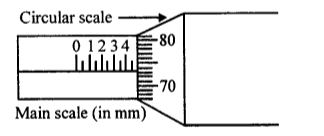
Figure shows a screw gauge in which circular scale has 100 divisions. Calculate the least count and the diameter of a wire.
Image
Answer
$
\begin{array}{l}
\text { No. of circular scale division }=100 \\
\text { Pitch }=0.5 mm \\
\qquad \quad=\frac{0.5 mm}{100}=0.005 mm \\
\text { L.C. }=0.005 mm=0.0005 cm \\
\text { Main scale reading }=4.5 mm=0.45 cm \\
\text { (C.S.D.) circular scale reading }=73 \text { division } \\
\text { Observed diameter of wire }=\text { Main scale reading }+ \text { L.C. } \times \text { C.S.D. } \\
\quad=0.45+0.0005 \times 73 \\
=0.45+0.0365=0.4865 cm
\end{array}
$
View full question & answer
Question 133 Marks
The circular scale of a screw gauge has 100 divisions. Its spindle moves forward by 2.5 mm when given five complete turns. Calculate
1. pitch
2. least count of the screw gauge.
Answer
Number of circular scale divisions $=100$
Distance moved by spindle $($ screw $)=2.5 mm$
No. of complete rotations given $=5$
$
\text { (i) } \begin{aligned}
\text { Pitch } & =\frac{\text { Distance moved by screw on sleeve }}{\text { No. of complete rotations }} \\
& =\frac{2.5}{5}=0.5 mm=0.05 cm
\end{aligned}
$
(ii) Least count $=\frac{\text { Pitch }}{\text { No. of circular scale divisions }}$
$
=\frac{0.05}{100} cm=0.0005 cm
$
View full question & answer
Question 143 Marks
The circular scale of a screw gauge has 50 divisions. Its spindle moves by 2 mm on sleeve, when given four complete rotations calculate
1. pitch
2. least count.
Answer
Number of circular scale divisions (C.S.D.) $=50$
Distance moved by screw (spindle) on sleeve $=2 mm$ Number of complete rotations given $=4$
$
\text { (i) } \begin{aligned}
\text { Pitch } & =\frac{\text { Distance moved by screw on sleeve }}{\text { No. of complete rotations }} \\
& =\frac{2 mm}{4}=0.5 mm
\end{aligned}
$
(ii) Pitch $=0.05 cm$
$
\begin{array}{l}
\text { Least count }=\frac{\text { Pitch }}{\text { No. of circular scale divisions }} \\
=\frac{0.05}{50} cm=0.001 cm
\end{array}
$
View full question & answer
Question 153 Marks
State the formula for determining:
1. pitch
2. least count for a vernier callipers.
Answer
(i) $\quad$ Pitch $=\frac{\text { Unit of main scale }}{\text { No. of divisions in the unit }}$
For example: If one centimetre length has ten divisions then
$
\text { Pitch }=\frac{1 cm}{10}=0.1 cm
$
(ii) Least count (L.C.) $=\frac{\text { Pitch }}{\text { No. of vernier scale division }}$
For example: If pitch is 0.1 cm and there are ten vernier scale divisions.
Then L.C. $=\frac{0.1}{10}=0.01 cm$
View full question & answer
Question 163 Marks
Define the terms:
1. pitch
2. least count as applied to a vernier callipers.
Answer
1. Pitch: "The pitch of a screw is the distance moved by the screw in one complete rotation of its head."
OR
Pitch may also be defined as "the distance between two consecutive threads of screw measured along the axis of screw."
$
\text { Pitch }=\frac{\text { Distance moved by thimble on M.S. }}{\text { Number of rotations of thimble }}
$
2. Least Count of Vernier Calliper : Least count of a vernier callipers is the difference between one main scale division (M.S.D.) and one vernier scale division (V.S.D.)
View full question & answer
Question 173 Marks
The least count of a vernier callipers is 0.01 cm and it has an error of +0.07 cm . While measuring the radius of a sphere, the main scale reading is 2.90 cm and the 5 th vernier scale division coincides with main scale. Calculate the correct radius.
Answer
Least count (L.C.) $=0.01 cm$
Error $=+0.07 cm$
Correction $=($ Error $)=-(+0.07)=-0.07 cm$
Main scale reading $=2.90 cm$
Vernier scale division (V.S.D.) coinciding with main scale $=5$ th Observed diameter of sphere $=$ Main scale reading + L.C. $\times$ V.S.D.
$
=2.90+0.01 \times 5=2.90+0.0=2.95 cm
$
Corrected diameter $=$ Observed diameter + Correction
$
=2.95+(-0.07)=2.95-0.07=2.88 cm
$
$\therefore$ Corrected radius $=2.88 / 2=1.44 cm$
View full question & answer
Question 183 Marks
The least count of a vernier callipers is 0.0025 cm and it has an error of +0.0125 cm . While measuring the length of a cylinder, the reading on main scale is 7.55 cm , and 12th vernier scale division coincides with main scale. Calculate the corrected length.
Answer
Least count (L.C.) $=0.0025 cm$
Error $=+0.0125 cm$
Correction $=-($ Error $)=-(+0.0125)=-0.0125 cm$
Main scale reading $=7.55 cm$
Vernier scale division (V.S.D.) coinciding with main scale $=12$ th
Length recorded $=$ Main scale reading + L.C. $\times$ V.S.D.
$
=7.55+0.0025 \times 12
$
$
=7.55+0.0300=7.58 cm
$
Correct length $=$ Length recorded + Correction
$
\begin{array}{l}
=7.58+(-0.0125) \\
=7.58-0.0125=7.5675 cm=7.567 cm
\end{array}
$
View full question & answer
Question 193 Marks
In a vernier callipers 19 main scale divisions coincide with 20 vernier scale divisions. If the main scale has 20 divisions in a centimetre, calculate
1. pitch
2. L.C. of vernier callipers.
Answer
Main scale divisions of vernier callipers in one centimetre $=20$ Unit
$
\begin{array}{l}
\text { Pitch }=\frac{\text { Unit of main scale }}{\text { Number of divisions in the unit }} \\
=\frac{1}{20} cm=0.05 cm \\
\begin{aligned}
\text { Least count } & =\frac{\text { Pitch }}{\text { No. of vernier scale divisions }} \\
\qquad & =\frac{0.05}{20}=0.0025 cm
\end{aligned}
\end{array}
$
View full question & answer
Question 203 Marks
The main scale of vernier callipers has 10 divisions in a centimetre and 10 vernier scale divisions coincide with 9 main scale divisions. Calculate
1. pitch
2. L.C. of vernier callipers.
Answer
Main scale divisions of vernier callipers in one centimetre $=10$
$
\begin{array}{l}
\begin{aligned}
\text { Pitch } & =\frac{\text { Unit of main scale }}{\text { Number of divisions in the unit }} \\
& =\frac{1}{10} cm=0.1 cm
\end{aligned} \\
\begin{aligned}
\text { Least count } & =\frac{\text { Pitch }}{\text { No. of vernier scale divisions }} \\
& =\frac{0.1}{10} cm=0.01 cm
\end{aligned}
\end{array}
$
View full question & answer
Question 213 Marks
(a) What do you understand by the term order of magnitude of a quantity?
(b) Why are physical quantities expressed in the order of magnitude? Support your answer by an example.
Answer
(a) Order of a magnitude of a quantity : The exponent part of a particular measurement is called order of magnitude of a quantity.
OR
The order of magnitude of a given numerical quantity is the nearest power of ten to which its value can be written, (b) Measurement of certain physical quantities are either too large or too small that these cannot be expressed conveniently. It is difficult to write or remember them. So such quantities can be expressed in the order of magnitude.
For example : The diameter of the sun is $1,390,000,000 m$. It is difficult to write or remember such a measurement. So it is expressed as $1.39 \times 109 m$. Here power of ten i.e. 9 (i.e. exponent part of the measurement) gives the order of magnitude of the given quantity.
So order of magnitude of diameter of the sun is $10^9 m$.
View full question & answer
Question 223 Marks
A pupil determines velocity of sound as $320 ms^{-1}$. If actual velocity of sound is $332 ms^{-1}$, calculate the percentage error.
Answer
Velocity of sound determined by pupil $= V _1=320 ms^{-1}$
Actual value of velocity of sound $= V _2=332 ms^{-1}$
Absolute error $= V _2- V _1=332-320=12 ms^{-1}$
$
\begin{aligned}
\text { Percentage error } & =\frac{\text { Absolute error }}{\text { Actual value }} \times 100 \\
& =\frac{12}{332} \times 100=3.61 \%
\end{aligned}
$
View full question & answer
Question 233 Marks
A student finds that boiling point of water in a particular experiment is $97.8^{\circ} C$. If the actual boiling point of water is $99.4^{\circ} C$, calculate the percentage error.
Answer
Experimental value of boiling point of water $= B \cdot P _1=97.8^{\circ} C$
Actual value of boiling point of water $=$ B. $P_2=99.4^{\circ} C$
Absolute error $=$ B.P. $._2-$ B. $P_1=99.4-97.8=1.6^{\circ} C$
$
\begin{aligned}
\text { Percentage error } & =\frac{\text { Absolute error }}{\text { Actual value }} \times 100 \\
& =\frac{1.6}{99.4} \times 100=1.60 \%
\end{aligned}
$
View full question & answer
Question 243 Marks
A student calculates experimentally the value of density of iron as $7.4 gem ^{-3}$. If the actual density of iron is $7.6 gcm ^{-3}$, calculate the percentage error in experiment.
Answer
Experimental value of density of iron $=\rho_1=7.4 g cm ^{-3}$
Actual value of density of iron $=\rho_2=7.6 g cm ^{-3}$
Absolute error $=\rho_2-\rho_1=7.6-7.4=0.2 g cm ^3$
$
\begin{aligned}
\text { Percentage error } & =\frac{\text { Absolute error }}{\text { Actual value }} \times 100 \\
& =\frac{0.2}{7.6} \times 100=\frac{100}{38}=2.63 \%
\end{aligned}
$
View full question & answer
Question 253 Marks
(a) Define mass.
(b) State the units in which mass is measured in (1) C.GS. system (2) S.I. system.
(c) Name the most convenient unit of mass you will use to measure :
1. Mass of small amount of a medicine.
2. The grain output of a state
3. The bag of sugar
4. Mass of a cricket ball.
Answer
(a) Mass: The quantity of matter contained in a body is known as its mass.
(b) In C.GS. system, mass is measured in gram. In S.I. system, mass is measured in Kilogram.
(c) (i) Microgram $(\mu g )$.
(ii) Tonne ( $t$ )
(iii) Quintal ( $\mu t$ )
(iv) Gram (g)
Note : 1 microgram $=10^{-6} g=10^{-9} kg$ 1 Tonne $=1000 kg ; 1$ Quintal $=100 kg$
View full question & answer
Question 263 Marks
(a) Define metre according to old definition.
(b) Define metre in terms of wavelength of light.
(c) Why is the metre length in terms of wavelength of light considered more accurate?
Answer
(a) Metre : One metre is defined as the one ten millionth part of distance from the pole to the equator.
(b) Metre: One metre is defined as $1,650,763.73$ times the wavelength of specified orange red spectral line in emission spectrum of Krypton $=86$.
OR
One metre is defined as 1,553,164.1 times the wavelength of the red line in emission spectrum of cadmium.
(c) Metre length in terms of wavelength of light is considered more accurate because
1. The wavelength of light does not change with time, temperature, pressure etc.
2. It can be reproduced anywhere at any time because Krypton is available every where.
View full question & answer
Question 273 Marks
Define the term fundamental unit. Name fundamental units of mass; length; time; current and temperature.
Answer
Fundamental unit : A fundamental or basic unit is that which is independent of any other unit or which can neither be changed nor can be related to any other fundamental unit. e.g. units of mass, length, time and temperature.
S. No.Physical quantityNameSymbol
1.MassKilogrammeKg
2.LengthMetreM
3.TimeSecondS
4.CurrentAmpereA
5.TemperatureKelvinK
View full question & answer
[3 Mark Question Answer] - PHYSICS STD 9 Questions - Vidyadip