Question
(a) What do you understand by the term constant of proportionality?
(b) How can proportionality constant be determined from the best fit straight line graph?
Answer

(a) Constant of proportionality : If a quantity say X is directly proportional to another quantity Y , then X is written as $X = KY$, where K is called constant of proportionality.
(b) Constant of proportionality : can be determined from the best fit straight line by calculating the slope of graph by using the formula. Slope of graph
Difference between the co-ordinates on $y$-axis
$
=\frac{\text { for any two points on the graph line }}{\text { Difference between the co-ordinates on } x-a x i s}
$
for any two points on the graph line

Need a full question paper?

Generate a complete, print-ready paper with questions like this in minutes — across 16+ boards, with answer keys.

Start Generating Free

Similar questions

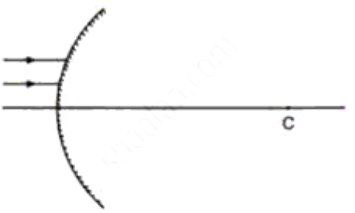
The diagram below shows the parallel rays incident on a convex mirror. C is the centre of the curvature of the mirror. By drawing the paths of the reflected rays, label the focus F and hence find the focal length of the mirror.
Image
(a) Define metre according to old definition.
(b) Define metre in terms of wavelength of light.
(c) Why is the metre length in terms of wavelength of light considered more accurate?
The angle between the incident ray and the normal to the surface at the point of incidence is called the angle of incidence.
A force of $4 \ N$ gives a mass $m_1$ an acceleration of $8 ms^{-2} $and a mass $m_2$ an acceleration of $20 ms^{-2}​​​​​​​$. What would be the acceleration if the same force acts on both the masses tied together?
State four effects of global warming.
A body weighs 300 gf in air and 280 gf when completely immersed in water. Calculate:
(i) The loss in weight of the body,
(ii) The upthrust on the body.
What do you mean by linear momentum of a body? A force causes an acceleration of $10 ms^{-2}$ in a body of mass $1 kg$ . What acceleration will be caused by the same force in a body of mass $4 kg $?
A car is moving with a velocity $20 m s^{-1}.$ The brakes are applied to retard it at a rate of $2 m s^{-2}.$ What will be the velocity after $5 s$ of applying the brakes?
What do you understand by the term acceleration? When is the acceleration
1. positive
2. negative?
What is a variable resistance? Explain its function using a labeled diagram.