Questions

[3 Mark Question Answer]

🎯

Test yourself on this topic

42 questions · timed · auto-graded

Question 13 Marks
Mention three precautions that you would observe to measure the mass of a body using a beam balance.
Answer
Three precautions to be taken to measure the mass of a body using beam balance are
(a). The beam must be gently lowered before adding or removing weights from the pan.
(b). The weights should not be carried with bare hands to avoid the change in weights due to moisture and dust particles from the surrounding
(c). Whenever you are near the actual weight, you should carefully try the weights in the descending order.
View full question & answer
Question 23 Marks
Name the factors on which the time period of a simple pendulum depends. Write the relation for the time period in terms of the above named factors.
Answer

The time period of a simple pendulum is directly proportional to the square root of the length of the pendulum

The time period of a simple pendulum is inversely proportional to the square root of acceleration due to gravity

$T =2 \sqrt[\pi]{\frac{1}{g}}$

Where T is the time period,

l is the length of the pendulum,

g is the acceleration due to gravity
View full question & answer
Question 33 Marks
What is meant by zero error of a vernier caliper? How is it determined? Draw neat diagrams to explain it. How is it taken into account to get the correct measurement?
Answer
In order to measure the length of an object using a metre rule, the metre rule must be placed with its marking close to the object, such that the zero marking on the scale coincides with one end of the object. Then the reading on the scale corresponding to the other end of the object will give the length of the object. Precautions to be taken for measuring the length of the object, the eye must be kept vertically above the end of the object to avoid parallax and the corresponding marking along the line should be carefully read. The meter scale can measure up to an accuracy of 1mm or 0.1 cm
View full question & answer
Question 43 Marks
An alloy is made by mixing $540 g$ of copper of density $9 g cm ^{-3}$ with 240 g of iron of density $8 g cm ^{-3}$. Find the density of the alloy assuming that the volume of each metal does not change during mixing.
Answer
Mass of copper $=540 g$
Density of copper $=9 g / cm ^3$
Volume of copper used in the alloy = mass of copper / density
$=540 / 9=60 cm^3$
Mass of iron $=240 g$
Density of iron $=8 g / cm ^3$
Volume of iron used in the alloy = mass of iron / density
$=240 / 8=30 cm^3$
Total mass of the alloy $=540+240=780 g$
Total volume of the alloy $=60+30=90$
Density of the alloy $=$ mass of the alloy $/$ density of the alloy $=780 / 90=8.67 g / cm ^3$
View full question & answer
Question 53 Marks
A screw thread has 20 threads in 1 cm and its circular scale has 50 divisions. Calculate its pitch and least count.
Answer
Number of threads $=20$
Distance covered in 20 threads $=10 mm$
Pitch of the screw gauge $=\frac{10}{20}=0.5 mm$
No of divisions on circular scale $=50$
Least count $=\frac{\text { pitch }}{\text { no. of divisions }}$
$=0.01 mm$
View full question & answer
Question 63 Marks
We can find the diameter of a wire by wrapping it around a pencil and measuring the length of turns with the help of a meter scale. Is this approach more accurate than determining the diameter of the wire with the help of a screw gauge?
Answer
No, we cannot measure the diameter of a wire by wrapping it around a pencil because it is not very accurate. We can use a screw gauge for this purpose as it can measure the diameter correct up to 1/100 of a millimeter or even less.
View full question & answer
Question 73 Marks
What is the zero error of a screw gauge?
Answer
If the zero of the circular scale does not coincide with the zero of the main scale (pitch scale) when the end of the movable screw is brought in contact with the fixed end then the screw gauge is said to have a zero error.
View full question & answer
Question 83 Marks
In the case of a vernier caliper, $1\ MSD = 1\ mm.$ If $10\ VSD$ coincide with $9\ MSD;$ what is its least count?
Answer
$1 MSD =1 mm$
$10 VSD =9 mm$
$1 VSD =\frac{9}{10} mm$
$\text { Least count }=1 MSD -1 VSD$
$=\frac{1}{10} MSD$
$=\frac{1}{10} \times 1 mm =0.1 mm$
$=0.01 cm $
View full question & answer
Question 93 Marks
A screw gauge has $50$ divisions on its circular scale and the pitch of the screw is $0.5\ mm.$ What us its least count?
Answer
Pitch of the screw $= 0.5\ mm$
No. of divisions on circular scale $= 50$
$\text { Least count }=\frac{\text { pitch of the screw }}{\text { no. of divisions on the circular scale }}$
$\text { so, L.C. }=\frac{0.5}{50}=0.01 mm $
View full question & answer
Question 103 Marks
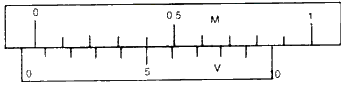
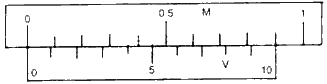
Consider the following case where the zero of vernier scale and the zero of the main scale are clearly seen. If $L.C$. of the vernier calipers is $0.01 \ cm$, write the zero error and zero correction of the following.
Answer

Here, zero of the vernier scale lies on the right of the main scale.
Also, the $5^{th}$ vernier division is coinciding with some main scale division
Thus, zero error $= 0 + 5 x L.C. = -0.05 cm$
Hence zero correction $= 0.05 cm$
View full question & answer
Question 113 Marks
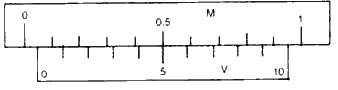
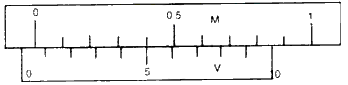
Consider the following case where the zero of vernier scale and the zero of the main scale are clearly seen. If L.C. of the vernier calipers is $0.01 \ cm$, write the zero error and zero correction of the following.
Answer

Here, zero of the vernier scale lies on the right of the zero of the main scale.
Also, the $5^{th}$ vernier division is coinciding with some main scale division
Thus, zero error $= 0 + 5 \times L.C. = 0.05 cm$
Hence zero correction $= -0.05 cm$
View full question & answer
Question 123 Marks
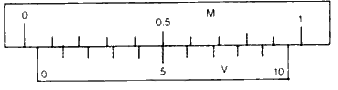
Consider the following case where the zero of vernier scale and the zero of the main scale are clearly seen. If L.C. of the vernier calipers is 0.01 cm, write the zero error and zero correction of the following.
Answer

Here, zero of the vernier scale coincides with the zero of the main scale, So, the zero error and zero error correction is nil.
View full question & answer
Question 133 Marks
What is the importance of maintaining the standard units?
Answer
The maintenance of standard units is essential because any variation in these standards would lead to wrong measurements, misleading results, and confusing generalizations. The standards are preserved in such a way that they do not undergo any change with the change in temperature, pressure, humidity, and other environmental changes.
View full question & answer
Question 143 Marks
Distinguish between fundamental and derived units.
Answer
Difference between fundamental units and derived units.
Fundamental units Derived units
These units are not derived from other units These units are derived from fundamental units
These cannot be further resolved into smaller units These can be resolved into fundamental units
Fundamental units of mass, length, time are kilogram, metre, second respectively Derived units are speed, density, etc
View full question & answer
Question 153 Marks
Briefly, explain the need for measurements.
Answer
Measurement is needed for a precise description of any phenomenon happening in the world. For example, if a body is freely falling down to the ground, to understand this phenomenon we must know its velocity, time it will take to reach the ground, etc, and to get answers to all our questions we need a measurement.
View full question & answer
Question 163 Marks
What is the principle of a physical balance?
Answer
A physical balance works on the principle of moments. According to the principle of moments, under equilibrium condition, the clockwise moment due to the body on one side of the beam equals the anti-clockwise moment due to standard weights on the other side of the beam. 
View full question & answer
Question 173 Marks
What is backlash error and how is it avoided?
Answer
Due to constant use, there is space for the play of screw gauge but gradually this space increases with the use or wear and tear so that when the screw is moved by rotating it in some direction, it slips in the nut and does not cover any linear distance for some rotation of the screw head. The error due to this is known as backlash error. It is avoided by turning the screw always in the same direction.
View full question & answer
Question 183 Marks
How does negative error arise in the instrument?
Answer
If the zero of the circular scale lies above the line of graduation then it is called negative zero error. When there is a negative zero error, then the instrument reads less than the actual reading. Therefore in order to get the correct reading, the zero error should always be added from the observed reading.
View full question & answer
Question 193 Marks
Define the pitch of the screw gauge.
Answer
When one complete rotation is given to the screw hand, it moves forward or backward by a distance is called the pitch of the screw. It is a distance between two consecutive threads of the screw.
Pitch of the screw = distance traveled by screw-in n rotations/n rotations
View full question & answer
Question 203 Marks
Define the time period of a simple pendulum,
Answer
The time taken by a sim pie pendulum for oscillation is known as the time period of a simple pendulum.
$T =2 \sqrt[\pi]{\frac{l}{g}}$
Where T is the time period,
l is the length of the pendulum,
g is the acceleration due to gravity
View full question & answer
Question 213 Marks
How does the zero error arise in the instrument?
Answer
If the zero of the one scale (vernier scale or circular scale of screw gauge) does not coincide with the zero of the main scale, this is known as zero scales, zero error arises. There are two types of zero error -
(a) If the zero of the scale remains below the line of graduation of the main scale then it is called positive zero error
(b) If the zero of the scale lies above the line of graduation of the main scale then it is called negative zero error
View full question & answer
Question 223 Marks
Can we measure the thickness of a piece of paper by vernier calipers?
Answer
No, we cannot measure the thickness of a paper with vernier caliper as its least count is only $0.1 \ mm $. We should use a screw gauge instead as its least count is $0.01 \ mm$ as the thickness of the paper is in the range of $10^{-2} mm$.
View full question & answer
Question 233 Marks
Define the least count of an instrument.
Answer
Least count of an instrument refers to the smallest reading that can be accurately measured while using the instrument. For an instrument provided with a scale, the least count is the value of one division on its scale.
View full question & answer
Question 243 Marks
What is the importance of a vernier scale?
Answer
Vernier caliper is an instrument used for measuring small lengths of solid objects where an ordinary scale cannot be applied. We can measure the length accurately up to the order of $10^{-2} cm, 10^{-3} cm$ depending upon the vernier used. Therefore a vernier caliper is important to measure the fraction of the smallest division of a measuring scale which otherwise could not be done by the judgment of the eye.
View full question & answer
Question 253 Marks
Is there any difference in the following measurements?
(a) 51.7 cm
(b) 51.70 cm
(c) 51.700 cm.
Explain your answer.
Which measurement is most accurate?
Answer
Basically there is no difference between the quantity being measured but there is a difference of significant figures in the measurement.
(a). Number of significant figures = 3
(b). Number of significant figures = 4
(c). Number of significant figures = 5
Since (c) part has the maximum number of significant figures = 5, therefore it is most accurate among the given three.
View full question & answer
Question 263 Marks
Name two kinds of error in a measurement. How are they minimized?
Answer
Two types of errors in measurement are
(a). Random errors-these errors are due to various factors. In a number of observations, we get different readings every time.
These errors can be minimized by making observations a large number of times and taking the arithmetic mean of the readings.
(b). Gross error- these errors are due to the carelessness of the observer like parallax, improper setting of the instrument.
These errors can be minimized only when the observer is careful in setting up of instrument and taking readings.
View full question & answer
Question 273 Marks
Each measuring instrument has a limit of accuracy'. Comment on the statement.
Answer
Accuracy is the extent to which a reported measurement approaches the true value of the quantity measured. This extent is usually described by the least count of the instrument and since the least count for a given instrument is limited hence, the accuracy of the instrument is limited.
View full question & answer
Question 283 Marks
Define the least count of an instrument.
Answer
The least count of an instrument refers to the smallest reading that can be accurately measured while using the instrument. For an instrument provided with a scale, the least count is the value of one division on its scale.
View full question & answer
Question 293 Marks
What is the principle of a beam balance?
Answer
A beam balance works on the principle of moments. According to the principle of moments, under equilibrium condition, the clockwise moment due to the body on one side of the beam equals the anti-clockwise moment due to standard weights on the other side of the beam.
View full question & answer
Question 303 Marks
Name the factors on which the time period of a simple pendulum depends. Write the formula for the time period in terms of the above named factors.
Answer
The time period of a simple pendulum is directly proportional to the square root of the length of the pendulum
The time period of a simple pendulum is inversely proportional to the square root of acceleration due to gravity
$T =2 \pi \sqrt{\frac{1}{g}}$
Where T is the time period,
l is the length of the pendulum,
g is the acceleration due to gravity
View full question & answer
Question 313 Marks
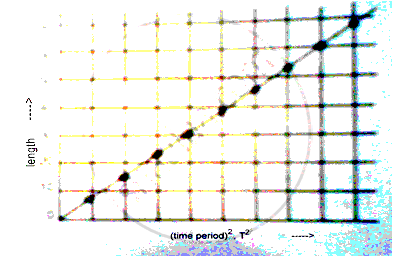
Draw a graph of l against $T^2$​​​​​​​ for a simple pendulum of length l and time period T for different values of l.
Answer
A graph of I against T2 for a simple pendulum of length I and time period T is shown in the figure
View full question & answer
Question 323 Marks
Calculate the length of a seconds pendulum at a place where $g = 9.8 ms^{-2}.$
Answer
$G = 9.8 ms^{-2}$^
Time, T for seconds pendulum $= 2 s$
Now, $T= 2$ $\pi \sqrt{\frac{l}{g}}$
$T^2= 4\pi ^2 l/g$
$L = T^2g/4\pi ^2$
$= 2^2x 9.8/4 x 3.14^2$
$=0.994 m$
View full question & answer
Question 333 Marks
Explain the term pitch. How are they determined?
Answer
When one complete rotation is given to the screw hand, it moves forward or backward by a distance called the pitch of the screw. It is a distance between two consecutive threads of the screw.
Pitch of the screw = distance travelled by screw-in n rotations/n rotations
View full question & answer
Question 343 Marks
State three precautions you would take while measuring the volume of an irregular solid lighter than water, using a measuring cylinder.
Answer
Precautions to be taken while measuring the volume of a solid lighter than water using the displacement method
(a). The sinker should be insoluble in water
(b). The sinker should have a high density than water.
(c). Lower meniscus should be read to note down the readings and errors due to parallax should be avoided.
View full question & answer
Question 353 Marks
A screw has a pitch equal to 0.5 mm. What should be the number of divisions on its head so as to read correctly up to 0.001 mm with its help?
Answer
Pitch of the screw gauge = 0.5 mm
L.C. of the screw gauge = 0.001 mm
No. of divisions on circular scale = Pitch / L.C.
= 0.5 / 0.001
= 500
View full question & answer
Question 363 Marks
What do you mean by a negative zero error of a screw gauge? How will you calculate it?
Answer
If the zero of the circular scale lies above the line of graduation then it is called negative zero error. When there is a negative zero error, then the instrument reads less than the actual reading. Therefore in order to get the correct reading, the zero error should always be added to the observed reading.
View full question & answer
Question 373 Marks
What do you mean by the term pitch of a screw gauge?
Answer
When one complete rotation is given to the screw hand, it moves forward or backward by a distance is called the pitch of the screw. It is a distance between two consecutive threads of the screw.
Pitch of the screw = distance travelled by screw-in n rotations/n rotations
View full question & answer
Question 383 Marks
The pitch of a screw gauge is 0.5 mm and the head scale is divided into 100 parts. What is the least count of screw gauge?
Answer
Pitch of the screw gauge = 0.5mm = 0.05 cm
Circular scale divisions = 100
Least Count of screw gauge = pitch of the gauge/circular scale divisions
= 0.05/100
= 0.0005cm
View full question & answer
Question 393 Marks
What do you mean by a positive zero error of a screw gauge? How will you calculate it?
Answer
If the zero of the circular scale remains below the line of graduation then it is called positive zero error. When there is a positive zero error, then the instrument reads more than the actual reading. Therefore in order to get the correct reading, the zero error should always be subtracted from the observed reading.
View full question & answer
Question 403 Marks
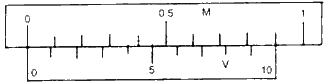
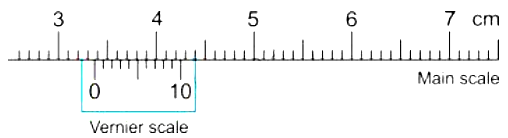
While measuring the length of a rod with a vernier callipers, below shows the position of its scales. What is the length of the rod?
Answer
L.C. of vernier callipers $= 0.01 cm$
In the shown scale,
Main scale reading $= 3.3 mm$
$6^{th}$​​​​​​​ vernier division coincides with an m.s.d.
Therefore, vernier scale reading $= 6 \times 0.01 cm = 0.06 cm$
Total reading $= m.s.r. + v.s.r.$
$= 3.3 + 0.06$
$= 3.36 cm$
View full question & answer
Question 413 Marks
What is the backlash error?
Answer
Due to constant use, there is space for the play of screw gauge but gradually this space increases with the use or wear and tear so that when the screw is moved by rotating it in some direction, it slips in the nut and does not cover any linear distance for some rotation of the screw head. The error due to this is known as backlash error.
View full question & answer
Question 423 Marks
The size of bacteria is $2 \mu ..$ Find the number of bacteria in $3 m$ length.
Answer
$1\mu =10^{-6}m$
Length of one bacteria $= 2 \mu = 2 X 10^{-6}m$
Length given$= 3m$
Number of bacteria= length given/length of one bacteria
$= 3/(2x10^{-6})$
$=1.5X10^6$
View full question & answer
[3 Mark Question Answer] - PHYSICS STD 9 Questions - Vidyadip