Questions

[2 Mark Question Answer]

🎯

Test yourself on this topic

41 questions · timed · auto-graded

Question 12 Marks
A body starts to slide over a horizontal surface with an initial velocity of $0.5 ms^{-1}.$ Due to friction, its velocity decreases at the rate of $0.05 ms^{-2}$​​​​​​​. How much time will it take for the body to stop?
Answer
Initial velocity of body $u = 0.5 ms^{-1}.$
Final velocity of the body $v = 0 ms^{-1}$​​​​​​​ as body comes to rest finally.
Retardation of body $= 0.05 ms^{-2}.$
We know that $v = u + at.$
$0 = 0.5 - 0.05t$
$T = 0.5/0.05 = 10 sec.$
View full question & answer
Question 22 Marks
Write an expression for the distance S covered in time t by a body which is initially at rest and starts moving with a constant acceleration a.
Answer
Distance $= s$, time $= t$, initial velocity $u =0$ and acceleration $= a$.
Using the second equation of motion and substituting the above values we get,
$ s=u t+(1 / 2) a t^2$
$s=\frac{1}{2} a t^2 $
View full question & answer
Question 32 Marks
A body starts with an initial velocity of $10 m s ^{-1}$ and acceleration $5 m s ^{-2}$. Find the distance covered by it in 5 s .
Answer
Initial velocity $u = 10 m/s$
Acceleration $a = 5 m/s^2$​​​​​​​
Time $t = 5s$
Let 'S' be the distance covered.
Using the second equation of motion,
$S = ut + (1/2) at^2$
$S = (10)(5) + (1/2) (5) (5)^2$
$S = 50 + 62.5$
$S = 112.5 m$
View full question & answer
Question 42 Marks
A body starts from rest with uniform acceleration $2 m s ^{-2}$. Find the distance covered by the body in 2 s .
Answer
Initial velocity $u = 0$
Acceleration $a = 2 m/s^2$​​​​​​​
Time $t = 2 s$
Let 'S' be the distance covered.
Using the second equation of motion,
$S = ut + (1/2) at^2$
$S = 0 + (1/2) (2) (2)^2$
$S = 4 m$
View full question & answer
Question 52 Marks
Write three equations of uniformly accelerated motion relating the initial velocity (u), final velocity (v), time (t), acceleration (a) and displacement (S).
Answer
Three equations of a uniformly accelerated motion are$v = u + at$
$s = ut + (1/2)at^2$
$v^2 = u^2 + 2as$
View full question & answer
Question 62 Marks
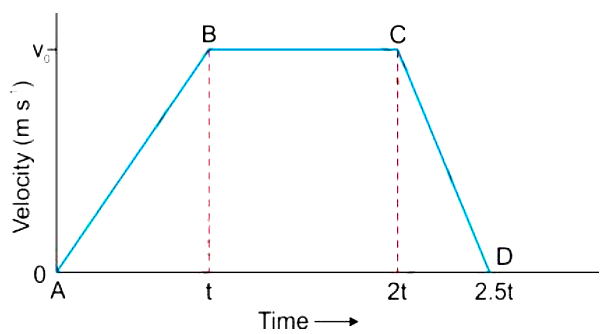
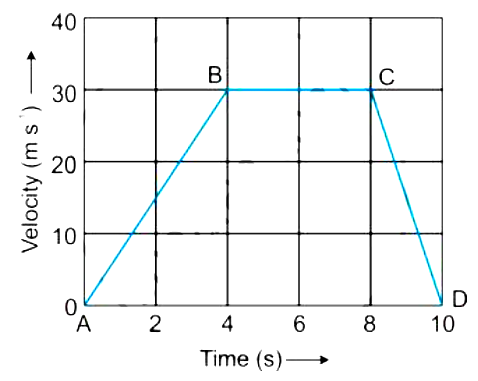
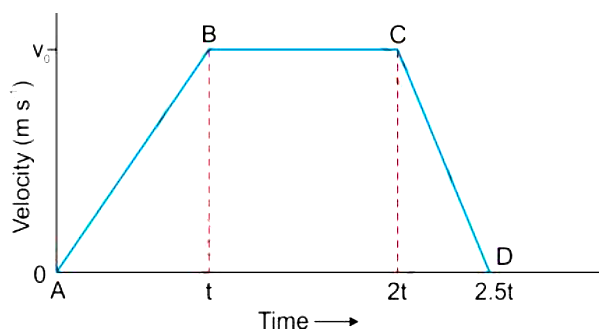
Figure given below shows a velocity-time graph for a car starting from rest. The graph has three parts $AB, BC$ and $CD.$

(a) Is the magnitude of acceleration higher or lower than that of retardation ? Give a reason .
(b) Compare the magnitude of acceleration and retardation .
Answer
(a) The magnitude of acceleration is lower as the slope of line AB is less than that of line $CD.$
(b) Slope of line $AB = v_o/t$
Slope of line $CD = v_o/0.5t$
Slope of line AB/Slope of line $CD = (v_o /t)/(v_o /0.5t)$
Slope of line AB:Slope of line $CD :: 1:2.$
View full question & answer
Question 72 Marks
Figure given below shows a velocity-time graph for a car starting from rest. The graph has three parts AB, BC and CD.

Which part of graph shows motion with uniform
(a) velocity (b) acceleration (c) retardation ?
Answer
(a) BC shows motion with uniform velocity.
(b) AB shows motion with uniform acceleration.
(c) CD shows motion with uniform retardation.
View full question & answer
Question 82 Marks
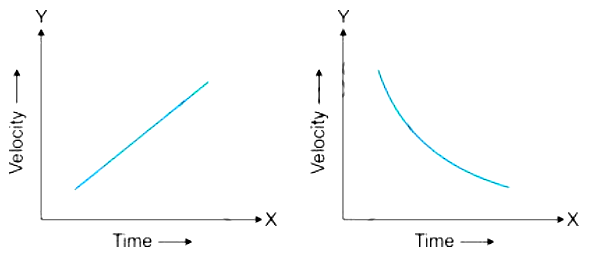
State the type of motion represented by the following sketches in Figures.
Give an example of each type of motion.

Answer
(a) represents uniformly accelerated motion. For example, the motion of a freely falling object. (b) represents motion with variable retardation. For example, a car approaching its destination.
View full question & answer
Question 92 Marks
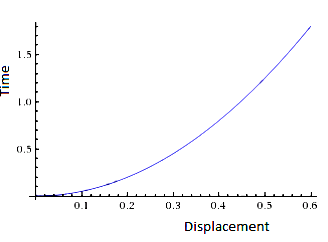
A body at rest is made to fall from the top of a tower . Its displacement at different instants is given in the following table :
Time (in s) 0.1 0.2 0.3 0.4 0.5 0.6
Displacement (in m) 0.05 0.20 0.45 0.80 1.25 1.80

Draw a displacement - time graph and state whether the motion is uniform or non - uniform ?
Answer
The displacement - time graph is given below :

Motion is Non-uniform
View full question & answer
Question 102 Marks
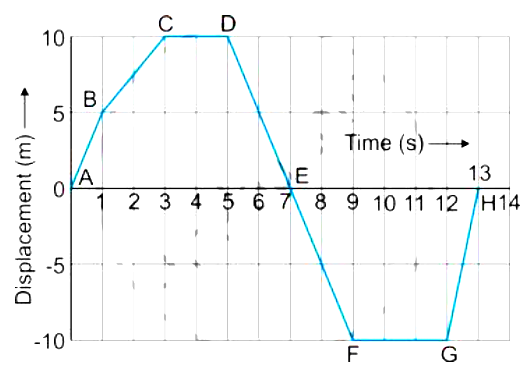
From the displacement-time graph of a cyclist given below in the Figure, find The displacement from the initial position at the end of 10 s,
Answer
Initial position = 0 m
Final position at the end of 10 s = -10m
Displacement = Final position - Initial position
= (-10) m - 0
= -10 m
View full question & answer
Question 112 Marks
From the displacement-time graph of a cyclist given below in the Figure, find The average velocity in the first $4 s$
Answer
Displacement in first $4s = 10 m$
Therefore, the average velocity = Displacement/time
$= (10/4) m/s$
$= 2.5 m/s^{-1}$
View full question & answer
Question 122 Marks
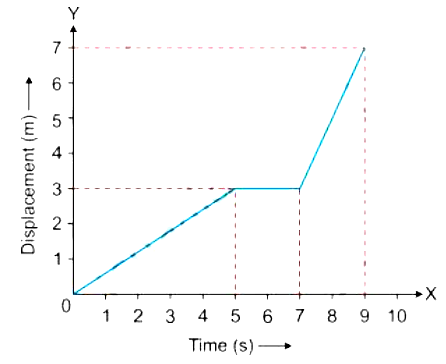
Figure shows the displacement of a body at different times .

Calculate the average velocity during the time interval 5 s to 9 s ,
[Hint : From 5 s to 9 s , displacement = 7 m - 3m = 4m]
Answer
From, $5 s$ to $9 s$ , displacement $= 7m - 3m = 4m.$
Time elapsed between $5 s$ to $9 s = 4 s$
Average velocity = Displacement/time
$= (4/4) m/s$
$= 1 m/s^{-1}$​​​​​​​
View full question & answer
Question 132 Marks
Can displacement-time sketch be parallel to the displacement axis? Give a reason to your answer.
Answer
The displacement-time graph can never be parallel to the displacement axis because such a line would mean that the distance covered by the body in a certain direction increases without any increase in time, which is not possible.
View full question & answer
Question 142 Marks
What information about the motion of a body are obtained from the displacement-time graph?
Answer
From displacement-time graph, the nature of motion (or state of rest) can be understood. The slope of this graph gives the value of velocity of the body at any instant of time, using which the velocity-time graph can also be drawn.
View full question & answer
Question 152 Marks
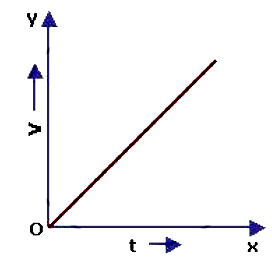
Draw the shape of the velocity-time graph for a body moving with (a) Uniform velocity and (b) Uniform acceleration.
Answer

Velocity-time for a body moving with uniform velocity and uniform acceleration .
View full question & answer
Question 162 Marks
The velocity-time graph of a moving body is given below in Figure

Total displacement.
Answer
Total displacement = Displacement of part AB + Displacement of part BC + Displacement of part CD = 60 + 120 + 30 = 210 m
View full question & answer
Question 172 Marks
A body starts from rest and acquires a velocity $10 m s ^{-1}$ in 2 s . Find the acceleration.
Answer
Here, final velocity = 10 m/s
Initial velocity = 0 m/s
Time taken = 2s
Acceleration = (Final Velocity - Initial Velocity)/time
$= (10/2) ms^{-2}$
$= 5 ms^{-2}$
View full question & answer
Question 182 Marks
Can displacement be zero even if the distance is not zero? Give one example to explain your answer.
Answer
Yes, displacement can be zero even if the distance is not zero. For example, when a body is thrown vertically upwards from a point A on the ground, after sometime it comes back to the same point A. Then, the displacement is zero, but the distance travelled by the body is not zero (it is 2h; h is the maximum height attained by the body).
View full question & answer
Question 192 Marks
A car moving on a straight path covers a distance of 1 km due east in 100 s. What is velocity of the car?
Answer
Distance = 1 km = 1000 m
Time = 100 s
Speed $=\frac{\text { dis } \tan c e}{\text { time }}=\frac{1000}{100}=10 m / s$.
Velocity of car = Speed with direction = 10 m/s due east
View full question & answer
Question 202 Marks
Differentiate between distance and displacement.
Answer
Distance is a scalar quantity, while displacement is a vector quantity. The magnitude of displacement is either equal to or less than the distance. The distance is the length of path travelled by the body so it is always positive, but the displacement is the shortest length in direction from initial to the final position so it can be positive or negative depending on its direction. The displacement can be zero even if the distance is not zero.
View full question & answer
Question 212 Marks
Define displacement. State its unit.
Answer
The shortest distance from the initial to the final position of the body is called the magnitude of displacement. It is in the direction from the initial position to the final position. Its SI unit is metre (m).
View full question & answer
Question 222 Marks
A train takes 3 h to travel from Agra to Delhi with a uniform speed of $65 km h ^{-1}$. Find the distance between the two cities.
Answer
Total time taken = 3 hours
Speed of the train = 65 km/hr
Distance travelled = speed x time
$= 65 x 3 = 195 km$
View full question & answer
Question 232 Marks
Express the following in m $s^{-1}.$
$18 km min^{-1}$​​​​​​​
Answer
$18 km min^{-1}$
$1 km = 1000 m$
$1 min = 60 s$
$\therefore 18 km min^{-1} =$
$18 \times \frac{1000}{60}$ $= 300 ms^{-1}​​​​​​​$​​​​​​​
View full question & answer
Question 242 Marks
Express the following in $m s^{-1}.$
$1 km h^{-1}$​​​​​​​
Answer
$1 km h ^{-1}=\frac{1 km }{1 h }=\frac{1 \times 1000 m }{60 \times 60 s }$
$\Rightarrow 1 km h ^{-1}=\frac{1 \times 10 m }{6 \times 6 s }$
$\therefore 1 km h ^{-1}=\frac{10 m }{36 s }$
$\therefore 1 km h ^{-1}=\frac{0.278 \times m }{ s }$
$\therefore 1 km h ^{-1}=0.278 ms ^{-1}$
View full question & answer
Question 252 Marks
Express $15 m s^{-1} in km h^{-1}.$
Answer
15 m/s = $\frac{15}{1000}$ km/hr
or , $15 m/s = 54 km/hr^{-1}$​​​​​​​
View full question & answer
Question 262 Marks
State whether the following quantity is a scalar or vector?

a) pressure

d) force

b) momentum

e) energy

c) weight

f) speed
Answer
a) Pressure is a scalar quantity.
b) Momentum is a vector quantity.
c) Weight is a vector quantity.
d) Force is a vector quantity.
e) Energy is a scalar quantity.
f) Speed is a scalar quantity.
View full question & answer
Question 272 Marks
Define the term acceleration due to gravity. State its average value.
Answer
When a body falls freely under gravity, the acceleration produced in the body due to the Earth's gravitational acceleration is called the acceleration due to gravity. It is represented by ‘g’. The average value of g is $9.8 m/s^2.$
View full question & answer
Question 282 Marks
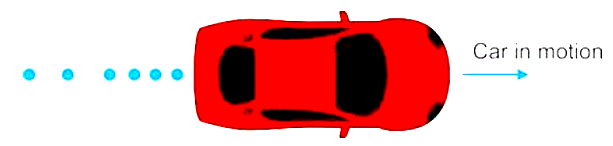
The diagram below shows the pattern of the oil on the road at a constant rate from a moving car. What information do you get from it about the motion of the car.
Answer
Initially as the drops are equidistant, we can say that the car is moving with a constant speed but later as the distance between the drops starts decreasing, we can say that the car slows down.
View full question & answer
Question 292 Marks
What is meant by the term retardation? Name its S.I. unit.
Answer
Retardation is the decrease in velocity per second. Its SI unit is metre/second$^2 (m/s^2).$
View full question & answer
Question 302 Marks
Differentiate between uniform acceleration and variable acceleration.
Answer
The acceleration is said to be uniform when equal changes in velocity take place in equal intervals of time, but if the change in velocity is not the same in the same intervals of time, the acceleration is said to be variable.
View full question & answer
Question 312 Marks
Distinguish between acceleration and retardation.
Answer
Acceleration is the increase in velocity per second, while retardation is the decrease in velocity per second. Thus, retardation is negative acceleration. In general, acceleration is taken positive, while retardation is taken negative.
View full question & answer
Question 322 Marks
The speed of a car is $72 km h ^{-1}$. Express it in $m s ^{-1}$.
Answer
Speed of car $=72 km h ^{-1}$
Speed of car in $ms ^{-1}$
$
=\frac{72 \times 1000}{3600}=20 m / s
$
View full question & answer
Question 332 Marks
Define acceleration. State its unit.
Answer
Acceleration is the rate of change of velocity with time. Its SI unit is metre/second$^2 (m/s^2).$
View full question & answer
Question 342 Marks
Give an example of motion in which the average speed is not zero but the average velocity is zero.
Answer
If a body starts its motion from a point and comes back to the same point after a certain time, then the displacement is zero, average velocity is also zero, but the total distance travelled is not zero, and therefore, the average speed in not zero.
View full question & answer
Question 352 Marks
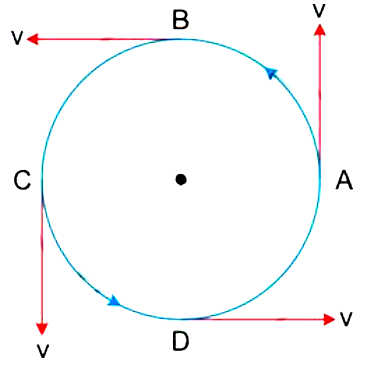
Give an example of the motion of a body moving with a constant speed but with a variable velocity. Draw a diagram to represent such a motion.
Answer
The motion of a body in a circular path with uniform speed has a variable velocity because in the circular path, the direction of motion of the body continuously changes with time.
View full question & answer
Question 362 Marks
Distinguish between average speed and average velocity.
Answer
Average speed is the ratio of the total distance travelled by the body to the total time of journey, it is never zero. If the velocity of a body moving in a particular direction changes with time, then the ratio of displacement to the time taken in entire journey is called its average velocity. Average velocity of a body can be zero even if its average speed is not zero.
View full question & answer
Question 372 Marks
A car accelerates at a rate of $5 m s^{-2}$. Find the increase in its velocity in $2$ s.
Answer
Acceleration = Increase in velocity/time taken
Therefore, increase in velocity = Acceleration × time taken
$= (5 \times 2) m/s$
$= 10 m/s$
View full question & answer
Question 382 Marks
Distinguish between speed and velocity.
Answer
Speed is a scalar quantity, while velocity is a vector quantity. The speed is always positive-it is the magnitude of velocity, but the velocity is given a positive or negative sign depending upon its direction of motion. The average velocity can be zero but the average speed is never zero.
View full question & answer
Question 392 Marks
A body is moving vertically upwards. Its velocity changes at a constant rate from $50 m s^{-1} to 20 m s^{-1} in 3 s$. What is its acceleration?
Answer
Here, final velocity $= 20 m/s$ Initial velocity $= 50 m/s$
Time taken $= 3 s$
Acceleration = (Final Velocity - Initial Velocity)/time $= (20 - 50)/3 m/s^{-2} = -10 m/s$
Negative sign here indicates that the velocity decreases with time, so retardation is $10 m/s.$
View full question & answer
Question 402 Marks
A car starting from rest acquires a velocity $180m s^{-1}$ in $0.05$ h. Find the acceleration.
Answer
Here, final velocity $= 180 m/s$
Initial velocity $= 0 m/s$
Time taken $= 0.05 h$ or $180 s$
Acceleration = (Final Velocity - Initial Velocity)/time
$= (180-0)/180 m s^{-2}$
$= 1 m s^-^2$​​​​​​​
View full question & answer
Question 412 Marks
Define velocity. State its unit.
Answer
The velocity of a body is the distance travelled per second by the body in a specified direction. Its SI unit is metre/second (m/s).
View full question & answer
[2 Mark Question Answer] - PHYSICS STD 9 Questions - Vidyadip