Question types

Motion in One Dimension question types

120 questions across 5 question groups — pick any mix to generate a PHYSICS paper with step-by-step answer keys.

120
Questions
5
Question groups
5
Question types
Sample Questions

Motion in One Dimension questions

One sample from each question group in this chapter. Select any group above to see the full set with answer keys.

Q 1MCQ1 Mark
A car starting from rest accelerates uniformly to acquire a speed $20\ km\ h ^{-1}$ in $30\min .$ The distance travelled by a car in this time interval will be$..........$
  • A
    $600\ km$
  • $5\ km$
  • C
    $6\ km$
  • D
    $10\ km$

Answer: B.

View full solution
Q 2MCQ1 Mark
The correct equation of motion is :
  • A
    $v = u + aS$
  • B
    $v=u t+a$
  • C
    $S =u t+\frac{1}{2} a t$
  • $v = u + at$

Answer: D.

View full solution
Q 3MCQ1 Mark
For uniform motion $...........$
  • A
    The distance-time graph is a straight line parallel to the time axis.
  • B
    The speed-time graph is a straight line inclined to the time axis.
  • The speed-time graph is a straight line parallel to the time axis.
  • D
    The acceleration-time graph is a straight line parallel to the time axis.

Answer: C.

View full solution
Q 4MCQ1 Mark
For a uniformly retarded motion, the velocity-time graph is $...........$
  • A
    A curve
  • B
    A straight line parallel to the time axis
  • C
    A straight line perpendicular to the time axis
  • A straight line inclined to the time axis

Answer: D.

View full solution
Q 5MCQ1 Mark
The velocity-time graph of a body in motion is a straight line inclined to the time axis. The correct statement is$..............$
  • A
    Velocity is uniform
  • Acceleration is uniform
  • C
    Both velocity and acceleration are uniform
  • D
    Neither velocity nor acceleration is uniform.

Answer: B.

View full solution
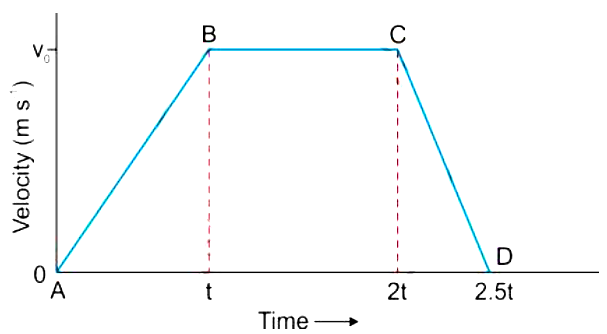
Figure given below shows a velocity-time graph for a car starting from rest. The graph has three parts $AB, BC$ and $CD.$

State how is the distance travelled in any part determined from this graph .
View full solution
A body starts to slide over a horizontal surface with an initial velocity of $0.5 ms^{-1}.$ Due to friction, its velocity decreases at the rate of $0.05 ms^{-2}$​​​​​​​. How much time will it take for the body to stop?
View full solution
A bullet initially moving with a velocity $20 \ m/s$ strikes a target and comes to rest after penetrating a distance $10 \ cm$ into the target. Calculate the retardation caused by the target.
View full solution
A vehicle is accelerating on a straight road. Its velocity at any instant is $30 km / h$. After 2 s , it is $33.6 km / h$, and after further 2 s , it is $37.2 km / h$. Find the acceleration of the vehicle in $m s ^{-2}$. Is the acceleration uniform?
View full solution
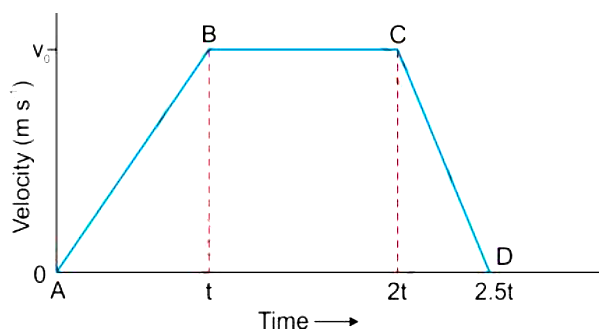
Figure given below shows a velocity-time graph for a car starting from rest. The graph has three parts $AB, BC$ and $CD.$

Compare the distance travelled in part BC with the distance travelled in part $AB$.
View full solution
A car travels a distance 100 m with constant acceleration and average velocity of $20 ms^{-1}$. The final velocity acquired by the car is $25 ms^{-1}$. Find (i) The initial velocity. (ii) Acceleration of the car.
View full solution
A train is moving with a velocity of $90 km h^{-1} $. It is brought to stop by applying the brakes which produce a retardation of $0.5 ms^{-2}$ Find :
(i) The velocity after $10 s$ , and
(ii) the time taken by the train to come to rest .
View full solution
 A train travels with a speed of $60 km h ^{-1}$ from station $A$ to station $B$ and then comes back with a speed $80 km^{-1}$ from station $B$ to station A. Find -
i. The average speed
ii. The average velocity of the train.
View full solution
Derive the following equations for uniformly accelerated motion:
(i) $v = u + at$
(ii) $S = ut +\frac{1}{2} at ^2$
(iii) $v ^2= u ^2+2 aS$
where the symbols have their usual meanings.
View full solution
A train starts from rest and accelerates uniformly at a rate of $2 m s ^{-2}$ for $10 $s . It then maintains a constant speed for 200 s . The brakes are then applied and the train is uniformly retarded and comes to rest in $50$ s . Find (i) The maximum velocity reached, (ii) The retardation in the last $50 s$ , (iii) The total distance travelled, (iv) The average velocity of the train.
View full solution

Generate a Motion in One Dimension paper free

Pick question groups from the list above, set marks and difficulty, and export a branded PDF with step-by-step answer keys. First 3 chapters free — no signup.

Download App