Questions

[5 Mark Question Answer]

🎯

Test yourself on this topic

19 questions · timed · auto-graded

Question 15 Marks
A car travels a distance 100 m with constant acceleration and average velocity of $20 ms^{-1}$. The final velocity acquired by the car is $25 ms^{-1}$. Find (i) The initial velocity. (ii) Acceleration of the car.
Answer
Distance travelled $s = 100 m$
Average velocity $V = 20 m/s$
Final velocity v $= 25 m/s$
(i) Let u be the initial velocity.
Average velocity = (Initial velocity + Final velocity)/2
$V = (u + v)/2$
$20 = (u + 25)/2$
$u = 40 - 25 = 15 m/s^{-1}$​​​​​​​
(ii) Let 'a' be the acceleration of the car.
Using the third equation of motion,
$v^2 - u^2 = 2as$
We get,
$(25)^2 - (15)^2 = 2 (a) (100)$
$625 - 225 = 200 a$
$a = (400/200) m/s^2 = 2 m/s^{-2}​​​​​​​$​​​​​​​
View full question & answer
Question 25 Marks
A train is moving with a velocity of $90 km h^{-1} $. It is brought to stop by applying the brakes which produce a retardation of $0.5 ms^{-2}$ Find :
(i) The velocity after $10 s$ , and
(ii) the time taken by the train to come to rest .
Answer
Initial velocity $u = 90 km/h = 25 m/s$
Final velocity $v = 0 m/s$
Acceleration $a = -0.5 m/s^2$
(i) Let 'V' be the velocity after time $t = 10 s$
Using the first equation of motion,
$v = u + at$
We get,
$V = 25 + (-0.5) (10) m/s$
$V = 25 - 5 = 20 m/s^{-1}​​​​​​​$​​​​​​​
(ii) Let t' be the time taken by the train to come to rest.
Using the first equation of motion,
$v = u + at$
We get,
$t' = [(0 - 25)/ (-0.5)] s$
$t' = 50 s$
View full question & answer
Question 35 Marks
 A train travels with a speed of $60 km h ^{-1}$ from station $A$ to station $B$ and then comes back with a speed $80 km^{-1}$ from station $B$ to station A. Find -
i. The average speed
ii. The average velocity of the train.
Answer
(i) Given,
From, $A$ to $B$
speed $_{A B}=60 km h ^{-1}$ distance travelled $=d_{A B}=d$
time taken $=\frac{ d }{60}$
From, B to A
speed $_{B A}=80 km h ^{-1}$
distance travelled $= d _{ BA }= d$
time taken $=\frac{d}{80}$
Total distance travelled $= d + d =2 d$
...[Eqn. 1]
Total time $=\frac{d}{60}+\frac{d}{80} \ldots$ [Eqn. 2]
Substituting the values from the equations 1 and 2 in the formula we get,
Average speed $=\frac{\text { Total Distance }}{\text { Total time }}$
$=\frac{2 d }{\frac{ d }{60}+\frac{ d }{80}}$
$=\frac{2 d }{\frac{4 d +3 d }{240}}$
$ =\frac{\frac{2}{7}}{240}$
$=\frac{2 \times 240}{7}$
$=\frac{480}{7}$
$=68.57 km h ^{-1} $
Hence, Average Speed $=68.57 km h ^{-1}$
(ii) Average velocity $=\frac{\text { Displacement }}{\text { total time taken }}$
Because the train starts and ends at the same station, the displacement is zero. Thus the average velocity is zero.
View full question & answer
Question 45 Marks
Derive the following equations for uniformly accelerated motion:
(i) $v = u + at$
(ii) $S = ut +\frac{1}{2} at ^2$
(iii) $v ^2= u ^2+2 aS$
where the symbols have their usual meanings.
Answer
Derivation of equations of motion

First equation of motion:
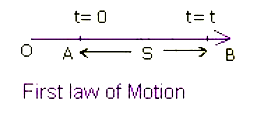
Consider a particle moving along a straight line with uniform acceleration 'a'. At $t = 0$, let the particle be at A and u be its initial velocity, and at t = t, let v be its final velocity.

Acceleration $=$ Change in velocity/Time $a=(v-u) / t$ at $=v-u$
$v = u + a t . .$. First equation of motion.
Second equation of motion: Average velocity = Total distance traveled/Total time taken Average velocity $= s / t . . .(1)$
Average velocity can be written as $(u+v) / 2$ Average velocity $=(u+v) / 2 \ldots(2)$
From equations (1) and (2) $s / t=(u+v) / 2 \ldots(3)$
The first equation of motion is $v=u+a t$.
Substituting the value of $v$ in equation (3), we get
$s / t=(u+u+a t) / 2 s=(2 u+a t) t / 2=2 u t+a t^2 / 2=2 u t / 2+a t^2 / 2$
$s=u t+(1 / 2) a t^2$...Second equation of motion.
Third equation of motion: The first equation of motion is $v=u+a t . v-u=$ at ... (1)
Average velocity $= s / t . . .(2)$
Average velocity $=(u+v) / 2 \ldots(3)$
From equation (2) and equation (3) we get,
$(u+v) / 2=s / t \ldots(4)$
Multiplying eq (1) and eq (4) we get,
$(v-u)(v+u)=\text { at } \times(2 s / t)(v-u)(v+u)=2 a s$
[We make the use of the identity $\left.a^2-b^2=(a+b)(a-b)\right]$
$v^2-u^2=2 a s \ldots$...Third equation of motion.
View full question & answer
Question 55 Marks
A train starts from rest and accelerates uniformly at a rate of $2 m s ^{-2}$ for $10 $s . It then maintains a constant speed for 200 s . The brakes are then applied and the train is uniformly retarded and comes to rest in $50$ s . Find (i) The maximum velocity reached, (ii) The retardation in the last $50 s$ , (iii) The total distance travelled, (iv) The average velocity of the train.
Answer
(i) For the first 10 s , initial velocity $u =0$
Acceleration $a =2 m / s ^2$
Time taken $t =10 s$
Let ' $v$ ' be the maximum velocity reached.
Using the first equation of motion
$v=u+a t$
We get
$V=(0)+(2)(10)=20 m / s^{-1}$
(ii) For the last 50 s : Final velocity $=0 m / s$, initial velocity $=20 m / s$.
Acceleration $=($ Final velocity - Initial velocity)/time
$=(0-20) / 50=-0.4 m / s^2$
Retardation $=0.4 m / s ^{-2}$
(iii) Total distance travelled = Distance travelled in the first $10 s+$ Distance travelled in $200 s+$ Distance travelled in last 50 s
Distance travelled in first $10 s\left(s_1\right)=u t+(1 / 2) a t^2$
$S_1=(0)+(1 / 2)(2)(10)^2$
$S_1=100 m$
Distance travelled in 200s $\left( s _2\right)=$ speed $\times$ time
$S_2=(20)(200)=4000 m$
Distance travelled in last $50s (s_3) = ut + (1/2) at^2$
Here, $u = 20 m/s, t = 50 s$ and $a = -0.4 m/s^2$
$S_3= (20)(50) + (1/2) (-0.4) (50)^2$
$S_3= 1000 - 500$
$S_3= 500 m$
Therefore, total distance travelled $= S_1+ S_2+ S_3 = 100 + 4000 + 500 = 4600 m​​​​​​​$​​​​​​​
(iv) Average velocity = Total distance travelled/total time taken
$= (4600/260) m/s$
$= 17.69 m/s^{-1}​​​​​​​$​​​​​​​
View full question & answer
Question 65 Marks
A space craft flying in a straight course with velocity of $75 km s ^{-1}$ fires its rocket motors for 6.0 s . At the end of this time its speed is $120 km s ^{-1}$ in the same direction. Find (i) The space craft's average acceleration while the motors were firing (ii) The distance travelled by the space craft in the first 10 s after the rocket motors were started, the motors being in action for only 6 s .
Answer
Given, the initial velocity $u=75 km / s$
Final velocity $v =120 km / s$
Time taken $=6 s$
(i) Acceleration = (Final velocity - Initial velocity)/time taken
$= [(120 - 75)/6] kms^{-2}$
$= (45/6) kms^{-2}$
$= 7.5 kms^{-2}$​​​​​​​
(ii) Distance travelled by the aircraft in the first 10
$s=$ Distance travelled in the first $6 s+$ Distance travelled in the next 4 s .
Distance travelled in the first $6 s\left( S _1\right)= ut +(1 / 2) at { }^2$
$(S_1) = ut + (1/2) at^2$
$(S_1) = (75)(6) + (1/2) (7.5)(6)^2$
$(S_1) = 450 + 135$
$(S_1) = 585 km$
Distance travelled in the next $4 s\left( S _2\right)=$ Speed $\times$ time
Speed at the end of 6 s is $120 km / s$.
$(S_2) = (120) (4)$
$(S_2) = 480 km$
Thus, the distance travelled by the aircraft in the first $10$
$s=\left(S_1\right)+\left(S_2\right)=585+480=1065 km$
View full question & answer
Question 75 Marks
A car travels with uniform velocity of $25 m s ^{-1}$ for 5 s . The brakes are then applied and the car is uniformly retarded and comes to rest in further 10 s . Find:
i. The distance which the car travels before the brakes are applied,
ii. Retardation and
iii. The distance travelled by car after applying the brakes.
Answer
(i) As we know, Distance $=$ Speed $x$ time
Initial velocity $(u)=25 m s ^{-1}$; Final velocity $(v)=0$, time $=5 s$
Substituting the values in the formula,
Distance $=$ Speed $x$ time
Distance $=(25) \times(5) m$
$\therefore$ Distance $=125 m$
(ii) Acceleration $=\frac{\text { Final velocity }- \text { Initial velocity }}{\text { Time taken }}$

$\therefore a=\frac{v-u}{t}$
$=\frac{0-25}{10} ms ^{-2}$
$=\frac{-5}{2} ms ^{-2}$
$=-2.5 ms ^{-2}$
$\because$ If $v < u$, then $a$ is negative, and $a$ is the retardation.
Therefore, retardation $=2.5 ms ^{-2}$
(iii) After applying brakes, the time taken to come to stop $=10 s$
Let $S^{\prime}$ be the distance travelled after applying the brakes.
Initial velocity $u=25 m / s$
Final velocity $v =0$
Using the third equation of motion.
$\therefore v^2 \cdot u^2=2 a s$
We get,
$=(0)^2-(25)^2=2(-2.5)\left(5^{\prime}\right)$
$=625=5(5)$
$=\frac{625}{5}=5^{\prime}$
$\Rightarrow 5^{\prime}=125 m$
View full question & answer
Question 85 Marks
A body moving with a constant acceleration travels distances $3 m$ and $8 m$, respectively in $1 s$ and $2 s$. Calculate:
  1. The initial velocity.
  2. The acceleration of body.
Answer
Let the constant acceleration with which the body moves be 'a'.
Given, the body travels distance $S_1 = 3$ m in time $t_1 = 1 s.$
Same body travels distance $S_2= 8 $ m in time $t_2= 2 s.$
(i) Let 'u' be the initial velocity.
Using the second equation of motion,
$S=u t+\frac{1}{2} a t^2$
Substituting the values in the formula above we get,
$ 3=( u \times 1)+\left(\frac{1}{2} \times a \times 1^2\right)$
$3= u +\left(\frac{1}{2}\right) a$
$3= u +\frac{ a }{2}$
$2 \times(3- u )= a$
$\Rightarrow a =6-2 u \quad \ldots .[\text { Equation 1] } $
For $8 m$ distance,
$ 8=(u \times 2)+\left(\frac{1}{2} \times a \times 2^2\right)$
$8=2 u+\left(\frac{1}{2} \times 4 a\right)$
$8-2 u=2 a$
$2(4-u)=2 a$
$\Rightarrow a=\frac{2(4-u)}{2}$
$\Rightarrow a=4-u \quad \ldots[\text { Equation 2] } $
Substracting the Equations 2 from 1
$ a=6-2 u$
$a=4-u$
$\underline{-\quad+\quad+}$
$0=2-u$
$\Rightarrow u=2 $
Hence, initial velocity $=2 m s ^{-1}$
(ii) Putting $u =2 m s$ in the equation (2)
$ a=4-u$
$\Rightarrow a=4-2$
$\Rightarrow a=2 m s ^{-1} $
Hence, the acceleration of body is $2 m s ^{-2}$
View full question & answer
Question 95 Marks
A body moves from rest with uniform acceleration and travels $270 m$ in $3$ s. Find the velocity of the body at $10$ s after the start.
Answer
Initial velocity u = 0 m/s
Distance travelled s = 270 m
Time taken to travel s distance = 3 s
Let 'a' be the uniform acceleration.
Using the second equation of motion,
$S = ut + (1/2) at^2$​​​​​​​
We get,
$270 = 0 + (1/2) a (3)^2$
$270 = 9a/2$
$a = 60 m/s^2​​​​​​​$​​​​​​​
Let v be the velocity of the body 10 s after the start.
Using the first equation of motion, we get
$v = u + at$
$v = 0 + (60)(10) = 600 m/s^{-1}​​​​​​​$​​​​​​​
View full question & answer
Question 105 Marks
When brakes are applied to a bus, retardation produced is $25 cm s ^{-2}$ and the bus takes 20 s to stop. Calculate -
i. The initial velocity of the bus
ii. The distance travelled by bus during this time.
Answer
Final velocity $(v)=0$
retardation $=-25 cm / s ^2$
Expressing it in $m s ^{-2}$
$25 cm s ^{-2}=\frac{25}{100} m s ^{-2}$
Hence, $-a=-0.25 m s ^{-2}$
Time taken $(t)=20$ :
(i) Let "u" be the initial velocity.
Using the first equation of motion.
$v=u+a t$
We get
$u = v - at$
$u =0 \cdot(-0.25)(20)$
$u =5 m s ^{-1}$
(ii) Let 's' be the distance travelled.
Using the third equation of motion.
$v^2-u^2=2 a s$
We gat
$\therefore(0)^2-(5)^2=2(-0.25)( s )$
$\therefore 0-25=-0.5 \times 5$
$\therefore-25=-0.5 s$
$\therefore \frac{-25}{-0.5}=5$
$\therefore s =50 m $
View full question & answer
Question 115 Marks
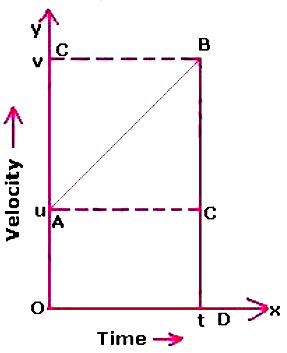
Draw a velocity-time graph for a body moving with an initial velocity u and uniform acceleration a. Use this graph to find the distance travelled by the body in time t.
Answer

In this graph, initial velocity = u
Velocity at time t = v
Let acceleration be 'a'
Time = t
Then, distance travelled by the body in t s = area between the v-t graph and X-axis
Or distance travelled by the body in t s = area of the trapezium OABD

= (1/2) × (sum of parallel sides) × (perpendicular distance between them)

= (1/2) × (u + v) × (t)

= (u + v)t /2
View full question & answer
Question 125 Marks
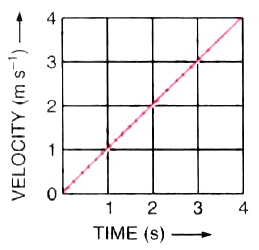
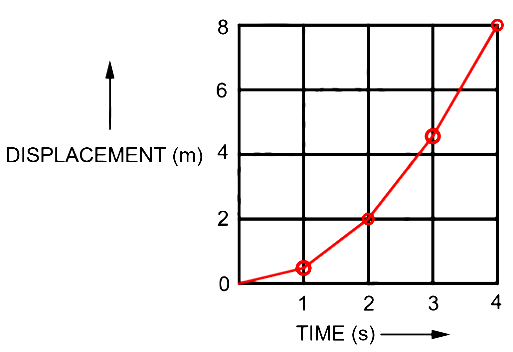
Figure (a) shows the velocity-time graph for the motion of a body. Use it to find the displacement of the body at t = 1 s, 2 s, 3 s and 4 s, then draw on Figure (b), the displacement-time graph for it.
(a)(b)
Answer
Let displacements at $t=1 s , 2 s , 3 s , 4 s$ be $S _1, S _2, S _3, S _4$ respectively.
At $t =1 s$, displacement $S _1=\frac{1}{2} \times 1 \times 1=0.5 m$
At $t =2 s$, displacement $S _2=\frac{1}{2} \times 2 \times 2=2 m$
At $t =3 s$, displacement $S _3=\frac{1}{2} \times 3 \times 3=4.5 m$
At $t =4 s$, displacement $S _4=\frac{1}{2} \times 4 \times 4=8 m$
The table below gives the displacement of body at different instants.
Time (in s)1234
Displacement (in m)0.524.58
The displacement time graph is shown below
View full question & answer
Question 135 Marks
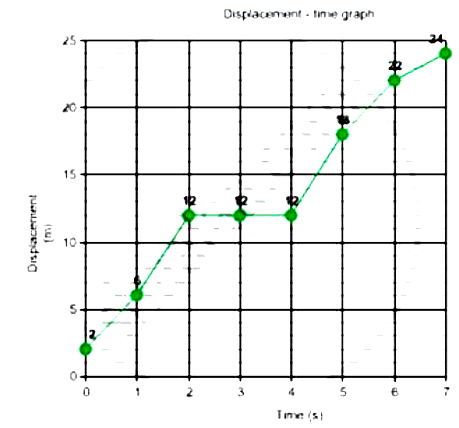
A body is moving in a straight line and its displacement at various instants of time is given in the following table
Time (s) 0 1 2 3 4 5 6 7
Displacement (m) 2 6 12 12 12 18 22 24
Plot the displacement-time graph and calculate (i) Total distance travelled in the interval 1 s to 5 s. (ii) Average velocity in time interval 1 s to 5 s.
Answer

(i) Total distance travelled in interval 1s to 5s = 18m - 6m = 12 m.
(ii) Average velocity = Total displacement in the given time interval/Time interval, i.e. 1 s to 5 s.
Or, Average velocity = 12 m/4 s = 3 m/s.
View full question & answer
Question 145 Marks
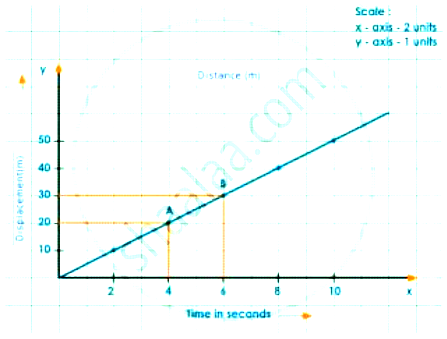
The following table gives the displacement of a car at different instants of time.
Time (s) 0 1 2 3 4
Displacement (m) 0 5 10 15 20
(a) Draw the displacement-time sketch and find the average velocity of the car. (b) What will be the displacement of the car at (i) 2.5 s and (ii) 4.5 s?
Answer

Displacement-time graph
From the part AB of the graph,
Average velocity = (Displacement at B - Displacement at A)/Time taken

= (30 - 20) m/( 6 - 4) s

= (10/2) m/s

= 5 m/s

(b) (i) From the graph, the displacement of car at 2.5 s is 12.5 m.
(ii) From the graph, the displacement of car at 4.5 s is 22.5 m.
View full question & answer
Question 155 Marks
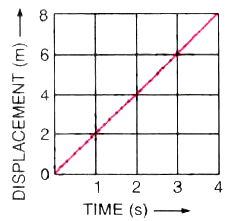
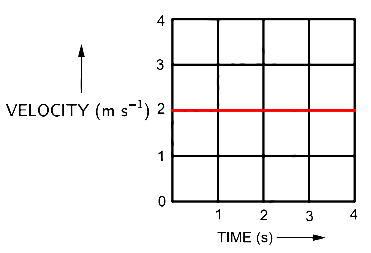
Figure (a) shows the displacement-time graph for the motion of a body. Use it to calculate the velocity of the body at t = 1 s, 2 s and 3 s, and then draw the velocity-time graph in Figure (b) for it.
(a) (b)
Answer
We observe from the given displacement time graph above, that the slope is a straight line inclined with time axis, so the body is moving with uniform velocity.
velocity $=$ Slope of straight line
$t =1 \text {; velocity }=\frac{2}{1}=2 m / s$
$ t =2 ; \text { velocity }=\frac{4}{2}=2 m / s$
$t =3 ; \text { velocity }=\frac{6}{3}=2 m / s $
Hence, velocity at $t =1 s , 2 s$ and $3 s$ is equal to $2 m s ^{-1}$
Velocity-time graph for the motion of a body is given below:

View full question & answer
Question 165 Marks
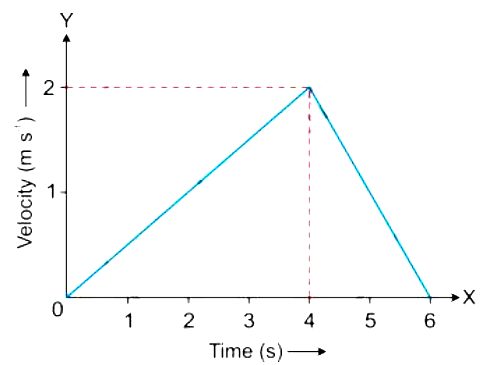
Figure shows the velocity-time graph of a particle moving in a straight line.

(i) State the nature of motion of particle.
(ii) Find the displacement of particle at $t =6 s$.
(iii) Does the particle change its direction of motion?
(iv) Compare the distance travelled by the particle from $0$ to $4 s$ and from $4 s$ to $6 s $.
(v) Find the acceleration from $0$ to $4 s$ and retardation from $4$ s to $6 s $.
Answer
(i) From 0 to 4 seconds, the motion is uniformly accelerated and from 4 to 6 seconds, the motion is uniformly retarded.
(ii) Displacement of the particle at $6 s=(1 / 2)(6)(2)=6 m$
(iii) The particle does not change its direction of motion.
(iv) Distance travelled by the particle from 0 to $4 s( D 1)=(1 / 2)(4)(2)=4 m$ Distance travelled by the particle from 4 to 6s (D2) $=(1 / 2)(2)(2)=2 m$ D1:D2:: 4:2 D1:D2:: 2:1
(v) Acceleration from 0 to $4 s=(2 / 4) ms ^{-2}$ or $0.5 ms^{-2}$ Retardation from 4 s to $6 s=(2 / 2) ms ^{-2}$ or $1 ms^{-2}$.
View full question & answer
Question 175 Marks
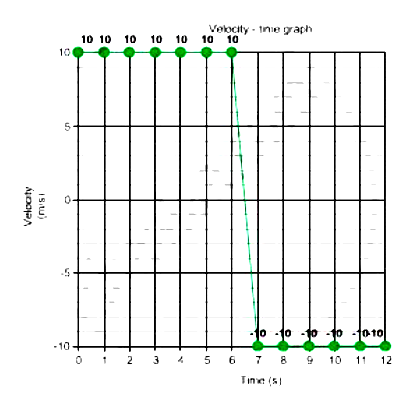
 A ball moves on a smooth floor in a straight line with uniform velocity $10 m s ^{-1}$ for 6 s . At $t =6 s$, the ball hits a wall and comes back along the same line to the starting point with the same speed. Draw the velocity-time graph and use it to find the total distance travelled by the ball and its displacement.
Answer

Distance travelled in first 6 s = velocity × time
$= 10 m/s × 6$
= 60 m/s Distance travelled in next 6 s = velocity × time
$= 10 m/s \times 6$
$= 60 m/s$
Total distance travelled in $12 s = (60 + 60) m = 120 m$
Total displacement $= 0$, as the ball returns its starting point.
View full question & answer
Question 185 Marks
A car travels the first $30 km$ with a uniform speed of $60 km h ^{-1}$ and the next 30 km with a uniform speed of $40 km h ^{-1}$. Calculate :
The total time of journey,
The average speed of the car.
Answer
For the first $30 km$ travelled, speed $=60 km / h$.
Thus time taken ( $t 1$ ) = Distance $/$ speed
$ =(30 / 60) h ^{-1}$
$ =0.5 h ^{-1} \text { or } 30 min .$
For the next $30 km$ travelled, speed $=40 km / h$
Thus time taken ( $t 2$ ) = Distance/speed
$ =(30 / 40) h ^{-1}$
$=0.75 h ^{-1} \text { or } 45 min \text {. }$
(i) Total time $=(30+45) min$
$=75 min \text { or } 1.25 h \text {. }$
(ii) Average speed of the car $=$ Total distance travelled/total time taken $=\frac{60 km }{1.25 hr }=$
$48 km h ^{-1}$
View full question & answer
Question 195 Marks
A toy car initially moving with uniform velocity of $18 km h ^{-1}$ comes to a stop in 2 s . Find the retardation of the car in S .I. units.
Answer
initial velocity $( u )=18 km / h ^{-1}$
final velocity $(v)=0 km / h$
time $(t)=2 s$
acceleration/retardation (a) = ?
To convert initial velocity $u$ to $m s ^{-1}$
$ 18 km / h ^{-1}=\frac{18 km }{1 h }=\frac{18 \times 1000 m }{60 \times 60 s }$
$\Rightarrow 18 km / h ^{-1}=\frac{18 \times 10 m }{6 \times 6 s }$
$\Rightarrow 18 km / h ^{-1}=5 m s ^{-1} $
Acceleration (a) $=\frac{\text { Final Velocity }( v )-\text { Initial Velocity }( u )}{\text { time }( t )}$
$a =\frac{0-5}{2} m s ^{-2}$
$ a =-\frac{5 ms ^{-1}}{2 s }$
$=-2.5 m s ^{-2} $
Hence, acceleration of the body is $-2.5 m s ^{-2}$.
Negative sign shows that the velocity decreases with time, so retardation is $2.5 m s ^{-2}$.
View full question & answer
[5 Mark Question Answer] - PHYSICS STD 9 Questions - Vidyadip