Questions

[5 Mark Question Answer]

🎯

Test yourself on this topic

12 questions · timed · auto-graded

Question 15 Marks
Describe an experiment to demonstrate that air exerts pressure.
Answer
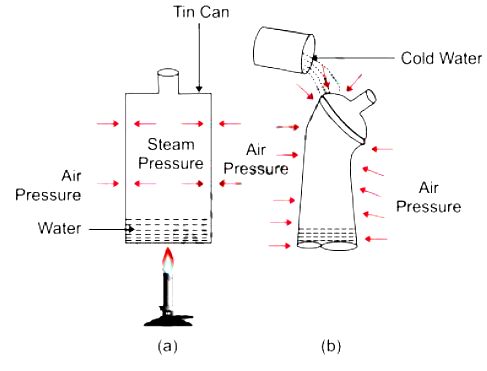
Experiment to demonstrate that air exerts pressure:
Take a thin can fitted with an airtight stopper. The stopper is removed and a small quantity of water is boiled in the can. Gradually the steam occupies the entire space of can by expelling the air from it [Fig (a)]. Then stopper is then tightly replaced and simultaneously the flame beneath the can is removed. Cold water is then poured over the can.
It is observed that the can collapses inwards as shown in fig (b).
The reason is that the pressure due to steam inside the can is same as the air pressure outside the can [Fig (a)]. However, on pouring cold water over the can, fitted with a stopper [fig (b)], the steam inside the can condenses producing water and water vapour at very low pressure. Thus, the air pressure outside the can becomes more than the vapour pressure inside the closed can.
Consequently, the excess atmospheric pressure outside the can causes it to collapse inwards.
View full question & answer
Question 25 Marks
What is an aneroid barometer? Draw a neat and labelled diagram to explain its construction and working.
Answer
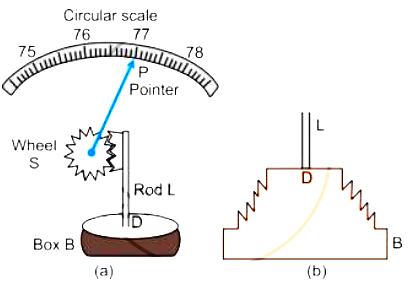
A barometer calibrated to read directly the atmospheric pressure is called an aneroid barometer. It has no liquid, it is light and portable.


Construction: Figure above shows the main parts of an aneroid barometer. It consists of a metallic box B which is partially evacuated. The top D of the box is springy and corrugated in form of a diaphragm as shown. At the middle of diaphragm, there is a thin rod L toothed at its upper end. The teeth of rod fit well into the teeth of a wheel S attached with a pointer P which can slide over a circular scale. The circular scale is initially calibrated with a standard barometer so as to read the atmospheric pressure directly in terms of the barometric height.

Working: When atmospheric pressure increases, it presses the diaphragm D and the rod L gets depressed. The wheel S rotates clockwise and pointer P moves to the right on the circular scale. When atmospheric pressure decreases, the diaphragm D bulges out due to which the rod L moves up and the wheel S rotates anti-clockwise. Consequently, the pointer moves to the left.
View full question & answer
Question 35 Marks
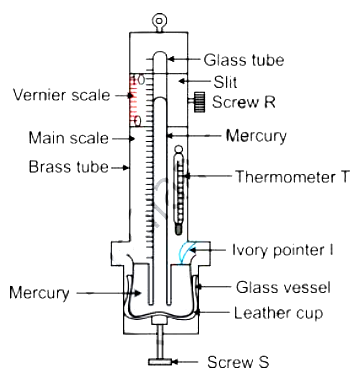
Draw a simple labelled diagram of a Fortin barometer and state how it is used to measure the atmospheric pressure.
Answer

To measure the atmospheric pressure, first the leather cup is raised up or lowered down with the help of the screw S so that the ivory pointer I just touches the mercury level in the glass vessel. The position of the mercury level in the barometer tube is noted with the help of main scale and the vernier scale. The sum of the vernier scale reading to the main scale reading gives the barometric height.
View full question & answer
Question 45 Marks
Explain how is the height of mercury column in tube of a simple barometer, a measure of the atmospheric pressure.
Answer
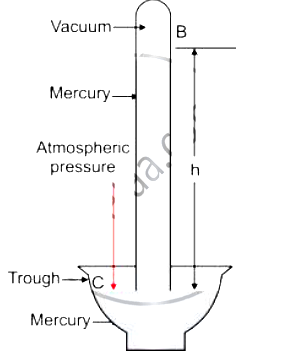
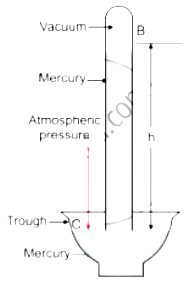
In given figure, at all points such as C on the surface of mercury in trough, only the atmospheric pressure acts. When the mercury level in the tube becomes stationary, the pressure inside tube at the point A, which is at the level of point C, must be same as that at the point C. The pressure at point A is due to the weight (or thrust) of the mercury column AB above it. Thus, the vertical height of the mercury column from the mercury surface in trough to the level in tube is a measure of the atmospheric pressure.

The vertical of the mercury column in it (i.e., AB = h) is called the barometric height.

Had the pressure at points A and C be not equal, the level of mercury in the tube would not have been stationary.
View full question & answer
Question 55 Marks
What is a barometer? How is a simple barometer constructed?
Answer
A barometer is an instrument which is used to measure the atmospheric pressure.
Construction of a simple barometer:

A simple mercury barometer can be made with a clear, dry, thick-walled glass tube about 1 metre ling. The glass tube is sealed at one end and is filled with mercury completely. While filling the tube with mercury care has to be taken so that there are no air bubbles present in the mercury column. Close the open end with thumb and turn the tube upside down carefully over a trough containing mercury. Dip the open end under the mercury level in the trough and remove the thumb.

The mercury level in the tube falls until it is about 76 cm (h =760 mm) vertically above the mercury level. It is the atmospheric pressure acting on the surface of the mercury in the trough that supports the vertical mercury column. The empty space above the mercury column is called the ‘Torricellian vacuum’.
View full question & answer
Question 65 Marks
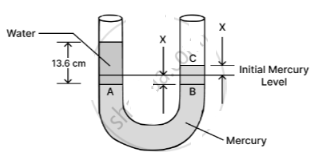
A simple $U$ tube contains mercury to the same level in both of its arms. If water is poured to a height of 13.6 cm in one arm, how much will be the rise in mercury level in the other arm? Given : density of mercury $=13.6 \times 10^3 kg m ^{-3}$ and density of water $=$ $10^3 kg m ^{-3}$.
Answer
Given, $\rho _m = 13.6 \times 10^3 kg m ^{-3}, \rho _w = 10^3 kg m ^{-3}$
Height to which water is poured in one arm, $h_w = 13.6 cm$​​​​​​​

Image
By pouring 13.6 cm of water, the mercury level in the left arm goes down to point A by x cm, while in the right arm, it rises to point C by x cm.
Therefore, $BC = h_m = 2x cm$
By Pascal's law,
Pressure in the water column = pressure in the mercury column
Therefore, $P_A = P_B$
$\Rightarrow h_w \rho _w g = h_m \rho _m g$
$\Rightarrow 13.6 \times 10^3 \times g = 2? \times 13.6 \times 10^3 \times g$
$\Rightarrow 1 = 2?$
$\Rightarrow x=\frac{1}{2}=0.5 cm$
Hence, the rise in mercury level $= 0.5 cm$
View full question & answer
Question 75 Marks
a. Calculate the height of a water column which will exert on its base the same pressure as the 70 cm column of mercury. Density of mercury is $13.6 g cm ^{-3}$.
b. Will the height of the water column in part (a) change if the cross-section of the water column is made wider?
Answer
(a) As we know,
Pressure due to water column of height $h=h \rho g$
Pressure due to water column = Pressure due to mercury column
Hence, $h_w \rho_w g=h_m \rho_m g$
Given, $h_m=70 cm , \rho_m=13.6 g cm ^{-3}, \rho_w=1 g cm ^{-3}$
From the above formula, we get,
$h _{ w }=\frac{ h _{ m } \rho_{ m }}{\rho_{ m }}$
Substituting the values, we get,
$h _{ w }=\frac{70 \times 13.6}{1}$
$h_w=952 cm$
$\therefore h _{ w }=\frac{952}{100}=9.52 m$
Hence, height of a water column $=9.52 m$
(b) No, if the cross-section of the water column is made wider, the height of the water column will be unaffected.
View full question & answer
Question 85 Marks
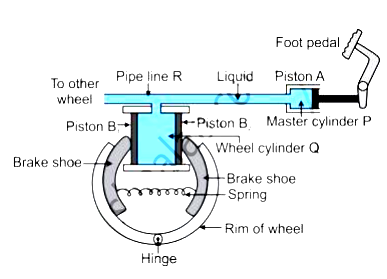
Explain the working of a hydraulic brake with a simple labelled diagram.
Answer

Working: To apply brakes, the foot pedal is pressed due to which pressure is exerted on the liquid in the master cylinder $P$, so liquid runs out from the master cylinder $P$ to the wheel cylinder $Q$. As a result, the pressure is transmitted equally and undiminished through the liquid to the pistons $B_1$ and $B_2$ of the wheel cylinder. Therefore, the pistons $B_1$ and $B_2$ get pushed outwards and brake shoes get pressed against the rim of the wheel due to which the motion of the vehicle retards. Due to transmission of pressure through the liquid, equal pressure is exerted on all the wheels of the vehicle connected to the pipe line $R$.
On releasing the pressure on the pedal, the liquid runs back from the wheel cylinder $Q$ to the master cylinder $P$ and the spring pulls the break shoes to their original position and forces the pistons $B_1$ and $B_2$ to return back into the wheel cylinder Q. Thus, the brakes get released.
View full question & answer
Question 95 Marks
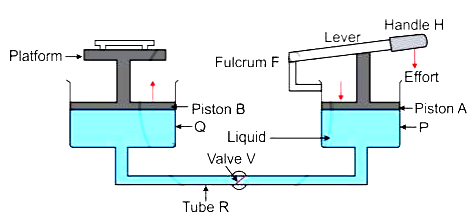
Draw a simple diagram of a hydraulic jack and explain its working.
Answer

Working: When handle H of the lever is pressed down by applying an effort, the valve V opens because of increase in pressure in cylinder P. The liquid runs out from the cylinder P to the cylinder Q. As a result, the piston B rises up and it raises the car placed on the platform. When the car reaches the desired height, the handle H of the lever is no longer pressed. The valve V gets closed (since the pressure on the either side of the valve becomes same) so that the liquid may not run back from the cylinder Q to cylinder P.
View full question & answer
Question 105 Marks
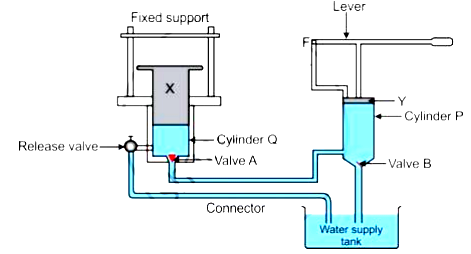
The diagram below in Fig. 4.12 shows a device which makes the use of the principle of transmission of pressure.
  1. Name the parts labelled by the letters X and Y.
  2. Describe what happens to valves A and B and to the quantity of water in the two cylinders when the lever arm is moved down.
  3. Give reasons for what happens to valves A and B in part (ii).
  4. What happens when the release valve is opened?
  5. What happens to valve B in cylinder P when the lever arm is moved up?
  6. Give a reason for your answer in part (v).
  7. State one use of the above device.
Answer
  1. X : Press Plunger; Y: Pump Plunger
  2. When the lever is moved down, valve B closes and valve A opens, so the water from cylinder P is forced into cylinder Q.
  3. Valve B closes due to an increase in pressure in cylinder P. This pressure is transmitted to the connecting pipe and when the pressure in connecting pipe becomes greater than the pressure in cylinder Q, valve A opens up.
  4. When the release valve is opened, the ram (or press) plunger Q gets lowered and water of cylinder Q runs out in the reservoir.
  5. When the lever arm is moved up valve B opens upwards.
  6. When the lever arm is moved up valve B opens upward because the pressure in cylinder P decreases.
  7. An hydraulic press is used for pressing cotton bales and goods like quilts, books, etc.
View full question & answer
Question 115 Marks
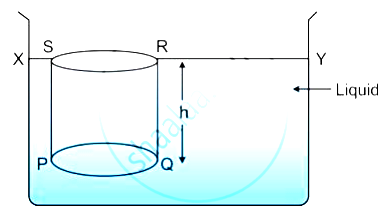
Deduce an expression for the pressure at depth inside a liquid.
Answer
Consider a vessel containing a liquid of density. Let the liquid be stationary. In order to calculate pressure at a depth, consider a horizontal circular surface PQ of area A at a depth h below the free surface XY of the liquid. The pressure on the surface PQ will be due to the thrust of the liquid contained in cylinder PQRS of height h with PQ as its base and top face RS lying on the frees surface XY of the liquid.

Total thrust exerted on the surface PQ
= Weight of the liquid column PQRS
= Volume of liquid column PQRS x density x g
= (Area of base PQ x height) x density x g
= (A x h) x ρ x g
This thrust is exerted on the surface PQ of area A. Therefore, pressure is given as shown below.
P = Thrust on surface / Area of surface
P = Ahρg / A = h ρ g
Thus, Pressure = depth x density of liquid x acceleration due to gravity
View full question & answer
Question 125 Marks
Two cylindrical vessels fitted with pistons A and B of area of cross-section $8 cm^2$ and $320 cm^2$ respectively are joined at their bottom by a tube and they are completely filled with water. When a mass of 4 kg is placed on piston A , Find :
(i) the pressure on piston A ,
(ii) the pressure on piston B , and
(iii) the thrust on piston B .
Answer

Given that the force applied to the smaller piston A is $4 kg$
Area of cross-section of piston $A=8 cm ^2$
Area of cross-section of piston $B=320 cm ^2$
(i) Pressure acting on piston $A$ in the downward direction $=\frac{\text { Thrust }}{\text { Area }}=\frac{4 kg }{8 cm ^2}$
$\therefore$ Pressure acting on piston $A =0.5 kg cm ^{-2}$
(ii) According to Pascal's Law
Pressure acting on piston $B=$ Pressure acting on Piston $A=0.5 kg cm ^{-2}$
(iii) Thrust acting on piston $B$ in the upward direction
$=$ Pressure $\times$ Area of $B$
$=4 kg \times \frac{320 cm ^2}{8 cm ^2}$
$\therefore$ Thrust acting on piston B in the upward direction $=160 kg$.
View full question & answer
[5 Mark Question Answer] - PHYSICS STD 9 Questions - Vidyadip