Question
What is a barometer? How is a simple barometer constructed?

Answer

A barometer is an instrument which is used to measure the atmospheric pressure.
Construction of a simple barometer:

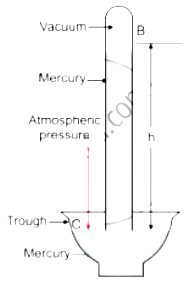
A simple mercury barometer can be made with a clear, dry, thick-walled glass tube about 1 metre ling. The glass tube is sealed at one end and is filled with mercury completely. While filling the tube with mercury care has to be taken so that there are no air bubbles present in the mercury column. Close the open end with thumb and turn the tube upside down carefully over a trough containing mercury. Dip the open end under the mercury level in the trough and remove the thumb.

The mercury level in the tube falls until it is about 76 cm (h =760 mm) vertically above the mercury level. It is the atmospheric pressure acting on the surface of the mercury in the trough that supports the vertical mercury column. The empty space above the mercury column is called the ‘Torricellian vacuum’.

Need a full question paper?

Generate a complete, print-ready paper with questions like this in minutes — across 16+ boards, with answer keys.
Start Generating Free

Similar questions

Describe an experiment to verify the Archimedes' principle.
A block of wood of mass 24 kg floats on water. The volume of wood is $0.032 m^3$. Find : (a) the volume of block below the surface of water,
(b) the density of wood.
(Density of water $=1000 kg m ^{-3}$ )
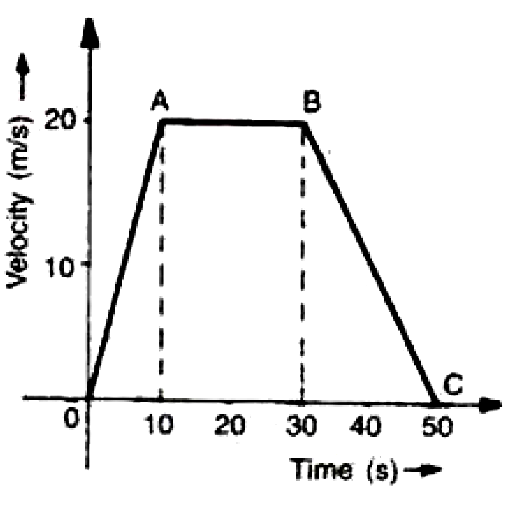
The graph shows how the velocity of a scooter varies with time in 50 s. Interpret the graph.
What do you understand by the following terms as applied to screw gauge?
(a) Zero error
(b) Positive zero error
(c) Negative zero error.
Distinguish between convergent and divergent beams of light.
When brakes are applied to a bus, retardation produced is $25 cm s ^{-2}$ and the bus takes 20 s to stop. Calculate -
i. The initial velocity of the bus
ii. The distance travelled by bus during this time.
What is the cause of upthrust? At which point can it be considered to act?
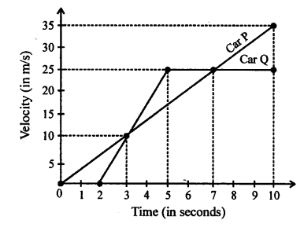
Diagram given below shows velocity - time graphs of car P and Q, starting from same place and in same direction. Calculate:
1. Acceleration of car P.
2. Acceleration of car Q between 2 s5 s.
3. At what time intervals both cars have same velocity?
4. Which car is ahead after 10 s and by how much?
Image
Two spheres $A$ and $B$, each of volume $100 cm^3$ is placed on water (density $=1.0 g cm ^{-3}$ ). The sphere A is made of wood of density $0.3 g cm ^{-3}$ and sphere B is made of iron of density $8.9 g cm ^{-3}$.
  1. Find:
    1. The weight of each sphere, and
    2. The upthrust on each sphere.
  2. Which sphere will float? Give reason.
How will you find the volume of a lump of salt or sugar using a graduated cylinder?