Questions

[1 Mark Question Answer]

🎯

Test yourself on this topic

28 questions · timed · auto-graded

Question 11 Mark
Name the mirrors shown in Figure (a) and (b).
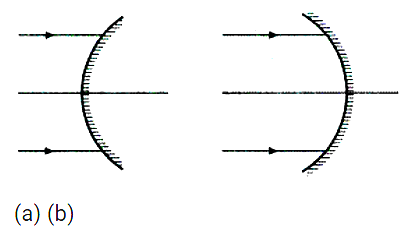
Answer
(i) In figure (a) a convex mirror is shown.
In figure (b) a concave mirror is shown.
View full question & answer
Question 21 Mark
State the direction of incident ray which after reflection from a spherical mirror retraces its path. Give a reason to your answer.
Answer
Incident ray is directed towards the centre of curvature because the ray is normal to the spherical mirror, so < i = <r = O.
View full question & answer
Question 31 Mark
State the kind of mirror used
(a) By a dentist,
(b) As a search-light reflector.
Answer
(a) Concave mirror
(b) Concave mirror
View full question & answer
Question 41 Mark
The focal length of a concave mirror is 10 cm. Find its radius of curvature.
Answer
Radius of curvature = 2 × focal length
Or, R = 2f = 2 × 10 = 20 cm
View full question & answer
Question 51 Mark
How is the focal length of a spherical mirror related to its radius of curvature?
Answer
Focal length is half the radius of curvature of a spherical mirror.
$f=\frac{R}{2}$
View full question & answer
Question 101 Mark
Does the mirror mentioned in part (b) form real image for all locations of the object?
Answer
No, it does not form real image for all locations of the object.
View full question & answer
Question 111 Mark
What type of mirror can be used to obtain a real image of an object?
Answer
A concave mirror can be used to obtain a real image of an object.
View full question & answer
Question 121 Mark
What is a real image?
Answer
When the rays of light diverging from a point, after reflection of refraction, actually converge at some point, then that point is the real image of the object.
View full question & answer
Question 141 Mark
State the position of object for which the image formed by a concave mirror is of same size.
Answer
If the object is placed at the centre of curvature of a concave mirror, the image formed is of same size.
View full question & answer
Question 161 Mark
For what position of object, the image formed by a concave mirror is magnified and erect?
Answer
If the object is placed between the pole and focus of a concave mirror, the image formed is magnified and erect.
View full question & answer
Question 171 Mark
The radius of curvature of a convex mirror is 40 cm. Find its focal length.
Answer
Focal length = ½ (Radius of curvature)
Or, f = $\frac{40}{2}$ = 20 cm
View full question & answer
Question 181 Mark
What is a spherical mirror?
Answer
A reflecting surface which is a part of a sphere is called a spherical mirror.
View full question & answer
Question 191 Mark
Name the mirror which always produces an erect and virtual image. How is the size of image related to the size of object?
Answer
Convex mirror always produces erect and virtual images. The images formed are diminished, i.e. the size of the image is shorter than the size of the object.
View full question & answer
Question 201 Mark
Two plane mirrors are placed making an angle θ° in between them. For an object placed in between the mirrors, if angle is gradually increased from 0° to 180°, how will the number of images change : increase, decrease or remain unchanged?
Answer
The number of images formed is given as n = $\frac{360}{\theta}$

So, if q is gradually increased, n decreases.
View full question & answer
Question 211 Mark
A light ray is incident normally on a plane mirror. (a) What is its angle of incidence?
Answer
$0^o$​​​​​​​
View full question & answer
Question 221 Mark
Differentiate between the reflection of light from a plane mirror and that from a plane sheet of paper.
Answer
Reflection of light from a plane mirror is regular reflection and reflection of light from plane sheet of paper is irregular reflection of light.
View full question & answer
Question 231 Mark
An insect is sitting in front of a plane mirror at a distance 1 m from it.
(b) What is the distance between the insect and its image?
Answer
Distance between the insect and his image = 1 + 1 = 2 m
View full question & answer
Question 241 Mark
An insect is sitting in front of a plane mirror at a distance 1 m from it.
(a) Where is the image of the insect formed?
Answer
Image of the insect is formed 1m behind the mirror.
View full question & answer
Question 251 Mark
State which surface of a plane mirror reflects most of the light incident on it: the front smooth surface or the back silvered surface.
Answer
Black silvered surface reflects most of the light incident on it.
View full question & answer
Question 261 Mark
What do you mean by reflection of light?
Answer
The return of light into the same medium after striking a surface is called reflection.
View full question & answer
Question 271 Mark
Why is it difficult to read the image of the text of a page formed due to reflection by a plane mirror?
Answer
Due to lateral inversion, , it becomes difficult to read the image of the text of a page formed due to reflection by a plane mirror.
View full question & answer
Question 281 Mark
How is the position of an image related to the position of the object?
Answer
The image is situated at the same perpendicular distance behind the mirror as the object in front of it.
View full question & answer
[1 Mark Question Answer] - PHYSICS STD 9 Questions - Vidyadip