Questions

[3 Mark Question Answer]

🎯

Test yourself on this topic

24 questions · timed · auto-graded

Question 13 Marks
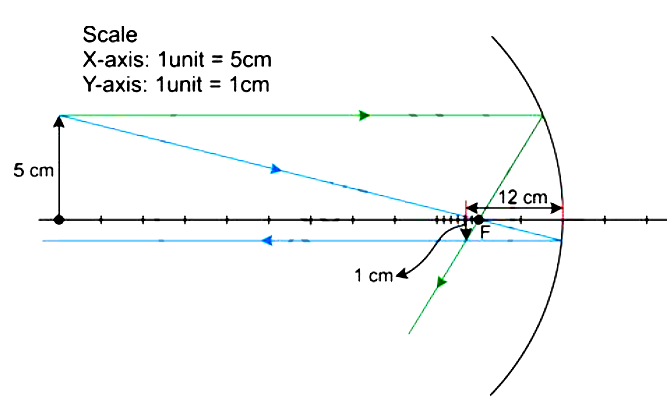
When an object of height 1 cm is kept at a distance 4 cm from a concave mirror, its erect image of height 1.5 cm is formed at a distance 6 cm behind the mirror. Find the focal length of mirror, by drawing.
Answer
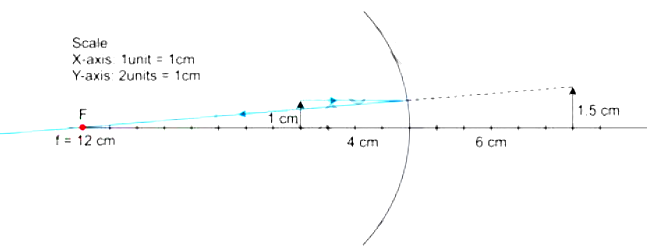
A ray passing parallel to the principal axis passes through the focal point after reflection. Hence, the focal length is 12 cm.
View full question & answer
Question 23 Marks
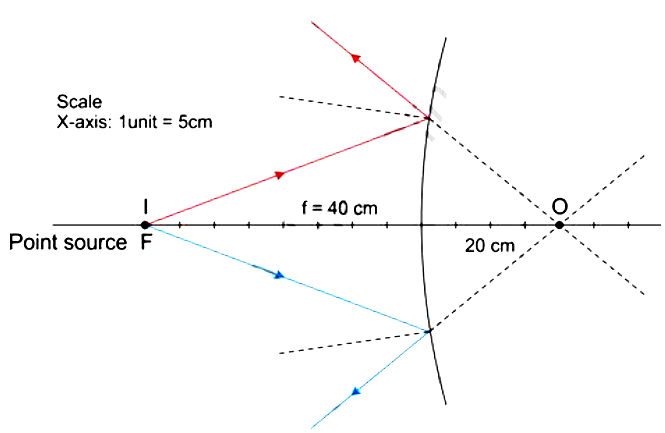
A point light source is kept in front of a convex mirror at a distance of 40 cm. The focal length of the mirror is 40 cm. Find the position of image by drawing.
Answer

The image is behind the mirror at a distance 20 cm. 
View full question & answer
Question 33 Marks
An object 5 cm high is placed at a distance 60 cm in front of a concave mirror of focal length 10 cm. Find the position and size of the image.
Answer

The position of the object is 12 cm in front of the mirror.
Its size is 1 cm.
View full question & answer
Question 43 Marks
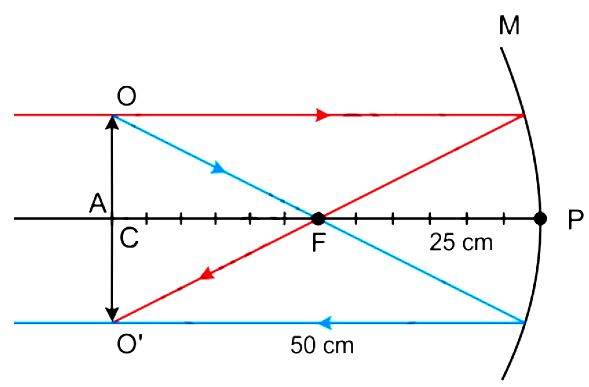
At what distance from a concave mirror of focal length 25 cm should an object be placed so that the size of image is equal to the size of the object.
Answer
The size of the image is equal to the size of the object if the object is placed at the centre of curvature of a concave mirror.
Hence, the object should be placed at 50 cm. 
View full question & answer
Question 53 Marks
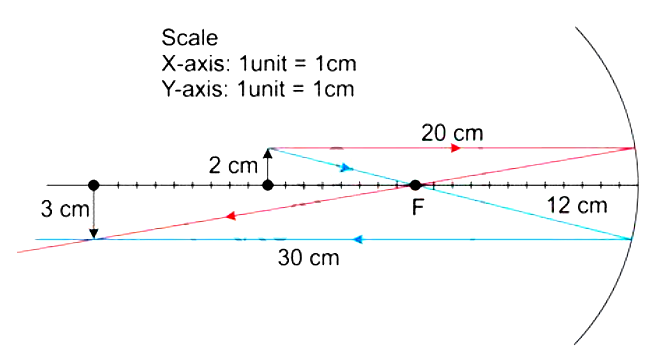
An object of height 2 cm is placed at a distance of 20 cm in front of a concave mirror of a focal length of 12 cm. Find the position, size, and nature of the image.
Answer

The image is 30 cm in front of the mirror, 3 cm high, real, inverted and magnified.
View full question & answer
Question 63 Marks
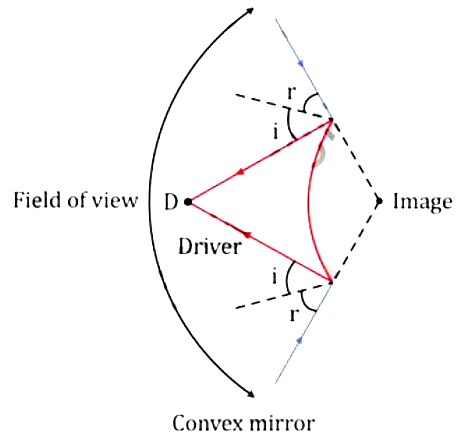
Why does a driver use a convex mirror instead of a plane mirror as a rear view mirror?
Illustrate your answer with the help of a ray diagram.
Answer
A convex mirror diverges the incident beam and always forms a virtual, small and erect image between its pole and focus. Thus, a driver can see all the traffic approaching from behind. This fact enables the driver to use it as a rear view in vehicles to see all the traffic approaching from behind.
View full question & answer
Question 73 Marks
What is meant by magnification? Write its expression. What is its sign for the (a) real (b) virtual, image?
Answer
Magnification is the ratio of the length of image to the length of the object.
$
m =\frac{1}{ O }
$
It is also given as
$
m =-\frac{ v }{ u }
$
Where, $u$ and $v$ is the object and image distance, respectively.

Hence, we have
1. For real image: $u$ and $v$ are negative. So, $m$ is negative.
2. For virtual image: $u$ is negative and $v$ is positive. So, $m$ is positive.
View full question & answer
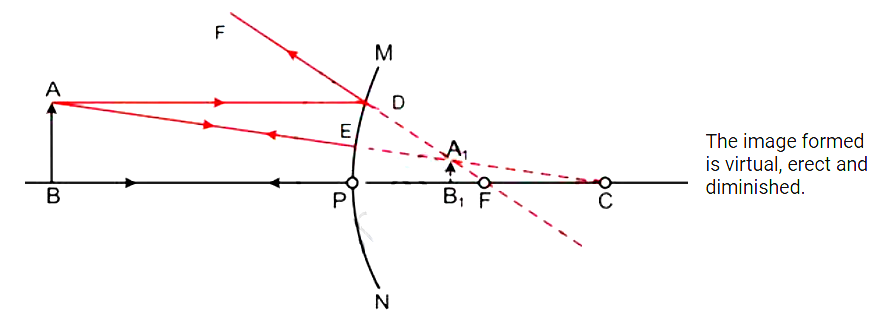
Question 83 Marks
Draw a ray diagram to show the formation of image of an object kept in front of a convex mirror. State three characteristics of the image.
Answer
Solution is as follows.
View full question & answer
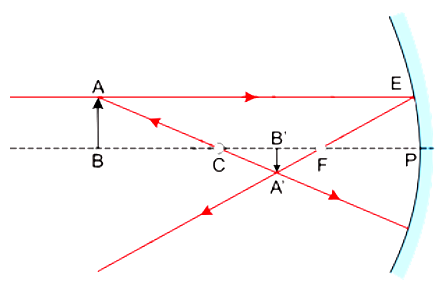
Question 93 Marks
Draw a ray diagram to show the formation of image by a concave mirror for the object beyond its centre of curvature. State three characteristics of the image.
Answer
Ray diagram showing the formation of an image by a concave mirror for the object beyond its centre of curvature:
When the object is placed beyond the centre of curvature C, the image is formed between focus F and centre of curvature C. The image so formed is real, inverted and diminished.
View full question & answer
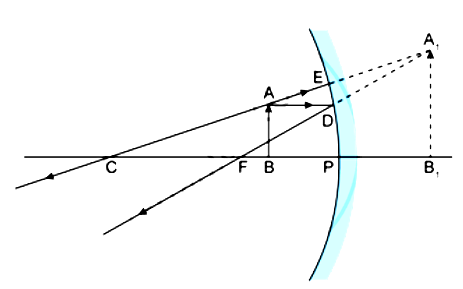
Question 103 Marks
Draw a ray diagram to show the formation of image by a concave mirror for an object placed between its pole and focus. State three characteristics of the image.
Answer
Ray diagram showing the formation of an image by a concave mirror for an object placed between its pole and focus:
When the object is placed between focus F and pole P, the image is formed behind the mirror.
The image so formed is virtual, upright and magnified.
View full question & answer
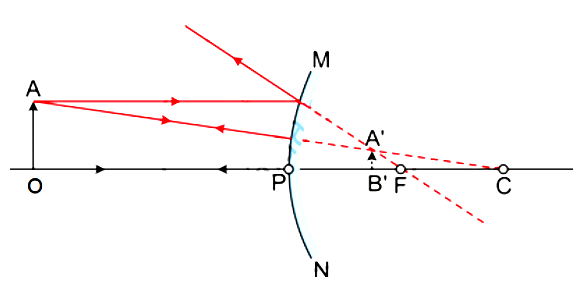
Question 113 Marks
The diagram below in Figure, shows a convex mirror. C is its centre of curvature and F is its focus. (i) Draw two rays from A and hence locate the position of image of object OA. Label the image IB. (ii) State three characteristics of the image.
Answer
The ray diagram shows two light rays from A. The image of the object OA is formed between the focus and the pole on the other side of the mirror.

The image so formed is erect, virtual and diminished.
View full question & answer
Question 123 Marks
The image formed by a convex mirror is of size one third the size of object. How are u and v related?
Answer
Magnification is
$m =\frac{ I }{ O }=\frac{\frac{1}{3} O }{ O }=\frac{1}{3}$
A convex mirror always forms a virtual and an upright image. So,
$ m =-\frac{ v }{ u }$
$\therefore-\frac{ v }{ u }=\frac{1}{3}$
$\therefore v =-\frac{1}{3} u $
But, $u$ is always negative
$ \therefore v =\frac{1}{3} u$
$\therefore u =3 v $
View full question & answer
Question 133 Marks
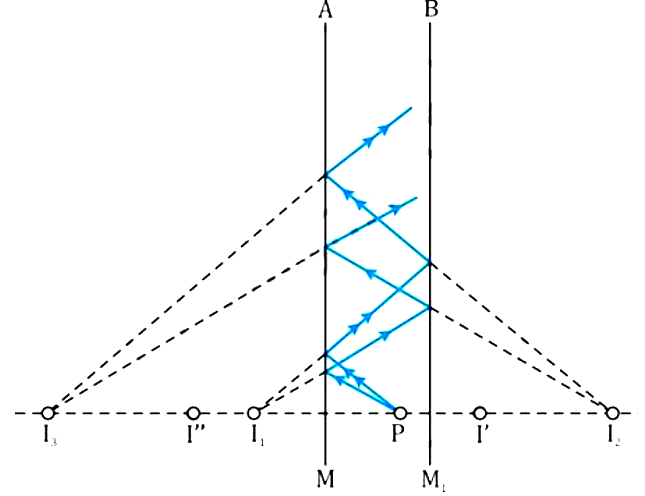
Two plane mirrors are arranged parallel and facing each other at some separation. How many images are formed for a point object kept in between them? Show the formation of images with the help of a ray diagram
Answer
For two mirrors kept parallel to each other, an infinite number of images are formed for an object kept in between them.
View full question & answer
Question 143 Marks
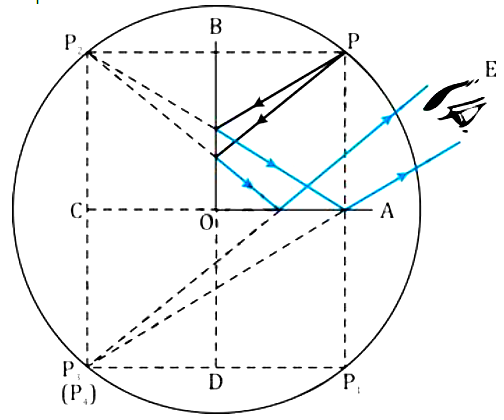
How many images are formed for a point object kept in between two plane mirrors at right angles to each other? Show them by drawing a ray diagram.
Answer
For two mirrors kept perpendicular to each other, three images are formed for an object kept in between them.
View full question & answer
Question 153 Marks
Two plane mirrors are placed making an angle$ \theta $ in between them. Write an expression for the number of images formed of an object placed in between the mirrors. State the condition, if any.
Answer
If two mirrors make an angle with each other and object is placed in between the two mirrors, the number of images formed is $n$ or $(n-1)$ depending upon $n=360^{\circ} /{ }^{\circ}$ is odd or even.
(a) If $n =360^{\circ} /{ }^{\circ}$ is odd,
(i) The number of images formed is n , when the object is placed asymmetrically between the mirrors.
(ii) The number of images formed is $n -1$, when the object is placed symmetrically between the mirrors.
(b) If $n =360^{\circ} /^{\circ}$ is even, the number of images is always $n -1$.
View full question & answer
Question 163 Marks
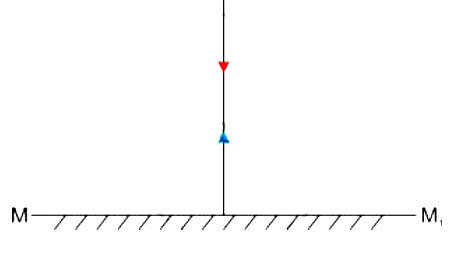
A light ray is incident normally on a plane mirror. What is the direction of reflected ray? Show it on a diagram.
Answer
Same as the incident ray
View full question & answer
Question 173 Marks
Explain the following term:
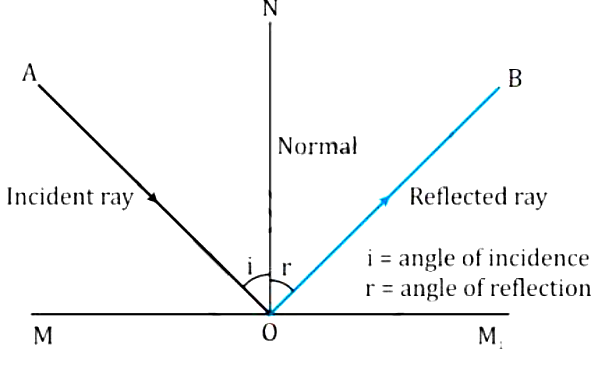
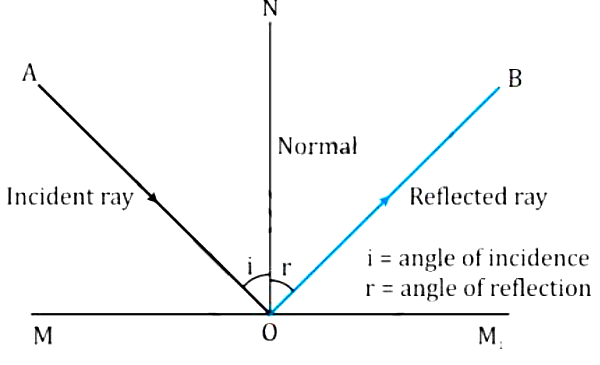
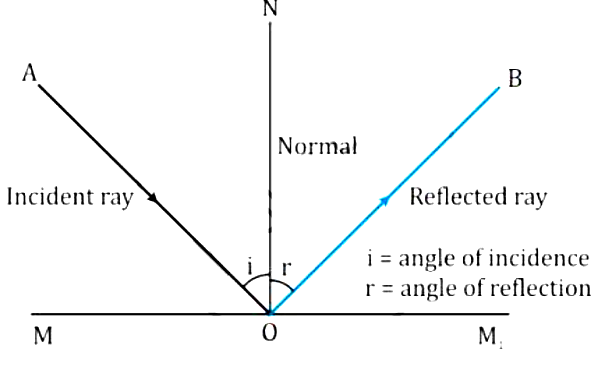
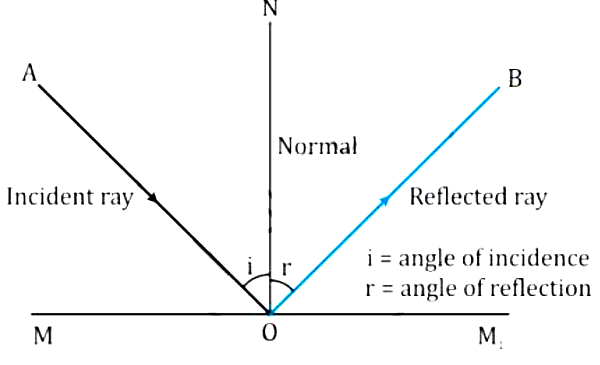
Angle of reflection.
Draw diagram/diagrams to show them.
Answer
Angle of reflection: The angle which the reflected ray makes with the normal at the point of incidence is called the angle of reflection. It is denoted by the letter r.
View full question & answer
Question 183 Marks
Explain the following term:
Angle of incidence
Draw diagram/diagrams to show them.
Answer
Angle of incidence: The angle which the incident ray makes with the normal at the point of incidence is called the angle of incidence. It is denoted by the letter "i".
View full question & answer
Question 193 Marks
Explain the following term:
Reflected ray
Draw diagram/diagrams to show them.
Answer
Reflected ray: The light ray obtained after reflection from the surface, in the same medium in which the incident ray is travelling, is called the reflected ray.
View full question & answer
Question 203 Marks
Explain the following term:
Incident ray
Draw diagram/diagrams to show them.
Answer
Incident ray: The light ray striking a reflecting surface is called the incident ray.
View full question & answer
Question 213 Marks
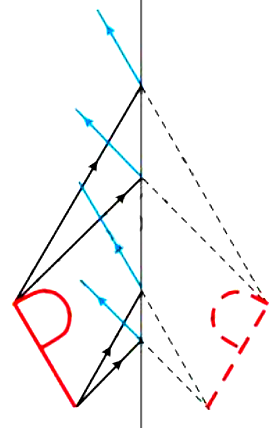
What is meant by lateral inversion of an image in a plane mirror? Explain it with the help of a ray diagram.
Answer
The interchange of the left and right sides in the image of an object in a plane mirror is called lateral inversion.
Figure above shows the image formation of a letter P in a plane mirror. The letter P appears in the plane mirror as .
View full question & answer
Question 223 Marks
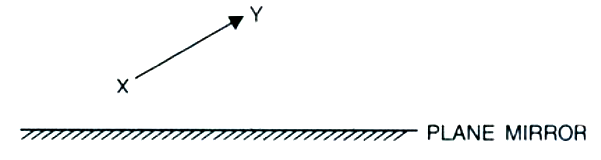
The diagram below in figure shows an object $XY$ in front of a plane mirror $MM_1 $. Draw on the diagram, path of two rays from each point $X$ and $Y$ of the object to show the formation of its image .
View full question & answer
Question 233 Marks
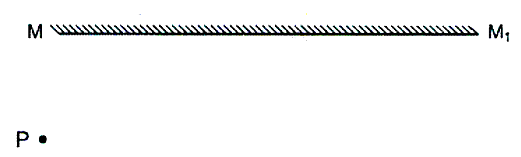
The diagram in Figure shows a point object P in front of a plane mirror$ MM_1.$

(a) Complete the diagram by taking two rays from the point P to show the formation of its image.

(b) In the diagram, mark the position of eye to see the image.

(c) Is the image formed real or virtual? Explain why?
Answer
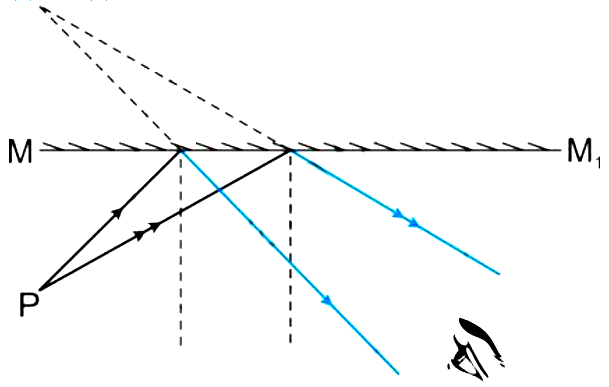
(a) and (b)

(c) The image formed is virtual because the reflected rays meet when produced backwards.
View full question & answer
Question 243 Marks
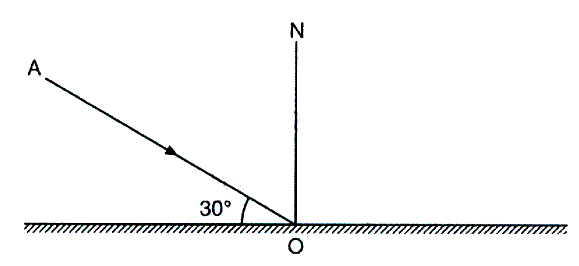
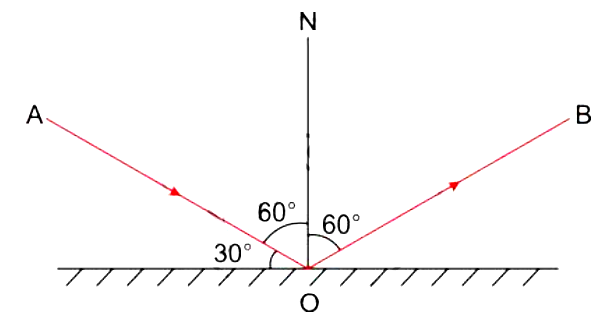
Figure shows an incident ray $AO$ and the normal $ON$ on a plane mirror. The angle which the incident ray $AO$ makes with mirror is $30^\circ$ . (a) Find the angle of incidence. (b) Draw the reflected ray and then find the angle between the incident and reflected rays.
Answer
(a) Angle of incidence $= 90^o- 30^o = 60^o$
(b) Angle between the incident ray and reflected ray = Angle of incidence + Angle of reflection
Angle of reflection = Angle of incidence $= 60^o$
Therefore, Angle between the incident ray and reflected ray $= 60^o + 60^o = 120^o$​​​​​​​
View full question & answer
[3 Mark Question Answer] - PHYSICS STD 9 Questions - Vidyadip