Questions

[3 Mark Question Answer]

🎯

Test yourself on this topic

15 questions · timed · auto-graded

Question 13 Marks
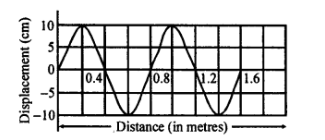
The diagram given below shows a displacement distance graph of a wave. If the velocity of wave is $160 ms-1$, calculate
1. wavelength
2. frequency
3. amplitude.
Image
Answer
(i) Wavelength $(\lambda)=$ Distance between two consecutive crests
$
=1.0-0.2=0.8 m
$
(ii) Frequency $(f)=\frac{v}{\lambda}$
$
\text { Wavelength }(v)=160 ms^{-1}
$ (given)
$
\therefore \quad f=\frac{160}{0.8}=200 Hz
$
(iii) Amplitude $=$ Maximum displacement from mean position $=10 cm$
View full question & answer
Question 23 Marks
The distance between three consecutive crests of wave is 60 cm . If the waves are produced at the rate of $180 / min$, calculate
1. wavelength
2. time period
3. wave velocity.
Answer
(i) We know distance between two consecutive crests $=\lambda$
$\Rightarrow$ Distance between three consecutive crests $=2 \lambda=60 cm$
$
\Rightarrow \lambda=\frac{60}{2}=30 cm
$
(ii) Frequency $=180 min^{-1}$
$
\begin{aligned}
& f=\frac{180}{60} S^{-1} \\
& f=3 s^{-1} \text { or } 3 Hz \\
\therefore \quad & \text { Time period }=T=\frac{1}{f}=\frac{1}{3}=0.33 s
\end{aligned}
$
(iii) Wave velocity $=v=$ ?
$
\begin{array}{c}
v=\lambda f \\
\nu=30 \times 30 \\
v=90 cms^{-1}
\end{array}
$
View full question & answer
Question 33 Marks
The distance between one crest and one trough of a sea wave is 4.5 m . If the waves are produced at the rate of $240 / min$, calculate
1. time period
2. wave velocity.
View full question & answer
Question 43 Marks
Two tuning forks A and B of frequencies 256 Hz and 192 Hz respectively are vibrated in air. If the wavelength of A is 1.25 m, calculate the wavelength produced by B.
Answer
Frequency of tuning fork $A =f_{ A }=256 Hz$
Frequency of tuning fork $B =f_{ B }=192 Hz$
Wavelength produced in $A =\lambda_{ A }=1.25 m$
Wavelength produced in $B =\lambda_{ B }=$ ?
Case - I
$
\begin{array}{l}
v=\lambda_A f_{\Lambda} \\
v=1.25 \times 256 \\
v=320 ms^{-1}
\end{array}
$
Case - II
$
\begin{array}{l}
v=\lambda_{B} f_{B} \\
\lambda_{B}=\frac{v}{f_{B}} \\
\lambda_{B}=\frac{320}{192}=1.67 m
\end{array}
$
View full question & answer
Question 53 Marks
A sound wave of wavelength $1 / 3 m$ has a frequency 996 Hz . Keeping the medium same, if frequency changes to 1328 Hz . Calculate
1. velcoity of sound
2. new wavelength.
Answer
Wevelength $=\lambda=\frac{1}{3} m$
Frequency $=f=996 Hz$
(i) Velocity of sound $=v=$ ?
$
\begin{array}{l}
v=\lambda f \\
v=\frac{1}{3} \times 996=332 ms^{-1}
\end{array}
$
(ii) New frequency $=f=1328 Hz$
$
v=332 ms^{-1}
$
New wavelength $=\lambda^{\prime}=$ ?
$
v=\lambda^{\prime} f
$
$
332=\lambda^{\prime} \times 1328
$
$
\lambda^{\prime}=\frac{332}{1328}=\frac{1}{4} m
$
$
\lambda^{\prime}=0.25 m
$
View full question & answer
Question 63 Marks
A thin metal plate is placed against the teeth of cog wheel. Cog wheel is rotated at a speed of 120 rotations per minute and has 160 teeth. Calculate :
1.frequency of node produced.
2.speed of sound, if wavelength is 1.05 m.
3.what will be the effect when speed ofcog wheel is doubled?
Answer
Frequency for rotation of wheel $=120$ rotations per minute
$f=\frac{120}{60}$ rotation per second
$f=2$ rotations per second.
Number of teeth on the wheel $= n =160$
(i) Frequency of nod $=n f$
$
\begin{array}{l}
f=160 \times 2 \\
f=320 Hz
\end{array}
$
(ii) Wavelength $=\lambda=1.05 m$
Speed of sound $=v=$ ?
$
\begin{array}{l}
v=\lambda f \\
v=1.05 \times 320 \\
v=336 ms^{-1}
\end{array}
$
(iii) When speed of cog wheel is doubled, then frequency of nod increases and hence sound becomes shrill.
View full question & answer
Question 73 Marks
A continuous progressive transverse wave of frequency 8 Hz moves across the surface of a ripple tank
(a)With reference to the frequency, describe the movement of water on the surface
(b)If the wavelength of transverse wave is 32 mm, calculate the speed with which wave travels across the surface of water.
Answer
(a) Frequency $=f=8 Hz$
$\Rightarrow 8$ continuous progressive transverse waves move over the surface of water in one second.
(b) Wavelength $=\lambda=32 mm=32 \times 10^{-3} m$
Speed $=v=$ ?
We know, $v=\lambda f$
$
\begin{aligned}
v & =32 \times 10^{-3} \times 8 \\
v & =256 \times 10^{-3} ms^{-1} \\
v & =256 \times 10^{-3} \times 10^{\cdot 2} cms^{-1} \\
v & =256 \times 10^{-1} cms^{-1} \\
v & =25.6 cms^{-1}
\end{aligned}
$
View full question & answer
Question 83 Marks
The wavelength of the vibrations produced on the surface of water is 2 cm . If the wave velocity is $16 ms^{-1}$, calculate
1. no. of waves produced in one second
2. time required to produce one wave.
View full question & answer
Question 93 Marks
An ultraviolet radiation has a wavelength of 300Å. If the velocity of electromagnetic wave is $3 \times 10^{ 8 } ms ^{-1}$. Calculate
1. frequency
2. time period.
Answer
Wavelength $=\lambda=300Å=300 \times 10^{-10} m$
Velocity $=v=3 \times 10^8 ms^{-1}$
Frequency $=f=$ ?
Time period $= T =$ ?
(i) We know $v=\lambda f$
$
\begin{array}{l}
f=\frac{v}{\lambda}=\frac{3 \times 10^8}{300 \times 10^{-10}} \\
f=\frac{3 \times 10^8}{3 \times 10^{-8}}=10^{16} Hz
\end{array}
$
(ii) Time period $= T =\frac{1}{f}$
$
\begin{array}{l}
T=\frac{1}{10^{16}} \\
T=10^{-16} s
\end{array}
$
View full question & answer
Question 103 Marks
What is approximate value of speed of sound in iron as compared to that in air? Illustrate your answer with a simple experiment.
Answer
Speed of sound in iron is approximately sixteen times the speed of sound in air.
[Speed of sound in iron $=5100 ms^{-1}$; Speed of sound in air $=332 ms^{-1}$ ]
Experiment: If we put our ears to rails, we can hear the sound of the train through metal. But at the same time, when we stand near by the railway track, we are not able to hear the sound.
This occurs because when we put our ears to rails, the sound travels through iron. But in standing position, sound travels through air and due to smaller speed of sound in air as compared to iron, we are not able to hear the sound.
View full question & answer
Question 113 Marks
The sound of an explosion on the surface of lake is heard by a boatman 100 m away and a diver 100 m below the point of explosion.
1.Of the two persons mentioned (boatman and diver), who would hear the sound first?
2.Give reason for your answer in (i).
3.If the sound takes ‘t’ seconds to reach the boatman, approximately how mcuh time it will take to reach the diver?
Answer
1. Diver would hear the sound first.
2. Because velocity of sound in water $\left(1450 ms^{-1}\right)$ is more than the velocity of sound in air (332 $ms ^{-1}$ ).
3. Time taken by sound to reach the diver would be less than $t$, where $t$ is the time taken by sound to reach the boatman.
Note: Time taken by sound to reach the diver would be 4.36 times less than the time taken by sound to reach the boatman.
View full question & answer
Question 123 Marks
State the relation between the wavelength and the frequency
Answer
Consider a wave is propagating through a medium,
Let,$f=$ Frequency of wave
$\lambda=$ Wavelength of wave
$T =$ Time period of the wave.
In the time ' $T$ ', distance covered by wave $=\lambda$
In the time 1 second, distance covered by wave $=\lambda / T$
But distance covered by wave in one second $= v =$ Velocity of the wave
$
\Rightarrow v=\frac{\lambda}{T}
$
But we know frequency $(f)=\frac{1}{\text { Time period (T) }}$
$
\begin{array}{l}
\Rightarrow v=\lambda\left(\frac{1}{T}\right)=\lambda f \\
\therefore v=\lambda f
\end{array}
$
Which is the required relation between wavelength and frequency.
View full question & answer
Question 133 Marks
State four practical uses of ultrasonic vibrations.
Answer
Uses of ultrasonic vibrations:
1. These are used for dissipating fogs on the runways at the airports.
2. These are used in the ultrasound scanning of internal organs of human body.
3. These are used for making dish washing machines. In these machines, water and detergents are vibrated with ultrasonics vibrator. The vibrating particles of the dissolved detergent rub against the plates and clean them.
4. These are used in SONAR (Sound navigation and ranging) to detect and find the distance of objects under water.
View full question & answer
Question 143 Marks
Describe briefly an experiment to provethat vibrating bodies produce sound.
View full question & answer
Question 153 Marks
(a) What do you understand by the term sound energy?
(b) State three conditions necessary for hearing sound.
View full question & answer
[3 Mark Question Answer] - PHYSICS STD 9 Questions - Vidyadip