Question 13 Marks
If the $9^{\text {th }}$ term of an AP is zero, prove that its $29^{\text {th }}$ term is twice its $19^{\text {th }}$ term.
AnswerLet the first term, common difference and number of term of an $A P$ are $a, d$ and $n$, resoectively. Given that, $9^{\text {th }}$ term of an $A P, T 9=$ 0
$\left[\because n^{\text {th }}\right.$ term of an $\left.A P, T_n=a+(n-1) d\right]$
$\Rightarrow a + (9 - 1)d = 0$
$\Rightarrow a + 8d = 0$
$\Rightarrow a = -8d ......(i)$
Now, its $19^{\text {th }}$ term, $T_{19}=a+(19-1) d$
$\Rightarrow T_{19} = -8d + 18d$ [from Eq. (i)]
$\Rightarrow T_{19} = 10d .....(ii)$
and its $29^{\text {th }}$ term, $T_{29}=a+(29-1) d$
$\Rightarrow T_{29} = -8d + 28d$ [from Eq. (i)]
$\Rightarrow T_{29} = 20d = 2 \times (10d)$
$\Rightarrow T_{29} = 2 \times T_{19}$
Hence, its $29^{\text {th }}$ term is twice its $19^{\text {th }}$ term.
View full question & answer→Question 23 Marks
How many terms of the $AP -15, -13, -11, .......$. are needed to make the sum $-55$? Explain the reason for double answer.
AnswerLet n number of terms are needed to make the sum -55.
Here, first term $(a) = -15$, common difference $(d) = -13 + 15 = 2$
Sum of n terms of an AP,
$\because\text{S}_{7}=\frac{\text{n}}{2}[2\text{a}+\big(\text{n}-1\big)\text{d}]$
$-55=\frac{\text{n}}{2}[2\big(-15\big)+\big(\text{n}-1\big)2]$ [sn = -15 (given)]
$\Rightarrow n^2 - 16n + 55 = 0$
$\Rightarrow n^2 - 11n - 5n + 55 = 0$ [by factorisation method]
$\Rightarrow n(n - 11) - 5(n - 11) = 0$
$\Rightarrow (n - 11)(n - 5) = 0$
$\therefore$ $n = 5, 11$
Hence, either $5$ and $11$ terms are needed to make the sum -55.
View full question & answer→Question 33 Marks
For the A.P: $-3,-7,-11$, ........ can we find directly $a_{30}-a_{20}$ without actually finding $a_{30}$ and $a_{20}$ ? Give reasons for your answer.
AnswerHere, $a = -3$
$d_1 = -7 (-3) = -7 + 3 = -4$
$d_2 = -11 - (-7) = -11 + 7 = -4$
$d = d_1 = d_2 = -4$
$\therefore$ $a_{30} = a + (30 - 1)d = a + 29d$
and $a_{20} = a + (20 - 1)d = a + 19d$
$So, a_{30} - a_{20}= (a + 29d) - (a + 19d)$
$a_{30} - a_{20} = a + 29d - a - 19d$
$a_{30}- a_{20} = 10d$
$a_{30} - a_{20} = 10 \times (-4)$
$a_{30} - a_{20} = -40$
So, we can find $a_{30}-a_{20}$ without finding $a_{30}$ and $a_{20}$.
Hence, $a_{30}-a_{20}=-40$
View full question & answer→Question 43 Marks
Write the first three terms of the APs when a and d are as given below: $a = -5, d = -3$
AnswerGiven that, first term $(a) = -5$ and common difference$ (d) = -3$
$\because$ $n^{th}$ term of an AP, $T_n = a + (n - 1)d$
$\therefore$ second term of an AP, $T_2 = a + d = -5 - 3 = -8$
and third term of an AP, $T_3 = a + 2d = -5 + 2(-3)$
$T_3= -5 - 6 = -11$
Hence, requied three term are $-5, -8, -11.$
View full question & answer→Question 53 Marks
In which of the following situations, do the lists of numbers involved form an AP Give reasons for your answers:
The fee charged every month by a school from Classes I to XII, when the monthly fee for Class I is Rs. 250, and it increases by Rs. 50 for the next higher class.
AnswerFee for $I^{st}$ class $= Rs. 250$
Fee for $II^{nd}$ class $= Rs. (250 + 50) = Rs. 300$
Fee for $III^{rd}$ class $= Rs. (300 + 50) = Rs. 350$
Fee for $IV^{rd}$ class $= Rs. (350 + 50) = Rs. 400$
$\therefore$ $250, 300, 350, 400, ....$. is a series consisting of $12$ terms.
So, $d_1 = 300 - 250 = Rs. 50, d_2 = 350 - 300 = Rs. = 50$
$d_3 = 400 - 350 = Rs. 50$
$\therefore$ $d_1 = d_2 = d_3 = Rs. 50$
So, the list numbers $250, 300, 350, 400, ........$ is in A.P.
View full question & answer→Question 63 Marks
Justify whether it is true to say that the following are the nth terms of an AP: $2n - 3$
Answer$a_n = 2n - 3$
$\therefore$ $a_1 = 2(1) - 3 = 2 - 3 = -1$
$a_2 = 2(2) - 3 = 4 - 3 = 1$
$a_3 = 2(3) - 3 = 6 - 3 = 3$
$a_4= 2(4) - 3 = 8 - 3 = 5$
So, $d_1= 1 - (-1) = 1 + 1 = 2$
$d_2 = 3 - 1 = 2$
$d_3= 5 - 3 = 2$
As $d_1 = d_2 = d_3= 2$
Hence, $a_n = 2n - 3$ from $n^{th}$ term of an $A.P.$
View full question & answer→Question 73 Marks
If sum of first $6$ terms of an AP is $36$ and of the first $16$ terms is $256$, find the sum of first $10$ terms.
AnswerLet a and d be the first terms and common difference, respectively of an AP
$\because$ Sum of n terms of an AP,
$\text{S}_{\text{n}}=\frac{\text{n}}{2}\big[2\text{a}+\big(\text{n}-1\big)\text{d}\big].....\big( \text{i}\big)$
Now, $S_6 = 36$ [given]
$\Rightarrow\frac{6}{2}\big[2\text{a}+\big(6-1\big)\text{d}\big] =36 $
$2a + 5d = 12 ......(ii)$
and $S_{16} = 256$
$\Rightarrow\frac{16}{2}\big[2\text{a}+\big(6-1\big)\text{d}\big]=256$
$\Rightarrow 2a + 15d = 32 ........(iii)$
On subtracting Eq. (ii) from Eq. (iii), we get
$\Rightarrow 10d = 20$
$\Rightarrow d = 2$
$\Rightarrow 2a + 5(2) = 12$ [from Eq. (ii))]
$\Rightarrow 2a = 12 - 10$
$\Rightarrow a = 1$
$\therefore\text{S}_{10}= \frac{10}{2}\big[2\text{a}+\big(10-1\big)\text{d}\big]$
$\Rightarrow S_{10} = 5[2(1) + 9(2)]$
$\Rightarrow S_{10}= 5(2 + 18)$
$\Rightarrow S_{10} = 5 \times 20$
$\Rightarrow S_{10}= 100$
Hence, the required sum of first 10 terms is 100.
View full question & answer→Question 83 Marks
In which of the following situations, do the lists of numbers involved form an AP Give reasons for your answers:
The fee charged from a student every month by a school for the whole session, when the monthly fee is Rs. 400.
AnswerThe fee charged from a student every month by a school is Rs. $400.$ So, the fee charged from a student the whole session is $400, 400, 400, 400, ..... As d_1 = d_2 = d_3 = -d_{12} = 0$ So, the series of numbers is an A.P.
View full question & answer→Question 93 Marks
Find whether 55 is a term of the AP $7, 10, 13,---$ or not. If yes, find which term it is.
AnswerYes, let the first term, common difference and the number the number of term of an $A P$ are $a, d$ and $n$ respectively. Let the $n ^{\text {th }}$ term of an AP be 55. i.e., $T_n=55$
Let the $n^{\text {th }}$ term of an AP be 55. i.e., $T_n=55$
We know that, the $n ^{\text {th }}$ term of an $A P, T_n=a+(n-1) d$ (i)
Given that, first term $(a)=7$ and common difference $( d )=10-7=3$
From Eq. $(i) 55 = 7 + (n - 1) \times 3$
$\Rightarrow 55 = 7 + 3n - 3$
$\Rightarrow 55 = 4 + 3n$
$\Rightarrow 3n = 51$
$\therefore$ $n = 17$
Since, n is a positive integer. So, 55 is a term of the AP.
Now, put the values of a, d and n in Eq. (i),
$\Rightarrow T_n = 7 + (17 - 1)(3)$
$\Rightarrow T_n = 7 + 16 \times 3$
$\Rightarrow T_n = 7 + 48$
$\Rightarrow T_n= 55$
Hence, $17^{th}$ term of an AP is $55$.
View full question & answer→Question 103 Marks
Verify that each of the following is an AP, and then write its next three terms: $0,\frac{1}{4},\frac{1}{2},\frac{3}{4},.....$
Answer$\text{Here},\text{a}_{1}=0,\text{a}_{2}=\frac{1}{4},\text{a}_{3}=\frac{1}{2}\text{ and}\text{ a}_{4}=\frac{3}{4}$
$\text{a}_{2}-\text{a}_{1}=\frac{1}{4},\text{a}_{3}-\text{a}_{2}=\frac{1}{2}-\frac{1}{4}=\frac{1}{4}$
$\text{a}_{4}-\text{a}_{3}=\frac{3}{4}-\frac{1}{2}=\frac{1}{4}$
$\therefore\text{a}_{2}-\text{a}_{1}=\text{a}_{3}-\text{a}_{2}=\text{a}_{4}-\text{a}_{3}$
Since, the each successive term of the given list has the same difference. So, if froms an A.P. The next three terms are-
$\text{a}_{5}=\text{a}_{1}+4\text{d}$
$\text{a}_{5}=\text{a}+4\big(\frac{1}{4}\big)=1$
$\text{a}_{6}=\text{a}_{1}+5\text{d}$
$\text{a}_{6}=\text{a}+5\big(\frac{1}{4}\big)=\frac{5}{4}$
$\text{a}_{7}=\text{a}+6\text{d}$
$\text{a}_{7}=0+\frac{6}{4}=\frac{3}{2}$
View full question & answer→Question 113 Marks
The sum of the first n terms of an AP whose first term is 8 and the common difference is $20$ is equal to the sum of first $2n$ term of another AP whose first term is $-30$ and the common difference is $8$. Find n.
AnswerGiven that, first term of the first $A P(a)=8$
And common difference of the first AP (d) $=20$
Let the number of terms in first AP be $n$.
Sum of first $n$ terms an AP,
$\text{S}_{\text{n}}=\frac{\text{n}}{2}\big[2\text{a}+\big(\text{n}-1\big)\text{d}\big]$
$\Rightarrow\text{S}_{\text{n}}=\frac{\text{n}}{2}\big[2\times8+\big(\text{n}-1\big)20\big]$
$\Rightarrow\text{S}_{\text{n}}=\frac{\text{n}}{2}\big(16+20\text{n}-20\big)$
$\Rightarrow\text{S}_{\text{n}}=\frac{\text{n}}{2}\big(20\text{n}-4\big)$
$\therefore\text{S}_{\text{n}}=\text{n}\big(10\text{n}-2\big)......(\text{i})$
Now, first term of the second $A P\left(a^{\prime}\right)=-30$
and common difference of the second AP $\left( d ^{\prime}\right)=8$
$\therefore$ sum of first $2 n$ terms of second AP,
$\text{S}_{2\text{n}}=\frac{2\text{n}}{2}\big[2\text{a}'+\big(2\text{n}-1\big)\text{d}'\big]$
$\Rightarrow\text{S}_{2\text{n}}=\text{n}\big[2\big(-30\big)+\big(2\text{n}-1\big)\big(8\big)\big]$
$\Rightarrow\text{S}_{2\text{n}}=\text{n}\big[-60+16\text{n}-8\big]$
$\Rightarrow\text{S}_{2\text{n}}=\text{n}\big[16\text{n}-68\big].......(\text{ii})$
Now, by given condition,
Sum of first n terms of the first AP = Sum of first 2n terms of the second AP
$\Rightarrow S_n = S_{2n} [from Eq. (i) and (ii)]$
$\Rightarrow n(10n - 2) = n(16n -68)$
$\Rightarrow n[(16n - 68) - (10n - 2)] = 0$
$\Rightarrow n(16n - 68 -10n + 2) = 0$
$\Rightarrow n(6n - 66) = 0$
$\Rightarrow n = 11$ $\big[\because\text{n}\neq0\big]$
Hence, the required value of n is 11.
View full question & answer→Question 123 Marks
Is $0$ a term of the A.P:$ 31, 28, 25, 25, ........? $Justify your answer.
AnswerMain concept used: $a_n = a + (n - 1)d$
If we substitute the values of $a_n, a$, and $d$ in the above equation and if $n n$ comes out to be a natural number then, the given an will be thge term of the given series.
Here, $a_n = 0, a = 31$
$d_1 = 28 - 31, d_2 = 25 - 28 = -3$
$So, d_1 = d_2 = -3$
$\because$ $a_n = a + (n - 1)d$
$0 = 31 + (n - 1) \times (-3)$
$-31 = -(n - 1) \times (-3)$
$\Rightarrow\big(\text{n}-1\big)=\frac{31}{3}$
$\Rightarrow\text{n}=\frac{31}{3}+1$
$\Rightarrow\text{n}=\frac{31+3}{3}$
$\Rightarrow\frac{34}{3}=11\frac{1}{3}$
$\Rightarrow11\frac{1}{3}\neq$ natural number.
Since n is in fraction and is not natural number so $0 (a_n)$ is not any term of the given A.P.
View full question & answer→Question 133 Marks
Find the sum of the two middle most terms of the AP: $-\frac{4}{3},-1,-\frac{2}{3},......,4\frac{1}{3}.$
AnswerHere, first term $\big(\text{a}\big)=-\frac{4}{3},$
Common difference $\big(\text{d}\big)=-1+\frac{4}{3}=\frac{1}{3}$
$\because$ $n^{th}$ term last of an AP, $l = a_n = a + (n - 1)d$
$\frac{13}{3}=-\frac{4}{3}+\big(\text{n}-1\big)\frac{1}{3}$
$\Rightarrow 13 = -4 + (n - 1)$
$\Rightarrow n - 1 = 17$
$\Rightarrow n = 18$
So, the two middle most term are $\big(\frac{\text{n}}{2}\big)^\text{th}$ and $\big(\frac{\text{n}}{2}+1\big)^\text{th}$ i.e.,$\big(\frac{18}{2}\big)^\text{th}$ and $\big(\frac{18}{2}+1\big)^\text{th}$ terms i.e., $9^{th}$ and 10th terms.
$\therefore$ $a_9= a + 8d$
$\Rightarrow\text{a}_{9}=-\frac{4}{3}+8\big(\frac{1}{3}\big)$
$\Rightarrow\text{a}_{9}=\frac{8-4}{3}$
$\Rightarrow\text{a}_{9}=\frac{4}{3}$
and a + 9d
$\Rightarrow\text{a}_{10}=-\frac{4}{3}+9\big(\frac{1}{3}\big)$
$\Rightarrow\text{a}_{10}=\frac{9-4}{3}$
$\Rightarrow\text{a}_{10}=\frac{5}{3}$
So, sum of the two middle most terms-
$= a_9 + a_{10}$
$\Rightarrow\frac{4}{3}+\frac{5}{3}=\frac{9}{3}=3$
View full question & answer→Question 143 Marks
Find the sum of first seven numbers which are multiples of 2 as well as of 9.
[Hint: Take the LCM of 2 and 9]
AnswerFor finding, the sum of first seven numbers which are multiples of 2 as well as of 9. Take LCM of 2 and 9 which is 18.
So, the series becomes 18, 36, 54, .......
Here, first term (a) = 18, common difference (of) = 36 - 18 = 18
$\therefore\text{S}_{7}=\frac{\text{n}}{2}[2\text{a}+\big(\text{n}-1\big)\text{d}]$
$\text{S}_{7}=\frac{\text{7}}{2}[2\big(18)+\big(7-1\big)18]$
$\text{S}_{7}=\frac{\text{7}}{2}\big[36+6\times18\big]$
$\text{S}_{7}=7\big(18+3\times18\big)$
$\text{S}_{7}=7\big(18+54\big)$
$\text{S}_{7}=7\times72$
$\text{S}_{7}=504$
View full question & answer→Question 153 Marks
In which of the following situations, do the lists of numbers involved form an AP Give reasons for your answers:
The number of bacteria in a certain food item after each second, when they double in every second.
AnswerLet the number of bacteria present initially $= x$
Then, the number of bacteria present after $1 sec =2(x)=2 x$
Number of bacteria present after $2 sec =2(2 x )=4 x$
Number of bacteria present after $3 sec =2(4 x )=8 x$
Number of bacteria present after $4 sec =2(8 x )=16 x$
So, the number of bacteria from starting to end of each second are given by-
$x, 2 x, 4 x, 8 x, 16 x, \ldots \ldots$
Now, $d _1=2 x - x = x$,
$d_2=4 x-2 x=2 x$
As $d _1 \neq d _2$, so the list of numbers does not from an A.P.
View full question & answer→Question 163 Marks
Find a, b and C such that the following numbers are in AP:
a, 7, b, 23, C.
AnswerSince a, 7, b, 23 and C are in AR
|
$\therefore$
|
$7-\text{a}$
|
$=$ |
$\text{b}-7$
|
$=$ |
$23-\text{b}$
|
$=$ |
$\text{c}-23$
|
$=$ |
$\text{Common difference}$
|
|
|
I
|
|
II
|
|
III
|
|
IV
|
|
|
Taking second and third terms, we get-
b - 7 = 23 - b
⇒ 2b =30
$\therefore$ b = 15
Taking first and second terms, we get-
7 - a = b - 7
⇒ 7 - a = 15 - 7 [$\because$ b = 15]
⇒ 7 - a = 8
⇒ a = -1
Taking third and fourth terms, we get-
23 - b = c - 23
⇒ 23 - 15 = c - 23 [$\therefore$ b= 15]
⇒ 8 = c - 23
⇒ 8 + 23 = c
⇒ c = 31
Hence, a = -1, b = 15, c = 31 View full question & answer→Question 173 Marks
Match the APs given in column A with suitable common differences given in column B.
|
Column A
|
Column B
|
|
$A_1$
|
$2, -2, -6, -10$
|
$B_1$ |
$\frac{2}{3}$
|
|
$A_2$
|
$a = -18, n = 10, a_n = 0$
|
$B_2$ |
-5
|
|
$A_3$
|
$a = 0, a_{10} = 6$
|
$B_3$ |
4
|
|
$A_4$
|
$a_2= 13, a_4 = 3$
|
$B_4$ |
-4
|
|
|
|
$B_5$
|
2
|
|
|
|
$B_6$ |
$\frac{1}{2}$
|
|
|
|
$B_7$
|
5
|
Answer
|
Column A
|
Column B
|
|
$A_1$
|
$2, -2, -6, -10$
|
$B_4$
|
$-4$
|
|
$A_2$
|
$a = -18, n = 10, a_n = 0$
|
$B_5$
|
$2$
|
|
$A_3$
|
$a = 0, a_{10} = 6$
|
$B_1$
|
$\frac{2}{3}$
|
|
$A_4$
|
$a_2= 13, a_4 = 3$
|
$B_2$
|
$-5$
|
$A_1, 2, -2, -6, -10, ......$
Here, Common difference, d = -2 - 2 = -4
$A_2$ $\because$ $a_1 = a + (n - 1)d$
$\Rightarrow 0 = -18 + (10 - 1)d$
$\Rightarrow 18 = 9d$
$\therefore$ Common difference, d = 2
$A_3$ $\because$ $a_{10} = 6$
$\Rightarrow a + (10 - 1)d = 6$
$\Rightarrow 0 + 9d = 6$ [$\because$ a = 0 (given)]
$\Rightarrow 9d = 6$
$\Rightarrow\text{d}=\frac{2}{3}$
$A_4$ $\because$ $a_2 = 13$
[$\because$ $a_n = a + (n - 1)d]$
$\Rightarrow a + (2 - 1)d = 13$
$\Rightarrow a + d = 13 ......(i)$
and $a_4= 3$
$\Rightarrow a + (4 - 1)d = 3$
$\Rightarrow a + 3d = 3 ........(ii)$
on subtracting Eq. (i) from Eq. (ii), we get-
$\Rightarrow 2d = -10$
$\Rightarrow d = -5$ View full question & answer→Question 183 Marks
In which of the following situations, do the lists of numbers involved form an AP Give reasons for your answers:
The amount of money in the account of Varun at the end of every year when Rs.$ 1000 $is deposited at simple interest of $10\%$ per annum.
Answer$\text{SI}=\frac{\text{PRT}}{100}=\frac{1000\times10\times1}{100}=\text{Rs. }100$
So, Rs. 100 is creaited at nthe end of each year in the account of varun.
Money in the beginning of $I^{st} $year (deposited) = Rs. 1000 Money at the end
of $I^{st}$ year when interest credited $= 1000 + 100 = Rs. 1100$
Money at the end of $\|^{\text {nd }}$ year when interest credited $=1100+100=$ Rs. 1200
Money at the end of $1 I^{\text {rd }}$ year when interest credited
$=1200+100=$ Rs. 1300 Money at the end of IVrd year
when interest credited $=1300+100=$ Rs. 1400
$\therefore$ Amount of money at the end
of each year starting initially From $1^{\text {st }}$ of year is
given by $1000,1100,1200,1300,1400 \ldots$.
$\therefore d_1=d_2=d_3=d_4=100$ So, the list of numbers in A.P.
View full question & answer→Question 193 Marks
Verify that each of the following is an AP, and then write its next three terms:
$a, 2a + 1, 3a + 2, 4a + 3, ......$
AnswerHere, $a_1 = a, a_2 = 2a + 1, a_3 = 3a + 2$ and $a_4 = 4a + 3$
$a_2- a_1= 2a + 1 - a = a + 1$
$a_3 - a_2 = 3a + 2 - 2a - 1 = a + 1$
$a_4 - a_3 = 4a + 3 - 3a - 2 = a + 1$
$a_2 - a_1 = a_3 - a_2 = a_4 - a_3 = a + 1 =$ Common difference
Since, the each successive term of the given list has the same difference.
So, if froms an A.P. The next three terms are-
$a_5 = a + 4d$
$a_5 = a + 4(a + 1) = 5a + 4$
$a_6 = a + 5d$
$a_6 = a + 5(a + 1) = 6a + 5$
$a_7 = a + 6d$
$a_7 = a + 6(a + 1) = 7a + 6$
View full question & answer→Question 203 Marks
write the first three terms of the APs when a and d are as given below: $\text{a}=\frac{1}{2},\text{d}=-\frac{1}{6}$
AnswerGiven that, first term $\big(\text{a}\big)=\frac{1}{2}$ and common difference $\big(\text{d}\big)=-\frac{1}{6}$
$\because$ $n^{th}$ term of abn AP, $T_n= a + (n - 1)d$
$\therefore$ Second term of an AP, $T_2 = a + d$
$\text{T}_{2}=\frac{1}{2}-\frac{1}{6}=\frac{2}{6}=\frac{1}{3}$
and third term of an AP, $T_3= a + 2d$
$\text{T}_{3}= \frac{1}{2}-\frac{2}{6}=\frac{1}{2}-\frac{1}{3}$
$\text{T}_{3}=\frac{3-2}{6}=\frac{1}{6}$
Hence, required three terms are-
$\frac{1}{2},\frac{1}{3},\frac{1}{6}.$
View full question & answer→Question 213 Marks
Write the first three terms of the APs when a and d are as given below: $\text{a}=\sqrt{2},\text{d}=\frac{1}{\sqrt{2}}.$
AnswerGiven that, first term $\big(\text{a}\big)=\sqrt{2}$ and common difference $\big(\text{d}\big)=\frac{1}{\sqrt{2}}$
$\because$ $n^{th}$ term of an AP, $T_n = a + (n - 1)d$
$\therefore$ second term of an AP, $T_2 = a + d$
$\text{T}_{2}=\sqrt{2}+\frac{1}{\sqrt{2}}=\frac{2+1}{\sqrt{2}}$
$\text{T}_{2}=\frac{3}{\sqrt{2}}$
and third term of an AP, $T_3 = a + 2d$
$\text{T}_{3}=\sqrt{2}+\frac{2}{\sqrt{2}}=\frac{2+2}{\sqrt{2}}$
$\text{T}_{3}=\frac{4}{\sqrt{2}}$
Hence, requied three term are $\sqrt{2},\frac{3}{\sqrt{2}},\frac{4}{\sqrt{2}}.$
View full question & answer→Question 223 Marks
Determine the $AP$ whose fifth term is $19 $and the difference of the eighth term from the thirteenth term is $20.$
AnswerLet the first term of an AP be a and common difference d.
Given, $a_5 = 19$ and $a_{13} - a_8= 20$ [given]
[$\because$ $a_n = a + (n - 1)d]$
$\Rightarrow a_5 = a + (5 - 1)d = 19 .......(i)$
and $[a + (13 - 1)d] - [a + (8 - 1)d] = 20$
and $a + 12d - a - 7d = 20$
$\Rightarrow 5d = 20$
$\therefore$ $d = 4$
On putting $d = 4$ in Eq. (i), we get
$a + 4(4) = 19$
$\Rightarrow a + 16 = 19$
$\Rightarrow a = 19 - 16$
$\Rightarrow a = 3$
so, required AP is a, $a + d, a + 2d, a + 3d, .....$
$i.e., 3, 3 + 4, 3 + 2(4), 3 + 3(4), ......$
$i.e., 3, 7, 11, 15, ......$
View full question & answer→Question 233 Marks
Find the sum:
$4-\frac{1}{\text{n}}+4-\frac{2}{\text{n}}+4-\frac{3}{\text{n}}+......\text{upto n terms}.$
AnswerHere, first term, $\text{a}=4-\frac{1}{\text{n}}$
Common difference, $\text{d}=\bigg(4-\frac{2}{\text{n}}\bigg)-\bigg(4-\frac{1}{\text{n}}\bigg)$
$\text{d}=-\frac{2}{\text{n}}+\frac{1}{\text{n}}=-\frac{-1}{\text{n}}$
$\because$ Sum of n terms of an AP,
$\Rightarrow\text{S}_\text{n}=\frac{\text{n}}{2}\big[2\text{a}+\big(\text{n}-1\big)\text{d}\big]$
$\Rightarrow\text{S}_\text{n}=\frac{\text{n}}{2}\bigg[2\bigg(4-\frac{1}{\text{n}}\bigg)+\big(\text{n}-1\big)\bigg(\frac{-1}{\text{n}}\bigg)\bigg]$
$\Rightarrow\text{S}_\text{n}=\frac{\text{n}}{2}\left\{8-\frac{2}{\text{n}}-1+\frac{1}{\text{n}}\right\}$
$\Rightarrow\text{S}_\text{n}=\frac{\text{n}}{2}\bigg(7-\frac{1}{\text{n}}\bigg)$
$\Rightarrow\text{S}_\text{n}=\frac{\text{n}}{2}\bigg(\frac{7\text{n}-1}{\text{n}}\bigg)$
$\Rightarrow\text{S}_\text{n}=\frac{7\text{n}-1}{\text{2}}$
View full question & answer→Question 243 Marks
Kanika was given her pocket money on Jan $1^{st},$ $2008$. She puts Rs. $1$ on Day $1,$ Rs. $2$ on Day $2$, Rs. $3$ on Day $3$, and continued doing so till the end of the month, from this money into her piggy bank. She also spent Rs. $204$ of her pocket money Rs. $2$ on Day $2$, Rs. $3$ on Day $3$, and continued doing so till the end of the month, from this money into her piggy bank. She also spent Rs. $204$ of her pocket money was her pocket money for the month?
AnswerLet her pocket money be Rs. x.
Now, she takes Rs. $1$ on day, $1$, Rs. $2$ on day, Rs. $3$ on day $3$ and so on till the and of the month, from this money.
i.e.,$ 1 + 2 + 3 + 4 + ........ + 31.$
Which from an AP in which terms are 31 and first term $(a) = 1$
Common difference $(d) = 2 - 1 = 1$
$\therefore$ Sum of list 31 terms = $S_{31}$
Sum of n terms,
$\text{S}_{\text{n}}=\frac{\text{n}}{2}\big[2\text{a}+\big(\text{n}-1\big)\text{d}\big]$
$\therefore\text{S}_{\text{31}}=\frac{\text{31}}{2}\big[2\times1+\big(31-1\big)\times1\big]$
$\text{S}_{\text{31}}=\frac{\text{31}}{2}\big(2+30\big)$
$\text{S}_{31}=\frac{31\times32}{2}$
$\text{S}_{31}=31\times16$
$\text{S}_{31}=496$
So, Kanika takes Rs. $496$ till the end of the month from this money.
Also, she spent Rs. $204$ of her pocket money and found that at the end of the month she still has Rs. $100$ with her.
Now, according to the condition,
$\Rightarrow (x - 496) - 204 = 100$
$\Rightarrow x - 700 = 100$
$\therefore$ $x = Rs. 800$
Hence, $Rs. 800$ was her poket money for the month.
View full question & answer→Question 253 Marks
The angles of a triangle are in AP. The greatest angle is twice the least. Find all the angles of the triangle.
AnswerGiven that, the angles of a triangle are in AR.
Let A, B and C are angles of a $\triangle\text{ABC}.$
$\therefore\text{B}=\frac{\text{A}+\text{C}}{2}$
⇒ 2B = A + C ......(i)
We know that, sum of all interior angles of a $\triangle\text{ABC}=180^\circ$
$\Rightarrow\text{A+B+C}=180^\circ$
$\Rightarrow\text{2B+B}=180^\circ[\text{From(i)}]$
$\Rightarrow\text{3B}=180^\circ$
$\Rightarrow\text{B}=60^\circ$
Let the greatest and least angles are A and C respectively.
A = 2C [by condition] .....(ii)
Now, put the value of C in Eq. (ii), we get
2 × 60 = 2C + C
⇒ 120 = 3C
$\Rightarrow\text{C}=40^\circ$
Put the value of C in Eq. (ii), we get
$\text{A}=2\times40^\circ$
$\Rightarrow\text{A}=80^\circ$
Hence, the required angles of triangle are $80^\circ,60^\circ,\text{and }40^\circ.$
View full question & answer→Question 263 Marks
Find the sum:
$\frac{\text{a}-\text{b}}{\text{a}+\text{b}}+\frac{3\text{a}-2\text{b}}{\text{a}+\text{b}}+\frac{5\text{a}-3\text{b}}{\text{a}+\text{b}}+......\text{to 11 terms.}$
AnswerHere, first term $\big(\text{A}\big)=\frac{\text{a}-\text{b}}{\text{a}+\text{b}}$
and common difference,
$\text{D}=\frac{3\text{a}-2\text{b}}{\text{a}+\text{b}}-\frac{\text{a}-\text{b}}{\text{a}+\text{b}}=\frac{\text{2a}-\text{b}}{\text{2a}+\text{b}}$
$\because$ Sum of n terms of an AP,
$\Rightarrow\text{S}_{\text{n}}=\frac{\text{n}}{2}\left\{2\frac{\big(\text{a}-\text{b}\big)}{\big(\text{a}+\text{b}\big)}+\big(\text{n}-1\big)\frac{2\text{a}-\text{b}}{\big(\text{a}+\text{b}\big)}\right\}$
$\text{S}_{\text{n}}=\frac{\text{n}}{2}\left\{\frac{2\text{a}-2\text{b}+2\text{an}-2\text{a}-\text{bn}+\text{b}}{\text{a}+\text{b}}\right\}$
$\text{S}_{\text{n}}=\frac{\text{n}}{2}\left\{\frac{2\text{an}-\text{bn}-\text{b}}{\text{a}+\text{b}}\right\}$
$\therefore$ $\text{S}_{\text{11}}=\frac{\text{11}}{2}\left\{\frac{2\text{a}\big(11\big)-\text{b}\big(11\big)-\text{b}}{\text{a}+\text{b}}\right\}$
$\text{S}_{\text{11}}=\frac{11\big(11\text{a}-6\text{b}\big)}{\text{a}+\text{b}}$
$\text{S}_{\text{11}}=\frac{11}{2}\bigg(\frac{22\text{a}-12\text{b}}{\text{a}+\text{b}}\bigg)$
View full question & answer→Question 273 Marks
Verify that each of the following is an AP, and then write its next three terms: $5,\frac{14}{3},\frac{13}{3},4,....$
Answer$\text{Here},\text{a}_{1}=5,\text{a}_{2}=\frac{14}{3},\text{a}_{3}=\frac{13}{3}\text{ and}\text{ a}_{4}=4$
$\text{a}_{2}-\text{a}_{1}=\frac{14}{3}-5=\frac{14-15}{3}=\frac{-1}{3}$
$\text{a}_{3}-\text{a}_{2}=\frac{13}{3}-\frac{14}{3}=\frac{1}{3}$
$\text{a}_{4}-\text{a}_{3}=4-\frac{13}{3}=\frac{12-13}{3}=\frac{-1}{3}$
$\therefore\text{a}_{2}-\text{a}_{1}=\text{a}_{3}-\text{a}_{2}=\text{a}_{4}-\text{a}_{3}$
Since, the each successive term of the given list has the same difference. So, if froms an A.P. The next three terms are-
$\text{a}_{5}=\text{a}_{1}+4\text{d}$
$\text{a}_{5}=5+4\big(-\frac{1}{3}\big)$
$\text{a}_{5}=5-\frac{4}{3}=\frac{11}{3}$
$\text{a}_{6}=\text{a}_{1}+5\text{d}$
$\text{a}_{6}=5+5\big(-\frac{1}{3}\big)$
$\text{a}_{6}=5-\frac{5}{3}=\frac{10}{3}$
$\text{a}_{7}=\text{a}_{1}+6\text{d}$
$\text{a}_{7}=5+6\big(-\frac{1}{3}\big)$
$\text{a}_{7}=5-2=3$
View full question & answer→Question 283 Marks
If the $n ^{\text {th }}$ terms of the two APs $9,7,5, \ldots$ and $24,21,18, \ldots$ are the same, find the value of $n$. Also find that term.
AnswerLet the first term, common difference and number of terms of the AP 9, $7,5, \ldots$. are $a_1, d_1$ and $n_1$ respectively.
i.e., first term ( $a_1$ ) = 9 and common difference $\left(d_1\right)=7-9=-2$
$\therefore$ Its $n^{\text {th }}$
term, $T_{n 1}=a_1+\left(n_1-1\right) d_1 T_{n 1}^{\prime}=9+\left(n_1-1\right)(-2) T_{n 1}^{\prime}=9-2 n_1+2\left[\because n^{\text {th }}\right.
$ term of an $A P$,
$\left.T_n=a+(n-1) d\right] \ldots$...(i)
Let the first term, common difference and the number of terms of the AP $24,21,18, \ldots .$. are $a_2, d_2$ and $n_2$, respectively.
i.e., first term, $\left(a_2\right)=24$ and
common difference $\left(d_2\right)=21-24=-3 \quad \therefore$ Its
$n^{\text {th }}$
term, $T^{\prime \prime \prime}{ }_{n 2}=a_2+\left(n_2-1\right) d_2 T_{n 2}^{\prime \prime \prime}=24+\left(n_2-1\right)(-3) T^{\prime \prime} n_2=24-3 n_2$
$+3 T^{\prime \prime}{ }_{n 2}=27-3 n_2 \ldots \ldots$. (ii) Now, by given condition, $n^{\text {th }}$ terms of the both APs are same, i.e., $T_{n 1}^{\prime}=T^{\prime \prime}{ }_{n 2} 11-2 n_1=27-3 n_2$ [from Eq.(i) and (ii)] n $=16 \therefore n^{\text {th }}$ term of first $A P, T_{n 1}^{\prime}=11-2 n_1 T_{n 1}^{\prime}=11-2(16) T_{n 1}^{\prime}=11-32 T_{n 1}^{\prime}=21$ and $n$th term of second $A P, T_{n 2}^{\prime \prime}=27-3 n_2$
$T ^{\prime \prime} n _2=27-3(16) T _{ n 2}^{\prime \prime}=27-48 T_{ n 2}=-21$
Hence, the value of is 16 and that term i.e.,
$n ^{\text {th }}$ term is -21.
View full question & answer→Question 293 Marks
The $26^{th}, 11^{th}$ and the last term of an AP are $0, 3$ and $-\frac{1}{5},$ respectively. Find the common difference and the number of terms.
AnswerLet the first term, common difference and number of terms of an AP are a, d and n, respectively.
we know that, if last term of an AP is known,
then $I=a+(n-1) d . . . . . .(i)$ and $n^{\text {th }}$ term of an
AP is $T_n=a+(n-1) d \ldots . .$. (ii) Given that, $26^{\text {th }}$ term of an
$A P=0$
$\Rightarrow T_{26}=a+(26-1) d=0[\text { from Eq.(i)] }$
$\Rightarrow a+25 d=0 \ldots \ldots . \text { (iii) } 11^{\text {th }} \text { term of an } A P=3$
$\Rightarrow T_{11}=a+(11-1) d=3 \text { [from Eq. (ii)] }$
$\Rightarrow a+10 d=3 \ldots . . \text { (iv) and last term of an }$
$\text{AP}=-\frac{1}{5}$
$\Rightarrow l = a + (n - 1)d$ [from Eq. (i)]
⇒ $-\frac{1}{5}$ $= a + (n - 1)d .......(v)$
Now, subtracting Eq. (iv) from Eq. (iii),
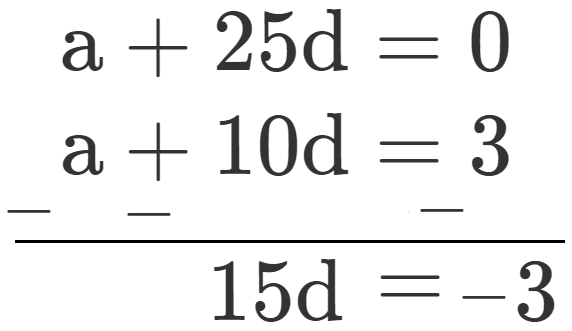
$\Rightarrow\text{d}=-\frac{1}{5}$ Put the values of d in Eq. (iii),
we get $\text{a}+25\big(-\frac{1}{5}\big)=0$
$\Rightarrow a - 5 = 0$
$\Rightarrow a = 5$
Now, put the value of a, d in Eq. (v),
we get $-\frac{1}{5}=5+\big(\text{n} - 1\big)\big(-\frac{1}{5}\big)$
$\Rightarrow -1 = 25 - n + 1$
$\Rightarrow n = 25 + 2$
$\Rightarrow n = 27$
Hence, the common difference and number of terms are
$-\frac{1}{5}$ and 27, respectively. View full question & answer→Question 303 Marks
In an $A P$, if $S_n=3 n^2+5 n$ and $a_k=164$, find value of $k$.
Answer$\because$ $n^{th}$ term of an AP,
$a_n= S_n - S_{n-1} $[$\because$ $S_n = 3n^2 + 5n$ (given)]
$a_n = 3n^2 + 5n - 3(n - 1)2 - 5(n - 1)$
$a_n = 3n^2 + 5n - 3n^2 - 3 + 6n - 5n + 5$
$a_n = 6n + 2 ......(i)$
or $a_k = 6k + 2$ [$\because$ $a_k = 164$ (given)]
$\Rightarrow a_k = 164 - 2$
$\Rightarrow a_k = 162$
$\therefore$ k = 27
View full question & answer→Question 313 Marks
Two A.P.s have the same common difference. The first term of one AP is $2$ and that of the other is $7$ . The difference between their $10^{\text {th }}$ terms is the same as the difference between their $21^{\text {st }}$ terms, which is the same as the difference between any two corresponding terms. Why?
AnswerGiven: $a_1 = 2$ and $a'_1 = 7$
Let d be the same common difference of two A.P.s.
So, $d_1= d$ and $d'_1 = d$
Now, $a_{10} - a'_{10} = a_1 + (10 - 1)d_1 - [a'_1 + (10 - 1)d'_1]$
$a_{10} - a'_{10} = 2 + 9d - [7 + 9d]$
$a_{10} - a'_{10} = 2 + 9d - 7 -9d$
$a_{10} - a'_{10} = -5$
Also, $a'_{21}- a_{21} = a_1 + (21 - 1)d_1 - [a'_1 + (21 - 1)d'_1]$
$a_{21} - a'_{21} = 2+ 20d - [7 + 20d]$
$a_{21} - a'_{21} = 2 + 20d - 7 -20d$
$a_{21} - a'_{21} = -5$
$a_{21} - a_{21} = a_{10} - a'_{10} = -5$
Now, $a_n - a'_n = a_1+ (n - 1)d_1 - [a'_1+ (n - 1)d'_1]$
$a_n - a'_n = 2 + (n - 1)d - [7 + (n - 1)d]$
$a_n - a'_n = 2 + nd - d - [7 + nd - d]$
$a_n - a'_n = 2 + nd -d - 7 - nd + d$
$a_n - a'_n= 2 - 7$
$a_n - a'_n = -5$
Hence, the difference between any two corresponding terms of such A.P.s same $(-5)$ as the difference between their terms and $21^{st}$ terms.
View full question & answer→Question 323 Marks
The sum of the $5^{\text {th }}$ and the $7^{\text {th }}$ terms of an $A P$ is 52 and the $10^{\text {th }}$ term is 46 . Find the AP.
AnswerLet the first and common difference of AP are a and d, respectively. According to the question,
$a_5+a_7=52$ and $a_{10}=46$
[$\because$ $a_n = a + (n - 1)d]$
$\Rightarrow a + (5 - 1)d + a + (7 - 1)d = 52$
and $a + (10 - 1)d = 46$
$\Rightarrow a + 4d + a + 6d = 52$
$and a + 9d = 46$
$\Rightarrow 2a + 10d = 52$
and $a + 9d = 46$
$\Rightarrow a + 5d = 26$
$\Rightarrow a + 9d = 46$
On aubtracting Eq. (i) from Eq. (ii), we get
$\Rightarrow 4d = 20$
$\Rightarrow d = 5$
From Eq. (i), $a = 26 - 5(5) = 1$
So, required AP is a, $a + d, a + 2d, a + 3d, ........i.e., ..... 1, 1 + 5, 1 + 2(5), 1 + 3(5), ...... i.e., ....... 1, 6, 11, 16, .......$
View full question & answer→Question 333 Marks
Verify that each of the following is an AP, and then write its next three terms:
$a + b, (a + 1) + b, (a + 1) + (b + 1), .....$
AnswerHere, $a_1 = a + b, a_2 = (a + 1) + b, a_3 = (a + 1) + (b + 1)$
$a_2- a_1= (a + 1) + b - (a + b) = a + 1 + b - a - b = 1$
$a_3 - a_2 = (a + 1) + (b + 1) - [(a + 1) + b]$
$a_3 - a_2 = a + 1 + b + 1 - a - 1 - b = 1$
$\because$ $a_2 - a_1 = a_3 - a_2= 1 =$ Common difference
Since, the each successive term of the given list has the same difference. So, if froms an A.P. The next three terms are-
$a_4 = a_1 + 3d = a + b + 3(1)$
$a_4 = (a + 2) + (b + 1)$
$a_5 = a_1 + 4d = a + b + 4(1)$
$a_5 = (a + 2) + (b + 2)$
$a_6 = a_1 + 5d = a + b + 5(1)$
$a_6 = (a + 3) + (b + 2)$
View full question & answer→Question 343 Marks
Which term of the $AP. 53, 48, 43,...$ is the first negative term?
AnswerGiven AP is $53,48,43, \ldots \ldots$
Whose, first term $(a)=53$ and common difference $(d)=48-53=-5$ Let $n ^{\text {th }}$ term of the AP be the first negative term.
$\left[\because n^{\text {th }} \text { term an AP, } T_n=a+(n-1) d\right]$
$i.e., T_n< 0$
${a + (n - 1)d} < 0$
$\Rightarrow 53 + (n - 1)(-5) < 0$
$\Rightarrow 53 - 5n + 5 < 0$
$\Rightarrow 58 - 5n < 0$
$\Rightarrow 5n > 58$
$\Rightarrow n > 11.6$
$\Rightarrow n = 12$
i.e., $12^{th}$ term is the first negative term of the given AP.
$\therefore$ $T_{12} = a + (12 - 1)d$
$\Rightarrow T_{12} = 53 + 11(-5)$
$\Rightarrow T_{12} = 53 - 55$
$\Rightarrow T_{12} = -2 < 0$
View full question & answer→Question 353 Marks
In an $A P$, if $S_n=n(4 n+1)$, find the $A P$.
AnswerWe know that, the $n^{\text {th }}$ term of an AP is
$a_n = S_n - S_{n-1}$[$\because$ $S_n = n(4n + 1)]$
$a_n = n(4n + 1) - (n - 1){4(n - 1) + 1}$
$a_n = 4n^2 + n - (n - 1)(4n - 3)$
$a_n = 4n^2 + n - 4n^2 + 3n + 4n - 3$
$a_n = 8n - 3$
Put n $= 1, a_1 = 8(1) - 3 = 5$
Put n $= 2, a_2 = 8(2) - 3 = 16 - 3 = 13$
Put n$ = 3, a_3 = 8(3) - 3 = 24 - 3 = 21$
Hence, the required $AP$ is $5, 13, 21, ......$
View full question & answer→Question 363 Marks
Find the sum of last ten terms of the $AP 8, 10, 12, ........, 126.$
AnswerFor finding, the sum of last ten terms, we write the given AP in reverse order.
i.e., $126, 124, 122, ....... 12, 10, 8$
Here, first term (a) = 126,Common difference, $(d) = 124 - 126 = -2$
$\therefore\text{S}_{\text{n}}=\frac{\text{n}}{2}\big[2\text{a}+\big(\text{n}-1\big)\text{d}\big]$
$\text{S}_{\text{10}}=\frac{10}{2}\big[2\text{a}+\big(10-1\big)\text{d}\big]$
$\Rightarrow S_{10} = 5{2(126) + 9(-2)}$
$\Rightarrow S_{10}= 5(252 - 18)$
$\Rightarrow S_{10} = 5 \times 234$
$\Rightarrow S_{10} = 1170$
View full question & answer→Question 373 Marks
How many numbers lie between $10$ and $300$, which when divided by $4$ leave a remainder $3$?
AnswerHere, the first number is 11 , which divided by 4 leave remainder 3 between 10 and 300. Last term before 300 is 299 , which divided by 4 leave remainder 3 .
$\therefore 11,15,19,23 \ldots . . . . . .299$
Here, first term $(a)=11$, common difference $d=15-11=-4$
$\because n ^{\text {th }}$ term, $a_n=a+(n-1) d=1[$ last term]
$\Rightarrow 299 = 11 + (n - 1)4$
$\Rightarrow 299 - 11 = (n - 1)4$
$\Rightarrow 4(n - 1) = 288$
$\Rightarrow (n - 1) = 72$
$\therefore$ $n = 73$
View full question & answer→Question 383 Marks
Split 207 into three parts such that these are in AP and the product of the two smaller parts is 4623.
AnswerLet the three parts of the number 207 are (a - d), a and (a + d), which in AP.
Now, by given condition,
⇒ Sum of these parts = 207
⇒ a - d + a + a + d = 207
⇒ 3a = 207
⇒ a = 69
Given that, product of the two smaller parts = 4623
⇒ a(a - d) = 4623
⇒ 69(69 - d) = 4623
⇒ 69 - d = 67
⇒ d = 69 - 67
⇒ d = 2
So, first part = a - d = 69 - 2 = 67
Second part = a = 69
and third part = a + d = 69 + 2 = 71
Hence, required three parts are 67, 69, 71.
View full question & answer→Question 393 Marks
The first term of an AP is –$5$ and the last term is $45$. If the sum of the terms of the $AP$ is $120$, then find the number of terms and the common difference.
AnswerLet the first term, common difference and the number of term of an AP are a, d and n respectively.
Given that, first term (a) = -5 and last
term(l) = 45 Sum of the term of the
$AP = 120$
$\Rightarrow s_n = 120$
We know that, if last term of an AP is known, then sum of n terms of an AP is, $\text{s}_{\text{n}}=\frac{\text{n}}{2}\big(\text{a}+\text{l}\big)$
$\Rightarrow120=\frac{\text{n}}{2}\big(-5+45\big)$
$\Rightarrow 120 \times 2$
$\Rightarrow 40 \times n$
$\Rightarrow n = 3 \times 2$
$\Rightarrow n = 6$
Number of terms of an AP is know,
then the nth term of an AP is,
$\Rightarrow l = a + (n - 1)d$
$\Rightarrow 45 = -5 + (6 - 1)d$
$\Rightarrow 50 = 5d$
$\Rightarrow d = 10$
So, the common difference is 10.
Hence, number of terms and the common difference of an AP are 6 and 10 respectively.
View full question & answer→Question 403 Marks
Verify that each of the following is an AP, and then write its next three terms: $\sqrt{3},2\sqrt{3},3\sqrt{3},.....$
Answer$\text{Here},\text{a}_{1}=\sqrt{3}=2\sqrt{3}\text{ and}\text{ a}_{3}=3\sqrt{3}$
$\text{a}_{2}-\text{a}_{1}=2\sqrt{3}-\sqrt{3}=\sqrt{3}$
$\text{a}_{3}-\text{a}_{2}=3\sqrt{3}-2\sqrt{3}=\sqrt{3}$
$\therefore\text{a}_{2}-\text{a}_{1}=\text{a}_{3}-\text{a}_{2}=\sqrt{3}=\text{Common difference}$
Since, the each successive term of the given list has the same difference. So, if froms an A.P. The next three terms are-
$\text{a}_{4}=\text{a}_{1}+3\text{d}$
$\text{a}_{4}=\sqrt{3}+3\big(\sqrt{3}\big)=4\sqrt{3}$
$\text{a}_{5}=\text{a}_{1}+4\text{d}$
$\text{a}_{5}=\sqrt{3}+4\sqrt{3}=5\sqrt{3}$
$\text{a}_{6}=\text{a}_{1}+5\text{d}$
$\text{a}_{6}=\sqrt{3}+5\sqrt{3}=6\sqrt{3}$
View full question & answer→Question 413 Marks
Determine k so that $k^2+ 4k + 8, 2k^2 + 3k + 6, 3k^2 + 4k + 4$ are three consecutive terms of an AP.
AnswerSince, $K^2+ 4k + 8, 2k^2 + 6$ and $3k^2 + 4k + 4$ are consecutive terms of an AP
$\therefore$ $2k^2 + 3k + 6 - (k^2 + 4k + 8) = 3k^2 + 4k + 4 - (2k^2 + 3k + 6) =$ Common difference
$\Rightarrow 2k^2 + 3k + 6 - k^2 - 4k - 8 = 3k^2 + 4k + 4 - 2k^2- 3k - 6$
$\Rightarrow k^2 - k - 2 = k^2 + k - 2$
$\Rightarrow -k = k$
$\Rightarrow 2k = 0$
$\Rightarrow k = 0$
View full question & answer→Question 423 Marks
Justify whether it is true to say that the following are the nth terms of an AP: $1 + n + n^2$
Answer$a_n= 1 + n + n^2$
$\therefore$$ a_1 = 1 + (1) + (1)^2= 1 + 1 + 1 = 3$
$a_2= 1 + (2) + (2)^2 = 1 + 2 + 4 = 7$
$a_3 = 1 + (3) + (3)^2 = 14 + 3 + 9 = 13$
$a_4 = 1 + (4) + (4)^2= 1 + 4 + 16 = 21$
$a_5 = 1 + (5) + (5)^2 = 1 + 5 + 25 = 31$
$So, d_1 = a_2 - a_1 = 7 - 3 = 4$
$d_2= a_3 - a_2 = 13 - 7 = 6$
$d_3 = a_4 - a_3 = 21 - 13 = 8$
$d_4 = a_5- a_4 = 31 - 21 = 10$
As $\text{d}_{1}\neq\text{d}_{2},$ so thr list of numbers $3, 7, 13, 21, 31, ...$ is not in A.P.
View full question & answer→