Questions

3 Marks Question

Take a timed test

11 questions · self-marked practice — reveal the answer and mark yourself.

Question 13 Marks

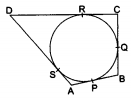
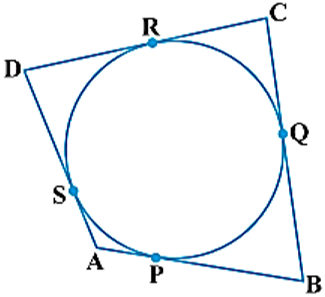
A quadrilateral ABCD is drawn to circumscribe a circle. Prove that AB + CD = AD + BC
Image

Answer

Image

We know that the lengths of tangents drawn from an exterior point to a circle are equal.
AP = AS, ... (i) [tangents from A]
BP = BQ, ... (ii) [tangents from B]
CR = CQ, ... (iii) [tangents from C]
DR = DS. ... (iv) [tangents from D]
AB + CD = (AP + BP) + (CR + DR)
= (AS + BQ) + (CQ + DS) [using (i), (ii), (iii), (iv)]
= (AS + DS) + (BQ + CQ)
= AD + BC.
Hence, AB + CD = AD + BC.
View full question & answer
Question 23 Marks
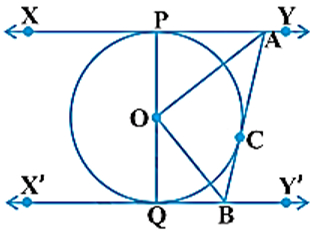
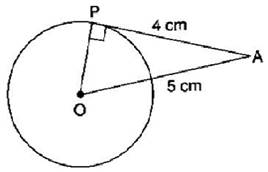
In Figure, $XY$ and $X'Y$' are two parallel tangents to a circle with centre $O$ and another tangent $AB$ with point of contact $C$ intersects $XY$ at A and $X'Y$' at $B$. Prove that $\angle A O B = 90^\circ.$
Image
Answer
Image
We know that the tangent at any point of a circle is $\perp$ to the radius through the point of contact.
$\therefore$ $\angle OPA = 90^o$
$\therefore$ $OA^2 = OP^2 + AP^2​​​​​​​$​​​​​​​ [By Pythagoras theorem]
$\Rightarrow$ $(5)^2 = (OP)^2 + (4)^2​​​​​​​$​​​​​​​
$\Rightarrow$ $25 = (OP)^2 + 16$
$\Rightarrow$ $OP^2= 9$
$\Rightarrow$ $OP = 3 cm$
View full question & answer
Question 33 Marks

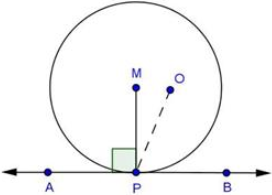
Prove that the perpendicular at the point of contact to the tangent to a circle passes through the centre of the circle.

Answer

Let APB be the tangent and take O as centre of the circle.
Image
Let us suppose that MP$\bot$AB does not pass through the centre.
Then,
$\angle OPA = 90^\circ$ [$\because$ Tangent is perpendicular to the radius of circle]
But $\angle MPA = 90^\circ$ [Given]
$\therefore \angle OPA = \angle MPA$
This is only possible when point O and point M coincide with each other.
Hence, the perpendicular at the point of contact to the tangent to a circle passes through the centre of the circle.

View full question & answer
Question 43 Marks

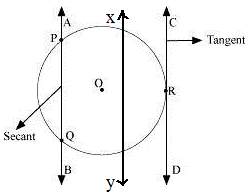
Prove that the tangents drawn at the ends of a diameter of a circle are parallel.

Answer

Image
Steps of Construction:

  1. Draw a circle with any radius and center O. Here xy is given line.
  2. Choose any point P on the circumference of the circle, and draw a line passing through P, Let's name it AB.
  3. Draw a line AB parallel to xy, such that AB intersects the circle at two points P and A.Here, AB and xy are two parallel lines. AB intersects the circle at exactly two points, P and Q. Therefore, line AB is the secant of this circle.
  4. CD intersects the circle at exactly one point, R, line CD is the tangent to the circle.
View full question & answer
Question 53 Marks
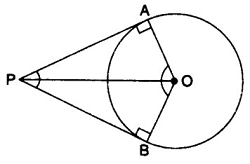
Prove that the angle between the two tangents drawn from an external point to a circle is supplementary to the angle subtended by the line-segment joining the points of contact at the centre.
Answer
$\angle O A P=90^{\circ}$ .........(1) [Angle between tangent and radius through the point of contact is $90^{\circ}$ ]
$\angle O B P=90^{\circ}$ ......... (2) [Angle between tangent and radius through the point of contact is $90^{\circ}$ ]
$\therefore OAPB$ is quadrilateral
Image
$\therefore$ $\angle$APB + $\angle$AOB + $\angle$OAP + $\angle$$OBP = 360^o​​​​​​​$​​​​​​​ [Angle sum property of a quadrilateral]
$\Rightarrow$ $\angle$APB + $\angle$$AOB + 90^o + 90^o = 360^o​​​​​​​$​​​​​​​ [From (1) and (2)]
$\Rightarrow$ $\angle$APB + $\angle$$AOB = 180^o​​​​​​​$​​​​​​​
$\Rightarrow$ $\angle$APB and $\angle$AOB are supplementary
View full question & answer
Question 63 Marks
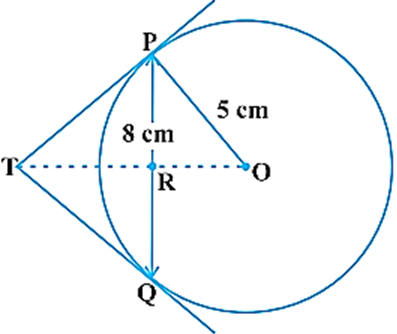
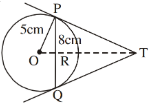
$PQ$ is a chord of length $8 \ cm$ of a circle of radius $5 \ cm$. The tangents at $P$ and $Q$ intersect at a point $T$. Find the length $TP$.
Image
Answer
Image
Let TR be x cm and TP be y cm
OT is perpendicular bisector of PQ
So PR = 4 cm ( PR = $\frac {PQ} {2} = \frac {8 } {2 } $)
In $\triangle$OPR, $OP^2 = PR^2 + OR^2$
$5^2 = 4^2+ OR^2$​​​​​​​
OR = $ \sqrt{25 - 16} $
$\therefore$ OR = 3 cm
In $\triangle$PRT, $PR^2 +RT^2 = PT^2$
$y^2 = x^2 + 4^2 .....(1)$
In $\triangle$OPT, $OP^2 + PT^2 = OT^2$
$(x + 3)^2 = 5^2 + y^2 ( OT = OR + RT = 3 + x)$
$\therefore$ $(x + 3)^2 = 5^2 + x^2 + 16$ [using (1)]
Solving, we get x = $\frac{16}{3}$ cm
From (1), $y^2​​​​​​​$​​​​​​​ = $\frac{256}{9}$ + 16 = $\frac{400}{9}$
So, y = $\frac{20}{3}$cm = 6.667 cm
View full question & answer
Question 73 Marks
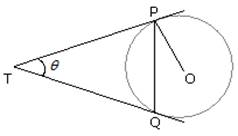
Two tangents $TP$ and $TQ$ are drawn to a circle with centre $O$ from an external point $T$. Prove that ​$\angle$​$PTQ =$ 2$\angle$$OPQ.$
Answer
Image
Given A circle with centre $O$ and an external point $T$ and two tangents TP and TQ to the circle, where $P, Q$ are the points of contact.
To Prove: $\angle PTQ =2 \angle OPQ$
Proof: Let $\angle PTQ =\theta$
Since TP, TQ are tangents drawn from point $T$ to the circle.
$T P=T Q$
$\therefore T P Q$ is an isoscles triangle
$\therefore \angle TPQ=\angle TQP=\frac{1}{2}\left(180^{\circ}-\theta\right)=90^{\circ}-\frac{\theta}{2}$
Since, TP is a tangent to the circle at point of contact $P$
$\therefore \angle OPT=90^{\circ}$
$\therefore \angle OPQ=\angle OPT-\angle TPQ=90^{\circ}-\left(90^{\circ}-\frac{1}{2} \theta\right)=\frac{\theta}{2}=\frac{1}{2} \angle PTQ$
Thus, $\angle PTQ =2 \angle OPQ$
View full question & answer
Question 83 Marks

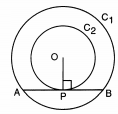
Prove that in two concentric circles, the chord of the larger circle, which touches the smaller circle is bisected at the point of contact.

Answer

Image
In larger circle C1 , AB is the chord and OP is the tangent.
Therefore, $\angle OPB=90^\circ$
Hence, AP = PB ( perpendicular from center of the circle to the chord bisects the chord)

View full question & answer
Question 93 Marks
The lengths of tangents drawn from an external point to a circle are equal.
Answer
Proof: We are given a circle with centre $\mathrm{O}$, a point $\mathrm{P}$ lying outside the circle and two tangents PQ, PR on the circle from P (see Fig. 10.7). We are required to prove that $\mathrm{PQ}=\mathrm{PR}$.
For this, we join OP, OQ and OR. Then $\angle \mathrm{OQP}$ and $\angle \mathrm{ORP}$ are right angles, because these are angles between the radii and tangents, and according to Theorem 10.1 they are right angles. Now in right triangles OQP and ORP,
\begin{array}{rlr}
\mathrm{OQ} & =\mathrm{OR} & \text { (Radii of the same circle) } \\
\mathrm{OP} & =\mathrm{OP} & (\text { Common) } \\
\Delta \mathrm{OQP} & \cong \Delta \mathrm{ORP} & (\mathrm{RHS}) \\
\mathrm{PQ} & =\mathrm{PR} & (\mathrm{CPCT})
\end{array}
View full question & answer
Question 103 Marks
The tangent at any point of a circle is perpendicular to the radius through the point of contact.
Answer
Image
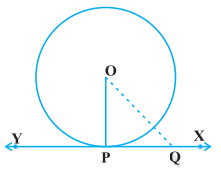
Proof : We are given a circle with centre $\mathrm{O}$ and a tangent $\mathrm{XY}$ to the circle at a point $\mathrm{P}$. We need to prove that $\mathrm{OP}$ is perpendicular to $\mathrm{XY}$.
Take a point $\mathrm{Q}$ on $\mathrm{XY}$ other than $\mathrm{P}$ and join $\mathrm{OQ}$ (see Fig. 10.5).
The point $\mathrm{Q}$ must lie outside the circle. (Why? Note that if Q lies inside the circle, XY will become a secant and not a tangent to the circle). Therefore, $\mathrm{OQ}$ is longer than the radius $\mathrm{OP}$ of the circle. That is,
$
\mathrm{OQ}>\mathrm{OP} \text {. }
$
Since this happens for every point on the line $X Y$ except the point $P, O P$ is the shortest of all the distances of the point $O$ to the points of XY. So OP is perpendicular to XY. (as shown in Theorem A1.7.)
View full question & answer
Question 113 Marks
Prove that the parallelogram circumscribing a circle is rhombus.
Answer

Image
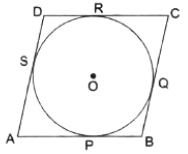
Let $A B C D$ be the rhombus circumscribing the circle with centre $O$, such that $A B, B C, C D$ and $D A$ touch the circle at points $P, Q, R$ and $S$ respectively. We know that the tangents drawn to a circle from an exterior point are equal in length.
$\therefore AP=AS \quad \text {...(i) }[\text { tangents from } A]$
$BP=BQ \quad . . \text { (ii) [tangents from } B \text { ] }$
$CR=CQ \quad \text {...(iii) }[\text { tangents from } C \text { ] }$
$DR=DS \quad \text {...(iv) } \text { [tangents from } D \text { ] }$
$\therefore AB+CD=AP+BP+CR+DR$
$=AS+BQ+CQ+DS \quad \ldots[\text { From (i), (ii), (iii), (iv)] }$
$=(AS+DS)+(BQ+CQ)$
$=A D+B C$
$\text { Hence, }(A B+C D)=(A D+B C)$
$\Rightarrow 2 AB=2 AD$
$\text {[}\because \text {opposite sides of a parallelogram are equal] }$
$\Rightarrow AB=AD$
$\therefore C D=A B=A D=B C$
Hence, $A B C D$ is a rhombus.
View full question & answer