Question

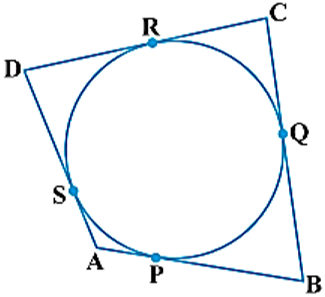
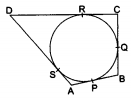
A quadrilateral ABCD is drawn to circumscribe a circle. Prove that AB + CD = AD + BC
Image

Answer

Image

We know that the lengths of tangents drawn from an exterior point to a circle are equal.
AP = AS, ... (i) [tangents from A]
BP = BQ, ... (ii) [tangents from B]
CR = CQ, ... (iii) [tangents from C]
DR = DS. ... (iv) [tangents from D]
AB + CD = (AP + BP) + (CR + DR)
= (AS + BQ) + (CQ + DS) [using (i), (ii), (iii), (iv)]
= (AS + DS) + (BQ + CQ)
= AD + BC.
Hence, AB + CD = AD + BC.

Need a full question paper?

Generate a complete, print-ready paper with questions like this in minutes — across 16+ boards, with answer keys.
Start Generating Free

Similar questions

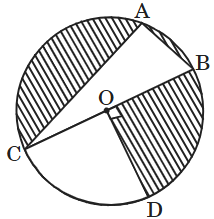
In the given figure, $O$ is the centre of the circle with $AC =24 \ cm, AB =7 \ cm$ and $\angle BOD =90^{\circ}$. Find the area of the shaded region.
Image
Find the area of the triangle $\text{ABC}$ with $(1,-4)$ and mid $-$ points of sides through $A$ being $(2,-1)$ and. $(0,-1)$
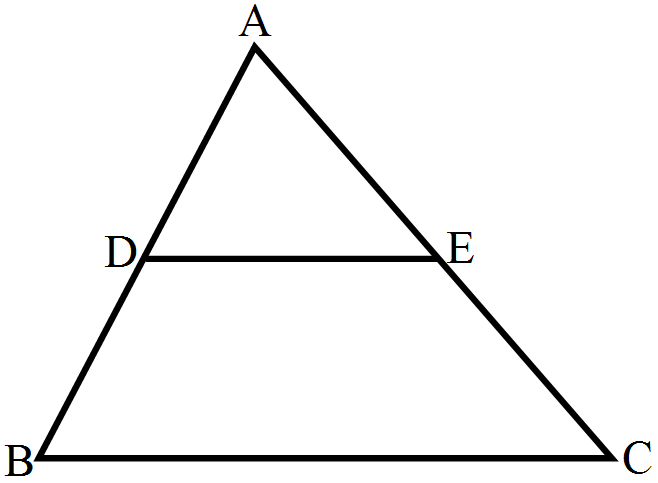
In the given figure, DE || BC such that AD = x cm, DB = (3x + 4)cm, AE = (x + 3)cm and EC = (3x + 19)cm. Find the value of x.
Find the value(s) of p in (i) to (iv) and p and q in (v) for the following pair of equations:
$-3x + 5y = 7$ and $2px - 3y = 1,$
if the lines represented by these equations are intersecting at a unique point.
Determine. if 3 is a root of the equation given below:
$\sqrt{\text{x}^2-4\text{x}+3}+\sqrt{\text{x}^2-9}=\sqrt{4\text{x}^2-14\text{x}+16}$
In what ratio is the line segments joining the points A(-2, -3) and B(3, 7) divided by the y-axis? Also, find the coordinates of the point of division.
Find a point on y-axis which is equidistant form the points $(5, -2)$ and $(-3, 2).$
Find the sum of the following arithmetic progressions:
$a + b, a - b, a - ab, ....$. to $22$ terms.
Match the APs given in column A with suitable common differences given in column B.
Column A
Column B
$A_1$
$2, -2, -6, -10$
$B_1$
$\frac{2}{3}$
$A_2$
$a = -18, n = 10, a_n = 0$
$B_2$
-5
$A_3$
$a = 0, a_{10} = 6$
$B_3​​​​​​​$
4
$A_4$​​​​​​​
$a_2= 13, a_4 = 3$
$B_4​​​​​​​$
-4
 
 
$B_5​​​​​​​$
2
 
 
$B_6​​​​​​​$
$\frac{1}{2}$
 
 
$B_7​​​​​​​$
5
A solid cone of base radius 10cm is cut into two parts through the mid-point of its height, by a plane parallel to its base. Find the ratio in the volumes of two parts of the cone.