Questions

5 Marks Questions

Take a timed test

6 questions · self-marked practice — reveal the answer and mark yourself.

Question 15 Marks
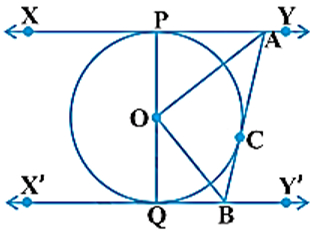
In Figure, XY and X'Y' are two parallel tangents to a circle with centre O and another tangent AB with point of contact C intersects XY at A and X'Y' at B. Prove that $\angle A O B$ = 90°.
Answer
According to the question, XY and X 'Y ' are x two parallel tangents to a circle with centre O and another tangent AB with point of contact C intersects XY at A and X 'Y ' at B.
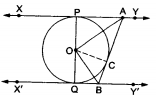
In quad. APQB, we have
$\angle A P O$ =90°
and $\angle B Q O$ = 90° [$\because$ tangent at any point is perpendicular to the radius through the point of contact]
Now, $\angle A P O + \angle B Q O + \angle Q B C + \angle P A C = 360 ^ { \circ }$
$\Rightarrow \angle P A C + \angle Q B C = 360 ^ { \circ }$$- ( \angle A P O + \angle B Q O ) = 180 ^ { \circ }$ ...(i)
We have,
$\angle C A O = \frac { 1 } { 2 }$ $\angle P A C$
and $\angle C B O = \frac { 1 } { 2 } $$\angle Q B C$ [$\because$ tangents from an external point are equally inclined to the line segment joining the centre to that point]
$\therefore \angle \mathrm { CAO } + \angle \mathrm { CBO } = \frac { 1 } { 2 }$$( \angle P A C + \angle Q B C ) = \frac { 1 } { 2 } \times 180 ^ { \circ } = 90 ^ { \circ }$.....(ii)
In $\triangle A O B$, we have
$\angle C A O + \angle A O B + \angle C B O = 180 ^ { \circ }$
$\Rightarrow 90 ^ { \circ }+\angle A O B = 180 ^ { \circ }$
$\Rightarrow \quad \angle A O B = 90 ^ { \circ }$
View full question & answer
Question 25 Marks
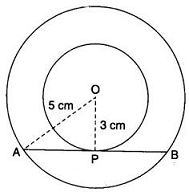
Two concentric circles are of radii 5 cm and 3 cm. Find the length of the chord of the larger circle which touches the smaller circle.
Answer
Let O be the common centre of the two concentric circles.

Let $A B$ be a chord of the larger circle which touches the smaller circle at $P$.
Join OP and OA
Then, $\angle O P A=90^{\circ}[\because$ The tangent at any point of a circle is perpendicular to th radius through the point of contact $]$
$\therefore O A^2=O P^2+A P^2 \ldots \ldots .$. By Pythagoras theorem
$\Rightarrow$ $(5)^2 = (3)^2 + AP^2$
$\Rightarrow$ $25 = 9 + AP^2$
$\Rightarrow$ $P^2 = 25 - 9$
$\Rightarrow$ $AP^2 = 16$
$\Rightarrow$ AP = $\sqrt{16}$ = 4 cm
SInce the perpendicular from the centre of a circle to a chord bisects the chord, therfore,
AP = BP = 4 cm
$\therefore$ $AB = AP + BP = AP + AP = 2AP = 2(4) = 8 cm$
Hence, the required length is 8 cm.
View full question & answer
Question 35 Marks
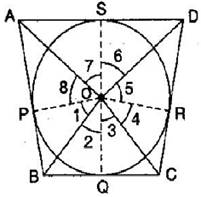
Prove that opposite sides of a quadrilateral circumscribing a circle subtend supplementary angles at the centre of the circle.
Answer
Given: ABCD is a quadrilateral circumscribing a circle whose centre is O.
To prove:
  1. $\angle$AOB + $\angle$COD $= 180^o$​​​​​​​​​​​​​​
  2. $\angle$BOC + $\angle$AOD $= 180^o​​​​​​​$
Construction: Join OP, OQ, OR and OS.

Proof: Since tangents from an external point to a circle are equal.
$\therefore$ $AP = AS,$
$BP = BQ ........ (i)$
$CQ = CR$
$DR = DS$
In $\triangle$OBP and $\triangle$OBQ,
OP = OQ [Radii of the same circle]
OB = OB [Common]
BP = BQ [From eq. (i)]
$\therefore$ $\triangle$OPB $\cong$ $\triangle$OBQ [By SSS congruence criterion]
$\therefore$ $\angle$1 = $\angle$2 [By C.P.C.T.]
Similarly, $\angle$3 = $\angle$4, $\angle$5 = $\angle$6, $\angle$7 = $\angle$8
Since, the sum of all the angles round a point is equal to $360^o.$
$\therefore$ $\angle$1 + $\angle$2 + $\angle$3 + $\angle$4+ $\angle$5 + $\angle$6 + $\angle$7 + $\angle$8 =$360^o.$​​​​​​​
$\Rightarrow$ $\angle$1 + $\angle$1 + $\angle$4 + $\angle$4+ $\angle$5 + $\angle$5 + $\angle$8 + $\angle$8 = $360^o.$​​​​​​​
$\Rightarrow$ 2 ($\angle$1 + $\angle$4 + $\angle$5 + $\angle$8) = $360^o.$​​​​​​​
$\Rightarrow$ $\angle$1 + $\angle$4 + $\angle$5 + $\angle$8 $= 180^o$
$\Rightarrow$ ($\angle$1 + $\angle$5) + ($\angle$4 + $\angle$8) $= 180^o$​​​​​​​
$\Rightarrow$ $\angle$AOB + $\angle$COD $= 180^o$​​​​​​​
Similarly we can prove that
$\angle$BOC + $\angle$AOD $= 180^o$​​​​​​​
View full question & answer
Question 45 Marks
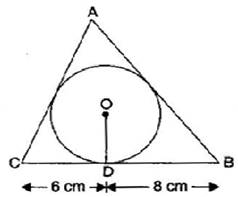
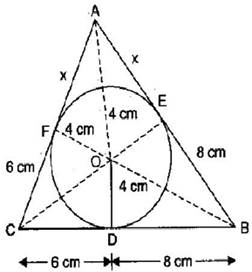
A triangle ABC is drawn to circumscribe a circle of radius 4 cm such that the segments BD and DC into which BC is divided by the point of contact D are of lengths 8 cm and 6 cm respectively (see figure). Find the sides AB and AC.
Answer
Join OE and OF. Also join OA, OB and OC.

Since BD = 8 cm
$\therefore$ BE = 8 cm
[Tangents from an external point to a circle are equal]
Since CD = 6 cm
$\therefore$ CF = 6 cm
[Tangents from an external point to a circle are equal]
Let AE = AF = x
Since OD = OE = OF = 4 cm [Radii of a circle are equal]
$\therefore$ Semi-perimeter of $\triangle$ ABC = $\frac{(x\;+6)(x\;+8)\;+\;(6+8)}2 = \frac{(2x\;+28)}2$= (x + 14)cm
$\therefore$ Area of $\triangle$ABC =$\sqrt{s(s-a)(s-b)\;(s-c)}$
= $\sqrt{(x\;+14)(x\;+14\;-14)(x\;+14-\overline{x+8})(x\;+14-\overline{x+6})}$
= $\sqrt{(x\;+14)(x\;)(8)(6)}$$cm^2$​​​​​​​
Now, Area of ΔABC = Area of $\triangle$OBC + Area of $\triangle$OCA + Area of $\triangle$OAB
$\Rightarrow$ $\sqrt{(x\;+14)(x\;)(8)(6)}$=$\frac{(6+8)4}2+\frac{\displaystyle(x+6)4}{\displaystyle2}+\frac{\displaystyle(x+8)4}{\displaystyle2}$
$\Rightarrow$ $\sqrt{(x\;+14)(x\;)(8)(6)}$= 28 + 2x + 12 + 2x + 16
$\Rightarrow$ $\sqrt{(x\;+14)(x\;)(8)(6)}$= 4x + 56
$\Rightarrow$$\sqrt{(x\;+14)(x\;)(8)(6)}$=4(x + 14)
Squaring both sides,
$(x + 14) (x) (6) (8) = 16(x + 14)^2​​​​​​​$​​​​​​​
$\Rightarrow$ 3x = x + 14
$\Rightarrow$ 2x = 14
$\Rightarrow$ x = 7
$\therefore$ AB = x + 8 = 7 + 8 = 15 cm
And AC = x + 6= 7 + 6 = 13 cm
View full question & answer
Question 55 Marks
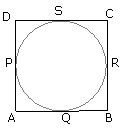
Prove that parallelogram circumscribing a circle is a rhombus.
Answer


Given ABCD is a parallelogram in which all the sides touch a given circle
To prove:- ABCD is a rhombus
Proof:-
$\because$ ABCD is a parallelogram
$\therefore$ AB = DC and AD = BC
Again AP, AQ are tangents to the circle from the point A
$\therefore$ AP = AQ
Similarly, BR = BQ
CR = CS
DP = DS
$\therefore$(AP + DP) + (BR + CR) = AQ + DS + BQ + CS = (AQ + BQ) + (CS + DS)
$\Rightarrow$ AD + BC = AB + DC
$\Rightarrow$ BC + BC = AB + AB [$\because$ AB = DC, AD = BC]
$\Rightarrow$ 2BC = 2AB
$\Rightarrow$ BC = AB
Hence, parallelogram ABCD is a rhombus
View full question & answer
Question 65 Marks
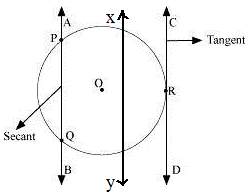
Draw a circle and two lines parallel to a given line such that one is a tangent and the other, a secant to the circle.
Answer


Steps of Construction:

  1. Draw a circle with any radius and center O. Here xy is given line.
  2. Choose any point P on the circumference of the circle, and draw a line passing through P, Let's name it AB.
  3.  Draw a line AB parallel to xy, such that AB intersects the circle at two points P and A.Here, AB and xy are two parallel lines. AB intersects the circle at exactly two points, P and Q. Therefore, line AB is the secant of this circle.
  4. CD intersects the circle at exactly one point, R, line CD is the tangent to the circle.
View full question & answer