Questions

M.C.Q (1 Marks)

Take a timed test

8 questions · auto-graded multiple-choice test.

MCQ 11 Mark
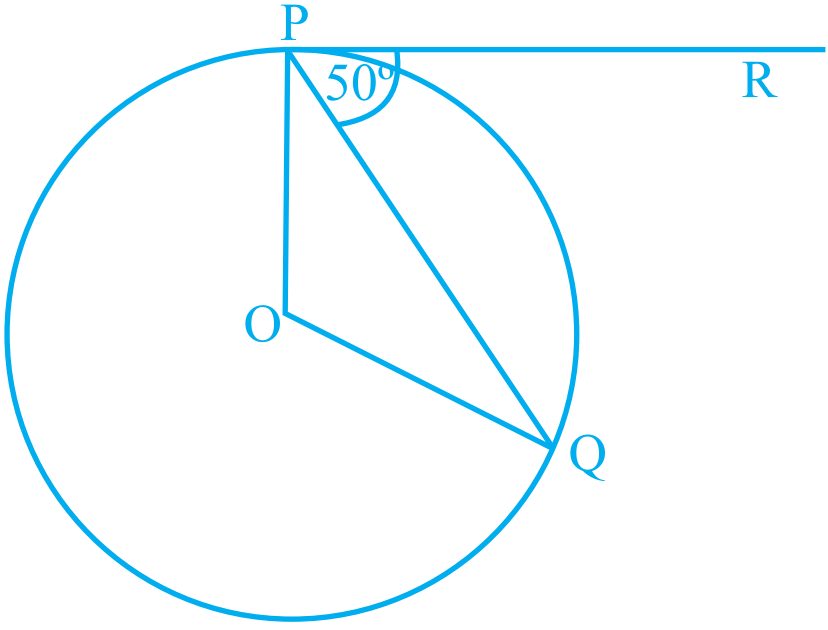
In Figure, if O is the centre of a circle, PQ is a chord and the tangent PR at P makes an angle of 50° with PQ, then $\angle\text{POQ}$ is equal to:
  • 100°
  • B
    80°
  • C
    90°
  • D
    75°
Answer
Correct option: A.
100°
Given, $\angle\text{QPR}=50^\circ$We know that, the tangent at any point of a circle is perpendicular to the radius through the point of contact.
$\therefore\ \angle\text{OPR}=90^\circ$
$\Rightarrow\ \angle\text{OPQ}+\angle\text{QPR}=90^\circ\ \ [\text{from figure}]$
$\Rightarrow\ \angle\text{OPQ}=90^\circ-50^\circ=40^\circ\ \ [\because\angle\text{QPR}=50^\circ]$
Now, OP = OQ = Radius of circle
$\therefore\ \angle\text{OQP}=\angle\text{OPQ}=40^\circ$
[since, angles opposite to equal sides are equal]
In $\triangle\text{OPQ},\ \ \angle\text{O}+\angle\text{P}+\angle\text{Q}=180^\circ$
[since, sum of angles of a triangle = 180º]
$\Rightarrow\ \angle\text{O}=180^\circ-(40^\circ+40^\circ)\ \ [\because\angle\text{P}=40^\circ=\angle\text{Q}]$
= 180º - 80º = 100º
View full question & answer
MCQ 21 Mark
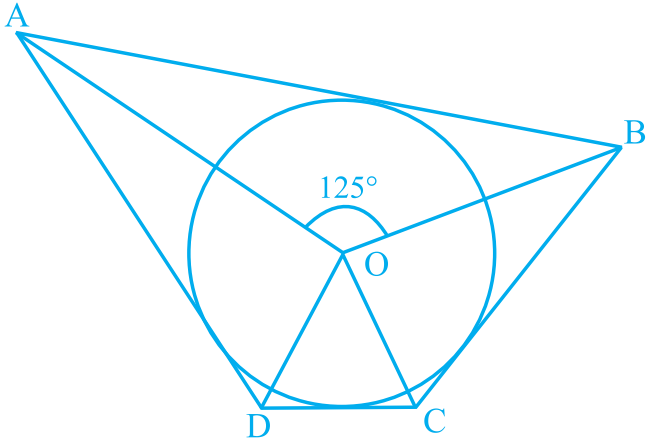
In figure, if $\angle\text{AOB}=125^\circ,$ then $\angle\text{COD}$ is equal to:
  • A
    62.5°
  • B
    45°
  • C
    35°
  • 55°
Answer
Correct option: D.
55°
we know that, the opposite sides of a quadrilateral circumscribing a circle subtend supplementary angles at the centre of the circle.i.e., $\angle\text{AOB}+\angle\text{COD}=180^\circ$
$\Rightarrow\ \angle\text{COD}=180^\circ-\angle\text{AOB}$
=180º - 125º = 55º
View full question & answer
MCQ 31 Mark
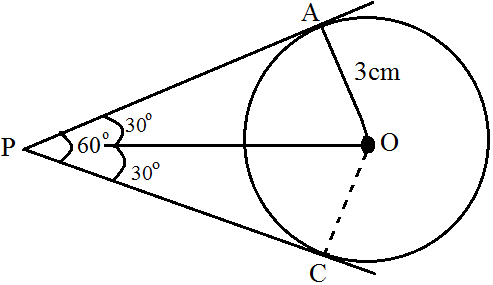
If two tangents inclined at an angle 60° are drawn to a circle of radius 3cm, then length of each tangent is equal to:
  • A
    $\frac{3}{2}\sqrt{3}\text{cm}$
  • B
    $6\text{cm}$
  • C
    $3\text{cm}$
  • $3\sqrt{3}\text{cm}$
Answer
Correct option: D.
$3\sqrt{3}\text{cm}$

Let P be an external point and a pair of tangents is drawn from point P and angle between these two tangents is 60º.
Join OA and OP.
Also, OP is a bisector line of $\angle\text{APC}.$
$\therefore\ \angle\text{APO}=\angle\text{CPO}=30^\circ$
Also, $\text{OA}\perp\text{AP}$
Tangent at any point of a circle is perpendicular to the radius through the point of contact.
In right angled $\triangle\text{OAP},\ \ \tan30^\circ=\frac{\text{OA}}{\text{AP}}=\frac{3}{\text{AP}}$
$\Rightarrow\ \frac{1}{\sqrt{3}}=\frac{3}{\text{AP}}$
$\Rightarrow\ \text{AP}=3\sqrt{3}\text{cm}$
Hence, the length of each tangent is $3\sqrt{3}\text{cm}.$
View full question & answer
MCQ 41 Mark
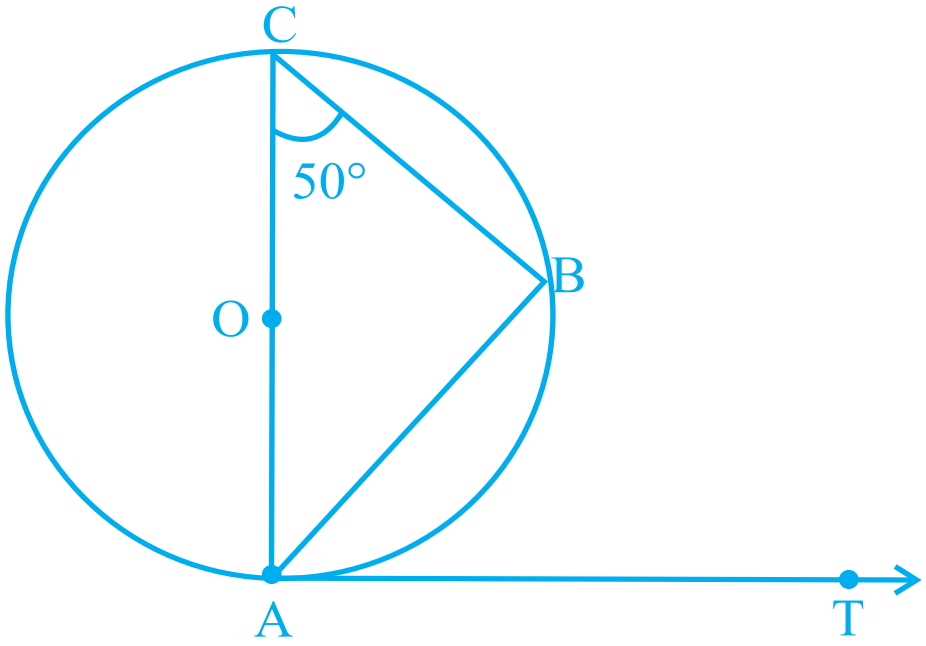
In figure, AB is a chord of the circle and AOC is its diameter such that $\angle\text{ACB}=50^\circ.$ If AT is the tangent to the circle at the point A, then $\angle\text{BAT}$ is equal to:
  • A
    65°
  • B
    60°
  • 50°
  • D
    40°
Answer
Correct option: C.
50°
In figure, AOC is a diameter of the circle. We know that, diameter subtends an angle 90º at the circle.So, $\angle\text{ABC}=90^\circ$
In $\triangle\text{ACB},\ \angle\text{A}+\angle\text{B}+\angle\text{C}=180^\circ$
[Since, sum of all angles of a triangle is 180º]
$\Rightarrow\ \angle\text{A}+90^\circ+50^\circ=180^\circ$
$\Rightarrow\ \angle\text{A}+140=180$
$\Rightarrow\ \angle\text{A}=180^\circ-140^\circ=40^\circ$
$\angle\text{A}\text{ or }\angle\text{OAB}=40^\circ$
Now, AT is the tangent to the circle at point A. So, OA is perpendicular to AT.
$\therefore\ \angle\text{OAT}=90^\circ\ \ [\text{from figure}]$
$\Rightarrow\ \angle\text{OAB}+\angle\text{BAT}=90^\circ$
On putting $\angle\text{OAB}=40^\circ,$ we get
$\Rightarrow\ \angle\text{BAT}=90^\circ-40^\circ=50^\circ$
Hence, the value of $\angle\text{BAT}$ is 50º.
View full question & answer
MCQ 51 Mark
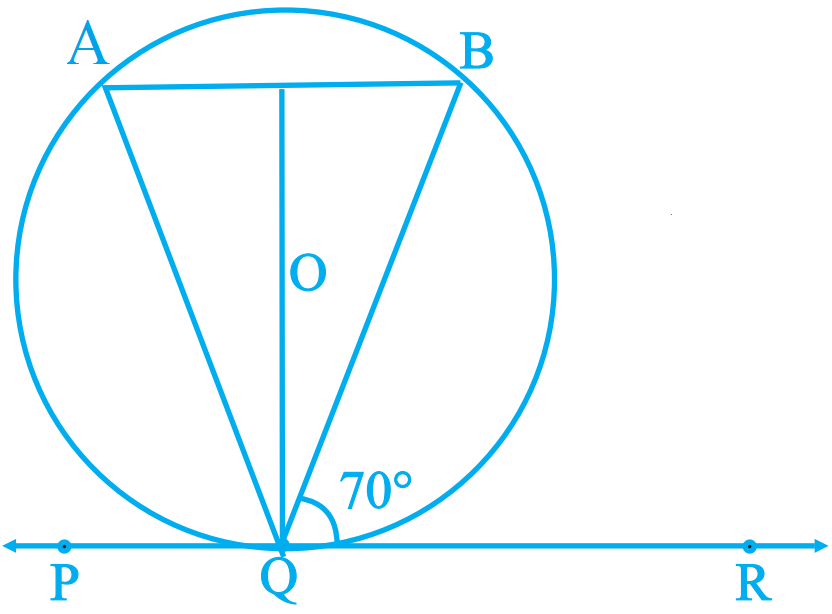
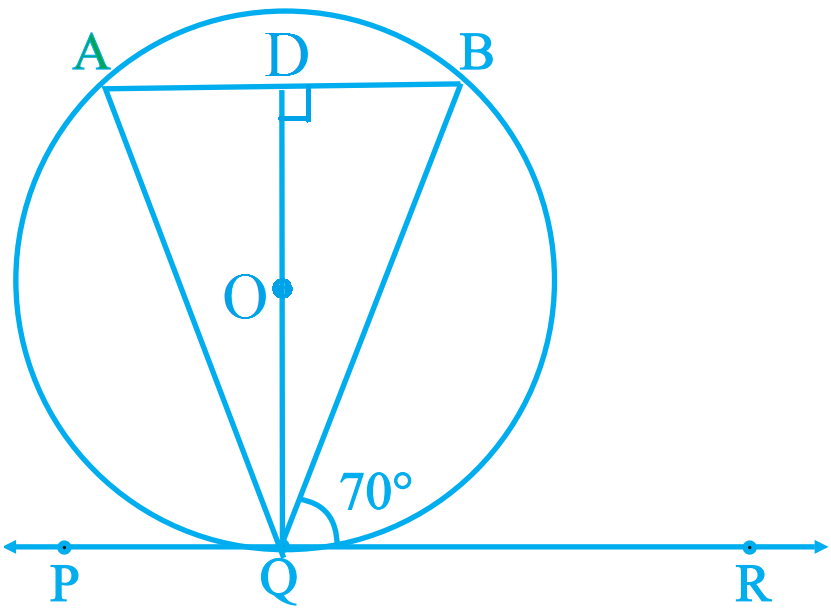
In Figure, if PQR is the tangent to a circle at Q whose centre is O, AB is a chord parallel to PR and $\angle\text{BQR}=70^\circ,$ then $\angle\text{AQB}$ is equal to:
  • A
    20°
  • 40°
  • C
    35°
  • D
    45°
Answer
Correct option: B.
40°

Given, AB || PR
$\therefore\ \angle\text{ABQ}=\angle\text{BQR}=70^\circ$ [alternate angles]
Also, QD is perpendicular to AB and QD bisects AB.
In $\triangle\text{QDA and }\triangle\text{QDB},\ \ \angle\text{QDA}=\angle\text{QDB}\ \ [\text{each }90^\circ]$
AD = BD
QD = QD [common side]
$\therefore\ \triangle\text{ADQ}\cong\triangle\text{BDQ}$ [by SAS similarity criterion]
Then $\angle\text{QAD}=\angle\text{QBD}\ \ [\text{CPCT}] ...(\text{i})$
Also $\angle\text{ABQ}=\angle\text{BQR}$ [alternate interior angle]
$\therefore\ \angle\text{ABQ}=70^\circ\ \ [\because\angle\text{BQR}=70^\circ]$
Hence, $\angle\text{QAB}=70^\circ\ \ [\text{from Eq. (i})]$
Now, in $\triangle\text{ABQ},\ \angle\text{A}+\angle\text{B}+\angle\text{Q}=180^\circ$
$\Rightarrow\ \angle\text{Q}=180^\circ-(70^\circ+70^\circ)=40^\circ$
View full question & answer
MCQ 61 Mark
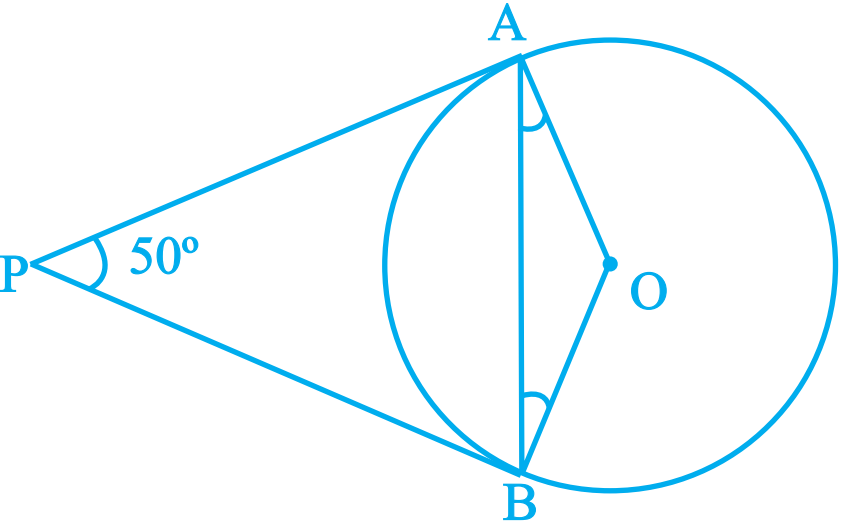
In figure, if PA and PB are tangents to the circle with centre O such that $\angle\text{APB}=50^\circ,$ then $\angle\text{OAB}$ is equal to:
  • 25°
  • B
    30°
  • C
    40°
  • D
    50°
Answer
Correct option: A.
25°
Given, PA and PB are tangent lines.$\therefore\ \text{PA}=\text{PB}$
[since, the length of tangents drawn from an external point to a circle is equal]
$\Rightarrow\ \angle\text{PBA}=\angle\text{PAB}=\theta\ \ [\text{say}]$
In $\triangle\text{PAB},\ \angle\text{P}+\angle\text{A}+\angle\text{B}=180^\circ$
[since, sum of angles of a triangle = 180º]
$\Rightarrow\ 50^\circ+\theta+\theta=180^\circ$
$\Rightarrow\ 2\theta=180^\circ-50^\circ=130^\circ$
$\Rightarrow\ \theta=65^\circ$
Also, $\text{OA}\perp\text{PA}$
[since, tangent at any point of a circle is perpendicular to the radius through the point of contact]
$\therefore\ \angle\text{PAO}=90^\circ$
$\Rightarrow\ \angle\text{PAB}+\angle\text{BAO}=90^\circ$
$\Rightarrow\ 65^\circ+\angle\text{BAO}=90^\circ$
$\Rightarrow\ \angle\text{BAO}=90^\circ-65^\circ=25^\circ$
View full question & answer
MCQ 71 Mark
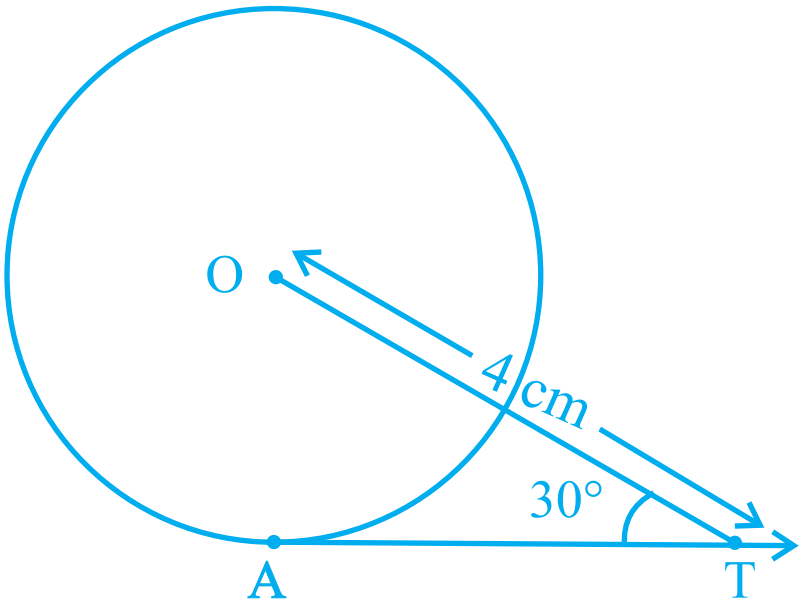
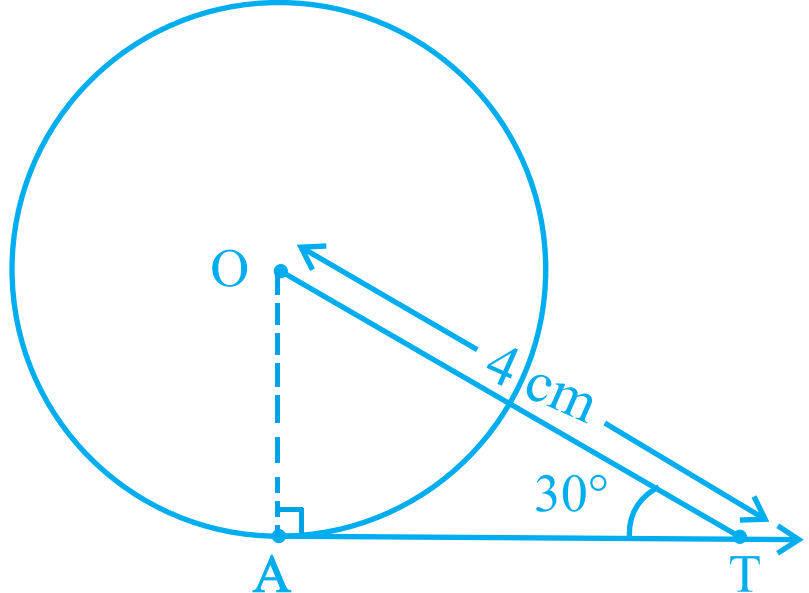
In figure, AT is a tangent to the circle with centre O such that OT = 4cm and $\angle\text{OTA}=30^\circ.$ Then AT is equal to:
  • A
    $4\text{cm}$
  • B
    $2\text{cm}$
  • $2\sqrt{3}\text{cm}$
  • D
    $4\sqrt{3}\text{cm}$
Answer
Correct option: C.
$2\sqrt{3}\text{cm}$
Join OA
We know that, the tangent at any point of a circle is perpendicular to the radius through the point of contact.

$\therefore\ \angle\text{OAT}=90^\circ$
In $\triangle\text{OAT},\ \cos30^\circ=\frac{\text{AT}}{\text{OT}}$
$\Rightarrow\ \frac{\sqrt{3}}{2}=\frac{\text{AT}}{4}$
$\Rightarrow\ \text{AT}=2\sqrt{3}\text{cm}.$
View full question & answer
MCQ 81 Mark
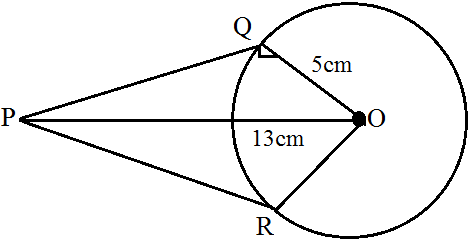
From a point $P$ which is at a distance of $13\ cm$ from the centre $O$ of a circle of radius $5\ cm$, the pair of tangents $PQ$ and $PR$ to the circle are drawn. Then the area of the quadrilateral $\text{PQOR}$ is:
  • $60 \ cm^2$
  • B
    $65 \ cm^2$
  • C
    $30 \ cm^2$
  • D
    $32.5 \ cm^2$
Answer
Correct option: A.
$60 \ cm^2$

Firstly, draw a circle of radius $5\ cm$ having centre $O.P$ is a point at a distance of $13\ cm$ from $O.A$ pair of tangents $PQ$ and $PR$ are drawn.
Thus, quadrilateral $\text{POOR}$ is formed.
$\because\ \text{OQ}\perp\text{QP} [$since, $AP$ is a tangent line$]$
In right angled $\triangle\text{PQO},\ \text{OP}^2=\text{OQ}^2+\text{QP}^2$
$\Rightarrow\ 13^2=5^2+\text{QP}^2$
$\Rightarrow\ \text{QP}^2=169-25=144$
$\Rightarrow\ \text{QP}=12\text{cm}$
Now, area of $\triangle\text{OQP}=\frac{1}{2}\times\text{QP}\times\text{QO}$
$=\frac{1}{2}\times12\times5=30\text{cm}^2$
$\therefore$ Area of quadrilateral $\text{QORP}=2\triangle\text{OQP}$
$=2 \times 30=60 \ cm^2$.
View full question & answer