MCQ 11 Mark
If the line segment joining the points $(3, -4)$ and $(1, 2)$ is trisected at points $P(a, -2)$ and $\text{Q}\Big(\frac{5}{3},\text{b}\Big).$ Then,
- A
$\text{a}=\frac{8}{3},\text{b}=\frac{2}{3}$
- ✓
$\text{a}=\frac{7}{3},\text{b}=0$
- C
$\text{a}=\frac{1}{3},\text{b}=1$
- D
$\text{a}=\frac{2}{3},\text{b}=\frac{1}{3}$
AnswerCorrect option: B. $\text{a}=\frac{7}{3},\text{b}=0$
We have two points $A(3, -4)$ and $B(1, 2).$ There are two points $P(a, -2)$ and $\text{Q}\Big(\frac{5}{3},\text{b}\Big)$ which trisect the line segment joining $A$ and $B.$
Now according to the section formula if any point $P$ divides a line segment joining $A(x_1, y_1)$ and $B(x_2, y_2)$ in the ratio $m: n$ internally than,
$\text{P(x, y)}=\Big(\frac{\text{nx}_1+\text{mx}_2}{\text{m}+\text{n}},\frac{\text{ny}_1+\text{my}_2}{\text{m}+\text{n}}\Big)$
The point $P$ is the point of trisection of the line segment $AB.$
So, $P$ divides $AB$ in the ratio $1: 2.$
Now we will use section formula to find the co$-$ordinates of unknown point $A$ as,
$\text{P(a,}-2)=\Big(\frac{2(3)+1(1)}{1+2},\frac{2(-4)+1(2)}{1+2}\Big)$
$=\Big(\frac{7}{3},-2\Big)$
Equate the individual terms on both the sides. We get,
$\text{a}=\frac{7}{3}$
Similarly, the point $Q$ is the point of trisection of the line segment $AB$.
So, $Q$ divides $AB$ in the ratio $2: 1$
Now we will use section formula to find the co$-$ordinates of unknown point $A$ as,
$\text{Q}\Big(\frac{5}{3},\text{b}\Big)=\Big(\frac{2(1)+1(3)}{1+2},\frac{2(2)+1(-4)}{1+2}\Big)$
$=\Big(\frac{5}{3},0\Big)$
Equate the individual terms on both the sides. We get,
$b = 0$
View full question & answer→MCQ 21 Mark
If points $(t, 2t), (-2, 6)$ and $(3, 1)$ are collinear, then $t =$
- A
$\frac{3}{4}$
- ✓
$\frac{4}{3}$
- C
$\frac{5}{3}$
- D
$\frac{3}{5}$
AnswerCorrect option: B. $\frac{4}{3}$
We have three collinear points $A ( t , 2 t ), B (-2,6), C (3,1)$.
In general if $A \left( x _1, y _1\right), B \left( x _2, y _2\right), C \left( x _3, y _3\right)$ are collinear then, $\frac{1}{2}\left[ x _1\left( y _2- y _3\right)+ x _2\left( y _3- y _1\right)+ x _3\left( y _1- y _2\right)\right]=0$
So,
$t(6-1)-2(1-2 t)+3(2 t-6)=0$
So,
$5 t+4 t+6 t-2-18=0$
So,
$15 t=20$
Therefore,
$t=\frac{4}{3}$
View full question & answer→MCQ 31 Mark
The distance between the points $(\text{a}\cos25^\circ,0)$ and $(0,\text{a}\cos65^\circ)$ is:
AnswerDistance between $(\text{a}\cos25^\circ,0)$ and $(0,\text{a}\cos65^\circ)$$=\sqrt{(\text{x}_2-\text{x}_1)^2+(\text{y}_2-\text{y}_1)^2}$
$=\sqrt{(0-\text{a}\cos25^\circ)^2+(\text{a}\cos65^\circ-0)^2}$
$=\sqrt{\text{a}^2\cos^225^\circ+\text{a}^2\cos^265^\circ}$
$=\sqrt{\text{a}^2[\cos^225^\circ+\cos^265^\circ]}$
$=\text{a}\sqrt{\cos^2(90^\circ-65^\circ)+\cos^265^\circ}$
$=\text{a}\sqrt{\sin^265^\circ+\cos^265^\circ}$
$=\text{a}(\sqrt{1})=\text{a}$
View full question & answer→MCQ 41 Mark
The coordinates of the fourth vertex of the rectangle formed by the points (0, 0), (2, 0), (0, 3) are,
AnswerThree vertices of a rectangle are A(0, 0), B(2, 0), C(0, 3).
Let fourth vertex be D(x, y).
The diagonals of a rectangle bisect eachother at O.
O is the mid-point of AC, then
Coordinates of O will be $\Big(\frac{0+0}{2},\frac{0+3}{2}\Big)$
or $\Big(0,\frac{3}{2}\Big)$
$\because$ O is also the mid-point of BD
$0=\frac{2+\text{x}}{2}\Rightarrow\ 2+\text{x}=0\Rightarrow\ \text{x}=-2$
and $\frac{3}{2}=\frac{0+\text{y}}{2}\Rightarrow\ \text{y}=3$
$\therefore$ Co-ordinates of D are (-2, 3).
View full question & answer→MCQ 51 Mark
A line segment is of length $10$ units. If the coordinates of its one end are $(2, -3)$ and the abscissa of the other end is $10$, then its ordinate is:
- A
$9, 6$
- ✓
$3, -9$
- C
$-3, 9$
- D
$9, -6$
AnswerCorrect option: B. $3, -9$
Let the ordinate of other end $= y$
Then distance between $(2, -3)$ and $(10, y) = 10$ units
$\Rightarrow\ \sqrt{(\text{x}_2-\text{x}_1)^2+(\text{y}_2-\text{y}_1)^2}=10$
$\Rightarrow\ \sqrt{(10-2)^2+(\text{y}+3)^2}=10$
$\Rightarrow\ \sqrt{(8)^2+(\text{y}+3)^2}=10$
Squaring both sides
$\Rightarrow(8)^2+(y+3)^2=(10)^2$
$\Rightarrow 64+(y+3)^2=100$
$\Rightarrow(y+3)^2=100-64=36=(6)^2$
$\Rightarrow(y+3)^2-(6)^2=0$
$\Rightarrow(y+3+6)(y+3-6)=0$
$\left\{\because a^2-b^2=(a+b)(a-b)\right\}$
$\Rightarrow(y+9)(y-3)=0$
Either $y+9=0$, then $y=-9$ or $y -3$, then $y =3$
$\therefore y=3,-9$
View full question & answer→MCQ 61 Mark
If $x$ is a positive integer such that the distance between points $P(x, 2)$ and $Q(3, -6)$ is $10$ units, then $x =$
AnswerDistance between $P(x, 2)$ and $Q(3, -6) = 10$ units
$\Rightarrow\ \sqrt{(\text{x}_2-\text{x}_1)^2+(\text{y}_2-\text{y}_1)^2}=10$
$\Rightarrow\ \sqrt{(3-\text{x})^2+(-6-2)^2}=10$
$\Rightarrow\ \sqrt{(3-\text{x})^2+(-8)^2}=10$
$\Rightarrow\ \sqrt{(3-\text{x})^2+64}=10$
Squaring both sides,
$ (3-x)^2+64=100 $
$ \Rightarrow 9+x^2-6 x+64-100=0 $
$ \Rightarrow x^2-6 x-27=0 $
$ \Rightarrow x^2-9 x+3 x-27=0$
$\begin{Bmatrix}\because\ 27=-9\times3\\\ \ -6=-9+3\end{Bmatrix}$
$\Rightarrow x(x - 9) + 3(x - 9) = 0$
$\Rightarrow (x - 9)(x - 3) = 0$
Either $x - 9 = 0$, then $x = 9$ or $x + 3 = 0,$ then $x = -3$
$x$ is positive integer.
Hence $x = 9.$
View full question & answer→MCQ 71 Mark
If three points $(0, 0), (3,\sqrt{3})$ and $(3,\lambda)$ form an equilateral triangle, then $\lambda=$
AnswerLet the points $(0, 0), (3,\sqrt{3})$ and $(3,\lambda)$ form an equilateral triangle
$AB = BC = CA$
$\Rightarrow A B^2=B C^2=C A^2$
$\text { Now, } A B^2=\left(x_2-x_1\right)^2+\left(y_2-y_1\right)^2$
$=(3-0)^2+(\sqrt{3}-0)^2$
$=(3)^2+(\sqrt{3})^2$
$=9+3=12$
$\text{BC}^2=(3-3)^2+(\lambda-\sqrt{3})^2$
$=(0)^2+(\lambda-\sqrt{3})^2=(\lambda-\sqrt{3})^2$
and $\text{CA}^2=(0-3)^2+(0-\lambda)^2$
$=(-3)^2+(-\lambda)^2$
$=9+\lambda^2$
$\text{AB}^2=\text{CA}^2\Rightarrow\ 12=9+\lambda^2$
$\Rightarrow\ \lambda^2=12-9=3$
$\therefore\ \lambda=\pm\sqrt{3}$
View full question & answer→MCQ 81 Mark
The ratio in which the line segment joining $P\left(x_1, y_1\right)$ and $Q\left(x_2, y_2\right)$ is divided by $x-$axis is:
AnswerCorrect option: B. $-y_1: y_2$
Let a point $A$ on $x-$axis divides the line segment joining the points $P(x_1, y_1), Q(x_2, y_2)$ in the ratio $m_1 : m_2$ and let co$-$ordinates of $A$ be $(x, 0)$
$\therefore\ 0=\frac{\text{m}_1\text{y}_2+\text{m}_2\text{y}_1}{\text{m}_1+\text{m}_2}$
$\Rightarrow\ 0=\text{m}_1\text{y}_2+\text{m}_2\text{y}_1$
$\Rightarrow\ \text{m}_1\text{y}_2=-\text{m}_2\text{y}_1$
$\Rightarrow\ \frac{\text{m}_1}{\text{m}_2}=\frac{-\text{y}_1}{\text{y}_2}$
$\therefore$ Ratio is $-y_1: y_2$
View full question & answer→MCQ 91 Mark
If points (1, 2), (-5, 6) and (a, -2) are collinear, then a =
AnswerThe area of a triangle whose vertices are (1, 2), (-5, 6) and (a, -2)$=\frac{1}{2}[\text{x}_1(\text{y}_2-\text{y}_3)+\text{x}_2(\text{y}_3-\text{y}_1)+\text{x}_3(\text{y}_1-\text{y}_2)]$
$=\frac{1}{2}[1(6+2)+(-5)(-2-2)+\text{a}(2-6)]$
$=\frac{1}{2}[1\times8+(-5)(-4)+\text{a}(-4)]$
$=\frac{1}{2}[8+20-4\text{a}]\Rightarrow\ \frac{1}{2}(28-4\text{a})$
$=(14-2\text{a})\text{ sq.units}$
$\because$ The points are collinear.
$\therefore$ Area = 0
$\Rightarrow\ 14-2\text{a}=0\Rightarrow\ 2\text{a}=14$
$\Rightarrow\ \text{a}=\frac{14}{2}=7$
Hence, a = 7
View full question & answer→MCQ 101 Mark
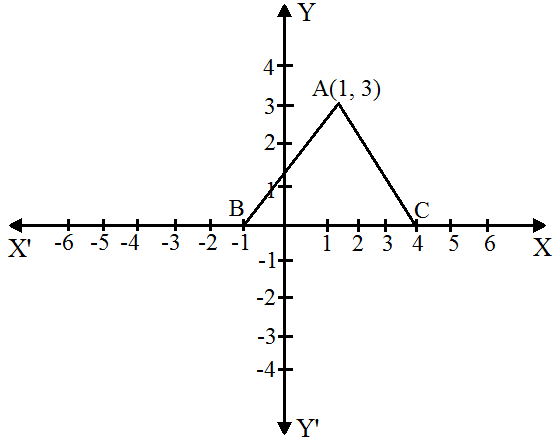
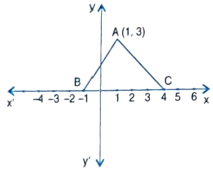
In the figure, the area of ∆ABC (in square units) is:
Answer
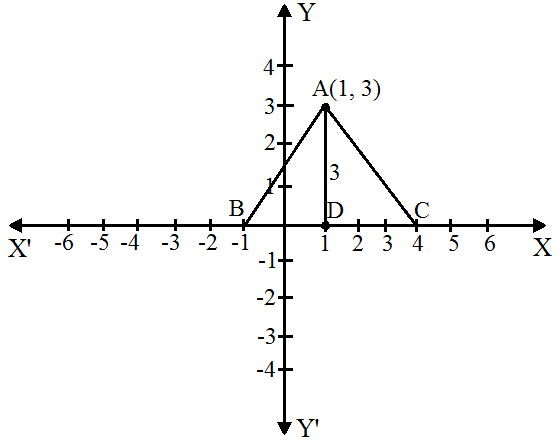
The coordinates of A are (1, 3).
$\therefore$ Distance of A from the x-axis, AD = y-coordinate of A = 3units.
The number of units between B and C on the x-axis are 5.
$\therefore$ BC = 5units
Now,
Area of $\triangle\text{ABC}=\frac{1}{2}\times\text{BC}\times\text{AD}$
$=\frac{1}{2}\times5\times3=\frac{15}{2}=7.5\text{ sq.units}$
Thus, the area of ∆ABC is 7.5sq. units. View full question & answer→MCQ 111 Mark
If P(2, 4), Q(0, 3), R(3, 6) and S(5, y) are the vertices of a paralelogram PQRS, then the value of y is:
AnswerIt is given that P(2, 4), Q(0, 3), R(3, 6) and S(5, y) are the vertices of a parallelogram PQRS.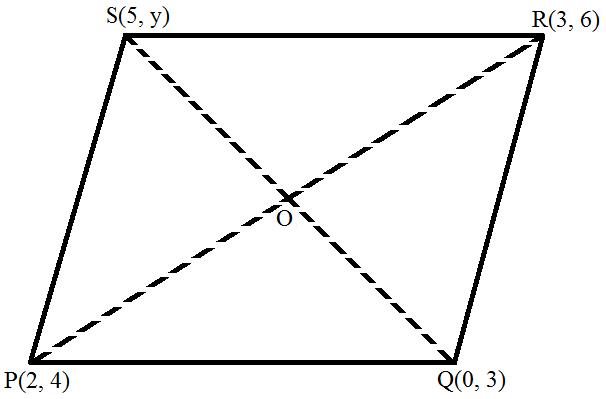
Join PR and QS, intersecting each other at O.
We know that the diagonals of the parallelogram bisect each other. So, O is the mid-point of PR and QS.
Coordinates of mid-point of $\text{PR}=\Big(\frac{2+3}{2},\frac{4+6}{2}\Big)$
$=\Big(\frac{5}{2},\frac{10}{2}\Big)=\Big(\frac{5}{2},5\Big)$
Coordinates of mid-point of $\text{QS}=\Big(\frac{0+5}{2},\frac{3+\text{y}}{2}\Big)$
$=\Big(\frac{5}{2},\frac{3+\text{y}}{2}\Big)$
Now, these points coincides at the point O.
$\therefore\ \Big(\frac{5}{2},\frac{3+\text{y}}{2}\Big)=\Big(\frac{5}{2},5\Big)$
$\Rightarrow\ \frac{3+\text{y}}{2}=5$
⇒ 3 + y = 10
⇒ y = 7
Thus, the value of y is 7. View full question & answer→MCQ 121 Mark
The coordinates of the point on $x-$axis which are equidistant from the points $(-3, 4)$ and $(2, 5)$ are:
Answer$\because$ The point is on $x-$axis.
$\therefore$ Its ordinate will be $= 0$
Let the points be $P(x, 0)$ which is equidistant from $A(-3, 4)$ and $B(2, 5)$
$PA = PB \Rightarrow PA^2 = PB^2$
Now, $PA^2 = (-3 - x)^2 + (4 - 0)^2$
$= (-3 - x)^2 + (4)^2$
$= 9 + x^2 + 6x + 16 = x^2 + 6x + 25$
and $PB^2 = (2 - x)^2 + (5 - 0)^2 = (2 - x)^2 + (5)^2$
$= 4 - 4x + x^2 + 25$
$= x^2 - 4x + 29$
$\therefore x^2 + 6x + 25 = x^2 - 4x + 29$
$\Rightarrow x^2 + 6x - x^2 + 4x = 29 - 25$
$\Rightarrow 10x = 4$
$\Rightarrow\ \text{x}=\frac{4}{10}=\frac{2}{5}$
Point will be $\Big(\frac{2}{5},0\Big).$
View full question & answer→MCQ 131 Mark
The line segment joining points (-3, -4) and (1, -2) is divided by y-axis in the ratio:
AnswerThe point lies on y-axis.Its abscissa will be zero.
Let the point divides the line segment joining the points (-3, -4) and (1, -2) in the ratio m : n
$\therefore\ 0=\frac{\text{mx}_2+\text{nx}_1}{\text{m}+\text{n}}\Rightarrow\ 0=\frac{\text{m}\times1+\text{n}\times(-3)}{\text{m}+\text{n}}$
$\Rightarrow\ \frac{\text{m}-3\text{n}}{\text{m}+\text{n}}=0\Rightarrow\ \text{m}-3\text{n}=0$
$\Rightarrow\ \text{m}=3\text{n}\Rightarrow\ \frac{\text{m}}{\text{n}}=\frac{3}{1}$
$\therefore$ Ratio = 3 : 1
View full question & answer→MCQ 141 Mark
If the point P(2, 1) lies on the line segment joining points A(4, 2) and B(8, 4), then:
- A
$\text{AP}=\frac{1}{3}\text{AB}$
- B
$\text{AP}=\text{BP}$
- C
$\text{BP}=\frac{1}{3}\text{AB}$
- ✓
$\text{AP}=\frac{1}{2}\text{AB}$
AnswerCorrect option: D. $\text{AP}=\frac{1}{2}\text{AB}$
Use section formula for finding out the ratio in which P divided the line segment AB.$(2,1)=\Big(\frac{\text{m}_1(8)+\text{m}_2(4)}{\text{m}_1+\text{m}_2},\frac{\text{m}_1(4)+\text{m}_2(2)}{\text{m}_1+\text{m}_2}\Big)$
$\Rightarrow\ 2=\frac{8\text{m}_1+4\text{m}_2}{\text{m}_1+\text{m}_2};\ 1=\frac{4\text{m}_1+2\text{m}_2}{\text{m}_1+\text{m}_2}$
$\Rightarrow\ 3\text{m}_1+\text{m}_2=0$
$\Rightarrow\ \frac{\text{m}_1}{\text{m}_2}=-\frac{1}{3}$
$\therefore$ The point P divided AB in ratio 1 : 3 externally.
AP : PB = 1 : 3
⇒ AP : AB = 1 : 2
$\Rightarrow\ \text{AP}=\frac{1}{2}\text{AB}$
View full question & answer→MCQ 151 Mark
If (x, 2), (-3, -4) and (7, -5) are coliinear, then x =
AnswerArea of triangle whose vertices are (x, 2), (-3, -4) and (7, -5)
$=\frac{1}{2}[\text{x}_1(\text{y}_2-\text{y}_3)+\text{x}_2(\text{y}_3-\text{y}_1)+\text{x}_3(\text{y}_1-\text{y}_2)]$
$=\frac{1}{2}[\text{x}(-4+5)+(-3)(-5-2)+7(2+4)]$
$=\frac{1}{2}[\text{x}\times1+(-3)(-7)+7\times6]$
$=\frac{1}{2}(\text{x}+21+42)=\frac{1}{2}(\text{x}+63)$
$\because$ The points are collinear
$\therefore$ Area of the $\triangle=0$
$\Rightarrow\ \frac{1}{2}(\text{x}+63)=0$
$\Rightarrow\ \text{x}+63=0$
$\Rightarrow\ \text{x}=-63$
View full question & answer→MCQ 161 Mark
The ratio in which (4, 5) divides the join of (2, 3) and (7, 8) is:
AnswerLet the point (4, 5) divides the line segment joining the points (2, 3) and (7, 8) in the ratio m : n
$\therefore\ 4=\frac{\text{mx}_2+\text{nx}_1}{\text{m}+\text{n}}=\frac{\text{m}\times7+\text{n}\times2}{\text{m}+\text{n}}$
⇒ 4(m + n) = 7m + 2n
⇒ 4m + 4n = 7m + 2n
⇒ 4n - 2n = 7m - 4m
⇒ 2n = 3m
$\Rightarrow\ \frac{\text{m}}{\text{n}}=\frac{2}{3}$
$\therefore$ m : n = 2 : 3
View full question & answer→MCQ 171 Mark
If points (a, 0), (0, b) and (1, 1) are collinear, then $\frac{1}{\text{a}}+\frac{1}{\text{b}}=$
AnswerThe area of triangle whose vertices are (a, 0), (0, b) and (1, 1).
$=\frac{1}{2}[\text{x}_1(\text{y}_2-\text{y}_3)+\text{x}_2(\text{y}_3-\text{y}_1)+\text{x}_3(\text{y}_1-\text{y}_2)]$
$=\frac{1}{2}[\text{a}(\text{b}-1)+0(1-0)+1(0-\text{b})]$
$=\frac{1}{2}[\text{ab}-\text{a}+0-\text{b}]$
$=\frac{1}{2}(\text{ab}-\text{a}-\text{b})$
$\because$ The points are collinear
$\therefore\ \frac{1}{2}(\text{ab}-\text{a}-\text{b})=0$
$\Rightarrow\ \text{ab}-\text{a}-\text{b}=0$
$\Rightarrow\ \text{ab}=\text{a}+\text{b}\Rightarrow\ \frac{\text{a}+\text{b}}{\text{ab}}=1$
$\Rightarrow\ \frac{\text{a}}{\text{ab}}+\frac{\text{b}}{\text{ab}}=1$
$\Rightarrow\ \frac{1}{\text{b}}+\frac{1}{\text{a}}=1$
$\Rightarrow\ \frac{1}{\text{a}}+\frac{1}{\text{b}}=1$
View full question & answer→MCQ 181 Mark
The perimeter of the triangle formed by the points (0, 0), (0, 1) and (0, 1) is:
- A
$1\pm\sqrt{2}$
- B
$\sqrt{2}+1$
- C
$3$
- ✓
$2+\sqrt{2}$
AnswerCorrect option: D. $2+\sqrt{2}$
We have a triangle $\triangle\text{ABC}$ whose co-ordinates are A(0, 0), B(1, 0), C(0, 1). So clearly the triangle is right angled triangle, right angled at A. So,AB = 1 units
AC = 1 units
Now apply Pythagoras theorem to get the hypotenuse,
$\text{BC}=\sqrt{\text{AB}^2+\text{AC}^2}$
$=\sqrt{2}$
So the perimeter of the triangle is,
$=\text{AB}+\text{BC}+\text{AC}$
$=1+1+\sqrt{2}$
$=2+\sqrt{2}$
View full question & answer→MCQ 191 Mark
If the centroid of the triangle formed by $(7, x), (y, -6)$ and $(9, 10)$ is at $(6, 3),$ then $(x, y) =$
- A
$(4, 5)$
- B
$(5, 4)$
- C
$(-5, -2)$
- ✓
$(5, 2)$
AnswerCorrect option: D. $(5, 2)$
We have to find the unknown co-ordinates.
The co$-$ordinates of vertices are $A(7, x), B(y, -6), C(9, 10).$
The co$-$ordinate of the centroid is $(6, 3).$
We know that the co$-$ordinates of the centroid of a triangle whose vertices are $(x_1, y_1), (x_2, y_2), (x_3, y_3)$ is,
$\Big(\frac{\text{x}_1+\text{x}_2+\text{x}_3}{3},\frac{\text{y}_1+\text{y}_2+\text{y}_3}{3}\Big)$
So,
$(6,3)=\Big(\frac{\text{y}+7+9}{3},\frac{\text{x}-6+10}{3}\Big)$
Compare individual terms on both the sides,
$\frac{\text{x}+4}{3}=3$
So,
$x = 5$
Similarly,
$\frac{\text{y}+16}{3}=6$
So,
$y = 2$
View full question & answer→MCQ 201 Mark
If the centroid of the triangle formed by the points $(3, -5), (-7, 4), (10, -k)$ is at the point $(k, -1),$ then $k =$
AnswerWe have to find the unknown co$-$ordinates.
The co$-$ordinates of vertices are $A(3, -5), B(-7, 4), C(10, -k)$
The co$-$ordinate of the centroid is $(k, -1)$
We know that the co$-$ordinates of the centroid of a triangle whose vertices are $(x_1, y_1), (x_2, y_2), (x_3, y_3)$ is:
$\Big(\frac{\text{x}_1+\text{x}_2+\text{x}_3}{3},\frac{\text{y}_1+\text{y}_2+\text{y}_3}{3}\Big)$
So,
$(\text{k}, -1)=\Big(\frac{3-7+10}{3},\frac{-5+4-\text{k}}{3}\Big)$
Compare individual terms on both the sides,
$k = 2$
View full question & answer→MCQ 211 Mark
A line intersects the $y-$axis and $x-$axis at $P$ and $Q$, respectively. If $(2, -5)$ is the mid$-$point of $PQ,$ then the coordinates of $P$ and $Q$ are, respectively:
- A
$(0, -5)$ and $(2, 0)$
- B
$(0, 10)$ and $(-4, 0)$
- C
$(0, 4)$ and $(-10, 0)$
- ✓
$(0, -10)$ and $(4, 0)$
AnswerCorrect option: D. $(0, -10)$ and $(4, 0)$
Let the coordinates of $P(0, y)$ and $Q(x, 0)$, respectively.
So, the mid$-$point of $P(0, y)$ and $Q(x, 0)$ is
$\text{M}\Big(\frac{0+\text{x}}{2},\frac{\text{y}+0}{2}\Big)$
$\bigg[\because$ mid$-$point of a line segment having points $(x_1, y_1)$ and $(x_2, y_2) =\Big(\frac{\text{x}_1+\text{x}_2}{2},\frac{\text{y}_1+\text{y}_2}{2}\Big)\bigg]$
But it is given that, mid$-$point of $PQ$ is $(2, -5)$
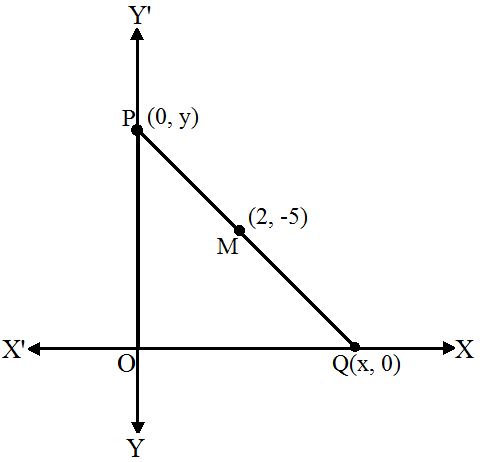
$2=\frac{\text{x}+0}{2}$ and $-5=\frac{\text{y}+0}{2}$
$\Rightarrow 4 = x$ and $-10 = y$
$\Rightarrow x = 4$ and $y = -10$
So, the coordinates of $P$ and $Q$ are $(0, -10)$ and $(4, 0).$ View full question & answer→MCQ 221 Mark
The perimeter of a triangle with vertices (0, 4) and (0, 0) and (3, 0) is:
AnswerA(0, 4) and B(0, 0) and C(3, 0) are the vertices of ∆ABC$\therefore\ \text{AB}=\sqrt{(0-0)^2+(4-0)^2}=\sqrt{0+4^2}$
$=\sqrt{0+16}=\sqrt{16}=4$
$\text{BC}=\sqrt{(0-3)^2+(0-0)^2}=\sqrt{(-3)^2+0^2}$
$=\sqrt{9+0}=\sqrt{9}=3$
$\text{CA}=\sqrt{(3-0)^2+(0-4)^2}=\sqrt{3^2+4^2}$
$=\sqrt{9+16}=\sqrt{25}=5$
$\therefore$ Perimeter = AB + BC + CA
= 4 + 3 + 5 = 12 units
View full question & answer→MCQ 231 Mark
The ratio in which the line segment joining points $A(a_1, b_1)$ and $B(a_2, b_2)$ is divided by $y-$axis is:
- ✓
$-a_1 : a_2$
- B
$a_1 : a_2$
- C
$b_1 : b_2$
- D
$-b_1 : b_2$
AnswerCorrect option: A. $-a_1 : a_2$
Let the point $P$ on $y-$axis, divides the line segment joining the point $A(a_1, b_1)$ and $B(a_2, b_2)$ is the ratio $m_1: m_2$ and let the co$-$ordinates of $P$ be $(0, y),$ then
$0=\frac{\text{m}_1\text{x}_2+\text{m}_2\text{x}_1}{\text{m}_1+\text{m}_2}$
$\Rightarrow\ 0=\frac{\text{m}_1\text{a}_2+\text{m}_2\text{a}_1}{\text{m}_1+\text{m}_2}$
$\Rightarrow\ \text{m}_1\text{a}_2+\text{m}_2\text{a}_1=0$
$\Rightarrow\ \text{m}_1\text{a}_2=-\text{m}_2\text{a}_1$
$\Rightarrow\ \frac{\text{m}_1}{\text{m}_2}=\frac{-\text{a}_1}{\text{a}_2}$
Ratio is $-a_1 : a_2$
View full question & answer→MCQ 241 Mark
If the point $P(x, y)$ is equidistant from $A(5, 1)$ and $B(-1, 5)$, then
- A
$5x = y$
- B
$x = 5y$
- ✓
$3x = 2y$
- D
$2x = 3y$
AnswerCorrect option: C. $3x = 2y$
Points $P(x, y)$ is equidistant from $A(5, 1), B(-1, 5)$
then $AP = BP \Rightarrow AP^2 = BP^2$
$\Rightarrow (5 - x)^2 + (1 - y)^2 = (-1 - x)^2 + (5 - y)^2$
$\Rightarrow 25 + x^2 - 10x + 1 + y^2 - 2y = 1 + x^2 + 2x + 25 + y^2 - 10y$
$\Rightarrow -10x - 2y + 26 = 2x - 10y + 26$
$\Rightarrow 2x + 10x = -2y + 10y$
$\Rightarrow 12x = 8y$
$\Rightarrow 3x = 2y$
View full question & answer→MCQ 251 Mark
If $A(5, 3), B(11, -5)$ and $P(12, y)$ are the vertices of a right triangle right angled at $P,$ then $y =$
- A
$-2, 4$
- B
$-2, 4$
- ✓
$2, -4$
- D
$2, 4$
AnswerCorrect option: C. $2, -4$
We have a right angled triangle $\triangle\text{APC}$ whose co$-$ordinates are $A (5, 3), B (11, -5), P(12, y).$ So clearly the triangle is, right angled at $A.$ So,
$AP^2 = (12 - 5)^2 + (y - 3)^2$
$BP^2 = (12 - 11)^2 + (y + 5)^2$
$AB^2 = (11 - 5)^2 + (-5 - 3)^2$
Now apply Pythagoras theorem to get,
$AB^2 = AP^2 + BP^2$
So,
$100 = 50 + 2y^2 + 34 + 4y$
On further simplification we get the quadratic equation as,
$2y^2 + 4y - 16 = 0$
$y^2 + 2y - 8 = 0$
Now solve this equation using factorization method to get,
$(y + 4)(y - 2) = 0$
Therefore, $y = (2, -4)$
View full question & answer→MCQ 261 Mark
If the centroid of a triangle is (1, 4) and two of its vertices are (4, -3) and (-9, 7), then the area of the triangle is:
AnswerCorrect option: B. $\frac{183}{2}\text{ sq.units}$
Centroid of a triangle = (1, 4)and two vertices of the triangle are (4, -3) and (-9, 7)
Let the third vertex be (x, y), then
$\frac{\text{x}_1+\text{x}_2+\text{x}_3}{3}=1$
$\Rightarrow\ \frac{4-9+\text{x}}{3}=1\Rightarrow\ -5+\text{x}=3$
$\Rightarrow\ \text{x}=3+5=8$
and $\frac{\text{y}_1+\text{y}_2+\text{y}_3}{3}=4$
$\Rightarrow\ \frac{-3+7+\text{y}}{3}=4$
$\Rightarrow\ 4+\text{y}=12\Rightarrow\ \text{y}=12-4=8$
$\therefore$ Third vertex = (8, 8)
Now area of the triangle,
$=\frac{1}{2}[\text{x}_1(\text{y}_2-\text{y}_3)+\text{x}_2(\text{y}_3-\text{y}_1)+\text{x}_3(\text{y}_1-\text{y}_2)]$
$=\frac{1}{2}[4(7-8)+(-9)(8+3)+8(-3-7)]$
$=\frac{1}{2}[4\times(-1)+(-9)\times11+8\times(-10)]$
$=\frac{1}{2}[-4-99-80]=\frac{1}{2}\times(-183)$
$=\frac{183}{2}\text{ sq.units}$
View full question & answer→MCQ 271 Mark
If P is a point on x-axis such that its distance from the origin is 3 units, then the coordinates of a point Q on OY such that OP = OQ, are
AnswerGiven: If P is a point on x axis such that its distance from the origin is 3 units.
To find: The coordinates of a point Q on OY such that OP = OQ.
On x axis y coordinates is 0. Hence the coordinates of point P will be (3, 0) as it is given that the distance from origin is 3 units.
Now then the coordinates of Q on OY such that OP = OQ
On y axis x coordinates is 0. Hence the coordinates of point Q will be (0, 3).
View full question & answer→MCQ 281 Mark
If the coordinates of one end of a diameter of a circle are (2, 3) and the coordinates of its centre are (-2, 5), then the coordinates of the other end of the diameter are:
AnswerLet AB be the diameter of a circle with centre O.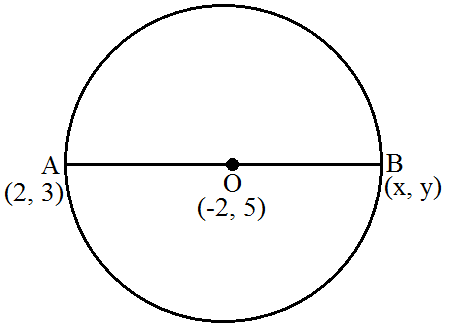
Coordinates of A(2, 3) and O(-2, 5)
Let coordinates of B be (x, y)
$\because\ -2=\frac{2+\text{x}}{2}\Rightarrow\ -4=2+\text{x}$
$\Rightarrow\ \text{x}=-4-2=-6$
and $5=\frac{3+\text{y}}{2}\Rightarrow\ 3+\text{y}=10$
$\Rightarrow\ \text{y}=10-3=7$
Coordinates of other end will be (-6, 7). View full question & answer→MCQ 291 Mark
If (-1, 2), (2, -1) and (3, 1) are any three vertices of a parallelogram, then:
AnswerIn || gm ABCD, diagonals AC and AD bisect each other at O.O is mid-point of AC
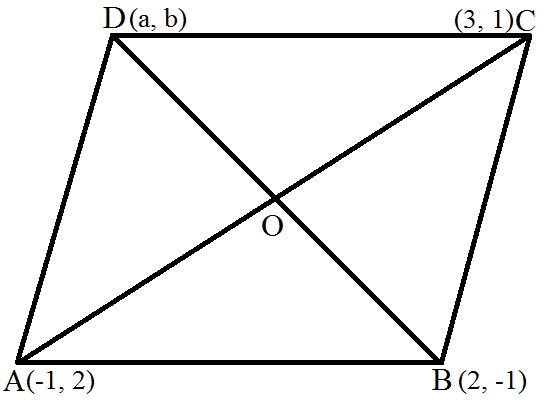
$\therefore$ Co-ordinates of O will be
$\Big(\frac{-1+3}{2},\frac{2+1}{2}\Big)$ or $\Big(\frac{2}{2},\frac{3}{2}\Big)$ or $\Big(1,\frac{3}{2}\Big)$
$\because$ O is mid-point of BD
$\therefore\ \frac{2+\text{a}}{2}=1$ and $\frac{-1+\text{b}}{2}=\frac{3}{2}\Rightarrow\ 2+\text{a}=2$
⇒ a = 2 - 2 = 0
and -1 + b = 3 ⇒ b = 3 + 1 = 4
$\therefore$ a = 0, b = 4 View full question & answer→MCQ 301 Mark
If (-2, 1) is the centroid of the triangle having its vertices at (x, 0), (5, -2), (-8, y), then x, y satisfy the relation:
AnswerAll the given four option are incorrect.
Solution:
(-2, 1) is the centroid of triangle whose vertices are (x, 0), (5, -2), (-8, y)
$\therefore$ Then $\text{x}=\frac{\text{x}_1+\text{x}_2+\text{x}_3}{3}$
$\Rightarrow\ -2=\frac{\text{x}+5-8}{3}\Rightarrow\ -6=\text{x}-3$
$\Rightarrow\ \text{x}=-6+3=-3$
and $1=\frac{0-2+\text{y}}{3}\Rightarrow\ -2+\text{y}=3$
$\Rightarrow\ \text{y}=3+2=5$
$\therefore\ \text{x}=-3,\text{y}=5$
Value of x and y do not satisfy any choice.
View full question & answer→MCQ 311 Mark
If the distance between the points (4, p) and (1, 0) is 5, then p =
AnswerCorrect option: A. $\pm4$
Distance between (4, p) and (1, 0) = 5$\Rightarrow\ \sqrt{(\text{x}_2-\text{x}_1)^2+(\text{y}_2-\text{y}_1)^2}=5$
$\Rightarrow\ \sqrt{(1-4)^2+(0-\text{p})^2}=5$
$\Rightarrow\ \sqrt{(-3)^2+(-\text{p})^2}=5$
Squaring, both sides
$\Rightarrow\ (-3)^2+(-\text{p})^2=(5)^2$
$\Rightarrow\ 9+\text{p}^2=25$
$\Rightarrow\ \text{p}^2=25-9=16$
$\therefore\ \text{p}=\pm\sqrt{16}=\pm4$
View full question & answer→MCQ 321 Mark
The coordinates of the circumcentre of the triangle formed by the points $O(0, 0), A(a, 0)$ and $B(0, b)$ are,
- A
$(\text{a, b})$
- ✓
$\Big(\frac{\text{a}}{2},\frac{\text{b}}{2}\Big)$
- C
$\Big(\frac{\text{b}}{2},\frac{\text{a}}{2}\Big)$
- D
$(\text{b, a})$
AnswerCorrect option: B. $\Big(\frac{\text{a}}{2},\frac{\text{b}}{2}\Big)$
Let co$-$ordinates of $C$ be $(x, y)$ which is the centre of the circumcircle of $\triangle OAB.$
Radii of a circle are equal
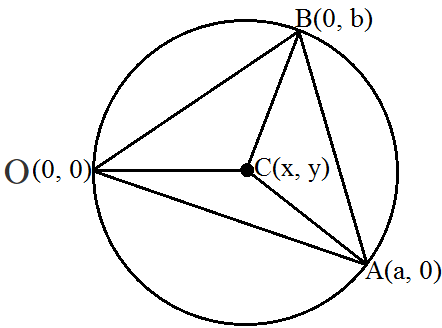
$\therefore OC = CA = CB$
$ \Rightarrow OC^2 = CA^2 = CB^2$
$\therefore (x - 0)^2 + (y - 0)^2 = (x - a)^2 + (y - 0)^2$
$\Rightarrow x^2 + y^2 = (x - a)2 + y^2$
$\Rightarrow x^2 = (x - a)^2$
$\Rightarrow x^2 = x^2 + a^2 - 2ax$
$\Rightarrow a^2 - 2ax = 0$
$\Rightarrow a(a - 2x) = 0$
$\Rightarrow a = 2x$
$\Rightarrow\ \text{x}=\frac{\text{a}}{2}$
and $(x - 0)^2 + (y - 0)^2 = (x - 0)^2 + (y - b)^2$
$x^2 + y^2 = x^2 + y^2 - 2by + b^2$
$\Rightarrow 2by = b^2$
$\Rightarrow\ \text{y}=\frac{\text{b}}{2}$
$\therefore$ Co-ordinates of circumcentre are $\Big(\frac{\text{a}}{2},\frac{\text{b}}{2}\Big).$ View full question & answer→MCQ 331 Mark
If A(x, 2), B(-3, -4) and C(7, -5) are collinear, then the value of x is:
AnswerA(x, 2), B(-3, -4) and C(7, -5) are collinear, then area ∆ABC = 0Now area of $\triangle\text{ABC}=\frac{1}{2}[\text{x}_1(\text{y}_2-\text{y}_3)+\text{x}_2(\text{y}_3-\text{y}_1)+\text{x}_3(\text{y}_1-\text{y}_2)]$
$=\frac{1}{2}[\text{x}(-4+5)+(-3)(-5-2)+7(2+4)]$
$=\frac{1}{2}[\text{x}+21+42]=\frac{1}{2}(63+\text{x})$
$\therefore$ Points are collinear
$\therefore$ area ∆ABC = 0
$=\frac{1}{2}(63+\text{x})=0\Rightarrow\ 63+\text{x}=0$
$\Rightarrow\ \text{x}=-63$
View full question & answer→MCQ 341 Mark
If A(2, 2), B(-4, -4) and C(5, -8) are the vertices of a triangle, then the length of the median through vertices C is:
- A
$\sqrt{65}$
- B
$\sqrt{117}$
- ✓
$\sqrt{85}$
- D
$\sqrt{113}$
AnswerCorrect option: C. $\sqrt{85}$
Let midpoint of A(2, 2), B(-4, -4) be D whose coordinates will be$=\Big(\frac{\text{x}_1+\text{x}_2}{2},\frac{\text{y}_1+\text{y}_2}{2}\Big)=\Big(\frac{2-4}{2},\frac{2-4}{2}\Big)$
or $\Big(\frac{-2}{2},\frac{-2}{2}\Big)$ or (-1, -1)
$\therefore$ Length of median CD
$=\sqrt{(\text{x}_2-\text{x}_1)^2+(\text{y}_2-\text{y}_1)^2}$
$=\sqrt{(5+1)^2+(-8+1)^2}$
$=\sqrt{(6)^2+(-7)^2}=\sqrt{36+49}$
$=\sqrt{85}\text{ units}$
View full question & answer→MCQ 351 Mark
The ratio in which the $x-$axis divides the segment joining $(3, 6)$ and $(12, -3)$ is:
- ✓
$2 : 1$
- B
$1 : 2$
- C
$-2 : 1$
- D
$1 : -2$
AnswerCorrect option: A. $2 : 1$
Let $P(x, 0)$ be the point of intersection of $x-$axis with the line segment joining $A(3, 6)$ and $B(12, -3)$ which divides the line segment $AB$ in the ratio $\lambda:1.$
Now, according to the section formula if point a point $P$ divides a line segment joining $A(x_1, y_1)$ and $B(x_2, y_2)$ in the ratio $m : n$ internally than,
$\text{P(x, y)}=\Big(\frac{\text{nx}_1+\text{mx}_2}{\text{m}+\text{n}},\frac{\text{ny}_1+\text{my}_2}{\text{m}+\text{n}}\Big)$
Now we will use section formula as,
$(\text{x},0)=\Big(\frac{12\lambda+3}{\lambda+1},\frac{-3\lambda+6}{\lambda+1}\Big)$
Now equate the y component on both the sides,
$\frac{-3\lambda+6}{\lambda+1}=0$
On further simplification,
$\lambda=\frac{2}{1}$
So, $x-$axis divides $AB$ in the ratio $\frac{2}{1}.$
View full question & answer→MCQ 361 Mark
The coordinates of a point on $x-$axis which lies on the perpendicular bisector of the line segment joining the points $(7, 6)$ and $(-3, 4)$ are,
- A
$(0, 2)$
- ✓
$(3, 0)$
- C
$(0, 3)$
- D
$(2, 0)$
AnswerCorrect option: B. $(3, 0)$
The given point $P$ lies on $x-$axis.
Let the co$-$ordinates of $P$ be $(x, 0).$
The point $P$ lies on the perpendicular bisector of of the line segment joining the points $A(7, 6), B(-3, 4)$
$\therefore PA = PB \Rightarrow PA^2 = PB^2$
$\Rightarrow (x - 7)^2 + (0 - 6)^2 = (x + 3)^2 + (0 - 4)^2$
$\Rightarrow x^2 - 14x + 49 + 36 = x^2 + 6x + 9 + 16$
$\Rightarrow -14x + 85 = 6x + 25$
$\Rightarrow 6x + 14x = 85 - 25$
$\Rightarrow 20x = 60$
$\Rightarrow\ \text{x}=\frac{60}{20}=3$
$\therefore$ Co$-$ordinates of $P$ will be $(3, 0).$
View full question & answer→MCQ 371 Mark
The distance of the point (4, 7) from the x-axis is:
AnswerThe distance of the point A(4, 7) from x-axis is B(x, 0) where x = 4$\text{AB}=\sqrt{(4-4)^2+(0-7)^2}$
$\sqrt{0^2+49}$
$=7$
View full question & answer→MCQ 381 Mark
If points $A(5, p), B(1, 5), C(2, 1)$ and $D(6, 2)$ form a square $\text{ABCD}$, then $p =$
AnswerThe distance d between two points $(x_1, y_1)$ and $(x_2, y_2)$ is given by the formula,
$\text{d}=\sqrt{(\text{x}_1-\text{x}_2)^2+(\text{y}_1-\text{y}_2)^2}$
In a square all the sides are equal to each other.
Here the four points are $A(5, p), B(1, 5), C(2, 1)$ and $D(6, 2)$.
The vertex $'A\ '$ should be equidistant from $'B\ '$ as well as $'D\ '.$
Let us now find out the distance $'AB'$ and $'AD\ '.$
$\text{AB}=\sqrt{(5-1)^2+(\text{p}-5)^2}$
$\text{AB}=\sqrt{(4)^2+(\text{p}-5)^2}$
$\text{AD}=\sqrt{(5-6)^2+(\text{p}-2)^2}$
$\text{AD}=\sqrt{(-1)^2+(\text{p}-2)^2}$
These two need to be equal.
Equating the above two equations we have,
$AB = AD$
$\sqrt{(4)^2+(\text{p}-5)^2}=\sqrt{(-1)^2+(\text{p}-2)^2}$
Squaring on both sides we have,
$(4)^2 + (p - 5)^2 = (-1)^2 + (p - 2)^2$
$16 + p^2 + 25 - 10p = 1 + p^2 + 4 - 4p$
$6p = 36$
$p = 6$
View full question & answer→MCQ 391 Mark
The distance of the point (4, 7) from the y-axis is:
AnswerThe distance of the point (4, 7) from y-axis means B(0, y) where y = 7$\text{AB}=\sqrt{(0,-4)^2+(7-7)^2}$
$=\sqrt{(-4)^2+(0)^2}=\sqrt{16+0}$
$=\sqrt{16}=4$
View full question & answer→MCQ 401 Mark
If the centroid of the triangle formed by the points $(a, b), (b, c)$ and $(c, a)$ is at the origin, then $a^3 + b^3 + c^3 =$
- A
$abc$
- B
$0$
- C
$a + b + c$
- ✓
$3abc$
AnswerCorrect option: D. $3abc$
Centroid of the triangle formed by the points $(a, b), (b, c)$ and $(c, a)$ is origin $(0, 0).$
$\therefore\ \frac{\text{a}+\text{b}+\text{c}}{3}=0$
$\Rightarrow a + b + c = 0$
$\therefore a^3 + b^3 + c^3 = 3abc$
$\because a + b + c = 0$
Hence $a^3 + b^3 + c^3 = 3abc$
View full question & answer→MCQ 411 Mark
The area of the triangle formed by $(a, b + c), (b, c + a)$ and $(c, a + b)$ is:
- A
$a + b + c$
- B
$abc$
- C
$(a + b + c)^2$
- ✓
$0$
AnswerVertices of a triangle are $(a, b + c), (b, c + a)$ and $(c, a + b)$
Area of $\triangle=\frac{1}{2}[\text{x}_1(\text{y}_2-\text{y}_3)+\text{x}_2(\text{y}_3-\text{y}_1)+\text{x}_3(\text{y}_1-\text{y}_2)]$
$=\frac{1}{2}[\text{a}(\text{c}+\text{a}-\text{a}-\text{b})+\text{b}(\text{a}+\text{b}-\text{b}-\text{c})+\text{c}(\text{b}+\text{c}-\text{c}-\text{a})]$
$=\frac{1}{2}[\text{a}(\text{c}-\text{b})+\text{b}(\text{a}-\text{c})+\text{c}(\text{b}-\text{a})]$
$=\frac{1}{2}[\text{ac}-\text{ab}+\text{ab}-\text{bc}+\text{bc}-\text{ac}]$
$=\frac{1}{2}\times0=0$
View full question & answer→MCQ 421 Mark
The distance between the points $(\cos\theta,\sin\theta)$ and $(\sin\theta,-\cos\theta)$ is:
- A
$\sqrt{3}$
- ✓
$\sqrt{2}$
- C
$2$
- D
$1$
AnswerCorrect option: B. $\sqrt{2}$
We have to find the distance between $\text{A}(\cos\theta,\sin\theta)$ and $\text{B}(\sin\theta,-\cos\theta).$
In general, the distance between $A(x_1, y_1)$ and $B(x_2, y_2)$ is given by,
$\text{AB}=\sqrt{(\text{x}_2-\text{x}_1)^2+(\text{y}_2-\text{y}_1)^2}$
So,
$\text{AB}=\sqrt{(\sin\theta-\cos\theta)^2+(-\cos\theta-\sin\theta)^2}$
$=\sqrt{2(\sin^2\theta+\cos^2\theta)}$
But according to the trigonometric identity,
$\sin^2\theta+\cos^2\theta=1$
Therefore,
$\text{AB}=\sqrt{2}$
View full question & answer→MCQ 431 Mark
The distance between the points $(\text{a}\cos\theta+\text{b}\sin\theta,0)$ and $(0,\text{a}\sin\theta-\text{b}\cos\theta)$ is:
AnswerCorrect option: D. $\sqrt{\text{a}^2+\text{b}^2}$
We have to find the distance between $\text{A}(\text{a}\cos\theta+\text{b}\sin\theta,0)$ and $\text{B}(0,\text{a}\sin\theta-\text{b}\cos\theta).$
In general, the distance between $A(x_1, y_1)$ and $B(x_2, y_2)$ is given by,
$\text{AB}=\sqrt{(\text{x}_2-\text{x}_1)^2+(\text{y}_2-\text{y}_1)^2}$
So,
$=\sqrt{(\text{a}\cos\theta+\text{b}\sin\theta)^2+(-\text{a}\sin\theta+\text{b}\cos\theta)^2}$
$=\sqrt{\text{a}^2\cos^2\theta+\text{b}^2\sin^2\theta+2\text{ab}\sin\theta\cos\theta+\text{a}^2\sin^2\theta+\text{b}^2\cos^2\theta-2\text{ab}\sin\theta\cos\theta}$
$\text{AB}=\sqrt{(\text{a}\cos\theta+\text{b}\sin\theta-0)^2+(0-\text{a}\sin\theta+\text{b}\cos\theta)^2}$
$=\sqrt{\text{a}^2(\sin^2\theta+\cos^2\theta)+\text{b}^2(\sin^2\theta+\cos^2\theta)}$
But according to the trigonometric identity,
$\sin^2\theta+\cos^2\theta=1$
Therefore,
$\text{AB}=\sqrt{\text{a}^2+\text{b}^2}$
View full question & answer→MCQ 441 Mark
If the area of the triangle formed by the points (x, 2x), (-2, 6) and (3, 1) is 5 square units, then x =
- A
$\frac{2}{3}$
- B
$\frac{3}{5}$
- ✓
$2$
- D
$5$
AnswerArea of triangle whose vertices are (x, 2x), (-2, 6) and (3, 1)$=\frac{1}{2}[\text{x}_1(\text{y}_2-\text{y}_3)+\text{x}_2(\text{y}_3-\text{y}_1)+\text{x}_3(\text{y}_1-\text{y}_2)]$
$=\frac{1}{2}[\text{x}(6-1)+(-2)(1-2\text{x})+3(2\text{x}-6)]$
$=\frac{1}{2}[5\text{x}-2+4\text{x}+6\text{x}-18]$
$=\frac{1}{2}[15\text{x}-20]$
$\because$ Area = 5sq. units
$\therefore\ \frac{1}{2}(15\text{x}-20)=5$
$\Rightarrow\ 15\text{x}-20=10$
$\Rightarrow\ 15\text{x}=10+20=30$
$\Rightarrow\ \text{x}=\frac{30}{15}=2$
$\therefore\ \text{x}=2$
View full question & answer→MCQ 451 Mark
If the points $(k, 2k), (3k, 3k)$ and $(3, 1)$ are collinear, then $k:$
- A
$\frac{1}{3}$
- ✓
$\frac{-1}{3}$
- C
$\frac{2}{3}$
- D
$\frac{-2}{3}$
AnswerCorrect option: B. $\frac{-1}{3}$
We have three collinear points $A(k, 2k), B(3k, 3k)$ and $C(3, 1).$
In general if $ A(x_1, y_1), B(x_2, y_2), C(x_3, y_3)$ are collinear then, area of the triangle is 0.
$\frac{1}{2}\Big[\text{x}_1(\text{y}_2 - \text{y}_3) + \text{x}_2(\text{y}_3 - \text{y}_1) + \text{x}_3(\text{y}_1 - \text{y}_2)\Big] = 0$
So,
$k(3k - 1) + 3k(1 - 2k) + 3(2k - 3k) = 0$
So,
$-3k^2- k = 0$
Take out the common terms,
$-k(3k + 1) = 0$
Therefore,
$\text{k}=-\frac{1}{3}$
View full question & answer→MCQ 461 Mark
The length of a line segment joining $A(2, -3)$ and $B$ is $10$ units. If the abscissa of $B$ is $10$ units, then its ordinates can be,
- ✓
$3$ or $-9$
- B
$-3$ or $9$
- C
$6$ or $27$
- D
$-6$ or $-27$
AnswerCorrect option: A. $3$ or $-9$
It is given that distance between $P(2, -3)$ and $Q(10, y)$ is $10.$
In general, the distance between $A(x_1, y_1)$ and $B(x_2, y_2)$ is given by,
$AB^2 = (x_2 - x_1)^2 + (y_2 - y_1)^2$
So, $10^2 = (10 - 2)^2 + (y + 3)^2$
On further simplification,
$(y + 3)^2 = 36$
$\text{y}=-3\pm6$
$= -9, 3$
$y = -9, 3$
View full question & answer→MCQ 471 Mark
The coordinates of the point P dividing the line segment joining the points A(1, 3) and B(4, 6) in the ratio 2 : 1 are:
AnswerPoint P divides the line segment joining the points A(1, 3) and B(4, 6) in the ratio 2 : 1
Let coordinates of P be (x, y), then
$\text{x}=\frac{\text{m}_1\text{x}_2+\text{m}_2\text{x}_1}{\text{m}_1+\text{m}_2}=\frac{2\times4+1\times1}{2+1}$
$=\frac{8+1}{3}=\frac{9}{3}=3$
$\text{y}=\frac{\text{m}_1\text{y}_2+\text{m}_2\text{y}_1}{\text{m}_1+\text{m}_2}=\frac{2\times6+1\times3}{2+1}$
$=\frac{12+3}{3}=\frac{15}{3}=5$
$\therefore$ Coordinates of P are (3, 5).
View full question & answer→MCQ 481 Mark
The point on the x-axis which is equidistant from points (-1, 0) and (5, 0) is:
Answer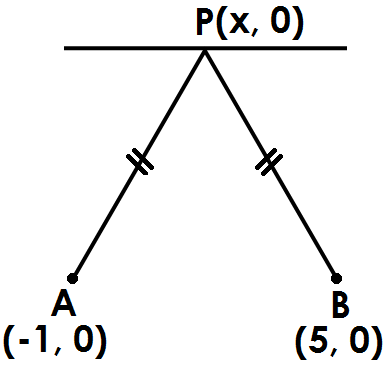
$\text{PA}=\sqrt{(\text{x}+1)^2+(0-0)^2}$
$\text{PA}=\sqrt{(\text{x}-1)^2}\ \ ...(\text{i})$
Similarly,
$\text{PB}=\sqrt{(\text{x}-5)^2+(0-0)^2}$
$\text{PB}=\sqrt{(\text{x}-5)^2}\ \ ...\text{(ii)}$
From equation (i) and (ii)
$\text{PA}=\text{PB}$
$\sqrt{(\text{x}+1)^2}=\sqrt{(\text{x}-5)^2}$
squaring both the side
$(\text{x}+1)^2=(\text{x}-5)^2$
$\text{x}^2+2\text{x}+1=\text{x}^2+25-10\text{x}$
$10\text{x}+2\text{x}=25-1$
$12\text{x}=24$
$\text{x}=2$
Correct option (b) (2, 0). View full question & answer→MCQ 491 Mark
If A(4, 9), B(2, 3) and C(6, 5) are the vertices of ∆ABC, then the length of median through C is:
- A
- ✓
$\sqrt{10}\text{ units}$
- C
- D
AnswerCorrect option: B. $\sqrt{10}\text{ units}$
A(4, 9), B(2, 3) and C(6, 5) are the vertices of ∆ABC
Let median CD has been drawn C(6, 5)
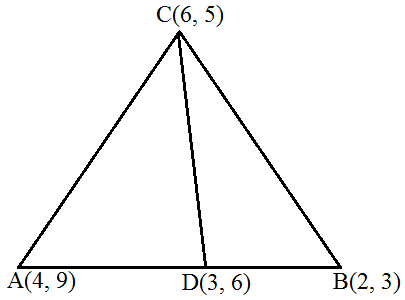
$\therefore$ D is mid-point of AB
$\text{D}=\Big(\frac{4+2}{2},\frac{9+3}{2}\Big)$
$\therefore$ D(3, 6)
$\therefore$ Length of $\text{CD}=\sqrt{(6-3)^2+(5-6)^2}=\sqrt{3^2+(-1)^2}$
$=\sqrt{9+1}=\sqrt{10}\text{ units}$ View full question & answer→MCQ 501 Mark
If the point (x, 4) lies on a circle whose centre is at the origin and radius is 5, then x =
- A
$\pm5$
- ✓
$\pm3$
- C
$0$
- D
$\pm4$
AnswerCorrect option: B. $\pm3$
Point A(x, 4) is on a circle with centre O(0, 0) and radius = 5
$\therefore\ \text{OA}=\sqrt{(\text{x}-0)^2+(4-0)^2}=\sqrt{\text{x}^2+16}$
$\therefore\ \sqrt{\text{x}^2+16}=5$
Squaring both sides,
$\Rightarrow\ \text{x}^2+16=25$
$\Rightarrow\ \text{x}^2=25-16=9=(\pm3)^2$
$\therefore\ \text{x}=\pm3$
View full question & answer→MCQ 511 Mark
The fourth vertex $D$ of a parallelogram $A B C D$ whose three vertices are $A(-2,3), B(6,7)$ and $C$ $(8,3)$ is
- A
$(0,1)$
- ✓
$(0,-1)$.
- C
$(-1,0)$
- D
$(1,0)$
AnswerCorrect option: B. $(0,-1)$.
View full question & answer→MCQ 521 Mark
The points $A(9,0), B(9,6), C(-9,6)$ and $D(-9,0)$ are the vertices of $a$
View full question & answer→MCQ 531 Mark
If the distance between the points $(4, p)$ and $(1,0)$ is 5 , then the value of $p$ is
AnswerCorrect option: B. $\pm 4$
View full question & answer→MCQ 541 Mark
A circle drawn with origin as the centre passes through $(13 / 2,0)$. The point which does not lie in the interior of the circle is
- A
$(-3 / 4,1)$
- B
$(2,7 / 3)$
- C
$(5,-1 / 2)$
- ✓
$(-6,5 / 2)$
AnswerCorrect option: D. $(-6,5 / 2)$
View full question & answer→MCQ 551 Mark
The coordinates of the point which is equidistant from the vertices $O(0,0), A(2 x, 0)$ and $B(0,2 y)$ of triangle $O A B$ are
- ✓
$(x, y)$
- B
$(y, x)$
- C
$(x / 2, y / 2)$
- D
$(y / 2, x / 2)$
AnswerCorrect option: A. $(x, y)$
View full question & answer→MCQ 561 Mark
The point which lies on the perpendicular bisector of the line segment joining the points $A(-2,-5)$ and $B(2,5)$ is
- ✓
$(0,0)$
- B
$(0,2)$
- C
$(2,0)$
- D
$(-2,0)$
AnswerCorrect option: A. $(0,0)$
View full question & answer→MCQ 571 Mark
The points $(-4,0),(4,0)$ and $(0,3)$ are the vertices of a
View full question & answer→MCQ 581 Mark
$A O B C$ is a rectangle whose three vertices are $A(0,3), O(0,0)$ and $B(5,0)$. The length of its diagonal is
AnswerCorrect option: C. $\sqrt{34}$
View full question & answer→MCQ 591 Mark
The distance of the point $P(2,3)$ from the $x$-axis is
View full question & answer→MCQ 601 Mark
The centre of a circle is at $(2,0)$. If one end of a diameter is at $(6,0)$, then the other end is at
- A
$(0,0)$
- B
$(4,0)$
- ✓
$(-2,0)$
- D
$(-6,0)$
AnswerCorrect option: C. $(-2,0)$
(C)$(-2,0)$
Let the coordinates of other end be $(x, y)$. Then, centre $(2,0)$ is the mid-point of the diameter.
$
(2,0)=\left(\frac{x+6}{2}, \frac{y+0}{2}\right) \Rightarrow \frac{x+6}{2}=2, \frac{y+0}{2}=0 \Rightarrow x+6=4, y=0 \Rightarrow x=-2, y=0
$
So, the coordinates of other end are $(-2,0)$.
View full question & answer→MCQ 611 Mark
$ A D$ is a median of $\triangle A B C$ with vertices $A(5,-6), B(6,4)$ and $C(0,0)$. Length $A D$ is equal to
- ✓
$\sqrt{68}$ units
- B
$2 \sqrt{15}$ units
- C
$\sqrt{101}$ units
- D
AnswerCorrect option: A. $\sqrt{68}$ units
(A)$\sqrt{68}$ units
The coordinates of $D$, the mid-point of $B C$, are $\left(\frac{6+0}{2}, \frac{4+0}{2}\right)=(3,2)$.
$
\therefore \quad A D=\sqrt{(5-3)^2+(-6,-2)^2}=\sqrt{4+64}=\sqrt{68} \text { units }
$
View full question & answer→MCQ 621 Mark
If origin is the mid-point of the line segment joining the points $P(a, b)$ and $Q(3,3)$, then the value of $(a+b)$ is
View full question & answer→MCQ 631 Mark
$X O Y Z$ is a rectangle with vertices $X(-3,0), O(0,0), Y(0,4)$ and $Z(x, y)$. The length of each diagonal is
- ✓
- B
$\sqrt{5}$ units
- C
$x^2+y^2$ units
- D
View full question & answer→MCQ 641 Mark
Point $P$ divides the line segment joining the points $A(4,-5)$ and $B(1,2)$ in the ratio $5: 2$. Coordinates of $P$ are
- A
$\left(\frac{5}{2},-\frac{3}{2}\right)$
- B
$\left(\frac{11}{7}, 0\right)$
- ✓
$\left(\frac{13}{7}, 0\right)$
- D
$\left(0, \frac{13}{7}\right)$
AnswerCorrect option: C. $\left(\frac{13}{7}, 0\right)$
View full question & answer→MCQ 651 Mark
If the distance between the points $(3,-5)$ and $(x,-5)$ is 15 units, then the values of $x$ are
- A
$12,-18$
- ✓
$-12,18$
- C
- D
$-9,-12$
AnswerCorrect option: B. $-12,18$
View full question & answer→MCQ 661 Mark
The coordinates of the vertex $A$ of a rectangle $A B C D$ whose three vertices are given as $B(0,0), C(3,0)$ and $D(0,4)$ are:
- A
$(4,0)$
- B
$(0,3)$
- ✓
$(-3,4)$
- D
$(4,3)$
AnswerCorrect option: C. $(-3,4)$
(C)$(0,3)$
Let the coordinates of vertex $A$ be $\left(x_1, y_1\right)$. Then,
$
\begin{array}{ll}
& \left.x_1+3=0+0 \text { and } y_1+0=0+4 \quad \text { [Using: } x_1+x_3=x_2+x_4, y_1+y_3=y_2+y_4\right] \\
\Rightarrow & x_1=-3 \text { and } y_1=4
\end{array}
$
Hence, the coordinates of vertex $A$ are $(-3,4)$.
View full question & answer→MCQ 671 Mark
The distance between the points $P\left(-\frac{11}{3}, 5\right)$ and $Q\left(-\frac{2}{3}, 5\right)$ is
View full question & answer→MCQ 681 Mark
The distance of the point $(-6,8)$ from origin is
View full question & answer→MCQ 691 Mark
The distance of the point $(-1,7)$ from $x$-axis is
View full question & answer→MCQ 701 Mark
The distance between the points $(0,2 \sqrt{5})$ and $(-2 \sqrt{5}, 0)$ is
- ✓
$2 \sqrt{10}$ units
- B
$4 \sqrt{10}$ units
- C
$2 \sqrt{20}$ units
- D
$0$
AnswerCorrect option: A. $2 \sqrt{10}$ units
View full question & answer→MCQ 711 Mark
The distance of the point $(-6,8)$ from the $x$-axis is
View full question & answer→MCQ 721 Mark
The ratio in which the $x$-axis divides the segment joining $A(3,6)$ and $B(-12,-3)$ is
- ✓
$2: 1$
- B
$1: 2$
- C
$-2: 1$
- D
$1:-2$
AnswerCorrect option: A. $2: 1$
View full question & answer→MCQ 731 Mark
If the point $(k, 0)$ divides the line segment joining the points $A(2,-2)$ and $B(-7,4)$ is the ratio $1: 2$, then the value of $k$ is
View full question & answer→MCQ 741 Mark
If the points $A(3,1), B(5, p)$ and $C(7,-5)$ are collinear, then the value of $p$ is
View full question & answer→MCQ 751 Mark
The distance between the points $(a \cos \theta+b \sin \theta, 0)$ and $(0, a \sin \theta-b \cos \theta)$ is
- A
$a^2+b^2$
- B
$a+b$
- C
$a^2-b^2$
- ✓
$\sqrt{a^2+b^2}$
AnswerCorrect option: D. $\sqrt{a^2+b^2}$
View full question & answer→MCQ 761 Mark
The perimeter of a triangle with vertices $(0,4)$ and $(0,0)$ and $(3,0)$ is
View full question & answer→MCQ 771 Mark
If $P(2,4), Q(0,3), R(3,6)$ and $S(5, y)$ are the vertices of a parallelogram $P Q R S$, then the value of $y$ is
View full question & answer→MCQ 781 Mark
If $A(4,9), B(2,3)$ and $C(6,5)$ are the vertices of $\triangle A B C$, then the length of median through $C$ is
AnswerCorrect option: B. $\sqrt{10}$ units
View full question & answer→MCQ 791 Mark
If $A(x, 2), B(-3,-4)$ and $C(7,-5)$ are collinear, then the value of $x$ is
View full question & answer→MCQ 801 Mark
In Fig. the area of $\triangle A B C$ (in square units) is
View full question & answer→MCQ 811 Mark
The point on the $x$-axis which is equidistant from points $(-1,0)$ and $(5,0)$ is
- A
$(0,2)$
- ✓
$(2,0)$
- C
$(3,0)$
- D
$(0,3)$
AnswerCorrect option: B. $(2,0)$
View full question & answer→MCQ 821 Mark
If the coordinates of one end of a diameter of a circle are $(2,3)$ and the coordinates of its centre are $(-2,5)$, then the coordinates of the other end of the diameter are
- ✓
$(-6,7)$
- B
$(6,-7)$
- C
$(6,7)$
- D
$(-6,-7)$
AnswerCorrect option: A. $(-6,7)$
View full question & answer→MCQ 831 Mark
The coordinates of the point $P$ dividing the line segment joining the points $A(1,3)$ and $B(4,6)$ in the ratio 2:1 are
- A
$(2,4)$
- ✓
$(3,5)$
- C
$(4,2)$
- D
$(5,3)$
AnswerCorrect option: B. $(3,5)$
View full question & answer→MCQ 841 Mark
If points $A(x, 2 x), B(3 x, 3 x)$ and $C(3,1)$ are collinear, then a non-zero value of $x$ is
- A
$1 / 3$
- ✓
$-1 / 3$
- C
$2 / 3$
- D
$-2 / 3$
AnswerCorrect option: B. $-1 / 3$
(B)$-1 / 3$
Given points will be collinear if
$
\frac{x-3 x}{x-3}=\frac{2 x-3 x}{2 x-1} \Rightarrow \frac{-2 x}{x-3}=\frac{-x}{2 x-1} \Rightarrow 2(2 x-1)=x-3 \Rightarrow 3 x=-1 \Rightarrow x=-\frac{1}{3}
$
View full question & answer→MCQ 851 Mark
If points $A\left(a^2, 0\right), B\left(0, b^2\right)$ and $C(1,1)$ are collinear, then
- ✓
$\frac{1}{a^2}+\frac{1}{b^2}=1$
- B
$\frac{1}{a}+\frac{1}{b}=1$
- C
$a^2+b^2=1$
- D
$\frac{1}{a^2}+\frac{1}{b^2}=2$
AnswerCorrect option: A. $\frac{1}{a^2}+\frac{1}{b^2}=1$
(A)$\frac{1}{a^2}+\frac{1}{b^2}=1$
Given points are collinear.
$\frac{a^2-0}{a^2-1}=\frac{0-b^2}{0-1} \qquad\left[\right.$ Using $\left.: \frac{x_1-x_2}{x_1-x_3}=\frac{y_1-y_2}{y_1-y_3}\right]$
$\Rightarrow \quad a^2=b^2\left(a^2-1\right) \Rightarrow a^2+b^2=a^2 b^2 \Rightarrow \frac{1}{a^2}+\frac{1}{b^2}=1$
View full question & answer→MCQ 861 Mark
If the area of the triangle formed by the points $O(0,0), A\left(a^{x^2}, 0\right)$ and $B\left(0, a^{6 x}\right)$ is $\frac{1}{2 a^5}$ square units, then $x=$
AnswerCorrect option: D. $-1,-5$
(D)$-1,-5$
Given points form a right triangle $O A B$ right angled at $O$ and two perpendicular sides $O A$ and $O B$.
$\therefore \quad$ Area of $\triangle O A B=\frac{1}{2}(O A \times O B)=\frac{1}{2}\left(a^{x^3} \times a^{6 x}\right)=\frac{1}{2} a^{x^2+6 x}$
It is given that area of $\triangle O A B$ is $\frac{1}{2 a^5}$ square units.
$
\therefore \quad \frac{1}{2} a^{x^2+6 x}=\frac{1}{2} a^{-5} \Rightarrow x^2+6 x=-5 \Rightarrow x^2+6 x+5=0 \Rightarrow(x+1)(x+5)=0 \Rightarrow x=-1,-5
$
View full question & answer→MCQ 871 Mark
In a $\triangle A B C, A B=6, B C=5, C A=4$ and $A D$ bisects angle $A$. If $D$ lies on $B C$, then $B D=$
- ✓
- B
$\frac{31}{10}$
- C
$\frac{9}{2}$
- D
$\frac{29}{10}$
Answer(A)3
Point $D$ divides $B C$ in the ratio $A B: A C$ i.e. $6: 4$ or $3: 2$. Therefore,
$
\frac{B D}{D C}=\frac{3}{2} \Rightarrow \frac{D C}{B D}=\frac{2}{3} \Rightarrow \frac{D C}{B D}+1=\frac{2}{3}+1 \Rightarrow \frac{B D+D C}{B D}=\frac{5}{3} \Rightarrow \frac{B C}{B D}=\frac{5}{3} \Rightarrow \frac{5}{B D}=\frac{5}{3} \Rightarrow B D=3
$
View full question & answer→MCQ 881 Mark
If $D(1,2), E(4,-3), F(-2,4)$ are mid-points of the sides $B C, C A, A B$ respectively of $\triangle A B C$ then the coordinates of the centroid of $\triangle A B C$ are
- A
$(1,0)$
- B
$(1,2)$
- ✓
$(1,1)$
- D
$(2,2)$
AnswerCorrect option: C. $(1,1)$
(C)$(1,1)$
The centroids of triangles DEF and $A B C$ are coincident. So, the coordinates of the centroid of $\triangle A B C$ are $\left(\frac{1+4-2}{3}, \frac{2-3+4}{3}\right)$ i.c. (1, 1).
View full question & answer→MCQ 891 Mark
If $\alpha, \beta, \gamma$ are real roots of the equation $x^3-3 p x^2+3 q x-1=0$ and $A\left(\alpha, \frac{1}{\alpha}\right), B\left(\beta, \frac{1}{\beta}\right)$, $C\left(\gamma, \frac{1}{\gamma}\right)$ are vertices of $\triangle A B C$, then the coordinates of the centroid of $\triangle A B C$ are
- A
$(-p, q)$
- B
$(p,-q)$
- ✓
$(p, q)$
- D
$(-p,-q)$
AnswerCorrect option: C. $(p, q)$
(C)$(p, q)$
Given that $\alpha, \beta, y$ are roots of the equation $x^3-3 p x^2+3 q x-1=0$.
$
\alpha+\beta+\gamma=3 p, \alpha \beta+\beta \gamma+\gamma \alpha=3 q \text { and } \alpha \beta \gamma=1
$
So, the coordinates of centroid of $\triangle A B C$ are $\left(\frac{\alpha+\beta+\gamma}{3}, \frac{1}{3}\left(\frac{1}{\alpha}+\frac{1}{\beta}+\frac{1}{\gamma}\right)\right)$
or, $\quad\left(\frac{\alpha+\beta+\gamma}{3}, \frac{\alpha \beta+\beta \gamma+\gamma \alpha}{3 \alpha \beta \gamma}\right)=\left(\frac{3 p}{3}, \frac{3 q}{3}\right)=(p, q)$
View full question & answer→MCQ 901 Mark
If the points $(t, 2 t),(-2,6)$ and $(3,1)$ are collinear, then $t=$
AnswerCorrect option: B. $4 / 3$
(B)$4 / 3$.
If the points $\left(x_1, y_1\right),\left(x_2, y_2\right)$ and $\left(x_3, y_3\right)$ are collinear, then
$
\frac{x_1-x_2}{x_1-x_3}=\frac{y_1-y_2}{y_1-y_3}
$
So, the points $(t, 2 t),(-2,6)$ and $(3,1)$ will be collinear, if
$
\frac{t+2}{t-3}=\frac{2 t-6}{2 t-1} \Rightarrow(t+2)(2 t-1)=2(t-3)^2 \Rightarrow 2 t^2+3 t-2=2 t^2-12 t+18 \Rightarrow 15 t=20 \Rightarrow t=\frac{4}{3}
$
View full question & answer→MCQ 911 Mark
If origin is the centroid of a triangle whose vertices are $A(a, b), B(b, c)$ and $C(c, a)$, then the value of $a^3+b^3+c^3$ is
- A
$3 b c$
- B
$3 a b$
- C
- ✓
$3 a b c$
AnswerCorrect option: D. $3 a b c$
(D)$3 a b c$
The coordinates of the centroid of $\triangle A B C$ are $\left(\frac{a+b+c}{3}, \frac{a+b+c}{3}\right)$. It is given that centroid is at the origin.
$
\therefore \quad\left(\frac{a+b+c}{3}, \frac{a+b+c}{3}\right)=(0,0) \Rightarrow a+b+c=0 \Rightarrow a^3+b^3+c^3=3 a b c
$
View full question & answer→MCQ 921 Mark
The perpendicular bisector of the line segment joining the points $A(2,3)$ and $B(5,6)$ cuts the $y$-axis at
- A
$(8,0)$
- ✓
$(0,8)$
- C
$(0,-8)$
- D
$(0,7)$
AnswerCorrect option: B. $(0,8)$
(B)$(0,8)$
Let $P(0, y)$ be the point of intersection of $y$-axis and the perpendicular bisector of the line segment $A B$. Then,
$
\begin{aligned}
P A=P B & \Rightarrow P A^2=P B^2 \Rightarrow(0-2)^2+(y-3)^2=(0-5)^2+(y-6)^2 \Rightarrow 4+y^2-6 y+9=25+y^2-12 y+36 \\
& \Rightarrow 6 y=48 \Rightarrow y=8
\end{aligned}
$
Hence, the coordinates of the required point are $(0,8)$.
View full question & answer→MCQ 931 Mark
If $A(5, p), B(1,5), C(2,1)$ and $D(6,2)$ taken in order are the vertices of a square, then $p=$
Answer(C)6
Given points taken in order are the vertices of a square.
$
\therefore \quad p+1=5+2 \Rightarrow p=6 \qquad[Using \quad y_1+y_3=y_2+y_4 ]
$
View full question & answer→MCQ 941 Mark
If $\Lambda(6,1), B(8,2), C(9,4)$, and $D(x, 3)$ are the vertices of a parallelogram $A B C D$, then the value of $x$ is
Answer(B)7
If $P\left(x_1, y_1\right), Q\left(x_2, y_2\right), R\left(x_3, y_3\right)$ and $S\left(x_4, y_4\right)$ are vertices of a parallelogram taken in order, then $x_1+x_3=x_2+x_4$ and $y_1+y_3=y_2+y_4$.
$
\therefore \quad 6+9=8+x \Rightarrow x=7
$
View full question & answer→MCQ 951 Mark
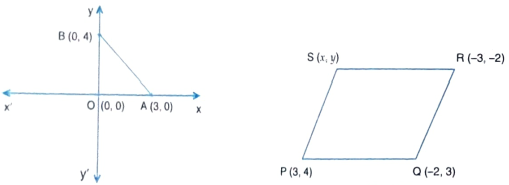
If the vertices of a rhombus $P Q R S$ (see Fig. 6.5) taken in order are $P(3,4), Q(-2,3)$ and $R$ $(-3,-2)$, then the coordinates of its fourth vertex $S$ are
- A
$(-2,-1)$
- B
$(-2,-3)$
- ✓
$(2,-1)$
- D
$(1,2)$
AnswerCorrect option: C. $(2,-1)$
(C)$(2,-1)$
If $\left(x_1, y_1\right),\left(x_2, y_2\right),\left(x_3, y_3\right)$ are vertices of a parallelogram/rectangle/rhombus taken, then the coordi-nates of its fourth vertex are $\left(x_1-x_2+x_3, y_1-y_2+y_3\right)$. So, the coordinates of $S$ are $(3-(-2)+(-3), 4-3+(-2))$ i.e. $(2,-1)$
View full question & answer→MCQ 961 Mark
The perimeter of the triangle wilh vertices $(0,4),(0,0)$ and $(3,0)$ is
Answer(B)12
Clearly, given points form a right $\triangle O A B$ with two legs of length 3 and 4 units and hypotenuse 5 units. Therefore, perimeter of $\triangle O A B=3+5+4=12$.
View full question & answer→MCQ 971 Mark
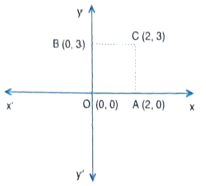
The coordinates of the fourth vertex of the rectangle formed by the points $O(0,0), A(2,0)$ and $B(0,3)$ are
- A
$(3,0)$
- B
$(0,2)$
- ✓
$(2,3)$
- D
$(3,2)$
AnswerCorrect option: C. $(2,3)$
(C)$(2,3)$
It is evident from Fig. 6.3 that the coordinates of $C$ are $(2,3)$.
View full question & answer→MCQ 981 Mark
If $90^{\circ}<\theta<180^{\circ}$, then the distance between the points $P(\tan \theta, 2)$ and $Q(0,3)$ is
AnswerCorrect option: C. $\sec \theta$
(C)$\sec \theta$
$P Q=\sqrt{(\tan \theta-0)^2+(2-3)^2}=\sqrt{1+\tan ^2 \theta}=\sqrt{\sec ^2 \theta}=|\sec \theta|=-\sec \theta$ as, $\sec \theta<0 \quad$ for $90^{\circ}<\theta<180^{\circ}$
View full question & answer→MCQ 991 Mark
The line segment joining the points $A(5,3)$ and $B(-3,11)$ is divided by the point $C(3,5)$ in the ratio
- ✓
$1: 3$
- B
$3: 1$
- C
$2: 3$
- D
$3: 2$
AnswerCorrect option: A. $1: 3$
(A)$1: 3$
The line segment joining point $P\left(x_1, y_1\right)$ and $Q\left(x_2, y_2\right)$ is divided by the point $R(x, y)$ in the ratio $x_1-x: x-x_2$ or, $y_1-y: y-y_2$. Hence, the required ratio is $5-3: 3-(-3)$ or, $1: 3$.
ALITER Let the required ratio be $\lambda: 1$. Then, the coordinates of the point of division i.e. $C$ are $\left(\frac{-3 \lambda+5}{\lambda+1}, \frac{11 \lambda+3}{\lambda+1}\right)$. But, the coordinates of $C$ are $(3,5)$.
$
\begin{array}{l}
\therefore \quad \frac{-3 \lambda+5}{\lambda+1}=3 \text { and } \frac{11 \lambda+3}{\lambda+1}=5 \\
\Rightarrow \quad-3 \lambda+5=3 \lambda+3 \text { and } 11 \lambda+3=5 \lambda+5 \Rightarrow 6 \lambda=2 \text { and } 6 \lambda=2 \Rightarrow \lambda=\frac{1}{3} \\
\text { Hence, required ratio is } 1: 3
\end{array}
$
View full question & answer→MCQ 1001 Mark
If $180^{\circ}<\alpha<360^{\circ}$, then the distance between the point $A(-1,3+2 \cot \alpha)$ and $B(1,3)$ is
AnswerCorrect option: B. $-2 \operatorname{cosec} \alpha$
(B)$-2 \operatorname{cosec} \alpha$
$
\begin{array}{ll}
\text {} & A B=\sqrt{(-1-1)^2+(3+2 \cot \alpha-3)^2}=\sqrt{4+4 \cot ^2 \alpha}=\sqrt{4 \operatorname{cosec}^2 \alpha}=|2 \operatorname{cosec} \alpha|\left[\because \sqrt{x^2}=|x|\right] \\
\Rightarrow & A B=-2 \operatorname{cosec} \alpha \\
& {\left[\because|x|=\left\{\begin{array}{rr}
x, & x \geq 0 \\
-x, & x<0
\end{array}\right]\right.}
\end{array}
$
View full question & answer→MCQ 1011 Mark
The distance between the points $P(2, \tan \alpha)$ and $Q(3,0)$ is
AnswerCorrect option: C. $|\sec \alpha|$
(C)$|\sec \alpha|$
$P Q=\sqrt{(2-3)^2+(\tan \alpha-0)^2}=\sqrt{1+\tan ^2 \alpha}=\sqrt{\sec ^2} \alpha=|\sec \alpha|\qquad\left[\because \sqrt{x^2}=|x|\right]$
View full question & answer→MCQ 1021 Mark
The ratio in which the line segment joining points $A(3,-4)$ and $B(-2,7)$ is divided by $x$-axis is
- A
$3: 2$
- B
$2: 3$
- ✓
$4: 7$
- D
$7: 4$
AnswerCorrect option: C. $4: 7$
(C)$4: 7$
The line segment joining points $A\left(x_1, y_1\right)$ and $\left(x_2, y_2\right)$ is divided by $x$-axis in the ratio $-y_1: y_2$. Hence, the required ratio is $-(-4 ; 7)$ i.e. $4: 7$.
AIITER Let the required ratio be $\lambda: 1$. Then, the coordinates of the point of division are $\left(\frac{-2 \lambda+3}{\lambda+1}, \frac{7 \lambda-4}{\lambda+1}\right)$. It lies on $x$-axis. So, its $y$-coordinate is zero.
$
\therefore \quad \frac{7 \lambda-4}{\lambda+1}=0 \Rightarrow \lambda=\frac{4}{7}
$
Hence, required ratio is $4: 7$.
View full question & answer→MCQ 1031 Mark
The ratio in which the line segment joining the points $A(-2,-3)$ and $B(3,7)$ is divided by $y$-axis is
- ✓
$2: 3$
- B
$1: 3$
- C
$1: 2$
- D
$3: 1$
AnswerCorrect option: A. $2: 3$
(A)$2: 3$
The line segment joining points $A\left(x_1, y_1\right)$ and $B\left(x_2, y_2\right)$ is divided $y$-axis in the ratio $-x_1: x_2$. So, required ratio is $-(-2): 3$ or $2: 3$.
ALITER Let the required ratio be $\lambda: 1$. Then, the coordinates of the point of division are $\left(\frac{3 \lambda-2}{\lambda+1}, \frac{7 \lambda-3}{\lambda+1}\right)$. This point lies on $y$-axis. So, its $x$ coordinate is zero.
i.e. $\qquad\frac{3 \lambda-2}{\lambda+1}=0 \Rightarrow \lambda=\frac{2}{3}$. Hence, required ratio is $2: 3$.
View full question & answer→MCQ 1041 Mark
The point $A$ is on positive $y$-axis at a distance 4 units from the origin. If the coordinates of $B$ are $(-3,0)$ the length of $A B$ is
Answer(B)5 units
The coordinates of $A$ and $B$ are $(0,4)$ and $(-3,0)$ respectively.
$
\therefore \quad A B=\sqrt{(0-(-3))^2+(4-0)^2}=\sqrt{9+16}=5
$
View full question & answer→MCQ 1051 Mark
The distance between the point $P\left(\cos 21^{\circ}, 0\right)$ and $Q\left(0,-\cos 69^{\circ}\right)$ is
Answer(A)1
$P Q=\sqrt{\left(\cos 21^{\circ}-0\right)^2+\left(0+\cos 69^{\circ}\right)^2}=\sqrt{\cos ^2 21^{\circ}+\cos ^2 69^{\circ}}=\sqrt{\cos ^2 21^{\circ}+\sin ^2 21^{\circ}}=1$
View full question & answer→MCQ 1061 Mark
The measure of the angle between the lines $x=2, y=-3$ and the coordinates of the point of intersection of these lines are respectively
- A
$180^{\circ},(2,-3)$
- ✓
$90^{\circ},(2,-3)$
- C
$90^{\circ},(-3,2)$
- D
$90^{\circ},(2,3)$
AnswerCorrect option: B. $90^{\circ},(2,-3)$
(B)$90^{\circ},(2,-3)$
We observe that $x=2$ is a line parallel to $y$-axis on its right and $y=-3$ is a line parallel to $x$-axis below it. These two lines intersect at $(2,-3)$ and are inclined at $90^{\circ}$.
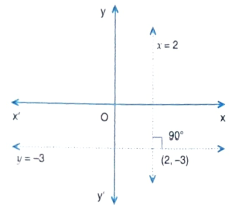
View full question & answer→MCQ 1071 Mark
Find the ratio in which the line segment joining $(2,-3)$ and $(5,6)$ is divided by $x$-axis.
- ✓
$1: 2$
- B
$2: 1$
- C
$2: 5$
- D
$5: 2$
AnswerCorrect option: A. $1: 2$
View full question & answer→MCQ 1081 Mark
Point $(x, y)$ is at a distance of 5 units from the origin. How many such points lie in the third quadrant?
View full question & answer→MCQ 1091 Mark
If the line segment joining the points $(3,-4)$, and $(1,2)$ is trisected at points $P(a,-2)$ and $Q\left(\frac{5}{3}, b\right)$. Then,
- A
$a=\frac{8}{3}, b=\frac{2}{3}$
- ✓
$a=\frac{7}{3}, b=0$
- C
$a=\frac{1}{3}, b=1$
- D
$a=\frac{2}{3}, b=\frac{1}{3}$
AnswerCorrect option: B. $a=\frac{7}{3}, b=0$
View full question & answer→MCQ 1101 Mark
The length of a line segment joining $A(2,-3)$ and $B$ is 10 units. If the abscissa of $B$ is 10 units, then its ordinates can be
View full question & answer→MCQ 1111 Mark
The coordinates of a point on $x$-axis which lies on the perpendicular bisector of the line segment joining the points $(7,6)$ and $(-3,4)$ are
- A
$(0,2)$
- ✓
$(3,0)$
- C
$(0,3)$
- D
$(2,0)$
AnswerCorrect option: B. $(3,0)$
View full question & answer→MCQ 1121 Mark
If points $A(5, p), B(1,5), C(2,1)$ and $D(6,2)$ form a square $A B C D$, then $p=$
View full question & answer→MCQ 1131 Mark
If the point $(x, 4)$ lies on a circle whose centre is at the origin and radius is 5 , then $x=$
- A
$\pm 5$
- ✓
$\pm 3$
- C
$0$
- D
$\pm 4$
AnswerCorrect option: B. $\pm 3$
View full question & answer→MCQ 1141 Mark
A line intersects the $y$-axis and $x$-axis at $P$ and $Q$, respectively. If $(2,-5)$ is the mid-point of $P Q$, then the coordinates of $P$ and $Q$ are, respectively
- A
$(0,-5)$ and $(2,0)$
- B
$(0,10)$ and $(-4,0)$
- C
$(0,4)$ and $(-10,0)$
- ✓
$(0,-10)$ and $(4,0)$
AnswerCorrect option: D. $(0,-10)$ and $(4,0)$
View full question & answer→MCQ 1151 Mark
If the point $P(2,1)$ lies on the line joining points $\Lambda(4,2)$ and $B(8,4)$, then
- A
$A P=\frac{1}{3} A B$
- B
$A P=B P$
- C
$P B=\frac{1}{3} A B$
- ✓
$A P=\frac{1}{2} A B$
AnswerCorrect option: D. $A P=\frac{1}{2} A B$
View full question & answer→MCQ 1161 Mark
The ratio in which the line segment joining points $A\left(a_1, b_1\right)$ and $B\left(a_2, b_2\right)$ is divided by $y$-axis is
- ✓
$-a_1: a_2$
- B
$a_1: a_2$
- C
$b_1: b_2$
- D
$-b_1: b_2$
AnswerCorrect option: A. $-a_1: a_2$
View full question & answer→MCQ 1171 Mark
The ratio in which the line segment joining $P\left(x_1, y_1\right)$ and $Q\left(x_2, y_2\right)$ is divided by $x$-axis is
- A
$y_1: y_2$
- ✓
$-y_1: y_2$
- C
$x_1: x_2$
- D
$-x_1: x_2$
AnswerCorrect option: B. $-y_1: y_2$
View full question & answer→MCQ 1181 Mark
The coordinates of the fourth vertex of the rectangle formed by the points $(0,0),(2,0),(0,3)$ are
- A
$(3,0)$
- B
$(0,2)$
- ✓
$(2,3)$
- D
$(3,2)$
AnswerCorrect option: C. $(2,3)$
View full question & answer→MCQ 1191 Mark
If $(-2,1)$ is the centroid of the triangle having its vertices at $(x, 2),(10,-2),(-8, y)$, then $x, y$ satisfy the relation
- ✓
$3 x+8 y=0$
- B
$3 x-8 y=0$
- C
$8 x+3 y=0$
- D
$8 x=3 y$
AnswerCorrect option: A. $3 x+8 y=0$
View full question & answer→MCQ 1201 Mark
If the centroid of the triangle formed by the points $(3,-5),(-7,4),(10,-k)$ is at the point ( $k,-1$ ), then $k=$
View full question & answer→MCQ 1211 Mark
If the point $P(x, y)$ is equidistant from $A(5,1)$ and $B(-1,5)$, then
- A
$5 x=y$
- B
$x=5 y$
- C
$3 x=2 y$
- ✓
$2 x=3 y$
AnswerCorrect option: D. $2 x=3 y$
View full question & answer→MCQ 1221 Mark
If $P$ is a point on $x$-axis such that its distance from the origin is 3 units, then the coordinates of a point $Q$ on $O Y$ such that $O P=O Q$, are
- ✓
$(0,3)$
- B
$(3,0)$
- C
$(0,0)$
- D
$(0,-3)$
AnswerCorrect option: A. $(0,3)$
View full question & answer→MCQ 1231 Mark
If the centroid of the triangle formed by $(7, x),(y,-6)$ and $(9,10)$ is at $(6,3)$, then $(x, y)=$
- A
$(4,5)$
- B
$(5,4)$
- C
$(-5,-2)$
- ✓
$(5,2)$
AnswerCorrect option: D. $(5,2)$
View full question & answer→MCQ 1241 Mark
If the centroid of a triangle is $(1,4)$ and two of its vertices are $(4,-3)$ and $(-9,7)$, then the area of the triangle is
AnswerCorrect option: B. $\frac{183}{2}$ sq. units
View full question & answer→MCQ 1251 Mark
If points $(a, 0),(0, b)$ and $(1,1)$ are collinear, then $\frac{1}{a}+\frac{1}{b}=$
View full question & answer→MCQ 1261 Mark
If the area of the triangle formed by the points $(x, 2 x),(-2,6)$ and $(3,1)$ is 5 square units, then $x=$
AnswerCorrect option: A. $2 / 3$
View full question & answer→MCQ 1271 Mark
The area of the triangle formed by $(a, b+c),(b, c+a)$ and $(c, a+b)$ is
- A
$a+b+c$
- B
$a b c$
- C
$(a+b+c)^2$
- ✓
$0$
View full question & answer→MCQ 1281 Mark
If $A(5,3), B(11,-5)$ and $P(12, y)$ are the vertices of a right triangle right angled at $P$, then $y=$
AnswerCorrect option: C. $2,-4$
View full question & answer→MCQ 1291 Mark
The coordinates of the point on $x$-axis which are equidistant from the points $(-3,4)$ and $(2,5)$ are
- A
$(20,0)$
- B
$(-23,0)$
- C
$(4 / 5,0)$
- ✓
View full question & answer→MCQ 1301 Mark
If the points $(k, 2 k),(3 k, 3 k)$ and $(3,1)$ are collinear, then $k$
- A
$1 / 3$
- ✓
$-1 / 3$
- C
$2 / 3$
- D
$-2 / 3$
AnswerCorrect option: B. $-1 / 3$
View full question & answer→MCQ 1311 Mark
If three points $(0,0),(3, \sqrt{3})$ and $(3, \lambda)$ form an equilateral triangle, then $\lambda=$
View full question & answer→MCQ 1321 Mark
The distance of the point $(4,7)$ from the $y$-axis is
View full question & answer→MCQ 1331 Mark
If points $(1,2),(-5,6)$ and $( a ,-2)$ are collinear, then $a=$
View full question & answer→MCQ 1341 Mark
The ratio in which $(4,5)$ divides the join of $(2,3)$ and $(7,8)$ is
- A
$-2: 3$
- B
$-3: 2$
- C
$3: 2$
- ✓
$2: 3$
AnswerCorrect option: D. $2: 3$
View full question & answer→MCQ 1351 Mark
If $(x, 2),(-3,-4)$ and $(7,-5)$ are collinear, then $x=$
View full question & answer→MCQ 1361 Mark
If points $(t, 2 t),(-2,6)$ and $(3,1)$ are collinear, then $t=$
- A
$\frac{3}{4}$
- ✓
$\frac{4}{3}$
- C
$\frac{5}{3}$
- D
$\frac{3}{5}$
AnswerCorrect option: B. $\frac{4}{3}$
View full question & answer→MCQ 1371 Mark
The line segment joining points $(-3,-4)$, and $(1,-2)$ is divided by $y$-axis in the ratio
- A
$1: 3$
- B
$2: 3$
- ✓
$3: 1$
- D
$2: 3$
AnswerCorrect option: C. $3: 1$
View full question & answer→MCQ 1381 Mark
If $A(2,2), B(-4,-4)$ and $C(5,-8)$ are the vertices of a triangle, then the length of the median through vertex $C$ is
- A
$\sqrt{65}$
- B
$\sqrt{117}$
- ✓
$\sqrt{85}$
- D
$\sqrt{113}$
AnswerCorrect option: C. $\sqrt{85}$
View full question & answer→MCQ 1391 Mark
The perimeter of the triangle formed by the points $(0,0),(1,0)$ and $(0,1)$ is
- A
$1 \pm \sqrt{2}$
- B
$\sqrt{2}+1$
- C
- ✓
$2+\sqrt{2}$
AnswerCorrect option: D. $2+\sqrt{2}$
View full question & answer→MCQ 1401 Mark
A line segement is of length 10 units. If the coordinates of its one end are $(2,-3)$ and the abscissad of the other end is 10 , then its ordinate is
AnswerCorrect option: B. $3,-9$
View full question & answer→MCQ 1411 Mark
If the distance between the points $(4, p)$ and $(1,0)$ is 5 , then $p=$
AnswerCorrect option: A. $\pm 4$
View full question & answer→MCQ 1421 Mark
If $x$ is a positive integer such that the distance between points $P(x, 2)$ and $Q(3,-6)$ is 10 unut, then $x=$
View full question & answer→MCQ 1431 Mark
The distance between the points $\left(a \cos 25^{\circ}, 0\right)$ and $\left(0, a \cos 65^{\circ}\right)$ is
View full question & answer→MCQ 1441 Mark
The distance between the points $(\cos \theta, \sin \theta)$ and $(\sin \theta-\cos \theta)$ is
AnswerCorrect option: B. $\sqrt{2}$
View full question & answer→MCQ 1451 Mark
If the distance between the points $(2,-2)$ and $(-1, x)$ is 5 , then the sum of the values of $x$ is
View full question & answer→