Questions

M.C.Q (1 Marks)

Take a timed test

15 questions · auto-graded multiple-choice test.

MCQ 11 Mark
Choose the correct answer from the given four options.
The value of $(\tan1^\circ\tan2^\circ\tan3^\circ...\tan89^\circ)$ is:
  • A
    0
  • 1
  • C
    2
  • D
    $\frac{1}{2}$
Answer
Correct option: B.
1
$\tan1^\circ-\tan2^\circ-\tan3^\circ...\tan89^\circ$
$=\tan1^\circ-\tan2^\circ-\tan3^\circ...\tan44^\circ.\tan45^\circ.\tan46^\circ...\tan87^\circ-\tan88^\circ\tan89^\circ$
$=\tan1^\circ-\tan2^\circ-\tan3^\circ...\tan44^\circ.(1)-\tan(90^\circ-44^\circ)...\tan(90^\circ-3^\circ)$
$\tan(90^\circ-2^\circ)-\tan(90^\circ-1^\circ)(\therefore\tan45^\circ=1)$
$=\tan1^\circ-\tan2^\circ-\tan3^\circ...\tan44^\circ.(1).\cot44^\circ......\cot3^\circ-\cot2^\circ-\cot1^\circ$
$[\because\tan(90^\circ-\theta)=\cot\theta]$
$=\tan1^\circ.\tan2^\circ.\tan3^\circ...\tan44^\circ(1).\frac{1}{\tan44^\circ}...\frac{1}{\tan30^\circ}.\frac{1}{\tan2^\circ}.\frac{1}{\tan1^\circ}$
$\Big[\because\cot\theta=\frac{1}{\tan\theta}\Big]$
$=1$
View full question & answer
MCQ 21 Mark
Choose the correct answer from the given four options.
If $\sin\text{A}=\frac{1}{2},$ then the value of $\cot\text{A}$ is:
  • $\sqrt{3}$
  • B
    $\frac{1}{\sqrt{3}}$
  • C
    $\frac{\sqrt{3}}{2}$
  • D
    $1$
Answer
Correct option: A.
$\sqrt{3}$
$\text{Given, }\sin\text{A}=\frac{1}{2}$
$\therefore\ \cos\text{A}=\sqrt{1-\sin^2\text{A}}=\sqrt{1-\Big(\frac{1}{2}\Big)^2}$
$=\sqrt{1-\frac{1}{4}}=\sqrt{\frac{3}{4}}=\frac{\sqrt{3}}{2}$ $[\because\sin^2\text{A}+\cos^2=1\Rightarrow\cos\text{A}=\sqrt{1-\sin^2\text{A}}]$
$\text{Now, }\cot\text{A}=\frac{\cos\text{A}}{\sin\text{A}}=\frac{\frac{\sqrt{3}}{2}}{\frac{1}{2}}=\sqrt{3}.$
View full question & answer
MCQ 31 Mark
Choose the correct answer from the given four options.
Given that $\sin\alpha=\frac{1}{2}\text{ and }\cos\beta=\frac{1}{2}$ then the value of $(\alpha+\beta)$ is:
  • A
  • B
    30º
  • C
    60º
  • 90º
Answer
Correct option: D.
90º
$\text{Given, }\sin\alpha=\frac{1}{2}=\sin30^\circ$ $\Big[\because\sin30^\circ=\frac{1}{2}\Big]$$\Rightarrow\ \alpha=30^\circ$
$\text{and }\cos\beta=\frac{1}{2}=\cos60^\circ$ $\Big[\because\cos60^\circ=\frac{1}{2}\Big]$
$\Rightarrow\ \beta=60^\circ$
$\therefore\ \alpha+\beta=30^\circ+60^\circ=90^\circ$
View full question & answer
MCQ 41 Mark
Choose the correct answer from the given four options. If $4\tan\theta=3,\text{then}\Big(\frac{4\sin\theta-\cos\theta}{4\sin\theta+\cos\theta}\Big)$ is equal to:
  • A
    $\frac{2}{3}$
  • B
    $\frac{1}{3}$
  • $\frac{1}{2}$
  • D
    $\frac{3}{4}$
Answer
Correct option: C.
$\frac{1}{2}$
$\text{Given, }4\tan\theta=3$
$\Rightarrow\tan\theta=\frac{3}{4}\ \ ...(\text{i})$
$\therefore\ \frac{4\sin\theta-\cos\theta}{4\sin\theta+\cos\theta}=\frac{4\frac{\sin\theta}{\cos\theta}-1}{4\frac{\sin\theta}{\cos\theta}+1}$
[divide by $\cos\theta$ in both numerator and denominator]
$=\frac{4\tan\theta-1}{4\tan\theta+1}$ $\bigg[\because\ \tan\theta=\frac{\sin\theta}{\cos\theta}\bigg]$
$=\frac{4\big(\frac{3}{4}\big)-1}{4\big(\frac{3}{4}\big)+1}=\frac{3-1}{3+1}=\frac{2}{4}=\frac{1}{2}$ [put the value from Eq.(i)]
View full question & answer
MCQ 51 Mark
Choose the correct answer from the given four options.
$\sin(45^\circ+\theta)-\cos(45^\circ-\theta)$ is equal to:
  • A
    $2\cos\theta$
  • $0$
  • C
    $2\sin\theta$
  • D
    $1$
Answer
Correct option: B.
$0$
$\sin(45^\circ+\theta)-\cos(45^\circ-\theta)=\cos[90^\circ-(45^\circ+\theta)]-\cos(45^\circ-6)$ $[\therefore\cos(90^\circ-\theta)=\sin0]$$=\cos(45^\circ-0)-\cos(45^\circ-0)$
$=0$
View full question & answer
MCQ 61 Mark
Choose the correct answer from the given four options.
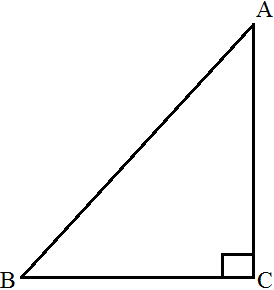
If $\triangle\text{ABC}$ is right angled at C, then the value of $\cos\text{(A+ B)}$ is:
  • $0$
  • B
    $1$
  • C
    $\frac{1}{2}$
  • D
    $\frac{\sqrt{3}}{2}$
Answer
Correct option: A.
$0$
We know that, in $\triangle\text{ABC,}$ sum of three angles = 180º
$\text{i.e., }\angle\text{A}+\angle\text{B}+\angle\text{C}=180^\circ$
But right angled at C. i.e., $\angle\text{C}=90^\circ$ [given]
$\angle\text{A}+\angle\text{B}+90^\circ=180^\circ$
$\Rightarrow\ \ \text{A}+\text{B}=90^\circ$ $[\because\angle\text{A}=\text{A}]$
$\therefore\ \ \cos(\text{A}+\text{B})=\cos90^\circ=0$
View full question & answer
MCQ 71 Mark
Choose the correct answer from the given four options.
If $\cos9\alpha=\sin\alpha\text{ and }9\alpha<90^\circ,$ then the value of $\tan5\alpha$ is:
  • A
    $\frac{1}{\sqrt{3}}$
  • B
    $\frac{\sqrt{3}}{1}$
  • $1$
  • D
    $0$
Answer
Correct option: C.
$1$
$\sin(90^\circ-9\alpha)=\sin\alpha$ $[\because\cos\text{A}=\sin(90^\circ-\text{A})]$
$\Rightarrow\ \ 90^\circ-9\alpha=\alpha$
$\Rightarrow\ \ 10\alpha=90^\circ$
$\Rightarrow\ \ \alpha=9^\circ$
$\therefore\tan5\alpha=\tan(5\times9^\circ)=\tan45^\circ=1$
$[\because\tan45^\circ=1]$
View full question & answer
MCQ 81 Mark
Choose the correct answer from the given four options.
The value of the expression $\Big[\frac{\sin^222^\circ+\sin^268^\circ}{\cos^222^\circ+\cos^268^\circ}+\sin^263^\circ+\cos63^\circ\sin27^\circ\Big]$ is:
  • A
    3
  • 2
  • C
    1
  • D
    0
Answer
Correct option: B.
2
Given expression, $\frac{\sin^222^\circ+\sin^268^\circ}{\cos^222^\circ+\cos^268^\circ}+\sin^263^\circ+\cos63^\circ\sin27^\circ$$=\frac{\sin^222^\circ+\sin^2(90^\circ-22^\circ)}{\cos^2(90^\circ-68^\circ)+\cos^268^\circ}+\sin^263+\cos63^\circ\sin(90^\circ-63^\circ)$
$=\frac{\sin^222^\circ+\cos^222^\circ}{\sin^268^\circ+\cos^268^\circ}+\sin^263^\circ+\cos63^\circ.\cos63^\circ$ $\begin{bmatrix}\because\ \sin(90^\circ-\theta)=\cos\theta \\\text{and }\cos(90^\circ-\theta)=\sin\theta \end{bmatrix}$
$=\frac{1}{1}+(\sin^263^\circ+\cos^263^\circ)$ $[\because\sin^2\theta+\cos^2\theta=1]$
$=1+1=2$
View full question & answer
MCQ 91 Mark
Choose the correct answer from the given four options.
If $\sin A+\sin ^2 A=1$, then the value of the expression $\left(\cos ^2 A+\cos ^4 A\right)$ is:
  • $1$
  • B
    $\frac{1}{2}$
  • C
    $2$
  • D
    $3$
Answer
Correct option: A.
$1$
Given, $\sin A + \sin^2A = 1$
$\Rightarrow\ \sin\text{A}=1-\sin^2\text{A}=\cos^2\text{A}$ $[\because\sin^2\theta+\cos^2\theta=1]$
On squaring both sides, we get
$\sin ^2 A=\cos ^4 A$
$\Rightarrow 1-\cos ^2 A=\cos ^4 A$
$\Rightarrow \cos ^2 A+\cos ^4 A=1$
View full question & answer
MCQ 101 Mark
Choose the correct answer from the given four options.
The value of the expression $[\text{cosec}(75^\circ+\theta)-\sec(15^\circ-\theta)-\tan(55^\circ+\theta)+\cot(35^\circ-\theta)]$ is:
  • A
    –1
  • 0
  • C
    1
  • D
    $\frac{3}{2}$
Answer
Correct option: B.
0
Given, expression $=\text{cosec}(75^\circ+\theta)-\sec(15^\circ-\theta)-\tan(55^\circ+\theta)+\cot(35^\circ-\theta)$$=\text{cosec}[90^\circ-(15^\circ-\theta)]-\sec(15^\circ-\theta)-\tan(55^\circ+\theta)+\cot(90^\circ-(55^\circ+\theta))$
$=\sec(15^\circ-\theta)-\sec(15^\circ-\theta)-\tan(55^\circ+\theta)+\tan(55^\circ+\theta)$
$[\therefore\text{cosec}(90^\circ-\theta)=\sec\theta\text{ and }\cot(90^\circ-\theta)=\tan\theta]$
$=0$
Hence, the required value of the given expression is 0.
View full question & answer
MCQ 111 Mark
Choose the correct answer from the given four options.
Given that $\sin\theta=\frac{\text{a}}{\text{b}},\text{then}\cos\theta$ is equal to:
  • A
    $\frac{\text{b}}{\sqrt{\text{b}^2-\text{a}^2}}$
  • B
    $\frac{\text{b}}{\text{a}}$
  • $\frac{\sqrt{\text{b}^2-\text{a}^2}}{\text{b}}$
  • D
    $\frac{\text{a}}{\sqrt{\text{b}^2-\text{a}^2}}$
Answer
Correct option: C.
$\frac{\sqrt{\text{b}^2-\text{a}^2}}{\text{b}}$
$\text{Given, }\sin\theta=\frac{\text{a}}{\text{b}}$ $[\because\sin^2\theta+\cos^2\theta=1\Rightarrow\cos\theta=\sqrt{1-\sin^2\theta}]$
$\therefore\ \cos\theta=\sqrt{1-\sin^2\theta}$
$=\sqrt{1-\Big(\frac{\text{a}}{\text{b}}\Big)^2}=\sqrt{1-\frac{\text{a}^2}{\text{b}^2}}=\frac{\sqrt{\text{b}^2-\text{a}^2}}{\text{b}}$
View full question & answer
MCQ 121 Mark
Choose the correct answer from the given four options.
If $\cos\text{A}=\frac{4}{5},$ then the value of $\tan\text{A}$ is:
  • A
    $\frac{3}{5}$
  • $\frac{3}{4}$
  • C
    $\frac{4}{3}$
  • D
    $\frac{5}{3}$
Answer
Correct option: B.
$\frac{3}{4}$
$\text{Given,}\cos\text{A}=\frac{4}{5}$$\therefore\ \sin\text{A}=\sqrt{1-\cos^2\text{A}}$ $\begin{bmatrix}\because\sin^2\text{A}+\cos^2\text{A}=1\\\therefore\sin\text{A}=\sqrt{1-\cos^2\text{A}}\end{bmatrix}$
$=\sqrt{1-\Big(\frac{4}{5}\Big)^2}=\sqrt{1-\frac{16}{25}}=\sqrt{\frac{9}{25}}=\frac{3}{5}$
$\text{Now,}\tan\text{A}=\frac{\sin\text{A}}{\cos\text{A}}=\frac{\frac{3}{5}}{\frac{4}{5}}=\frac{3}{4}$
Hence, the required value of $\tan\text{A is }\frac{3}{4}.$
View full question & answer
MCQ 131 Mark
Choose the correct answer from the given four options.
If $\sin\theta-\cos\theta=0,$ then the value of $(\sin^4\theta+\cos^4\theta)$ is:
  • A
    $1$
  • B
    $\frac{3}{4}$
  • $\frac{1}{2}$
  • D
    $\frac{1}{4}$
Answer
Correct option: C.
$\frac{1}{2}$
$\text{Given, }\sin\theta-\cos\theta=0$
$\Rightarrow\ \sin\theta=\cos\theta\Rightarrow\frac{\sin\theta}{\cos\theta}=1$
$\Rightarrow\ \tan\theta=1\bigg[\because\tan\theta=\frac{\sin\theta}{\cos\theta}\text{ and }\tan45^\circ=1\bigg]$
$\Rightarrow\ \tan\theta=\tan45^\circ$
$\therefore\ \theta=45^\circ$
$\text{Now, }\sin^4\theta+\cos^4\theta=\sin^445^\circ+\cos^445^\circ$
$=\Big(\frac{1}{\sqrt{2}}\Big)^4+\Big(\frac{1}{\sqrt{2}}\Big)^4\Big[\because\sin45^\circ=\cos45^\circ=\frac{1}{\sqrt{2}}\Big]$
$=\frac{1}{4}+\frac{1}{4}=\frac{2}{4}=\frac{1}{2}$
View full question & answer
MCQ 141 Mark
Choose the correct answer from the given four options.
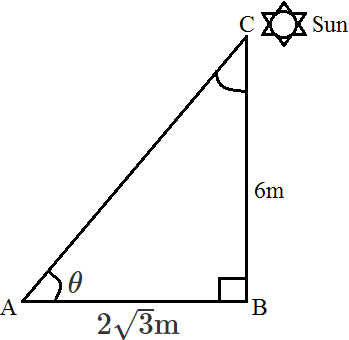
A pole 6m high casts a shadow $2\sqrt{3}\text{m}$ long on the ground, then the Sun’s elevation is:
  • 60º
  • B
    45º
  • C
    30º
  • D
    90º
Answer
Correct option: A.
60º
Let $\text{BC}=6\text{m}$ be the height of the pole and $\text{AB}=2\sqrt{3}\text{m}$ be the lenth of the shadow on the ground. let the Sun's makes an angle $\theta$ on the ground.
$\text{Now, in }\triangle\text{BAC},\ \tan\theta=\frac{\text{BC}}{\text{AB}}$
$\Rightarrow\ \tan\theta=\frac{6}{2\sqrt{3}}=\frac{3}{\sqrt{3}}.\frac{\sqrt{3}}{\sqrt{3}}$
$\Rightarrow\ \tan\theta=\frac{3\sqrt{3}}{3}=\sqrt{3}=\tan60^\circ\ [\because\tan60^\circ=\sqrt{3}]$
$\therefore\ \theta=60^\circ$
Hence, the Sun's elevation is 60°.
View full question & answer
MCQ 151 Mark
Choose the correct answer from the given four options.
If $\cos(\alpha+\beta)=0,$ then $\sin(\alpha-\beta)$ can be reduced to:
  • A
    $\cos\beta$
  • $\cos2\beta$
  • C
    $\sin\alpha$
  • D
    $\sin2\alpha$
Answer
Correct option: B.
$\cos2\beta$
$\text{Given, }\cos(\alpha+\beta)=0=\cos90^\circ$ $[\because\cos90^\circ=0]$
$\Rightarrow\ \alpha+\beta=90^\circ$
$\Rightarrow\ \alpha=90^\circ-\beta\ \ ...(\text{i})$
$\text{Now, }\sin(\alpha-\beta)=\sin(90^\circ-\beta-\beta)$ [put the value from Eq. (i)]
$=\sin(90^\circ-2\beta)$
$=\cos2\beta$ $[\because\sin(90^\circ-\theta)=\cos\theta]$
Hence, $\sin(\alpha-\beta)$ can be reduced to $\cos2\beta.$
View full question & answer