Questions

3 Marks Question

Take a timed test

13 questions · self-marked practice — reveal the answer and mark yourself.

Question 13 Marks
Prove the given identities, where the angles involved are acute angles for which the expressions are defined. $(sin A + cosec A)^2 + (cos A + sec A)^2 = 7 + tan^2A + cot^2A$
Answer
To prove: $(sinA + cosecA)^2 + (cosA + secA)^2 = 7 + tan^2A + cot^2A$
taking L.H.S
Using the formula$ (a+b)^2 = a^2 + b^2 + 2ab to get,$
$= (sin^2A + cosec^2A + 2sinA cosecA) + (cos^2A + sec^2A + 2 cos A sec A)$
Since sin$\theta$ =$\frac {{1 }}{{\ cosec\theta }}$ and $\cos \theta = \frac{1}{{\sec \theta }}$
$=\left(\sin ^{2} A+\csc ^{2} A+2 \sin A \frac{1}{\sin A}\right)+\left(\cos ^{2} A+\sec ^{2} A+2 \cos A \frac{1}{\cos A}\right)$
$= sin^2A + cosec^2A + 2 + cos^2A + sec^2A + 2$
$= (sin^2A + cos^2A) + cosec^2A + sec^2A + 2 + 2$
Using the identities $sin^2A + cos^2A = 1, sec^2A = 1 + tan^2A and cosec^2A = 1 + cot^2A to get$
$= 1+ 1 + tan^2A + 1 + cot^2A + 2 + 2$
$= 1 + 2 + 2 + 2 + tan^2A + cot^2A$
$= 7 + tan^2A + cot^2A$
$= R.H.S.$
Hence proved
View full question & answer
Question 23 Marks
Prove the given identity, where the angles involved are acute angles for which the expressions are defined.$ \frac{{\tan A }}{{1 - \cot A }} + \frac{{\cot A }}{{1 - \tan A }}$ = 1 + sec A cos ecA
[Hint: Write the expression in terms of sin $\theta$ and cos $\theta$]
Answer
LHS-$\frac{{\tan A}}{{1 - \cot A }} + \frac{{\cot A }}{{1 - \tan A }}$
=$\frac{{\tan A}}{{1 - \frac{1}{{\tan A}}}} + \frac{{\frac{1}{{\tan A}}}}{{1 - \tan A}}$
=$\frac{{\tan A}}{{\frac{{\tan A - 1}}{{\tan A}}}} + \frac{1}{{\tan A(1 - \tan A)}}$
=$\frac{{{{\tan }^2}A}}{{\tan A - 1}} + \frac{1}{{\tan A(1 - \tan A)}}$
=$\frac{{{{\tan }^3}A - 1}}{{\tan A(\tan A - 1)}}$
=$\frac{{(\tan A - 1)({{\tan }^2}A + \tan A + 1)}}{{\tan A(\tan A - 1)}}$ $[a^3-b^3=(a-b)(a^2+ab+b^2)]$
=$\frac{{{{\tan }^2}A + \tan A + 1}}{{\tan A}}$
=$\tan A + 1 + \cot A$
=$\frac{{\sin A}}{{\cos A}} + \frac{{\cos A}}{{\sin A}} + 1$
=$\frac{{{{\sin }^2}A + {{\cos }^2}A}}{{\sin A\cos A}} + 1$
=$\frac{1}{{\sin A\cos A}} + 1$
= sec A cosec A+ 1
= R.H.S
View full question & answer
Question 33 Marks
Express the trigonometric ratios sin A, sec A and tan A in terms of cot A.
Answer
We have to express the trigonometric ratios sin A, sec A and tan A in terms of cot A.

For sin A,

By using identity $cosec ^ { 2 } A - \cot ^ { 2 } A = 1$

$\Rightarrow cosec ^ { 2 } A = 1 + \cot ^ { 2 } A$

$\Rightarrow \frac { 1 } { \sin ^ { 2 } A } = 1 + \cot ^ { 2 } A$

$\Rightarrow \sin ^ { 2 } A = \frac { 1 } { 1 + \cot ^ { 2 } A }$

$ \Rightarrow \quad \sin A = \frac { 1 } { \sqrt { 1 + \cot ^ { 2 } A } }$

For sec A,

By using identity $ \sec ^ { 2 } A - \tan ^ { 2 } A = 1$

$ \Rightarrow \sec ^ { 2 } A = 1 + \tan ^ { 2 } A$

$ \Rightarrow \sec ^ { 2 } A = 1 + \frac { 1 } { \cot ^ { 2 } A } = \frac { \cot ^ { 2 } A + 1 } { \cot ^ { 2 } A }$

$ \Rightarrow \sec ^ { 2 } A = \frac { 1 + \cot ^ { 2 } A } { \cot ^ { 2 } A }$

$ \Rightarrow \sec A = \frac { \sqrt { 1 + \cot ^ { 2 } A } } { \cot A }$

For tanA,

$ \tan A = \frac { 1 } { \cot A }$

View full question & answer
Question 43 Marks
In $\triangle A B C$, right angled at B, if $\tan A = \frac { 1 } { \sqrt { 3 } }$. Find the value of cos A cos C - sin A sin C
Answer
Give that 3cot A = 4
Or cot $A = \frac{4}{3}$
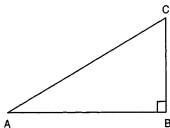
Consider a right angle triangle $\Delta ABC$ right angled at point B.

$\cot A = \frac{{Side\;adjacent\;to\;\angle A}}{{Side\;opposite\;to\;\angle A}}$
$\frac{{AB}}{{BC}} = \frac{4}{3}$
If AB is 4K, BC will be 3K. where K is a positive integer
Now in $\Delta ABC$
$(AC)^2 = (AB)^2 + (BC)^2$
$= (4K)^2 + (3K)^2$
$= 16 K^2 + 9K^2$
$= 25K^2$
$AC = 5K$
$\cos A = \frac{{Side\;adjacent\;to\;\angle A}}{{hypotenuse}} = \frac{{AB}}{{AC}}$
$ = \frac{{4K}}{{5K}} = \frac{4}{5}$
$\sin A = \frac{{Side\;opposite\;to\;\angle A}}{{hypotenuse}} = \frac{{BC}}{{AC}}$
$ = \frac{{3K}}{{5K}} = \frac{3}{5}$
$\tan A = \frac{{Side\;opposite\;to\;\angle A}}{{Side\;adjacent\;to\;angle\;A}} = \frac{{BC}}{{AB}}$
$ = \frac{{3K}}{{4K}} = \frac{3}{4}$
$\frac{{1 - {{\tan }^2}A}}{{1 + {{\tan }^2}A}} = \frac{{1 - {{\left( {\frac{3}{4}} \right)}^2}}}{{1 + {{\left( {\frac{3}{4}} \right)}^2}}} = \frac{{1 - \frac{9}{{16}}}}{{1 + \frac{9}{{16}}}}$
$ = \frac{{\frac{7}{{16}}}}{{\frac{{25}}{{16}}}} = \frac{7}{{25}}$
${\cos ^2}A - {\sin ^2}A = {\left( {\frac{4}{5}} \right)^2} - {\left( {\frac{3}{5}} \right)^2}$
$ = \frac{{16}}{{25}} - \frac{9}{{25}} = \frac{7}{{25}}$
Hence $\frac{{1 - {{\tan }^2}A}}{{1 + {{\tan }^2}A}} = {\cos ^2}A - {\sin ^2}A$
View full question & answer
Question 53 Marks
In $\triangle A B C$, right angled at B, if $\tan A = \frac { 1 } { \sqrt { 3 } }$. Find the value of sin A cos C + cos A sin C.
Answer


we have,
$\tan A = \frac { 1 } { \sqrt { 3 } }$ $= tan30^\circ$
$\therefore A = 30^\circ$
In $\triangle$ABC, we have
$\angle A+\angle B+\angle C=180^\circ$
$\Rightarrow30^\circ+90^\circ+\angle C=180^\circ$
$\Rightarrow120^\circ+\angle C=180^\circ$
$\Rightarrow\angle C=180^\circ-120^\circ=60^\circ$
So,
sinA . cosC + cos A . sin C
$=\sin30^\circ.\cos60^\circ+\cos30^\circ.\sin60^\circ$
$=\frac12\cdot\frac12+\frac{\sqrt3}2\cdot\frac{\sqrt3}2=1$
View full question & answer
Question 63 Marks
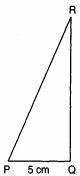
In $ \triangle P Q R$, right angled at $Q, PR + QR = 25 $cm and $PQ = 5 \ cm$. Determine the values of sinP, cosP and tanP.
Answer

In $ \triangle P Q R$ by Pythagoras theorem
$PR^2 = PQ^2 + QR^2$​​​​​​​
$ \Rightarrow ( 25 - Q R ) ^ { 2 } = 5 ^ { 2 } + Q R ^ { 2 } [ \because P R + Q R = 25 \;\mathrm { cm } \Rightarrow P R = 25 - \mathrm { QR } ]$
$625 - 50QR + QR^2 = 25 + QR^2​​​​​​​$​​​​​​​
$ \Rightarrow 600 - 50 Q R = 0$
$ \Rightarrow Q R = \frac { 600 } { 50 } = 12 \;\mathrm { cm }$
Now, $PR + QR = 25 cm$
$ \Rightarrow PR = 25 - Q R = 25 - 12 = 13 cm$
Hence,$\sin P = \frac { Q R } { P R } = \frac { 12 } { 13 } , \cos P = \frac { P Q } { P R } = \frac { 5 } { 13 } \text { and, } \tan P = \frac { Q R } { P Q } = \frac { 12 } { 5 }$
View full question & answer
Question 73 Marks
In $ \triangle$ABC, right angled at B, AB = 24 cm, BC = 7 cm. Determine:
  1. Sin A cos A
  2. Sin C cos C
Answer
Let us draw a right triangle ABC.
15 cot A = 8 ...... Given
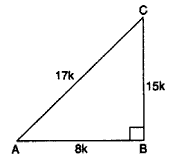
$\Rightarrow \cot A = \frac { 8 } { 15 } \Rightarrow \frac { A B } { B C } = \frac { 8 } { 15 }$
$\Rightarrow \frac { A B } { 8 } = \frac { B C } { 15 } = k ( 5 a y )$
where k is a positive number
$\Rightarrow A B = 8 k$
BC = 15k

By using the Pythagoras theorem, we have
$A C ^ { 2 } = A B ^ { 2 } + B C ^ { 2 }$
$\Rightarrow A C ^ { 2 } = ( 8 k ) ^ { 2 } + ( 15 k ) ^ { 2 } \Rightarrow A C ^ { 2 } = 64 k ^ { 2 } + 225 k ^ { 2 }$
$\Rightarrow A C = \sqrt { 289 k ^ { 2 } } \Rightarrow A C = 17 k$
Now, $\sin A = \frac { B C } { A C } = \frac { 15 k } { 17 k } = \frac { 15 } { 17 }$
and, $\sec A = \frac { A C } { A B } = \frac { 17 k } { 8 k } = \frac { 17 } { 8 }$
View full question & answer
Question 83 Marks
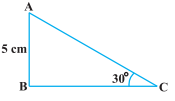
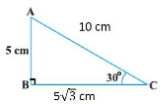
In $\triangle$ABC, right-angled at B, $AB = 5 $ cm and $\angle$$ACB = 30^\circ$. Determine the lengths os sides $BC$ and $AC.$
Answer
Given $AB = 5 cm $
$\angle$$ACB = 30^o$ 

According to diagram,
tan C = $\frac{side \ opposite \ to \ angle \ C}{side \ adjacent \ to \ angle \ C}$
tan $30^o$​​​​​​​ = $\frac{AB}{BC}$
$\frac{1}{\sqrt{3}}$ = $\frac{5}{BC}$
BC = 5$\sqrt{3}$ cm
sin C = $\frac{side \ of \ angle \ C}{hypotenuse}$
sin $30^o​​​​​​​$​​​​​​​ = $\frac{AB}{AC}$
$\frac{1}{2}$ = $\frac{5}{AC}$
$AC = 10 cm.$
View full question & answer
Question 93 Marks
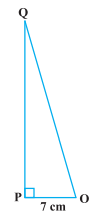
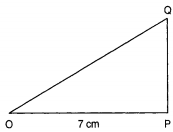
In $\triangle O P Q$ right angled at $P, OP = 7 $cm, $OQ - PQ = 1 cm$. Determine the values of sin $Q$ and cos $Q.$
Answer


In,$\triangle O P Q$ by Pythagoras theorem
$OQ^2 = OP^2 + PQ^2$​​​​​​​
$\Rightarrow ( P Q + 1 ) ^ { 2 } = O P ^ { 2 } + P Q ^ { 2 } \ [ \because O Q - P Q = 1 \Rightarrow O Q = 1 + P Q ]$
$\Rightarrow P Q ^ { 2 } + 2 P Q + 1 = 7 ^ { 2 } + P Q ^ { 2 }$
$\Rightarrow 2 P Q + 1 = 49$
$\Rightarrow 2 P Q = 48$
$\Rightarrow P Q = 24\;\mathrm { cm }$
$\therefore O Q - P Q = 1 \mathrm { cm }$ $\Rightarrow$OQ - 24 = 1 $\Rightarrow$ OQ = 25 cm
Now, $\sin Q = \frac { O P } { O Q } = \frac { 7 } { 25 }$
and, $\cos Q = \frac { P Q } { O Q } = \frac { 24 } { 25 }$
View full question & answer
Question 103 Marks
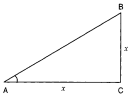
In a right triangle ABC, right-angled at B, if tan A = 1, then verify that 2 sin A cos A = 1.
Answer


In $ \triangle A B C$,
$\tan A = 1$
$\Rightarrow \quad \frac { B C } { A C } = 1$
$\Rightarrow $ BC = x and AC = x
Using Pythagoras theorem,
$\Rightarrow A B ^ { 2 } = A C ^ { 2 } + B C ^ { 2 }$
$\Rightarrow \quad A B ^ { 2 } = x ^ { 2 } + x ^ { 2 }$
$\Rightarrow \quad A B = \sqrt { 2 } x$
$\therefore \quad \sin A = \frac { B C } { A B } = \frac { x } { \sqrt { 2 } x } = \frac { 1 } { \sqrt { 2 } } \text { and } \cos A = \frac { A C } { \sqrt { 2 } x } = \frac { x } { \sqrt { 2 } x } = \frac { 1 } { \sqrt { 2 } } $

2 sin A cos A $= 2 \times \frac { 1 } { \sqrt { 2 } } \times \frac { 1 } { \sqrt { 2 } } = 1$

View full question & answer
Question 113 Marks
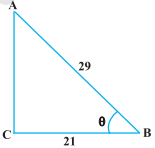
Consider $\triangle A C B$ right angled at C in which $AB =29$ units, $BC =21$ units and $\angle A B C=\theta$. Determine the values of
i. $\cos ^2 \theta+\sin ^2 \theta$
ii. $\cos ^2 \theta-\sin ^2 \theta$
Answer
In, $ \Delta A C B$ we have
$ A B ^ { 2 } = A C ^ { 2 } + B C ^ { 2 }$
$ \Rightarrow \quad A C = \sqrt { A B ^ { 2 } - B C ^ { 2 } } = \sqrt { 29 ^ { 2 } - 21 ^ { 2 } } = \sqrt { ( 29 + 21 ) ( 29 - 21 ) } = \sqrt { 400 } = 20$ units
$ \therefore \quad \sin \theta = \frac { A C } { A B } = \frac { 20 } { 29 }$and $ \cos \theta = \frac { B C } { A B } = \frac { 21 } { 29 }$
  1. Using the values of $ \sin \theta$ and,$ \cos \theta$ we get
    $ \cos ^ { 2 } \theta + \sin ^ { 2 } \theta = \left( \frac { 21 } { 29 } \right) ^ { 2 } + \left( \frac { 20 } { 29 } \right) ^ { 2 }$
    $ = \frac { 441 + 400 } { 841 } = 1$
  2. Using the values of $ \sin \theta$and,$ \cos \theta$ we obtain
    $\cos^2\theta-\sin^2\theta=\left(\frac{21}{29}\right)^2-\left(\frac{20}{29}\right)^2=\frac{21^2-20^2}{29^2}=\frac{(21+20)(21-20)}{841}=\frac{41}{841}$
View full question & answer
Question 123 Marks
Prove that $\frac{{\sin \theta - \cos \theta + 1}}{{\sin \theta + \cos \theta - 1}} = \frac{1}{{\sec \theta - \tan \theta }}$, using identity $sec^2\theta=1+tan^2\theta$.
Answer
We have to prove that,$\frac{{\sin \theta - \cos \theta + 1}}{{\sin \theta + \cos \theta - 1}} = \frac{1}{{\sec \theta - \tan \theta }}$ using identity $sec^2\theta=1+tan^2\theta$

LHS = $\frac{{\sin \theta - \cos \theta + 1}}{{\sin \theta + \cos \theta - 1}} $$ = \frac{{\tan \theta - 1 + \sec \theta }}{{\tan \theta + 1 - \sec \theta }}$ [ dividing the numerator and denominator by $\cos{\theta}$.]

$ = \frac{{(\tan \theta + \sec \theta)-1 }}{{(\tan \theta - \sec \theta )+1}}$$=\frac{\{{(\tan\theta+\sec\theta)-1\}}(tan\theta-\sec\theta)}{\{{(\tan\theta-\sec\theta)+1\}}(\tan\theta-\sec\theta)}$ [ Multiplying and dividing by $(\tan{\theta}-\sec{\theta})$]

$=\frac{{(\tan^2\theta-\sec^2\theta)-}(tan\theta-\sec\theta)}{\{{(\tan\theta-\sec\theta)+1\}}(\tan\theta-\sec\theta)}$ [$\because (a-b)(a+b)=a^2-b^2$]

$ = \frac{{-1-\tan \theta + \sec \theta }}{{(\tan \theta - \sec \theta+1)(\tan{\theta}-\sec{\theta}) }}$[$\because \tan^2\theta-\sec^2\theta=-1$]

$=\frac{-(\tan\theta-\sec\theta+1)}{(\tan\theta-\sec\theta+1)(\tan\theta-\sec\theta)}$$=\frac{-1}{\tan{\theta}-\sec{\theta}}$

$ = \frac{1}{{\sec \theta - \tan \theta }}$=RHS

Hence Proved.

View full question & answer
Question 133 Marks
Given tan A = $\frac{4}{3}$, find all other trigonometric ratios of the angle A.
Answer
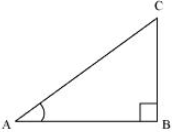
Let us first draw a right $\triangle$ABC
Now, we have given that, tan $A=\frac{B C}{A B}=\frac{4}{3}$
Therefore, if BC = 4k, then AB = 3k, where k is any positive integer.
Now, by using the Pythagoras Theorem, we have
$AC^2 = AB^2 + BC^2 = (4k)^2 + (3k)^2 = 25k$
$So, AC = 5k$
Now, we can write all the trigonometric ratios using their definitions
$\sin A=\frac{B C}{A C}=\frac{4 k}{5 k}=\frac{4}{5}$
$\cos A=\frac{A B}{A C}=\frac{3 k}{5 k}=\frac{3}{5}$
Therefore, cot A = $\frac{1}{\tan A}=\frac{3}{4},cosec A=\frac{1}{\sin A}=\frac{5}{4} $ and $\sec A=\frac{1}{\cos A}=\frac{5}{3}$
View full question & answer