MCQ 11 Mark
If the system of equations has infinitely many solutions, then : $2x + 3y = 7(a + b)x + (2a - b)y = 21$
- A
$a = 1, b = 5$
- ✓
$a = 5, b = 1$
- C
$a = -1, b = 5$
- D
$a = 5, b = -1$
AnswerCorrect option: B. $a = 5, b = 1$
The given systems of equations are
$2 x+3 y=7$
$(a+b) x+(2 a-b) y=21$
For the equations to have infinite number of solutions, $\frac{a_1}{a_2}=\frac{b_1}{b_2}=\frac{c_1}{c_2}$
Here, $a _1=2, a _2=( a + b ), b _1=3, b_2=(2 a - b ), c _1=7, c _2=21$
$\frac{2}{a+b}=\frac{3}{2 a-b}=\frac{7}{21}$
Let us take $\frac{a_1}{a_2}=\frac{b_1}{b_2}$
$\frac{2}{a+b}=\frac{3}{2 a-b}$
By cross multiplication we get,
$2(2 a-b)=3(a+b)$
$4 a-2 b=3 a+3 b$
$4 a-3 a=3 b+2 b$
$a=5 b \ldots \ldots . .(i)$
Now take $\frac{ b _1}{b_2}=\frac{ c _1}{ c _2}$
$\frac{3}{2 a-b}=\frac{7}{21}$
$\frac{3}{2 a-b}=\frac{1}{3}$
By cross multiplication we get,
$3 \times 3=1 \times 2 a-b$
$9=2 a-b \ldots \ldots . .(\text { ii) }$
Substitute $a=5 b$ in the above equation
$9=2 \times 5 b-b$
$9=10 b-b$
$9=9 b$
$\frac{9}{9}=b$
$1=b$
Substitute $b=1$ in equation $(i)$ we get $a=5 b$
$a=5 \times 1$
$a=5$
Therefore $a=5$ and $b=1$
View full question & answer→MCQ 21 Mark
The value of k for which the system of equations x + 2y - 3 = 0 and 5x + ky + 7 = 0 has no solution, is:
AnswerThe given system of equations are
x + 2y - 3 = 0
5x + ky + 7 = 0
For the equations to have no solutions,
$\frac{\text{a}_1}{\text{a}_2}=\frac{\text{b}_1}{\text{b}_2}\neq\frac{\text{c}_1}{\text{c}_2}$
$\frac{1}{5}=\frac{2}{\text{k}}\neq\frac{-3}{7}$
If we take
$\frac{\text{a}_1}{\text{a}_2}=\frac{\text{b}_1}{\text{b}_2}$
$\frac{1}{5}=\frac{2}{\text{k}}$
$\text{k}=10$
Therefore the value of k is10. Hence, correct choice is a.
View full question & answer→MCQ 31 Mark
The sum of the digits of a two digit number is 9. if 27 is added to it, the digits of the number get reversed. The number is:
AnswerSince the sum of the digits of a two-digit number is 9, therefore
x + y = 9 .....(i)
It says if the digits are reversed, the new number is 27 less than the original.
Since we are looking at the number like xy, to separate them, it is actually 10x + y for x is a tens digit.
10y+ x = 10x + y + 27
Simplify it, we get 9y = 9x + 27
y = x + 3 ....(ii)
Substitute (ii) into (i), we will have
x + (x + 3) = 9
⇒ 2x + 3 = 9
⇒ 2x = 6
⇒ x = 3
Put back into equation (i),
⇒ 3 + y = 9
⇒ y = 6
The original number is 36.
View full question & answer→MCQ 41 Mark
If am ≠ bl, then the system of equations $ax + by = clx + my = nax + by = clx + my = n.$
- ✓
- B
- C
Has infinitely many solutions.
- D
May or may not have a solution.
AnswerHas a unique solution.
Given $\text{am}\neq\text{bl},$ the system of equations has
$ax + by = c$
$lx + my = n$
We know that intersecting lines have unique solution $\frac{\text{a}_1}{\text{a}_2}\neq\frac{\text{b}_1}{\text{b}_2}$
$\text{a}_1\times\text{b}_2\neq\text{a}_2\times\text{b}_1$
Here $a_1=a, a_2=l, b_1=b, b_2=m$
$\frac{\text{a}}{\text{l}}\neq\frac{\text{b}}{\text{m}}$
$\text{a}\times\text{m}\neq\text{l}\times\text{b}$
Therefore intersecting lines, have unique solution. Hence, the correct choice is a.
View full question & answer→MCQ 51 Mark
If 2x - 3y = 7 and (a + b)x - (a + b - 3)y = 4a + b represent coincident lines, then a and b satisfy the equation:
AnswerThe given equation are
2a - 3y = 7 ......(i)
(a + b)x - (a + b - 3)y = 4a + b .....(ii)
For coincident lines,
$\frac{\text{a}_1}{\text{a}_2}=\frac{\text{b}_1}{\text{b}_2}=\frac{\text{c}_1}{\text{c}_2}$
$\Rightarrow\frac{2}{(\text{a}+\text{b})}=\frac{-3}{-(\text{a}+\text{b}-3)}=\frac{-7}{-(4\text{a}+\text{b})}$
$\Rightarrow\frac{2}{(\text{a}+\text{b})}=\frac{3}{(\text{a}+\text{b}-3)}$
⇒ 2(a + b - .3) = 3(a + b)
⇒ 2a + 2b - 6 = 3a + 3b
⇒ a + b + 6 = 0 ......(iii)
$\Rightarrow\frac{2}{(\text{a}+\text{b})}=\frac{7}{(4\text{a}+\text{b})}$
⇒ 2(4a + b) = 7(a + b)
⇒ 8a + 2b = 7a + 7b
⇒ a - 5b = 0
⇒ a = 5b .....(iv)
Putting a = 5b in (iii) we get
⇒ 5b + b + 6 = 0
⇒ 6b + 6 = 0
$\Rightarrow\text{b}=\frac{-6}{6}$
⇒ b = -1
Putting b = -1 in (iv) we get
⇒ a = 5(-1)
⇒ a = -5
Thus, a - 5b = 0
View full question & answer→MCQ 61 Mark
The value of k for which the system of equations 3x + 5y = 0 and kx + 10y = 0 has non-zero solution, is:
AnswerThe given equations are
3x + 5y = 0 .....(i)
kx + 10y = 0 ......(ii)
For non-zero solution,
$\frac{\text{a}_1}{\text{a}_2}=\frac{\text{b}_1}{\text{b}_2}$
$\Rightarrow\frac{3}{\text{k}}=\frac{5}{10}$
$\Rightarrow\frac{3}{\text{k}}=\frac{1}{2}$
$\Rightarrow\text{k}=6$
View full question & answer→MCQ 71 Mark
Aruna has only ₹ 1 and ₹ 2 coins with her. If the total number of coins that she has is 50 and the amount of money with her is ₹ 75, then the number of ₹ 1 and ₹ 2 coins are, respectively:
AnswerLet number of ₹ 1 coins = x
and number of ₹ 2 coins = y
Now, by given condition x + y = 50 ..…(i)
Also, x × 1 + y × 2 = 75
⇒ x + 2y = 75 …...(ii)
On subtracting eq. (i) from eq. (ii), we get
(x + 2y) - (x + y) = 75 - 50
⇒ y = 25
When y = 25, then x = 25
View full question & answer→MCQ 81 Mark
The value of $k$ for which the system of equations has a unique solution, is: $kx - y = 2 , 6x - 2y = 3$
- A
$= 3$
- ✓
$\neq 3$
- C
$\neq 0$
- D
$= 0$
AnswerCorrect option: B. $\neq 3$
The given system of equation are
$kx - y = 2$
$6x - 2y =2 $
$\frac{\text{a}_1}{\text{a}_2}\neq\frac{\text{b}_1}{\text{b}_2}$ for unique solutio
Here $a_1=k, a_2=6, b_1=-1, b_2=-2$
$\frac{\text{k}}{6}\neq\frac{-1}{-2}$
By cross multiply we ge
$2\text{k}\neq6$
$\text{k}\neq\frac{6}{2}$
$\text{k}\neq3$
Hence, the correct choice is $b.$
View full question & answer→MCQ 91 Mark
The value of k for which the system, of equations has infinite number of solutions, is:
2x + 3y = 5
4x + ky = 10
AnswerThe given equation are
2x + 3y = 5 ....(i)
4x + ky = 10 ......(ii)
For infinite solution,
$\frac{\text{a}_1}{\text{a}_2}=\frac{\text{b}_1}{\text{b}_2}=\frac{\text{c}_1}{\text{c}_2}$
$\Rightarrow\frac{2}{4}=\frac{3}{\text{k}}=\frac{5}{10}$
$\Rightarrow\frac{2}{4}=\frac{3}{\text{k}}$
$\Rightarrow\frac{1}{2}=\frac{3}{\text{k}}$
$\Rightarrow\text{k}=6$
Thus, k = 6
View full question & answer→MCQ 101 Mark
The area of the triangle formed by the lines y = x, x = 6 and y = 0 is:
Answer18 sq. units
Given x = 6, y = 0 and x = y
We have poltting points as (6, 0) (0, 0) (6, 6) when x = y
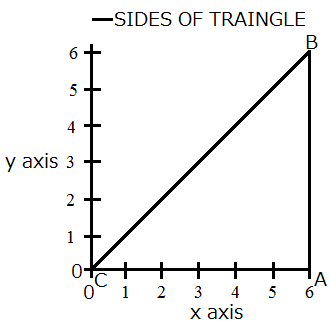
Therefore, area of $\triangle\text{ABC}=\frac{1}{2}\times\text{base}\times\text{height}$
$=\frac{1}{2}(\text{CA}\times\text{AB})$
$=\frac{1}{2}(6\times6)$
$=\frac{1}{2}\times36=18$
Area of triangle ABC is 18 square units.
Hence the correct choice is b. View full question & answer→MCQ 111 Mark
For what value $k,$ do the equations $3x - y + 8 = 0$ and $6x - ky + 16 = 0$ represent:
- A
$\frac{1}{2}$
- B
$-\frac{1}{2}$
- ✓
$2$
- D
$-2$
AnswerLet $3 x-y+8=0$
and $6 x-(-k y)+16=0$
Here, $a_1=3, b_1=-1, c_1=8$
and $a_2=6, b_2=-k, c_2=16$
The given lines are coincident
$\therefore\frac{\text{a}_1}{\text{a}_2}=\frac{\text{b}_1}{\text{b}_2}=\frac{\text{c}_1}{\text{c}_2}$
$\therefore\frac{3}{6}=\frac{-1}{-\text{k}}=\frac{8}{16}$
$\therefore\frac{3}{6}=\frac{-1}{-\text{k}}$
$\therefore-\text{k}=-1\times\frac{6}{3}$
$\Rightarrow\text{k}=2$
View full question & answer→MCQ 121 Mark
If the system of equations is inconsistent, then k = 3x + y = 1(2k - 1)x + (k - 1)y = 2k + 13x + y = 12k - 1x + k - 1 = 2k + 1.
AnswerThe given equation are,
3x + y = 1 .....(i)
(2k - 1)x + (k - 1)y = 2k + 1 ....(ii)
For inconsistencey,
$\frac{\text{a}_1}{\text{a}_2}=\frac{\text{b}_1}{\text{b}_2}\neq\frac{\text{c}_1}{\text{c}_2}$
$\Rightarrow\frac{3}{2\text{k}-1}=\frac{1}{\text{k}-1}\neq\frac{-1}{-2(\text{k}+1)}$
$\Rightarrow\frac{3}{2\text{k}-1}=\frac{1}{\text{k}-1}$
⇒ 3(k - 1) = 2k - 1
⇒ 3k - 3 = 2k - 1
⇒ 3k - 2k = 3 - 1
⇒ k = 2
View full question & answer→MCQ 131 Mark
If a pair of linear equations in two variables is consistent, then the lines represented by two equations are:
- A
- B
- C
- ✓
Intersecting or coincident.
AnswerCorrect option: D. Intersecting or coincident.
If a pair of linear equations in two variables is consistent, then its solution exists.
$\therefore$ The lines represented by the equations are either intersecting or coincident.
Hence, correct choice is d.
View full question & answer→MCQ 141 Mark
The area of the triangle formed by the line $\frac{\text{x}}{\text{a}}+\frac{\text{y}}{\text{b}}=1$ with the coordinate axes is:
- A
$\text{ab}$
- B
$2\text{ab}$
- ✓
$\frac{1}{2}\text{ab}$
- D
$\frac{1}{4}\text{ab}$
AnswerCorrect option: C. $\frac{1}{2}\text{ab}$
Given
$\frac{\text{x}}{\text{a}}+\frac{\text{y}}{\text{b}}=1\ .....(\text{i})$
Eq. (i) cut x-axis and y-axis at a and b respectively.
Area of $\triangle=\frac{1}{2}\times\text{base}\times\text{height}$
$=\frac{1}{2}\times\text{a}\times\text{b}$
$=\frac{1}{2}\text{ab}$
View full question & answer→MCQ 151 Mark
If the system of equations $kx - 5y = 2, 6x + 2y = 7$ has no solution, then $k =$
- A
$-10.$
- B
$-5.$
- C
$-6.$
- ✓
$-15.$
AnswerCorrect option: D. $-15.$
The given equation are,
$kx - 5y = 2$
$6x + 2y = 7$
If $\frac{\text{a}_1}{\text{a}_2}=\frac{\text{b}_1}{\text{b}_2}\neq \frac{\text{c}_1}{\text{c}_2}$
Here $a_1=k, a_2=6, b_1=-5, b_2=2$
$\frac{\text{k}}{6}=\frac{-5}{2}$
$2\text{k}=-30$
$\text{k}=-15$
Hence, the correct choice is $d.$
View full question & answer→MCQ 161 Mark
If the system of equations 2x + 3y = 5, 4x + ky = 10 has infinitely many solutions, then k =
AnswerThe given equation are,
2x + 3y = 5 .....(i)
4x + ky = 10 ......(ii)
For nfinitely many solution,
$\frac{\text{a}_1}{\text{a}_2}=\frac{\text{b}_1}{\text{b}_2}=\frac{\text{c}_1}{\text{c}_2}$
$\Rightarrow\frac{2}{4}=\frac{3}{\text{k}}=\frac{-5}{-10}$
$\Rightarrow\frac{2}{4}=\frac{3}{\text{k}}$
$\Rightarrow\text{k}=\frac{3\times4}{2}$
$\Rightarrow\text{k}=6$
Thus, k = 6
View full question & answer→MCQ 171 Mark
The area of the triangle formed by the lines 2x + 3y = 12, x - y - 1 = 0 and x = 0.
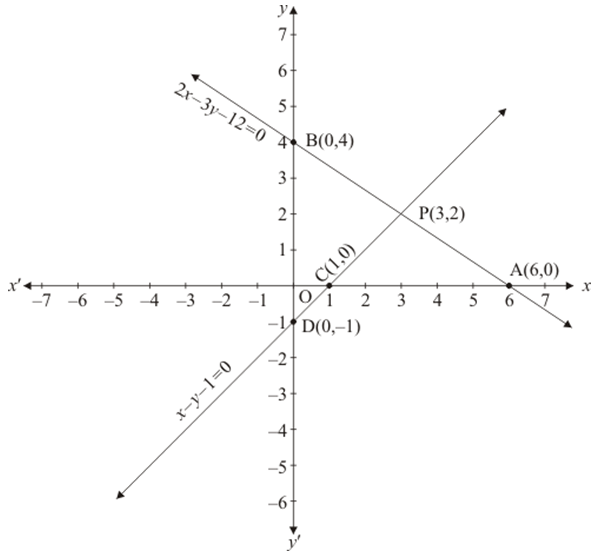
AnswerGiven 2x + 3y = 12, x - y - 1 = 0 and x = 0
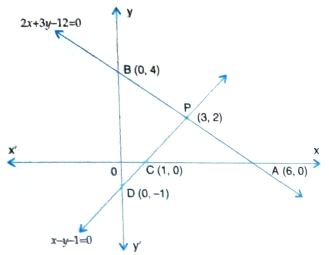
If x = 0 we have plotting points as D(0, -1), B(0, 4), P(3, 2)
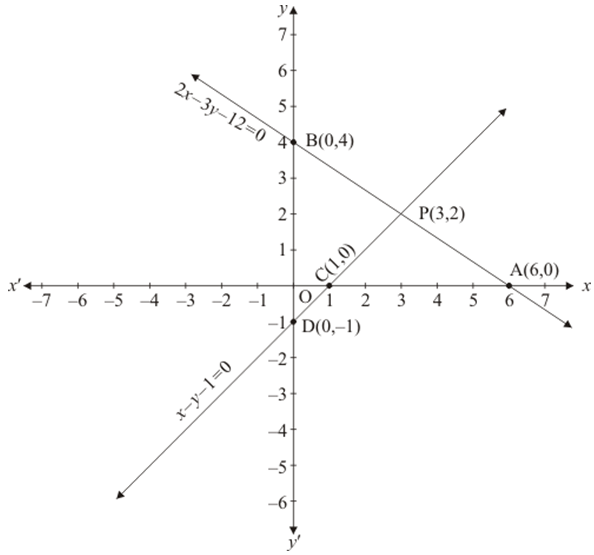
Therefore, area os $\text{BPD}=\frac{1}{2}(\text{Base}\times\text{Height})$
$=\frac{1}{2}(\text{BP}\times\text{PM})$
$=\frac{1}{2}(5\times3)$
$=\frac{1}{2}(15)$
$=7.5$
Area of triangle ABC is 7.5 square units.
Hence, the correct choice is b. View full question & answer→MCQ 181 Mark
The area of the triangle formed by the lines x = 3, y = 4 and x = y is:
- ✓
$\frac{1}{2}$ sq. unit
- B
- C
- D
AnswerCorrect option: A. $\frac{1}{2}$ sq. unit
Given x = 3, y = 4 and x = y
Thus, when x = 1, then y = 1
So, area of $\triangle=\frac{1}{2}\times\text{base}\times\text{height}$
$=\frac{1}{2}\times1\times1$
$=\frac{1}{2}$ sq. unit
View full question & answer→MCQ 191 Mark
If x = a, y = b is the solution of the systems of equations x - y = 2 and x + y = 4, then the values of a and b are, respectively.
AnswerSince, x = a and y = b is the solution of the equations x - y = 2 and x + y = 4, then these values will satisfy that equations
a - b = 2 .....(i)
and a + b = 4 .....(ii)
By adding (i) and (ii) we get
2a = 6
Therefore, a = 3
By putting a = 3 in (i), we get
3 - b = 2 Therefore, b = 1
Thus, a = 3, b = 1
View full question & answer→MCQ 201 Mark
The value of k for which the system of equations has no solution is:
x + 2y = 5
3x + ky + 15 = 0
AnswerThe given system of equation is
x + 2y = 5
3x + ky + 15 = 0
If $\frac{\text{a}_1}{\text{a}_2}=\frac{\text{b}_1}{\text{b}_2}=\frac{\text{c}_1}{\text{c}_2}$ then the equation have no solution
$\frac{1}{3}=\frac{2}{\text{k}}=\frac{-5}{-15}$
By cross multiply we get
k × 1 = 3 × 2
k = 6
Hence, the correct choice is a.
View full question & answer→MCQ 211 Mark
If the system of equations has infinitely many solutions, then:
2x + 3y = 7
2ax + (a + b)y = 28
AnswerThe given equation are,
2x + 3y = 7 .....(i)
2ax + (a + b)y = 28 .....(ii)
For infinite many solutions,
$\frac{\text{a}_1}{\text{a}_2}=\frac{\text{b}_1}{\text{b}_2}=\frac{\text{c}_1}{\text{c}_2}$
$\Rightarrow\frac{2}{2\text{a}}=\frac{3}{(\text{a}+\text{b})}=\frac{-7}{-28}$
$\Rightarrow\frac{2}{2\text{a}}=\frac{-7}{-28}$
$\Rightarrow\frac{1}{\text{a}}=\frac{1}{4}$
$\Rightarrow\text{a}=4$
and, $\frac{3}{(\text{a}+\text{b})}=\frac{1}{4}$
$\Rightarrow\text{a}+\text{b}=12$
$\Rightarrow4+\text{b}=12$
$\Rightarrow\text{b}=8$
Thus, b = 2a
View full question & answer→MCQ 221 Mark
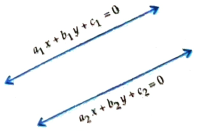
The following pair of lines are non-intersecting. Which of the following statements is true?
- A
$\frac{a_1}{a_2}=\frac{b_1}{b_2}=\frac{c_1}{c_2}$
- ✓
$\frac{a_1}{a_2}=\frac{b_1}{b_2} \neq \frac{c_1}{c_2}$
- C
$\frac{a_1}{a_2}=\frac{b_1}{b_2}=\frac{c_1}{c_2}$
- D
$\frac{a_1}{a_2} \neq \frac{b_1}{b_2} \neq \frac{c_1}{c_2}$
AnswerCorrect option: B. $\frac{a_1}{a_2}=\frac{b_1}{b_2} \neq \frac{c_1}{c_2}$
(B)$\frac{a_1}{a_2}=\frac{b_1}{b_2} \neq \frac{c_1}{c_2}$
If $\frac{a_1}{a_2}=\frac{b_1}{b_2} \neq \frac{c_1}{c_2}$, then the lines representing linear equations $a_1 x+b_1 y+c_1=0$ and $a_2 x+b_2 y+c_2=0$ are parallel and hence non-intersecting.
View full question & answer→MCQ 231 Mark
Two lines are given to be parallel. The equation of one of these lines is $5 x-3 y=2$. The equation of second line can be
- A
$-15 x-9 y=5$
- B
$15 x+9 y=5$
- C
$9 x-15 y=6$
- ✓
$-15 x+9 y=5$
AnswerCorrect option: D. $-15 x+9 y=5$
(D)$-15 x+9 y=5$
Two lines $a_1 x+b_1 y+c_1=0$ and $a_2 x+b_2 y+c_2=0$ are parallel, iff $\frac{a_1}{a_2}=\frac{b_1}{b_2}$.
For the lines $5 x-3 y=2$ and $-15 x+9 y=5$, we find that $\frac{5}{-15}=\frac{-3}{9}$.
Hence, $-15 x+9 y=5$ is a line parallel to line $5 x-3 y=2$.
View full question & answer→MCQ 241 Mark
If $a x+b y=a^2-b^2$ and $b x+a y=0$, then the value of $x+y$ is
- A
$a^2-b^2$
- B
$a+b$
- ✓
$a-b$
- D
$a^2+b^2$
Answer(C)$a-b$
We have, $a x+b y=a^2-b^2$$...(i)$ and $b x+a y=0\qquad\ldots(ii)$
Multiplying (i) by $a$ and (ii) by $b$, we obtain
$
\begin{array}{l}
a^2 x+a b y=a^3-a b^3 \qquad\ldots(iii)\\
b^2 x+a b y=0\qquad\ldots(iv)
\end{array}
$
Subtracting (iv) from (iii), we obtain
$
\left(a^2-b^2\right) x=a\left(a^2-b^2\right) \Rightarrow x=a
$
Putting $x=a$ in (ii), we obtain $y=-b$. Hence, $x+y=a-b$.
View full question & answer→MCQ 251 Mark
The system of equations given by $\begin{array}{l}2 x-3 y=5 \\ 6 x+9 y=15\end{array}$
- ✓
- B
- C
has infinitely many solutions
- D
may have infinitely many solutions or no solution
View full question & answer→MCQ 261 Mark
The pair of linear equations $x+2 y+5=0$ and $-3 x=6 y-1$ has
- A
- B
- C
infinitely many solutions
- ✓
View full question & answer→MCQ 271 Mark
Which out of the following type of straight lines will be represented by the system of equations $3 x+4 y=5$ and $6 x+8 y=7 ?$
- ✓
- B
- C
- D
Perpendicular to each other
View full question & answer→MCQ 281 Mark
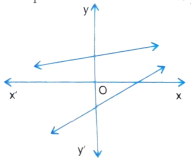
In Fig. graphs of two linear equations are shown. The pair of these linear equations is
- ✓
consistent with unique solution
- B
consistent with infinitely many solutions
- C
- D
inconsistent but can be made consistent by extending these lines
AnswerCorrect option: A. consistent with unique solution
View full question & answer→MCQ 291 Mark
For what value of $k$, do the equations $3 x-y+8=0$ and $6 x-k y+16=0$ represent coincident lines?
- A
$\frac{1}{2}$
- B
$-\frac{1}{2}$
- ✓
- D
View full question & answer→MCQ 301 Mark
The value of $k$ for which the pair of equations $k x=y+2$ and $6 x=2 y+3$ has infinitely many solutions, is
Answer(B)does not exist
Given system of equations is $k x-y-2=0$ and $6 x-2 y-3=0$. This system will have infinitely many solutions, if
$
\frac{k}{6}=\frac{-1}{-2}=\frac{-2}{-3} \Rightarrow \frac{k}{6}=\frac{1}{2}=\frac{2}{3}
$
Clearly, $\frac{1}{2} \neq \frac{2}{3}$ is not true. Hence, the given system does not have infinitely many solution for any value of $k$.
View full question & answer→MCQ 311 Mark
3 chairs and 1 table cost ₹$ 900$; where as 5 chairs and 3 tables cost ₹$ 2,100$. If the cost of 1 chair is ₹$ x$ and 1 table is ₹$ y$, then the situation can be represented algebraically as
- A
$3 x+y=900,3 x+5 y=2100$
- B
$x+3 y=900,3 x+5 y=2100$
- ✓
$3 x+y=900,5 x+3 y=2100$
- D
$x+3 y=900,5 x+3 y=2100$
AnswerCorrect option: C. $3 x+y=900,5 x+3 y=2100$
(C)$3 x+y=900,5 x+3 y=2100$
The cost of 3 chairs and 1 tables is $₹ 3 x+y$ and that of 5 chairs and 3 tables is $5 x+3 y$.
$
\therefore \quad 3 x+y=900,5 x+3 y=2100
$
View full question & answer→MCQ 321 Mark
The point of intersection of the line representd by $3 x-y=3$ and $y$-axis is given by
- ✓
$(0,-3)$
- B
$(0,3)$
- C
$(2,0)$
- D
$(-2,0)$
AnswerCorrect option: A. $(0,-3)$
(A)$(0,-3)$
The equation of $y$-axis is $x=0$. Solving $3 x-y=3$ and $x=0$, we obtain $y=-3$ Hence, the point of intersection is $(0,-3)$.
View full question & answer→MCQ 331 Mark
The area of the triangle formed by the line $\frac{x}{a}+\frac{y}{b}=1$ with the coordinate axes is
- A
$a b$
- ✓
$\frac{1}{2} a b$
- C
$\frac{1}{4} a b$
- D
$2 a b$
AnswerCorrect option: B. $\frac{1}{2} a b$
(B)$\frac{1}{2} a b$
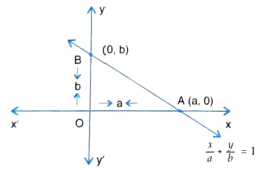
Line $\frac{x}{a}+\frac{y}{b}=1$ cuts the coordinate axes at $A(a, 0)$ and $B(0, b)$ to form $\triangle O A B$. Area of $\triangle O A B=\frac{1}{2}(O A \times O B)=\frac{1}{2} a b$ View full question & answer→MCQ 341 Mark
The pair of equations $x=a$ and $y=b$ graphically represents lines which are:
- A
- B
intersecting at $(b, a)$
- C
- ✓
intersecting at $(a, b)$
AnswerCorrect option: D. intersecting at $(a, b)$
(D)intersecting at $(a, b)$
Equations $x=a$ and $y=b$ represent lines parallel to $y$-axis and $x$-axis respectively intersecting at $(a, b)$.
View full question & answer→MCQ 351 Mark
If the pair of equations $3 x-y+8=0$ and $6 x-r y+16=0$ represent comcident lines, then the value of $r$ is
- A
$-\frac{1}{2}$
- B
$\frac{1}{2}$
- ✓
- D
Answer(C)$\frac{1}{2}$
Equations $3 x-y+8=0$ and $6 x-r y+16=0$ represent coincident lines.
$
\frac{3}{6}=\frac{-1}{-r}=\frac{8}{16} \Rightarrow \frac{1}{2}=\frac{1}{r} \Rightarrow r=2
$
View full question & answer→MCQ 361 Mark
A pair of equations $a x+2 y=9$ and $3 x+b y=18$ represent parallel lines, where $a, b$ are integers, if
- A
$a=b$
- B
$3 a=2 b$
- C
$2 a=3 b$
- ✓
$a b=6$
AnswerCorrect option: D. $a b=6$
(D)$a b=6$
Given that $a x+2 y=9$ and $3 x+b y=18$ represent parallel lines.
$
\frac{a}{3}=\frac{2}{b} \Rightarrow a b=6
$
View full question & answer→MCQ 371 Mark
The area of the triangle formed by the line $\frac{x}{a}+\frac{y}{b}=1$ with the coordinate axes is
- A
$a b$
- B
$2 a b$
- ✓
$\frac{1}{2} a b$
- D
$\frac{1}{4} a b$
AnswerCorrect option: C. $\frac{1}{2} a b$
View full question & answer→MCQ 381 Mark
If $\frac{2}{x}+\frac{3}{y}=13$ and $\frac{5}{x}-\frac{4}{y}=-2$, then $x+y$ equals
- A
$\frac{1}{6}$
- B
$-\frac{1}{6}$
- ✓
$\frac{5}{6}$
- D
$-\frac{5}{6}$
AnswerCorrect option: C. $\frac{5}{6}$
(C)$\frac{5}{6}$
Let $\frac{1}{x}=u$ and $\frac{1}{y}=v$. Then, the given system of equations becomes
$
2 u+3 v-13=0
$
and,
$
5 u-4 v+2=0
$
Using cross-multiplication, we obtain
$
\begin{array}{ll}
& \frac{u}{6-52}=\frac{v}{-65-4}=\frac{1}{-8-15} \Rightarrow \frac{u}{-46}=\frac{v}{-69}=\frac{1}{-23} \Rightarrow u=2, v=3 \Rightarrow x=\frac{1}{2}, y=\frac{1}{3} \\
\therefore & x+y=\frac{1}{2}+\frac{1}{3}=\frac{5}{6}
\end{array}
$
View full question & answer→MCQ 391 Mark
If the pair of linear equations $(3 k+1) x+3 y-5=0$ and $2 x-3 y+5=0$ have infinite number of solutions, then the value of $k$ is
Answer(D)-1
For infinitely many solutions, we must have
$
\frac{3 k+1}{2}=\frac{3}{-3}=\frac{-5}{5} \Rightarrow 3 k+1=-2 \Rightarrow k=-1 .
$
View full question & answer→MCQ 401 Mark
One equation of a pair of dependent linear equations is $-5 x+7 y-2=0$, the second equation can be
- A
$10 x+14 y+4=0$
- B
$-10 x-14 y+4=0$
- C
$-10 x+14 y+4=0$
- ✓
$10 x-14 y=-4$
AnswerCorrect option: D. $10 x-14 y=-4$
(D)$10 x-14 y=-4$
Two equations $a_1 x+b_1 y+c_1=0$ and $a_2 x+b_2 y+c_2=0$ represent a pair of dependent linear equations if $\frac{a_1}{a_2}=\frac{b_1}{b_2}=\frac{c_1}{c_2}$ i.e. one equation is constant times the other. For the equation in option (d), we find that $10 x-14 y+4=-2(-5 x+7 y-2)$. i.e. $\frac{10}{-5}=\frac{-14}{7}=\frac{4}{-2}$. So, the second equation can be $10 x-14 y=-4$.
View full question & answer→MCQ 411 Mark
The pair of linear equations $2 x=5 y+6$ and $15 y=6 x-18$ represents two lines which are:
- A
- B
- ✓
- D
either intersecting or parallel
Answer(C)coincident
Given linear equations are $2 x-5 y-6=0$ and $6 x-15 y-18=0$. We find that $\frac{2}{6}=\frac{-5}{-15}=\frac{-6}{-18}$. So, lines represented by given equations are coincident.
View full question & answer→MCQ 421 Mark
If the pair of linear equations $2 x-3 y=0$ and $k x+6 y=0$ has non-zero solutions, then the value of $k$ is
Answer(C)-4
The homogeneous system of equations $a_1 x+b_1 y=0$ and $a_2 x+b_2 y=0$ has non-zero solutions, if $\frac{a_1}{a_2}=\frac{b_1}{b_2}$. Thus, the given system of equations, will have non-zero solutions if $\frac{2}{k}=-\frac{3}{6} \Rightarrow-3 k=12 \Rightarrow k=-4$
View full question & answer→MCQ 431 Mark
The value of $k$ for which the system of equations $k x+y=k^2$ and $x+k y=1$ has infinitely many solutions, is
Answer(A)1
Given system of equations will have infinitely many solutions, if $\frac{k}{1}=\frac{1}{k}=\frac{-k^2}{-1} \Rightarrow \frac{k}{1}=\frac{1}{k}$ and $\frac{1}{k}=\frac{k^2}{1} \Rightarrow k^2=1$ and $k^3=1 \Rightarrow k= \pm 1$ and $k=1 \Rightarrow k=1$
View full question & answer→MCQ 441 Mark
The pair of equations $x=4$ and $y=-3$ graphically represent lines which are
- A
- B
- ✓
intersecting at $(4,-3)$
- D
intersecting at $(-3,4)$
AnswerCorrect option: C. intersecting at $(4,-3)$
(C)intersecting at $(4,-3)$
Equation $x=4$ represent a line parallel to $y$-axis at a distance 4 on its right side and $y=-3$ respresents a line parallel to $x$-axis at a distance of 3 units below it. These two liens intersect at $(4,-3)$.
View full question & answer→MCQ 451 Mark
If the system of equations $2 x+3 y=7$ and $2 a x+(a+b) y=8$ has infinitely many solutions, then
- A
$a=2 b$
- B
$a+2 b=0$
- ✓
$b=2 a$
- D
$2 a+b=0$
AnswerCorrect option: C. $b=2 a$
(C)$b=2 a$
Given system of equations will have infintely many solutions, if
$
\frac{2 a}{2}=\frac{a+b}{3}=\frac{8}{7} \quad\left[\text { Using }: \frac{a_1}{a_2}=\frac{b_1}{b_2}=\frac{c_1}{c_2}\right]
$
$\begin{array}{ll}\Rightarrow & a=\frac{a+b}{3} \text { and } \frac{a+b}{3}=\frac{8}{7} \\ \Rightarrow & 2 a=b \text { and } 7 a+7 b=24 \Rightarrow b=2 a \text { and } 7 a+7 \times 2 a=24 \Rightarrow b=2 a \text { and } 7 a=8\end{array}$
View full question & answer→MCQ 461 Mark
The system of equations $x=0, y=3$ has
- ✓
- B
- C
- D
infinitely many solutions
Answer(A)a unique solution
We find that $x=0$ represents $y$-axis and $y=3$ is a line parallel to $x$-axis at a distance of 3 units from it. These two lines intersect at exactly one point $(0,3)$. Hence, the system has a unique solutions.
View full question & answer→MCQ 471 Mark
The value of $k$ for which the system of linear equations $x+2 y=3,5 x+k y+7=0$ is inconsistent is
- A
$-\frac{14}{3}$
- B
$\frac{2}{5}$
- C
- ✓
Answer(D)10
Given system of equations will be inconsistent, if
$\frac{1}{5}=\frac{2}{k} \neq-\frac{3}{7} \qquad\left[\right.$ Using $\left.: \frac{a_1}{a_2}=\frac{b_1}{b_2} \neq \frac{c_1}{c_2}\right]$
$\Rightarrow \quad \frac{1}{5}=\frac{2}{k} \Rightarrow k=10 . \qquad\left[\because \frac{1}{5} \neq-\frac{3}{7}\right.$ is true $]$
View full question & answer→MCQ 481 Mark
If a pair of equations is consistent, then the lines representing them are
- A
- B
- ✓
intersecting or coincident
- D
AnswerCorrect option: C. intersecting or coincident
(C) intersecting or coincident
If a pair of equations $a_1 x+b_1 y+c_1=0$ and $a_2 x+b_2 y+c_2=0$ is consistent then either it has unique solution on inifinitely many solutions. Consequently, lines representing the two equations either intesect or coincide.
View full question & answer→MCQ 491 Mark
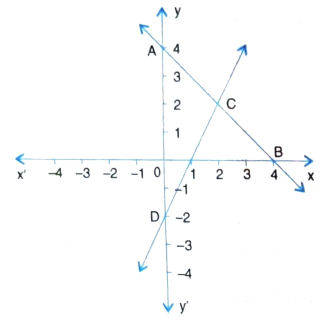
Figure is the graph representing two linear equations by lines $A B$ and $C D$ respectively. The area of the triangle formed by these two lines and the line $x=0$ is
View full question & answer→MCQ 501 Mark
The area of the triangle formed by the lines $2 x+3 y=12, x-y-1=0$ and $x=0$ (as shown in Fig.), is
View full question & answer→MCQ 511 Mark
The number of solutions of $3^{x+y}=243$ and $243^{x-y}=3$ is
View full question & answer→MCQ 521 Mark
If $217 x+131 y=913$ and $131 x+217 y=827$, then $x+y$ is equal to
View full question & answer→MCQ 531 Mark
One equation of a pair of dependent linear equations is $-5 x+7 y=2$. The second equation is
- A
$10 x+14 y+4=0$
- B
$-10 x-14 y+4=0$
- C
$-10 x+14 y+4=0$
- ✓
$10 x-14 y=-4$
AnswerCorrect option: D. $10 x-14 y=-4$
View full question & answer→MCQ 541 Mark
The value of $k$ for which the lines $5 x+7 y=3$ and $15 x+21 y=k$ coincide is
View full question & answer→MCQ 551 Mark
If $x=a, y=b$ is the solution of the pair of linear equations $37 x+43 y=123,43 x+37 y=117$, then $a^3+b^3$ is equal to
View full question & answer→MCQ 561 Mark
Aruna has only ₹ $1$ and ₹ $2$ coins with her. If the total number of coins that she has is 50 and the amount of money with her is ₹ $75$, then the number of ₹ $1$ and ₹ $2$ coins are, respectively
View full question & answer→MCQ 571 Mark
The sum of the digits of a two digit number is 9 . If 27 is added to it, the digits of the number get reversed. The number is
MCQ 581 Mark
The area of the triangle formed by the lines $x=3, y=4$ and $x=y$ is
AnswerCorrect option: A. $1 / 2$ sq. unit
View full question & answer→MCQ 591 Mark
The area of the triangle formed by the lines $y=x, x=6$ and $y=0$ is
View full question & answer→MCQ 601 Mark
If $2 x-3 y=7$ and $(a+b) x-(a+b-3) y=4 a+b$ represent coincident lines, then $a$ and $b$ satisfy the equation
- A
$a+5 b=0$
- B
$5 a+b=0$
- ✓
$a-5 b=0$
- D
$5 a-b=0$
AnswerCorrect option: C. $a-5 b=0$
View full question & answer→MCQ 611 Mark
If the system of equations
$\begin{array}{l}2 x+3 y=7 \\2 a x+(a+b) y=28\end{array}$
has infinitely many solutions, then
- A
$a=2 b$
- ✓
$b=2 a$
- C
$a+2 b=0$
- D
$2 a+b=0$
AnswerCorrect option: B. $b=2 a$
View full question & answer→MCQ 621 Mark
If $a m \neq b l$, then the system of equations $a x+b y=c$ and, $l x+m y=n$
- ✓
- B
- C
has infinitely many solutions
- D
may or may not have a solution.
View full question & answer→MCQ 631 Mark
If the system of equations $3 x+y=1$ and, $(2 k-1) x+(k-1) y=2 k+1$ is inconsistent, then $k=$
View full question & answer→MCQ 641 Mark
If the system of equations $2 x+3 y=7$ and, $(a+b) x+(2 a-b) y=21$ has infinitely many solutions, then
- A
$a=1, b=5$
- ✓
$a=5, b=1$
- C
$a=-1, b=5$
- D
$a=5, b=-1$
AnswerCorrect option: B. $a=5, b=1$
View full question & answer→MCQ 651 Mark
If the sum of the ages of a father and his son in years is 65 and twice the difference of their ages in years is 50 , then the age of father is
MCQ 661 Mark
The pair of linear equations $3 x+5 y=3$ and $6 x+k y=8$ do not have a solution, if $k$
- A
$=5$
- ✓
$=10$
- C
$\neq 10$
- D
$\neq 5$
View full question & answer→MCQ 671 Mark
If $A B C D$ is a rectangle shown in Fig. then
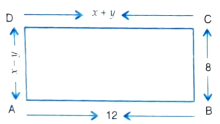
- ✓
$x=10, y=2$
- B
$x=12, y=8$
- C
$x=2, y=10$
- D
$x=20, y=0$
AnswerCorrect option: A. $x=10, y=2$
View full question & answer→MCQ 681 Mark
8 chairs and 5 tables cost ₹$10,500$, while 5 chairs and 3 tables cost ₹$6,450$. The cost of each chair will be
View full question & answer→MCQ 691 Mark
The pair of linear equatins $y=0$ and $y=-5$ has
- A
- B
- C
infinitely many solutions
- ✓
View full question & answer→MCQ 701 Mark
If $x=a, y=b$ is the solution of the systems of equations $x-y=2$ and $x+y=4$, then the values of $a$ and $b$ are, respectively
View full question & answer→MCQ 711 Mark
If the system of equations $k x-5 y=2,6 x+2 y=7$ has no solution, then $k=$
View full question & answer→MCQ 721 Mark
If the system of equations $2 x+3 y=5,4 x+k y=10$ has infinitely many solutions, then $k=$
View full question & answer→MCQ 731 Mark
If a pair of linear equations in two variables is consistent, then the lines represented by two equations are
- A
- B
- C
- ✓
intersecting or coincident
AnswerCorrect option: D. intersecting or coincident
View full question & answer→MCQ 741 Mark
The value of $k$ for which the system of equations $\begin{array}{l}x+2 y=5 \\ 3 x+k y+15=0\end{array}$ has no solution is
View full question & answer→MCQ 751 Mark
The value of $k$ for which the system of equations $3 x+5 y=0$ and $k x+10 y=0$ has a non-zero tion, is
View full question & answer→MCQ 761 Mark
The value of $k$ for which the system of equations $x+2 y-3=0$ and $5 x+k y+7=0$ has no ation, is
View full question & answer→MCQ 771 Mark
The value of $k$ for which the system of equations $2 x+3 y=5$ and, $4 x+k y=10$ has infinite mber of solutions, is
View full question & answer→MCQ 781 Mark
The value of $k$ for which the system of equations $k x-y=2$ and, $6 x-2 y=3$ has a unique lution, is
- A
$=3$
- ✓
$\neq 3$
- C
$\neq 0$
- D
$=0$
AnswerCorrect option: B. $\neq 3$
View full question & answer→