Questions

2 Marks Questions

🎯

Test yourself on this topic

9 questions · timed · auto-graded

Question 12 Marks
If the zeroes of the polynomial $f(x)=x^3-3 x^2+x+1$ are $a-b, a, a+b$, find $a$ and $b$.
Answer
$f(x)=x^3-3 x^2+x+1$
It is given that $a-b, a$ and $a+b$ are the zeroes of $f(x)$.
Now, Sum of the zeroes $=-\frac{\text { Coeff. of } x^2}{\text { Coeff. of } x^3}$
$\Rightarrow a-b+a+a+b=-\frac{-3}{1}$
$\Rightarrow 3 a=3$
$\Rightarrow a=1$
and, Product of zeros $=-\frac{\text { Constant term }}{\text { Coeff. of } x^3}$
$\Rightarrow(a-b)(a)(a+b)=-\frac{1}{1}$
$\Rightarrow a\left(a^2-b^2\right)=-1$
$\Rightarrow 1-b^2=-1(\because a=1)$
$\Rightarrow b^2=2$
$\Rightarrow b= \pm \sqrt{2}$
Hence the value of $a=1$ and $b= \pm \sqrt{2}$
View full question & answer
Question 22 Marks
Find a quadratic polynomial, the sum and product of whose zeroes are $\sqrt { 2 } , \frac { 1 } { 3 }$ respectively.
Answer
Let the polynomial be $a x^2+b x+c$.
and its zeroes be $\alpha$ and $\beta$.
Then, $\alpha + \beta = \sqrt { 2 } = - \frac { b } { a } \text { and } \alpha \beta = \frac { 1 } { 3 } = \frac { c } { a }$
If a = 3, then $b = - 3 \sqrt { 2 }$ and c = 1.
So, one quadratic polynomial which fits the given conditions is $3 x ^ { 2 } - 3 \sqrt { 2 } x + 1$.
It is given that $\alpha + \beta = \sqrt { 2 }$ and $\alpha \beta = \frac { 1 } { 3 }$
Now, standard form of quadratic polynomial is given by $x ^ { 2 } - ( \alpha + \beta ) x + \alpha \beta$
$= x ^ { 2 } - ( \alpha + \beta ) x + \alpha \beta$
$= x ^ { 2 } - \sqrt { 2 } x + \frac { 1 } { 3 }$
$= \frac { 1 } { 3 } \left( 3 x ^ { 2 } - 3 \sqrt { 2 } x + 1 \right)$
Hence the required quadratic polynomial is $3 x ^ { 2 } - 3 \sqrt { 2 } x + 1$
View full question & answer
Question 32 Marks
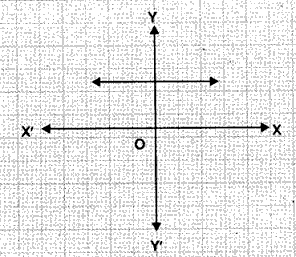
The graph of y = p(x) in a figure given below, for some polynomial p(x). Find the number of zeroes of p(x).
Answer
Let the required polynomial be $ax^2 + bx + c$
and let its zeroes be $\alpha$ and $\beta$
Then, $\alpha + \beta = \frac { 1 } { 4 } = - \frac { b } { a } \text { and } \alpha \beta = - 1 = \frac { c } { a }$
If a = 4, then b = -1 and c = -4
So, one quadratic polynomial which satisfies the given conditions is $4x^2 - x - 4$
Or
If $\alpha$ and $\beta$ zeroes of the polynomials then standard quadratic polynomial is given by
$x ^ { 2 } - ( \alpha + \beta ) x + \alpha \beta$, where $\alpha + \beta = \frac14 ~and~ \alpha\beta=-1 $ [Given]
Now, we have,
$ x ^ { 2 } - ( \alpha + \beta ) x + \alpha \beta$
$= x ^ { 2 } - \left( \frac { 1 } { 4 } \right) x + ( - 1 )$
$= \frac { 1 } { 4 } \left( 4 x ^ { 2 } - x - 4 \right)$
Required polynomial is $4x^2 - x - 4$
View full question & answer
Question 42 Marks
Find the zeroes of quadratic polynomial $t^2-15$ and verify the relationship between the zeroes and their coefficients.
Answer
We have quadratic polynomial as $t^2-15$
$=t^2-(\sqrt{15})^2$
$=(t-\sqrt{15})(t+\sqrt{15})\left[A s, x^2-y^2=(x-y)(x+y)\right]$
The value of $t^2-15$ is zero when $(t-\sqrt{ 1 5 })=0$ or $(t+\sqrt{ 1 5 })=0$, i.e., when $t=\sqrt{15}$ or $t=-\sqrt{15}$
therefore, the zeroes of $t^2-15$ are $\sqrt{15}$ and $-\sqrt{15}$.
Sum of zeroes $=\sqrt{15}+(-\sqrt{15})=0=\frac{-0}{1}=\frac{-(\text { coefficient of } t)}{\text { coefficient of } t^2}$
Product of zeroes $=(\sqrt{15})(-\sqrt{15})=-15=\frac{-15}{1}=\frac{\text { constant term }}{\text { coefficient of } t^2}$
Hence verified.
View full question & answer
Question 52 Marks
Find the zeroes of quadratic polynomial $4u^2 + 8u$ and verify the relationship between the zeroes and their coefficients.
Answer
The quadratic equation is given as: $4 u^2+8 u$
it can be written in the standard form as:
$=4 u^2+8 u+0$
$=4 u(u+2)$
The value of $4 u^2+8 u$ is zero when $4 u=0$ or $u+2=0$, i.e., $u=0$ or $u=-2$
Therefore, the zeroes of $4 u^2+8 u$ are 0 and -2
Sum of zeroes $=0+(-2)=-2=\frac{-(8)}{4}=\frac{-(\text { coefficient of } u)}{\text { coefficient of } u^2}$
Product of zeroes $=0 \times(-2)=0=\frac{0}{4}=\frac{\text { constant torm }}{\text { coefficient of } u^2}$
Hence verified
View full question & answer
Question 62 Marks
Find the zeroes of quadratic polynomial $6 x^2-3-7 x$ and verify the relationship between the zeroes and their coefficients.
Answer
We have given the quadratic equation as: $6 x^2-3-7 x$
First of all we will write it into standard form as: $6 x^2-7 x-3$
(Now we will factorize 7 such that the product of the factors is equal to - 18 and the sum is equal to - 7 )
It can be written as
$=6 x^2+2 x-9 x-3$
$=2 x(3 x+1)-3(3 x+1)$
$=(3 x+1)(2 x-3)$
The value of $6 x^2-3-7 x$ is zero when $3 x+1=0$ or $2 x-3=0$, i.e. $X=\frac{-1}{3}$ or $\frac{3}{2}$
Therefore, the zeroes of $6 x^2-3-7 x$ are $\frac{-1}{3}$ and $\frac{3}{2}$
Sum of zeroes $=\frac{-1}{3}+\frac{3}{2}=\frac{7}{6}=\frac{-(-7)}{6}=\frac{-(\text { coefficient of } x)}{\text { coefficient of } x^2}$
Product of zeroes $=\frac{-1}{3} \times \frac{3}{2}=\frac{-1}{2}=\frac{-3}{6}=\frac{\text { constant term }}{\text { coefficient of } x^2}$
Hence, verified
View full question & answer
Question 72 Marks
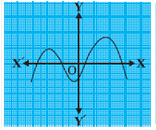
The graph of y = p(x) in a figure given below, for some polynomial p(x). Find the number of zeroes of p(x).
Answer
The given quadratic equation is $4 s^2-4 s+1$
$=(2 s)^2-2(2 s) 1+1^2$
As, we know $(a-b)^2=a^2-2 a b+b^2$, the above equation can be written as $=(2 s-1)^2$
The value of $4 s^2-4 s+1$ is zero when $2 s-1=0$, when, $s=\frac{1}{2}, \frac{1}{2}$
Therefore, the zeroes of $4 s^2-4 s+1$ are $\frac{1}{2}$ and $\frac{1}{2}$
Sum of zeroes $=\frac{1}{2}+\frac{1}{2}=1=\frac{-(-4)}{4}=\frac{-(\text { coefficient of } s)}{\text { coefficient of } s^2}$
Product of zeroes $=\frac{1}{2} \times \frac{1}{2}=\frac{1}{4}=\frac{\text { constant term }}{\text { coefficient of } s^2}$
Hence Verified.
View full question & answer
Question 82 Marks
Find the zeroes of the polynomial $x^2 – 3$ and verify the relationship between the zeroes and the coefficients.
Answer
Given quadratic equation: $x^2-3$
Recall the identity $a^2-b^2=(a-b)(a+b)$. Using it, we can write:
$x^2-3=(x-\sqrt{3})(x+\sqrt{3})$
So, the value of $x^2-3$ is zero when $x=\sqrt{3}$ or $x=-\sqrt{3}$
Therefore, the zeroes of $x^2-3$ are $\sqrt{3}$ and $-\sqrt{3}$
Now, the sum of zeroes $=\sqrt{3}-\sqrt{3}=0=\frac{-(\text { Coefficient of } x)}{\text { Coefficient of } x^2}$ and the product of zeroes $=(\sqrt{3})(-\sqrt{3})=-3=\frac{-3}{1}=\frac{\text { Constant term }}{\text { Coefficient of } x^2}$
View full question & answer
Question 92 Marks
Find the zeroes of the quadratic polynomial $x^2 + 7x + 10$, and verify the relationship between the zeroes and the coefficients.
Answer
We have,
$x^2+7 x+10=(x+2)(x+5)$
So, the value of $x^2+7 x+10$ is zero when $x+2=0$ or $x+5=0$, i.e., when $x=-2$ or $x=-5$. Therefore, the zeroes of $x^2+7 x+10$ are -2 and -5 .
Now,
sum of zeroes = $-2+(-5)=-(7)=\frac{-(7)}{1}=\frac{-(\text { Coefficient of } x)}{\text { Coefficient of } x^{2}}$
product of zeroes = $(-2) \times(-5)=10=\frac{10}{1}=\frac{\text { Constant term }}{\text { coefficient of } x^{2}}$
View full question & answer
2 Marks Questions - Maths STD 10 Questions - Vidyadip