Sample QuestionsPolynomials questions
One sample from each question group in this chapter. Select any group above to see the full set with answer keys.
The degree of polynomial having zeroes $-3$ and $4$ only is :
- ✓
$2$
- B
$1$
- C
More than $3$
- D
$3$
Answer: A.
View full solution →On dividing a polynomial $p(x)$ by $x^2- 4,$ quotient and remainder are found to be $x$ and $3$ respectively. The polynomial $p(x)$ is :
- A
$ 3 x^2+x-12 $
- ✓
$ x^3-4 x+3 $
- C
$ x^2+3 x-4 $
- D
$ x^3-4 x-3 $
Answer: B.
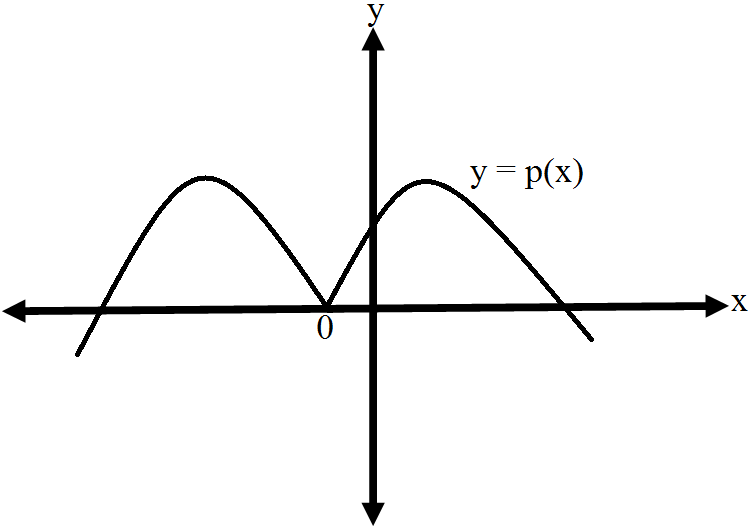
View full solution →The number of zeroes for a polynomial $p(x)$ where graph of $y = p(x)$ is given in Figure, is :
Answer: A.
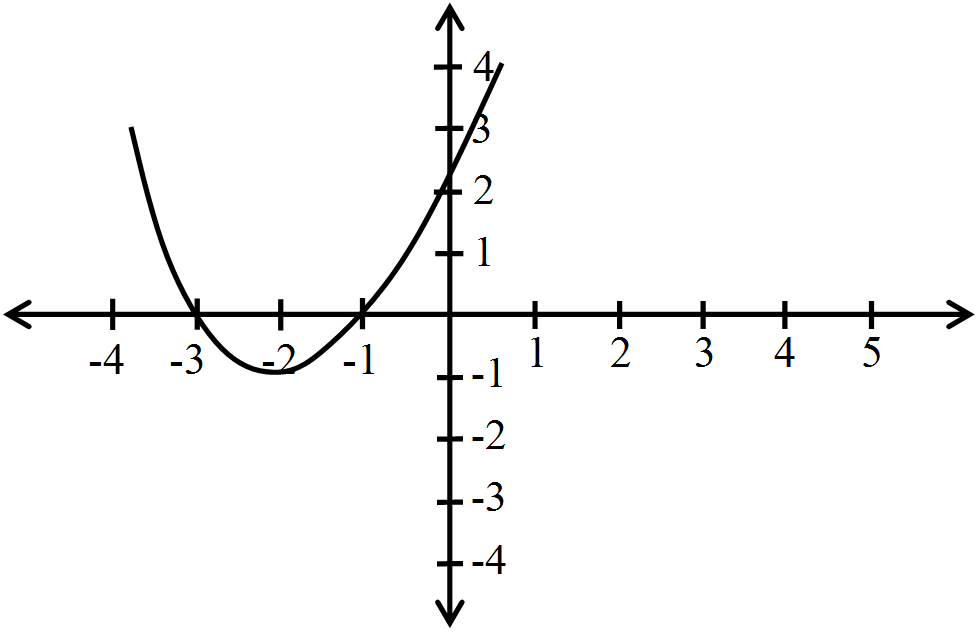
View full solution →In fig. the graph of the polynomial $p(x)$ is given. The number of zeroes of the polynomial is :
Answer: B.
View full solution →The zeroes of the polynomial $x^2-3 x-m(m+3)$ are :
- A
$m, m + 3$
- ✓
$–m, m + 3$
- C
$m, – (m + 3)$
- D
$–m, – (m + 3)$
Answer: B.
View full solution →Directions: In the following questions, the Assertions $(A)$ and Reason$(s) (R)$ have been put forward. Read both the statements carefully and choose the correct alternative from the following:
Assertion: The polynomials in which the highest power of the variable is two are known as Quadratic polynomials.
Reason: $P(x) = ax^2 + bx + c$ is a quadratic polynomial.
- ✓
Both assertion $(A)$ and reason $(R)$ are true and reason $(R)$ is the correct explanation of assertion $(A)$.
- B
Both assertion $(A)$ and reason $(R)$ are true but reason $(R)$ is not the correct explanation of assertion $(A)$.
- C
Assertion $(A)$ is true but reason $(R)$ is false.
- D
Assertion $(A)$ is false but reason $(R)$ is true.
Answer: A.
View full solution →Directions: In the following questions, the Assertions $(A)$ and Reason$(s) (R)$ have been put forward. Read both the statements carefully and choose the correct alternative from the following:
Assertion: If the product of the zeroes of the quadratic polynomial $x^2+3 x+5 k$ is $-10$ then value of kis $-2$ . Reason: Sum of zeroes of a quadratic polynomial $a \times 2+b x+c$ is $\frac{-b}{a}$.
- A
Both assertion $(A)$ and reason $(R)$ are true and reason $(R)$ is the correct explanation of assertion $(A)$.
- ✓
Both assertion $(A)$ and reason $(R)$ are true but reason $(R)$ is not the correct explanation of assertion $(A)$.
- C
Assertion $(A)$ is true but reason $(R)$ is false.
- D
Assertion $(A)$ is false but reason $(R)$ is true.
Answer: B.
View full solution →Directions: In the following questions, the Assertions $(A)$ and Reason$(s) (R)$ have been put forward. Read both the statements carefully and choose the correct alternative from the following:
Assertion: A quadratic polynomial can have at most two zeroes.
Reason: $x^2 + 4x + 5$ has two zeroes.
- A
Both assertion $(A)$ and reason $(R)$ are true and reason $(R)$ is the correct explanation of assertion $(A)$.
- B
Both assertion $(A)$ and reason $(R)$ are true but reason $(R)$ is not the correct explanation of assertion $(A)$.
- ✓
Assertion $(A)$ is true but reason $(R)$ is false.
- D
Assertion $(A)$ is false but reason $(R)$ is true.
Answer: C.
View full solution →Directions: In the following questions, the Assertions $(A)$ and Reason$(s) (R)$ have been put forward. Read both the statements carefully and choose the correct alternative from the following:
Assertion: $x^2+ 4x + 5$ has two zeroes.
Reason: A quadratic polynomial can have at the most two zeroes.
- A
Both assertion $(A)$ and reason $(R)$ are true and reason $(R)$ is the correct explanation of assertion $(A)$.
- B
Both assertion $(A)$ and reason $(R)$ are true but reason $(R)$ is not the correct explanation of assertion $(A)$.
- C
Assertion $(A)$ is true but reason $(R)$ is false.
- ✓
Assertion $(A)$ is false but reason $(R)$ is true.
Answer: D.
View full solution →Directions: In the following questions, the Assertions $(A)$ and Reason $(s)(R)$ have been put forward. Read both the statements carefully and choose the correct alternative from the following:
Assertion: $x=3$ is a zero of the polynomial. $p(x)=2 x^3-5 x^2-4 x+3$.
Reason: $p(x)=2 x^3-5 x^2-4 x+3$
\$itherefore $\$ p(3)=2(3)^3-5 x(3)^2-4 \times 3+3$
$=54-45-12+3=0$
$P(3)=0$
- ✓
Both assertion $(A)$ and reason $(R)$ are true and reason $(R)$ is the correct explanation of assertion $(A)$.
- B
Both assertion $(A)$ and reason $(R)$ are true but reason $(R)$ is not the correct explanation of assertion $(A)$.
- C
Assertion $(A)$ is true but reason $(R)$ is false.
- D
Assertion $(A)$ is false but reason $(R)$ is true.
Answer: A.
View full solution →Are the following statements 'True' or 'False'? Justify your answers.
If two of the zeroes of a cubic polynomial are zero, then it does not have linear and constant terms.
If a quadratic polynomial f(x) is not factorizable into linear factors, then it has no real zero. (True/ False).
Are the following statements 'True' or 'False'? Justify your answers.
If the graph of a polynomial intersects the x-axis at only one point, it cannot be a quadratic polynomial.
Are the following statements 'True' or 'False'? Justify your answers.
If all the zeroes of a cubic polynomial are negative, then all the coefficients and the constant term of the polynomial have the same sign.
Are the following statements 'True' or 'False'? Justify your answers.
If the zeroes of a quadratic polynomial $ax^2 + bx + c$ are both positive, then a, b and c all have the same sign.
View full solution →Find a quadratic polynomial, the sum and product of whose zeroes are $0,\sqrt 5 $ respectively.
View full solution →Find a quadratic polynomial of 4, 1 as the sum and product of its zeroes respectively.
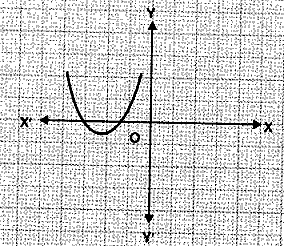
The graph of y = p(x) in a figure given below, for some polynomial p(x). Find the number of zeroes of p(x).
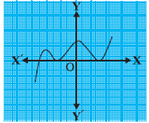
The graph of y = p(x) in a figure given below, for some polynomial p(x). Find the number of zeroes of p(x).
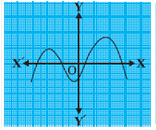
The graph of y = p(x) in a figure given below, for some polynomial p(x). Find the number of zeroes of p(x).
If the zeroes of the polynomial $f(x)=x^3-3 x^2+x+1$ are $a-b, a, a+b$, find $a$ and $b$.
View full solution →Find a quadratic polynomial, the sum and product of whose zeroes are $\sqrt { 2 } , \frac { 1 } { 3 }$ respectively.
View full solution →The graph of y = p(x) in a figure given below, for some polynomial p(x). Find the number of zeroes of p(x).
Find the zeroes of quadratic polynomial $t^2-15$ and verify the relationship between the zeroes and their coefficients.
View full solution →Find the zeroes of quadratic polynomial $4u^2 + 8u$ and verify the relationship between the zeroes and their coefficients.
View full solution →If two zeroes of the polynomial $p(x) = x^4- 6x^3- 26x^2 + 138x - 35$ are 2 ± $\sqrt3$. Find the other zeroes.
View full solution →Find a quadratic polynomial of the given numbers as the sum and product of its zeroes respectively. $- \frac { 1 } { 4 } , \frac { 1 } { 4 }$
View full solution →Find the zeroes of quadratic polynomial $3x^2 - x - 4$ and verify the relationship between the zeroes and their coefficients.
View full solution →
Priya visited a temple in Gwalior. On the way she sees the Agra Fort. The entrance gate of the fort has a shape of quadratic polynomial (parabolic). The mathematical representation of the gate is shown in the figure.
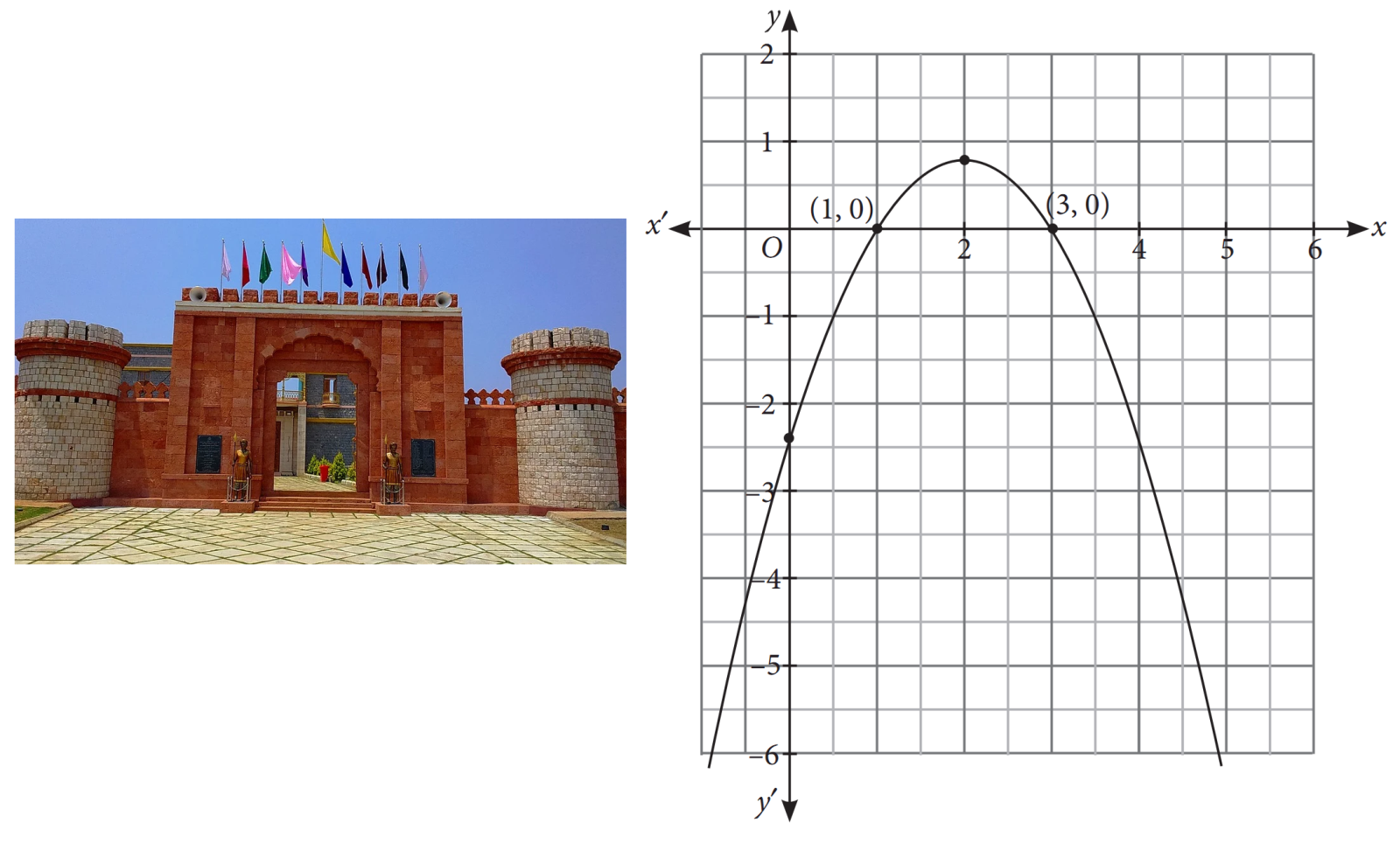
Based on the above information, answer the following questions.
- Find the zeroes of the polynomial represented by the graph.
- What will be the value of polynomial, represented by the graph, when x = 4?
- What will be the expression for the polynomial represented by the graph?
Or
If one zero of a polynomial p(x) is 7 and product of its zeroes is -35, then p(x) = ?
Quadratic polynomial can be used to model the shape of many architectural structures in the world. Pershing field of Jersey city in US is one such structure.
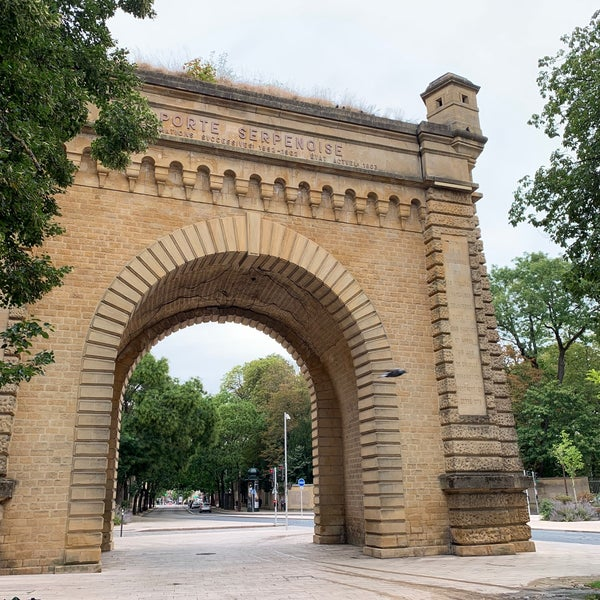
Based on the above information, answer the following questions.
- If the Arch is represented by $10x^2 - x - 3$, then its zeroes are:
- The quadratic polynomial whose sum of zeroes is 0 and product of zeroes is 1 is given by?
- Which of the following has $\frac{-1}{2}$ and 2 as their zeroes?
Or
The product of zeroes of the polynomial $\sqrt{3}\text{x}^2-14\text{x}+8\sqrt{3}$ is:
Pankaj's father gave him some money to buy avocado from the market at the rate of $p(x) = x^2 - 24x + 128$. Let $\alpha,\beta$ are the zeroes of p(x).
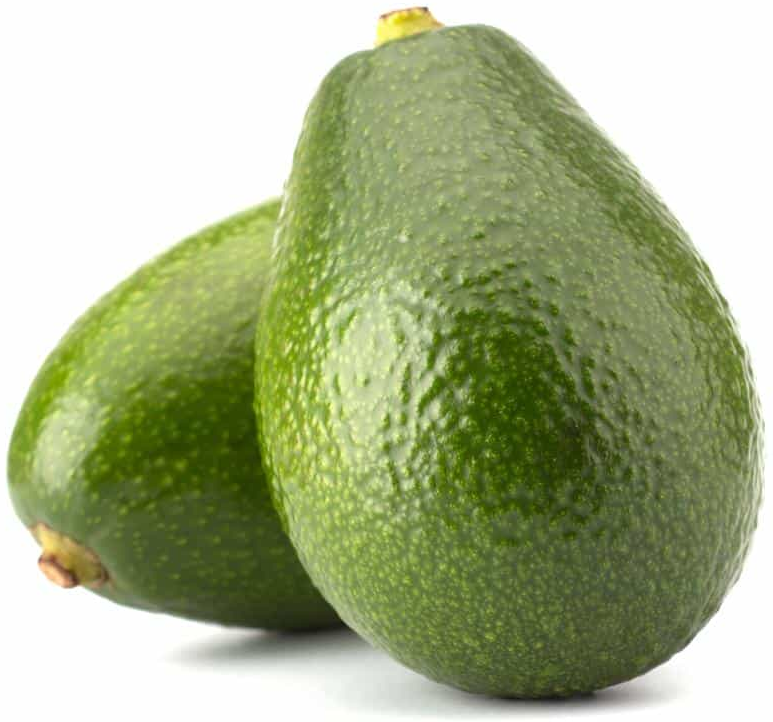
Based on the above information, answer the following questions.
- Find the value of $\alpha+\beta+\alpha\beta.$
- The value of p(2) is?
- If $\alpha$ and $\beta$ are zeroes of $x^2 + x - 2,$ then $\frac{1}{\alpha}+\frac{1}{\beta}=$
Or
If sum of zeroes of $q(x) = kx^2 + 2x + 3k$ is equal to their product, then k = ?
ABC construction company got the contract of making speed humps on roads. Speed humps are parabolic in shape and prevents overspeeding, minimise accidents and gives a chance for pedestrians to cross the road. The mathematical representation of a speed hump is shown in the given graph.
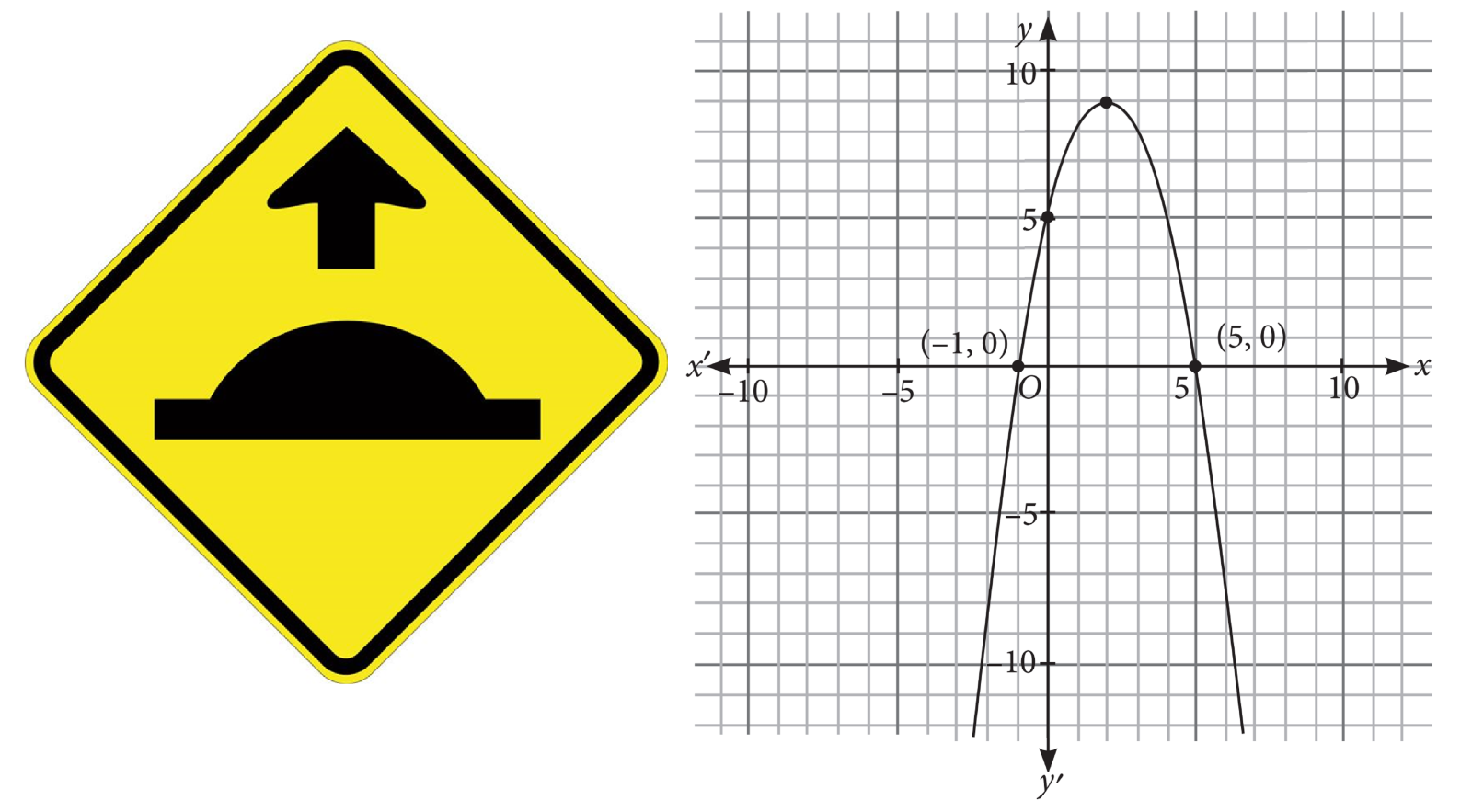
Based on the above information, answer the following questions.
- The polynomial represented by the graph can be which polynomial?
- The zeroes of the polynomial represented by the graph are?
- If $\alpha$ and $\beta$ are the zeroes of the polynomial represented by the graph such that $\beta>\alpha,$ then $|8\alpha\ +\ \beta|= $
Or
The expression of the polynomial represented by the graph is?
View full solution →
Just before the morning assembly a teacher of kindergarten school observes some clouds in the sky and so she cancels the assembly. She also observes that the clouds has a shape of the polynomial. The mathematical representation of a cloud is shown in the figure.
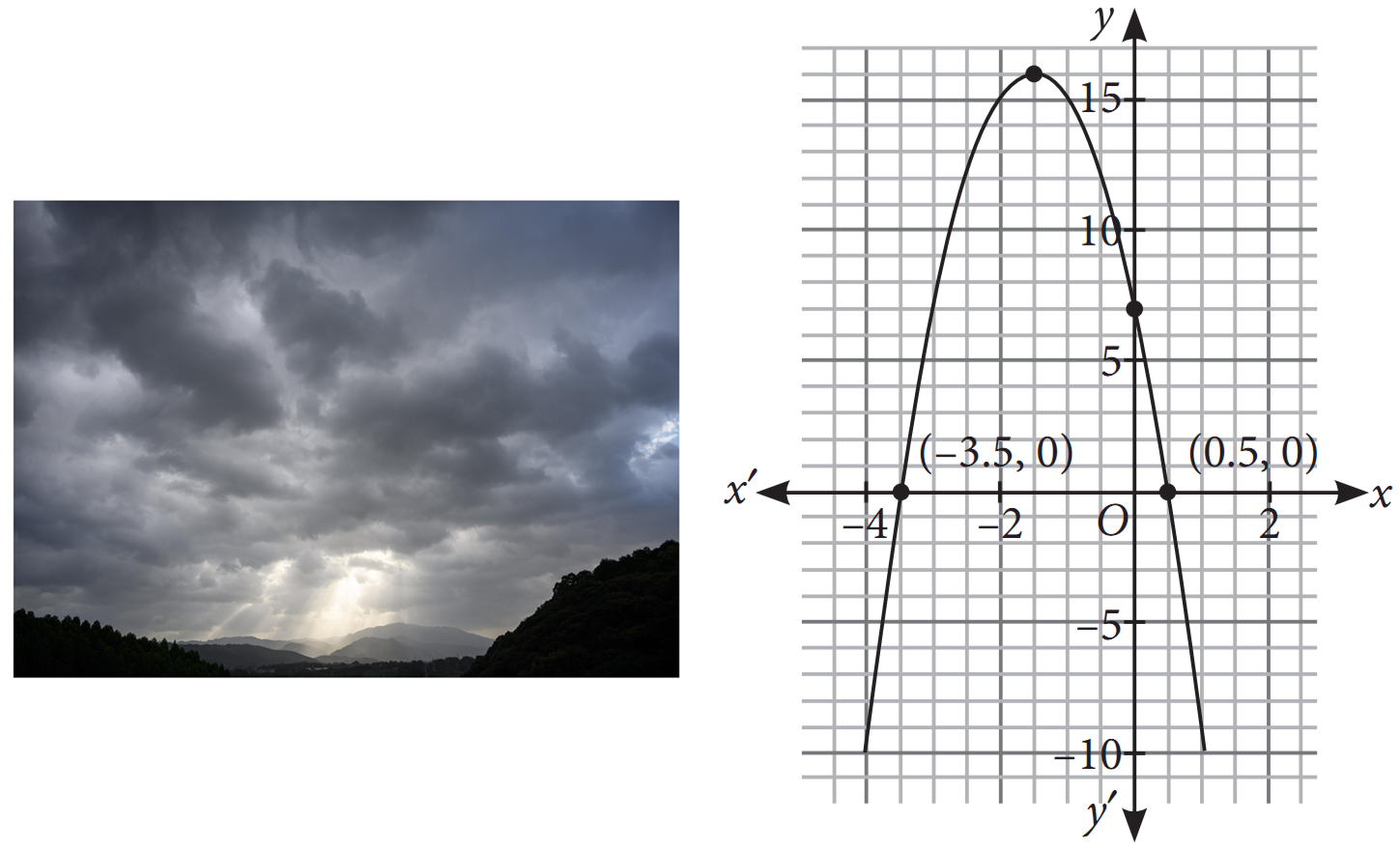
- Find the zeroes of the polynomial represented by the graph.
- What will be the expression for the polynomial represented by the graph?
- What will be the value of polynomial represented by the graph, when x = 3?
Or
If $\alpha$ and $\beta$ are the zeroes of the polynomial $f(x) = x^2 + 2x - 8$, then $\alpha^4+\beta^4=$