MCQ 11 Mark
Directions: In the following questions, the Assertions $(A)$ and Reason$(s) (R)$ have been put forward. Read both the statements carefully and choose the correct alternative from the following:
Assertion: The polynomials in which the highest power of the variable is two are known as Quadratic polynomials.
Reason: $P(x) = ax^2 + bx + c$ is a quadratic polynomial.
- ✓
Both assertion $(A)$ and reason $(R)$ are true and reason $(R)$ is the correct explanation of assertion $(A)$.
- B
Both assertion $(A)$ and reason $(R)$ are true but reason $(R)$ is not the correct explanation of assertion $(A)$.
- C
Assertion $(A)$ is true but reason $(R)$ is false.
- D
Assertion $(A)$ is false but reason $(R)$ is true.
AnswerCorrect option: A. Both assertion $(A)$ and reason $(R)$ are true and reason $(R)$ is the correct explanation of assertion $(A)$.
Both assertion $(A)$ and reason $(R)$ are true and reason $(R)$ is the correct explanation of assertion $(A).$
View full question & answer→MCQ 21 Mark
Directions: In the following questions, the Assertions $(A)$ and Reason$(s) (R)$ have been put forward. Read both the statements carefully and choose the correct alternative from the following:
Assertion: If the product of the zeroes of the quadratic polynomial $x^2+3 x+5 k$ is $-10$ then value of kis $-2$ . Reason: Sum of zeroes of a quadratic polynomial $a \times 2+b x+c$ is $\frac{-b}{a}$.
- A
Both assertion $(A)$ and reason $(R)$ are true and reason $(R)$ is the correct explanation of assertion $(A)$.
- ✓
Both assertion $(A)$ and reason $(R)$ are true but reason $(R)$ is not the correct explanation of assertion $(A)$.
- C
Assertion $(A)$ is true but reason $(R)$ is false.
- D
Assertion $(A)$ is false but reason $(R)$ is true.
AnswerCorrect option: B. Both assertion $(A)$ and reason $(R)$ are true but reason $(R)$ is not the correct explanation of assertion $(A)$.
Reason is true as we know that Sum of zeroes $=\frac{\text{-b}}{\text{a}}.$
Also we know that Product of zeroes $=\frac{\text{c}}{\text{a}}$
$\Rightarrow\frac{5\text{k}}{1}=-10$
$\Rightarrow\text{k}-2$
So, Assertion is true.
But Reason is not the correct explanation of assertion.
View full question & answer→MCQ 31 Mark
Directions: In the following questions, the Assertions $(A)$ and Reason$(s) (R)$ have been put forward. Read both the statements carefully and choose the correct alternative from the following:
Assertion: A quadratic polynomial can have at most two zeroes.
Reason: $x^2 + 4x + 5$ has two zeroes.
- A
Both assertion $(A)$ and reason $(R)$ are true and reason $(R)$ is the correct explanation of assertion $(A)$.
- B
Both assertion $(A)$ and reason $(R)$ are true but reason $(R)$ is not the correct explanation of assertion $(A)$.
- ✓
Assertion $(A)$ is true but reason $(R)$ is false.
- D
Assertion $(A)$ is false but reason $(R)$ is true.
AnswerCorrect option: C. Assertion $(A)$ is true but reason $(R)$ is false.
Assertion $(A)$ is true but reason $(R)$ is false.
View full question & answer→MCQ 41 Mark
Directions: In the following questions, the Assertions $(A)$ and Reason$(s) (R)$ have been put forward. Read both the statements carefully and choose the correct alternative from the following:
Assertion: $x^2+ 4x + 5$ has two zeroes.
Reason: A quadratic polynomial can have at the most two zeroes.
- A
Both assertion $(A)$ and reason $(R)$ are true and reason $(R)$ is the correct explanation of assertion $(A)$.
- B
Both assertion $(A)$ and reason $(R)$ are true but reason $(R)$ is not the correct explanation of assertion $(A)$.
- C
Assertion $(A)$ is true but reason $(R)$ is false.
- ✓
Assertion $(A)$ is false but reason $(R)$ is true.
AnswerCorrect option: D. Assertion $(A)$ is false but reason $(R)$ is true.
Assertion $(A)$ is false but reason $(R)$ is true.
View full question & answer→MCQ 51 Mark
Directions: In the following questions, the Assertions $(A)$ and Reason $(s)(R)$ have been put forward. Read both the statements carefully and choose the correct alternative from the following:
Assertion: $x=3$ is a zero of the polynomial. $p(x)=2 x^3-5 x^2-4 x+3$.
Reason: $p(x)=2 x^3-5 x^2-4 x+3$
\$itherefore $\$ p(3)=2(3)^3-5 x(3)^2-4 \times 3+3$
$=54-45-12+3=0$
$P(3)=0$
- ✓
Both assertion $(A)$ and reason $(R)$ are true and reason $(R)$ is the correct explanation of assertion $(A)$.
- B
Both assertion $(A)$ and reason $(R)$ are true but reason $(R)$ is not the correct explanation of assertion $(A)$.
- C
Assertion $(A)$ is true but reason $(R)$ is false.
- D
Assertion $(A)$ is false but reason $(R)$ is true.
AnswerCorrect option: A. Both assertion $(A)$ and reason $(R)$ are true and reason $(R)$ is the correct explanation of assertion $(A)$.
Both assertion $(A)$ and reason $(R)$ are true and reason $(R)$ is the correct explanation of assertion $(A).$
View full question & answer→MCQ 61 Mark
Directions : In the following questions, the Assertions $(A).$ and Reason $(s) \ (R).$ have been put forward. Read both the statements carefully and choose the correct alternative from the following:
Assertion : The graph of a polynomial $p(x)$ is a straight line parallel to $x -$ axis. The polynomial has no zeros.
Reason : If a polynomial $P(x)$ does not intersect the $x -$ axis at any point, it does not have any zero
- ✓
Both assertion $(A).$ and reason $(R).$ are true and reason $(R).$ is the correct explanation of assertion $(A).$.
- B
Both assertion $(A).$ and reason $(R).$ are true but reason $(R).$ is not the correct explanation of assertion $(A).$.
- C
Assertion $(A).$ is true but reason $(R).$ is false.
- D
Assertion $(A).$ is false but reason $(R).$ is true.
AnswerCorrect option: A. Both assertion $(A).$ and reason $(R).$ are true and reason $(R).$ is the correct explanation of assertion $(A).$.
Both assertion $(A).$ and reason $(R).$ are true and reason $(R).$ is the correct explanation of assertion $(A).$.
View full question & answer→MCQ 71 Mark
Directions: In the following questions, the Assertions $(A)$ and Reason $(s)(R)$ have been put forward. Read both the statements carefully and choose the correct alternative from the following:Assertion: If one zero of polynomial $p(x)$ $=\left(k^2+4\right) x^2+13 x+4 k$ is reciprocal of the other, then $k=2$.
Reason: If $(x-a)$ is a factor of $p(x)$, then $p(a)=0$ i.e., $a$ is a zero of $p(x)$.
- A
Both assertion $(A)$ and reason $(R)$ are true and reason $(R)$ is the correct explanation of assertion $(A)$.
- ✓
Both assertion $(A)$ and reason $(R)$ are true but reason $(R)$ is not the correct explanation of assertion $(A)$.
- C
Assertion $(A)$ is true but reason $(R)$ is false.
- D
Assertion $(A)$ is false but reason $(R)$ is true.
AnswerCorrect option: B. Both assertion $(A)$ and reason $(R)$ are true but reason $(R)$ is not the correct explanation of assertion $(A)$.
Both assertion $(A)$ and reason $(R)$ are true but reason $(R)$ is not the correct explanation of assertion $(A).$
View full question & answer→MCQ 81 Mark
Directions: In the following questions, the Assertions $(A)$ and Reason(s) $(R)$ have been put forward. Read both the statements carefully and choose the correct alternative from the following:
Assertion: $x^2 + 4x + 5$ has two zeroes.
Reason: A quadratic polynomial can have at the most two zeroes.
- A
Both assertion $(A)$ and reason $(R)$ are true and reason $(R)$ is the correct explanation of assertion $(A).$
- B
Both assertion $(A)$ and reason $(R)$ are true but reason $(R)$ is not the correct explanation of assertion $(A).$
- C
Assertion $(A)$ is true but reason $(R)$ is false.
- ✓
Assertion $(A)$ is false but reason $(R)$ is true.
AnswerCorrect option: D. Assertion $(A)$ is false but reason $(R)$ is true.
Assertion $(A)$ is false but reason $(R)$ is true.
View full question & answer→MCQ 91 Mark
Directions : In the following questions, the Assertions $(A)$ and Reason $(s)\ (R)$ have been put forward. Read both the statements carefully and choose the correct alternative from the following :
Assertion : A polynomial of degree $n$ has at most $n$ zeroes.
Reason : Maximum number of zeroes of a polynomial $=$ degree of the polynomial.
- ✓
Both assertion $(A)$ and reason $(R)$ are true and reason $(R)$ is the correct explanation of assertion $(A)$.
- B
Both assertion $(A)$ and reason $(R)$ are true but reason $(R)$ is not the correct explanation of assertion $(A)$.
- C
Assertion $(A)$ is true but reason $(R)$ is false.
- D
Assertion $(A)$ is false but reason $(R)$ is true.
AnswerCorrect option: A. Both assertion $(A)$ and reason $(R)$ are true and reason $(R)$ is the correct explanation of assertion $(A)$.
Both assertion $(A)$ and reason $(R)$ are true and reason $(R)$ is the correct explanation of assertion $(A)$.
View full question & answer→MCQ 101 Mark
Directions: In the following questions, the Assertions $(A)$ and Reason(s) $(R)$ have been put forward. Read both the statements carefully and choose the correct alternative from the following:
Assertion: Product of the zeroes of $-2x^2 + kx + 6$. is $-3.$
Reason: Product of zeroes $ =\frac{\text{c}}{\text{a}}.$
- ✓
Both assertion $(A)$ and reason $(R)$ are true and reason $(R)$ is the correct explanation of assertion $(A).$
- B
Both assertion $(A)$ and reason $(R)$ are true but reason $(R)$ is not the correct explanation of assertion $(A).$
- C
Assertion $(A)$ is true but reason $(R)$ is false.
- D
Assertion $(A)$ is false but reason $(R)$ is true.
AnswerCorrect option: A. Both assertion $(A)$ and reason $(R)$ are true and reason $(R)$ is the correct explanation of assertion $(A).$
Both assertion $(A)$ and reason $(R)$ are true and reason $(R)$ is the correct explanation of assertion $(A).$
View full question & answer→MCQ 111 Mark
Directions : In the following questions, the Assertions $(A)$ and Reason $(s)\ (R)$ have been put forward. Read both the statements carefully and choose the correct alternative from the following:
Assertion : Degree of a zero polynomial is not defined.
Reason : Degree of a non $-$ zero constant polynomial is $'0\ '.$
- A
Both assertion $(A)$ and reason $(R)$ are true and reason $(R)$ is the correct explanation of assertion $(A)$.
- ✓
Both assertion $(A)$ and reason $(R)$ are true but reason $(R)$ is not the correct explanation of assertion $(A)$.
- C
Assertion $(A)$ is true but reason $(R)$ is false.
- D
Assertion $(A)$ is false but reason $(R)$ is true.
AnswerCorrect option: B. Both assertion $(A)$ and reason $(R)$ are true but reason $(R)$ is not the correct explanation of assertion $(A)$.
Both assertion $(A)$ and reason $(R)$ are true but reason $(R)$ is not the correct explanation of assertion $(A)$.
View full question & answer→MCQ 121 Mark
Directions: In the following questions, the Assertions $(A)$ and Reason(s) $(R)$ have been put forward. Read both the statements carefully and choose the correct alternative from the following:
Assertion: $p(x) = 4x^3 - x^2+ 5x^4 +3x - 2$ is a polynomial of degree $3.$
Reason: The highest power of $x$ in the polynomial $p(x)$ is the degree of the polynomial.
- A
Both assertion $(A)$ and reason $(R)$ are true and reason $(R)$ is the correct explanation of assertion $(A).$
- B
Both assertion $(A)$ and reason $(R)$ are true but reason $(R)$ is not the correct explanation of assertion $(A).$
- C
Assertion $(A)$ is true but reason $(R)$ is false.
- ✓
Assertion $(A)$ is false but reason $(R)$ is true.
AnswerCorrect option: D. Assertion $(A)$ is false but reason $(R)$ is true.
The highest power of $x$ in the polynomial $p(x) = 4x^3 - x^2+ 5x^4 +3x - 2$ is 4.
Therefore, the degree of the polynomial $P(x)$ is $4.$
View full question & answer→MCQ 131 Mark
Directions: In the following questions, the Assertions $(A) $and Reason(s) $(R)$ have been put forward. Read both the statements carefully and choose the correct alternative from the following:
Assertion: $3x^3 + 3x^2 + 3x + 3$ is a cubic polynomial.
Reason: If the number $'3\ '$ is multiplied in all the terms of a polynomial then it is called a cubic polynomial.
- A
Both assertion $(A)$ and reason $(R)$ are true and reason $(R)$ is the correct explanation of assertion $(A).$
- B
Both assertion $(A)$ and reason $(R)$ are true but reason $(R)$ is not the correct explanation of assertion $(A).$
- ✓
Assertion $(A)$ is true but reason $(R)$ is false.
- D
Assertion $(A)$ is false but reason $(R)$ is true.
AnswerCorrect option: C. Assertion $(A)$ is true but reason $(R)$ is false.
Assertion $(A)$ is true but reason $(R)$ is false.
View full question & answer→MCQ 141 Mark
Directions : In the following questions, the Assertions $(A)$ and Reason $(s)\ (R)$ have been put forward. Read both the statements carefully and choose the correct alternative from the following:
Assertion : The degree of polynomial $2x - 1$ is $1.$
Reason : Polynomial the degree is the value of highest power of the variable.
- ✓
Both assertion $(A)$ and reason $(R)$ are true and reason $(R)$ is the correct explanation of assertion $(A)$.
- B
Both assertion $(A)$ and reason $(R)$ are true but reason $(R)$ is not the correct explanation of assertion $(A)$.
- C
Assertion $(A)$ is true but reason $(R)$ is false.
- D
Assertion $(A)$ is false but reason $(R)$ is true.
AnswerCorrect option: A. Both assertion $(A)$ and reason $(R)$ are true and reason $(R)$ is the correct explanation of assertion $(A)$.
Both assertion $(A)$ and reason $(R)$ are true and reason $(R)$ is the correct explanation of assertion $(A).$
View full question & answer→MCQ 151 Mark
Directions : In the following questions, the Assertions $(A)$ and Reason $(s) \ (R)$ have been put forward. Read both the statements carefully and choose the correct alternative from the following:
Assertion : The graph of $x = p(y)$ is given below, for some polynomial $p(y)$. the number of zeroes of $p(y)$ is $4.$
Reason : Graph of $p(y)$ intersects $y -$ axis in four different points.
- ✓
Both assertion $(A)$ and reason $(R)$ are true and reason $(R)$ is the correct explanation of assertion $(A)$.
- B
Both assertion $(A)$ and reason $(R)$ are true but reason $(R)$ is not the correct explanation of assertion $(A)$.
- C
Assertion $(A)$ is true but reason $(R)$ is false.
- D
Assertion $(A)$ is false but reason $(R)$ is true.
AnswerCorrect option: A. Both assertion $(A)$ and reason $(R)$ are true and reason $(R)$ is the correct explanation of assertion $(A)$.
Both assertion $(A)$ and reason $(R)$ are true and reason $(R)$ is the correct explanation of assertion $(A)$.
View full question & answer→MCQ 161 Mark
The graph of the polynomial $f(x) = 2x - 5$ intersects the $x-$ axis at :
- ✓
$(\frac{5}{2}, 0)$
- B
$(\frac{5}{2},-\frac{5}{2})$
- C
$(-\frac{5}{2}, 0)$
- D
$(\frac{5}{2}, \frac{5}{2})$
AnswerCorrect option: A. $(\frac{5}{2}, 0)$
Graph $f(x) = 2x - 5$ is on $x-$ axis $($when the graph is on $x-$ axis then the $y$ point $($ordinate$)$ is $0)$
put $f(x) = 0$
$2x - 5 = 0$
$2x = 5$
View full question & answer→MCQ 171 Mark
Directions: In the following questions, the Assertions $(A)$ and Reason(s) $(R)$ have been put forward. Read both the statements carefully and choose the correct alternative from the following:
Assertion: $x^3+x$ has only one real zero.
Reason: A polynomial of nth degree must have n real zeroes.
- A
Both assertion $(A)$ and reason $(R)$ are true and reason $(R)$ is the correct explanation of assertion $(A).$
- B
Both assertion $(A)$ and reason $(R)$ are true but reason $(R)$ is not the correct explanation of assertion $(A).$
- ✓
Assertion $(A)$ is true but reason $(R)$ is false.
- D
Assertion $(A)$ is false but reason $(R)$ is true.
AnswerCorrect option: C. Assertion $(A)$ is true but reason $(R)$ is false.
Assertion $(A)$ is true but reason $(R)$ is false.
View full question & answer→MCQ 181 Mark
Directions: In the following questions, the Assertions $(A)$ and Reason(s) $(R)$ have been put forward. Read both the statements carefully and choose the correct alternative from the following:
Assertion: $-1\ \&\ -4$ are the zeroes of polynomial $x^2 - 3x - 4.$
Reason: A real number $k$ is said to be a zero of polynomial $P(x)$ if $P(K) = 0.$
- ✓
Both assertion $(A)$ and reason $(R)$ are true and reason $(R)$ is the correct explanation of assertion $(A).$
- B
Both assertion $(A)$ and reason $(R)$ are true but reason $(R)$ is not the correct explanation of assertion $(A).$
- C
Assertion $(A)$ is true but reason $(R)$ is false.
- D
Assertion $(A)$ is false but reason $(R)$ is true.
AnswerCorrect option: A. Both assertion $(A)$ and reason $(R)$ are true and reason $(R)$ is the correct explanation of assertion $(A).$
Both assertion $(A)$ and reason $(R)$ are true and reason $(R)$ is the correct explanation of assertion $(A).$
View full question & answer→MCQ 191 Mark
Directions: In the following questions, the Assertions $(A)$ and Reason(s) $(R)$ have been put forward. Read both the statements carefully and choose the correct alternative from the following:
Assertion: $3x^3$ is a cubic polynomial
Reason: Whose highest power of polynomial is $3$ it is a type of cubic polynomial
- ✓
Both assertion $(A)$ and reason $(R)$ are true and reason $(R)$ is the correct explanation of assertion $(A).$
- B
Both assertion $(A)$ and reason $(R)$ are true but reason $(R)$ is not the correct explanation of assertion $(A).$
- C
Assertion $(A)$ is true but reason $(R)$ is false.
- D
Assertion $(A)$ is false but reason $(R)$ is true.
AnswerCorrect option: A. Both assertion $(A)$ and reason $(R)$ are true and reason $(R)$ is the correct explanation of assertion $(A).$
Both assertion $(A)$ and reason $(R)$ are true and reason $(R)$ is the correct explanation of assertion $(A).$
View full question & answer→MCQ 201 Mark
Directions: In the following questions, the Assertions $(A)$ and Reason(s) $(R)$ have been put forward. Read both the statements carefully and choose the correct alternative from the following:
Assertion: The number of zeros that a polynomial can have is equal to the degree of the polynomial.
Reason: The polynomial $x^5 - x^4 - 2x^3 + x^2 - 1$ has four zeroes.
- A
Both assertion $(A)$ and reason $(R)$ are true and reason $(R)$ is the correct explanation of assertion $(A).$
- B
Both assertion $(A)$ and reason $(R)$ are true but reason $(R)$ is not the correct explanation of assertion $(A).$
- ✓
Assertion $(A)$ is true but reason $(R)$ is false.
- D
Assertion $(A)$ is false but reason $(R)$ is true.
AnswerCorrect option: C. Assertion $(A)$ is true but reason $(R)$ is false.
Assertion $(A)$ is true but reason $(R)$ is false.
View full question & answer→MCQ 211 Mark
Directions: In the following questions, the Assertions $(A)$ and Reason(s) $(R)$ have been put forward. Read both the statements carefully and choose the correct alternative from the following:
Assertion: A quadratic polynomial can have at the most two zeroes.
Reason: $x^2+ 7x + 12$ has no real zeroes.
- A
Both assertion $(A)$ and reason $(R)$ are true and reason $(R)$ is the correct explanation of assertion $(A).$
- B
Both assertion $(A)$ and reason $(R)$ are true but reason $(R)$ is not the correct explanation of assertion $(A).$
- ✓
Assertion $(A)$ is true but reason $(R)$ is false.
- D
Assertion $(A)$ is false but reason $(R)$ is true.
AnswerCorrect option: C. Assertion $(A)$ is true but reason $(R)$ is false.
Assertion $(A)$ is true but reason $(R)$ is false.
View full question & answer→MCQ 221 Mark
Directions: In the following questions, the Assertions $(A)$ and Reason(s) $(R)$ have been put forward. Read both the statements carefully and choose the correct alternative from the following:
Assertion: Degree of the polynomial $5x^2+ 3x + 4$ is $2.$
Reason: The degree of a polynomial of one variable is the highest value of the exponent of the variable.
- ✓
Both Assertion and Reason are correct and Reason is the correct explanation for Assertio
- B
Both Assertion and Reason are correct, but Reason is not the correct explanation for Assertion
- C
Assertion is correct but Reason is incorrect
- D
Assertion is incorrect but Reason is correct
AnswerCorrect option: A. Both Assertion and Reason are correct and Reason is the correct explanation for Assertio
By definition of degree of a polynomial in one variable is the highest value of the exponent of the variable.
Here, $5x^2+ 3x + 4$ is a polynomial in $x,$ which has $2$ as the highest power.
Therefor the degree is $2.$
View full question & answer→MCQ 231 Mark
Directions: In the following questions, the Assertions $(A)$ and Reason(s) $(R)$ have been put forward. Read both the statements carefully and choose the correct alternative from the following:
Assertion: $y^2 + 6y + 9$ has two zeros.
Reason: A quadratic Polynomial can have at most two zeros.
- ✓
Both assertion $(A)$ and reason $(R)$ are true and reason $(R)$ is the correct explanation of assertion $(A).$
- B
Both assertion $(A)$ and reason $(R)$ are true but reason $(R)$ is not the correct explanation of assertion $(A).$
- C
Assertion $(A)$ is true but reason $(R)$ is false.
- D
Assertion $(A)$ is false but reason $(R)$ is true.
AnswerCorrect option: A. Both assertion $(A)$ and reason $(R)$ are true and reason $(R)$ is the correct explanation of assertion $(A).$
Both assertion $(A)$ and reason $(R)$ are true and reason $(R)$ is the correct explanation of assertion $(A).$
View full question & answer→MCQ 241 Mark
Directions : In the following questions, the Assertions $(A)$ and Reason $(s)\ (R)$ have been put forward. Read both the statements carefully and choose the correct alternative from the following:
Assertion : In linear polynomial $t + 5, t$ is a variable
Reason : Since in a polynomial $x + a, x$ is a variable and a is a constant term.
- ✓
Both assertion $(A)$ and reason $(R)$ are true and reason $(R)$ is the correct explanation of assertion $(A)$.
- B
Both assertion $(A)$ and reason $(R)$ are true but reason $(R)$ is not the correct explanation of assertion $(A)$.
- C
Assertion $(A)$ is true but reason $(R)$ is false.
- D
Assertion $(A)$ is false but reason $(R)$ is true.
AnswerCorrect option: A. Both assertion $(A)$ and reason $(R)$ are true and reason $(R)$ is the correct explanation of assertion $(A)$.
Both assertion $(A)$ and reason $(R)$ are true and reason $(R)$ is the correct explanation of assertion $(A)$.
View full question & answer→MCQ 251 Mark
Directions: In the following questions, the Assertions $(A)$ and Reason(s) $( R )$ have been put forward. Read both the statements carefully and choose the correct alternative from the following:
Assertion: If the product of the zeroes of the quadratic polynomial $x^2+3 x+5 k$ is $-10$ then value of $k$ is $-2 .$
Reason: Sum of zeroes of a quadratic polynomial $a x^2+b x+c$ is $\frac{-b}{a}$.
- A
Both assertion $(A)$ and reason $(R)$ are true and reason $(R)$ is the correct explanation of assertion $(A).$
- ✓
Both assertion $(A)$ and reason $(R)$ are true but reason $(R)$ is not the correct explanation of assertion $(A).$
- C
Assertion $(A)$ is true but reason $(R)$ is false.
- D
Assertion $(A)$ is false but reason $(R)$ is true.
AnswerCorrect option: B. Both assertion $(A)$ and reason $(R)$ are true but reason $(R)$ is not the correct explanation of assertion $(A).$
Both assertion $(A)$ and reason $(R)$ are true but reason $(R)$ is not the correct explanation of assertion $(A).$
View full question & answer→MCQ 261 Mark
Directions : In the following questions, the Assertions $(A)$ and Reason $(s) \ (R)$ have been put forward. Read both the statements carefully and choose the correct alternative from the following :
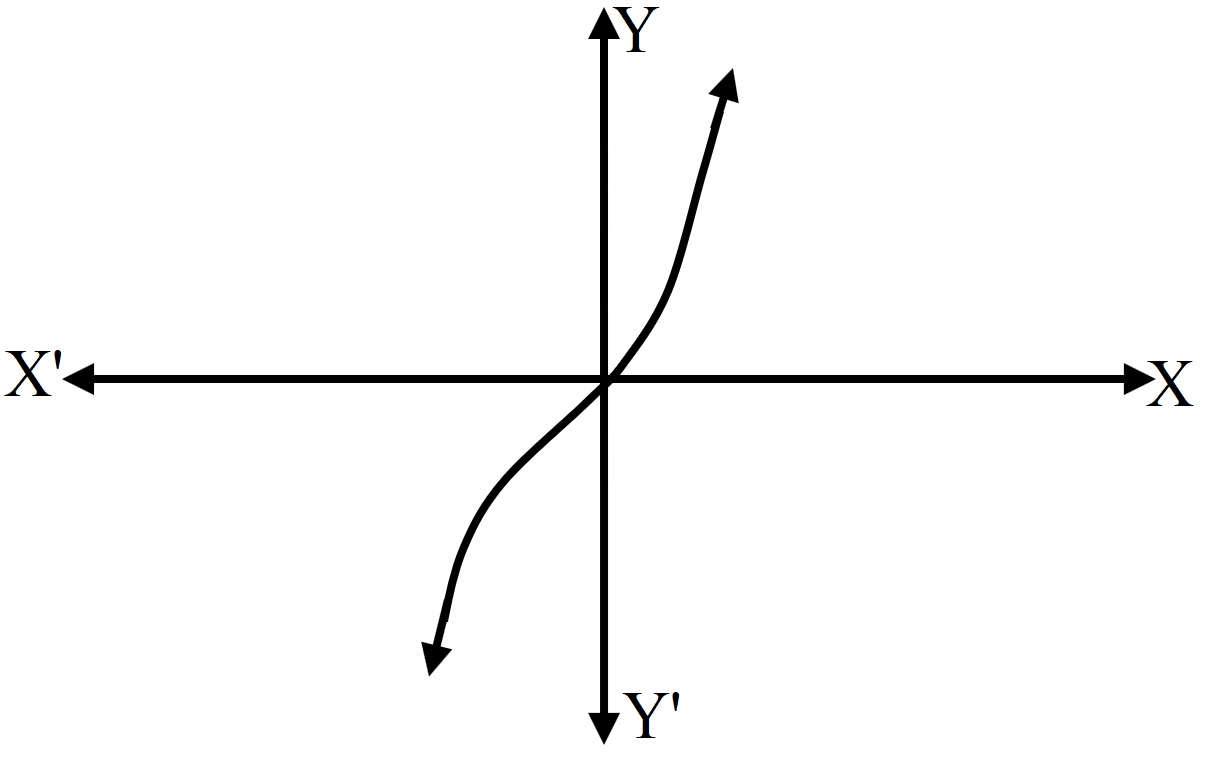
Assertion : The graph of $y =f(x)$ is given below. Number of zeroes of $F(x) = 1.$
Reason : Graph of $y = f(x) $ intersect $x -$ axis in one point only.
- ✓
Both assertion $(A)$ and reason $(R)$ are true and reason $(R)$ is the correct explanation of assertion $(A)$.
- B
Both assertion $(A)$ and reason $(R)$ are true but reason $(R)$ is not the correct explanation of assertion $(A)$.
- C
Assertion $(A)$ is true but reason $(R)$ is false.
- D
Assertion $(A)$ is false but reason $(R)$ is true.
AnswerCorrect option: A. Both assertion $(A)$ and reason $(R)$ are true and reason $(R)$ is the correct explanation of assertion $(A)$.
Both assertion $(A)$ and reason $(R)$ are true and reason $(R)$ is the correct explanation of assertion $(A)$.
View full question & answer→MCQ 271 Mark
Directions: In the following questions, the Assertions $(A)$ and Reason(s) $(R)$ have been put forward. Read both the statements carefully and choose the correct alternative from the following:
Assertion: Zeroes of $p(z)=z^2-27$ are $\sqrt{3}$ and $-\sqrt{3}$.
Reason: For zeroes $z^2-27=0, z^2=27 z = \pm \sqrt{27} z = \pm 3 \sqrt{3}$.
- ✓
Both assertion $(A)$ and reason $(R)$ are true and reason $(R)$ is the correct explanation of assertion $(A).$
- B
Both assertion $(A)$ and reason $(R)$ are true but reason $(R)$ is not the correct explanation of assertion $(A).$
- C
Assertion $(A)$ is true but reason $(R)$ is false.
- D
Assertion $(A)$ is false but reason $(R)$ is true.
AnswerCorrect option: A. Both assertion $(A)$ and reason $(R)$ are true and reason $(R)$ is the correct explanation of assertion $(A).$
Both assertion $(A)$ and reason $(R)$ are true and reason $(R)$ is the correct explanation of assertion $(A).$
View full question & answer→MCQ 281 Mark
Directions : In the following questions, the Assertions $(A)$ and Reason $(s) \ (R)$ have been put forward. Read both the statements carefully and choose the correct alternative from the following:
Assertion : A polynomial of degree five is divided by a quadratic polynomial. If it leaves a remainder, then the degree of remainder is $1$ or $0.$
Reason : Degree of remainder is always less than divisor.
- ✓
Both assertion $(A)$ and reason $(R)$ are true and reason $(R)$ is the correct explanation of assertion $(A)$.
- B
Both assertion $(A)$ and reason $(R)$ are true but reason $(R)$ is not the correct explanation of assertion $(A)$.
- C
Assertion $(A)$ is true but reason $(R)$ is false.
- D
Assertion $(A)$ is false but reason $(R)$ is true.
AnswerCorrect option: A. Both assertion $(A)$ and reason $(R)$ are true and reason $(R)$ is the correct explanation of assertion $(A)$.
Both assertion $(A)$ and reason $(R)$ are true and reason $(R)$ is the correct explanation of assertion $(A).$
View full question & answer→MCQ 291 Mark
Directions: In the following questions, the Assertions $(A)$ and Reason(s) $(R)$ have been put forward. Read both the statements carefully and choose the correct alternative from the following:
Assertion: $x^{20} + 1$ is a binomial.
Reason: If an expression contains two unlike terms, then it is called as a binomial.
- ✓
Both assertion $(A)$ and reason $(R)$ are true and reason $(R)$ is the correct explanation of assertion $(A).$
- B
Both assertion $(A)$ and reason $(R)$ are true but reason $(R)$ is not the correct explanation of assertion $(A).$
- C
Assertion $(A)$ is true but reason $(R)$ is false.
- D
Assertion $(A)$ is false but reason $(R)$ is true.
AnswerCorrect option: A. Both assertion $(A)$ and reason $(R)$ are true and reason $(R)$ is the correct explanation of assertion $(A).$
Both assertion $(A)$ and reason $(R)$ are true and reason $(R)$ is the correct explanation of assertion $(A).$
View full question & answer→MCQ 301 Mark
Directions: In the following questions, the Assertions $(A)$ and Reason $(s)(R)$ have been put forward. Read both the statements carefully and choose the correct alternative from the following:
Assertion: $\alpha, \beta, \gamma$ are the zeroes of $x ^3-2 x ^2+ qx - r$ and $\alpha+\beta=0$, then $2 q = r$.
Reason: If $\alpha, \beta, \gamma$ are the zeroes of $ax ^3+ bx ^2+ cr + d$, then $\alpha+\beta+\gamma=-\frac{ b }{ a }$
$\alpha \beta+\beta \gamma+\gamma \alpha=\frac{c}{a}$
$\alpha \beta \gamma=-\frac{d}{a}$
- ✓
Both assertion $(A)$ and reason $(R)$ are true and reason $(R)$ is the correct explanation of assertion $(A).$
- B
Both assertion $(A)$ and reason $(R)$ are true but reason $(R)$ is not the correct explanation of assertion $(A).$
- C
Assertion $(A)$ is true but reason $(R)$ is false.
- D
Assertion $(A)$ is false but reason $(R)$ is true.
AnswerCorrect option: A. Both assertion $(A)$ and reason $(R)$ are true and reason $(R)$ is the correct explanation of assertion $(A).$
Clearly, Reason is true. [Standard Result]
$\alpha+\beta+\gamma=-(-2)=2$
$0+\gamma=2$
$\gamma=2$
$\alpha\beta\gamma=-(-\text{r})=\text{r}$
$\alpha\beta(2)=\text{r}$
$\alpha\beta=\frac{\text{r}}{2}$
$\alpha\beta+\beta\gamma+\gamma\alpha=\text{q}$
$\frac{\text{r}}{2}+\text{r}(\alpha+\beta)=\text{q}$
$\frac{\text{g}}{2}+\gamma(0)=\text{q}$
$\gamma=2\text{q}$
Assertion is true.
Since, Reason gives Assertion.
View full question & answer→MCQ 311 Mark
Directions: In the following questions, the Assertions $(A)$ and Reason(s) $(R)$ have been put forward. Read both the statements carefully and choose the correct alternative from the following:
Assertion: $4x^2+ 9x + 79$ here $4, 9$ are the cofficent in this polynomial.
Reason: In above polynomial $79$ is constant term.
- ✓
Both assertion $(A)$ and reason $(R)$ are true and reason $(R)$ is the correct explanation of assertion $(A).$
- B
Both assertion $(A)$ and reason $(R)$ are true but reason $(R)$ is not the correct explanation of assertion $(A).$
- C
Assertion $(A)$ is true but reason $(R)$ is false.
- D
Assertion $(A)$ is false but reason $(R)$ is true.
AnswerCorrect option: A. Both assertion $(A)$ and reason $(R)$ are true and reason $(R)$ is the correct explanation of assertion $(A).$
Both assertion $(A)$ and reason $(R)$ are true and reason $(R)$ is the correct explanation of assertion $(A).$
View full question & answer→MCQ 321 Mark
Directions : In the following questions, the Assertions $(A)$ and Reason $(s)\ (R)$ have been put forward. Read both the statements carefully and choose the correct alternative from the following:
Assertion : Degree of aa zero polynomial is not defined.
Reason : Degree of a non $-$ zero constant polynomial is $0.$
- A
Both assertion $(A)$ and reason $(R)$ are true and reason $(R)$ is the correct explanation of assertion $(A)$.
- ✓
Both assertion $(A)$ and reason $(R)$ are true but reason $(R)$ is not the correct explanation of assertion $(A)$.
- C
Assertion $(A)$ is true but reason $(R)$ is false.
- D
Assertion $(A)$ is false but reason $(R)$ is true.
AnswerCorrect option: B. Both assertion $(A)$ and reason $(R)$ are true but reason $(R)$ is not the correct explanation of assertion $(A)$.
Both assertion $(A)$ and reason $(R)$ are true but reason $(R)$ is not the correct explanation of assertion $(A).$
View full question & answer→MCQ 331 Mark
Directions : In the following questions, the Assertions $(A)$ and Reason $(s)\ (R)$ have been put forward. Read both the statements carefully and choose the correct alternative from the following:
Assertion : The polynomial $\text{p}(\text{x})=\frac{3}{2}\text{x}-\frac{10}{7}$ is a linear polynomial.
Reason : The general form of linear polynomial is $ax + b.$
- ✓
Both assertion $(A)$ and reason $(R)$ are true and reason $(R)$ is the correct explanation of assertion $(A)$.
- B
Both assertion $(A)$ and reason $(R)$ are true but reason $(R)$ is not the correct explanation of assertion $(A)$.
- C
Assertion $(A)$ is true but reason $(R)$ is false.
- D
Assertion $(A)$ is false but reason $(R)$ is true.
AnswerCorrect option: A. Both assertion $(A)$ and reason $(R)$ are true and reason $(R)$ is the correct explanation of assertion $(A)$.
Both assertion $(A)$ and reason $(R)$ are true and reason $(R)$ is the correct explanation of assertion $(A).$
View full question & answer→MCQ 341 Mark
Directions : In the following questions, the Assertions $(A)$ and Reason $(s)\ (R)$ have been put forward. Read both the statements carefully and choose the correct alternative from the following:
Assertion : The graph of linear polynomial intersect the $x -$ axis at point.
Reason : For polynomial $P(x)$ of degree n the graph of $y = P(x)$ intersect $x -$ axis at most points.
- ✓
Both assertion $(A)$ and reason $(R)$ are true and reason $(R)$ is the correct explanation of assertion $(A)$.
- B
Both assertion $(A)$ and reason $(R)$ are true but reason $(R)$ is not the correct explanation of assertion $(A)$.
- C
Assertion $(A)$ is true but reason $(R)$ is false.
- D
Assertion $(A)$ is false but reason $(R)$ is true.
AnswerCorrect option: A. Both assertion $(A)$ and reason $(R)$ are true and reason $(R)$ is the correct explanation of assertion $(A)$.
Both assertion $(A)$ and reason $(R)$ are true and reason $(R)$ is the correct explanation of assertion $(A).$
View full question & answer→MCQ 351 Mark
Directions: In the following questions, the Assertions $(A)$ and Reason$(s) (R)$ have been put forward. Read both the statements carefully and choose the correct alternative from the following:
Assertion: If one zero' of poly $-$ nominal $p ( x )=\left( k ^2+4\right) x ^2+13 x +4 k$ is reciprocal of other, then $k =2$.
Reason: If $(\text{x}-\alpha)$ is a factor of p(x), then $p(a) = 0$ i.e. $\alpha$ is a zero of $p(x). $
- A
Both assertion $(A)$ and reason $(R)$ are true and reason $(R)$ is the correct explanation of assertion $(A)$.
- ✓
Both assertion $(A)$ and reason $(R)$ are true but reason $(R)$ is not the correct explanation of assertion $(A)$.
- C
Assertion $(A)$ is true but reason $(R)$ is false.
- D
Assertion $(A)$ is false but reason $(R)$ is true.
AnswerCorrect option: B. Both assertion $(A)$ and reason $(R)$ are true but reason $(R)$ is not the correct explanation of assertion $(A)$.
Reason is true.
Let $\alpha,\frac{1}{\alpha}$ be the zeroes of $p(2)$, then
$\alpha\cdot\frac{1}{\alpha}=\frac{4\text{k}}{\text{k}^{2}+4}$
$1=\frac{4\text{k}}{\text{k}^{2}+4}$
$\text{k}^{2}-4\text{k}+4=0$
$(\text{k}-2)^{2}=0$
$\text{k}=2$
Assertion is true.
Since, Reason is not correct for Assertion.
View full question & answer→MCQ 361 Mark
Directions: In the following questions, the Assertions $(A)$ and Reason$(s) (R)$ have been put forward. Read both the statements carefully and choose the correct alternative from the following:
Assertion:$x^3 + x$ has only one real zero.
Reason: A polynomial of $n^{th}$ degree must have n real Zeroes.
- A
Both assertion $(A)$ and reason $(R)$ are true and reason $(R)$ is the correct explanation of assertion $(A)$.
- B
Both assertion $(A)$ and reason $(R)$ are true but reason $(R)$ is not the correct explanation of assertion $(A)$.
- ✓
Assertion $(A)$ is true but reason $(R)$ is false.
- D
Assertion $(A)$ is false but reason $(R)$ is true.
AnswerCorrect option: C. Assertion $(A)$ is true but reason $(R)$ is false.
Reason is false $[$a polynomial of $n ^{\text {th }}$ degree has at most $x$ zeroes.$]$
Again, $x^3+x=x\left(x^2+1\right)$
which has only one real zero $(x=0)\left[x^2+1 \neq 0\right.$ for all $\left.x \in R\right]$
Assertion is true.
View full question & answer→MCQ 371 Mark
Directions : In the following questions, the Assertions $(A)$ and Reason $(s)\ (R)$ have been put forward. Read both the statements carefully and choose the correct alternative from the following:
Assertion : A term of the expression having no literal factors is called a constant term.
Reason : $5 + 4x$ here $5$ is the constant term.
- ✓
Both assertion $(A)$ and reason $(R)$ are true and reason $(R)$ is the correct explanation of assertion $(A)$.
- B
Both assertion $(A)$ and reason $(R)$ are true but reason $(R)$ is not the correct explanation of assertion $(A)$.
- C
Assertion $(A)$ is true but reason $(R)$ is false.
- D
Assertion $(A)$ is false but reason $(R)$ is true.
AnswerCorrect option: A. Both assertion $(A)$ and reason $(R)$ are true and reason $(R)$ is the correct explanation of assertion $(A)$.
Both assertion $(A)$ and reason $(R)$ are true and reason $(R)$ is the correct explanation of assertion $(A).$
View full question & answer→MCQ 381 Mark
Directions : In the following questions, the Assertions $(A)$ and Reason $(s) \ (R)$ have been put forward. Read both the statements carefully and choose the correct alternative from the following:
Assertion : The graph of a quadratic polynomial $P(x)$ intersects the $x -$ axis at two points.
Reason : The graph of a quadratic polynomial is a parabola.
- A
Both assertion $(A)$ and reason $(R)$ are true and reason $(R)$ is the correct explanation of assertion $(A)$.
- ✓
Both assertion $(A)$ and reason $(R)$ are true but reason $(R)$ is not the correct explanation of assertion $(A)$.
- C
Assertion $(A)$ is true but reason $(R)$ is false.
- D
Assertion $(A)$ is false but reason $(R)$ is true.
AnswerCorrect option: B. Both assertion $(A)$ and reason $(R)$ are true but reason $(R)$ is not the correct explanation of assertion $(A)$.
Both assertion $(A)$ and reason $(R)$ are true but reason $(R)$ is not the correct explanation of assertion $(A).$
View full question & answer→MCQ 391 Mark
Directions: In the following questions, the Assertions $(A)$ and Reason$(s) (R)$ have been put forward. Read both the statements carefully and choose the correct alternative from the following:
Assertion: $P(x) = 14x^3- 2x^2 + 8x^4 + 7x - 8$ is a polynomial of degree $3.$
Reason: The highest power of x in the polynomial $p(x)$ is the degree of the polynomial.
- A
Both assertion $(A)$ and reason $(R)$ are true and reason $(R)$ is the correct explanation of assertion $(A)$.
- B
Both assertion $(A)$ and reason $(R)$ are true but reason $(R)$ is not the correct explanation of assertion $(A)$.
- C
Assertion $(A)$ is true but reason $(R)$ is false.
- ✓
Assertion $(A)$ is false but reason $(R)$ is true.
AnswerCorrect option: D. Assertion $(A)$ is false but reason $(R)$ is true.
The highest power of x in the polynomial $P(x) = 14x^3- 2x^2 + 8x^4 + 7x - 8$ is $4.$
Degree of $p(x)$ is $4$.
So, A is incorrect but $R$ is correct.
View full question & answer→MCQ 401 Mark
Directions : In the following questions, the Assertions $(A)$ and Reason $(s)\ (R)$ have been put forward. Read both the statements carefully and choose the correct alternative from the following :
Assertion : The graph of polynomial intersect $x -$ axis at $3$ points and $y -$ axis at $1$ points the polynomial has $3$ zeroes.
Reason : The number of zeroes that a polynomial $P(x)$ can have is the number of times polynomial intersect $x$ and $y -$ axis.
- A
Both assertion $(A)$ and reason $(R)$ are true and reason $(R)$ is the correct explanation of assertion $(A)$.
- B
Both assertion $(A)$ and reason $(R)$ are true but reason $(R)$ is not the correct explanation of assertion $(A)$.
- ✓
Assertion $(A)$ is true but reason $(R)$ is false.
- D
Assertion $(A)$ is false but reason $(R)$ is true.
AnswerCorrect option: C. Assertion $(A)$ is true but reason $(R)$ is false.
Assertion $(A)$ is true but reason $(R)$ is false.
View full question & answer→MCQ 411 Mark
Directions : In the following questions, the Assertions $(A)$ and Reason $(s) \ (R)$ have been put forward. Read both the statements carefully and choose the correct alternative from the following:
Assertion : $3-2\sqrt{5}$ is one zero of the quadratic polynomial then other zero willbe $3+2\sqrt{5}.$
Reason : Irrational zeros $($roots$)$ always occurs in pairs.
- ✓
Both assertion $(A)$ and reason $(R)$ are true and reason $(R)$ is the correct explanation of assertion $(A)$.
- B
Both assertion $(A)$ and reason $(R)$ are true but reason $(R)$ is not the correct explanation of assertion $(A)$.
- C
Assertion $(A)$ is true but reason $(R)$ is false.
- D
Assertion $(A)$ is false but reason $(R)$ is true.
AnswerCorrect option: A. Both assertion $(A)$ and reason $(R)$ are true and reason $(R)$ is the correct explanation of assertion $(A)$.
Asirrational roots/ zeros always occurs in pairs therefore, when one zero is $3-2\sqrt{5}$ then other willbe $3+2\sqrt{5}.$
So, both $A$ and Rare correct and Rexplains $A.$
View full question & answer→MCQ 421 Mark
Directions: In the following questions, the Assertions $(A)$ and Reason$(s) (R)$ have been put forward. Read both the statements carefully and choose the correct alternative from the following:
Assertion: If $x ^6+1$ is divided by $x -1$, then the remainder is $2 $.
Reason: $p(x)=x^6+1$ when divided by $x-1$, then remainder $=p(1), p(1)=1^6+1=2$.
- ✓
Both assertion $(A)$ and reason $(R)$ are true and reason $(R)$ is the correct explanation of assertion $(A)$.
- B
Both assertion $(A)$ and reason $(R)$ are true but reason $(R)$ is not the correct explanation of assertion $(A)$.
- C
Assertion $(A)$ is true but reason $(R)$ is false.
- D
Assertion $(A)$ is false but reason $(R)$ is true.
AnswerCorrect option: A. Both assertion $(A)$ and reason $(R)$ are true and reason $(R)$ is the correct explanation of assertion $(A)$.
Both assertion $(A)$ and reason $(R)$ are true and reason $(R)$ is the correct explanation of assertion $(A).$
View full question & answer→MCQ 431 Mark
Directions : In the following questions, the Assertions $(A)$ and Reason $(s) \ (R)$ have been put forward. Read both the statements carefully and choose the correct alternative from the following:
Assertion : $5\text{t}-\sqrt{7}$ is a linear polynomial.
Reason : A polynomial of degree $1$ is called a linear polynomial.
- ✓
Both assertion $(A)$ and reason $(R)$ are true and reason $(R)$ is the correct explanation of assertion $(A)$.
- B
Both assertion $(A)$ and reason $(R)$ are true but reason $(R)$ is not the correct explanation of assertion $(A)$.
- C
Assertion $(A)$ is true but reason $(R)$ is false.
- D
Assertion $(A)$ is false but reason $(R)$ is true.
AnswerCorrect option: A. Both assertion $(A)$ and reason $(R)$ are true and reason $(R)$ is the correct explanation of assertion $(A)$.
Both assertion $(A)$ and reason $(R)$ are true and reason $(R)$ is the correct explanation of assertion $(A)$.
View full question & answer→MCQ 441 Mark
Directions : In the following questions, the Assertions $(A)$ and Reason $(s) \ (R)$ have been put forward. Read both the statements carefully and choose the correct alternative from the following:
Assertion : The graph of quadratic polynomial $P(x)$ intersect $x -$ axis at two point.
Reason : Degree of quadratic polynomial is $2.$
- ✓
Both assertion $(A)$ and reason $(R)$ are true and reason $(R)$ is the correct explanation of assertion $(A)$.
- B
Both assertion $(A)$ and reason $(R)$ are true but reason $(R)$ is not the correct explanation of assertion $(A)$.
- C
Assertion $(A)$ is true but reason $(R)$ is false.
- D
Assertion $(A)$ is false but reason $(R)$ is true.
AnswerCorrect option: A. Both assertion $(A)$ and reason $(R)$ are true and reason $(R)$ is the correct explanation of assertion $(A)$.
Both assertion $(A)$ and reason $(R)$ are true and reason $(R)$ is the correct explanation of assertion $(A).$
View full question & answer→MCQ 451 Mark
Directions: In the following questions, the Assertions $(A)$ and Reason(s) $(R)$ have been put forward. Read both the statements carefully and choose the correct alternative from the following:
Assertion: If $a, b, c$ are the zeroes of $x^3-2 x^2+q x-r$ and $a+b=0$ then $2 q=r$.
Reason: If $a, b, c$ are the zeroes of $p x^3+ qx ^2+r x+s$ then $a+b+c=-\frac{q}{p}, a b+b c+c a=\frac{ r }{ s }, a b c=-\frac{ s }{ p }$.
- ✓
Both assertion $(A)$ and reason $(R)$ are true and reason $(R)$ is the correct explanation of assertion $(A).$
- B
Both assertion $(A)$ and reason $(R)$ are true but reason $(R)$ is not the correct explanation of assertion $(A).$
- C
Assertion $(A)$ is true but reason $(R)$ is false.
- D
Assertion $(A)$ is false but reason $(R)$ is true.
AnswerCorrect option: A. Both assertion $(A)$ and reason $(R)$ are true and reason $(R)$ is the correct explanation of assertion $(A).$
Both assertion $(A)$ and reason $(R)$ are true and reason $(R)$ is the correct explanation of assertion $(A).$
View full question & answer→MCQ 461 Mark
Directions : In the following questions, the Assertions $(A)$ and Reason $(s) \ (R)$ have been put forward. Read both the statements carefully and choose the correct alternative from the following:
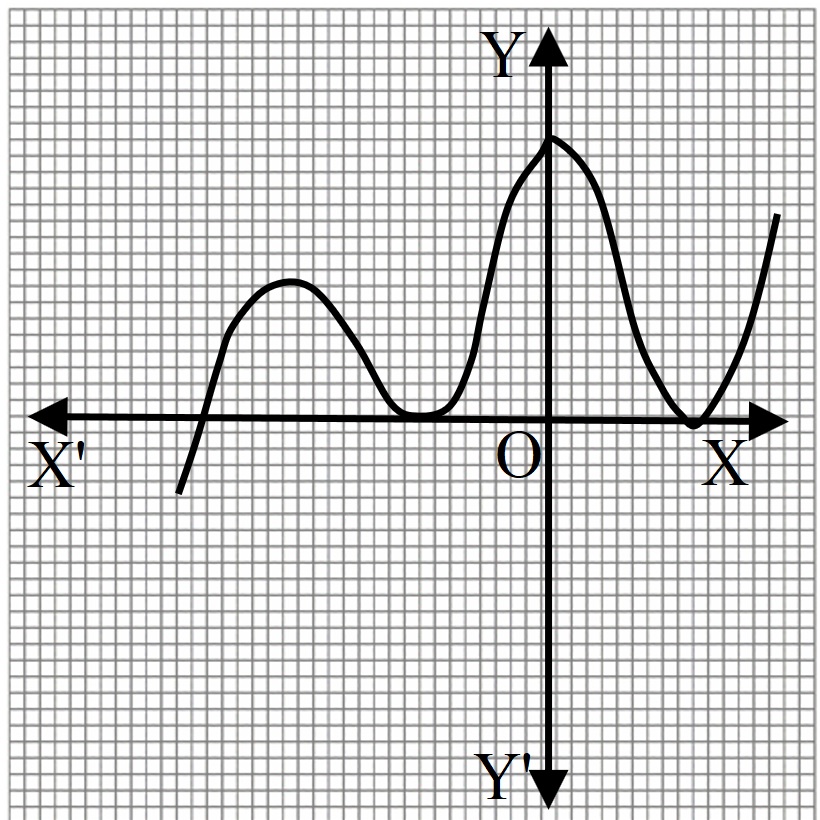
Assertion : The graph $y = f(x)$ is shown in figure, for the polynomial $f(x)$. The number of zero of $f(x)$ is $4.$
Reason : The number of zero of the polynomial $f(x) -$ is the number of point of which $f(x)$ cuts of touches the axes.
- A
Both assertion $(A)$ and reason $(R)$ are true and reason $(R)$ is the correct explanation of assertion $(A)$.
- B
Both assertion $(A)$ and reason $(R)$ are true but reason $(R)$ is not the correct explanation of assertion $(A)$.
- ✓
Assertion $(A)$ is true but reason $(R)$ is false.
- D
Assertion $(A)$ is false but reason $(R)$ is true.
AnswerCorrect option: C. Assertion $(A)$ is true but reason $(R)$ is false.
As the number zero of polynomial $f(x)$ is the number of points at which $f(x)$ cuts $($intersects$)$ the $x -$ axis and number of zero in the given figure is $4.$
So $A$ is correct but $R$ is incorrect.
View full question & answer→MCQ 471 Mark
Directions: In the following questions, the Assertions $(A)$ and Reason $(s)(R)$ have been put forward. Read both the statements carefully and choose the correct alternative from the following:
Assertion: The sum and product of the zeros of a quadratic polynomial are $-\frac{1}{4}$ and $\frac{1}{4}$ respectively. $4$ Then the quadratic polynomial is $4 x^2+x+1$.
Reason: The quadratic polynomial whose sum and product of zeros are given is $x^2 - ($sum of zeros$). x+$ product of zeros.
- ✓
Both assertion $(A)$ and reason $(R)$ are true and reason $(R)$ is the correct explanation of assertion $(A)$.
- B
Both assertion $(A)$ and reason $(R)$ are true but reason $(R)$ is not the correct explanation of assertion $(A)$.
- C
Assertion $(A)$ is true but reason $(R)$ is false.
- D
Assertion $(A)$ is false but reason $(R)$ is true.
AnswerCorrect option: A. Both assertion $(A)$ and reason $(R)$ are true and reason $(R)$ is the correct explanation of assertion $(A)$.
Sum of zeros $=-\frac{1}{4}$ and product of zeros $=\frac{1}{4}$ Quadratic polynomial be
$\text{x}^{2}-\big(-\frac{1}{4}\big)\text{x}+\frac{1}{4}$
$\Rightarrow\text{x}^{2}+\frac{1}{4}\text{x}+\frac{1}{4}$
$\Rightarrow\frac{1}{4}(4\text{x}^{2}+\text{x}+1)$
Quadratic polynomial be $4x^2 + x + 1.$
So, both A and R are correct and $R$ explains $A.$
View full question & answer→MCQ 481 Mark
Directions: In the following questions, the Assertions $(A)$ and Reason$(s) (R)$ have been put forward. Read both the statements carefully and choose the correct alternative from the following:Assertion: $(100+2)^2=10404$.
Reason: $(a+b)^2=a^2+b^2+2 a b$.
- ✓
Both assertion $(A)$ and reason $(R)$ are true and reason $(R)$ is the correct explanation of assertion $(A)$.
- B
Both assertion $(A)$ and reason $(R)$ are true but reason $(R)$ is not the correct explanation of assertion $(A)$.
- C
Assertion $(A)$ is true but reason $(R)$ is false.
- D
Assertion $(A)$ is false but reason $(R)$ is true.
AnswerCorrect option: A. Both assertion $(A)$ and reason $(R)$ are true and reason $(R)$ is the correct explanation of assertion $(A)$.
Both assertion $(A)$ and reason $(R)$ are true and reason $(R)$ is the correct explanation of assertion $(A).$
View full question & answer→MCQ 491 Mark
Directions : In the following questions, the Assertions $(A)$ and Reason $(s)\ (R)$ have been put forward. Read both the statements carefully and choose the correct alternative from the following:
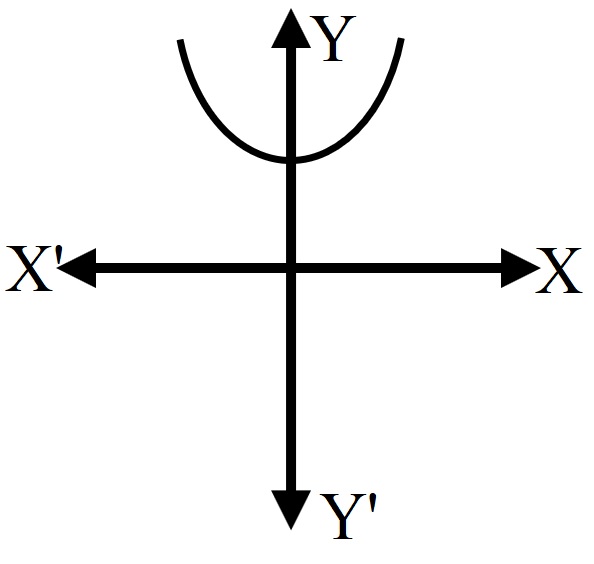
Assertion : The graph of $y = f(x)$ is given, number of zeroes of $f(x) = 0.$
Reason : Graph $y = f(x)$ does not intersect $x - $ axis.
- ✓
Both assertion $(A)$ and reason $(R)$ are true and reason $(R)$ is the correct explanation of assertion $(A)$.
- B
Both assertion $(A)$ and reason $(R)$ are true but reason $(R)$ is not the correct explanation of assertion $(A)$.
- C
Assertion $(A)$ is true but reason $(R)$ is false.
- D
Assertion $(A)$ is false but reason $(R)$ is true.
AnswerCorrect option: A. Both assertion $(A)$ and reason $(R)$ are true and reason $(R)$ is the correct explanation of assertion $(A)$.
View full question & answer→MCQ 501 Mark
Directions: In the following questions, the Assertions $(A)$ and Reason$(s) (R)$ have been put forward. Read both the statements carefully and choose the correct alternative from the following:Assertion:The polynomial $x^5+4 x 4-2 x$ $3+x^2-1$ has four zeros.
Reason: The number of zeros that a polynomial can have is equal to the degree of the polynomial.
- A
Both assertion $(A)$ and reason $(R)$ are true and reason $(R)$ is the correct explanation of assertion $(A)$.
- B
Both assertion $(A)$ and reason $(R)$ are true but reason $(R)$ is not the correct explanation of assertion $(A)$.
- C
Assertion $(A)$ is true but reason $(R)$ is false.
- ✓
Assertion $(A)$ is false but reason $(R)$ is true.
AnswerCorrect option: D. Assertion $(A)$ is false but reason $(R)$ is true.
Assertion $(A)$ is false but reason $(R)$ is true.
View full question & answer→MCQ 511 Mark
Directions : In the following questions, the Assertions $(A)$ and Reason $(s)\ (R)$ have been put forward. Read both the statements carefully and choose the correct alternative from the following:
Assertion : If the graph of polynomial intersect the $x -$ axis at only pont it be a quadratic polynomial.
Reason : Because every quadratic has at most two zeroes.
- ✓
Both assertion $(A)$ and reason $(R)$ are true and reason $(R)$ is the correct explanation of assertion $(A)$.
- B
Both assertion $(A)$ and reason $(R)$ are true but reason $(R)$ is not the correct explanation of assertion $(A)$.
- C
Assertion $(A)$ is true but reason $(R)$ is false.
- D
Assertion $(A)$ is false but reason $(R)$ is true.
AnswerCorrect option: A. Both assertion $(A)$ and reason $(R)$ are true and reason $(R)$ is the correct explanation of assertion $(A)$.
View full question & answer→MCQ 521 Mark
Directions: In the following questions, the Assertions $(A)$ and Reason$(s) (R)$ have been put forward. Read both the statements carefully and choose the correct alternative from the following:
Assertion: $x^2 + x$ is a quadratic polynomial.
Reason: In this polynomial the highest power of $x$ is $2$.
Hence, the given polynomial is quadratic.
- ✓
Both assertion $(A)$ and reason $(R)$ are true and reason $(R)$ is the correct explanation of assertion $(A)$.
- B
Both assertion $(A)$ and reason $(R)$ are true but reason $(R)$ is not the correct explanation of assertion $(A)$.
- C
Assertion $(A)$ is true but reason $(R)$ is false.
- D
Assertion $(A)$ is false but reason $(R)$ is true.
AnswerCorrect option: A. Both assertion $(A)$ and reason $(R)$ are true and reason $(R)$ is the correct explanation of assertion $(A)$.
Both assertion $(A)$ and reason $(R)$ are true and reason $(R)$ is the correct explanation of assertion $(A).$
View full question & answer→MCQ 531 Mark
Directions: In the following questions, the Assertions $(A)$ and Reason$(s) (R)$ have been put forward. Read both the statements carefully and choose the correct alternative from the following:
Assertion: $− 1$ and $4$ are the zeros of the polynomial $x^2 − 3x − 4.$
Reason: A real number $k$ is said to be a zero of a polynomial $p(x)$, if $p(k) = 0.$
- ✓
Both assertion $(A)$ and reason $(R)$ are true and reason $(R)$ is the correct explanation of assertion $(A)$.
- B
Both assertion $(A)$ and reason $(R)$ are true but reason $(R)$ is not the correct explanation of assertion $(A)$.
- C
Assertion $(A)$ is true but reason $(R)$ is false.
- D
Assertion $(A)$ is false but reason $(R)$ is true.
AnswerCorrect option: A. Both assertion $(A)$ and reason $(R)$ are true and reason $(R)$ is the correct explanation of assertion $(A)$.
Both assertion $(A)$ and reason $(R)$ are true and reason $(R)$ is the correct explanation of assertion $(A).$
View full question & answer→MCQ 541 Mark
Directions: In the following questions, the Assertions $(A)$ and Reason$(s) (R)$ have been put forward. Read both the statements carefully and choose the correct alternative from the following:
Assertion: $x^2+ 4x + 5$ has two zeroes.
Reason: A quadratic polynomial can have at the most two zeroes.
- A
Both assertion $(A)$ and reason $(R)$ are true and reason $(R)$ is the correct explanation of assertion $(A)$.
- B
Both assertion $(A)$ and reason $(R)$ are true but reason $(R)$ is not the correct explanation of assertion $(A)$.
- C
Assertion $(A)$ is true but reason $(R)$ is false.
- ✓
Assertion $(A)$ is false but reason $(R)$ is true.
AnswerCorrect option: D. Assertion $(A)$ is false but reason $(R)$ is true.
Assertion $(A)$ is false but reason $(R)$ is true.
View full question & answer→MCQ 551 Mark
Directions: In the following questions, the Assertions $(A)$ and Reason$(s) (R)$ have been put forward. Read both the statements carefully and choose the correct alternative from the following:
Assertion: The sum of the zeroes of the given quadratic polynomial $-3x^2 + k$ is $0$.
Reason: Sum of zeroes $=\frac{-\text{b}}{\text{a}}$
- ✓
Both assertion $(A)$ and reason $(R)$ are true and reason $(R)$ is the correct explanation of assertion $(A)$.
- B
Both assertion $(A)$ and reason $(R)$ are true but reason $(R)$ is not the correct explanation of assertion $(A)$.
- C
Assertion $(A)$ is true but reason $(R)$ is false.
- D
Assertion $(A)$ is false but reason $(R)$ is true.
AnswerCorrect option: A. Both assertion $(A)$ and reason $(R)$ are true and reason $(R)$ is the correct explanation of assertion $(A)$.
Both assertion $(A)$ and reason $(R)$ are true and reason $(R)$ is the correct explanation of assertion $(A).$
View full question & answer→MCQ 561 Mark
Directions: In the following questions, the Assertions $(A)$ and Reason$(s) (R)$ have been put forward. Read both the statements carefully and choose the correct alternative from the following:
Assertion: Zeroes of $f(x) = x^2 - 4x - 5$ are $5, -1.$
Reason: The polynomial whose zeroes are $2+\sqrt{3},$ $2-\sqrt{3},$ is $x^2 - 4x = 7.$
- A
Both assertion $(A)$ and reason $(R)$ are true and reason $(R)$ is the correct explanation of assertion $(A)$.
- B
Both assertion $(A)$ and reason $(R)$ are true but reason $(R)$ is not the correct explanation of assertion $(A)$.
- ✓
Assertion $(A)$ is true but reason $(R)$ is false.
- D
Assertion $(A)$ is false but reason $(R)$ is true.
AnswerCorrect option: C. Assertion $(A)$ is true but reason $(R)$ is false.
Assertion $(A)$ is true but reason $(R)$ is false.
View full question & answer→MCQ 571 Mark
Directions: In the following questions, the Assertions $(A)$ and Reason$(s) (R)$ have been put forward. Read both the statements carefully and choose the correct alternative from the following:
Assertion: If both zeros of the quadratic polynomial $x^2 - 2kx + 2$ are equal in magnitude but opposite in sign then value of k is $\frac{1}{2}.$
Reason: Sum of zeros of a quadratic polynomial $ax^2 + bx + c$ is $\frac{-\text{b}}{\text{a}}.$
- A
Both assertion $(A)$ and reason $(R)$ are true and reason $(R)$ is the correct explanation of assertion $(A)$.
- B
Both assertion $(A)$ and reason $(R)$ are true but reason $(R)$ is not the correct explanation of assertion $(A)$.
- C
Assertion $(A)$ is true but reason $(R)$ is false.
- ✓
Assertion $(A)$ is false but reason $(R)$ is true.
AnswerCorrect option: D. Assertion $(A)$ is false but reason $(R)$ is true.
As the polynomial is $x^2 - 2kx + 2$ and its zeros are equal but opposition sign
sum of zeros = 0 $=\frac{-(-2\text{k})}{1}=0$
$\Rightarrow2\text{k}=0$
$\Rightarrow\text{k}=0$
So, $A$ is incorrect but $R$ is correct.
View full question & answer→MCQ 581 Mark
Directions : In the following questions, the Assertions $(A)$ and Reason $ (s) \ (R)$ have been put forward. Read both the statements carefully and choose the correct alternative from the following :
Assertion : $(2-\sqrt{3}) $ is one zero of the quadratic polynomial then other zero will be $(2+\sqrt{3}).$
Reason : Irrational zeros $($roots$)$ always occurs in pairs.
- ✓
Both assertion $(A)$ and reason $(R)$ are true and reason $(R)$ is the correct explanation of assertion $(A)$.
- B
Both assertion $(A)$ and reason $(R)$ are true but reason $(R)$ is not the correct explanation of assertion $(A)$.
- C
Assertion $(A)$ is true but reason $(R)$ is false.
- D
Assertion $(A)$ is false but reason $(R)$ is true.
AnswerCorrect option: A. Both assertion $(A)$ and reason $(R)$ are true and reason $(R)$ is the correct explanation of assertion $(A)$.
As irrational roots/ zeros always occurs in pairs therefore, when one zero is $(2-\sqrt{3}) $ then other will be $(2+\sqrt{3}).$
So, both $A$ and $R$ are correct and $R$ explains $ A.$
View full question & answer→MCQ 591 Mark
Directions : In the following questions, the Assertions $(A)$ and Reason $(s)\ (R)$ have been put forward. Read both the statements carefully and choose the correct alternative from the following:
Assertion : $x + 1$ is a Linear Polynomial.
Reason : The polynomials of degree $1$ are called linear polynomials.
- ✓
Both assertion $(A)$ and reason $(R)$ are true and reason $(R)$ is the correct explanation of assertion $(A)$.
- B
Both assertion $(A)$ and reason $(R)$ are true but reason $(R)$ is not the correct explanation of assertion $(A)$.
- C
Assertion $(A)$ is true but reason $(R)$ is false.
- D
Assertion $(A)$ is false but reason $(R)$ is true.
AnswerCorrect option: A. Both assertion $(A)$ and reason $(R)$ are true and reason $(R)$ is the correct explanation of assertion $(A)$.
View full question & answer→MCQ 601 Mark
Directions: In the following questions, the Assertions $(A)$ and Reason$(s) (R)$ have been put forward. Read both the statements carefully and choose the correct alternative from the following:Assertion: If one zero of polynomial $p(x)=\left(k^2+4\right) x^2+13 x+4 k$ is reciprocal of the other, then $k =2$.
Reason: If $(x-a)$ is a factor of $p(x)$, then $p(a)=0$ i.e., $a$ is a zero of $p(x)$.
- A
Both assertion $(A)$ and reason $(R)$ are true and reason $(R)$ is the correct explanation of assertion $(A)$.
- ✓
Both assertion $(A)$ and reason $(R)$ are true but reason $(R)$ is not the correct explanation of assertion $(A)$.
- C
Assertion $(A)$ is true but reason $(R)$ is false.
- D
Assertion $(A)$ is false but reason $(R)$ is true.
AnswerCorrect option: B. Both assertion $(A)$ and reason $(R)$ are true but reason $(R)$ is not the correct explanation of assertion $(A)$.
Both assertion $(A)$ and reason $(R)$ are true but reason $(R)$ is not the correct explanation of assertion $(A).$
View full question & answer→MCQ 611 Mark
Directions: In the following questions, the Assertions $(A)$ and Reason$(s) (R)$ have been put forward. Read both the statements carefully and choose the correct alternative from the following:
Assertion: $t^2$ is a quadratic polynomial.
Reason: The degree of the given expression is $2$. So, it is a quadratic polynomial.
- ✓
Both assertion $(A)$ and reason $(R)$ are true and reason $(R)$ is the correct explanation of assertion $(A)$.
- B
Both assertion $(A)$ and reason $(R)$ are true but reason $(R)$ is not the correct explanation of assertion $(A)$.
- C
Assertion $(A)$ is true but reason $(R)$ is false.
- D
Assertion $(A)$ is false but reason $(R)$ is true.
AnswerCorrect option: A. Both assertion $(A)$ and reason $(R)$ are true and reason $(R)$ is the correct explanation of assertion $(A)$.
Both assertion $(A)$ and reason $(R)$ are true and reason $(R)$ is the correct explanation of assertion $(A).$
View full question & answer→MCQ 621 Mark
Directions: In the following questions, the Assertions $(A)$ and Reason $( s )( R )$ have been put forward. Read both the statements carefully and choose the correct alternative from the following:Assertion: $\left(a^2-b^2\right)=(a-b)(a+b)$.
Reason: $\left(5^2-4^2\right)=9$
- ✓
Both assertion $(A)$ and reason $(R)$ are true and reason $(R)$ is the correct explanation of assertion $(A)$.
- B
Both assertion $(A)$ and reason $(R)$ are true but reason $(R)$ is not the correct explanation of assertion $(A)$.
- C
Assertion $(A)$ is true but reason $(R)$ is false.
- D
Assertion $(A)$ is false but reason $(R)$ is true.
AnswerCorrect option: A. Both assertion $(A)$ and reason $(R)$ are true and reason $(R)$ is the correct explanation of assertion $(A)$.
Both assertion $(A)$ and reason $(R)$ are true and reason $(R)$ is the correct explanation of assertion $(A).$
View full question & answer→MCQ 631 Mark
Directions : In the following questions, the Assertions $(A)$ and Reason $(s) \ (R)$ have been put forward. Read both the statements carefully and choose the correct alternative from the following:
Assertion : A polynomial having variable with two constant value is called constant polynomial
Reason : A constant polynomial has highest degree is $2.$
- A
Both assertion $(A)$ and reason $(R)$ are true and reason $(R)$ is the correct explanation of assertion $(A)$.
- B
Both assertion $(A)$ and reason $(R)$ are true but reason $(R)$ is not the correct explanation of assertion $(A)$.
- C
Assertion $(A)$ is true but reason $(R)$ is false.
- ✓
Assertion $(A)$ is false but reason $(R)$ is true.
AnswerCorrect option: D. Assertion $(A)$ is false but reason $(R)$ is true.
View full question & answer→MCQ 641 Mark
Directions: In the following questions, the Assertions $(A)$ and Reason $(s)\ (R)$ have been put forward. Read both the statements carefully and choose the correct alternative from the following:
Assertion: The cofficent of $x$ in the expansion of $(x + 3)^3$ is $27$.
Reason: $(\text{a}+\text{b})^{3}=\text{a}^{3}+\text{b}^{3}+3\text{a}^{2}+3\text{ab}^{2}$
- ✓
Both assertion $(A)$ and reason $(R)$ are true and reason $(R)$ is the correct explanation of assertion $(A)$.
- B
Both assertion $(A)$ and reason $(R)$ are true but reason $(R)$ is not the correct explanation of assertion $(A)$.
- C
Assertion $(A)$ is true but reason $(R)$ is false.
- D
Assertion $(A)$ is false but reason $(R)$ is true.
AnswerCorrect option: A. Both assertion $(A)$ and reason $(R)$ are true and reason $(R)$ is the correct explanation of assertion $(A)$.
Both assertion $(A)$ and reason $(R)$ are true and reason $(R)$ is the correct explanation of assertion $(A).$
View full question & answer→MCQ 651 Mark
Directions : In the following questions, the Assertions $(A)$ and Reason $(s) \ (R)$ have been put forward. Read both the statements carefully and choose the correct alternative from the following:
Assertion : If the sum of the zeroes of the quadratic polynomial $x^2 - 2kx + 8$ is $2$ then value of $k$ is $1$.
Reason : Sum of zeroes of a quadratic polynomial $ax^2 + bx + c$ is $\frac{-\text{b}}{\text{a}}.$
- ✓
Both assertion $(A)$ and reason $(R)$ are true and reason $(R)$ is the correct explanation of assertion $(A)$.
- B
Both assertion $(A)$ and reason $(R)$ are true but reason $(R)$ is not the correct explanation of assertion $(A)$.
- C
Assertion $(A)$ is true but reason $(R)$ is false.
- D
Assertion $(A)$ is false but reason $(R)$ is true.
AnswerCorrect option: A. Both assertion $(A)$ and reason $(R)$ are true and reason $(R)$ is the correct explanation of assertion $(A)$.
Both assertion $(A)$ and reason $(R)$ are true and reason $(R)$ is the correct explanation of assertion $(A)$.
View full question & answer→MCQ 661 Mark
Directions : In the following questions, the Assertions $(A)$ and Reason $(s)\ (R)$ have been put forward. Read both the statements carefully and choose the correct alternative from the following:
Assertion : A quadratic polynomial, sum of whose zeroes is $8$ and their product is $12$ is $x^2 - 20x + 96.$
Reason : If $\alpha$ and $\beta$ be the zeroes of the polynomial $f(x),$ then polynomial is given by $\text{f}(\text{x})=\text{x}^{2}-(\alpha+\beta)\text{x}+\alpha\beta.$
- A
Both assertion $(A)$ and reason $(R)$ are true and reason $(R)$ is the correct explanation of assertion $(A)$.
- B
Both assertion $(A)$ and reason $(R)$ are true but reason $(R)$ is not the correct explanation of assertion $(A)$.
- C
Assertion $(A)$ is true but reason $(R)$ is false.
- ✓
Assertion $(A)$ is false but reason $(R)$ is true.
AnswerCorrect option: D. Assertion $(A)$ is false but reason $(R)$ is true.
Assertion $(A)$ is false but reason $(R)$ is true.
Reason is correct.
If $\alpha$ and $\beta$ be the zeroes of the required polynomial $f(x),$
then, $(\alpha+\beta)=8$ and $\alpha\beta=12$
$\therefore\text{f}(\text{x})=\text{x}^{2}-(\alpha+\beta)\text{x}+\alpha\beta$
$\Rightarrow\text{f}(\text{x})=\text{x}^{2}-8\text{x}+12$
So, Assertion is not correct
View full question & answer→MCQ 671 Mark
Statement A (Assertion): Zeroes of the polynomial $2 x^2-8 x+6$ are 1 and 3 .
Statement $R$ (Reason) : If $\alpha$ and $\beta$ are zeroes of quadratic polynomial $p(x)=a x^2+b x+c, a \neq$ 0 , then $p(x)=k\left[x^2-(\alpha+\beta) x+\alpha \beta\right]$, where $k$ is a constant.
- A
Both assertion (A) and reason ( $R$ ) are true and reason $(R)$ is the correct explanation of assertion $(A)$.
- ✓
Both assertion (A) and reason ( $R$ ) are true and reason $(R)$ is not the correct explanation of assertion (A).
- C
Assertion $(A)$ is true but reason $(R)$ is false.
- D
Assertion (A) is false but reason $(R)$ is true.
AnswerCorrect option: B. Both assertion (A) and reason ( $R$ ) are true and reason $(R)$ is not the correct explanation of assertion (A).
(b) : Clearly, Reason is true.
Let $p$
$\begin{aligned}
p(x) & =2 x^2-8 x+6 \\
& =2 x^2-2 x-6 x+6=2 x(x-1)-6(x-1) \\
& =(x-1)(2 x-6)
\end{aligned}$
So, the value of $p(x)$ is zero, when
$x-1=0 \text { or } 2 x-6=0$
i.e., when $x=1$ or $x=3$.
$\therefore \quad$ Zeroes of $p(x)$ are 1 and 3 .
$\therefore \quad$ Assertion and Reason both are true but Reason is not the correct explanation of Assertion.
View full question & answer→MCQ 681 Mark
Statement $A\ ($Assertion$)$ : If $-1$ is the zero of the polynomial $p(x)=x^2-3 a x+3 a-7,$ then value of $a$ is $3$ .
Statement $R\ ($Reason$)$ : The zeroes of polynomial $a x^2+b x+c, a \neq 0$ are the $x-$ coordinate of the points where the parabola representing $y$
$=a x^2+b x+c$ intersects the $x-$ axis.
- A
Both assertion $(A)$ and reason $(R)$ are true and reason $(R)$ is the correct explanation of assertion $(A)$.
- B
Both assertion $(A)$ and reason $(R)$ are true and reason $(R)$ is not the correct explanation of assertion $(A)$.
- C
Assertion $(A)$ is true but reason $(R)$ is false.
- ✓
Assertion $(A)$ is false but reason $(R)$ is true.
AnswerCorrect option: D. Assertion $(A)$ is false but reason $(R)$ is true.
We have $, -1$ is the zero of $p(x)=x^2-3 a x+3 a-7$.
$\therefore p(-1)=0$
$\Rightarrow (-1)^2-3 a(-1)+3 a-7=0$
$\Rightarrow 1+3 a+3 a-7=0$
$\Rightarrow 6 a-6=0 $
$\Rightarrow a=1$
$\therefore \quad$ Assertion is false.
View full question & answer→MCQ 691 Mark
Statement A (Assertion): If the sum and product of zeroes of a quadratic polynomial is 3 and -2 respectively, then the quadratic polynomial is $x^2-3 x-2$.
Statement R (Reason) : If $S$ is the sum of zeroes and $P$ is the product of zeroes of a quadratic polynomial, then the quadratic polynomial is given by $x^2-S x+P$.
- ✓
Both assertion (A) and reason ( $R$ ) are true and reason $(R)$ is the correct explanation of assertion $(A)$.
- B
Both assertion (A) and reason ( $R$ ) are true and reason $(R)$ is not the correct explanation of assertion (A).
- C
Assertion $(A)$ is true but reason $(R)$ is false.
- D
Assertion (A) is false but reason $(R)$ is true.
AnswerCorrect option: A. Both assertion (A) and reason ( $R$ ) are true and reason $(R)$ is the correct explanation of assertion $(A)$.
(a) : Let $\alpha$ and $\beta$ are the zeroes of quadratic polynomial.
Now, given $\alpha+\beta=3=S$ and $\alpha \beta=-2=P$
So, one of the quadratic polynomial is $x^2-3 x-2$.
$\therefore \quad$ Assertion and Reason both are true and Reason is the correct explanation of Assertion.
View full question & answer→MCQ 701 Mark
Statement A (Assertion) : One of the zeroes of the polynomial $f(x)=x^3-2 x^2-3 x+6$ is $\sqrt{3}$.
Statement R (Reason): A real number $k$ is said to be a zero of a polynomial $p(x)$, if $p(k)=0$.
- ✓
Both assertion (A) and reason ( $R$ ) are true and reason $(R)$ is the correct explanation of assertion $(A)$.
- B
Both assertion (A) and reason ( $R$ ) are true and reason $(R)$ is not the correct explanation of assertion (A).
- C
Assertion $(A)$ is true but reason $(R)$ is false.
- D
Assertion (A) is false but reason $(R)$ is true.
AnswerCorrect option: A. Both assertion (A) and reason ( $R$ ) are true and reason $(R)$ is the correct explanation of assertion $(A)$.
(a) : Clearly, Reason is true.
We have, $f(x)=x^3-2 x^2-3 x+6$
$\begin{aligned}
f(\sqrt{3}) & =(\sqrt{3})^3-2(\sqrt{3})^2-3 \sqrt{3}+6 \\
& =3 \sqrt{3}-6-3 \sqrt{3}+6=0
\end{aligned}$
$\therefore \quad \sqrt{3}$ is zero of $f(x)$.
$\therefore \quad$ Assertion and Reason both are true and Reason is the correct explanation of Assertion.
View full question & answer→MCQ 711 Mark
Statement A (Assertion) : A quadratic polynomial having 5 and -3 as zeroes is $x^2-2 x$ -15 .
Statement R (Reason): The quadratic polynomial having $\alpha$ and $\beta$ as zeroes is given by $p(x)=x^2-(\alpha+\beta) x+\alpha \beta$.
- ✓
Both assertion (A) and reason ( $R$ ) are true and reason $(R)$ is the correct explanation of assertion $(A)$.
- B
Both assertion (A) and reason ( $R$ ) are true and reason $(R)$ is not the correct explanation of assertion (A).
- C
Assertion $(A)$ is true but reason $(R)$ is false.
- D
Assertion (A) is false but reason $(R)$ is true.
AnswerCorrect option: A. Both assertion (A) and reason ( $R$ ) are true and reason $(R)$ is the correct explanation of assertion $(A)$.
(a) : Clearly, Reason is true.
Let $\alpha=5$ and $\beta=-3$.
Then, $\alpha+\beta=2$ and $\alpha \beta=-15$
$\therefore \quad$ Required polynomial is given by $p(x)=x^2-2 x-15$
$\therefore \quad$ Assertion and Reason both are true and Reason is the true explanation of Assertion.
View full question & answer→MCQ 721 Mark
Statement $A\ ($Assertion$)$ : If one zero of the polynomial $p(x)=\left(k^2+9\right) x^2+9 x+6 k$ is the reciprocal of the other zero, then $k=3$.
Statement $R \ ($Reason$)$ : If $(x-\alpha)$ is a factor of the polynomial $p(x),$ then $\alpha$ is a zero of $p(x)$.
- A
Both assertion $(A)$ and reason $(R)$ are true and reason $(R)$ is the correct explanation of assertion $(A)$.
- ✓
Both assertion $(A)$ and reason $(R)$ are true and reason $(R)$ is not the correct explanation of assertion $(A)$.
- C
Assertion $(A)$ is true but reason $(R)$ is false.
- D
Assertion $(A)$ is false but reason $(R)$ is true.
AnswerCorrect option: B. Both assertion $(A)$ and reason $(R)$ are true and reason $(R)$ is not the correct explanation of assertion $(A)$.
Let $\alpha$ and $\frac{1}{\alpha}$ be the zeroes of polynomial
$p(x)=\left(k^2+9\right) x^2+9 x+6 k \text {. }$
Then, product of zeroes $=\alpha \times \frac{1}{\alpha}$
$=\frac{6 k}{k^2+9}$
$\Rightarrow \frac{6 k}{k^2+9}=1$
$\Rightarrow k^2+9=6 k $
$\Rightarrow k^2-6 k+9=0$
$\Rightarrow(k-3)^2=0 $
$\Rightarrow k-3=0 $
$\Rightarrow k=3$
$\therefore$ Assertion and Reason both are true but Reason is not the correct explanation of Assertion.
View full question & answer→MCQ 731 Mark
Statement A (Assertion): The polynomial $p(x)=x^3+x$ has one real zero.
Statement R (Reason) : A polynomial of $n^{\text {th }}$ degree has at most $n-1$ zeroes.
- A
Both assertion (A) and reason ( $R$ ) are true and reason $(R)$ is the correct explanation of assertion $(A)$.
- B
Both assertion (A) and reason ( $R$ ) are true and reason $(R)$ is not the correct explanation of assertion (A).
- ✓
Assertion $(A)$ is true but reason $(R)$ is false.
- D
Assertion (A) is false but reason $(R)$ is true.
AnswerCorrect option: C. Assertion $(A)$ is true but reason $(R)$ is false.
(c) : Clearly Reason is false.
We have, $p(x)=x^3+x=x\left(x^2+1\right)$
So, the value of $p(x)$ is zero when $x=0$ or $x^2+1=0$
But $x^2+1 \neq 0$ for any real value of $x \quad\left[\because x^2+1>0\right]$.
$\therefore \quad p(x)$ has one real zero, namely 0 .
So, Assertion is true.
View full question & answer→MCQ 741 Mark
StatementA(Assertion): $f(x)=2 x^3-\frac{3}{x}+7$ is a polynomial in the variable $x$ of degree 3 .
Statement R (Reason) : The highest power of $x$ in a polynomial $f(x)$ is called the degree of the polynomial $f(x)$.
- A
Both assertion (A) and reason ( $R$ ) are true and reason $(R)$ is the correct explanation of assertion $(A)$.
- B
Both assertion (A) and reason ( $R$ ) are true and reason $(R)$ is not the correct explanation of assertion (A).
- C
Assertion $(A)$ is true but reason $(R)$ is false.
- ✓
Assertion (A) is false but reason $(R)$ is true.
AnswerCorrect option: D. Assertion (A) is false but reason $(R)$ is true.
(d) : $f(x)=2 x^3-\frac{3}{x}+7=2 x^3-3 x^{-1}+7$ is not a polynomial as one of the term is $-3 x^{-1}$.
$\therefore$ Assertion is false but Reason is true.
View full question & answer→MCQ 751 Mark
Statement A (Assertion) : $4 x+1$ is a linear polynomial.
Statement R (Reason): A polynomial of degree 1 is a linear polynomial.
- ✓
Both assertion (A) and reason ( $R$ ) are true and reason $(R)$ is the correct explanation of assertion $(A)$.
- B
Both assertion (A) and reason ( $R$ ) are true and reason $(R)$ is not the correct explanation of assertion (A).
- C
Assertion $(A)$ is true but reason $(R)$ is false.
- D
Assertion (A) is false but reason $(R)$ is true.
AnswerCorrect option: A. Both assertion (A) and reason ( $R$ ) are true and reason $(R)$ is the correct explanation of assertion $(A)$.
(a) : Both assertion (A) and reason ( $R$ ) are true and reason $(R)$ is the correct explanation of assertion $(A)$.
View full question & answer→