Question 12 Marks
The graph of the polynomial $f(x)=a x^2+b x+c$ is as shown in Fig. Write the value of $b^2-4 a c$ and the number of real zeros of $f(x)$, write the sign of $c$.
AnswerThe parabola $y = ax^2 + bx + c$ cuts y-axis at point P which lies on $OY.$
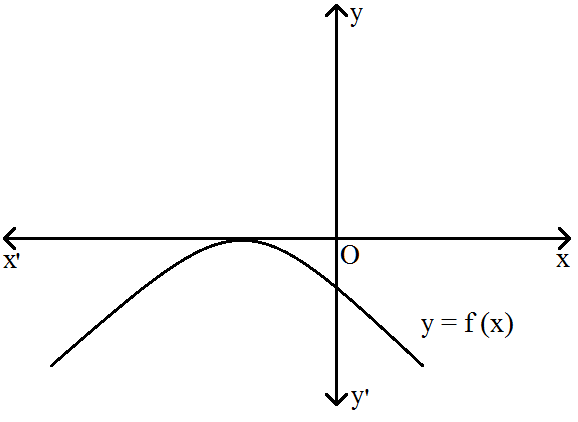
Putting $x = 0$ in $y = ax^2 + bx + c,$ We get $y = c.$
So, the coordinates of P are $(0, c).$
Clearly, P lies on $OY'$
Therefore $c < 0$ View full question & answer→Question 22 Marks
Write the standard form of a quadratic polynomial with real coefficients.
Answer$a x^2+b x+c$ is a standard form of quadratic polynomial with real co-efficients and $a \neq 0$.
View full question & answer→Question 32 Marks
The graph of the polynomial $f(x) = ax^2 + bx + c$ is as shown in Fig. Write the value of $b^2 - 4ac$ and the number of real zeros of f(x).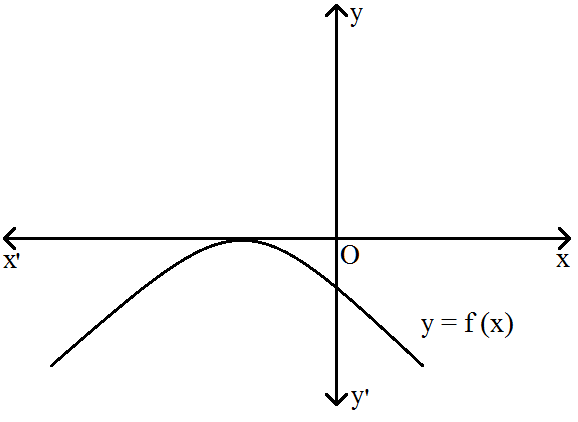
AnswerThe graph of the polynomial $f(x) = ax^2 + bx + c $or the curve touches x-axis at point $\Big(\frac{-\text{b}}{2\text{a}},0\Big).$
The x-coordinate of this point given two equal zeros of the polynomial and $b^2 - 4ac = 0.$
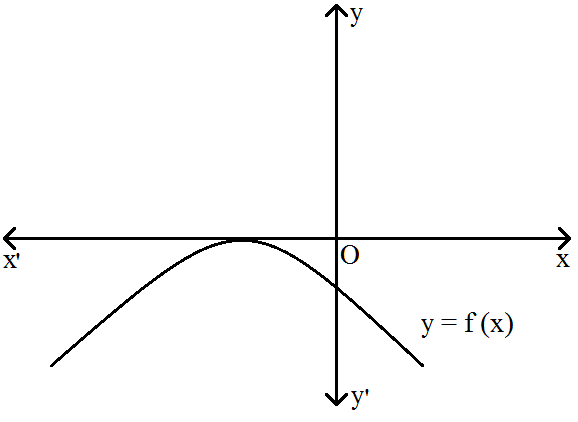
Hence the number of real zeros of f(x) is 2 and $b^2 - 4ac = 0$ View full question & answer→Question 42 Marks
If a quadratic polynomial f(x) is factorizable into linear distinct factors, then what is the total number of real and distinct zeros of f(x)?
AnswerIn a quadratic polynomial f(x) its degree is 2 and it can be factorised in to two distinct linear factors.
f(x) has two distinct zeros.
View full question & answer→Question 52 Marks
Write the family of quadratic polynomials having $-\frac{1}{4}$ and 1 as its zeros.
AnswerWe know that, if x = a is a zero of a polynomial then x - 2 is a factor of quadratic polynomials.
Since $\frac{-1}{4}$ and 1 are zeros of polynomial.
Therefore $\big(\text{x}+\frac{1}{4}\big)(\text{x}-1)$
$=\text{x}^2+\frac{1}{4}\text{x}-\text{x}-\frac{1}{4}$
$=\text{x}^2+\frac{1}{4}\text{x}-\frac{1\times4}{1\times4}\text{x}-\frac{1}{4}$
$=\text{x}^2+\frac{1-4}{4}\text{x}-\frac{1}{4}$
$=\text{x}^2-\frac{3}{4}\text{x}-\frac{1}{4}$
Hence, the family of quadratic polynomials is $\text{f(x)}=\text{k}\Big(\text{x}^2-\frac{3}{4}\text{x}-\frac{1}{4}\Big),$ where k is any non-zeros real number
View full question & answer→Question 62 Marks
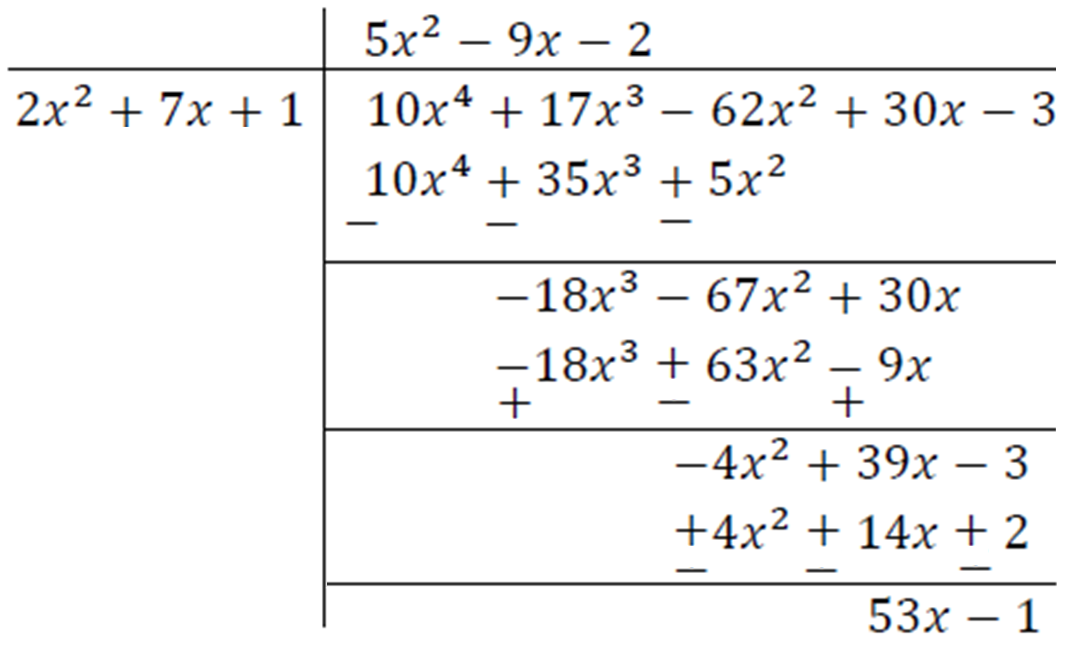
Apply division algorithm to find the quotient q(x) and remainder r(x) in dividing f(x) by g(x) in the following:
$f(x) = 10x^4 + 17x^3 - 62x^2 + 30x - 3, g(x) = 2x^2 + 7x + 1$
Answer$f(x) = 10x^4 + 17x^3 - 62x^2 + 30x - 105(x) = 2x^2 + 7x + 1$
View full question & answer→Question 72 Marks
What must be subtracted from the polynomial $f(x) = x^4 + 2x^3 − 13x^2 − 12x + 21$ so that the resulting polynomial is exactly divisible by $x^2 − 4x + 3?$
Answer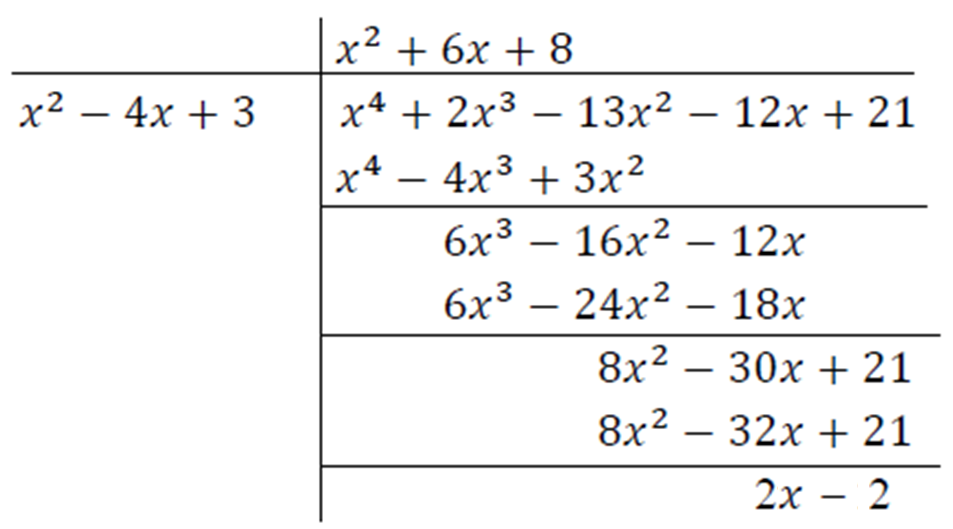
We must subtract [2x - 2] + 10m the given polynomial so as to get the resulting polynomial exactly divisible by $x^2 - x + 3$ View full question & answer→Question 82 Marks
If $\alpha,\beta$ are the zeros of the polynomial $2y^2 + 7y + 5$, write the value of $\alpha+\beta+\alpha\beta.$
Answer$\alpha$ and $\beta$ are the zeros of the polynomial $2y^2 + 7y + 5$
$\therefore\ \alpha+\beta=\frac{-\text{b}}{\text{a}}=\frac{-7}{2}$
$\alpha\beta=\frac{\text{c}}{\text{a}}=\frac{5}{2}$
$\therefore\ \alpha+\beta+\alpha\beta=\frac{-7}{2}+\frac{5}{2}=\frac{-2}{2}=-1$
View full question & answer→Question 92 Marks
State division algorithm for polynomials.
AnswerIf f(x) is a polynomial and g(x) is a non zero polynomial, there exist two polynomials q(x) and r(x) such that,
f(x) = g(x) x q(x) + r(x)
where r(x) = 0 or degree r(x) < degree g(x)
This is called division algorithm.
View full question & answer→Question 102 Marks
If the sum of the zeros of the quadratic polynomial $f(x) = kx^2 - 3x + 5$ is 1, write the value of k.
Answer$f(x) = kx^2 - 3x + 5$
Here $a = k, b = -3, c = 5$
$\therefore$ Sum of zeros $=\frac{-\text{b}}{\text{a}}=-\Big(\frac{-3}{\text{k}}\Big)=\frac{3}{\text{k}}$
$\therefore \frac{3}{\text{k}}=1 \Rightarrow\text{k}=3$
View full question & answer→Question 112 Marks
If the product of zeros of the quadratic polynomial$ f(x) = x^2 - 4x + k $is 3, find the value of k.
AnswerProduct of zeros $=\frac{\text{c}}{\text{a}}$
$\alpha\cdot\beta=\frac{\text{K}}{1}$
$3=\frac{\text{K}}{1}$
$3=\text{K}$
$\text{K}=3$
View full question & answer→Question 122 Marks
Define a polynomial with real coefficients.
AnswerIn the polynomial $\text{f(x)}=\text{a }_\text{n}\text{x}^\text{n}+\text{a}_{\text{n}-1}\text{x}^{\text{n}-1}+...+\text{a}_1\text{x}+\text{a}_0,\text{a}_\text{n}\text{x}^\text{n},\text{a}_{\text{n}-1}\text{x}^{\text{n}-1},...,\text{a}_1\text{x},$ and $a_0$ are known as the terms of the polynomial and $\text{a}_\text{n},\text{a}_{\text{n}-1},...,\text{a}_1$ $a_0$ are their real coefficients.
For example, $p(x) = 3x - 2$ is a polynomial and $3$ is a real coefficient
View full question & answer→Question 132 Marks
The Sum and product of the zeros of a quadratic polynomial are $-\frac{1}{2}$ and $-3$ respectively. What is the quadratic polynomial?
AnswerSum of zeros $(\alpha+\beta)=\frac{-1}{2}$
and product of zeros $(\alpha\cdot\beta)=-3$
$\therefore$ Quadratic polynomial with be
$k(x^2-$ {sum of zeros) x + product of zeros}
$\Rightarrow\text{k}\Big[\text{x}^2-\Big(-\frac{1}{2}\Big)\text{x}+(-3)\Big]$
$\Rightarrow \text{k}\Big[\text{x}^2+\frac{1}{2}\text{x}-3\Big]$
View full question & answer→Question 142 Marks
The graph of a polynomial y = f(x), shown in Fig. Find the number of real zeros of f(x).
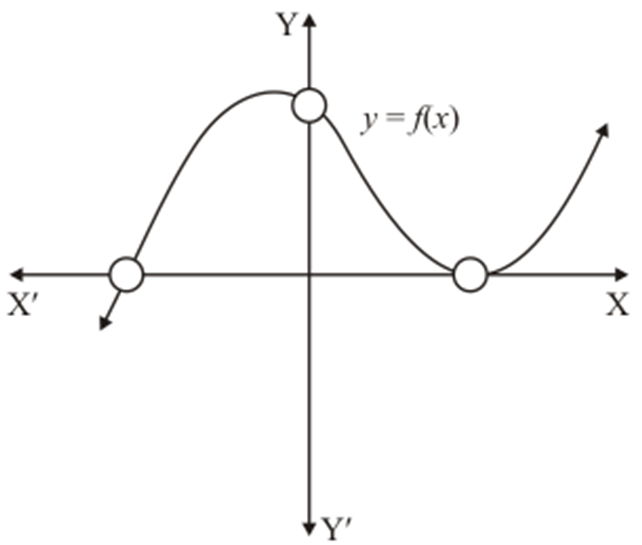
AnswerThe curve touches x-axis at one point and also intersects at one point So number of zeros will be 3, two equal and one distinct.
View full question & answer→Question 152 Marks
If the graph of quadratic polynomial $a x^2+b x+c$ cuts negative direction of $y$-axis, then what is the sign of $c$ ?
AnswerSince graph of quadratic polynomial $f(x)=a x^2+b x+c$ cuts negative direction of $y$-axis
So, put $x=0$ to find the intersection point on $y$-axis $y=0+0+c=c$
So, the point is $(0, c)$
Now it is given that the quadratic polynomial cuts negative direction of $y$
So, $c<0$
View full question & answer→Question 162 Marks
Write a quadratic polynomial, sum of whose zeros is $2\sqrt{3}$ and their product is $2$.
AnswerSum of zeros $=2\sqrt{3}$
and product of zeros $= 2$
Quadratic polynomial will be $f(x) = x^2$ - (sum of zeros) x + product of zeros
$ = \text{x}^2 – 2\sqrt{3}\text{x} + 2$
View full question & answer→Question 172 Marks
Check whether the first polynomial is a factor of the second polynomial by applying the division algorithm:$g(x) = 2x^2 - x + 3, f(x) = 6x^5 - x^4 + 4x^3 - 5x^2 - x - 15$
Answer$g(x) = 2x^2 - x + 3, f(x) = 6x^5 - x^4 + 4x^3 - 5x^2 - x - 15$
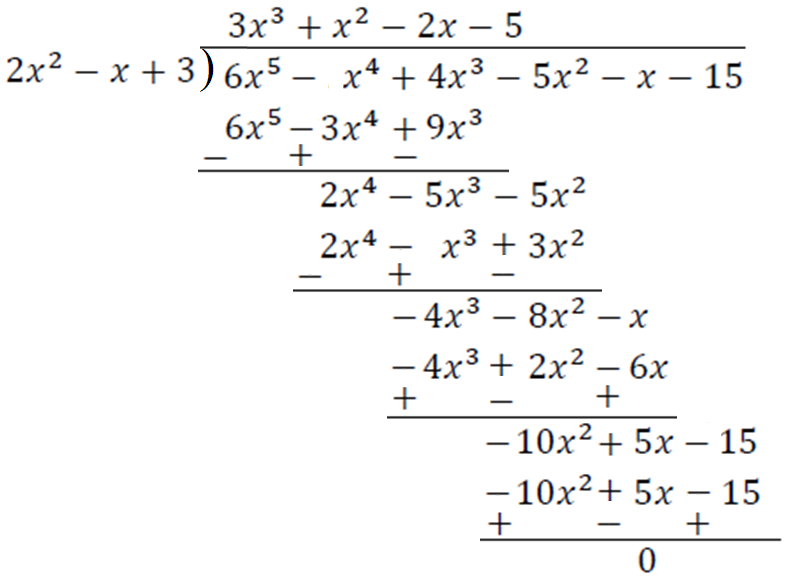
View full question & answer→Question 182 Marks
Write the standard form of a cubic polynomial with real coefficients.
AnswerThe most general form of a cubic polynomial with coefficients as real numbers is of the from $f(x)=a x^3+b x^2+c x+d$, where $a$, $b , c , d$ are real number and $a \neq 0$.
View full question & answer→Question 192 Marks
Write the standard form of a linear polynomial with real coefficients.
AnswerAny linear polynomial in variable x with real coefficients is of the form f(x) = ax + b where a, b are real numbers and a ≠ 0.
View full question & answer→Question 202 Marks
If $\alpha$ and $\beta$ are the zeroes of the quadratic polynomial $f(x) = ax^2 + bx + c$, then evaluate:$\frac{1}{\alpha}+\frac{1}{\beta}-2\alpha\beta$
Answer$\frac{1}{\alpha}+\frac{1}{\beta}-2\alpha\beta$
$\Rightarrow\ \Big[\frac{\alpha+\beta}{\alpha\beta}\Big]-2\alpha\beta$
$ \Rightarrow\ \frac{-\text{b}}{\text{a}}\times\frac{\text{a}}{\text{c}}-2\frac{\text{c}}{\text{a}}=-2\frac{\text{c}}{\text{a}}-\frac{\text{b}}{\text{c}}=\frac{-\text{ab}-2\text{c}^2}{\text{ac}}-\Big[\frac{\text{b}}{\text{c}}+\frac{2\text{c}}{\text{a}}\Big]$
View full question & answer→Question 212 Marks
If $\alpha$ and $\beta$ are the zeroes of the quadratic polynomial $f(x) = ax^2 + bx + c$, then evaluate:
$\alpha-\beta$
AnswerThe two zerose of the polynomials are,
$\frac{-\text{b}+\sqrt{\text{b}^2-4\text{ac}}}{2\text{a}}-\bigg(\frac{-\text{b}-\sqrt{\text{b}^2-4\text{ac}}}{2\text{a}}\bigg)$
$=\frac{-\text{b}+\sqrt{\text{b}^2-4\text{ac}}+\text{b}+\sqrt{\text{b}^2-4\text{ac}}}{2\text{a}}$
$=\frac{2\sqrt{\text{b}^2-4\text{ac}}}{2\text{a}}=\frac{\sqrt{\text{b}^2-4\text{ac}}}{\text{a}}$
View full question & answer→Question 222 Marks
Check whether the first polynomial is a factor of the second polynomial by applying the division algorithm:$g(x) = x^3 - 3x + 1, f(x) = x^5 - 4x^3 + x^2 + 3x + 1$
Answer$g(x) = x^2 - 3x + 1, f(x) = x^5 - 4x^3 + x^2 + 3x + 1$
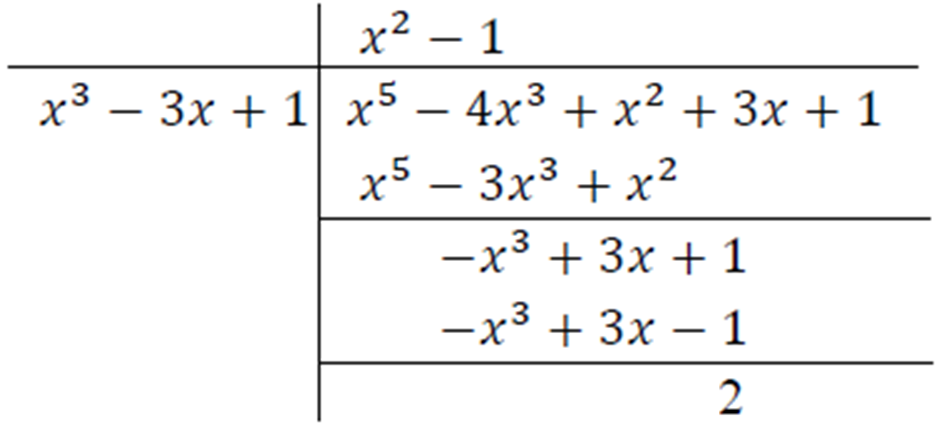
View full question & answer→Question 232 Marks
If $f(x)=x^3+x^2-a x+b$ is divisible by $x^2-x$ write the value of $a$ and $b$.
Answer$f(x) = x^3 + x^2 - ax + b$
$g(x) = x^2 - x = x(x - 1)$
Let $x(x - 1) = 0$, there $x = 0 or x - 1 = 0$
$\Rightarrow x = 1$
$\therefore$ 0, 1 are the zeros of f(x)
Now, $f(0) = 0 + 0 - 0 + b = b$
$\therefore b = 0$
and $f(1) = (1)^3 + (1)^2 - a(1) + b$
$= 1 + 1 - a + b$
$= 2 - a + b$
$\therefore 2 - a + b = 0$
$\Rightarrow 2 - a + 0 = 0$
$\Rightarrow 2 - a = 0$
$\Rightarrow a = 2$
Hence $a = 2, b = 0$
View full question & answer→Question 242 Marks
Define value of polynomial at a point.
AnswerIf f(x) is a polynomial and a is any real number then the real number obtained by replacing x by α in f(x) is called the value of f(x) at $\text{x}=\alpha$ and is denoted by $\text{f}(\alpha).$
View full question & answer→Question 252 Marks
Find the zeros of the following quadratic polynomial and verify the relationship between the zeros and their coefficients:
$6x^2 - 3 - 7x$
Answer$6x^2 - 3 - 7x = 6x^2 - 7x - 3 = (3x + 1) (2x - 3)$
Zeros of polynomials are $\frac{+3}{2}$ and $ \frac{-1}{3}$
Sum of zeros $= \frac{-1}{3} + \frac{3}{2} = \frac{7}{6} = \frac{-7}{6} = \frac{-(\text{coefficient of x)} }{\text{coefficient of x}^{2}}$
Productor zeroes $= \frac{-1}{3} \times \frac{3}{2} = \frac{-1}{2} = \frac{-3}{6} = \frac{+\text{Constant term}}{\text{Coefficient of x}^{2}}$
$\therefore $ Hence, relationship varified.
View full question & answer→Question 262 Marks
The graph of the polynomial $f(x) = ax^2 + bx + c $is as shown below Fig. Write the signs of 'a' and $b^2 - 4ac$, write the sign of c.
AnswerThe parabola $y = ax^2 + bx + c$ cuts y-axis at point P which lies on y-axis Putting $x = 0$ in$ y = ax^2 + bx + c$, we get $y = c,$
So the coordinates of P are $(0, c).$
Clearly, P line on OY. Therefore c > 0
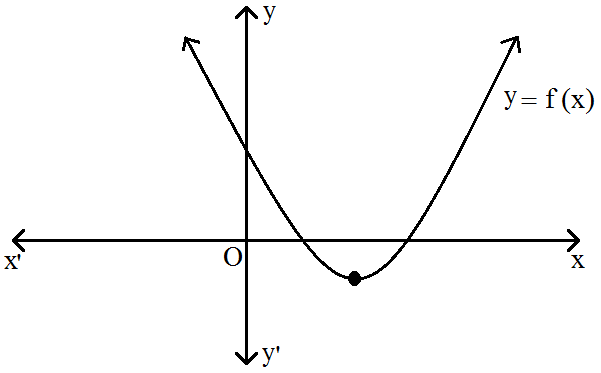
Hence, the sign of c is c > 0 View full question & answer→Question 272 Marks
If graph of quadratic polynomial $a x^2+b x+c$ cuts positive direction of $y$-axis, then what is the sign of $c$ ?
AnswerThe graph of quadratic polynomial $a x^2+b x+c$ cuts positive direction of $y$-axis Then sign of constant term $c$ will be also positive.
View full question & answer→Question 282 Marks
If $\alpha$ and $\beta$ are the zeroes of the quadratic polynomial $f ( x )= ax { }^2+ bx + c$, then evaluate: $\alpha^2 \beta+\alpha \beta^2$
Answer$\alpha^2\beta+\alpha\beta^2$
$\alpha\beta(\alpha+\beta)$
$ =\frac{\text{c}}{\text{a}}\Big(\frac{-\text{b}}{\text{a}}\Big)$
$=\frac{-\text{bc}}{\text{a}^2}$
View full question & answer→Question 292 Marks
The graph of the polynomial $f(x) = ax^2 + bx + c$ is as shown below Fig. Write the signs of 'a' and $b^2 - 4ac.$
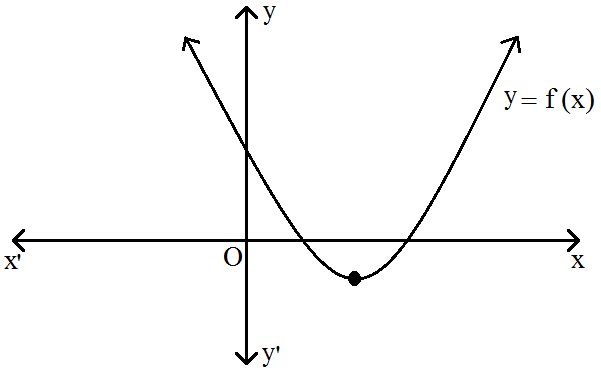
AnswerClearly, f(x) = ax2 + bx + c represent a parabola opening upwards. Therefore, a > 0
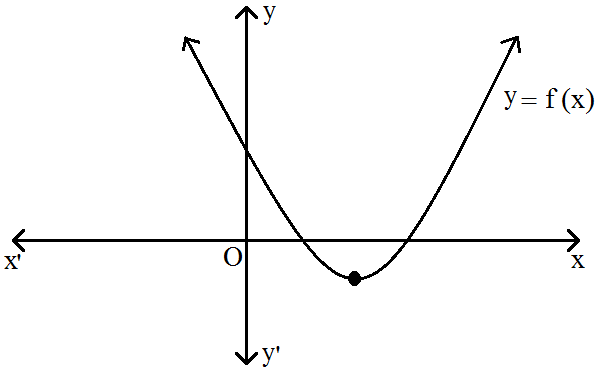
Since the parabola cuts x-axis at two points, this means that the polynomial will have two real solutions
Hence b2 - 4ac > 0
Hence a > 0 and b2 - 4ac > 0
View full question & answer→Question 302 Marks
Find the zeros of the following quadratic polynomial and verify the relationship between the zeros and their coefficients:$h(t) = t^2 - 15$
Answer$\text{h(t)}=\text{t}^2-15=(\text{t}^2)-\big(\sqrt{15}\big)^2=\big(\text{t}+\sqrt{15}\big)\big(\text{t}-\sqrt{15}\big)$
Zeroes of the polynomials are $-\sqrt{15}$ and $\sqrt{15}$
Sum of zeroes $=0$
$-\sqrt{15}+\sqrt{15}=0$
$0=0$
Now,
Product of zeroes $=\frac{-\text{Constant term}}{\text{Coefficient of x}^2}$
We have to products of polynomials are $-\sqrt{15}$ and $\sqrt{15}$
So, Product of zeroes $=\frac{-\sqrt{15}\times\sqrt{15}}{1}$
$= -15$
View full question & answer→Question 312 Marks
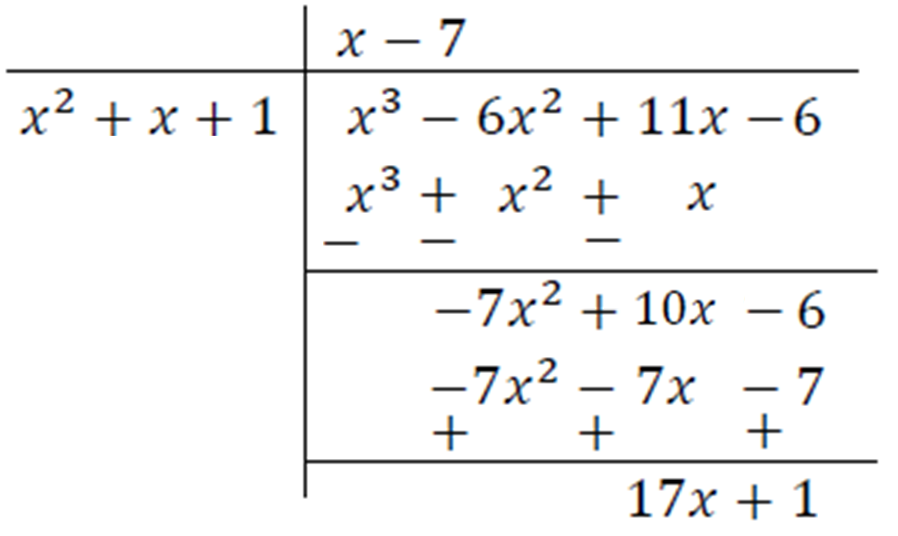
Apply division algorithm to find the quotient q(x) and remainder r(x) in dividing f(x) by g(x) in the following:
$f(x) = x^3 - 6x^2 + 11x - 6, g(x) = x^2 + x + 1$
Answer$f(x) = x^3 - 6x^2 + 11x - 6 g(x) = x^2 + x + 1$
View full question & answer→Question 322 Marks
Define degree of a polynomial.
AnswerThe exponent of the highest degree term in a polynomial is known as its degree. A polynomial of degree O is called a constant polynomial.
View full question & answer→Question 332 Marks
In Fig. the graph of a polynomial p(x) is given. Find the zeros of the polynomial.
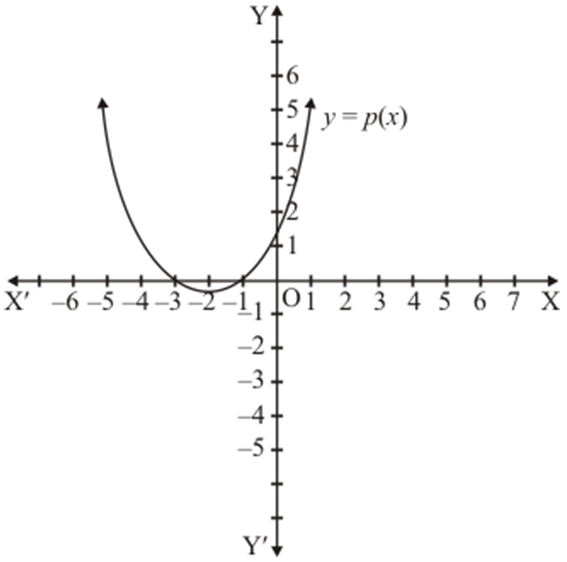
AnswerThe graph of the given polynomial meets the x-axis at -1 and -3
Zero will be -1 and -3
Zero of polynomial is 3
View full question & answer→Question 342 Marks
If f(x) is a polynomial such that f(a) f(b) < 0, then what is the number of zeros lying between a and b?
AnswerIf f(x) is a polynomial such that f(a) f(b) < 0 then this means the value of the polynomial are of different sign for a to b.
Hence, at least one zero will be lying between a and b
View full question & answer→Question 352 Marks
If $x = 1$ is a zero of the polynomial $f(x) = x^3 - 2x^2 + 4x + k$, write the value of k.
Answer$f(x) = x^3 - 2x^2 - 4x + k$
$\because x = 1$ is the zero of f(x)
$\therefore f(x) = 0$
$\therefore f(1) = (1)^3 -2(1)^2 + 4 \times 1 + k$
$= 1 - 2 + 4 + k = 3 + k$
$\therefore 3 + k = 0 $
$⇒ k = -3$
View full question & answer→Question 362 Marks
The graph of a polynomial f(x) is as shown in Fig. Write the number of real zeros of f(x).
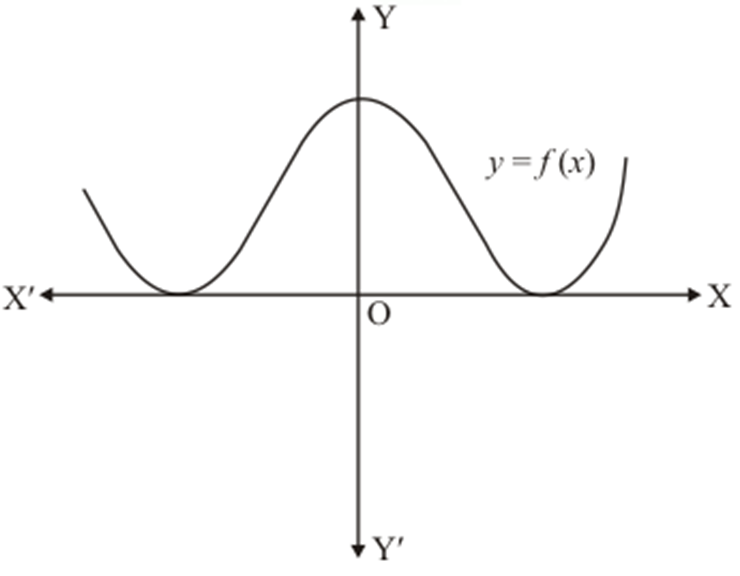
AnswerThe graph of a polynomial f(x) touches x-axis at two points
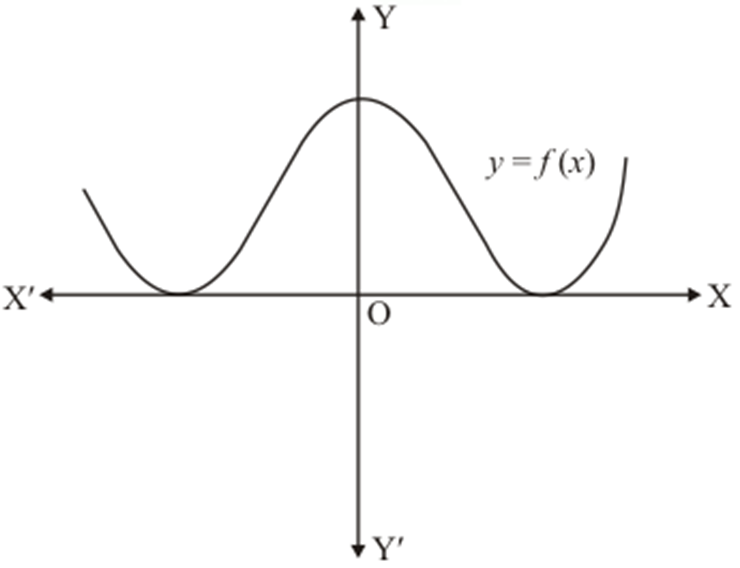
We know that if a curve touches the x-axis at two points then it has two common zeros of f(x).
Hence the number of zeros of f(x), in this case is 2.
View full question & answer→Question 372 Marks
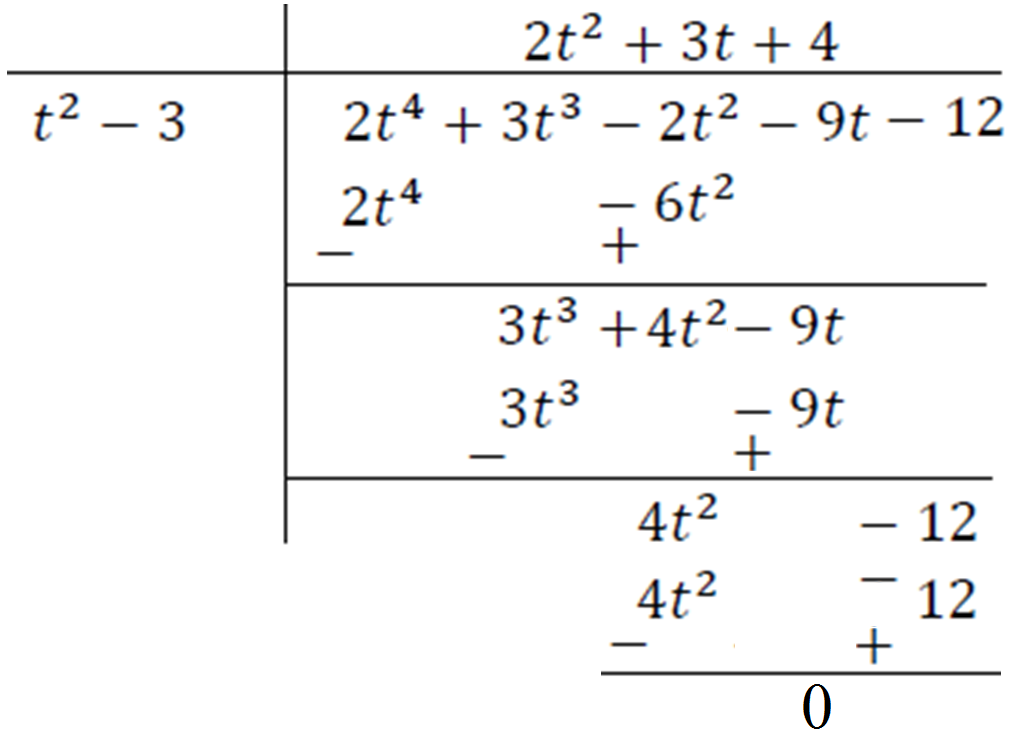
Check whether the first polynomial is a factor of the second polynomial by applying the division algorithm:
$g(t) = t^2 - 3, f(t) = 2t^4 + 3t^3 - 2t^2 - 9t - 12.$
Answer$g(t) = t^2 - 3; f(t) = 2t^4 + 3t^3 - 2t^2 - 9t - 12$
View full question & answer→Question 382 Marks
Define the zero of a polynomial.
AnswerThe zero of a polynomial f(x) is defined as any real number $\alpha$ such that $\text{f}(\alpha)=0.$
View full question & answer→Question 392 Marks
If $\alpha$ and $\beta$ are the zeroes of the quadratic polynomial $f(x) = ax^2 + bx + c$, then evaluate:$\frac{1}{\alpha}-\frac{1}{\beta}$
Answer$\Rightarrow\ \frac{1}{\alpha}-\frac{1}{\beta}=\frac{\beta-\alpha}{\alpha\beta}$
$\Rightarrow\ \frac{1}{\alpha}-\frac{1}{\beta}=\frac{-(\alpha-\beta)}{\alpha\beta}$
$\Rightarrow\ \frac{1}{\alpha}-\frac{1}{\beta}=\frac{-\frac{1}{\text{a}}\sqrt{\text{b}^2-4\text{ac}}}{\frac{\text{c}}{\text{a}}}$
$\Rightarrow\ \frac{1}{\alpha}-\frac{1}{\beta}=\frac{-\sqrt{\text{b}^2-4\text{ac}}}{\text{c}}$
Thus, $\frac{1}{\alpha}-\frac{1}{\beta}=\frac{-\sqrt{\text{b}^2-4\text{ac}}}{\text{c}}$
View full question & answer→