Question types

Polynomials question types

232 questions across 5 question groups — pick any mix to generate a Maths paper with step-by-step answer keys.

232
Questions
5
Question groups
5
Question types
Sample Questions

Polynomials questions

One sample from each question group in this chapter. Select any group above to see the full set with answer keys.

What should be subtracted to the polynomial $x^2-16 x+30$, so that $15$ is the zero of the resulting polynomial?
  • A
    $30$
  • B
    $14$
  • $15$
  • D
    $16$

Answer: C.

View full solution
If one of the zeroes of a quadratic polynomial of the form $x^2+a x+b$ is the negative of the other, then it:
  • Has no linear term and constant term is negative.
  • B
    Has no linear term and the constant term is position.
  • C
    Can have a linear term but the constant term is negative.
  • D
    Can have a linear term but the constant term is positive.

Answer: A.

View full solution
If $\alpha,\beta$ are the zeros of the polynomial $f(x) = ax^2 + bx + c$, then $\frac{1}{\text{a}^2}+\frac{1}{\beta^2}=$
  • A
    $\frac{\text{b}^2-2\text{ac}}{\text{a}^2}$
  • $\frac{\text{b}^2-2\text{ac}}{\text{c}^2}$
  • C
    $\frac{\text{b}^2+2\text{ac}}{\text{a}^2}$
  • D
    $\frac{\text{b}^2+2\text{ac}}{\text{c}^2}$

Answer: B.

View full solution
If one of the zeroes of the quadratic polynomial $(k - 1)x^2 + kx + 1$ is $-3$, then the value of $k$ is:
  • $\frac{4}{3}$
  • B
    $\frac{-4}{3}$
  • C
    $\frac{2}{3}$
  • D
    $\frac{-2}{3}$

Answer: A.

View full solution
Given that of the zeroes of the cubic polynomial $a x^3+b x^2+c x+d$ are $0$ , the third zero is:
  • $\frac{-\text{b}}{\text{a}}$
  • B
    $\frac{\text{b}}{\text{a}}$
  • C
    $\frac{\text{c}}{\text{a}}$
  • D
    $\frac{-\text{d}}{\text{a}}$

Answer: A.

View full solution
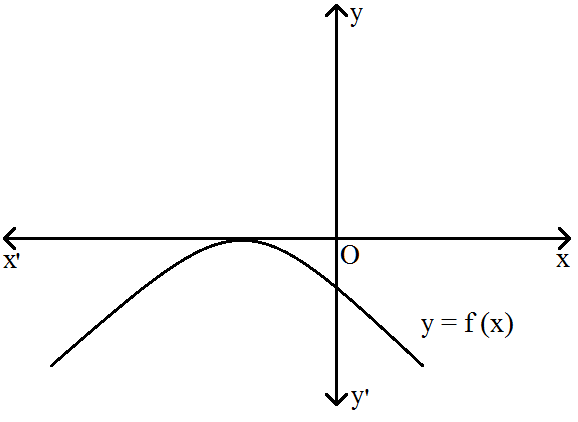
The graph of the polynomial $f(x)=a x^2+b x+c$ is as shown in Fig. Write the value of $b^2-4 a c$ and the number of real zeros of $f(x)$, write the sign of $c$.
View full solution
Q 173 Marks Question3 Marks
For the following, find a quadratic polynomial whose sum and product respectively of the zeroes are as given. Also, find the zeroes of these polynomials by factorization.
$\frac{21}{8},\frac{5}{16}$
View full solution
Q 193 Marks Question3 Marks
What must be added to the polynomial $f(x) = x^4 + 2x^3 - 2x^2 + x - 1$ so that the resulting polynomial is exactly divisible by $x^2 + 2x - 3?$
View full solution
If $\alpha$ and $\beta$ are the zeros of the quadratic polynomial $f(x) = x^2 - px + q$, prove that $\frac{\alpha^2}{\beta^2}+\frac{\beta^2}{\alpha^2}=\frac{\text{p}^2}{\text{q}}-\frac{4\text{p}^2}{\text{q}}+2.$
View full solution

Generate a Polynomials paper free

Pick question groups from the list above, set marks and difficulty, and export a branded PDF with step-by-step answer keys. First 3 chapters free — no signup.

Download App