Question 13 Marks
Give an example of polynomials $f(x), g(x), q(x)$ and $r(x)$ satisfying $f(x)=g(x), q(x)+r(x)$, where degree $r(x)=0$.
AnswerUsing division algorithm, we have
$f(x) = g(x) \times q(x) + r(x)$
$x^5 - 4x^3 + x^2 + 3x + 1 = (x^3 - 3x + 1)(x^2 - 1) + 2$
$x^5 - 4x^3 + x^2 + 3x + 1 = x^5 - 3x^3 + x^2 - x^3 + 3x - 1 + 2$
$x^5 - 4x^3 + x^2 + 3x + 1 = x^5 - 3x^3 - x^3 + x^2 + 3x - 1 + 2$
$x^5 - 4x^3 + x^2 + 3x + 1 = x^5 - 4x^3 + x^2 + 3x + 1$
Hence an example for polynomial $f(x), g(x), q(x)$ and $r(x)$ satisfying $f(x) = g(x) \times q(x) + r(x)$ are
$f(x) = x^5 - 4x^3 + x^2 + 3x + 1$
$g(x) = (x^3 - 3x + 1)$
$q(x) = (x^2 - 1)$
$r(x) = 2$
View full question & answer→Question 23 Marks
If $\alpha$ and $\beta$ are the zeroes of the quadratic polynomial $f(x) = ax^2 + bx + c$, then evaluate:$\alpha^4+\beta^4$
AnswerNow, $\alpha^4+\beta^4=(\alpha^2+\beta^2)^2-2\alpha^2\beta^2$
$=\{(\alpha+\beta)^2-2\alpha\beta\}^2-2(\alpha\beta)^2$
$ =\bigg\{\Big(\frac{-\text{b}}{\text{a}}\Big)^2-\frac{2\text{c}}{\text{a}}\bigg\}^2-2(\alpha\beta)^2$
$ =\Big(\frac{\text{b}^2}{\text{a}^2}-\frac{2\text{c}}{\text{a}}\Big)^2-2(\alpha\beta)^2$
$ =\frac{\text{b}^4}{\text{a}^4}-\frac{4\text{b}^2\text{c}}{\text {a}^3}+\frac{4\text{c}^2}{\text{a}^2}-2\Big(\frac{\text{c}}{\text{a}}\Big)^2$
$ \frac{\text{b}^4}{\text{a}^4}-\frac{4\text{b}^2\text{c}}{\text{a}^3}+\frac{4\text{c}^2}{\text{a}^2}-2\frac{\text{c}^2}{\text{a}^2}$
$=\frac{\text{b}^4}{\text{a}^4}-\frac{4\text{b}^2\text{c}}{\text{a}^3}+\frac{2\text{c}^2}{\text{a}^2}$
$ =\frac{\text{b}^4-4\text{ab}^2\text{c}+2\text{a}^2\text{c}^2}{\text{a}^4}$
$ =\frac{(\text{b}^2-2\text{ac})^2-2\text{a}^2\text{c}^2}{\text{a}^4}$
Thus, $ \alpha^4+\beta^4=\frac{(\text{b}^2-2\text{ac})^2-2\text{a}^2\text{c}^2}{\alpha^4}$
View full question & answer→Question 33 Marks
For the following, find a quadratic polynomial whose sum and product respectively of the zeroes are as given. Also, find the zeroes of these polynomials by factorization.
$\frac{21}{8},\frac{5}{16}$
AnswerGiven that $\text{S}=\frac{21}{8}$ and $\text{P}=\frac{5}{16}$
Required quadratic expression,
$\text{f(x)}=\text{x}^2-\text{Sx}+\text{P}$
$=\text{x}^2-\frac{21}{8}\text{x}+\frac{5}{16}=16\text{x}^2-42\text{x}+5$
Using factrisation method
$=16\text{x}^2-40\text{x}-2\text{x}+5$
$=8\text{x}(2\text{x}-5)-1(2\text{x}-5)=(2\text{x}-5)(8\text{x}-1)$
Hence, the zeroes of f(x) and $\frac{5}{2}$ and $\frac{1}{8}$
View full question & answer→Question 43 Marks
If a - b, a and b are zeros of the polynomial $f(x) = 2x^3- 6x^2 + 5x - 7$, write the value of a.
AnswerLet a - b, a and a + b be the zeros of the polynomial$ f(x) = 2x^3 - 6x^2 + 5x - 7 $then
Sum of the zeros $=\frac{-\text{Coefficiemt of x}^2}{\text{Coefficiemt of x}^3}$
$(\text{a}-\text{d})+\text{a}+(\text{a}+\text{b})=-\Big(\frac{-6}{2}\Big)$
$\text{a}+\text{a}+\text{a}-\text{d}+\text{d}=\frac{6}{2}$
$3\text{a}=3$
$\text{a}=\frac{3}{3}$
$\text{a}=1$
Hence, the value of a is 1.
View full question & answer→Question 53 Marks
What must be added to the polynomial $f(x) = x^4 + 2x^3 - 2x^2 + x - 1$ so that the resulting polynomial is exactly divisible by $x^2 + 2x - 3?$
AnswerWe know that, $f(x) = g(x) \times q(x) + r(x) f(x) - r(x) = g(x) \times q(x) f(x) + {- r(x)} = g(`1x) \times q(x)$ Clearly, Right hand side is divisible by g(x).
Therefore, Left hand side is also divisible by g(x). Thus, if
we add - r(x) to f(x), then the resulting polynomial is divisible by g(x).
Let us now find the remainder when f(x) is divided by g(x).
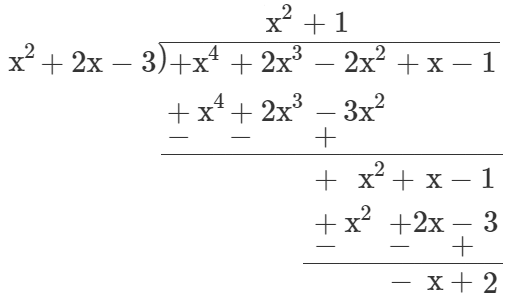
Hence, we shuold add $-r(x) = x - 2 to f(x)$
so that the resulting polynomial is divisible by g(x). View full question & answer→Question 63 Marks
If $\alpha$ and $\beta$ are the zeroes of the quadratic polynomial $p(y) = 5y^2 - 7y + 1$, find the value of $\frac{1}{\alpha}+\frac{1}{\beta}$
Answer$\text{p}(\text{y})=5\text{y}^2-7\text{y}+1$here, $\text{a}=5, \text{b}=-7,\text{ c}=1$
$\because\ \alpha$ and $\beta$ are the zeroes of p(y)
$\therefore\alpha$ and $\beta=\frac{-\text{b}}{\text{a}}=-\bigg(\frac{-7}{5}\bigg)=\frac{7}{5} $
and $\alpha\beta=\frac{\text{c}}{\text{a}}=\frac{1}{5} $
Now $\frac{1}{\alpha}+\frac{1}{\beta}=\frac{\beta+\alpha}{\alpha\beta}=\frac{\alpha+\beta}{\alpha\beta} $$=\frac{\frac{7}{5}}{\frac{1}{5}}=\frac{7}{5}\times\frac{5}{1}=7$
View full question & answer→Question 73 Marks
Find the cubic polynomial with the sum, sum of the product of its zeros taken two at a time, and product of its zeros as 3, -1 and -3 respectively.
AnswerLet $\alpha,\beta$ and $\gamma$ be the zrose of cubic polynomial p(x).
Given:
$\alpha+\beta+\gamma=3\ \dots(1)$
$\alpha\beta+\beta\gamma+\gamma\alpha=-1\ \dots(2)$
$\alpha\beta\gamma=-3\ \dots(3)$
Thus, required cubic polynomial is
$\text{p}(\text{x})=\text{k}\big\{{\text{x}^3-(\alpha+\beta+\gamma)\text{x}^2}+(\alpha\beta+\beta\gamma+\gamma\alpha)\text{x}-\alpha\beta\gamma\big\}$
$\text{p}(\text{x})=\text{k}(\text{x}^3-3\text{x}^2-\text{x}+3)$
Where is any non-zerorcal number.
View full question & answer→Question 83 Marks
If the squared difference of the zeroes of the quadratic polynomial $f(x) = x^2 + px + 45$ is equal to $144$, find the value of$ p$.
Answer$\text{f(x)}=\text{x}^2+\text{P(x)}+45$
Here $\text{a}=1, \text{b}=\text{p},\text{c}=45$
Let $\alpha$ and $\beta$ be the zeroes of f(x),their
$\alpha+\beta=\frac{-\text{b}}{\text{a}}=\frac{-\text{p}}{1}=-\text{p}$
and $ \alpha\beta=\frac{\text{c}}{\text{a}}=\frac{\text{45}}{1}=45$
and $(\alpha-\beta)^2=144$
$\because(\alpha+\beta)^2=(\alpha-\beta)^2+4\alpha\beta$
$\Rightarrow(-\text{p})^2=144+4\times45$
$ \Rightarrow\text{p}^2=144+180=324$
$ \Rightarrow\text{p}^2=(\pm18)^2$
$\therefore\ \text{p}=\pm18$
View full question & answer→Question 93 Marks
For the following, find a quadratic polynomial whose sum and product respectively of the zeroes are as given. Also, find the zeroes of these polynomials by factorization.
$-2\sqrt{3},-9$
AnswerGiven that, $\text{S}=-2\sqrt{3}$ and $\text{P}=-9$
$\therefore$ Required quadratic expression,
$$$\text{f}(\text{x})=\text{x}^2-\text{Sx}+\text{P}=\text{x}^2+2\sqrt{3}\text{x}-9 $
$=\text{x}^2+3\sqrt{3}\text{x}-\sqrt{3}\text{x}-9$
[using factorisation method]
$=\text{x}\big(\text{x}+3\sqrt{3}\big)-\sqrt{3}\big(\text{x}+3\sqrt{3}\big)$
$=\big(\text{x}+3\sqrt{3}\big)\big(\text{x}-\sqrt{3}\big)$
Hence, the zeroes of f(x) are $-3\sqrt{3}$ and $\sqrt{3}$
View full question & answer→Question 103 Marks
For the following, find a quadratic polynomial whose sum and product respectively of the zeroes are as given. Also, find the zeroes of these polynomials by factorization.
$\frac{-3}{2\sqrt{5}},-\frac{1}{2}$
AnswerGive that,$\text{S}=-\frac{3}{2\sqrt{5}}$ and $\text{P}=-\frac{1}{2} $
$\therefore$ Required quadratic expression,
$\text{f}(\text{x})=\text{x}^2-\text{S}\text{x}+\text{P}=\text{x}^2+\frac{3}{2\sqrt{5}}\text{x}-\frac{1}{2}$
$=2\sqrt{5}\text{x}^2+3\text{x}-\sqrt{5}$
Using factorisation method,
$=2\sqrt{5}\text{x}^2+5\text{x}-2\text{x}-\sqrt{5}$
$=\sqrt{5}\text{x}\big(2\text{x}+\sqrt{5}\big)-1\big(2\text{x}+\sqrt{5}\big)$
$=\big(2\text{x}+\sqrt{5}\big)\big(\sqrt{5}\text{x}-1\big)$
$$Hence, the zeroes of f(x) are $-\sqrt{\frac{5}{2}}$ and $\frac{1}{\sqrt{5}}$
View full question & answer→Question 113 Marks
Write the zeros of the polynomial $x^2 - x - 6.$
Answer$f(x) = x^2 - x - 6$
$= x^2 - 3x + 2x - 6$
$\begin{Bmatrix}-6=-3\times2\\-1=-3+2\end{Bmatrix}$
$= x(x - 3) + 2(x - 3)$
$= (x - 3)(x + 2)$
$\therefore$ Zeros of f(x) will be if (x - 3)(x + 2) = 0
Either $x - 3 = 0$, then $x = 3$
or $x + 2 = 0,$ then $x = 3$
$\therefore$ Zeros are $3, -2$
View full question & answer→Question 123 Marks
For what value of k, is $3$ a zero of the polynomial $2x^2 + x + k$?
AnswerWe know that is $\text{x}=\alpha$ is zero polynomial, and then $\text{x}-\alpha$ is a factor of f(x)
Since 3 is zero of f(x)
Therefore x - 3 is a factor of f(x)
Now, we divide $f(x) = 2x^2 + x + k by g(x) = x - 3$ to find the value of k
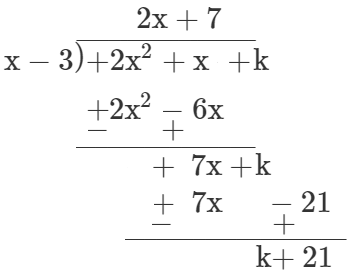
Now, remainde $r = 0$
$k + 21 = 0$
$k = -21$
Hence, the value of k is -21 View full question & answer→Question 133 Marks
Apply division algorithm to find the quotient q(x) and remainder r(x) in dividing f(x) by g(x) in the following:$f(x) = 4x^3 + 8x + 8x^2 + 7, g(x) = 2x^2 - x + 1$
Answer$f(x) = 4x^3+ 8x + 8x^2+ 7, g(x) = 2x^2- x + 1$
or $f(x) = 4x^3 + 8x^2 + 8x + 7, g(x) = 2x^2 - x + 1$
$\because$ Degree of f(x) = 3 and degree of g(x) = 2
$\therefore$ Degree of q(x) = will be $= 3 - 2 = 1$
and degree of r(x) will be less than $2$
Now using division algorithm,
$f(x) = g(x) \times q(x) + r(x)$
$\Rightarrow 4x^3 + 8x^2 + 8x + 7 = (2x^2 - x + 1)(ax + b) + (cx + d)$
$= 2ax^3 + (2b - a) x^2 + (a - b + c) x + (b + d)$
Equating the corresponding co-effecients
$2a = 4$
$\Rightarrow a = 2$
$2b - a = 8$
$\Rightarrow 2b - 2 = 8$
$\Rightarrow 2b = 8 + 2 = 10$
$\Rightarrow\ \text{b} = \frac{10}{2} = 5$
$a - b + c = 8$
$2 - 5 + c = 8 $
$\Rightarrow c = 8 - 2 + 5 = 11$
$b + d = 7 $
$\Rightarrow 5 + d = 7$
$\Rightarrow d = 7 - 5 = 2$
$q(x) = (ax + b) = 2x + 5$
$r(x) = cx + d = 11x + 2$
View full question & answer→Question 143 Marks
If $\alpha$ and $\beta$ are the zeroes of the quadratic polynomial $f(x) = x^2 - 5x + 4$, find the value of $\frac{1}{\alpha}+\frac{1}{\beta}-2\alpha\beta.$
Answer$\text{f}(\text{x})=\text{x}^2-5\text{x}+4$
Here $\text{a}=1,\text{b}=-5,\text{ c}=4$
$\because\ \alpha$ and $\beta$ are the zeroes of f(x)
$\therefore\alpha+\beta=\frac{-\text{b}}{\text{a}}=\frac{-(-5)}{1}=5$
and $ \alpha\beta=\frac{\text{c}}{\text{a}}=\frac{4}{1}=4$
Now, $\frac{1}{\alpha}+\frac{1}{\beta}-2\alpha\beta=\frac{\beta+\alpha}{\beta\alpha}-2\alpha\beta $
$=\frac{\alpha+\beta}{\alpha\beta}-2\alpha\beta $
$=\frac{5}{4}-2\times4=\frac{5}{4}-8$
$=\frac{5-32}{4}=\frac{-27}{4}$
View full question & answer→Question 153 Marks
Write the coefficient of the polynomial $p(z) = z^5 - 2z^2 + 4.$
Answer$p(z) = z^5 + oz^4 + oz^3 – 2z^2 + oz + 4$
Coefficient of $z^5 = 1$
Coefficient of $z^4 = 0$
Coefficient of $z^3 = 0$
Coefficient of $z^2 = -2$
Coefficient of$ z = 0$
Constant $= 4$
View full question & answer→Question 163 Marks
If fourth degree polynomial is divided by a quadratic polynomial, write the degree of the remainder.
AnswerHere f(x) represent dividend and g(x) represent divisor.
g(x) = quadratic polynomial
$g(x) = ax^2 + bx + c$
Therefore degree of $(f(x)) = 4$
Degree of $(g(x)) = 2$
The quotient q(x) is of degree 2(= 4 - 2)
The remainder r(x) is of degree 1 or less.
Hence, the degree of the remainder is equal to 1 or less than $1$
View full question & answer→Question 173 Marks
Given that $\sqrt{2}$ is a zero of the cubic polynomial $6\text{x}^3+\sqrt{2}\text{x}^2-10\text{x}-4\sqrt{2},$ find its other two zeroes.
AnswerLet $\text{f(x) }6\text{x}^3+\sqrt{2}\text{x}^2-10\text{x}-4\sqrt{2}$ and given that $\sqrt{2}$ is one of the zeroes of f(x) i.e., $\big(\text{x}-\sqrt{2}\big)$ is one of the factor of given cubic polynomial. Now, using divison algorithm,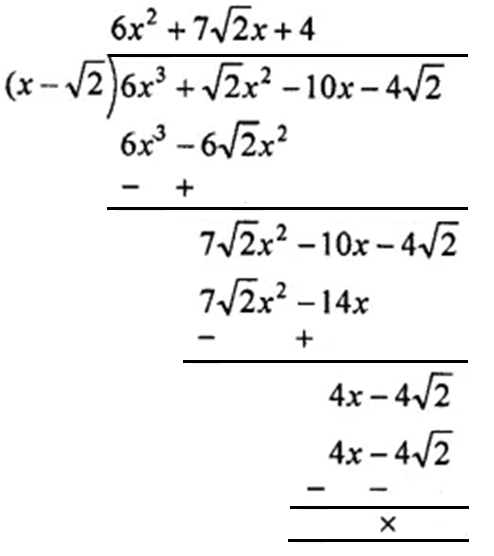
View full question & answer→Question 183 Marks
If the sum of the zeros of the quadratic polynomial $f(t) = kt^2 + 2t + 3k$ is equal to their product, find the value of k.
AnswerLet, the two zeroes of the $f(t) = kt^2 + 2t + 3k$ be $\alpha$ and $\beta$Sum of the zeroes $(\alpha+\beta)=\frac{-2}{\text{k}}$
Product of the zeroes $\alpha\beta=\frac{3\text{k}}{\text{k}}=3$
According to question,
$\frac{-2}{\text{k}}=3$
$-2=3\text{k}$
$\text{k}=\frac{-2}{3}$
View full question & answer→Question 193 Marks
If $\alpha$ and $\beta$ are the zeroes of the quadratic polynomial $f(x) = x^2 - x - 4$, find the value of $\frac{1}{\alpha}+\frac{1}{\beta}-\alpha\beta$
AnswerSince $\alpha+\beta$ are the zeroes of the polynomial:$ x^2 - x - 4$
Sum of the roots $(\alpha+\beta)=1$
Product of the roots $(\alpha\beta)=-4$
$=\frac{1}{\alpha}+\frac{1}{\beta}-\alpha\beta=\frac{\alpha+\beta}{\alpha\beta}-\alpha\beta $
$=\frac{1}{-4}+4=\frac{-1}{4}+4=\frac{-1+16}{4}=\frac{15}{4} $
View full question & answer→Question 203 Marks
If $\alpha$ and $\beta$ are the zeros of the quadratic polynomial $f(x) = x^2 - 1,$ find a quadratic polynomial whose zeroes are $\frac{2\alpha}{\beta}$ and $\frac{2\beta}{\alpha}.$
Answer$\text{f(x)}=\text{x}^2-1$
sum of zeroes $\alpha+\beta=0$
Product of zeroes $\alpha\beta=-1$
Sum of zeroes $ =\frac{2\alpha}{\beta}+\frac{2\beta}{\alpha}=\frac{2\alpha^2+2\beta^2}{\alpha\beta}$
$ =\frac{2\big((\alpha+\beta)^2-2\alpha\beta\big)}{\alpha\beta}$
$=\frac{2\big[(0)^2-2\times-1\big]}{-1}$
$=\frac{2(2)1}{-1}$
$=-4$
Product of zeroes $ =\frac{2\alpha\times2\beta}{\alpha\beta}=\frac{4\alpha\beta}{\alpha\beta}$
Hence the quadratic equation is $x^2$ - (sum of zeroes)x + product of zeroes
$=\text{k}(\text{x}^2+4\text{x}+14)$
View full question & answer→Question 213 Marks
If $\alpha$ and $\beta$ are the zeros of the quadratic polynomial $p ( x )=4 x ^2-5 x -1$, find the value of $\alpha^2 \beta+\alpha \beta^2$.
AnswerWe have,
$\text{P}(\text{x})=4\text{x}^2-5\text{x}-1 $
give that $\alpha$ and $\beta$ are zeroes of p(x)
$\therefore\alpha+\beta=\frac{-(-5)}{4}=\frac{5}{4},$ $\alpha\beta=\frac{(-1)}{4}=\frac{-1}{4}$
Now $\alpha^2\beta+\alpha\beta^2=\alpha\beta(\alpha+\beta) $
$=\Big(\frac{-1}{4}\Big)\Big(\frac{5}{4}\Big) $
$$$=\frac{-5}{16}$
View full question & answer→Question 223 Marks
If $1$ is a zero of the polynomial $p(x) = ax^2 - 3(a - 1) x - 1$, then find the value of a.
Answer$p(x) = ax^2 - 3(a - 1) x - 1$
$\because$ 1 is its zero
$\therefore$ (x - 1) will be its factor
Now, $p(1) = a(1)^2 - 3(a - 1) \times 1 - 1$
$= a - 3a + 3 - 1$
$= -2a + 2$
$\therefore$ (x - 1) is its factor
$\therefore$ Remainder = 0
$\therefore$ $p(1) = 0$
$\Rightarrow -2a + 2 = 0$
$\Rightarrow 2a = 2$
$\Rightarrow\text{a}=\frac{2}{2}=1$
$\therefore$ a = 1
View full question & answer→Question 233 Marks
For what value of k, is $-3$ a zero of the polynomial $x^2 + 11x + k?$
Answer$-3$ is a zero of polynomial $f(x) = x^2 + 11x + k$
It will satisfy the polynomial
$f(x) = 0$
$\Rightarrow f(-3) = 0$
Now $x^2 + 11x + k = 0$
$\Rightarrow (-3)^2+ 11x(-3) + k = 0$
$\Rightarrow 9 - 33 + k = 0$
$\Rightarrow -24 + k = 0$
$\Rightarrow k = 24$
View full question & answer→Question 243 Marks
For the following, find a quadratic polynomial whose sum and product respectively of the zeroes are as given. Also, find the zeroes of these polynomials by factorization.
$-\frac{8}{3},\frac{4}{3}$
AnswerGiven that, sum of zeroes $\text{(S)}=-\frac{8}{3}$
and product of zeroes $(\text{P})=\frac{4}{3}$
Required quadratic expression,
$$$\text{f(x)}=\text{x}^2-\text{Sx}+\text{P}$
$=\text{x}^2+\frac{8}{3}\text{x}+\frac{4}{3}=3\text{x}^2+8\text{x}+4$
Using factorisation method,
$=3\text{x}^2+6\text{x}+2\text{x}+4$
$=3\text{x}(\text{x}+2)+2(\text{x+2})=(\text{x+2})(3\text{x}+2)$
Hence, the zeroes of f(x) are -2 and $-\frac{2}{3}$
View full question & answer→Question 253 Marks
If $\alpha$ and $\beta$ are the zeroes of the quadratic polynomial $f(x) = ax^2 + bx + c$, then evaluate:$\frac{1}{\text{a}\alpha+\text{b}}+\frac{1}{\text{a}\beta+\text{b}} $
Answer$\frac{1}{\text{a}\alpha+\text{b}}+\frac{1}{\alpha\beta+\text{b}}$
$ \Rightarrow\ \frac{\text{a}\beta+\text{b}+\text{a}\alpha+\text{b}}{(\text{a}\alpha+\text{b})(\alpha\beta+\text{b})}$
$ =\frac{\text{a}(\alpha+\beta)+2\text{b}}{\text{a}^2\alpha\beta+\text{ab}\alpha+\text{ab}\beta+\text{b}^2}$
$ =\frac{\text{a}(\alpha+\beta)+\text{b}}{\text{a}^2\alpha\beta+\alpha\beta(\alpha^2\beta)+\text{b}^2}$
$ =\frac{\text{a}\times\frac{\text{a}+2\text{b}}{\text{a}}}{\text{a}\times\frac{\text{c}}{\text{a}}+\frac{\text{abc}(-\text{b})+\text{b}^2}{\text{a}}}=\frac{\text{b}}{\text{ac}-\text{b}^2+\text{b}^2}=\frac{\text{b}}{\text{ac}}$
View full question & answer→Question 263 Marks
If $\alpha$ and $\beta$ are the zeros of the quadratic polynomial $f(x)=x^2-p(x+1)-c$, show that $(\alpha+1)(\beta+1)=1-c$
Answer$\text{f}(\text{x})=\text{x}^2-\text{p}(\text{x}+1)-\text{c}=\text{x}^2-\text{px}-\text{p}-\text{c}$
Sum of zeroes $ =\alpha+\beta=\text{p}$
Product of zeroes $ =-\text{p}-\text{c}=\alpha\beta$
$ (\alpha+1)(\beta+1)=\alpha\beta+\alpha+\beta+1=-\text{p}-\text{c}+\text{p}+1$
$=1-\text{c}=\text{R.H.S}$
$\therefore$ Hence proved.
View full question & answer→Question 273 Marks
Verify that the numbers given along side of the cubic polynomials below are their zeros. Also, verify the relationship between the zeros and coefficients in each case:
$\text{g}(\text{x})=\text{x}^3-4\text{x}^2+5\text{x}-2;2,2,1,1$
Answer$\text{g}(\text{x})=\text{x}^3-4\text{x}^2+5\text{x}-2$
$\text{g}(2)=(2)^3-4(2)^2+5(2)-2=8-16+10-2=18-18=0$
$\text{g}(1)=[1]^3-4[1]^2+5[1]-2=1-4+5-2=6-6=0$
$\alpha+\beta+\gamma=\frac{-\text{b}}{\text{a}}$
$\Rightarrow2+1+1=-(-4)$
$\Rightarrow4=4$
$\alpha\beta+\beta\gamma+\gamma\alpha=\frac{\text{c}}{\text{a}}$
$2\times1+1\times1+1\times2=5$
$2+1+2=5$
$5=5$
$\alpha\beta\gamma=-(-2)$
$2\times1\times1=2$
$2=2$
View full question & answer→Question 283 Marks
Find all the zeros of the polynomial $x^3 + 3x^2 - 2x - 6$, if two of its zeros are $-\sqrt{2}$ and $\sqrt{2}.$
AnswerLet $f(x) = x^3 + 3x^2 - 2x - 36$ and its two zeros are $-\sqrt{2}$ and $\sqrt{2}$ $\therefore\ (\text{x}+\sqrt{2})(\text{x}-\sqrt{2})$
will be its factor or $(x^2 - 2)$ will be its factor Now dividing $f(x) = by x^2 - 2$
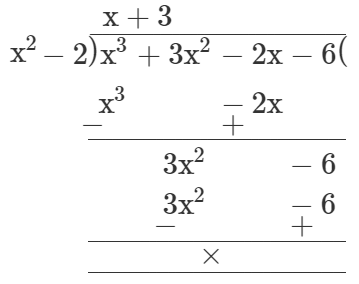
We get quotient $= x + 3$ Let $x + 3 = 0$, then $x = -3$ $\therefore$ All zeros of f(x) are $-\sqrt{2},\sqrt{2}$ and - 3 View full question & answer→Question 293 Marks
For what value of k, is $-2$ a zero of the polynomial $3x^2 + 4x + 2k?$
AnswerWe know if $\text{x}=\alpha$ is zero polynomial then $\text{x}-\alpha$ is a factor of f(x) Since -2 is factor of f(x).
Therefore x + 2 is a factor of f(x)
Now, we divide $f(x) = 3x^2 + 4x +2k by g(x) = x + 2$ to find the value of k
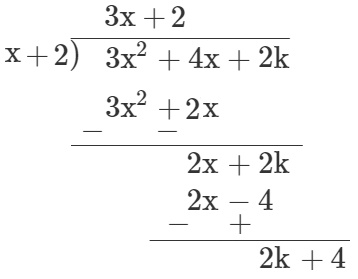
Now, Remainde$r = 0 2k + 4 = 0 2k = -4$ $\text{k}=\frac{-4}{2} k = -2$
Hence, the value of k is -2 View full question & answer→Question 303 Marks
Apply division algorithm to find the quotient q(x) and remainder r(x) in dividing f(x) by g(x) in the following:$f(x) = 15x^3 - 20x^2 + 13x - 12, g(x) = 2 - 2x + x^2$
Answer$f(x) = 15x^3- 20x^2 + 13x - 12, g(x) = x^2 - 2x + 2$
$\because$ Degree of f(x) = 3 and degree of g(x) = 2
$\therefore$ Degree of q(x) = will be = 3 - 2 = 1 and
degree of r(x) will be less than 2
Using division algorithm,
$f(x) = g(x) \times q(x) + r(x)$
$\Rightarrow 15x^3 - 20x^2 + 13x - 12 = (x^2 - 2x + 2)(ax + b) + (cx + d)$
$= ax^3 + (-2a + b) x^2 + (-2b + 2a + c) x + (2b + d)$
Equating the corresponding co-effecients
$a = 15$
$-2a - b = 20 $
$\Rightarrow -2 \times 15 + b = -20$
$\Rightarrow -30 + b = -20 $
$\Rightarrow b = -20 + 30 = 10$
$-2b + 2a + c = 13$
$\Rightarrow -2 \times 10 + 2 \times 15 + c = 13$
$\Rightarrow -20 + 30 + c = 13 $
$\Rightarrow c = 13 + 20 - 30 = 3$
and $2b + d = -12 $
$\Rightarrow 2 \times 10 + d = -12$
$\Rightarrow 20 + d = -12 $
$\Rightarrow d = -12 - 20$
Now $q(x) = ax + b = 15x + 10$
$r(x) = cx + d = 3x - 32$
View full question & answer→Question 313 Marks
If the sum of the zeros of the quadratic polynomial $f(t)=k t^2+2 t+3 k$ is equal to their product, find the value of $k$.
AnswerLet, the two zeroes of the $f ( t )= kt { }^2+2 t +3 k$ be $\alpha$ and $\beta$ Sum of the zeroes $(\alpha+\beta)=\frac{-2}{ k }$
Product of the zeroes $\alpha\beta=\frac{3\text{k}}{\text{k}}=3$
According to question,
$\frac{-2}{\text{k}}=3$
$-2=3\text{k}$
$\text{k}=\frac{-2}{3}$
View full question & answer→Question 323 Marks
If the zeros of the polynomial $f(x)=x^3-12 x^2+39 x+k$ are in A.P., find the value of $k$
AnswerLet $a-d, a$ and $a+d$ be the zeros of the polynomial $f(x)$. Then,
Sum of the zeros $=\frac{\text{Coefficient of x}^2}{\text{Coefficient of x}^3}$
$\text{a}-\text{d}+\text{a}+\text{a}+\text{d}=\frac{-(-12)}{1}$
$\text{a}-\text{d}+\text{a}+\text{a}+\text{d}=12$
$3\text{a}=12$
$ \text{a}=\frac{12}{3}$
$ \text{a}=4$
Since a is a zero of the polynomial f(x)
$f(x) = x^3 - 12x^2 + 39x + k$
$f(a) = 0$
$f(a) = 4^3 - 12 \times 4^2 + 39 \times 4 + k$
$0 = 64 - 192 + 156 + k$
$0 = 220 - 192 + k$
$0 = 28 + k$
$-28 = k$
Hence, the value of k is $-28.$
View full question & answer→Question 333 Marks
If $(x + a) $is a factor of $2x^2 + 2ax + 5x + 10,$ find a.
Answerx + a is a factor of
$f(x) = 2x^2 + 2ax + 5x + 10$
Let $x + a = 0, x = -a$
$\therefore$ $f(-a) = 2(-a)^2 + 2a(-a) + 5(-a) + 10$
$= 2a^2 - 2a^2 - 5a + 10 = -5a + 10$
$\because$ x + a is its factor
$\therefore$ $f(-a) = 0$
$\Rightarrow -5a + 10 = 0$
$\Rightarrow 5a = 10$
$\Rightarrow a = 2$
Hence $a = 2$
View full question & answer→Question 343 Marks
If $\alpha$ and $\beta$ are the zeroes of the quadratic polynomial $p ( s )=3 s^2-6 s+4$, find the value of $\frac{\alpha}{\beta}+\frac{\beta}{\alpha}+2\left(\frac{1}{\alpha}+\frac{1}{\beta}\right)+3 \alpha \beta$.
AnswerSince $\alpha$ and $\beta$ are the zeroes of the quadratic polynomial $p ( s )=3 s^2-6 s+4 \alpha+\beta=\frac{- \text { Coefficient of } x }{\text { Coefficient of } x ^2}$
$\alpha+\beta=\frac{-(-6)}{3}$
$\alpha+\beta=\frac{6}{3}$
$\alpha+\beta=2$
$\alpha\beta=\frac{\text{Constant term}}{\text{Coefficient of x}^2}$
$\alpha\beta=\frac{4}{3}$
We have, $ \frac{\alpha}{\beta}+\frac{\beta}{\alpha}+2\Big(\frac{1}{\alpha}+\frac{1}{\beta}\Big)+3\alpha\beta$
$ =\frac{\alpha^2+\beta^2}{\alpha\beta}+2\Big(\frac{1}{\alpha}+\frac{1}{\beta}\Big)+3\alpha\beta$
$ =\frac{(\alpha+\beta^2)-2\alpha\beta}{\alpha\beta}+2\Big(\frac{\alpha+\beta}{\alpha\beta}\Big)+3\alpha\beta$
By substituting $\alpha+\beta=2$ and $\alpha\beta=\frac{4}{3}$ we get,
$ \frac{\alpha}{\beta}+\frac{\beta}{\alpha}+2\Big(\frac{1}{\alpha}+\frac{1}{\beta}\Big)+3\alpha\beta$ $=\frac{(2)^2-2\Big(\frac{4}{3}\Big)}{\frac{4}{3}}+2\frac{(2)}{\frac{4}{3}}+3\Big(\frac{4}{3}\Big)$
$ \frac{\alpha}{\beta}+\frac{\beta}{\alpha}+2\Big(\frac{1}{\alpha}+\frac{1}{\beta}\Big)+3\alpha\beta$ $=\frac{4-\frac{8}{3}}{\frac{4}{3}}+\frac{4}{\frac{4}{3}}+\frac{12}{3}$
$ \frac{\alpha}{\beta}+\frac{\beta}{\alpha}+2\Big(\frac{1}{\alpha}+\frac{1}{\beta}\Big)+3\alpha\beta$ $=\frac{\frac{4\times3}{1\times3}-\frac{8}{3}}{\frac{4}{3}}+\frac{4}{\frac{4}{3}}+\frac{12}{3}$
$\frac{\alpha}{\beta}+\frac{\beta}{\alpha}+2\Big(\frac{1}{\alpha}+\frac{1}{\beta}\Big)+3\alpha\beta$ $=\frac{\frac{12-8}{3}}{\frac{4}{3}}+\frac{4}{\frac{4}{3}}+\frac{12}{3}$
$ \frac{\alpha}{\beta}+\frac{\beta}{\alpha}+2\Big(\frac{1}{\alpha}+\frac{1}{\beta}\Big)+3\alpha\beta$ $=\frac{4}{\frac{3}{\frac{4}{3}}}+\frac{4}{\frac{4}{3}}+\frac{12}{3}$
$ \frac{\alpha}{\beta}+\frac{\beta}{\alpha}+2\Big(\frac{1}{\alpha}+\frac{1}{\beta}\Big)+3\alpha\beta$ $=\frac{4}{3}\times\frac{3}{4}+\frac{4\times3}{4}+\frac{12}{3}$
$ \frac{\alpha}{\beta}+\frac{\beta}{\alpha}+2\Big(\frac{1}{\alpha}+\frac{1}{\beta}\Big)+3\alpha\beta$ $=1+\frac{12}{4}+\frac{12}{3}$
$ \frac{\alpha}{\beta}+\frac{\beta}{\alpha}+2\Big(\frac{1}{\alpha}+\frac{1}{\beta}\Big)+3\alpha\beta$ $=\frac{1\times12}{1\times12}+\frac{12\times3}{4\times3}+\frac{12\times4}{3\times4}$
$ \frac{\alpha}{\beta}+\frac{\beta}{\alpha}+2\Big(\frac{1}{\alpha}+\frac{1}{\beta}\Big)+3\alpha\beta$ $=\frac{12+36+48}{12}$
$\frac{\alpha}{\beta}+\frac{\beta}{\alpha}+2\Big(\frac{1}{\alpha}+\frac{1}{\beta}\Big)+3\alpha\beta=\frac{48+48}{12}$
$\frac{\alpha}{\beta}+\frac{\beta}{\alpha}+2\Big(\frac{1}{\alpha}+\frac{1}{\beta}\Big)+3\alpha\beta=\frac{96}{12}$
$\frac{\alpha}{\beta}+\frac{\beta}{\alpha}+2\Big(\frac{1}{\alpha}+\frac{1}{\beta}\Big)+3\alpha\beta=8$
Hence, the value of $ \frac{\alpha}{\beta}+\frac{\beta}{\alpha}+2\Big(\frac{1}{\alpha}+\frac{1}{\beta}\Big)+3\alpha\beta\text{ is }8$
View full question & answer→Question 353 Marks
If $\alpha$ and $\beta$ are the zeros of the quadratic polynomial $f ( t )= t ^2-4 t +3$, find the value of $\alpha^4 \beta^3+\alpha^3 \beta^4$.
AnswerWe have,
$\text{F}(\text{t})=\text{t}^2-4\text{t}+3$
given that $\alpha$ and $\beta$ are zeroes of F(t)
$\therefore\ \alpha+\beta=\frac{-(-4)}{1}=4$
$\alpha\beta=\frac{3}{1}=3$
Now $ \alpha^4\beta^3+\alpha^3\beta^4=\alpha^3\beta^3(\alpha+\beta)$
$=(\alpha\beta)^3(\alpha+\beta)$
$=(3)^3\times4$
$=27\times4$
$=108$
View full question & answer→Question 363 Marks
Find the zeros of the following quadratic polynomial and verify the relationship between the zeros and their coefficients:
$g(s) = 4s^2 - 4s + 1$
Answer$g(s) = 4s^2 - 4s + 1$
$\Rightarrow g(s) = 4s^2 - 2s - 2s + 1$
$\Rightarrow g(s) = 2s(2s - 1) -1(2s - 1)$
$\Rightarrow g(s) = (2s - 1)(2s - 1)$ The zeros of g(s) = 0
$\Rightarrow (2s - 1)(2s - 1) = 0$
$\Rightarrow (2s - 1) = 0 or (2s - 1) = 0$
$\Rightarrow 2s = 1 or 2s = 1$
$\Rightarrow\ \text{s}=\frac{1}{2}$ or $\text{s}=\frac{1}{2}$
Sum of zeroes $=\alpha+\beta$
$-\frac{\text{b}}{\text{a}}=\alpha+\beta$
$\frac{4}{4}=\frac{1}{2}+\frac{1}{2}$
$1=1$Product of zeroes
$=\alpha\cdot\beta$
$\frac{\text{c}}{\text{a}}=\alpha\cdot\beta$
$\frac{1}{4}=\frac{1}{2}\times\frac{1}{2}$ $\frac{1}{4}=\frac{1}{4}$
View full question & answer→Question 373 Marks
Find the zeros of the following quadratic polynomial and verify the relationship between the zeros and their coefficients:
$\text{p(x)}=\text{x}^2+2\sqrt{2\text{x}}-6$
Answer$\text{p}(\text{x})=\text{x}^2+2\sqrt{2}\text{x}-6$ $=\text{x}^2+3\sqrt{2}\text{x}-\sqrt{2}\text{x}-\sqrt{2}\times3\sqrt{\text{2}}$
$=\text{x}\big(\text{x}+3\sqrt{2}\big)-\sqrt{2}\big(\text{x}+3\sqrt{2}\big)$ $=\big(\text{x}-\sqrt{2}\big)\big(\text{x}+3\sqrt{2}\big)$
Zeroes of the polynomial are $\sqrt{2}$ and $-3\sqrt{2}$
Sum of the zeroes $=\frac{-2\sqrt{2}}{1}$
$\sqrt{2}-3\sqrt{2}=-2\sqrt{2}$
$-2\sqrt{2}=-2\sqrt{2}$
product of zeroes $\Rightarrow\ \sqrt{2}\times-3\sqrt{2}=-\frac{6}{1}$
$-6=-6$
Hence the relatioship varified.
View full question & answer→Question 383 Marks
If one zero of the quadratic polynomial $f(x)=4 x^2-8 k x-9$ is negative of the other, find the value of $k$.
AnswerSince $\alpha$ and $-\alpha$ are the zeros of the quadratic polynomial $f(x)=4 x^2-8 kx -9$
$\alpha-\alpha=0$
$\frac{-\text{Coefficient of x}}{\text{Coefficient of x}^2}=0$
$\frac{-8\text{k}}{4}=0$
$-8\text{k}=0\times4$
$\text{k}=\frac{0}{-8}$
$-8\text{k}=0 $
$\text{k}=0$
Hence, the Value of k is 0.
View full question & answer→Question 393 Marks
If $\alpha$ and $\beta$ are the zeroes of the quadratic polynomial $f(x) = x^2 - x - 2$, find the value of $\frac{1}{\alpha}-\frac{1}{\beta}$
Answer$\text{f(x)}=\text{x}^2+\text{x}-2$
Here $\text{a}=1 ,\text{b}=1 ,\text{c}=-2$
$\because\ \alpha$ and $\beta$ are the zeroes of f(x)
$\therefore\alpha+\beta=\frac{-\text{b}}{\text{a}}=\frac{-1}{1}=-1$
and $ \alpha\beta=\frac{\text{c}}{\text{a}}=\frac{-2}{1}=-2$
Now $\frac{1}{\alpha}-\frac{1}{\beta}=\frac{\beta-\alpha}{\alpha\beta}-\frac{\alpha-\beta}{\alpha\beta} $
$=\frac{\sqrt{(\alpha+\beta)^2-4\alpha\beta}}{\alpha\beta}=\frac{\sqrt{(-1)^2-4(-2)}}{-2} $
$ =\frac{\sqrt{1+8}}{-2}=\frac{\sqrt{9}}{-2}=\frac{-3}{2} $
View full question & answer→Question 403 Marks
If $\alpha$ and $\beta$ are the zeroes of the quadratic polynomial such that $\alpha+\beta=24$ and $\alpha-\beta=8,$ find a quadratic polynomial have $\alpha$ and $\beta$ as its zeroes.
Answer$\because \alpha$ and $\beta$ are the zeroes of a quadratic polynomial
$\alpha+\beta=24\ \text{and}\ \alpha-\beta=8$
$\therefore\ 4\alpha\beta=(\alpha+\beta)^2-(\alpha-\beta)^2$
$ =(24)^2-(8)^2=576-64=512$
$\alpha\beta=\frac{512}{4}=128$
$\therefore$ Quadratic polynomial will be
$k[x^2$ - (sum of zeroes)x + product of zero]
$\Rightarrow\text{k}[\text{x}^2-24\text{x}+128]$
View full question & answer→Question 413 Marks
If $\alpha,\beta$ are the zeros of a polynomial such that $\alpha + \beta = −6$ and $\alpha\beta = −4,$ then write the polynomial.
AnswerLet S and P denotes respectively the sum and product of the zeros of a polynomial
We are given S = -6 and P = -4 Then
The required polynomial g(x) is given by
$g(x) = x^2 - Sx + P$
$g(x) = x^2 - (-6)x + (-4)$
$= x^2 + 6x - 4$
Hence, the polynomial is $x^2 + 6x - 4$
View full question & answer→Question 423 Marks
If $\alpha$ and $\beta$ are the zeroes of the quadratic polynomial $f(x) = x^2+ px + q,$ find a quadratic polynomial whose zeroes are:
- $\alpha+2 ,\beta+2$
- $\frac{\alpha-1}{\alpha+1},\frac{\beta-1}{\beta+1}.$
Answer$\because \alpha$ and $\beta $ are the zeroes of the quadratic polynomial
$\text{f(x)}=\text{x}^2-2\text{x}+3$
Here a = 1, b = -2, c = 3
$\alpha+\beta=\frac{-\text{b}}{\text{a}}=-\bigg(\frac{-2}{1}\bigg)=2$
$\alpha\beta=\frac{\text{c}}{\text{a}}=\frac{3}{1}=3$
- Zeros are $\alpha+2,\beta+2,$
$\therefore\ \text{Sum of zeros}=\alpha+2+\beta+2=(\alpha+\beta)+4$
$=2+4=6$
and product of zeros $=(\alpha+2)(\beta+2)$
$=\alpha\beta+2\alpha+2\beta+4$
$=\alpha\beta+2=(\alpha+\beta)+4$
$=3+2\times2+4$
$=3+4+4=11$
$\therefore$ Polynomial will be
k[$x^2$ - (sumof zeroes)x + product of zeros]
$\Rightarrow\ \text{k}(\text{x}^2-6\text{x}+11)$
- Zeros are $ \frac{\alpha-1}{\alpha+1},\frac{\beta-1}{\beta+1}$
Sum of zeros $=\frac{\alpha-1}{\alpha+1}+\frac{\beta-1}{\beta+1}$
$ =\frac{(\alpha-1)(\beta+1)+(\beta-1)(\alpha+1)}{(\alpha+1)(\beta+1)}$
$ =\frac{\alpha\beta+\alpha-\beta-1+\alpha\beta+\beta-\alpha-1}{\alpha\beta+\alpha+\beta+1}$
$ =\frac{2\alpha\beta-2}{\alpha\beta+(\alpha+\beta)+1}=\frac{2\times3-2}{3+2+1}$
$ =\frac{6-2}{6}=\frac{4}{6}=\frac{2}{3}$
and product of zeros $ \frac{\alpha-1}{\alpha+1}\times\frac{\beta-1}{\beta+1}$
$ =\frac{(\alpha-1)(\beta-1)}{(\alpha+1)(\beta+1)}$
$ =\frac{\alpha\beta-\alpha-\beta+1}{\alpha\beta+\alpha+\beta+1}=\frac{\alpha\beta-(\alpha+\beta)+1}{\alpha\beta+(\alpha+\beta)+1}$
$=\frac{3-2+1}{3+2+1}=\frac{2}{3}=\frac{1}{3}$
$\therefore$ Polynomial will be
k$[x^2$ - (sum of zeros)x + product of zeros]
$ \Rightarrow\ \text{k}\Big[\text{x}^2-\frac{2}{3}\text{x}+\frac{1}{3}\Big]$ View full question & answer→Question 433 Marks
If $\alpha$ and $\beta$ are the zeroes of the quadratic polynomial $f(x) = ax^2 + bx + c$, find evaluate: $\text{a}\Big(\frac{\alpha^2}{\beta}+\frac{\beta^2}{\alpha}\Big)+\text{b}\Big(\frac{\alpha}{\beta}+\frac{\beta}{\alpha}\Big)$
Answer$\text{a}\Big(\frac{\alpha^2}{\beta}+\frac{\beta^2}{\alpha}\Big)+\text{b}\Big(\frac{\alpha}{\beta}+\frac{\beta}{\alpha}\Big)$
$ =\text{a}\Big(\frac{\alpha^3+\beta^3}{\alpha\beta}\Big)+\text{b}\Big(\frac{\alpha^2+\beta^2}{\alpha\beta}\Big)$
$=\text{a}\times\frac{(\alpha+\beta)^3-3\alpha\beta(\alpha+\beta)}{\alpha\beta}+\text{b}\times\frac{(\alpha+\beta)^2-2\alpha\beta}{\alpha\beta}$
$ =\text{a}\times\frac{\Big(\frac{-\text{b}}{\text{a}}\Big)^3-3\Big(\frac{\text{c}}{\text{a}}\Big)\Big(\frac{-\text{b}}{\text{a}}\Big)}{\Big(\frac{\text{c}}{\text{a}}\Big)}+\text{b}\frac{\Big(\frac{-\text{b}}{\text{a}}\Big)^2-2\times\frac{\text{c}}{\text{a}}}{\frac{\text{c}}{\text{a}}}$
$ =\frac{\frac{-\text{b}^3}{\text{a}^2}+\frac{3\text{bc}}{\text{a}}}{\frac{\text{c}}{\text{a}}}+\frac{\frac{\text{b}^3}{\text{a}^2}-\frac{2\text{bc}}{\text{a}}}{\frac{\text{c}}{\text{a}}}$
$=\frac{\frac{-\text{b}^3}{\text{a}^2}+\frac{3\text{b}\text{c}}{\text{a}}+\frac{\text{b}^3}{\text{a}^2}-\frac{2\text{b}\text{c}}{\text{a}}}{\frac{\text{c}}{\text{a}}}$
$ =\frac{\text{bc}}{\text{a}}\times\frac{\text{a}}{\text{c}}$
$=\text{b}$
View full question & answer→Question 443 Marks
If $\alpha$ and $\beta$ are the zeros of the quadratic polynomial $f(x) = 6x^2 + x − 2$, find the value of $\frac{\alpha}{\beta}+\frac{\beta}{\alpha}$
Answer$\text{f(x)}=6\text{x}^2-\text{x}-2$
Since $\alpha$ and $\beta$ are the zeroes of the given polynomial
$\therefore$ Sum of zeroes $[\alpha+\beta]=\frac{-1}{6}$
Product of zeroes $(\alpha\beta)=\frac{-1}{3}$
$ =\frac{\alpha}{\beta}+\frac{\beta}{\alpha}=\frac{\alpha^2+\beta^2}{\alpha\beta}=\frac{(\alpha+\beta)^2-2\alpha\beta}{\alpha\beta} $
$ =\frac{\big(\frac{-1}{6}\big)^2-2\times\big(\frac{-1}{3}\big)}{-\frac{1}{3}}=\frac{\frac{1}{36}+\frac{2}{3}}{\frac{-1}{3}}=\frac{\frac{1+24}{36}}{\frac{-1}{3}} $
$=\frac{\frac{25}{36}}{\frac{-1}{3}}=\frac{-25}{12}$
View full question & answer→