Questions

3 Marks Question

Take a timed test

22 questions · self-marked practice — reveal the answer and mark yourself.

Question 13 Marks
A bag contains 3 red balls and 5 black balls. A ball is drawn at random from the bag. What is the probability that the ball drawn is:
  1. Red.
  2. Black.
Answer
Total no. of possible outcomes = 8 {3 red, 5 black}
  1. Let E → event of drawing red ball.
No. favourable outcomes = 1 {1 ace card}

$\text{P(E)}=\frac{\text{No. of favorable outcomes}}{\text{Total no. of possible outcomes}}=\frac{3}{8}$
  1. Let E → event of drawing black ball.
No. favourable outcomes = 5 {5 black ball}

$\text{P(E)}=\frac{5}{8}$
View full question & answer
Question 23 Marks
A group consists of 12 persons, of which 3 are extremely patient, other 6 are extremely honest and rest are extremely kind. A person form the group is selected at random. Assuming that each person is equally likely to be selected, find the probability of selecting a person who is:
  1. Extremely patient.
  2. Extremely kind or honest.
Which of the above you prefer more.
Answer
Number of persons in the group = 12
$\therefore$ Total number of outcomes = 12
  1. Number of persons who are extremely patient = 3
So, the favourable number of outcomes are 3.

$\therefore$ P(selecting a person who is extremely patient)

$=\frac{\text{Favourable number of outcomes}}{\text{Total number of outcomes}}$

$=\frac{3}{12}=\frac{1}{4}$
  1. Number of persons who are extremely honest = 6
$\therefore$ Number of persons who are extremely kind = 12 - (3 + 6) = 3

Number of persons who are extremely kind or honest = 6 + 3 = 9

So, the favourable number of outcomes are 9.

$\therefore$ P(selecting a person who is extremely patient)

$=\frac{\text{Favourable number of outcomes}}{\text{Total number of outcomes}}$

$=\frac{9}{12}=\frac{3}{4}$
View full question & answer
Question 33 Marks
A box contains 5 red marbles, 8 white marbles and 4 green marbles. One marble is taken out of the box at random. What is the probability that the marble taken out will be:
  1. Red?
  2. White?
  3. Not green?
Answer
In a bag, there are 5 red, 8 white and 4 green marbles
$\therefore$ Total marbles (n) = 5 + 8 + 4 = 17
  1. Red marbles (m) = 5
$\therefore$ Probability of red ball $=\frac{\text{m}}{\text{n}}=\frac{5}{17}$
  1. White balls (m) = 8
$\therefore$ Probability pf white balls $=\frac{\text{m}}{\text{n}}=\frac{8}{17}$
  1. Not green balls (m) = 5 + 8 = 13
$\therefore$ Probability of not green ball $=\frac{\text{m}}{\text{n}}=\frac{13}{17}$
View full question & answer
Question 43 Marks
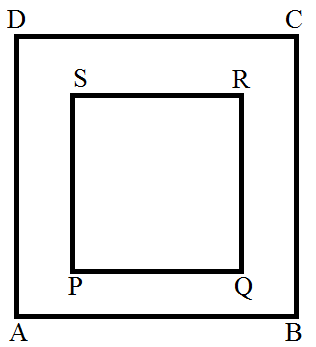
In the figure, a square dart board is shown. The length of a side of the larger square is $1.5$ times the length of a side of the smaller square. If a dart is thrown and lands on the larger square. What is the probability that it will land in the interior of the smaller square?
Answer
Let the side of smaller square $= a$
Let lenght of side of square $ABCD = a × 1.5$
$=\frac{3}{2}\text{a}$
Now are of sq. $\text{ABCD}=\Big(\frac{3\text{a}}{2}\Big)^2=\frac{9}{4}\text{a}^2$ sq. units
and area of sq. $PQRS = a^2 $sq. units
$\text{Probability}=\frac{\text{a}^2}{\frac{9}{4}\text{a}^2}=\text{a}^2\times\frac{4}{9\text{a}^2}=\frac{4}{9}$
View full question & answer
Question 53 Marks
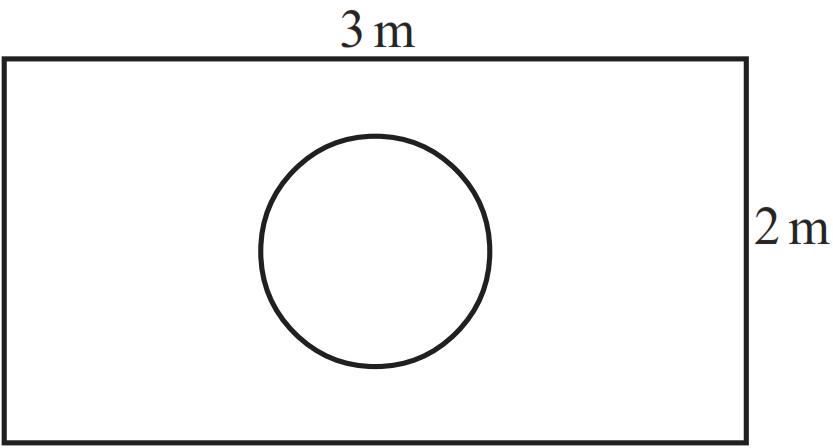
Suppose you drop a tie at random on the rectangular region shown in the given figure. What is the probability that it will land inside the circle with diameter 1m?
Answer
Area of circle with radius 0.5m
A circle $=(0.5)^2=0.25\pi\text{m}^2$
Area of rectangle $=3\times2=6\text{m}^2$
Probability (geometric) $=\frac{\text{measured of specified region part}}{\text{measure of whole region}}$
Probability that tie will land inside the circle with diameter 1m
$=\frac{\text{area of circle}}{\text{area of reatangle}}$
$=\frac{0.25\pi\text{m}^2}{6\text{m}^2}$
$=\frac{1}{4}\times\frac{\pi}{6}$
$=\frac{\pi}{24}$
View full question & answer
Question 63 Marks
A and B throw a pair of dice. If A throws 9, find B's chance of throwing a higher number.
Answer
$\because$ A and B throws a air of dice
$\therefore$ n = 6 × 6 = 36
$\because$ A throws 9 but B throws more i.e., 10, 11, 12 which can be (4, 6), (5, 5), (5, 6), (6, 4), (6, 5), (6, 6) which are 6
$\therefore$ m = 6
$\therefore\ \text{P(A)}=\frac{\text{m}}{\text{n}}=\frac{6}{36}=\frac{1}{6}$
View full question & answer
Question 73 Marks
A box contains 90 discs which are numbered from 1 to 90. If one discs is drawn at random from the box, find the probability that it bears:
  1. A two digit number.
  2. A perfect square number.
  3. A number divisible by 5.
Answer
No. of discs in a box (n) = 90
(from 1 to 90)
  1. No. of 2 - digit numbers (m)
= 10 to 90 = 90 - 9 = 81

$\therefore\ \text{Probability}=\frac{\text{m}}{\text{n}}=\frac{81}{90}=\frac{9}{10}$
  1. No. of perfect squares = 1, 4, 9, 16, 25, 36, 49, 64, 81 which are (m) = 9
$\therefore\ \text{Probability}=\frac{\text{m}}{\text{n}}=\frac{9}{90}=\frac{1}{10}$
  1. No. divisible by 5 are 5, 10, 15, 20, 25, 30, 35, 40, 45, 50, 55, 60, 65, 70, 75, 80, 85, 90 (m) = 18
$\therefore\ \text{Probability}=\frac{\text{m}}{\text{n}}=\frac{18}{90}=\frac{1}{5}$
View full question & answer
Question 83 Marks
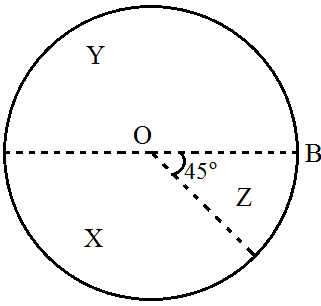
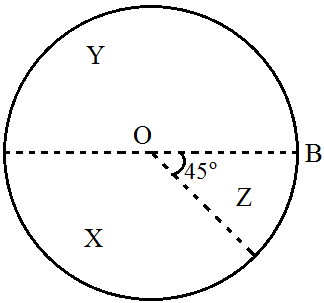
In the accompanying diagram a fair spinner is placed at the centre O of the circle Diameter AOB and radius OC divide the circle into three regions labelled X, Y and Z. It $\angle\text{BOC}=45^\circ$. What is the probability that the spinner will land in the region X?
Answer
Given: A fair spinner is placed at the centre O of the circle. Diameter AOB and radius OC divide the circle into three regions labeled X, Y and Z and angle $\angle\text{BOC}=45^\circ$. To find: Probability that the spinner will land in X region? Total angle of circle is 360º. $\angle\text{AOC}+\angle\text{BOC}=180^\circ(\text{Straight angle})$
$\angle\text{AOC}+45^\circ=180^\circ$
$\angle\text{AOC}=180^\circ-45^\circ$
$\angle\text{AOC}=135^\circ\ .....(\text{i})$
We know thet $\text{Probability}=\frac{\text{Number of favourable event}}{\text{Total number of event}}$ Hence probability of "spinner will land in X region" is $\frac{135}{360}=\frac{3}{8}$
View full question & answer
Question 93 Marks
Two dice are thrown simultaneously. What is the probability that:
  1. $5$ will not come up on either of them?
  2. $5$ will come up on at least one?
  3. $5$ will come up at both dice?
Answer
Given: Two dice are thrown
To Find: Probability of the following:
Let us first write the all possible events that can occur
$(1,1), (1,2), (1,3), (1,4), (1,5), (1,6),$
$(2,1), (2,2), (2,3), (2,4), (2,5), (2,6),$
$(3,1), (3,2), (3,3), (3,4), (3,5), (3,6),$
$(4,1), (4,2), (4,3), (4,4), (4,5), (4,6),$
$(5,1), (5,2), (5,3), (5,4), (5,5), (5,6),$
$(6,1), (6,2), (6,3), (6,4), (6,5), (6,6)$
Hence total number of events is $6^2 = 36$
Favorable events i.e. 5 will not come up on either of them
$(1, 1), (1, 2), (1, 3), (1, 4), (1, 6),$
$(2, 1), (2, 2), (2, 3), (2, 4), (2, 6),$
$(3, 1), (3, 2), (3, 3), (3, 4), (3, 6),$
$(4, 1), (4, 2), (4, 3), (4, 4), (4, 6),$
$(6, 1), (6, 2), (6, 3), (6, 4), (6, 6)$
Hence total number of favorable events i.e. $5$ will not come up on either of them is $25$

We know that $\text{Probability}=\frac{\text{Number of favourable event}}{\text{Total number of event}}$

Hence probability that 5 will not come up on either of them is equal to $=\frac{25}{36}$
  1. Favorable events i.e. 5 will come on at least once
$(1, 5), (2, 5), (3, 5), (4, 5),$
$(5, 1), (5, 2), (5, 3), (5, 4), (5, 5), (5, 6), (6, 5),$
Hence total number of favorable events i.e.$5$ will not come on at least once is $11$

We know that $\text{Probability}=\frac{\text{Number of favourable event}}{\text{Total number of event}}$

Hence probability of getting i.e. $5$ will come on at least once is equal to $=\frac{11}{36}$
  1. Favorable events i.e. $5$ will come on both side is $(5, 5)$
Hence total number of favorable events i.e. $5$ will come on both side is $1$

We know that $\text{Probability}=\frac{\text{Number of favourable event}}{\text{Total number of event}}$

Hence probability of getting $5$ will come on both side is equal to $=\frac{1}{36}$
View full question & answer
Question 103 Marks
A bag contains 6 red, 8 black and 4 white balls. A ball is drawn at random. What is the probability that ball drawn is not black?
Answer
Givne: A bag contains 6 red, 8 black and 4 white balls and a ball is drawn at random
To Find: Probability that the ball drawn is not black
Total number of balls 6 + 8 + 4 = 18
Total number of black balls is 8
We know that $\text{Probability}=\frac{\text{Number of favourable event}}{\text{Total number of event}}$
Probability of getting a black ball $\text{P(E)}=\frac{8}{18}=\frac{4}{9}\ .....(\text{i})$
We know that sum of probability of occurrence of an event and probability of non occurrence of an event is 1.
Hence,
$\text{P(E)}+\text{P}(\bar{\text{E}})=1$
$\frac{4}{9}+\text{P}(\bar{\text{E}})=1$
$\text{P}(\bar{\text{E}})=1-\frac{4}{9}$
$\text{P}(\bar{\text{E}})=\frac{5}{9}$
View full question & answer
Question 113 Marks
12 defective pens are accidently mixed with 132 good ones. It is not possible to just look at pen and tell whether or not it is defective. one pen is taken out at random from this lot. Determine the probability that the pen taken out is good one.
Answer
Given: 12 defective pens are accidently mixed with 132 good ones. One pen is taken out at random from this lot.
To Find: Probability that the pen taken out is good.
Total number of bulbs is 132 + 12 = 144
Total numbers of bulbs which are good are 132
We know that $\text{Probability}=\frac{\text{Number of favourable event}}{\text{Total number of event}}$
Hence probability that pen taken out is good is $\frac{132}{144}=\frac{11}{12}$
View full question & answer
Question 123 Marks
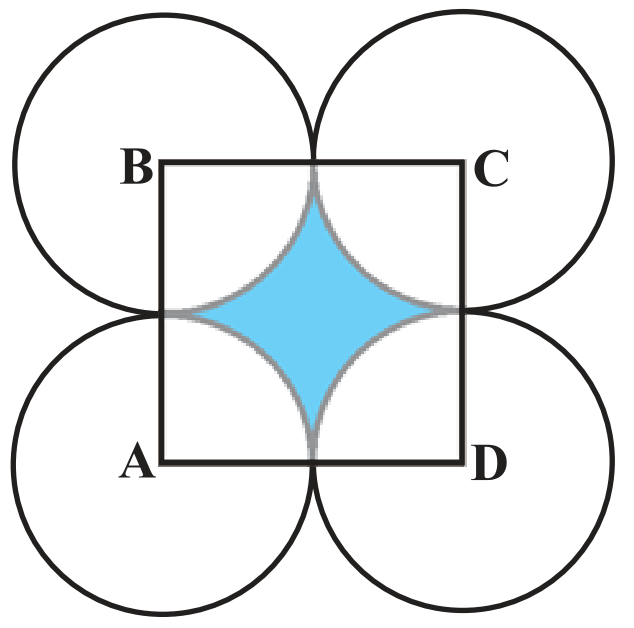
In the given figure, points $A, B, C$ and $D$ are the centres of four circles that each have a radius of length one unit. If a point is selected at random from the interior of square $A B C D$. What is the probability that the point will be chosen from the shaded region.
Answer
Radius of each circle $=1$ unit
$\therefore$ Side of the square $A B C D=1+1=2$ units
Now area of square $=a^2=2 \times 2=4$ sq. units
and area of 4 quadrats at $A, B, C$ and $D$
$=4 \times \frac{1}{4} \pi r^2=\pi(1)^2=\pi$ sq. unit
$\therefore$ Area of shaded portion $=(4-\pi)$ sq. units
$\therefore$ Probability of the point chosen from the shaded region $=\frac{4-\pi}{4}=\left(1-\frac{\pi}{4}\right)$
View full question & answer
Question 133 Marks
A bag contains 8 red, 6 white and 4 black balls. A ball is drawn at random from the bag. Find the probability that the drawn ball is:
  1. Red or white.
  2. Not black.
  3. Neither white nor black.
Answer
In a bag, there are 8 red, 6 white and 4 black balls
$\therefore$ Total balls (n) = 8 + 6 + 4 = 18
One ball is drawn at random
  1. No. of red of white balls (m) = 8 + 6 = 14
$\therefore\ \text{Probability P(A)}=\frac{\text{m}}{\text{n}}=\frac{14}{18}=\frac{7}{9}$
  1. No. of balls which are not black (m) = 8 + 6 = 14
$\therefore\ \text{Probability P(A)}=\frac{14}{18}=\frac{7}{9}$
  1. No. of ball which neither white nor black
(m) = 18 - 6 - 4 = 8

$\therefore\ \text{Probability P(A)}=\frac{\text{m}}{\text{n}}=\frac{8}{18}=\frac{4}{9}$
View full question & answer
Question 143 Marks
Five cards ten, jack, queen, king and an ace of diamonds are shuffled face downwards. One card is picked at random.
  1. What is the probability that the card is a queen?
  2. If a king is drawn first and put aside, what is the probability that the second card picked up is the (i) Ace (ii) King?
Answer
Fivew cards - ten, jack, queen, king and an ace of diamonds: There are 5
$\therefore$ n = 5
One card is drawn at random
  1. Card is queen which is random
$\therefore$ m = 1

$\therefore\ \text{P(A)}=\frac{1}{5}$
  1. A king is drawn first and put aside
Then there will be 4 card remaining

Now probability of card being are ace

$\text{P(A)}=\frac{1}{4}$
View full question & answer
Question 153 Marks
  1. A lot of 20 bulbs contain 4 defective ones. One bulb is drawn at random from the lot. What is the probability that this bulb is defective?
  2. Suppose the bulb drawn in (i) is not defective and not replaced. Now bulb is drawn at random from the rest. What is the probability that this bulb is not defective?
Answer
  1. Total bulbs (n) = 20
Defective bulbs = 4

$\therefore$ Not defective bulbs = 20 - 4 = 16

One bulb is drawn

$\therefore$ Probability of defective bulb $=\frac{4}{20}=\frac{1}{5}$
  1. One bulb taken out is not replaced and is not a defective one
$\therefore$ Remaining bulb = 20 - 1 = 19

$\therefore$ No. of bulbs which are not defective (m) = 16 - 1 = 15

Now the probability of bulb which is not defective $=\frac{\text{m}}{\text{n}}=\frac{15}{19}$
View full question & answer
Question 163 Marks
The probability of selecting a green marble at random from a jar that contains only green, white and yellow marbles is $\frac{1}{4}$. The probability of selecting a white marble at random from the same jar is $\frac{1}{3}$. If this jar contains 10 yellow marbles. What is the total number of marbles in the jar?
Answer
Given: A bag contains green, white and yellow marbles.
  1. Probability of selecting green marbles $=\frac{1}{4}$
  2. Probability of selecting white marbles $=\frac{1}{3}$
  3. The jar contains 10 yellow marbles.
To Find: Total number of marbles in the same jar
We know that sum of probabilities of all elementary events is 1.
Hence,
P(green marble) + P(white marble) + P(yellow marble) = 1
$\frac{1}{4}+\frac{1}{3}+\text{P(yellow marble)}=1$
$\frac{3+4}{12}+\text{P(yellow marble)}=1$
$\frac{7}{12}+\text{P(yellow marble)}=1$
$\text{P(yellow marble)}=1-\frac{7}{12}$
$\text{P(yellow marble)}=\frac{5}{12}$
We know that $\text{Probability}=\frac{\text{Number of favourable event}}{\text{Total number of event}}$
Hence
$\frac{5}{12}=\frac{\text{Number of favourable event i.e. yellow marble}}{\text{Total number of marble}}$
$\frac{5}{12}=\frac{\text{10}}{\text{Total number of marble}}$
$\text{Total number of marbles}=\frac{10\times12}{5}$
$\text{Total number of marbles}=24$
View full question & answer
Question 173 Marks
A dice is rolled twice. Find the probability that:
  1. 5 will not come up either time.
  2. 5 will come up exactly one time.
Answer
When a dice is rolled twice, all possible outcomes are
(1, 1), (1, 2), (1, 3), (1, 4), (1, 5), (1, 6)
(2, 1), (2, 2), (2, 3), (2, 4), (2, 5), (2, 6)
(3, 1), (3, 2), (3, 3), (3, 4), (3, 5), (3, 6)
(4, 1), (4, 2), (4, 3), (4, 4), (4, 5), (4, 6)
(5, 1), (5, 2), (5, 3), (5, 4), (5, 5), (5, 6)
(6, 1), (6, 2), (6, 3), (6, 4), (6, 5), (6, 6)
$\therefore$ Total number of outcomes = 36
  1. The outcomes where 5 will not come up either time are
(1, 1), (1, 2), (1, 3), (1, 4), (1, 6),
(2, 1), (2, 2), (2, 3), (2, 4), (2, 6),
(3, 1), (3, 2), (3, 3), (3, 4), (3, 6),
(4, 1), (4, 2), (4, 3), (4, 4), (4, 6),
(6, 1), (6, 2), (6, 3), (6, 4), (6, 6)
So, the number of favourable outcomes are 25.

$\therefore$ P(5 will not come up either time)

$\therefore$ P(5 will not come up either time)

$=\frac{\text{Favourable number of outcomes}}{\text{Total number of outcomes}}=\frac{26}{36}$
  1. The outcomes where 5 will come up exactly one time are
(1, 5), (2, 5), (3, 5), (4, 5),
(5, 1), (5, 2), (5, 3), (5, 4), (5, 6), (6, 5)
So, the number of favourable outcomes are 10.

$\therefore$ P(5 will come up exactly one time)

$=\frac{\text{Favourable number of outcomes}}{\text{Total number of outcomes}}$

$=\frac{10}{36}=\frac{5}{18}$​​​​​​​
View full question & answer
Question 183 Marks
All red face cards are removed from a pack of playing cards. The remaining cards are well shuffled and then a card is drawn at random from them. Find the probability that the drawn card is:
  1. A red card.
  2. A face card.
  3. A card of clubs.
Answer
After removing the red face cards, remaining cards = 52 - 6 = 46
$\therefore$ Number of total outcomes = 46
  1. A red card
Number of favourable outcomes = 26 - 6 = 20

$\therefore\ \text{Probability}=\frac{20}{46}=\frac{10}{23}$
  1. A face card
Number of favourable outcomes = 6

$\therefore\ \text{Probability}=\frac{6}{46}=\frac{3}{23}$
  1. A card of clubs
Numbers of favourable outcomes = 13

$\therefore\ \text{Probability}=\frac{13}{46}$
View full question & answer
Question 193 Marks
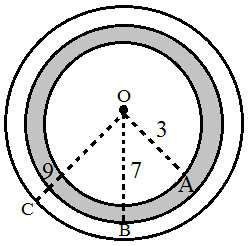
A target shown in the figure consists of three concentric circles of radii 3, 7 and 9cm respectively. A dart is thrown and lands on the target. What is the probability that the dart will land on the shaded region?
Answer
There are three concentric circles with radii
3cm, 7cm, and 9cm
i.e., OA = 3cm, OB = 7cm, OC = 9cm
Area of circle with centre $\text{OC}=\pi\text{r}^2$
$=\pi(9)^2=81\pi$
and area of shaded region
$=\pi(\text{OB})^2-\pi(\text{OA})^2$
$=\pi(7)^2-\pi(3)^2=49\pi-9\pi=40\pi$
$\therefore$ Probability of shaded region $\frac{40\pi}{81\pi}=\frac{40}{81}$
View full question & answer
Question 203 Marks
A bag contains cards which are numbered form 2 to 90. A card is drawn at random from the bag. Find the probability that it bears:
  1. A two digit number.
  2. A number which is a perfect square.
Answer
Given: Cards are marked with one of the numbers 2 to 90 are placed in a bag and mixed thoroughly. One card is picked at random.
To Find: Probability of getting
  • A two digit number
  • A number which is a perfect square
Total number of cards is 90 - 2 + 1 = 89 (Since 2 and 90 both are included).
  1. Cards marked two digit starts from 10
Total number of cards marked two digits from 10 to 90 is 90 - 10 + 1 = 81 (Since 10 and 90 both are included)

We know that $\text{Probability}=\frac{\text{Number of favourable event}}{\text{Total number of event}}$

Hence probability of getting a two digit card $=\frac{81}{89}$
  1. Cards which are perfect square form 2 to 90 are 4, 9, 16, 25, 36, 49, 64, 81
Total number of cards marked perfect square from 2 to 90 are 8

We know that $\text{Probability}=\frac{\text{Number of favourable event}}{\text{Total number of event}}$

Hence probability of getting perfect square card $=\frac{8}{89}$
View full question & answer
Question 213 Marks
A bag contains 5 black, 7 red and 3 white balls. A ball is drawn from the bag at random. Find the probability that the ball drawn is:
  1. Red.
  2. Black or white.
  3. Not black.
Answer
In a bag, there are 5 black, 7 red and 3 white balls
$\therefore$ Total number of balls (n) = 5 + 7 + 3 = 15
One ball is drawn at random
  1. Red ball (m) = 7
$\therefore$ Probability of being a red ball

$\text{P(A)}=\frac{\text{m}}{\text{n}}=\frac{7}{15}$
  1. Black or white balls (m) = 5 + 3 = 8
$\therefore\ \text{Probability P(A)}=\frac{\text{m}}{\text{n}}=\frac{8}{15}$
  1. Not black balls (m) = 7 + 3 = 10
$\therefore\ \text{Probability P(A)}=\frac{\text{m}}{\text{n}}=\frac{8}{15}$
View full question & answer
Question 223 Marks
A lot consists of 144 ball pens of which 20 are defective and others good. Nutri will buy a pen if it is good, but will not buy if it is defective. the shopkeeper draws one pen at random and gives it to her. What is the probability that:
  1. She will buy it?
  2. She will not buy it?
Answer
No. of good pens = 144 - 20 = 124
No. of detective pens = 20
Total no. of possible outcomes = 144 {total no pens}
  1. E → event of buying pen which is good.
No. of favourable outcomes = 124 {124 good pens}

$\text{P(E)}=\frac{\text{No. of favorable outcomes}}{\text{Total no. of possible outcomes}}$

$\text{P(E)}=\frac{124}{144}=\frac{31}{36}$
  1. $\bar{\text{E}}\rightarrow$ event of not buying a pen which is bad $\text{P(E)}+\text{P}(\bar{\text{E}})=1$
$\text{P(E)}+\text{P}(\bar{\text{E}})=1$

$\text{P}(\bar{\text{E}})=1-\text{P(E)}$

$=1-\frac{31}{36}=\frac{5}{36}$
View full question & answer