Questions

1 Marks Question

Take a timed test

23 questions · self-marked practice — reveal the answer and mark yourself.

Question 11 Mark
Find the nature of the roots of the quadratic equation $2 x^2-3 x+5=0$. If the real roots exist. Find it.
Answer
The given equation is
$2 x^2-3 x+5=0$
Here, $a=2, b=-3, c=5$
Therefore, discriminant $=b^2-4 a c$
$=(-3)^2-4(2)(5)$
$=9-40=-31<0$
So, the qiven equation has no real roots.
View full question & answer
Question 21 Mark
John and Jivanti together have 45 marbles. Both of them lost 5 marbles each, and the product of the number of marbles they now have is 124. We would like to find out how many marbles they had to start with. Represent situation mathematically (quadratic equation).
Answer
Let the number of John's marbles be $x$.
Therefore, number of Jivanti's marble $=45-x$
After losing 5 marbles,
Number of John's marbles $=x-5$
Number of Jivanti's marbles $=45-x-5=40-x$
Given that the product of their marbles is 124.
$\therefore(x-5)(40-x)=124$
$\Rightarrow x^2-45 x+324=0$
View full question & answer
Question 31 Mark
Find the roots of the quadratic equation $100x^2- 20x + 1 = 0$ by factorization.
Answer
We have, $100x^2 - 20x +1 = 0$
$\Rightarrow$ $100x^2 -10x -10x +1 = 0$
$\Rightarrow$ 10x (10x -1) - 1 (10x -1) = 0
$\Rightarrow$ (10x -1) (10x -1) = 0
Either 10x -1 = 0 or 10x -1 = 0
$\Rightarrow$ x = ${1\over10},\,{1\over10}$
$\therefore x={1\over10}$ are the repeated roots.
View full question & answer
Question 41 Mark
Find the roots of the quadratic equation $2x^2-x+{1 \over8} = 0$ by factorization.
Answer
We have, $2x^2-x+{1\over8}=0$

$\implies 2x^2-{1\over2}x-{1\over2}x+{1\over8}=0$

$\implies x(2x-{1\over2}) - {1\over4}(2x-{1\over2})=0$

$\implies (2x-{1\over2}) (x-{1\over4})=0$

$Either \,(2x-{1\over2})\, =0\,or\, (x-{1\over4})=0$

$\implies x = {1\over4},\,{1\over4}$

So, this root is repeated root.

$\therefore $ both the roots are ${1\over4}$.

View full question & answer
Question 51 Mark
Find the roots of the quadratic equation $\sqrt { 2 } x ^ { 2 } + 7 x + 5 \sqrt { 2 } = 0$ by factorization.
Answer

We have, $\sqrt { 2 } x ^ { 2 } + 7 x + 5 \sqrt { 2 } = 0$
$\Rightarrow \quad \sqrt { 2 } x ^ { 2 } + 2 x + 5 x + 5 \sqrt { 2 } = 0$
$\Rightarrow \sqrt { 2 } x ( x + \sqrt { 2 } ) + 5 ( x + \sqrt { 2 } ) = 0$
$\Rightarrow \quad ( x + \sqrt { 2 } ) ( \sqrt { 2 } x + 5 ) = 0$
$\Rightarrow \quad x = - \sqrt { 2 }$ and $\frac{-5}{\sqrt{2}}$

View full question & answer
Question 61 Mark
Find the roots of the quadratic equation $2x^2 + x – 6 = 0$ by factorization.
Answer
We have, $2 x^2+x-6=0$
$\Rightarrow 2 x^2+4 x-3 x-6=0$
$\Rightarrow 2 x(x+2)-3(x+2)=0$
$\Rightarrow(2 x-3)(x+2)=0$
Either $2 x -3=0$ or $x +2=0 \quad x=\frac{3}{2},-2$ $\therefore x=\frac{3}{2},-2$ are the required roots.
View full question & answer
Question 71 Mark
Find the roots of the quadratic equation $x^2-3 x-10=0$ by factorization.
Answer
$x^2−3x - 10=0$
$\Rightarrow x^2−5x +2x - 10=0$
$\Rightarrow x (x−5)+2(x−5)=0$
$\Rightarrow (x−5)(x +2)=0$
$\Rightarrow x =5,−2$
View full question & answer
Question 81 Mark
Represent the situation in the form of the quadratic equation:
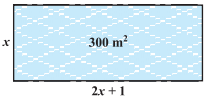
The area of a rectangular plot is $528 m^2$. The length of the plot (in metres) is one more than twice its breadth. We need to find the length and breadth of the plot.
Answer
Let the breadth of the plot be 'x' m
$\therefore$ Length = (2x + 1) m
Now, Area of the plot $= 528 m^2$
$\Rightarrow$ L $\times$B $= 528 m^2$
$\Rightarrow$ $(2x+1) \times x=528 \Rightarrow 2x^2+x-528=0$
This is the required quadratic equation.
View full question & answer
Question 91 Mark
Check whether the given equation is quadratic equation or not: $x^3 - 4x^2 - x + 1 = (x - 2)^3$
Answer
We have given that, $x^3 - 4x^2 - x + 1 = (x - 2)^3$
Applying identity on R.H.S. we get,
$(a-b)^{3}=a^{3}-b^{3}-3 a^{2} b+3 a b^{2}$
$\Rightarrow x^{3}-4 x^{2}-x+1=x^{3}-8-6 x^{2}+12 x$
$\Rightarrow x^{3}-4 x^{2}-x+1-x^{3}+8+6 x^{2}-12 x=0$
$\Rightarrow 2 x^{2}-13 x+9=0$
Degree of the equation is 2 and
It is of the form $a x^{2}+b x+c=0,$ with $a \neq 0$ , therefore, the given equation is quadratic.
View full question & answer
Question 101 Mark
Check the equation is quadratic equation or not:$ (x + 2)^3 = 2x(x^2- 1)$
Answer
We have the following equation,
$(x+2)^3=2 x\left(x^2-1\right)$
$\Rightarrow x^3+8+6 x(x+2)=2 x^3-2 x$
$\Rightarrow x^3+6 x^2+12 x+8=2 x^3-2 x$
$\Rightarrow x^3-6 x^2-14 x-8=0$
Cleary, It is not in the form of $ax ^2+ bx + c =0$.
Therefore, it is not a quadratic equation.
View full question & answer
Question 111 Mark
Check the equation is quadratic equation: $x^2+3 x+1=(x-2)^2$
Answer
We have $x^2+3 x+1=(x-2)^2$
$\Rightarrow x^2+3 x+1=x^2-4 x+4$
$\Rightarrow 7 x-3=0$
It is not of the form $a x^2+b x+c=0, a \neq 0$
$\therefore$ the given equation is not a quadratic equation.
View full question & answer
Question 121 Mark
Check the equation is quadratic equation or not: (2x - 1) (x - 3) = (x + 5) (x - 1)
Answer
$\text { We have }(2 x-1)(x-3)=(x+5)(x-1)$
$\Rightarrow 2 x^2-6 x-x+3=x^2-x+5 x-5$
$\Rightarrow 2 x^2-7 x+3=x^2+4 x-5$
$\Rightarrow x^2-11 x+8=0$
which is of the form $a x^2+b x+c=0, a \neq 0$
$\therefore$ the given equation is a quadratic equation.
View full question & answer
Question 131 Mark
Check the equation is quadratic equation or not: (x - 3) (2x + 1) = x(x + 5)
Answer
The given equation is (x - 3) (2x +1) = x (x+5)
$\Rightarrow$$ 2x^2 + x - 6x - 3 = x^2 + 5x$
$\Rightarrow$ $2x^2 - 5x - 3 = x^2 + 5x$
$\Rightarrow$$ x^2 - 10x - 3 = 0$
It is in the form of $ax^2 + bx + c = 0$, $a\ne 0$
$\therefore$ the given equation is a quadratic equation.
View full question & answer
Question 141 Mark
Check the equation is quadratic equation or not: (x - 2) (x + 1) = (x - 1) (x + 3)
Answer
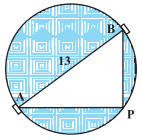
Let P be the position of the pole and A & B be the opposite fixed gates. Let, BP = x metres.
$\therefore$ AP = x + 7
In right triangle APB,

$A P^2+B P^2=A B^2$
$\Rightarrow(x+7)^2+x^2=13^2$
$\Rightarrow x^2+49+14 x+x^2=169$
$\Rightarrow 2 x^2+14 x+49-169=0$
$\Rightarrow 2 x^2+14 x-120=0$
$\Rightarrow 2\left(x^2+7 x-60\right)=0$
$\Rightarrow x^2+7 x-60=0$
$\Rightarrow x^2+12 x-5 x-60=0$
$\Rightarrow x(x+12)-5(x+12)=0$
$\Rightarrow(x+12)(x-5)=0$
Either x+12 = 0, then x = -12 which is not possible being negative or x - 5 = 0, then x = 5.
Thus P is at a distance of 5m from B and 5+7 = 12m from A.
View full question & answer
Question 151 Mark
Check the equation is quadratic equation or not: $x^2 - 2x = (-2)(3 - x)$
Answer
$x^2−2x =(−2)(3−x )$
$\Rightarrow x^2−2x =−6+2x$
$\Rightarrow x^2−2x−2x +6=0$
$\Rightarrow x^2−4x +6=0$
Here, degree of equation is 2.
Therefore, it is a Quadratic Equation.
View full question & answer
Question 161 Mark
Check the equation is quadratic equation or not: $(x + 1)^2= 2(x – 3)$
Answer
The given equation is $(x+1)^2=2(x-3) \Longrightarrow x^2+2 x+1-2 x+6=0$
$\Longrightarrow x^2+7=0$
$\Longrightarrow x^2+0 \cdot x+7=0$
Which is of the form $a x^2+b x+c=0$
Hence, the given equation is a quadratic equation.
View full question & answer
Question 171 Mark
Find the roots of the quadratic equation $6x^2 - x - 2 = 0.$
Answer
$6x^2- x - 2 = 0$
$or, 6x^2 + 3x - 4x - 2 = 0$
$or, 3x(2x + 1) -2(2x + 1) = 0$
$or, (2x + 1)(3x - 2) = 0$
$\Rightarrow$ either 3x - 2 = 0 or 2x + 1 = 0
$\therefore \quad x = \frac { 2 } { 3 } \text { or } x = - \frac { 1 } { 2 }$
Therefore, Roots of equation are $\frac { 2 } { 3 } \text { and } - \frac { 1 } { 2 }$.
View full question & answer
Question 181 Mark
Find the roots of the quadratic equation $2 x^2-5 x+3=0$ by factorisation.
Answer
Let us first split the middle term $-5 x$ as $-2 x,-3 x$ [because $(-2 x) \times(-3 x)=6 x^2=\left(2 x^2\right) \times 3$ ] So, $2 x^2-5 x+3=2 x^2-2 x-3 x+3=2 x(x-1)-3(x-1)=(2 x-3)(x-1)$
Now, $2 x^2-5 x+3=0$ can be rewritten as $(2 x-3)(x-1)=0$
So, the values of $x$ for which $2 x^2-5 x+3=0$ are the same for which $(2 x-3)(x-1)=0$
i.e., either $2 x-3=0$ or $x-1=0$.
Now, $2 x-3=0$ gives $x=\frac{3}{2}$ and $x-1=0$ gives $x=1$.
So, $x=\frac{3}{2}$ and $x=1$ are the roots of the given quadratic equation.
View full question & answer
Question 191 Mark
Check the equation is quadratic equation or not: $(x+2)^3=x^3-4$
Answer
Here, LHS $=(x+2)^3=x^3+6 x^2+12 x+8$
Therefore, $(x+2)^3=x^3-4$ can be rewritten as
$x^3+6 x^2+12 x+8=x^3-4$
i.e., $6 x^2+12 x+12=0$ or, $x^2+2 x+2=0$
It is of the form $a x^2+b x+c=0$.
So, the given equation is a quadratic equation.
View full question & answer
Question 201 Mark
Check the equation is quadratic equation or not: $x(2 x+3)=x^2+1$
Answer
Taking, L.H.S. $=x(2 x+3)=2 x^2+3 x$
So, $x(2 x+3)=x^2+1$ can be rewritten as
$2 x^2+3 x=x^2+1$
Therefore, we get $x^2+3 x-1=0$
It is of the form $a^2+b x+c=0$. Also degree is 2 . So, the given equation is a quadratic equation.
View full question & answer
Question 211 Mark
Check the equation is quadratic equation or not: x(x + 1) + 8 = (x + 2) (x – 2)
Answer
Since $x(x+1)+8=x^2+x+8$ and $(x+2)(x-2)=x^2-4$
Therefore, $x^2+x+8=x^2-4$
i.e., $x+12=0$
It is not of the form $a x^2+b x+c=0$
Therefore, the given equation is not a quadratic equation.
View full question & answer
Question 221 Mark
Check the equation is quadratic equation or not: $(x-2)^2+1=2 x-3$
Answer
Taking L.H.S. $=(x-2)^2+1=x^2-4 x+4+1=x^2-4 x+5$
Therefore, $(x-2)^2+1=2 x-3$ can be rewritten as $x^2-4 x+5=2 x-3$
i.e., $x^2-6 x+8=0$
It is of the form $a x^2+b x+c=0$. Also degree of equation is 2
Therefore, the given equation is a quadratic equation.
View full question & answer
Question 231 Mark
Find the dimensions of the prayer hall given in the below figure.
Answer
Let the number of toys produced be x.
$\therefore$ Cost of production of each toy = Rs (55 − x)
It is given that, total production of the toys = Rs 750
$\therefore$ x(55 – x) = 750
$\Rightarrow x^2 – 55x + 750 = 0$
View full question & answer
1 Marks Question - Maths STD 10 Questions - Vidyadip