MCQ 11 Mark
Directions: In the following questions, a statement of assertion $(A)$ is followed by a statement of reason $(R)$.Mark the correct choice as:
Assertion: Two identical solid cube of side $5 \ cm$ are joined end to end.Then total surface area of the resulting cuboid is $300 \ cm^2$
Reason: Total surface area of a cuboid is $2(lb + bh + lh).$
- A
Both assertion $(A)$ and reason $(R)$ are true and reason $(R)$ is the correct explanation of assertion $(A)$.
- B
Both assertion $(A)$ and reason $(R)$ are true but reason $(R)$ is not the correct explanation of assertion $(A)$.
- C
Assertion $(A)$ is true but reason $(R)$ is false.
- ✓
Assertion $(A)$ is false but reason $(R)$ is true.
AnswerCorrect option: D. Assertion $(A)$ is false but reason $(R)$ is true.
When cubes are joined end to end, it will form a cuboid.
$1 = 2 \times 5 = 10\ cm, b = 5\ cm$
and $h = 5\ cm$
Total surface area $= 2(1b + bh + lh)$
$= 2(10 \times 5 + 5 \times 5 + 10 \times 5)$
$= 2 \times 125 = 250\ cm^2$
View full question & answer→MCQ 21 Mark
Directions : In the following questions, a statement of assertion $(A)$ is followed by a statement of reason $(R)$.Mark the correct choice as:
Assertion: If a ball is in the shape of a sphere has a surface area of $ 221.76\ cm^2$, then its diameter is $8.4\ cm.$
Reason: If the radius of the sphere be $r,$ then surface area, $\text{S}=4\pi\text{r}^2\text{ i.e}.\text{r}=\frac{1}{2}\sqrt{\frac{\text{S}}{\pi}}$
- ✓
Both assertion $(A)$ and reason $(R)$ are true and reason $(R)$ is the correct explanation of assertion $(A)$.
- B
Both assertion $(A)$ and reason $(R)$ are true but reason $(R)$ is not the correct explanation of assertion $(A)$.
- C
Assertion $(A)$ is true but reason $(R)$ is false.
- D
Assertion $(A)$ is false but reason $(R)$ is true.
AnswerCorrect option: A. Both assertion $(A)$ and reason $(R)$ are true and reason $(R)$ is the correct explanation of assertion $(A)$.
Both assertion $(A)$ and reason $(R)$ are true and reason $(R)$ is the correct explanation of assertion $(A)$.
View full question & answer→MCQ 31 Mark
Directions : In the following questions, a statement of assertion $(A)$ is followed by a statement of reason $(R).$ Mark the correct choice as:
Assertion : From a solid cylinder, whose height is $12\ cm$ and diameter $10\ cm$ a conical cavity of same height and same diameter is hollowed out. Then, volume of the cone is $\frac{2200}{7}\text{ cm}^3$
Reason : If a conical cavity of same height and same diameter is hollowed out from a cylinder of height $h$ and base radius $r,$ then volume of the cone will be half of the volume of the cylinder.
- A
Both assertion $(A)$ and reason $(R)$ are true and reason $(R)$ is the correct explanation of assertion $(A)$.
- B
Both assertion $(A)$ and reason $(R)$ are true but reason $(R)$ is not the correct explanation of assertion $(A)$.
- ✓
Assertion $(A)$ is true but reason $(R)$ is false.
- D
Assertion $(A)$ is false but reason $(R)$ is true.
AnswerCorrect option: C. Assertion $(A)$ is true but reason $(R)$ is false.
$\because$ Volume of cylinder $=\pi\text{r}^2\text{h}$ and volume of conical cavity $=\frac{1}{3}\pi\text{r}^2\text{h}$
$\therefore$ Volume of cone $=\frac{1}{3}$ Volume of cylinder.
So, Reason is wrong.
Now, diameter of cone $=10\text{ cm}$
$\therefore$ Radius of cone $\text{r}=5\text{ cm}$
Also, height of cone, $\text{h}=12\text{ cm}.$
Volume of cone $=\frac{1}{3}\pi\text{r}^2\text{h}$
$=\frac{1}{3}\times\frac{22}{7}\times5\times5\times12$
$=\frac{6600}{21}$
$=\frac{2200}{7}\text{m}^3$
View full question & answer→MCQ 41 Mark
Directions : In the following questions, a statement of assertion $(A)$ is followed by a statement of reason $(R)$.Mark the correct choice as:
Assertion : If the areas of three adjacent faces of a cuboid are $x, y, z$ respectively then the volume of the cuboid is $\sqrt{\text{xyz}}$
Reason : Volume of a cuboid whose edges are $l, b$ and $h$ is lbh units.
- ✓
Both assertion $(A)$ and reason $(R)$ are true and reason $(R)$ is the correct explanation of assertion $(A)$.
- B
Both assertion $(A)$ and reason $(R)$ are true but reason $(R)$ is not the correct explanation of assertion $(A)$.
- C
Assertion $(A)$ is true but reason $(R)$ is false.
- D
Assertion $(A)$ is false but reason $(R)$ is true.
AnswerCorrect option: A. Both assertion $(A)$ and reason $(R)$ are true and reason $(R)$ is the correct explanation of assertion $(A)$.
$\text{lb} = \text{xbh} = \text{ylh} =\text{z}$
$\Rightarrow\text{lb}\times\text{bh}\times\text{lh}=\text{xyz}$
$\Rightarrow\text{l}^2\text{b}^2\text{h}^2=\text{xyz}$
$\Rightarrow\text{lbh}=\sqrt{\text{xyz}}$
$\Rightarrow\text{Volume}=\sqrt{\text{xyz}}$
View full question & answer→MCQ 51 Mark
Directions: In the following questions, a statement of assertion $(A)$ is followed by a statement of reason $(R)$.Mark the correct choice as:
Assertion: Total surface area of the cylinder having radius of the base $14 \ cm$ and height 30\ cm is $3872 \ cm^2$
Reason: If $r$ be the radius and h be the height of the cylinder, then total surface area $(2\pi\text{r}\text{h}+2\pi\text{r}^2)$
- ✓
Both assertion $(A)$ and reason $(R)$ are true and reason $(R)$ is the correct explanation of assertion $(A)$.
- B
Both assertion $(A)$ and reason $(R)$ are true but reason $(R)$ is not the correct explanation of assertion $(A)$.
- C
Assertion $(A)$ is true but reason $(R)$ is false.
- D
Assertion $(A)$ is false but reason $(R)$ is true.
AnswerCorrect option: A. Both assertion $(A)$ and reason $(R)$ are true and reason $(R)$ is the correct explanation of assertion $(A)$.
Total surface area $=2\pi\text{r}\text{h}+2\pi\text{r}^2$
$=2\pi\text{r}(\text{h}+\text{r})$
$=2\times\frac{22}{7}\times14(30+14)=88(44)$
$=3832\text{cm}^2$
View full question & answer→MCQ 61 Mark
Directions : In the following questions, a statement of assertion $(A)$ is followed by a statement of reason $(R).$ Mark the correct choice as:
Assertion : If the radius of a cone is halved and volume is not changed, then height remains same.
Reason : If the radius of a cone is halved and volume is not changed then height must become four times of the original height.
- A
Both assertion $(A)$ and reason $(R)$ are true and reason $(R)$ is the correct explanation of assertion $(A)$.
- B
Both assertion $(A)$ and reason $(R)$ are true but reason $(R)$ is not the correct explanation of assertion $(A)$.
- C
Assertion $(A)$ is true but reason $(R)$ is false.
- ✓
Assertion $(A)$ is false but reason $(R)$ is true.
AnswerCorrect option: D. Assertion $(A)$ is false but reason $(R)$ is true.
$\frac{\text{V}_1}{\text{V}_2}=\frac{\big(\frac{1}{3}\big)\pi\text{r}^2\text{h}_1}{\big(\frac{1}{3}\big)\pi\big(\frac{\text{r}}{2}\big)^2\text{h}_2}=\frac{4\text{h}_1}{\text{h}_2}$
As, $\text{V}_1=\text{V}_2$
$\text{h}_2=4\text{h}_1$
View full question & answer→MCQ 71 Mark
Directions : In the following questions, a statement of assertion $(A)$ is followed by a statement of reason $(R).$ Mark the correct choice as:
Assertion : The sum of the length, breadth and height of a cuboid is $19\ cm$ and its diagonal is $5\sqrt{5}\text{ cm}$.Its surface area is $236\text{ cm}^2$
Reason : The lateral surface area of a cuboid is $2(l + b).$
- A
Both assertion $(A)$ and reason $(R)$ are true and reason $(R)$ is the correct explanation of assertion $(A)$.
- B
Both assertion $(A)$ and reason $(R)$ are true but reason $(R)$ is not the correct explanation of assertion $(A)$.
- ✓
Assertion $(A)$ is true but reason $(R)$ is false.
- D
Assertion $(A)$ is false but reason $(R)$ is true.
AnswerCorrect option: C. Assertion $(A)$ is true but reason $(R)$ is false.
We have, $\text{l}+\text{b}+\text{h} = 19\text{ cm} $
$\Rightarrow\sqrt{\text{l}^2+\text{b}^2+\text{h}^2}=5\sqrt{5}$
$\Rightarrow\text{l}^2+\text{b}^2+\text{h}^2=125$
$\Rightarrow(\text{l}+\text{b}+\text{h})^2=19^2$
$\Rightarrow\text{l}^2+\text{b}^2+\text{h}^2+2(\text{lb}+\text{bh}+\text{hl})=361$
$\Rightarrow2(\text{lb}+\text{bh}+\text{hl})=361-125$
$\text{S.A}$. of cuboid $=236\text{ cm}^2$
Lateral surface area does not include top and base.
$\Rightarrow\text{L.S.A}=2({\text{bh}+\text{lh}})=2(\text{b}+\text{l})\text{h}$
View full question & answer→MCQ 81 Mark
Directions: In the following questions, a statement of assertion $(A)$ is followed by a statement of reason $(R)$.Mark the correct choice as:
Assertion: The volume of a hall, which is $5$ times as high as it is broad and $8$ times as long as it is high, is $12.8m^3$.The breadth of the hall is $25 \ cm.$
Reason: The total surface area of a cuboid of length $(l)$, breadth $(b)$ and height $(h)$ is $2[lb + bh + lh]$
- A
Both assertion $(A)$ and reason $(R)$ are true and reason $(R)$ is the correct explanation of assertion $(A)$.
- B
Both assertion $(A)$ and reason $(R)$ are true but reason $(R)$ is not the correct explanation of assertion $(A)$.
- C
Assertion $(A)$ is true but reason $(R)$ is false.
- ✓
Assertion $(A)$ is false but reason $(R)$ is true.
AnswerCorrect option: D. Assertion $(A)$ is false but reason $(R)$ is true.
Let breadth of a hall be x and height $=5\text{x}$
Length $8\times5\text{x}=40\text{x}$
$\therefore$ Volume of hall $\text{x}\times5\text{x}=\times40\text{x}=200\text{x}^3$
But, volume of hall $=12.8\text{m}^3$
$\therefore200\text{x}^3=12.8\text{m}^3$
$\Rightarrow\text{x}^3=\frac{12.8}{200}=\frac{8}{125}$
$\Rightarrow\text{x} = 0.4 \text{m} = 40 \text{cm}$
View full question & answer→MCQ 91 Mark
Directions : In the following questions, a statement of assertion $(A)$ is followed by a statement of reason $(R).$ Mark the correct choice as :
Assertion : If the volumes of two spheres are in the ratio $27 : 8$.Then their surface areas are in the ratio $3 : 2.$
Reason : Volume of the sphere $=\frac{4}{3}\pi\text{r}^3$ and its surface area $=4\pi\text{r}^2$
- A
Both assertion $(A)$ and reason $(R)$ are true and reason $(R)$ is the correct explanation of assertion $(A)$.
- B
Both assertion $(A)$ and reason $(R)$ are true but reason $(R)$ is not the correct explanation of assertion $(A)$.
- C
Assertion $(A)$ is true but reason $(R)$ is false.
- ✓
Assertion $(A)$ is false but reason $(R)$ is true.
AnswerCorrect option: D. Assertion $(A)$ is false but reason $(R)$ is true.
We have $,\frac{\frac{4}{3}\pi\text{R}^3}{\frac{4}{3}\pi\text{r}^3}=\frac{27}{8}$
$\frac{\text{R}^3}{\text{r}^3}=\frac{27}{8}$
$\frac{\text{R}}{r}=\frac{3}{2}$
Ratio of surface area $=\frac{4\pi\text{R}^2}{4\pi\text{r}^2}=\frac{\text{R}^2}{\text{r}^2}$
$=\big(\frac{3}{2}\big)^2=\frac{9}{4}$
View full question & answer→MCQ 101 Mark
Directions: In the following questions, a statement of assertion $(A)$ is followed by a statement of reason $(R)$.Mark the correct choice as:
Assertion: If a ball is in the shape of a sphere has a surface area of $221.76 \ cm^2$ then its diameter is $8.4\ cm.$
Reason: If the radius of the sphere be $r, $then surface area, $\text{S}=4\pi\text{r}^2, \text{i.e}.\text{r}=\frac{1}{2}\sqrt{\frac{\text{S}}{\pi}}.$
- ✓
Both assertion $(A)$ and reason $(R)$ are true and reason $(R)$ is the correct explanation of assertion $(A)$.
- B
Both assertion $(A)$ and reason $(R)$ are true but reason $(R)$ is not the correct explanation of assertion $(A)$.
- C
Assertion $(A)$ is true but reason $(R)$ is false.
- D
Assertion $(A)$ is false but reason $(R)$ is true.
AnswerCorrect option: A. Both assertion $(A)$ and reason $(R)$ are true and reason $(R)$ is the correct explanation of assertion $(A)$.
Both assertion $(A)$ and reason $(R)$ are true and reason $(R)$ is the correct explanation of assertion $(A)$.
View full question & answer→MCQ 111 Mark
Directions : In the following questions, a statement of assertion $(A)$ is followed by a statement of reason $(R).$ Mark the correct choice as:
Assertion : No.of spherical balls that can be made out of a solid cube of lead whose edge is $44\ cm,$ each ball being $4\ cm.$ in diameter, is $2541$
Reason : $\text{Number of balls}=\frac{(\text{Volume of one ball})}{(\text{volume of lead})}$
- A
Both assertion $(A)$ and reason $(R)$ are true and reason $(R)$ is the correct explanation of assertion $(A)$.
- B
Both assertion $(A)$ and reason $(R)$ are true but reason $(R)$ is not the correct explanation of assertion $(A)$.
- ✓
Assertion $(A)$ is true but reason $(R)$ is false.
- D
Assertion $(A)$ is false but reason $(R)$ is true.
AnswerCorrect option: C. Assertion $(A)$ is true but reason $(R)$ is false.
View full question & answer→MCQ 121 Mark
Directions : In the following questions, a statement of assertion $(A)$ is followed by a statement of reason $(R).$ Mark the correct choice as:
Assertion : If the height of a cone is $24\ cm$ and diameter of the base is $14\ cm,$ then the slant height of the cone is $15\ cm.$
Reason : If $r$ be the radius and fh the slant height of the cone, then slant height $=\sqrt{\text{h}^2+\text{r}^2}$
- A
Both assertion $(A)$ and reason $(R)$ are true and reason $(R)$ is the correct explanation of assertion $(A)$.
- B
Both assertion $(A)$ and reason $(R)$ are true but reason $(R)$ is not the correct explanation of assertion $(A)$.
- C
Assertion $(A)$ is true but reason $(R)$ is false.
- ✓
Assertion $(A)$ is false but reason $(R)$ is true.
AnswerCorrect option: D. Assertion $(A)$ is false but reason $(R)$ is true.
Slant, hight $=\sqrt{\big(\frac{14}{2}\big)+(24)^2}$
$=\sqrt{49+576}$
$=\sqrt{625=25}$
View full question & answer→MCQ 131 Mark
Directions : In the following questions, a statement of assertion $(A)$ is followed by a statement of reason $(R)$.Mark the correct choice as :
Assertion : The number of coins $1.75\ cm$ in diameter and $2\ mm$ thick is formed from a melted cuboid $10\ cm \times 5.5\ cm \times 3.5\ cm$ is $400$.
Reason : Volume of a cylinder $=\pi\text{r}^2$ cubic units and area of cuboid $=(1\times\text{b}\times\text{h})$ cubic units.
- ✓
Both assertion $(A)$ and reason $(R)$ are true and reason $(R)$ is the correct explanation of assertion $(A)$.
- B
Both assertion $(A)$ and reason $(R)$ are true but reason $(R)$ is not the correct explanation of assertion $(A)$.
- C
Assertion $(A)$ is true but reason $(R)$ is false.
- D
Assertion $(A)$ is false but reason $(R)$ is true.
AnswerCorrect option: A. Both assertion $(A)$ and reason $(R)$ are true and reason $(R)$ is the correct explanation of assertion $(A)$.
$\text{Number of coins}=\frac{\text{volume of cuboid}}{\text{volume of one coin}} $
$=\frac{10\times5.5\times3.5}{\pi\times\frac{1.75}{2}\times\frac{1.75}{2}\times0.2}$
$=\frac{10\times5.5\times3.5}{\frac{22}{7}\times\frac{1.75}{2}\times\frac{1.75}{2}\times0.2}=400$
View full question & answer→MCQ 141 Mark
Directions : In the following questions, a statement of assertion $(A)$ is followed by a statement of reason $(R).$ Mark the correct choice as:
Assertion : The radii of two cones are in the ratio $2 : 3$ and their volumes in the ratio $1 : 3.$Then the ratio of their heights is $3 : 2.$
Reason : Volume of the cone $=\frac{1}{3}\pi\text{r}^2.\text{h}$
- A
Both assertion $(A)$ and reason $(R)$ are true and reason $(R)$ is the correct explanation of assertion $(A)$.
- B
Both assertion $(A)$ and reason $(R)$ are true but reason $(R)$ is not the correct explanation of assertion $(A)$.
- C
Assertion $(A)$ is true but reason $(R)$ is false.
- ✓
Assertion $(A)$ is false but reason $(R)$ is true.
AnswerCorrect option: D. Assertion $(A)$ is false but reason $(R)$ is true.
We have, ratio of volume $=\frac{\frac{1}{3}\pi\times(2\text{x})^2\times\text{h}_1}{\frac{1}{3}\pi\times(3\text{x})^2\times\text{h}_2}$
$\frac{1}{3}=\frac{4}{9}\times\frac{\text{h}_1}{\text{h}_2}$
$\frac{\text{h}_1}{\text{h}_2}=\frac{3}{4}$
$\text{h}_1:\text{h}_2=3 : 4$
View full question & answer→MCQ 151 Mark
Directions : In the following questions, a statement of assertion $(A)$ is followed by a statement of reason $(R).$ Mark the correct choice as:
Assertion : The slant height of the frustum of a cone is $5\ cm$ and the difference between the radii of its two circular ends is $4\ cm.$ Than the height of the frustum is $3\ cm.$
Reason : Slant height of the frustum of the cone is given by $1=\sqrt{(\text{R}-\text{r})^2+\text{h}^2}$
- ✓
Both assertion $(A)$ and reason $(R)$ are true and reason $(R)$ is the correct explanation of assertion $(A)$.
- B
Both assertion $(A)$ and reason $(R)$ are true but reason $(R)$ is not the correct explanation of assertion $(A)$.
- C
Assertion $(A)$ is true but reason $(R)$ is false.
- D
Assertion $(A)$ is false but reason $(R)$ is true.
AnswerCorrect option: A. Both assertion $(A)$ and reason $(R)$ are true and reason $(R)$ is the correct explanation of assertion $(A)$.
We have $,1=5\text{ cm},\text{ R}-\text{r}=4\text{ cm}$
$5\sqrt{(4)^2+\text{h}^2}$
$16+\text{h}^2=25$
$\text{h}^2=25-16=9$
$\text{h}=3\text{ cm}$
View full question & answer→MCQ 161 Mark
Statement $A ($Assertion$):$ The sum of the length $(l)$, breadth $(b)$ and height $(h)$ of a cuboid is $19 \ cm$ and its diagonal is $5 \sqrt{5} \ cm$. Its surface area is $236 \ cm ^2$.
Statement $R ($Reason$):$ The lateral surface area of a cuboid is $2(l+b)$.
- A
Both assertion $(A)$ and reason $(R)$ are true and reason $(R)$ is the correct explanation of assertion $(A)$.
- B
Both assertion $(A)$ and reason $(R)$ are true and reason $(R)$ is not the correct explanation of assertion $(A).$
- ✓
Assertion $(A)$ is true but reason $(R)$ is false.
- D
Assertion $(A)$ is false but reason $(R)$ is true.
AnswerCorrect option: C. Assertion $(A)$ is true but reason $(R)$ is false.
We have, $l+b+h=19 \ cm$
$\sqrt{l^2+b^2+h^2}=5 \sqrt{5}$
$\Rightarrow l^2+b^2+h^2=125$
$\Rightarrow \quad(l+b+h)^2=19^2$
$\Rightarrow l^2+b^2+h^2+2(l b+b h+l h)=361$
$\Rightarrow 2(l b+b h+l h)=361-125$
$S.A.$ of cuboid $=236 \ cm ^2$
Lateral surface area does not include top and base.
$\Rightarrow \text { L.S.A. }=2(b h+l h)=2(b+l) h$
$\therefore$ Assertion is true but Reason is false.
View full question & answer→MCQ 171 Mark
Statement A (Assertion) : The curved surface area of a cone of base radius $6 cm$ and height $8 cm$ is $60 \pi cm ^2$.
Statement R (Reason) : Curved surface area of a cone $=\pi r^2 h$, where $r$ be the radius and $h$ be the height of cone.
- A
Both assertion (A) and reason ( $R$ ) are true and reason $(R)$ is the correct explanation of assertion $(A)$.
- B
Both assertion (A) and reason ( $R$ ) are true and reason $(R)$ is not the correct explanation of assertion (A).
- ✓
Assertion $(A)$ is true but reason $(R)$ is false.
- D
Assertion (A) is false but reason $(R)$ is true.
AnswerCorrect option: C. Assertion $(A)$ is true but reason $(R)$ is false.
(c) : We know that the curved surface area of a cone is $\pi r l$. So, the given Reason is false.
Now, radius of cone, $r=6 cm$ and height of cone, $h=8 cm$.
Slant height, $l=\sqrt{r^2+h^2}=\sqrt{6^2+8^2}=\sqrt{100}=10 cm$
$
\begin{aligned}
\therefore \text { Curved surface area of the cone } & =\pi r l=\pi \times 6 \times 10 \\
& =60 \pi cm ^2
\end{aligned}
$
$\therefore \quad$ Assertion is true but Reason is false.
View full question & answer→MCQ 181 Mark
Statement $A ($Assertion$) :$ The radii of two cylinders are in the ratio $2: 3$ and their heights are in the ratio $5: 3$. Then, the ratio of their volume is $5: 3$.
Statement $R ($Reason$) :$ Volume of cylinder $=\pi r^2 h$, where $r$ be the radius and $h$ be the height.
- A
Both assertion $(A)$ and reason $(R)$ are true and reason $(R)$ is the correct explanation of assertion $(A).$
- B
Both assertion $(A)$ and reason $(R)$ are true and reason $(R)$ is not the correct explanation of assertion $(A).$
- C
Assertion $(A)$ is true but reason $(R)$ is false.
- ✓
Assertion $(A)$ is false but reason $(R)$ is true.
AnswerCorrect option: D. Assertion $(A)$ is false but reason $(R)$ is true.
Clearly, Statement$-II$ is true.
Let radii of two cylinders are $2x$ and $3x$ and heights of two cylinders are $5y$ and $3y$ respectively.
$\therefore$ Required ratio $=\frac{\text { Volume of cylinder I }}{\text { Volume of cylinder II }}$
$=\frac{\pi \times 2 x \times 2 x \times 5 y}{\pi \times 3 x \times 3 x \times 3 y}$
$=20: 27$
$\therefore$ Assertion is false but Reason is true.
View full question & answer→MCQ 191 Mark
Statement A (Assertion) : A godown building is in the form as shown in the figure. The vertical cross section parallel to the width side of the building is a rectangle 7 $m \times 3 m$, mounted by a semicircle of radius $3.5 m$.
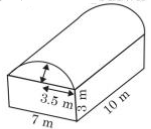
The inner measurements of the cuboidal portion of the building are $10 m \times 7 m \times 3 m$. Then, the volume of the godown is $406 m ^3$.
Statement R (Reason) : Volume of the solid made up by combination of two or more basic solids will be equal to the sum of the volumes of the constituent basic solid. - A
Both assertion (A) and reason ( $R$ ) are true and reason $(R)$ is the correct explanation of assertion $(A)$.
- B
Both assertion (A) and reason ( $R$ ) are true and reason $(R)$ is not the correct explanation of assertion (A).
- C
Assertion $(A)$ is true but reason $(R)$ is false.
- ✓
Assertion (A) is false but reason $(R)$ is true.
AnswerCorrect option: D. Assertion (A) is false but reason $(R)$ is true.
(d) : A godown building consists of cuboid at the bottom and the top of the building is in the form of $\frac{1}{2}$ of the cylinder.
Length of the cuboid, $l=10 m$,
Breadth of the cuboid, $b=7 m$
Height of the cuboid, $h=3 m$
Volume of the cuboid $=l b h=10 \times 7 \times 3=210 m ^3$.
Radius of the cylinder $=3.5 m$
Length of the cylinder $=10 m$
Volume of the half cylinder $=\frac{1}{2} \pi r^2 h$
$
=\frac{1}{2} \times \frac{22}{7} \times(3.5)^2 \times 10=192.5 m ^3
$Volume of the godown $=$ Volume of the cuboid + Volume of the half cylinder $=210+192.5=402.5 m ^3$
$\therefore \quad$ Assertion is false but Reason is true.
View full question & answer→MCQ 201 Mark
Statement A (Assertion) : From a solid cylinder, whose height is $12 cm$ and diameter $10 cm$, a conical cavity of same height and same diameter is hollowed out. Then,volume of the cone is $\frac{2200}{7} cm ^3$.
Statement R (Reason) : If a conical cavity of same height and same diameter is hollowed out from a cylinder of height $h$ and base radius $r$, then volume of the cone will be half of the volume of the cylinder.
- A
Both assertion (A) and reason ( $R$ ) are true and reason $(R)$ is the correct explanation of assertion $(A)$.
- B
Both assertion (A) and reason ( $R$ ) are true and reason $(R)$ is not the correct explanation of assertion (A).
- ✓
Assertion $(A)$ is true but reason $(R)$ is false.
- D
Assertion (A) is false but reason $(R)$ is true.
AnswerCorrect option: C. Assertion $(A)$ is true but reason $(R)$ is false.
(c) : $\because$ Volume of cylinder $=\pi r^2 h$ and volume of conical cavity $=\frac{1}{3} \pi r^2 h$
$\therefore \quad$ Volume of cone $=\frac{1}{3}$ Volume of cylinder
So, Reason is false.
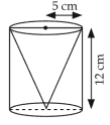
Now, diameter of cone $=10 cm$
$\therefore \quad$ Radius of cone, $r=5 cm$
Also, height of cone, $h=12 cm$
Volume of cone $=\frac{1}{3} \pi r^2 h$
$
=\frac{1}{3} \times \frac{22}{7} \times 5 \times 5 \times 12=\frac{6600}{21}=\frac{2200}{7} cm ^3
$ View full question & answer→MCQ 211 Mark
Statement A (Assertion) : The volume of a hall, which is 5 times as high as it is broad and 8 times as long as it is high, is $12.8 m ^3$. The breadth of the hall is $25 cm$.
Statement R (Reason) : The total surface area of a cuboid of length $(l)$, breadth $(b)$ and height $(h)$ is $2[l b+b h+l h]$.
- A
Both assertion (A) and reason ( $R$ ) are true and reason $(R)$ is the correct explanation of assertion $(A)$.
- B
Both assertion (A) and reason ( $R$ ) are true and reason $(R)$ is not the correct explanation of assertion (A).
- C
Assertion $(A)$ is true but reason $(R)$ is false.
- ✓
Assertion (A) is false but reason $(R)$ is true.
AnswerCorrect option: D. Assertion (A) is false but reason $(R)$ is true.
(d) : Let breadth of a hall be $x$ and height $=5 x$Length $=8 \times 5 x=40 x$
$\therefore \quad$ Volume of hall $=x \times 5 x \times 40 x=200 x^3$
But, volume of hall $=12.8 m ^3$
$\therefore \quad 200 x^3=12.8 m ^3 \Rightarrow x^3=\frac{12.8}{200}=\frac{8}{125}$
$\Rightarrow x=0.4 m =40 cm$
$\therefore$ Assertion is false but Reason is true.
View full question & answer→MCQ 221 Mark
Statement A (Assertion) : If the areas of three adjacent faces of a cuboid are $x, y, z$ respectively, then the volume of the cuboid is $\sqrt{x y z}$.
Statement R (Reason) : Volume of a cuboid whose edges are $l, b$ and $h$ is $l b h$ units.
- ✓
Both assertion (A) and reason ( $R$ ) are true and reason $(R)$ is the correct explanation of assertion $(A)$.
- B
Both assertion (A) and reason ( $R$ ) are true and reason $(R)$ is not the correct explanation of assertion (A).
- C
Assertion $(A)$ is true but reason $(R)$ is false.
- D
Assertion (A) is false but reason $(R)$ is true.
AnswerCorrect option: A. Both assertion (A) and reason ( $R$ ) are true and reason $(R)$ is the correct explanation of assertion $(A)$.
(a): $l b=x, b h=y, l h=z$
$l b \times b h \times l h=x y z \Rightarrow l^2 b^2 h^2=x y z$
$\Rightarrow l b h=\sqrt{x y z}$
$\Rightarrow$ Volume $=\sqrt{x y z}$
$\therefore$ Both Assertion and Reason are true and Reason is the correct explanation of Assertion.
View full question & answer→