MCQ 11 Mark
A solid right circular cone is cut into two parts at the middle of its height by a plane parallel to its base. The ratio of the volume of the smaller cone to the whole cone is :
- A
$1 : 2$
- B
$1 : 4$
- C
$1 : 6$
- ✓
$1 : 8$
AnswerCorrect option: D. $1 : 8$
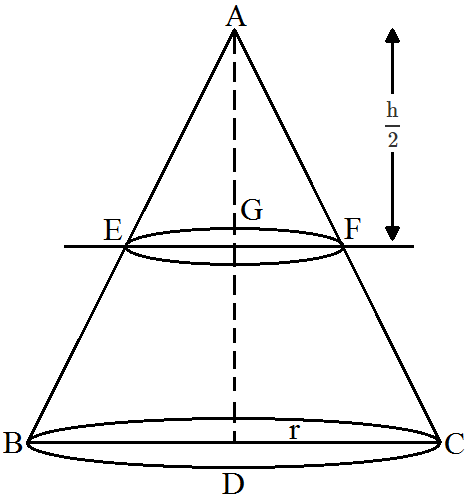
Let the radius of the given cone be $r$ and height be $h.$
$AD = h$ and $DC = r$
$\therefore\ \text{AG}=\frac{\text{h}}{2}$
In $\triangle\text{AGF}$ and $\triangle\text{ADC}$
$\angle\text{AFG}=\angle\text{ACD}$
$\big[\because\ \text{EF}\|\text{BC}\big]$
$\angle\text{AFG}=\angle\text{ADC}=90^\circ$
$\therefore\ \triangle\text{AGF}\sim\triangle\text{ADC}$
$\Rightarrow\frac{\text{AG}}{\text{AD}}=\frac{\text{GF}}{\text{DC}}$
$\Rightarrow\frac{\frac{\text{h}}{2}}{\text{h}}=\frac{\text{GF}}{\text{DC}}$
$\therefore\ \frac{\text{GF}}{\text{DC}}=\frac{1}{2}$
$\therefore\ \frac{\text{GF}}{\text{r}}=\frac{1}{2}$
Or $\text{GF}=\frac{\text{r}}{2}$
$\frac{\text{Volume of smaller cone}}{\text{Volume of whole cone}}=\frac{\frac{1}{3}\pi\big(\frac{\text{r}}{2}\big)\times\big(\frac{\text{h}}{2}\big)}{\frac{1}{3}\pi(\text{r})^2\times\text{h}}$
$=\frac{\frac{\text{r}^2\text{h}}{8}}{\text{r}^2\text{h}}$
$=\frac{1}{8}=1:8$ View full question & answer→MCQ 21 Mark
The radius $($in $\ cm)$ of the largest right circular cone that can be cut out from a cube Of edge $4.2 \ cm$ is
- A
$4.2$
- ✓
$2.1$
- C
$8.4$
- D
$1.05$
AnswerThe diametre of such cone is $4.2 \ cm$ that is equal to the edge of cube.
Thus, the radius is $2.1\ cm.$
View full question & answer→MCQ 31 Mark
The number of solid spheres, each of diameter $6\ cm$ that can be made by melting a solid metal cylinder of height $45 \ cm$ and diameter $4\ cm,$ is :
AnswerDiameter of sphere $d_1=6 \mathrm{~cm}$, Radius $r_1=3 \mathrm{~cm}$
Height of cylinder $\mathrm{H}_2=45$
Radius of cylinder $r_2=2 \mathrm{~cm}$
Let no. of sphere be $'n\ '$
Volume of cylinder $=\mathrm{n}\ \times$ Volume of $1$ sphere
$\pi\text{r}^2\text{H}=\text{n}\times\frac{4}{3}\pi\text{r}^3$
$\pi\times2\times2\times45=\text{n}\times\frac{4}{3}\pi\text{r}^3$
$180=\text{n}\times\frac{4}{3}\times27$
$\frac{180}{36}=\text{n}$
Therefore $,n = 5$ spheres.
View full question & answer→MCQ 41 Mark
If the radius of the base of a right circular cylinder is halved, keeping the height the same, then the ratio of the volume of the cylinder thus obtained to the volume of original cylinder is :
- A
$1 : 2$
- B
$2 : 1$
- ✓
$1 : 4$
- D
$4 : 1$
AnswerCorrect option: C. $1 : 4$
Let the radius of the original cylinder $= r$
And its height $= h$
Now the radius of the reduced cylinder $=\frac{\text{r}}{2}$ and height $= h$
$\therefore\ \frac{\text{Volume of the reduced cylinder}}{\text{Volume of the original cylinder}}=\frac{\pi\big(\frac{\text{r}}{2}\big)^2\times\text{h}}{\pi\text{r}^2\text{h}}=\frac{1}{4}$
Hence, the ratio is $1 : 4.$
View full question & answer→MCQ 51 Mark
A sphere of diameter $18 \ cm$ is dropped into a cylindrical vessel of diameter $36 \ cm,$ partly filled with water. If the sphere is completely submerged, then the water level rises $($in $\ cm)$ by
Answer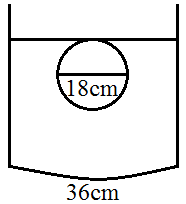
Diameter of sphere $= 16\ cm$
Radius of the sphere $= 9\ cm$
Volume of the sphere $=\frac{4}{3}\pi\text{r}^3$
$=\frac{4}{3}\pi\times9\times9\times9$
$=972\pi\text{ cm}^3$
Diameter of the cylinder $= 36\ cm$
Radius of the cylinder $= 18\ cm$
Volume of the cylinder $=\pi\text{r}^2\text{h}$
$=\pi\times18\times18\times\text{h}$
It is completely submerged so, their volume are equal.
$\therefore\ 972\pi=\pi\times18\times18\times\text{h}$
$\text{h}=\frac{972}{18\times18}$
$\text{h}=3$
$\therefore$ Rise in water $= 3\ cm.$ View full question & answer→MCQ 61 Mark
The radius of a sphere $($in $\ cm)$ whose volume is $12\pi \text{ cm}^3,$ is :
- A
$3$
- B
$3\sqrt{3}$
- ✓
$3^{\frac23}$
- D
$3^{\frac13}$
AnswerCorrect option: C. $3^{\frac23}$
The volume of a sphere $=12\pi\text{ cm}^3$
Let the radius of a sphere $= r$
To find, the radius of a sphere $(r) = ?$
We know that,
The volume of a sphere $=\frac43\pi\text{r}^3$
According to question,
$\therefore\frac43\pi\text{r}^3=12\pi$
$\Rightarrow\text{r}^3=\frac{12\times3}{4}$
$\Rightarrow\text{r}^3=\frac{36}{4}$
$\Rightarrow\text{r}^3=9$
$\Rightarrow\text{r}=(3^2)^{\frac13}$
Using the identity,
$(\text{a}^{\text{m}})^{\text{n}}=\text{a}^{\text{mn}}$
$\Rightarrow\text{r}=3^{\frac23}\text{ cm}$
$\therefore$ The radius of a sphere $\text{(r)}=3^{\frac23}\text{ cm}$
Thus, the radius of a sphere $\text{(r)}=3^{\frac23}\text{ cm}$
View full question & answer→MCQ 71 Mark
If the volume of a cube is $343 \text{ cu.cm},$ then its edge is :
- ✓
$7\ cm$
- B
$8\ cm$
- C
$9\ cm$
- D
$49\ cm$
AnswerCorrect option: A. $7\ cm$
The volume of the cube $=343 \ \mathrm{ cu} . \mathrm{ cm}$
$\Rightarrow a^3=343$
$\Rightarrow a^3=7^3$
$\Rightarrow a=7 \mathrm{~cm}$
View full question & answer→MCQ 81 Mark
The ratio between the radius of the base and the height of a cylinder is $2 : 3$. If its volume is $1617\ cm^3,$ the total surface area of the cylinder is :
- A
$308\ cm^2$
- B
$462\ cm^2$
- C
$540\ cm^2$
- ✓
$770\ cm^2$
AnswerCorrect option: D. $770\ cm^2$
Let the radius of the cylinder be $2x$ and $3x.$
Volume of the cylinder $=\pi\text{r}^2\text{h}$
$\Rightarrow1617=\pi\text{r}^2\text{h}$
$\Rightarrow1617=\pi(2\text{x})^2(3\text{x})$
$\Rightarrow1617=\frac{22}{7}\times(12\text{x}^3)$
$\Rightarrow\frac{343}{8}=\text{x}^3$
$\Rightarrow\text{x}=\frac{7}{2}$
So, radius $=2\Big(\frac{7}{2}\Big)=7\text{ cm}$ and height $=3\Big(\frac{7}{2}\Big)=\frac{21}{2}\text{ cm}$
Hence, the total surface area of the cylinder
$=2\pi\text{rh}+2\pi\text{r}^2$
$=2\pi\text{r}(\text{h}+\text{r})$
$=2\times\frac{22}{7}\times7\Big(\frac{21}{2}+7\Big)$
$=770\text{ cm}^2$
View full question & answer→MCQ 91 Mark
The material of a cone is converted into the shape of a cylinder of equal radius. If height of the cylinder is $5\ cm,$ then height of the cone is :
- A
$10\ cm$
- ✓
$15\ cm$
- C
$18\ cm$
- D
$24\ cm$
AnswerCorrect option: B. $15\ cm$
Let height of cone $= h$
and let $r$ be its radius
$\therefore$ Volume $=\Big(\frac{1}{3}\Big)\pi\text{r}^3\text{h}$
Now radius of cylinder so formed $= r$
and height $= 5\ cm$
$\therefore$ Volume $=\pi\text{r}^2\times5=5\pi\text{r}^2$
$\therefore\frac{1}{3}\pi\text{r}^2\text{h}=5\pi\text{r}^2$
$\Rightarrow\frac{1}{3}\text{h}=5$
$\text{h}=5\times3=15\text{ cm}$
View full question & answer→MCQ 101 Mark
A metallic cylinder of radius $8 \ cm$ and height $2\ cm$ is melted and converted into a right circular cone of height $6\ cm.$ The radius of the base of this cone is :
- A
$4\ cm$
- B
$5\ cm$
- C
$6\ cm$
- ✓
$8\ cm$
AnswerCorrect option: D. $8\ cm$
Volume of the cylinder $=$ Volume of the cone
$\Rightarrow\pi(8)^2(2)=\frac{1}{3}\times\pi(\text{r})^2(6)$
$\Rightarrow\text{r}^2=64$
$\Rightarrow\text{r}=8\text{ cm}$
Hence, the radius of the base of the cone is $8\ cm.$
View full question & answer→MCQ 111 Mark
If two solid $-$ hemispheres of same base radius r are joined together along their bases, then curved surface area of this new solid is :
- ✓
$4\pi\text{r}^2$
- B
$6\pi\text{r}^2$
- C
$3\pi\text{r}^2$
- D
$8\pi\text{r}^2$
AnswerCorrect option: A. $4\pi\text{r}^2$
Because curved surface area of a hemisphere is $2\pi\text{r}^2$ and here, we join two solid hemispheres along their bases of radius $r,$ from which we get a solid sphere.
Hence, the curved surface area of new solid $=2\pi\text{r}^2+2\pi\text{r}^2=4\pi\text{r}^2$.
View full question & answer→MCQ 121 Mark
The diameters of two circular ends of the bucket are $44\ cm$ and $24\ cm.$ The height of the bucket is $35\ cm$. The capacity of the bucket is :
- ✓
$32.7$ litres
- B
$33.7$ litres
- C
$34.7$ litres
- D
$31.7$ litres
AnswerCorrect option: A. $32.7$ litres
Given, diameter of one end of the bucket $, 2R = 44 $
$\Rightarrow R = 22\ cm\ [\therefore$ diameter,$ r = 2 x$ radius$]$ and diameter of the other end,
$2r = 24 $
$\Rightarrow r = 12\ cm\ [\because$ diameter $, r = 2 x$ radius$]$
Height of the bucket $, h = 35\ cm$
Since, the shape of bucket is look like as frustum of a cone.
$\therefore$ Capacity of the bucket $=$ Volume of the frustum of the cone.
$=\frac{1}{3}\pi\text{h} \ [\text{R}^2+\text{r}^2+\text{Rr}]$
$=\frac{1}{3}\times\pi\times35[(22)^2+(12)^2+22\times12]$
$=\frac{35\pi}{3}[484+144+264]$
$=\frac{35\pi\times892}{3}=\frac{35\times22\times892}{3\times7}$
$=32706.6\text{ cm}^3=32.7\ \text{L}$
$[\because1000\text{ cm}^3=1\text{L}]$
View full question & answer→MCQ 131 Mark
The maximum volume of a cone that can be carved out of a solid hemisphere of radius $r$ is :
AnswerCorrect option: B. $\frac{\pi\text{r}^3}{3}$
Radius of cone $= r$ and height $= r$
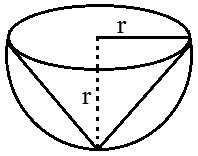
$\therefore\text{volume}=\frac{1}{3}\pi\text{r}^2\text{h}$
$=\frac{1}{3}\pi\text{r}^2\times\text{r}=\frac{1}{3}\pi\text{r}^3$ View full question & answer→MCQ 141 Mark
Choose the correct answer from the given four options : A medicine-capsule is in the shape of a cylinder of diameter $0.5\ cm$ with two hemispheres stuck to each of its ends. The length of entire capsule is $2\ cm$. The capacity of the capsule is :
- ✓
$0.36\ cm^3$
- B
$0.35\ cm^3$
- C
$0.34\ cm^3$
- D
$0.33\ cm^3$
AnswerCorrect option: A. $0.36\ cm^3$
Given, diameter of cylinder $=$ Diameter of hemisphere $= 0.5\ cm$
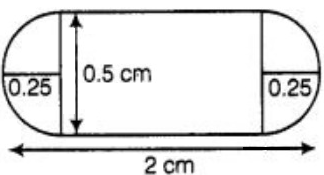
$[$since, both hemispheres are attach with cylinder$]$
$\therefore$ Radius of cylinder $(r) =$ radius of hemisphere $(\text{r})=\frac{0.5}{2}=0.25\text{ cm}$
$[\because\text{diameter}=2\times\text{radius}]$
and total length of capsule $= 2\ cm$
$\therefore$ Length of cylindrical part of capsule,
$h =$ Length of capsule $-$ Radius of both hemispheres
$= 2 - (0.25 + 0.25) = 1.5\ cm$
Now, capacity of capsule $=$ Volume of cylindrical part $+ \ 2 \ \times$ Volume of hemisphere
$=\pi\text{r}^2\text{h}+2\times\frac{2}{3}\pi\text{r}^3$
$\big[\because$ volume of cylinder $=\pi\times(\text{radius})^2 \times$ height and volume of hemispere $=\frac{2}{3}\pi(\text{radiud})^3\big]$
$=\frac{22}{7}\big[(0.25)^2\times1.5+\frac{4}{3}\times(0.25)^3\big]$
$=\frac{22}{7}[0.09375+0.0208]$
$=\frac{22}{7}\times0.11455=0.36\text{ cm}^3$
Hence, the capacity of capsule is $0.36\ cm^3$. View full question & answer→MCQ 151 Mark
A mason constructs a wall of dimensions $(270\ cm \times 300\ cm \times 350\ cm)$ with bricks, each of size $(22.5\ cm \times 11.25\ cm \times 8.75\ cm)$ and it is assumed that $1818$ space is covered by the mortar. Number of bricks used to construct the wall is :
- A
$11000$
- B
$11100$
- ✓
$11200$
- D
$11300$
AnswerCorrect option: C. $11200$
Dimensions of the wall are $= 270\ cm \times 300\ cm \times 350\ cm.$
So, the volume of the wall $= 270\ cm \times 300\ cm \times 350\ cm.$
$\frac{1}{8}\text{th}$ of the wall is covered eith mortar.
Volume of the wall filled bricks
$=\Big(\frac{7}{8}\times270\times300\times350\Big)\text{cm}^3$
Volume of each brick $= (22.5 \times 11.25 \times 8.75) \mathrm{cm}^3$
Number of bricks used to construct the wall
$=\frac{\text{Volume of the wall filled with bricks}}{\text{Volume of each brick bricks}}$
$=\frac{\frac{7}{8}\times270\times300\times350}{22.5\times11.25\times8.75}$
$=\frac{\frac{7}{8}\times270\times300\times350\times100000}{225\times1125\times875}$
$=11200$
View full question & answer→MCQ 161 Mark
The shape of a glass $($tumbler$)$ is usually in the form of :
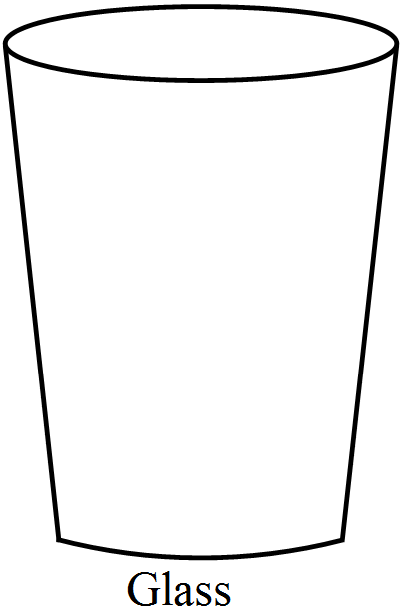
AnswerThe shape of a glass $($tumbler$)$ is usually in the from of a frustum of a cone.
View full question & answer→MCQ 171 Mark
How many bricks, each measuring $(25\ cm \times 11.25\ cm \times 6\ cm),$ will be required to construct a wall $(8m \times 6m \times 22.5\ cm)?$
- A
$8000$
- ✓
$6400$
- C
$4800$
- D
$7200$
AnswerCorrect option: B. $6400$
Number of bricks $=\frac{\text{Volume of the wall}}{\text{Volume of each brick}}$
$=\frac{(800\times600\times22.5)}{(25\times11.25\times6)}$
$=6400$
View full question & answer→MCQ 181 Mark
A right circular cylinder of radius $r$ and height $h (h = 2r)$ just encloses a sphere of diameter :
- A
$3r$ units
- B
$r$ units
- ✓
$2r$ units
- D
$4r$ units
AnswerCorrect option: C. $2r$ units
Radius of right cylinder $= r$
Height $= h$ or $2r \ (\because h = 2r)$
Diameter of sphere encloses by the cylinder $= 2r$
View full question & answer→MCQ 191 Mark
The cost of painting a cubical box of side $3m$ at the rate of $Rs. 2 \text{ per sq. m}$ is :
- A
$Rs. 120$
- B
$Rs. 125$
- C
$Rs. 112$
- ✓
$Rs. 108$
AnswerCorrect option: D. $Rs. 108$
Given : Side of the cube $(a)=3 \mathrm{~m}$
$\therefore$ Surface Area of Cube $=6 \mathrm{a}^2=6 \times 3 \times 3=54\ \mathrm{sq} . \mathrm{cm}$
Now, Cost of painting the cubical box of $1\ \mathrm{sq} . \mathrm{m}= Rs. 2$
$\therefore$ Cost of painting the cubical box of $54 \text{ sq}. \mathrm{m}=54 \times 2= Rs. 108$
View full question & answer→MCQ 201 Mark
Choose the correct answer from the given four options : A mason constructs a wall of dimensions $270\ cm \times 300\ cm \times 350\ cm$ with the bricks each of size $22.5\ cm \times 11.25\ cm \times 8.75\ cm$ and it is assumed that $\frac{1}{8}$ space is covered by the mortar. Then the number of bricks used to construct the wall is :
- A
$11100$
- ✓
$11200$
- C
$11000$
- D
$11300$
AnswerCorrect option: B. $11200$
Volume of the wall $= 270 \times 300 \times 350=28350000 \mathrm{~cm}^3$
$[\because$ volume of chboid $=$ lenth $\times$ breadth $\times $ height$]$
Since, $\frac{1}{8}$ space of wall is covered by mortar.
So, remainig space of wall $=$ Volume of wall $-$ Volume of mortar
$=28350000-28350000\times\frac{1}{8}$
$=28350000-3543750=24806250\text{ cm}^3$
Now, volume of one birck $= 22.5 \times 1125 \times 875 = 2214.844\ cm3$
$[\because$ volume of chboid $=$ lenth $\times $ breadth $\times $ height$]$
$\therefore$ Required number of bricks $=\frac{24806250}{2214.844}=11200\ (\text{approx})$
Hence, the number of used to construct the wall is $11200.$
View full question & answer→MCQ 211 Mark
A reservoir is in the shape of a frustum of a right circular cone. It is $8\ m$ across at the top and 4m across at the bottom. If it is $6\ m$ deep, then its capacity is :
- ✓
$176m^3$
- B
$196m^3$
- C
$200m^3$
- D
$110m^3$
AnswerCorrect option: A. $176m^3$
A reservoir is a frustum in shape which Upper diameter $= 8m$
and lower diameter $= 4m$
Upper radius $\Big(\frac{8}{2}\Big)=4\text{m}$
and lower radius $\Big(\frac{4}{2}\Big)=2\text{m}$
Height $(h) = 6m$
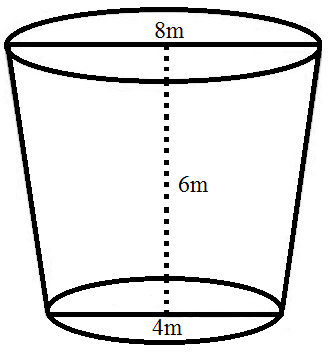
$\therefore$ Volume $=\frac{\pi}{3}[\text{r}_1^2+\text{r}_1\text{r}_2+\text{r}_2^2]\times\text{h}$
$=\frac{\pi}{3}[(4)^2+4\times2+(2)^2]\times6\text{m}^3$
$=\frac{22}{7\times3}[16+8+4]\times6\text{m}^3$
$=\frac{22}{21}(28\times6)\text{m}^3=176\text{m}^3$ View full question & answer→MCQ 221 Mark
Choose the correct answer from the given four options : The shape of a gilli, in the gilli $-$ danda game see Fig. is a combination of :

- A
- B
- ✓
Two cones and a cylinder.
- D
Two cylinders and a cone.
AnswerCorrect option: C. Two cones and a cylinder.
Two cones and a cylinder.

View full question & answer→MCQ 231 Mark
The volumes of two spheres are in the ratio $64 : 27. $ The ratio of their surface areas is :
- A
$9 : 16$
- ✓
$16 : 9$
- C
$3 : 4$
- D
$4 : 3$
AnswerCorrect option: B. $16 : 9$
Let the radii of the speres be $r$ and $R$.
The volume of the spheres are in ratio $64 : 27.$
$\Rightarrow\frac{\frac{4}{3}\pi\text{r}^3}{\frac{4}{3}\pi\text{R}^3}=\frac{64}{27}$
$\Rightarrow\frac{\text{r}^3}{\text{R}^3}=\frac{64}{27}$
$\Rightarrow\frac{\text{r}^3}{\text{R}^3}=\frac{64}{27}$
$\Rightarrow\frac{\text{r}}{\text{R}}=\frac{4}{3}$
Ratio of the sirface area of the spheres
$=\frac{4\pi\text{r}^2}{4\pi\text{R}^2}$
$=\Big(\frac{\text{r}}{\text{R}}\Big)$
$=\Big(\frac{4}{3}\Big)^2$
$=\frac{16}{9}$
Hence, the ratio is $16 : 9$
View full question & answer→MCQ 241 Mark
A cylindrical vessel $32\ cm$ high and $18\ cm$ as the radius of the base, is filled with sand. This bucket is emptied on the ground and a conical heap of sand is formed. If the height of the conical heap is $24\ cm,$ the radius of its base is :
- A
$12\ cm$
- B
$24\ cm$
- ✓
$36\ cm$
- D
$48\ cm$
AnswerCorrect option: C. $36\ cm$
Radius of a cylindrical vessel $\left(r_1\right)=18 \mathrm{~cm}$ and height $\left(h_1\right)=32 \mathrm{~cm}$
$\therefore \text { Volume of sand filled in it }=\pi \mathrm{r}_1^2 \mathrm{~h}_1$
$=\pi(18)^2 \times 32=\pi \times 324 \times 32 \mathrm{~cm}^3$
$=10368 \pi \mathrm{cm}^3$
Now height of the conical heap $\left(\mathrm{h}_2\right)=24 \mathrm{~cm}$
Let $\mathrm{r}_2$ be its redius, then
$\frac{1}{3} \pi \mathrm{r}_2^2 \mathrm{~h}_2=10368 \pi$
$\Rightarrow \frac{1}{3} \pi \mathrm{r}_2^2 \times 24=10368 \pi$
$\Rightarrow 8 \pi \mathrm{r}_2^2=10368 \pi$
$\mathrm{r}_2^2=\frac{10368 \pi}{8 \pi}=1296$
$\therefore \mathrm{r}_2=\sqrt{1296}=36$
Hence radius of the base of the heap $=36 \mathrm{~cm}$
View full question & answer→MCQ 251 Mark
A solid metallic spherical ball of diameter $6\ cm$ is melted and recast into a cone with diameter of the base as $12\ cm$. The height of the cone is :
- A
$2\ cm$
- ✓
$3\ cm$
- C
$4\ cm$
- D
$6\ cm$
AnswerCorrect option: B. $3\ cm$
Clearly,
The volume of recasted cone $ =$ volume of sphere
$\frac{1}{3}\pi\Big(\frac{12}{2}\Big)^2\times\text{h}=\frac{4}{3}\pi\Big(\frac{6}{2}\Big)^3$
$\frac{1}{3}\times36\times\text{h}=\frac{4}{3}\times27$
$\text{h}=\frac{4\times27\times3}{36}$
$\text{h}=3\text{ cm}$
View full question & answer→MCQ 261 Mark
Assertion and Reason Type Each question consists of two statements, namely, Assertion $(A)$ and Reason $(R).$ For selecting the correct answer, use the following code:
| Assertion $(A)$ |
Reason $(R)$ |
| The curved surface area of a cone of base radius $3\ cm$ and height $4\ cm$ is $ \ (15\pi\text{ cm}^2$ |
Volume of a cone $ (\pi\text{r}^2\text{h}$ |
- A
Both Assertion $(A)$ and Reason $(R)$ are true and Reason $(R)$ is a correct explanation of Assertion $(A)$.
- B
Both Assertion $(A)$ and Reason $(R)$ are true but Reason $(R)$ is not a correct explanation of Assertion $(A).$
- ✓
Assertion $(A)$ is true and Reason $(R)$ is false.
- D
Assertion $(A)$ is false and Reason $(R)$ is true.
AnswerCorrect option: C. Assertion $(A)$ is true and Reason $(R)$ is false.
$\text{l}\sqrt{\text{r}^2+\text{h}^2}$
$\Rightarrow\text{l}=\sqrt{3^2+4^2}$
$\Rightarrow\text{l}=\sqrt{9+16}$
$\Rightarrow\text{l}=\sqrt{25}$
$\Rightarrow\text{l}=5\text{cm}$
Curved surface area of a cone
$=\pi\text{rl}$
$=\pi(3)(5)$
$=15\pi\text{ cm}^2$
So, the Assertion $(A)$ is true.
Volume of a cone $=\frac{1}{3}\pi\text{r}^2\text{h}$
So, the reason $(R)$ is false.
View full question & answer→MCQ 271 Mark
A circus tent is cylindrical to a height of $4m$ and conical above it. If its diameter is $105m$ and its slant height is $40m,$ the total area of canvas required is :
- A
$1760 \mathrm{~m}^2$
- B
$2640 \mathrm{~m}^2$
- C
$3960 \mathrm{~m}^2$
- ✓
$7920 \mathrm{~m}^2$
AnswerCorrect option: D. $7920 \mathrm{~m}^2$
Total area of the canvas required
$=$ Curved surface area of the cylinder $+$ Curved surface area of the cone
$=2\pi\text{rh}+\pi\text{rl}$
$=\Big(2\times\frac{22}{7}\times\frac{105}{2}\times4\Big)+\Big(\frac{22}{7}\times\frac{105}{2}\times40\Big)$
$=(1320)+(6600)$
$=7920\text{m}^2$
View full question & answer→MCQ 281 Mark
A solid piece of iron of dimensions $49 \times 33 \times 24\ cm$ is moulded into a sphere. The radius of the sphere is :
- ✓
$21\ cm$
- B
$28\ cm$
- C
$35\ cm$
- D
AnswerCorrect option: A. $21\ cm$
The volume of iron piece $= 49 \times 33 \times 24 \mathrm{~cm}^3$
Let $,r$ is the radius sphere.
Clearly,
The volume of sphere $=$ volume of iron piece
$\frac{4}{3}\pi\text{r}^3=49\times33\times24$
$\frac{4}{3}\times\frac{22}{7}\times\text{r}^3=49\times33\times24$
$\text{r}^3=\frac{49\times33\times24\times3\times7}{4\times22}$
$\text{r}^3=49\times3\times3\times3\times7$
$\text{r}=7\times3$
$\text{r}=21\text{ cm}$
View full question & answer→MCQ 291 Mark
A solid piece of iron in the fo of a cuboid of dimensions $(49\ cm \times 33\ cm \times 24\ cm)$ is moulded to orm a solid sphere. The $r$ dius of the sphere is :
- A
$19\ cm$
- ✓
$21\ cm$
- C
$23\ cm$
- D
$25\ cm$
AnswerCorrect option: B. $21\ cm$
Since the cuboid is moulded to from a solid sphere, the volume of sphere $=$ volume of the cuboid
$\Rightarrow\frac{4}{3}\pi\text{r}^3=49\times33\times24$
$\Rightarrow\frac{4}{3}\times\frac{22}{7}\times\text{r}^3=49\times33\times24$
$\Rightarrow\text{r}^3=\frac{49\times33\times24\times3\times7}{22\times4}$
$\Rightarrow\text{r}^3=7\times7\times7\times3\times3\times3$
$\Rightarrow\text{r}=7\times3$
$\Rightarrow\text{r}=21\text{ cm}$
View full question & answer→Question 301 Mark
Match the following columns:
|
|
Column $I$
|
|
Column $II$
|
| $a.$ |
A solid metallic sphere of radius $8\ cm$ is melted and the material is used to make solid right cones with height $4\ cm$ and base radius of $8\ cm$. How many cones are formed? |
$q.$ |
$8$ |
| $b.$ |
A $20 - m -$ deep well with diameter $14m$ is dug up and the earth from digging is evenly spread out to form a platform $44m$ by $14m$. The height of the platform is $........ m.$
|
$s.$ |
$5$ |
| $c.$ |
A sphere of radius $6 \ cm$ is melted and recast in the shape of a cylinder of radius $4\ cm$. Then, the height of the cylinder is $......... \ cm.$
|
$p.$ |
$18$ |
| $d.$ |
The volumes of two spheres are in the ratio $64 : 27$. The ratio of their surface areas is $....... .$
|
$r.$ |
$16 : 9$ |
Answer
|
|
Column $I$
|
|
Column $II$
|
| $a.$ |
A solid metallic sphere of radius $8\ cm$ is melted and the material is used to make solid right cones with height $4\ cm$ and base radius of $8\ cm$. How many cones are formed? |
$q.$ |
$8$ |
| $b.$ |
A $20 - m -$ deep well with diameter $14m$ is dug up and the earth from digging is evenly spread out to form a platform $44m$ by $14m$. The height of the platform is $........ m.$
|
$s.$ |
$5$ |
| $c.$ |
A sphere of radius $6 \ cm$ is melted and recast in the shape of a cylinder of radius $4\ cm$. Then, the height of the cylinder is $......... \ cm.$
|
$p.$ |
$18$ |
| $d.$ |
The volumes of two spheres are in the ratio $64 : 27$. The ratio of their surface areas is $....... .$
|
$r.$ |
$16 : 9$ |
$(a)$ Number of cones formed $=\frac{\text{Volume of the sphere}}{\text{Volume of each cone}}$
$=\frac{\frac{4}{3}\pi\text{r}^3}{\frac{1}{3}\pi\text{r}^2\text{h}}$
$=\frac{4\text{r}}{\text{h}}$
$=\frac{4\times8}{4}$
$=8$
$(b)$ Volume of the earth dug out $=$ Volume of the cylinder
$=\pi\text{r}^2\text{h}$
$=\frac{22}{7}\times7^2\times20$
Let the height of the platfrom be $h.$
Volume of the platfrom $=$ volume of the cuboid
$=44\times14\times\text{h}$
$\Rightarrow\frac{22}{7}\times7^2\times20=44\times14\times\text{h}$
$\Rightarrow3080=616\times\text{h}$
$\Rightarrow\text{h}=\frac{3080}{616}$
$\Rightarrow\text{h}=5\text{m}$
$(c)$ Volume of the sphere $=\frac{4}{3}\pi\text{r}^3=\frac{4}{3}\pi(6)^3$
Let $ h$ be the height of the cylinder.
Volume of the cylinder $=\pi\text{r}^2\text{h}$
$=\pi(4)^2\text{h}$
$\Rightarrow\frac{4}{3}\pi(6)^3=\pi(4)^2\text{h}$
$\Rightarrow\frac{1}{3}(6)^3=(4)^2\text{h}$
$\Rightarrow\text{h}=\frac{228}{16}=18\text{cm}$
$(d)$ Let the radii of the sphere be $R$ and $r.$
Radio of their volume $=\frac{\frac{4}{3}\pi\text{R}^3}{\frac{4}{3}\pi\text{r}^3}$
$\Rightarrow\frac{\frac{4}{3}\pi\text{R}^3}{\frac{4}{3}\pi\text{r}^3}=\frac{64}{27}$
$\Rightarrow\Big(\frac{\text{R}}{\text{r}}\Big)^3=\Big(\frac{4}{3}\Big)^3$
Ratio of there surface areas $=\frac{4\pi\text{R}^2}{4\pi\text{r}^2}$
$=\Big(\frac{\text{R}}{\text{r}}\Big)^2$
$=\Big(\frac{4}{3}\Big)^2$
$=\frac{16}{9}$ View full question & answer→MCQ 311 Mark
A right circular cylinder of radius $r$ and height $h \ (h = 2r)$ just encloses a sphere of diameter :
AnswerRadius of right cylinder $= r$
Height $= h$ or $2r\ (\because h = 2r)$
Diameter of sphere encloses by the cylinder $= 2r$
View full question & answer→MCQ 321 Mark
If the areas of three adjacent faces of a cuboid are $x, y$ and $z,$ respectively, the volume of the cuboid is :
- A
$\text{xyz}$
- B
$2\text{xyz}$
- ✓
$\sqrt{\text{xyz}}$
- D
$\sqrt[3]{\text{xyz}}$
AnswerCorrect option: C. $\sqrt{\text{xyz}}$
Given that the areas of the three adjacent faces of a cub oid are $x, y$, and $z$.
This means,
$\mathrm{lb}=\mathrm{x}, \mathrm{bh}=y, \mathrm{Ih}=z$
$\therefore \mathrm{lb} \times \mathrm{bh} \times \mathrm{lh}=\mathrm{xyz}$
$\therefore \mathrm{l}^2 b^2 h^2=x y z$
$\therefore(\mathrm{lbh})^2=x y z$
$\therefore\left(\right.$ Volume of the cuboid) ${ }^2=x y z$
$\therefore$ Volume of the cuboid $=\sqrt{x y z}$
View full question & answer→MCQ 331 Mark
The total surface area of a hemisphere of radius $7\ cm$ is :
- A
$(588\pi)\text{ cm}^2$
- B
$(392\pi)\text{ cm}^2$
- ✓
$(147\pi)\text{ cm}^2$
- D
$(98\pi)\text{ cm}^2$
AnswerCorrect option: C. $(147\pi)\text{ cm}^2$
The total surface area of a hemisphere
$=3\pi\text{r}^2$
$=3\times\pi\times7^2$
$=147\pi\text{ cm}^2$
View full question & answer→MCQ 341 Mark
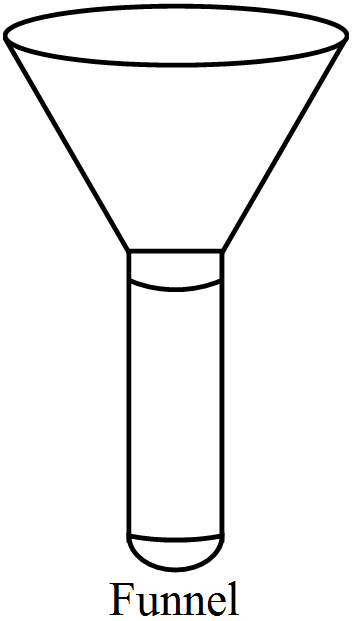
A funnel is the combination of :
- A
- B
A cylinder and a hemisphere.
- ✓
A cylinder and frustum of a cone.
- D
AnswerCorrect option: C. A cylinder and frustum of a cone.
A funnel is the combination of a cylinder and frustum of a cone. the lower portion is cylindrical the upper poetion is a frustum of a cone.
View full question & answer→MCQ 351 Mark
The number of solid spheres, each of diameter $6\ cm$ that could be moulded to form a solid metal cylinder of height $45\ cm$ and diameter $4\ cm,$ is :
AnswerDiameter of each sphere $= 6\ cm$
$\therefore$ Radius $\left(r_1\right)$
$=\frac{6}{2}=3\text{ cm}$
Volume $=\frac{4}{3}\pi\text{r}_1^3=\frac{4}{3}\pi\times(3)^3\text{ cm}^3$
$=36\pi\text{ cm}^3$
Diameter of cylinder $= 4\ cm$
$\therefore$ Radius $\left(r_2\right)$
$=\frac{4}{2}=2\text{ cm}$
and height $(h) = 45\ cm$
$\therefore$ Volume $=\pi\text{r}^2\text{h}=\pi\times(2)^2\times45\text{ cm}^3$
$=\pi\times4\times45=180\pi\text{ cm}^3$
$\therefore$ Number of sphere required $=\frac{180\pi}{36\pi}=5$
View full question & answer→MCQ 361 Mark
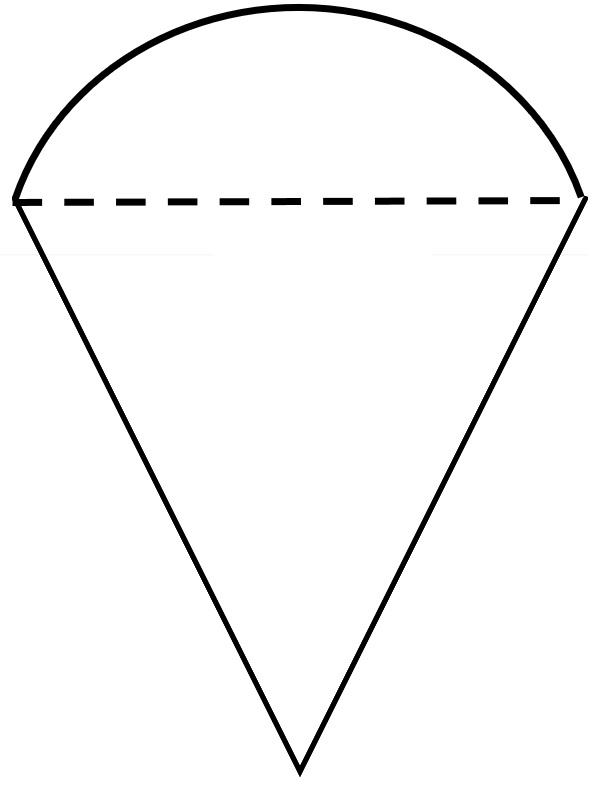
A plumbline $($sahul$)$ is the combination of :
- A
A hemisphere and a cylinder
- ✓
- C
- D
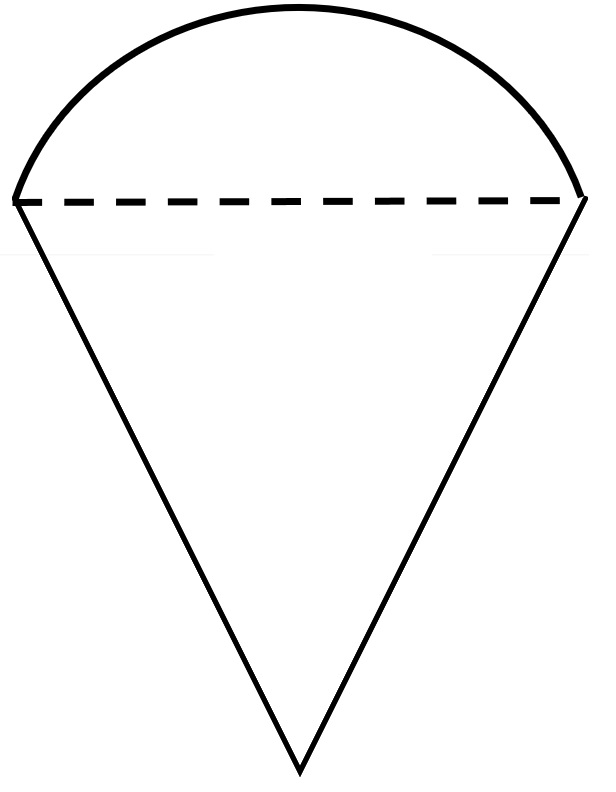
AnswerA plumb line is a combination of a hemisphere and a cone
View full question & answer→MCQ 371 Mark
The radii of the base of a cylinder and a cone are in the ratio $3 : 4$. If their heights are in the ratio $2 : 3,$ the ratio between their volumes is :
- ✓
$9 : 8$
- B
$3 : 4$
- C
$8 : 9$
- D
$4 : 3$
AnswerCorrect option: A. $9 : 8$
Let the radiiof the base of the cylinder and the cone be $3r$ and $4r$ and their heights be $2h$ and $3h$ respectively.
Ratio of their volume $=\frac{\pi(3\text{r})^2(2\text{h})}{\frac{1}{3}\pi(4\text{r})^3(3\text{h})}$
$=\frac{\pi\times9\text{r}^2\times2\text{h}\times3}{\pi\times16\text{r}^2\times3\text{h}}$
$=\frac{9}{8}$
Hence, the ratio is $9 : 8$
View full question & answer→MCQ 381 Mark
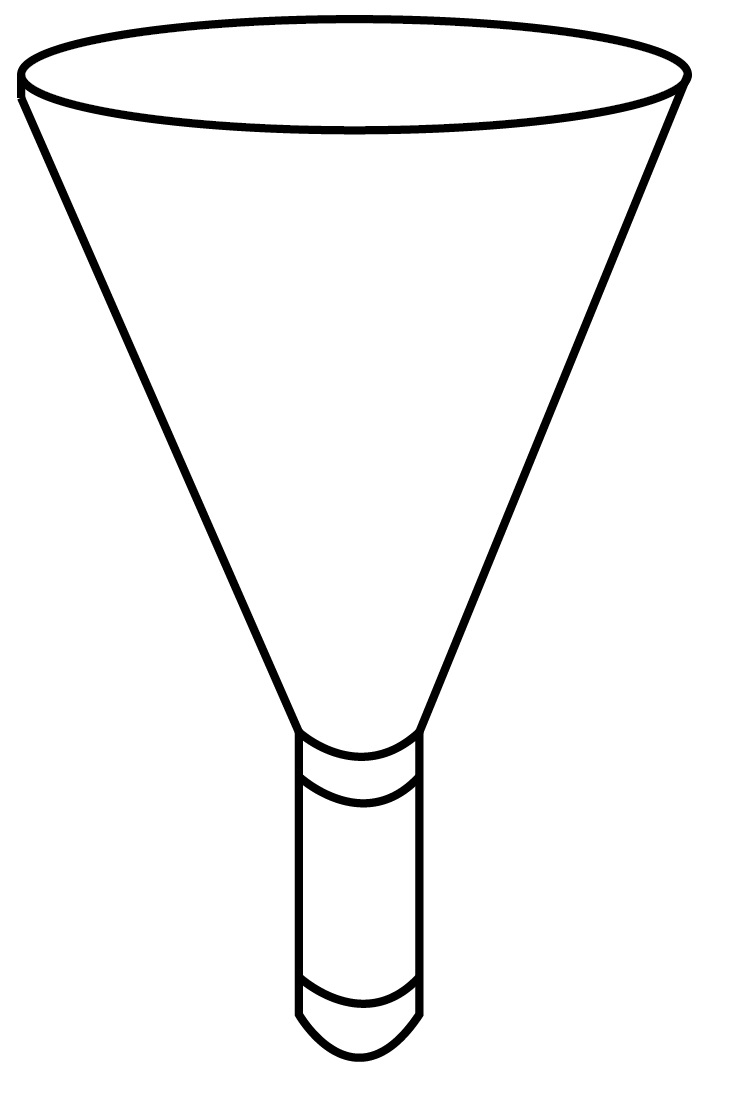
A funnel is the combination of :
- A
- B
- ✓
A frustum of a cone and a cylinder
- D
A hemisphere and a cylinder
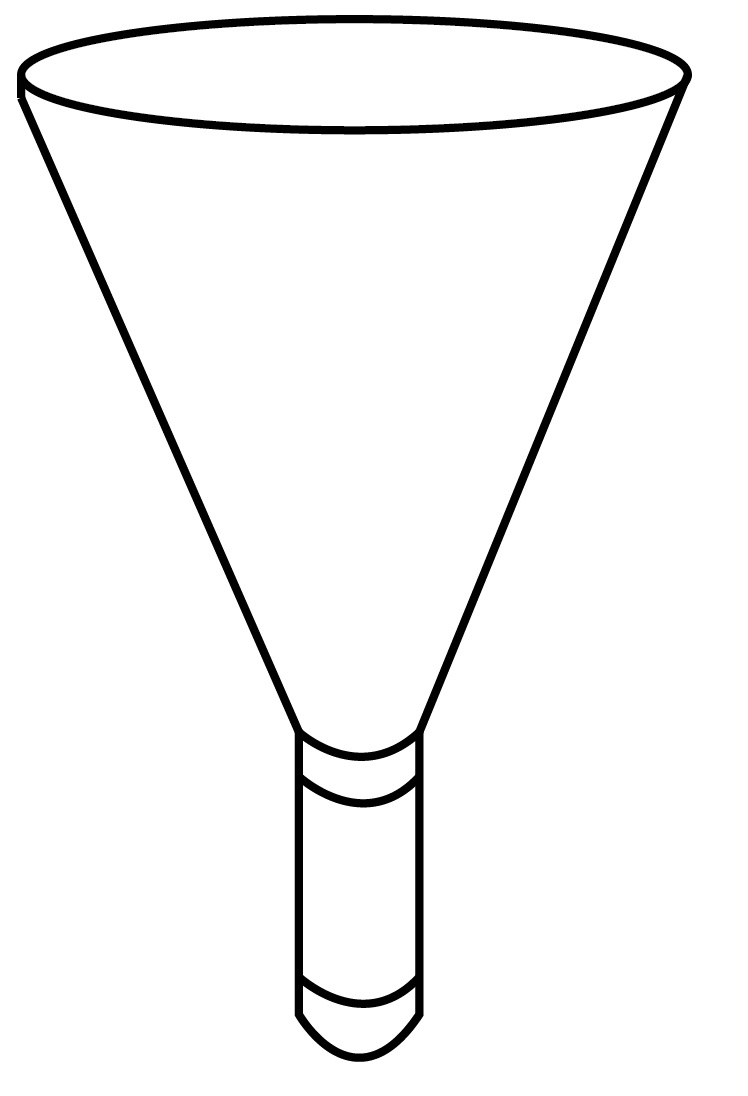
AnswerCorrect option: C. A frustum of a cone and a cylinder
A frustum of a cone and a cylinder
View full question & answer→MCQ 391 Mark
A metallic solid sphere of radius $9\ cm$ is melted to form a solid linder of radius $9\ cm$. The height of the cylin er is :
- ✓
$12\ cm$
- B
$18\ cm$
- C
$36\ cm$
- D
$96\ cm$
AnswerCorrect option: A. $12\ cm$
The metallic solid sphere is melted to from a solid cylinder.
Let the height of the cylinder be $h$.
So, volume of the sphere $=$ volume of the cylinder
$\Rightarrow\frac{4}{3}\pi\text{r}_1^3=\pi\text{r}^2\text{h}$
$\Rightarrow\frac{4}{3}\text{r}_1=\text{h}$
$\Rightarrow\text{h}=\frac{4}{3}\times9=12\text{ cm}$
View full question & answer→MCQ 401 Mark
A solid frustum is of height $8\ cm$. If the radii of its lower and upper ends are $3\ cm$ and $9\ cm$ respectively, then its slant height is
- A
$15\ cm$
- B
$12\ cm$
- ✓
$10\ cm$
- D
$17\ cm$
AnswerCorrect option: C. $10\ cm$
In the frustum,
Upper radius $\left(r_1\right)=9 \mathrm{~cm}$
and lower radius $\left(\mathrm{r}_2\right)=3 \mathrm{~cm}$
and height $(\mathrm{h})=8 \mathrm{~cm}$
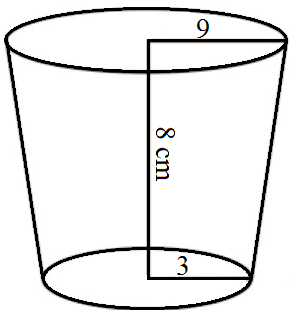
$\therefore$ Slant height $(l) =\sqrt{\text{h}^2+(\text{r}_1-\text{r}_2)^2}$
$=\sqrt{(8)^2+(9-3)^2}=\sqrt{64+36}$
$=\sqrt{100}=10\text{ cm}$ View full question & answer→MCQ 411 Mark
Choose the correct answer from the given four options : A surahi is the combination of :
- ✓
- B
A hemisphere and a cylinder.
- C
- D
AnswerBecause the shape of surahi is,
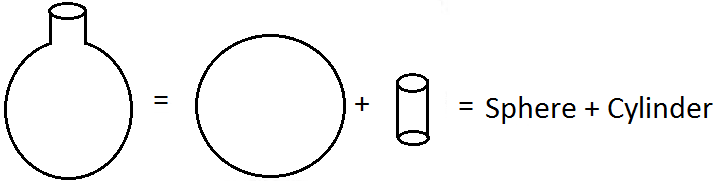
View full question & answer→MCQ 421 Mark
Volumes of two spheres are in the ratio $64 : 27$. The ratio of their surface areas is :
- A
$3 : 4$
- B
$4 : 3$
- C
$9 : 16$
- ✓
$16 : 9$
AnswerCorrect option: D. $16 : 9$
Let the radii of the two sphere are $r_1$ and $r_2$ respectively
$\therefore$ Volume of the sphere of radius, $r_1=v_1$
$=\frac{4}{3} \pi r_1^3 \cdots(1)$
${\left[\because \text { Volume of sphere }=\frac{4}{3} \pi(\text { radius })^3\right]}$
and volume of the sohere of radius,
$\mathbf{r}_2=\mathbf{v}_2=\frac{4}{3} \pi \mathrm{r}_2^3...(2)$
Given, ratio of volume $=V_1: V_2$
$=64: 27$
$ \Rightarrow \frac{\frac{4}{3} \pi r_1^3}{\frac{4}{3} \pi \tau_2^3}=\frac{64}{27}$
$[$using eqs. $(1)$ and $(2)]$
$\Rightarrow \frac{r_1^3}{r_2^3}=\frac{64}{27} $
$\Rightarrow \frac{r_1}{r_2}=\frac{4}{3} \cdots$
Now, ratio of surface area $=\frac{4 \pi r_1^2}{4 \pi r_2^2}$
$\left[\because\right.$ surface area of a sphere $\left.=4 \pi(\text { radius })^2\right]$
$=\frac{r_1^2}{r_2^2}$
$=\left(\frac{r^1}{r^2}\right)^2=\left(\frac{4}{3}\right)^2 \text { [using eq. (3)] }$
$=16: 9$
Hence, the required ratio of their surface area is $16: 9$.
View full question & answer→MCQ 431 Mark
Choose the correct answer from the given four options : The radii of the top and bottom of a bucket of slant height $45\ cm$ are $28\ cm$ and $7\ cm,$ respectively. The curved surface area of the bucket is :
- ✓
$4950 \mathrm{~cm}^2$
- B
$4951 \mathrm{~cm}^2$
- C
$4952 \mathrm{~cm}^2$
- D
$4953 \mathrm{~cm}^2$
AnswerCorrect option: A. $4950 \mathrm{~cm}^2$
Given, the radius of the of the bucket $, R = 28\ cm$
and the radius of the bottom of the bucket $, r = 7\ cm$
Slant height of the bucket $, l = 45\ cm$
Since, bucket is in the from of frustum of a cone.
$\therefore$ Curved surface area of the bucket $=\pi\text{l}(\text{R}+\text{r})=\pi\times45(28+7)$
$\big[\because$ curved surface area of frustum of a cone $=\pi(\text{R}+\text{r})\text{l}\big]$
$=\pi\times45\times35$
$=\frac{22}{7}\times45\times35=4950\text{ cm}^2$
View full question & answer→MCQ 441 Mark
A cubical ice $-$ cream brick of edge $22\ cm$ is to be distributed among some children by filling ice $-$ cream cones of radius $2\ cm$ and height $7\ cm$ up to the brim. How many children will get the ice $-$ cream cones?
AnswerGiven that the cubical ice cream brick $= 22^3$
Volume of each ice $-$ cream cone $=\frac{1}{3}\pi\text{r}^2\text{h}$
$=\frac{1}{3}\times\frac{22}{7}\times(2)^2\times7$
So, the number of ice $-$ cream cones
$=\frac{\text{Volume of the cubical ice $-$ cream brick}}{\text{Volume of each ice $-$ cream cone}}$
$=\frac{22\times22\times22}{\frac{1}{3}\times\frac{22}{7}\times(2)^2\times7}$
$=\frac{22\times22\times22\times7\times3}{22\times4\times7}$
$=363$
Hence, the number of ice $-$ cream cones is $363.$
View full question & answer→MCQ 451 Mark
During the conversion of a solid from one shape to another, the volume of the new shape will :
AnswerDuring conversion of a solid from one shape to another, the volume of the new shape will remain unaltered.
View full question & answer→MCQ 461 Mark
A rectangular sheet of paper $40\ cm \times 22\ cm,$ is rolled to form a hollow cylinder of height $40\ cm.$ The radius of the cylinder $($in $\ cm)$ is :
- ✓
$3.5$
- B
$7$
- C
$\frac{80}{7}$
- D
$5$
AnswerLength of rectangular sheet $(l) = 40\ cm$
and width $(b) = 22\ cm$
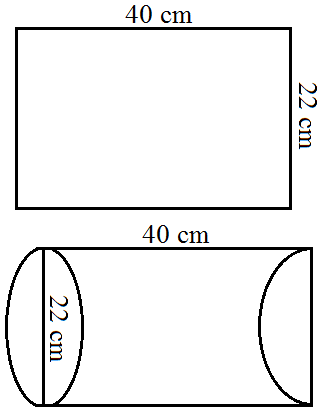
By rolling it is cylinder is formed
$\therefore$ circumference of cylinder $= b = 22\ cm$
Let $r$ be the radius
$\therefore22=2\times\frac{22}{7}\text{r}$
$\Rightarrow\text{r}=\frac{22\times7}{2\times22}=\frac{7}{2}$
$\therefore\text{Radius}=\frac{7}{2}=3.5\text{ cm}$ View full question & answer→MCQ 471 Mark
The perpendicular distance between the two parallel circular bases is called the $............$ of the frustum of the cone.
AnswerThe perpendicular distance between the two parallel circular bases is called the height of the frustum of the cone.
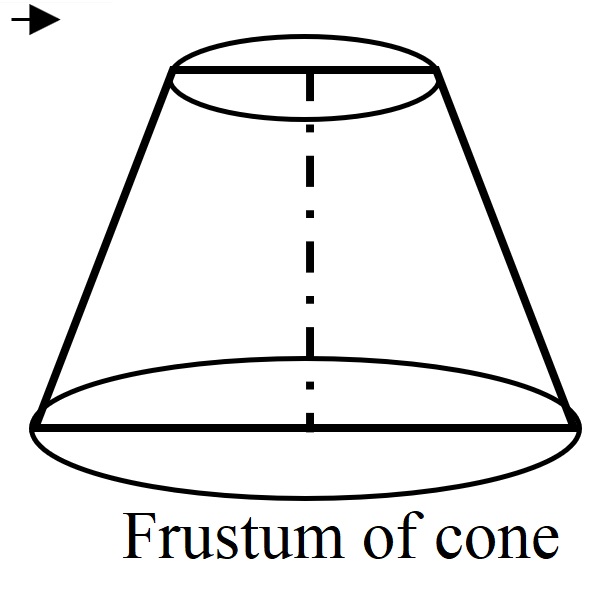
View full question & answer→MCQ 481 Mark
A shuttlecock has the shape of :
- A
- B
A hemisphere and a cylinder
- C
A frustum of a cone and a cylinder
- ✓
A frustum of a cone and a hemisphere
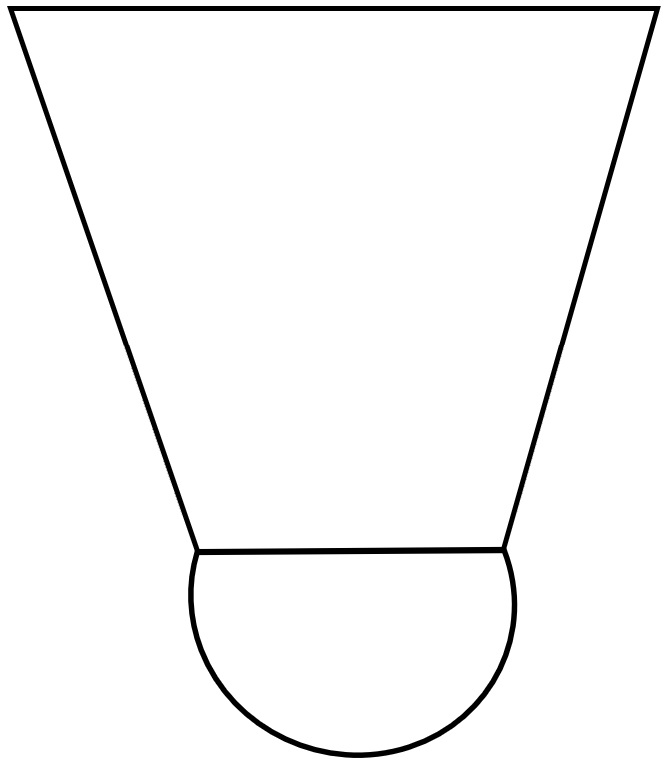
AnswerCorrect option: D. A frustum of a cone and a hemisphere
A shuttle cock has the shape of a frustum of a cone and a hemisphere.
View full question & answer→MCQ 491 Mark
Frustum is a $............$ word.
AnswerFrustum is a Latin word, which means piece or bit.
View full question & answer→MCQ 501 Mark
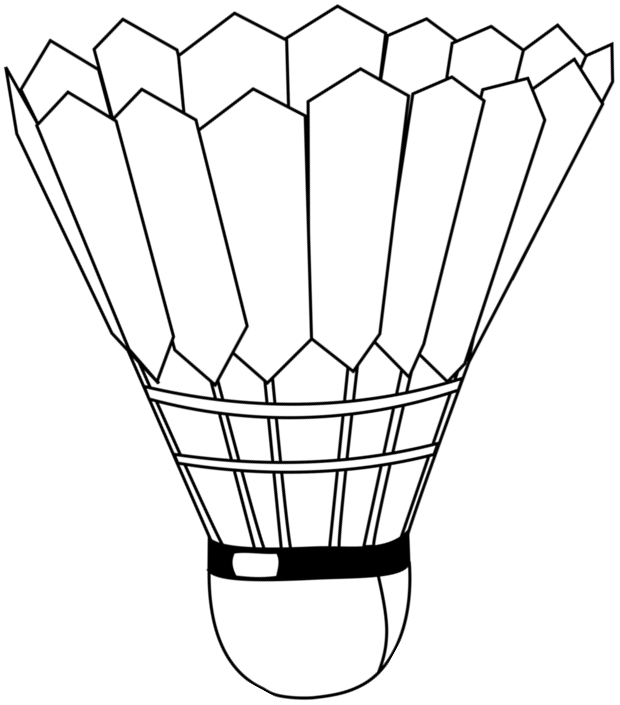
A shuttlecock used for playing badminton is the combination of :
- A
Cylinder and a hemisphere.
- ✓
Frustum of a cone and a hemispher.
- C
- D
AnswerCorrect option: B. Frustum of a cone and a hemispher.
A shuttlecock used for playing badminton is the combination of a frustum of a cone and hemisphere,
the lower portion being the hemisphere and the portion above that being the frustum of the cone.
View full question & answer→