Questions

3 Marks Question

Take a timed test

13 questions · self-marked practice — reveal the answer and mark yourself.

Question 13 Marks
Three metallic solid cubes whose edges are $3cm, 4cm$ and 5cm are melted and formed into a single cube. Find the edge of the cube so formed.
Answer
Given, edges of three solid cubes are $3 cm, 4 cm$ and 5 cm , respectively.
$\therefore$ Volume of first cude $=(3)^3=27 cm^3$
Volume of second cube $=(4)^3 64 cm^3$
and volume of third cude $=(5)^3=125 cm^3$
$\therefore$ Sum of volume of three cubes $=(27+64+125)=216 cm^3$
Let the edge of the resulting cude $= Rcm$
Then, volume of the resulting cube, $R ^3=216$
$\Rightarrow R=6 cm$
View full question & answer
Question 23 Marks
How many shots each having diameter 3cm can be made from a cuboidal lead solid of dimensions $9cm × 11cm × 12cm?$
Answer
Given, dimensiond of cuboidal $=9 cm \times 11 cm \times 12 cm$
$\therefore$ Volume of cuboidal $=9 \times 11 \times 12=1188 cm^3$
and diameter of shot $=3 cm$
$\therefore$ Radius of shot, $\text{r}=\frac{3}{2}=1.5\text{cm}$
Volume of shot $=\frac{4}{3}\pi\text{r}^3=\frac{4}{3}\times\frac{22}{7}\times(1.5)^3$
$=\frac{297}{21}=14.143\text{cm}^3$
$\therefore$ Required number of shots $=\frac{1188}{14.143}=84\ (\text{approx})$
View full question & answer
Question 33 Marks
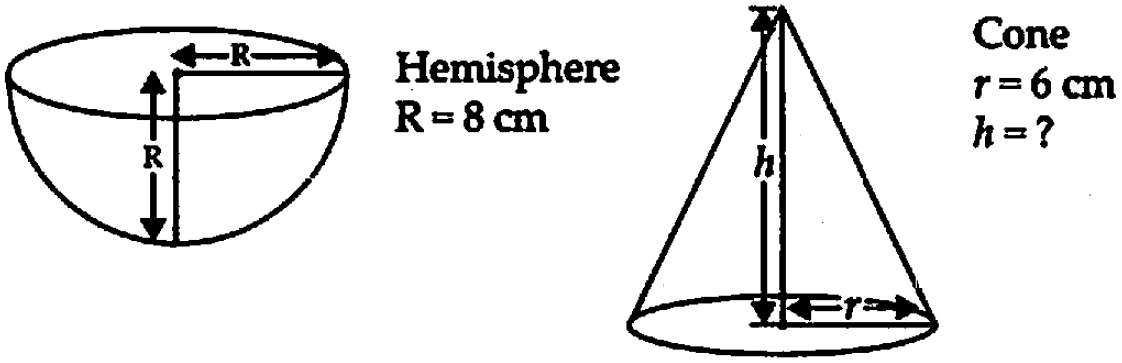
A solid metallic hemisphere of radius 8cm is melted and recasted into a right circular cone of base radius 6cm. Determine the height of the cone.
Answer

As the hemisphere is recasted into a cone. So,
Volume of cone = Volume of hemisphere
$\Rightarrow\ \ \frac{1}{3}\pi\text{r}^2\text{h}=\frac{2}{3}\pi\text{R}^3$
$\Rightarrow\ \ \text{r}^2\text{h}=2\text{R}^3$
$\Rightarrow\ \ \text{h}=\frac{2\text{R}^3}{\text{r}^2}=\frac{2\times8\times8\times8}{6\times6}=\frac{32\times8}{9}$
$=\frac{256}{9}=\frac{28.44}{}\text{cm}$
$\Rightarrow\ \ \text{h}=28.44\text{cm}.$
Hence, the height of the cone is 28.44cm.
View full question & answer
Question 43 Marks
$500$ persons are taking a dip into a cuboidal pond which is $80m$ long and 50m broad. What is the rise of water level in the pond, if the average displacement of the water by a person is $0.04m^3$​​​​​​​?
Answer
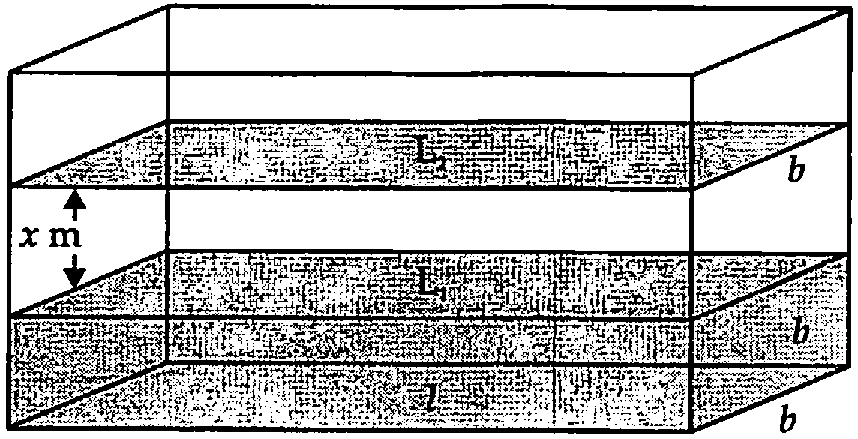
Let the rise of water level in the pond be x m. The shape of water rise in rectangular pond will be of cuboid.
Here, $180 m, b =50 m, h = x m$ Numbe of persons $=500$
Let the water level before the persons took a dip was at $L _1$.
Now, when 500 persons dipped into the pond, water level rises from $L_1$ to $L_2$ of height $x m$.
The volume of water between two levels will be equal to the water displaced by 500 persons.
$\therefore$ Volume of water raised $=$ Volume of cuboid
$\Rightarrow\ \ \text{l}\times\text{b}\times\text{h}=500\times0.04$
$\Rightarrow\ \ 80\times50\times\text{x}=500\times0.4$
$\Rightarrow\ \ \text{x}=\frac{500\times0.04}{80\times50}=\frac{1}{200}\text{m}=\frac{100}{200}\text{cm}=0.05\text{cm}$
$\Rightarrow\ \ \text{x}=0.5\text{cm}$
Hence, the rise of water level imn the pond is 0.5cm.
View full question & answer
Question 53 Marks
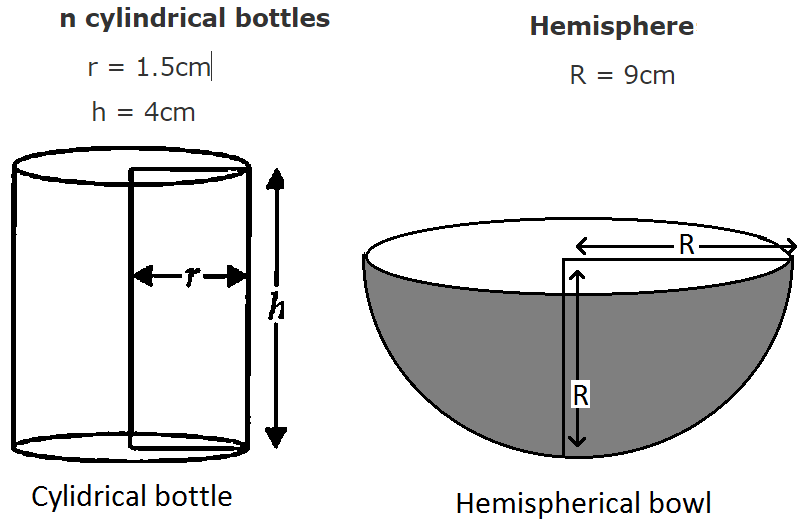
A hemispherical bowl of internal radius 9cm is full of liquid. The liquid is to be filled into cylindrical shaped bottles each of radius 1.5cm and height 4cm. How many bottles are needed to empty the bowl?
Answer

As the volume of liquid does not change
So, Volume of n bottles = Volume of hemisphere
$\Rightarrow\ \ \text{n}\pi\text{r}^2\text{h}=\frac{2}{3}\pi\text{R}^3$ $\Rightarrow\ \text{nr}^2\text{h}=\frac{2}{3}\text{R}^3$
$\Rightarrow\ \ \text{n}\times1.5\times1.5\times4=\frac{2}{3}\times9\times9\times9$
$\Rightarrow\ \ \text{n}=\frac{2\times9\times9\times9\times100}{3\times15\times15\times4}=54$
Hence, 54 bottles are needed.
View full question & answer
Question 63 Marks
A factory manufactures $120000$ pencils daily. The pencils are cylindrical in shape each of length $25cm$ and circumference of base as $1.5cm$. Determine the cost of colouring the curved surfaces of the pencils manufactured in one day at Rs. $0.05$ per dm$^2.$
Answer
Shape of the pencil is cylindrical.
Here, $\text{h}=25\text{cm},\ 2\pi\text{r}=1.5\text{cm}$
Curved surface area of one pencil $2\pi\text{rh}$
$\therefore$ Curved surface area of 1,20,000 pencils
$=1,20,000\times2\pi\text{rh}=1,20,000\times1.5\times25\text{cm}^2$
$=\frac{1,20,000\times15\times25}{10\times100}\text{dm}^2=600\times75\text{dm}^2$
$\therefore$ Cost of colouring $₹ 600 × 75 × 0.025 = ₹ 2250$
Hence, cost of colouring is $₹ 2250.$
View full question & answer
Question 73 Marks
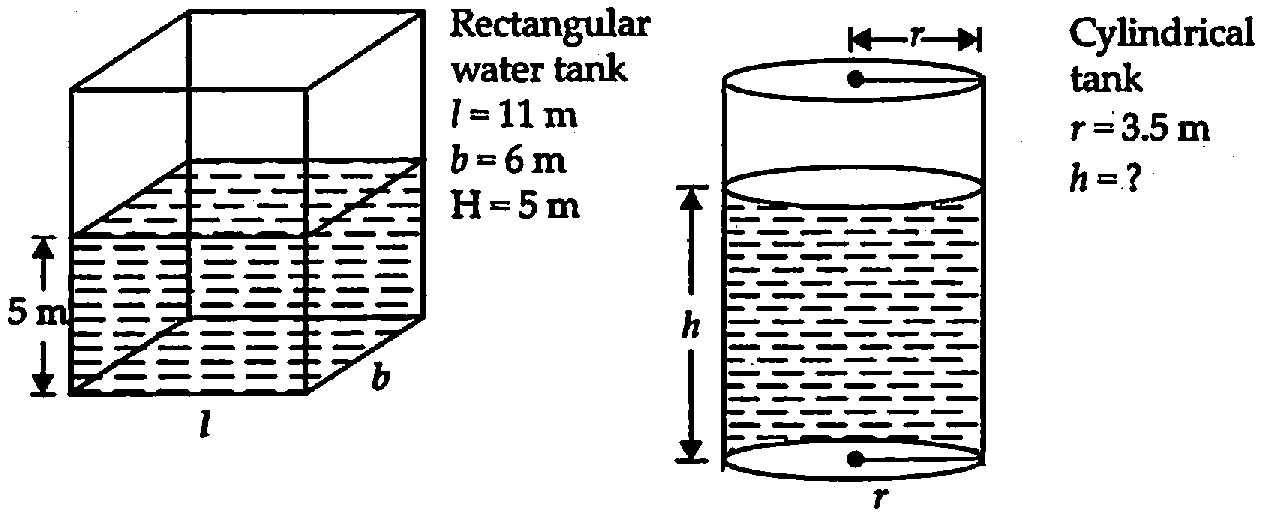
A rectangular water tank of base 11m × 6m contains water upto a height of 5m. If the water in the tank is transferred to a cylindrical tank of radius 3.5m, find the height of the water level in the tank.
Answer

Water is transferred from cuboid to cylider, so, the volume of water in both the vessels will be same.
$\therefore\ \ \pi\text{r}^2\text{h}=\text{l}\times\text{b}\times\text{H}$
$\Rightarrow\ \ \frac{22}{7}\times3.5\times3.5\times\text{h}=11\times6\times5$
$\Rightarrow\ \ \text{h}=\frac{11\times6\times5\times7\times100}{22\times35\times35}=\frac{60}{7}$
$\Rightarrow\ \ \text{h}\cong8.6\text{m (approx.)}$
Hence, the height of water level in cylindrical tank is 8.6m.
View full question & answer
Question 83 Marks
A bucket is in the form of a frustum of a cone and holds $28.490$ litres of water. The radii of the top and bottom are $28cm$ and $21cm$, respectively. Find the height of the bucket. 
Answer
Given, volume of the frustum $=28.49 L=28.49 \times 1000 cm^3=28490 cm^3$
and radius of the top $\left(r_1\right)=28 cm$
radius of the bottom $\left( r _2\right)=21 cm$
Let height of the bucket $= h cm$
Now, volume of the bucket $=\frac{1}{3}\pi\text{h}(\text{r}^2_1+\text{r}^2_2+\text{r}_1\text{r}_2)=28490$
$\Rightarrow\ \ \frac{1}{3}\times\frac{22}{7}\times\text{h}(28^2+21^2+28\times21)=28490$
$\Rightarrow\ \ \text{h}(784+441+588)=\frac{28490\times3\times7}{22}$
$\Rightarrow\ \ 1813\text{h}=1295\times21$
$\therefore\ \ \text{h}=\frac{1295\times21}{1813}=\frac{27195}{1813}=12\text{cm}$
View full question & answer
Question 93 Marks
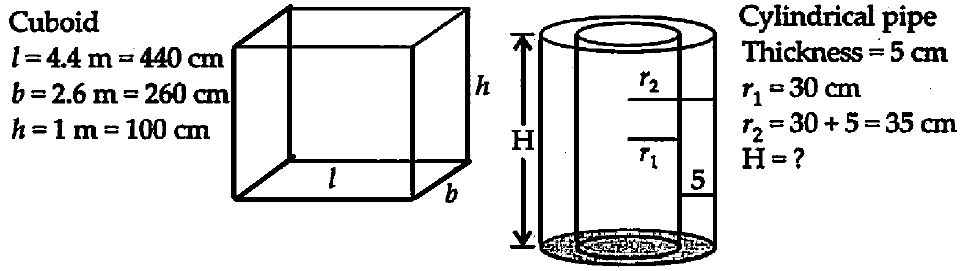
A solid iron cuboidal block of dimensions 4.4m × 2.6m × 1m is recast into a hollow cylindrical pipe of internal radius 30cm and thickness 5cm. Find the length of the pipe.
Answer

Cuboid is recasted into hollow cylindrical pipe.
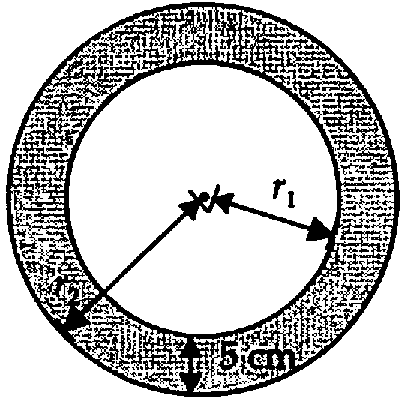
$\therefore$ Volume of cuboid = Volume of cylindrical pipe (hollow)
$\Rightarrow\ \ \text{l bh}=\pi\text{r}^2_2\text{H}-\pi\text{r}^2_1\text{H}$
$\Rightarrow\ \ \text{l bh}=\pi\text{H}\big[\text{r}^2_2-\text{r}^2_1\big]$
$\Rightarrow\ \ 400\times260\times100=\frac{22}{7}\times\text{H}[35^2-30^2]$
$\Rightarrow\ \ 400\times260\times100=\frac{22}{7}\times\text{H}[1225-900]$
$\Rightarrow\ \ 400\times260\times100=\frac{22}{7}\times\text{H}[325]$
$\Rightarrow\ \ \text{H}=\frac{100\times440\times260\times7}{22\times325}\text{m}$
$=\frac{1600\times7}{100}\text{m}$
$\Rightarrow\ \ \text{H}=112\text{m}$
Hence, the length of pipe is 112m.
View full question & answer
Question 103 Marks
16 glass spheres each of radius 2cm are packed into a cuboidal box of internal dimensions 16cm × 8cm × 8cm and then the box is filled with water. Find the volume of water filled in the box.
Answer
Cuboidal box:l = 16cm
b = 8cm
h = 8cm
16 shpheres:
r = 2cm
Volume of water filled in the box = Volume of box - Volume of 16 glass spheres
$\therefore$ Volume of water filled in the box $=\text{l bh}-16.\frac{4}{3}\pi\text{r}^3$
$=16\times8\times8-\frac{16\times4}{3}\times\frac{22}{7}\times2\times2\times2$
$=16\times8\Big[\frac{16\times8\times8}{16\times8}-\frac{4\times22\times2\times2\times2}{3\times7\times1\times8}\Big]$
$=16\times8\Big[8-\frac{88}{21}\Big]=16\times8\Big[\frac{168-88}{21}\Big]$
$=\frac{16\times8\times80}{21}=\frac{10240}{21}=487.6\text{cm}^3$
View full question & answer
Question 113 Marks
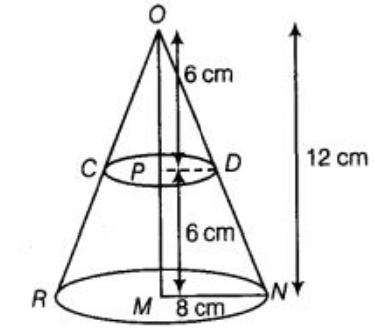
A cone of radius 8cm and height $12\ cm$ is divided into two parts by a plane through the mid-point of its axis parallel to its base. Find the ratio of the volumes of two parts.
Answer
Let ORN be the cone then given, radius of the base of the cone $r_1 = 8\ cm$

and height of the cone, (h) OM = 12cm Let P be the mid-point of OM,
then $\text{OP}=\text{PM}=\frac{12}{2}=6\text{cm}$
Now, $\triangle\text{OPD}\sim\triangle\text{OMN}$
$\therefore\ \ \frac{\text{OP}}{\text{OM}}=\frac{\text{PD}}{\text{MN}}$ $\Rightarrow\ \ \frac{6}{12}=\frac{\text{PD}}{8}$
$\Rightarrow\ \ \frac{1}{2}=\frac{\text{PD}}{8}$ $\Rightarrow\ \ \text{PD}=4\text{cm}$
The plane along CD divides the cone into two parts, namely a smaller cone of radius 4cm and height 6cm and (ii) frustum of a cone for which Radiud of the top of
the frustum $r_1 = 4cm$ Radiud of the bottom, $r_2 = 8cm$ and
height of the frustum, $h = 6cm$
$\therefore$ Volume of smaller cone
$=\Big(\frac{1}{3}\pi\times4\times4\times6\Big)=32\pi\text{cm}^3$
and volume of the frustum of cone
$=\frac{1}{3}\times\pi\times6\big[(8)^2+(4)^2+8\times4\big]$
$\therefore$ Required ratio = Volume of frustum :
Volume of cone $=24\pi:32\pi=1:7$
View full question & answer
Question 123 Marks
Water is flowing at the rate of 15km/ h through a pipe of diameter 14cm into a cuboidal pond which is 50m long and 44m wide. In what time will the level of water in pond rise by 21cm?
Answer
Main conceot: Volume of flowing water $=\text{A}.\upsilon.\text{t}$ Here, A = Area of cross-section of pipe of flowing water $\upsilon$ = Speed of water t = Time Here, A is equivalent to area of base and height equal to distance $(\upsilon.\text{t})$ and we know that V = area of base × height.
Flowing water Pond
$\text{A}=\pi\text{r}^2(\text{circular pipe})$ $\text{l}=50\text{m}$
$\text{r}=\frac{14}{2}\text{cm}=7\text{cm}=0.07\text{m}$ $\text{b}=44\text{m}$
$\upsilon=15\text{km/hr}=15000\text{m/hr}$ $\text{h}=21\text{cm}=0.21\text{m}$
$\therefore$ Volume of flowing water = Volume of same water in pond $\Rightarrow\ \ \text{A}.\upsilon.\text{t}=1\times\text{b}\times\text{h}$ $\Rightarrow\ \ \pi\text{r}^2.\upsilon.\text{t}=\text{l}\times\text{b}\times\text{h}$ $\Rightarrow\ \ \frac{22}{7}\times0.07\times0.07\times15000\text{t (hrs.)}=50\times44\times0.21$ $\Rightarrow\ \ \text{t}=\frac{50\times44\times0.21\times7}{22\times0.07\times0.07\times15000}$ $=\frac{50\times44\times21\times7\times7\times100}{22\times7\times7\times15000}\Rightarrow\text{t}=2\text{ hours}$ Hence, time required is 2 hours.
View full question & answer
Question 133 Marks
The rain water from a roof of dimensions 22m 20m drains into a cylindrical vessel having diameter of base 2m and height 3.5m. If the rain water collected from the roof just fill the cylindrical vessel, then find the rainfall in cm.
Answer
Cuboid:l = 22m = 2200cm
b = 20m = 2000cm
H = x cm
Cylinder:
$\text{r}=\frac{2}{2}=1\text{m}=100\text{cm}$
$\text{h}=3.5\text{m}=350\text{cm}$
If water from roof is not allowed to flow, then water level on roof rises upto x cm (let) then volume of cuboidal shape of water will be equal to the volume of cylinder.
$\therefore$ Volume of rain water = Volume of cylinder
$\Rightarrow\ \ \text{l}\times\text{b}\times\text{h}=\pi\text{r}^2\text{h}$
$\Rightarrow\ \ 2200\times2000\times\text{x}=\frac{22}{7}\times100\times100\times350$
$\Rightarrow\ \ \text{x}=\frac{22\times100\times100\times350}{7\times2200\times2000}=\frac{5}{2}=2.5\text{cm}$
Hence, the rainfall is 2.5cm.
View full question & answer
3 Marks Question - Maths STD 10 Questions - Vidyadip