Questions

True False[1 Marks ]

Take a timed test

8 questions · self-marked practice — reveal the answer and mark yourself.

Question 11 Mark
Write ‘True’ or ‘False’ and justify your answer in the following:
A solid cylinder of radius r and height h is placed over other cylinder of same height and radius. The total surface area of the shape so formed is $4\pi\text{r h}+4\pi\text{r}^2.$
Answer
False: When two identical cylinders of same radius 'r' and height 'h' are stuck base (circular) to base, then the resulting cylinder will have h' = 2h, r' = r
$\therefore\ \ \text{T.S.A}=2\pi\text{r}'(\text{r}'+\text{h})=2\pi\text{r}(\text{r}+2\text{h})=2\pi\text{r}^2+2\pi\text{r}.2\text{h}$
$=4\pi\text{r h}+2\pi\text{r}^2$
Hence, the given statement is false.
View full question & answer
Question 21 Mark
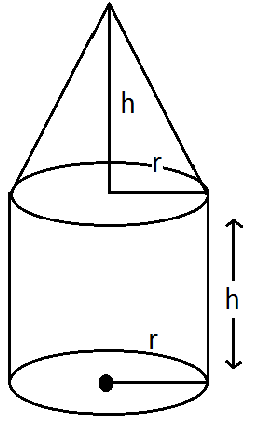
Write ‘True’ or ‘False’ and justify your answer in the following: A solid cone of radius r and height h is placed over a solid cylinder having same base radius and height as that of a cone. The total surface area of the combined solid $\pi\text{r}\Big[\sqrt{\text{r}^2+\text{h}^2}+3\text{r}+2\text{h}\Big].$
Answer
False:Cone:
Radius = r
Height = h
Cylinder:
Radius = r
Height = h
Total surface area of the combined solid = Curved surface area of cone + Area of the base of cylinder

$=\pi\text{rl}+2\pi\text{rh}+\pi\text{r}^2=\pi\text{r}[\text{l}+2\text{h}+\text{r}]$
$\because\ \ \text{l}=\sqrt{\text{r}^2+\text{h}^2}$
$\therefore$ Total surface area of the combined solid
$=\pi\text{r}\Big[\sqrt{\text{r}^2+\text{h}^2}+2\text{h}+\text{r}\Big]$ which is not according to the given statement.
Hence, the given statement is false.
View full question & answer
Question 31 Mark
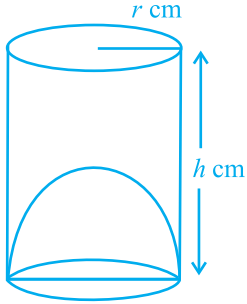
Write ‘True’ or ‘False’ and justify your answer in the following: The capacity of a cylindrical vessel with a hemispherical portion raised upward at the bottom as shown in the Fig. is $\frac{\text{r}^2}{3}3\text{h}-2\text{r}.$
Answer
True:Cylinder:
Radius = r
Height = h
Hemisphere:
Radius = r
Capacity of vessel = Volume of cylinder - Volume of hemisphere
$=\pi\text{r}^2\text{h}-\frac{2}{3}\pi\text{r}^3$
$\Rightarrow\ \text{Volume of vessel}=\frac{\pi\text{r}^2}{3}[3\text{h}-2\text{r}]$
which is equal to the volume given in the statement.
Hence, the given statement is true.
View full question & answer
Question 41 Mark
Write ‘True’ or ‘False’ and justify your answer in the following:
A solid ball is exactly fitted inside the cubical box of side a. The volume of the ball is $\frac{4}{3}\pi\text{a}^3.$
Answer
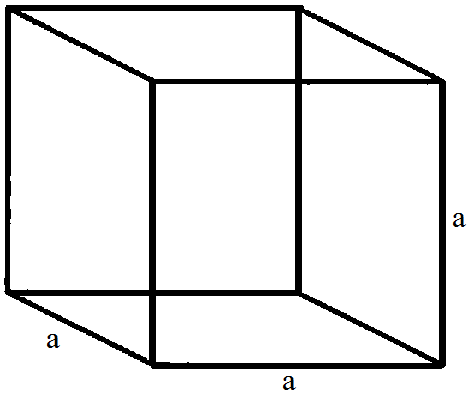
False: Clearly from figure when ball (spherical) is exatly fitted inside the cubical box then diameter of the ball becomes equal to side of cube so
Diameter = d = a $\Rightarrow\ \ \text{Radius}=\text{r}=\frac{\text{a}}{2}$ $\therefore$ Volume of spherical ball $=\frac{4}{3}\pi\text{r}^3$ $=\frac{4}{3}\pi\Big(\frac{\text{a}}{2}\Big)=\frac{4}{3}\pi\frac{\text{a}^3}{8}=\frac{1}{6}\pi\text{a}^3\neq\frac{4}{3}\pi\text{a}^3$ Hence, the given statement is false.
View full question & answer
Question 51 Mark
Write ‘True’ or ‘False’ and justify your answer in the following:
The curved surface area of a frustum of a cone is $\pi\text{l}(\text{r}_1+\text{r}_2),$ where $\text{l}\sqrt{\text{h}^2(\text{r}_1\ \ \text{r}_2)^2},$ $r_1$ and $r_2$ are the radii of the two ends of the frustum and h is the vertical height.
Answer
False: We know that the curved surface area of frustrum $=\pi\text{l}[\text{r}_1+\text{r}_2]$
where $\text{l}=\sqrt{\text{h}^2+(\text{r}_1-\text{r}_2)^2}$
But, $\text{l}=\sqrt{\text{h}^2+(\text{r}_1+\text{r}_2)^2}$ in the given statement.
So, the given statement is false.
View full question & answer
Question 61 Mark
Write ‘True’ or ‘False’ and justify your answer in the following:
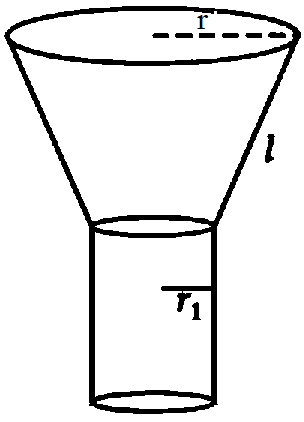
An open metallic bucket is in the shape of a frustum of a cone, mounted on a hollow cylindrical base made of the same metallic sheet. The surface area of the metallic sheet used is equal to curved surface area of frustum of a cone + area of circular base + curved surface area of cylinder.
Answer
True: The surface area of the sheet used for vessel will be equal to the total surface area of cylinder excluding the top and only curved surface area of frustrum of a cone.
So, total surface area of vessel = Curved surface area of frustrum + Curved surface area of cylinder + Area of base of cylinder It is equal to the surface area of the metallic sheet given in the statement. Hence, the given statement is true.
View full question & answer
Question 71 Mark
Write ‘True’ or ‘False’ and justify your answer in the following:
The volume of the frustum of a cone is $\frac{1}{3}\pi\text{h}\big[\text{r}^2_2\ \ \text{r}^2_2-\text{r}^2_2-\text{r}_1\text{r}_2\big],$ where h is vertical height of the frustum and $r_1, r_2$ are the radii of the ends.
Answer
False: As we know that the volume of the frustrum
$\text{V}=\frac{1}{3}\pi\text{h}\big[\text{r}^2_1+\text{r}^2_2+\text{r}_1\text{r}_2\big]\neq\frac{1}{3}\pi\text{h}\big[\text{r}^2_1+\text{r}^2_2-\text{r}_1\text{r}_2\big]$
Hence, the given statement is false.
View full question & answer
Question 81 Mark
Write ‘True’ or ‘False’ and justify your answer in the following:
Two identical solid hemispheres of equal base radius r cm are stuck together along their bases. The total surface area of the combination is $6\pi\text{r}^2.$
Answer
False: When two hemispheres of equal bases are stuck base to base it forms a sphere and total surface area of resulting sphere is $4\pi\text{r}^2.$
Hence, the given statement is false.
View full question & answer