Question 15 Marks
The $\frac{3}{4}\text{th}$ part of a conical vessel of internal radius 5cm and height 24cm is full of water. The water is emptied into a cylindrical vessel with internal radius 10cm. Find the height of water in cylindrical vessel.
AnswerLet height of water in cylindrical vessel = h cm
Volume of water (in cylinder) $=\Big(\frac{3}{4}\Big)$ Volume of water (in cone)
$\therefore$ Volume of cylinder $=\pi\text{r}^2\text{h}$ & Volume of cone $=\Big(\frac{1}{3}\Big)\pi\text{r}^2\text{h}$
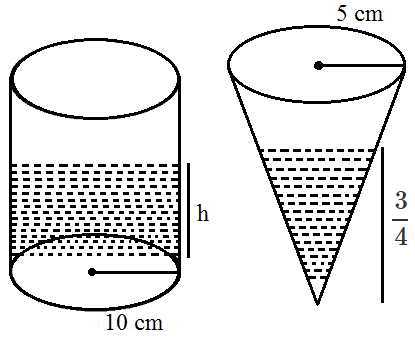
$\Rightarrow\pi(10)^2\text{h}=\frac{3}{4}\Big[\frac{1}{3}\pi(5)^224\Big]$
$\Rightarrow100\text{h}=\frac{1}{4}\times25\times24$
$\Rightarrow\text{h}=\frac{25\times24}{4\times100}=1.5\text{cm}$
Hence, height of water in cylindrical vessel (h) = 1.5cm. View full question & answer→Question 25 Marks
An icecream cone full of icecream having radius 5cm and height 10cm as shown’in the figure. Calculate the volume of icecream, provided that its $\frac{1}{6}$ parts is left unfilled with icecream.
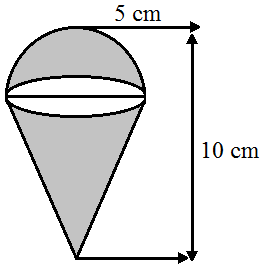
AnswerGiven, ice-cream cone is the combination of a hemisphere and a cone.
Also, radius of hemisphere = 5cm
$\therefore$ Volume of hemisphere $=\frac{2}{3}\pi\text{r}^3$
$=\frac{2}{3}\times\frac{22}{7}\times(5)^3$
$=\frac{5500}{21}=261.90\text{cm}^3$
Now, radius of the cone = 5cm
and height of the cone = 10 - 5 = 5cm
$\therefore$ Volume of the cone $=\frac{1}{3}\pi\text{r}^2\text{h}$
$=\frac{1}{3}\times\frac{22}{7}\times(5)^2\times5$
$=\frac{2750}{21}=130.95\text{cm}^3$
Now, total volume of ice- cream cone
$= 261.90 + 130.95 = 392.85cm^2$
Since, $\frac{1}{6}$ part is left unfilled with ice cream.
Required volume of ice cream
$=392.85-392.85\times\frac{1}{6}=392.85-65.475$
$=327.4\text{cm}^3$
View full question & answer→Question 35 Marks
The internal and external diameters of a hollow hemispherical vessel are 21cm and 25.2cm respectively. The cost of painting $1cm^2$ of the surface is 10 paise. Find the total cost to paint the vessel all over.
AnswerOuter diameter of the hemispherical vessel = 25.2cm
and inner diameter = 21cm
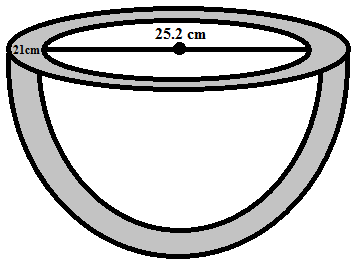
$\therefore$ outer radius (R) $=\frac{25.2}{2}=12.6\text{cm}$
And inner radius (r) $=\frac{21}{2}=10.5\text{cm}$
Total surface area = Outer surface area + Inner surface area + Area of the base ring.
$= 2\pi\text{R}^2+2\pi\text{r}^2+\pi\Big\{\text{R}^2-\text{r}^2\Big\}$
$= 2\pi\text{R}^2+2\pi\text{r}^2+\pi\text{R}^2-\pi\text{r}^2$
$= 3\pi\text{R}^2+\pi\text{r}^2$
$=3\times\frac{22}{7}(12.6)^2+\frac{22}{7}(10.5)^2\text{cm}^2$
$=\frac{66}{7}\times158.76+\frac{22}{7}\times110.25\text{cm}^2$
$= 1496.88 + 346.50cm^2 $
$= 1843.38cm^2$
Rate of polishing the surface $= ₹ 0.10 per cm^2$
Total cost = 1843.38 $\times\frac{10}{100}$ = ₹ 184.338 = ₹ 184.34 View full question & answer→Question 45 Marks
In the given figure, from the top of a solid cone of height 12cm and base radius 6cm, a cone of height 4cm is removed by a plane parallel to the base. Find the total surface area of the remaining solid.$\Big(\text{use}\ \pi=\frac{22}{7}\text{and}\sqrt{5}=2.236\Big).$
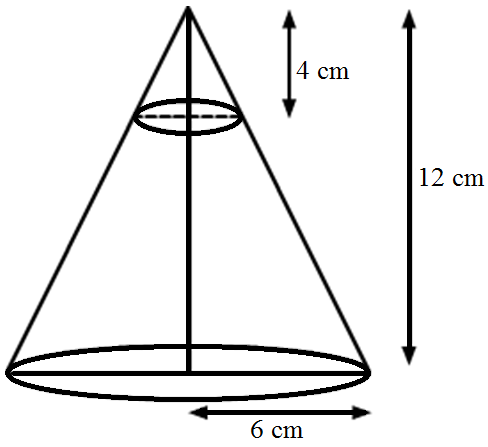
AnswerTotal height of cone = 12cm
Radius of its base = 6cm
A cone of height 4cm is cut out
Height of the so formed frustum = 12 – 4 = 8cm
Let r be the radius of the cone cut out
Then, $\frac{\text{r}}{6}=\frac{4}{12}=\text{r}=\frac{6\times4}{12}=2\text{cm}$
Let l is the slant height of whole cone
$\therefore\text{l}=\sqrt{\text{r}^2+\text{h}^2}=\sqrt{6^2+12^2}=\sqrt{36+144\text{cm}}\\=\sqrt{180}\text{cm}=\sqrt{36\times5}=6\sqrt{5}\text{cm}$
and slant height of the remaining portion i.e., of frustum $=6\sqrt{5}-\frac{6\sqrt{5}}{3}$
$=6\sqrt{5}-2\sqrt{5}=4\sqrt{5}\text{cm}$
Now surface area of remaining portion $=\pi(\text{r}_1+\text{r}_2)\times\text{l}_1$
$=\frac{22}{7}(6+2)\times4\sqrt{5}\text{cm}^2$
$=\frac{22}{7}\times8\times4\sqrt{5}\text{cm}^2$
$=\frac{704\sqrt{5}}{7}\text{cm}^2=\frac{704}{7}(2.236)=224.88\text{cm}^2$
and area of base and top $=\pi(6^2+2^2)$
$=\frac{22}{7}(36+4)\text{cm}^2$
$=40\times\frac{22}{7}=\frac{880}{7}\text{cm}^2=125.71\text{cm}^2$
$\therefore$ Total surfce area $= 224.88 + 125.71 = 350.59cm^2$
View full question & answer→Question 55 Marks
A vessel is a hollow cylinder fitted with a hemispherical bottom of the same base. The depth of the cylinder is $\frac{14}{3}\text{m}$ and the diameter of hemisphere is 3.5m. Calculate the volume and the internal surface area of the solid.
AnswerGiven radius of hemisphere (r) $=\frac{3.5}{2}=1.75\text{m}$
Height of cylinder (h) $\frac{14}{3}\text{m}$
Volume of cylinder $=\pi\text{r}^2\text{h}$
$=\pi(1.75)^2\Big(\frac{14}{3}\Big)\text{cm}^3...(1)$
Volume of Hemisphere $=\frac{2}{3}\pi\text{r}^3$
$=\frac{2}{3}\times\pi(1.75)^3\text{cm}^3...(2)$
Volume of vessel = (1) + (2)
$V = V_1 + V_2$
$\text{V}=\pi\text{r}^2\text{h}+\frac{2}{3}\pi\text{r}^3$
$\text{V}=\pi(1.75)^2\Big(\frac{14}{3}\Big)+\frac{2}{3}\pi(1.75)^2$
$\text{V}=56\text{m}^3$
$\therefore$ Volume of vessel $(v) = 56m^3$
Internal surface area of solid (s) $=2\pi\text{rh}+2\pi\text{r}^2$
S = Surface area of cylinder + Surface area of hemisphere
$\text{S}=2\pi(1.75)\Big(\frac{14}{3}\Big)+2\pi(1.75)^2$
$\text{S}=70.51\text{m}^2$
$\therefore$ Internal surface area of solid (s) $= 70.51m^2$
View full question & answer→Question 65 Marks
A solid right circular cone of height 120cm and radius 60cm is placed in a right circular cylinder full of water of height 180cm such that it touches the bottom. Find the volume of water left in the cylinder, if the radius of the cylinder is equal to the radius of the cone.
Answer
- Whenever we placed a solid right circular cone in a right circular cylinder with full of water, then volume of a solid right circular cone is equal to the volume of water failed from the cylinder.
- Total volume of water in a cylinder is equal to the volume of the cylinder.
- Volume of water left in the cylinder = Volume of the right circular cylinder – Volume of a right circular cone.
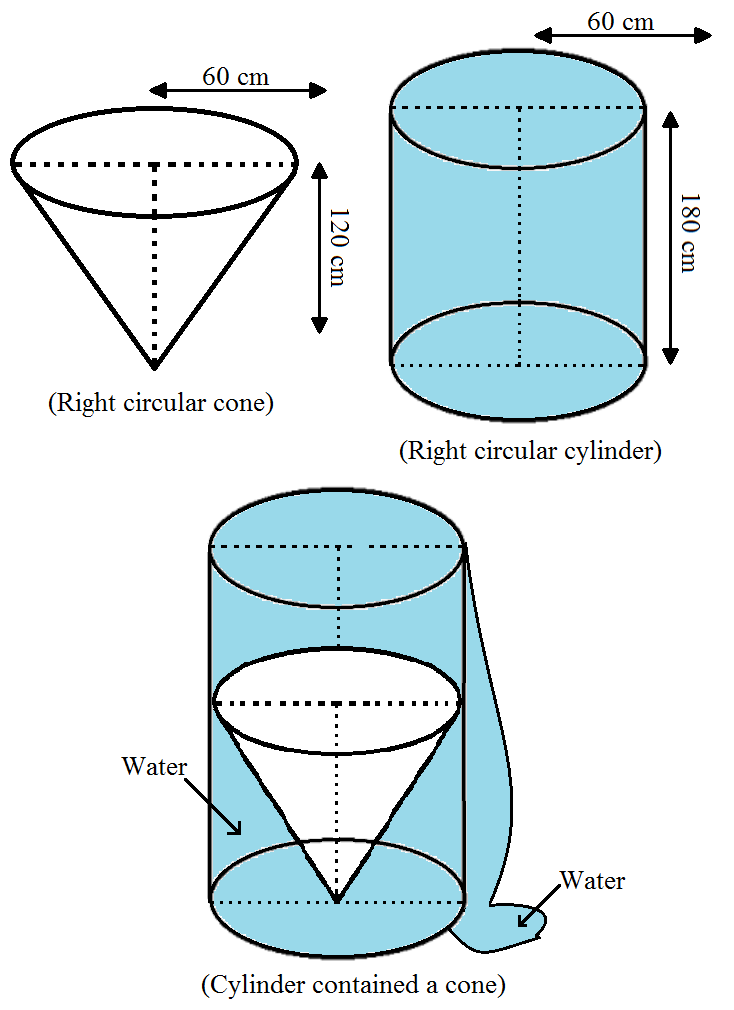
Now, given that
Height of a right circular cone = 120cm
Radius of a right circular cone = 60cm
$\therefore$ Volume of a right circular cone $=\Big(\frac{1}{3}\Big)\pi\text{r}^2\times\text{h}$
$=\Big(\frac{1}{3}\Big)\times\Big(\frac{22}{7}\Big)\times60\times60\times120$
$=\Big(\frac{22}{7}\Big)\times20\times60\times120$
$=144000\pi\text{cm}^3$
$\therefore$ Volume of a right circular cone = Volume of water failed from the cylinder = 1440007cm3 [from point (i)]
Given that, height of a right circular cylinder = 180cm
and radius of a right circular cylinder = Radius of a right circular cone = 60cm View full question & answer→Question 75 Marks
A solid toy is in the form of a hemisphere surmounted by a right circular cone. Height of the cone is 2cm and the diameter of the base is 4cm. If a right circular cylinder circumscribes the toy, find how much more space it will cover.
AnswerGiven radius of cone, cylinder and hemisphere (r) $=\frac{4}{2}=2\text{cm}$
Height of cone (l) = 2cm
Height of cylinder (h) = 4cm
Volume of cylinder $=\pi\text{r}^2\text{h}=\pi(2)^2(4)\text{cm}^3...(1)$
Volume of cone $=\frac{1}{3}\pi\text{r}^2\text{l}$
$=\frac{1}{3}\pi(2)^2\times2$
$=\frac{\pi}{3}(4)\times2\text{cm}^3...(2)$
Volume of hemisphere $=\frac{2}{3}\pi\text{r}^3$
$=\frac{2}{3}\times\pi(2)^3$
$=\frac{2}{3}\times\pi(8)\text{cm}^3...(3)$
So remaining volume of cylinder when toy is inserted to it $=\pi\text{r}^2\text{h}-\Big(\frac{1}{3}\pi\text{r}^2\text{l}+\frac{2}{3}\pi\text{r}^3\Big)$
$=(1)-((2)+(3))$
$=\pi(2)^2(4)-\Big(\frac{\pi}{3}\times8+\frac{2}{3}\times\pi\times8\Big)$
$=16\pi-\frac{2}{3}\pi(4+8)=16\pi-8\pi=8\pi\text{cm}^3$
$\therefore$ so remaining volume of cylinder when toy is inserted to it $=8\pi\text{cm}^3$
View full question & answer→Question 85 Marks
A spherical ball of radius 3cm is melted and recast into three spherical balls. The radii of the two of the balls are 1.5cm and 2cm respectively. Determine the diameter of the third ball.
AnswerRadius of larger ball (R) = 3cm.
$\therefore\text{volume}=\frac{4}{3}\pi(\text{R})^3$
$=\frac{4}{3}\pi(\text{3})^3=36\pi\text{cm}^3$
Radius of smaller ball ($r_1$) = 1.5cm = $\frac{3}{2}\text{cm}$
$\therefore\text{volume}=\frac{4}{3}\pi(\text{r}{_1})^3=\frac{4}{3}\pi\Big(\frac{3}{2}\Big)^3$
$=\frac{9{\pi}}{2}\text{cm}^3$ and radius of secound ball ($r_2$) = 2cm
$\therefore\text{volume}=\frac{4}{3}\pi(\text{r}{_2})^3=\frac{4}{3}\pi\times(2)^3$
$=\frac{32}{3}\pi\text{cm}^3$
$\therefore$ volume of the third ball,
$=36\pi-\Big(\frac{9}{2}\pi+\frac{32}{3}\pi\Big)$
$=36\pi-\Big(\frac{27+64}{6}\pi\Big)$
$=\frac{216\pi-91\pi}{6}=\frac{125}{6}\pi$
View full question & answer→Question 95 Marks
A toy is in the form of a cone surmounted on a hemisphere. The diameter of the base and the height of the cone are 6cm and 4cm, respectively. Determine the surface area of the toy. $(\text{use}\ \pi=3.14)$
AnswerGiven height of cone (h) = 4cm
Diameter of cone (d ) = 6cm
$\therefore$ Radius (r) $=\frac{6}{2}=3\text{cm}$
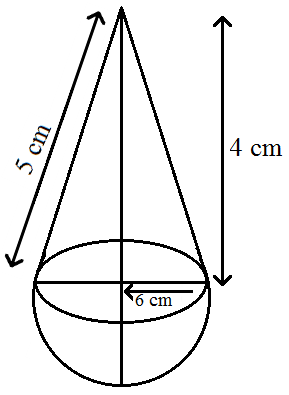
Let 'l' be slant height of cone
$\text{l}=\sqrt{\text{r}^2+\text{h}^2}$
$=\sqrt{3^2+4^2}=5\text{cm}$
$\text{l}=5\text{cm}$
$\therefore$ slant height of cone (l) = 5cm View full question & answer→Question 105 Marks
A circus tent has cylindrical shape surmounted by a conical roof. The radius of the cylindrical base is 20m. The heights of the cylindrical and conical portions are 4.2m and 2.1m respectively. Find the volume of the tent.
AnswerGiven that:
Radius of the cylindrical base r = 20m
Height of the cylindrical portion $h_1 = 4.2m$
Height of the conical portion $h_2 = 2.1m$
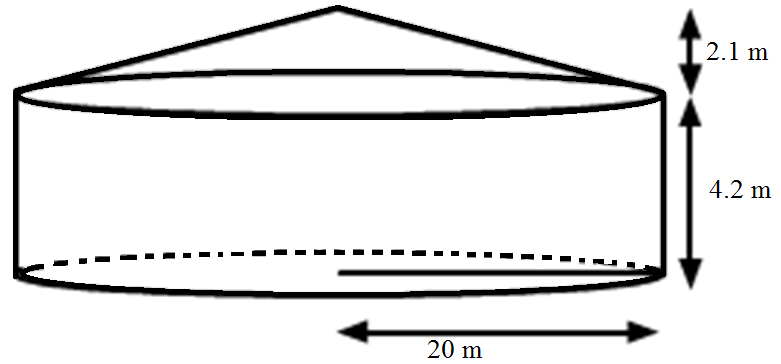
The volume of the cylinder is given by the following formula
$\text{V}_1=\pi\text{r}^2\text{h}_1$
$=\frac{22}{7}\times20^2\times4.2$
$=5280\text{m}^3$
The volume of the conical portion is
$\text{V}_1=\frac{1}{3}\pi\text{r}^2\text{h}_2$
$=\frac{1}{3}\times\frac{22}{7}\times20^2\times2.1$
$=880\text{m}^3$
Therefore, the total volume of the circus tent is
$V = V_1 + V_2$
$= 5280 + 880$
$= 6160m^3$
Hence, the volume of the circus tent is $V = 6160m^3$ View full question & answer→Question 115 Marks
Find the number of metallic circular discs with 1.5cm base diameter and of height 0.2cm to be melted to form a right circular cylinder of height 10cm and diameter
4.5cm.
AnswerGiven that, lots of metallic circular disc to be melted to form a right circular cylinder. Here, a circular disc work as a circular cylinder.
Base diameter of metallic circular disc = 1.5cm
$\therefore$ Radius of metallic circular disc $=\frac{1.5}{2}\text{cm}[\because\text{diameter}=2\times\text{radius}]$
and height of metallic circular disc i.e., = 0.2cm
$\therefore$ Volume of a circular disc $=\pi\times(\text{Radius})^2\times\text{Hieght}.$
$=\pi\times\Big(\frac{1.5}{2}\Big)^2\times0.2$
$=\frac{\pi}{4}\times1.5\times1.5\times0.2$
Now, hieght of a right circular cylinder (h) = 10cm
and diameter of a right circular cylinder = 4.5cm
⇒ Radius of a right circular cylinder (r) $=\frac{4.5}{2}\text{cm}$
$\therefore$ Volume of a right circular cylinder $=\pi\text{r}^2\text{h}$
$\pi\Big(\frac{4.5}{2}\Big)^2\times10=\frac{\pi}{4}\times4.5\times4.5\times10$
$\therefore$ Number of metallic circular disc.
$=\frac{\text{volume of right circular cylinder}}{\text{volume of metallic circular disc}}$
$=\frac{\frac{\pi}{4}\times4.5\times4.5\times10}{\frac{\pi}{4}\times1.5\times1.5\times0.2}$
$=\frac{3\times3\times10}{0.2}=\frac{900}{2}=450$
Hence, the required number of metallic circular disc is 450.
View full question & answer→Question 125 Marks
A toy is in the shape of a right circular cylinder with a hemisphere on one end and a cone on the other. The radius and height of the cylindrical part are 5cm and 13cm respectively. The radii of the hemispherical and conical parts are the same as that of the cylindrical part. Find the surface area of the toy if the total height of the toy is 30cm.
AnswerRadius of the base of the cylindrical part (r) = 5cm
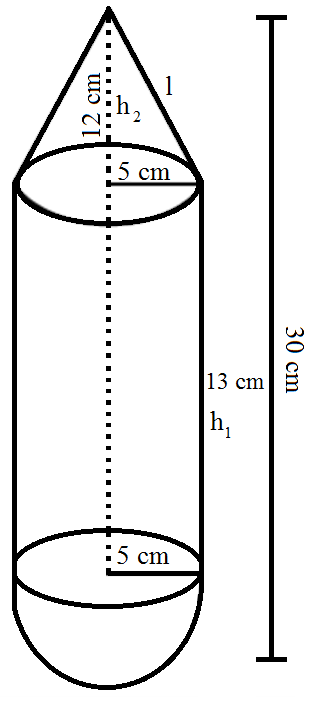
Height of cylindrical part $(h_1) = 13cm$
Height of the conical part $(h_2) = 30 – (13 + 5) = 30- 18 = 12cm$
$\therefore$ Slant height (l) $=\sqrt{\text{r}^2+\text{h}^2_2}$
$=\sqrt{(5)^2+(12)^2}=\sqrt{25+144}$
$=\sqrt{169}=13\text{cm}$
Radius of heispherical part (r) = 5cm
Total surface area of the toy = curved surface area of conical part + curved surface area of cylindrical part + curved surface area of hemisphere
$=\pi\text{rl}+2\pi\text{rh}_1+2\pi\text{r}^2$
$=\pi\text{r}(\text{l}+2\text{h}_1+2\text{r})$
$=\frac{22}{7}\times5[13+2\times13+2\times5]\text{cm}^2$
$=\frac{110}{7}[13+26+10]=\frac{110}{7}\times49$
$=770\text{cm}^2$ View full question & answer→Question 135 Marks
A hemispherical bowl of internal radius 9cm is full of liquid. The liquid is to be filled into cylindrical shaped small bottles each of diameter 3cm and height 4cm. How many bottles are necessary to empty the bowl?
AnswerRadius of hemisphere bowl ($r_1$) = 9cm
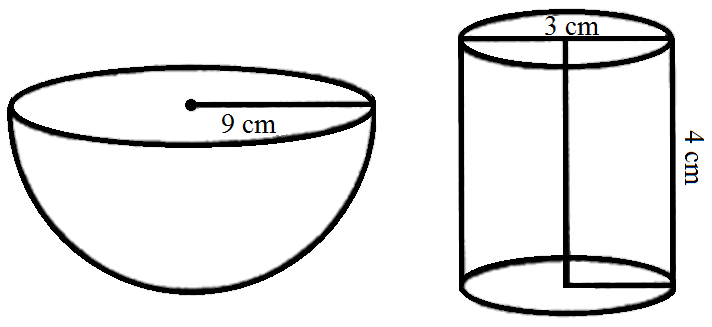
$\therefore$ Volume of liquids filled in it
$=\frac{2}{3}\pi\text{r}^3=\frac{2}{3}\pi(9)^3\text{cm}^3=486\pi\text{cm}^3$
Diameter of cylindrical bottle = 3cm
$\therefore$ Radius ($r_2$) $=\frac{3}{2}\text{cm}$
and height (h) = 4cm
$\therefore$ Volume of one bottle $=\pi\text{r}^2\text{h}=\pi\Big(\frac{3}{2}\Big)^2\times4$
$=\frac{9}{4}\pi\times4=9\pi\text{cm}^3$
$\therefore$ Number of bottles requird to fill the liquid of the bowl $=\frac{486\pi}{9\pi}=54$ View full question & answer→Question 145 Marks
A bucket is in the form of a frustum of a cone of height 30cm with radii of its lower and upper ends as 10cm and 20cm respectively. Find the capacity and surface area of the bucket. Also, find the cost of milk which can completely fill the container, at the rate of ₹ 25 per litre. $(\text{use}\ \pi=3.14)$
AnswerHeight of the bucket, h = 30cm
Radii $r_1=10cm$ and $r_2 = 20cm$
Capacity of the bucket,
$\text{V}=\frac{1}{3}\pi\text{h}\big(\text{r}^2_1+\text{r}_1\text{r}_2+\text{r}^2_2\big)$
$=\frac{1}{3}\pi\times30\big(10^2+10\times20+20^2\big)$
$=21980\text{cm}^3$
$=21.980\ \text{liters}$
$ \text{l}=\sqrt{\text{h}^2+(\text{r}-\text{r}_1)^2}$
$ \text{l}=\sqrt{30^2+(20-10)^2}=10\sqrt{10}$
Surface area of the bucket
$ \text{S}= \text{CSA}+\text{area or the base}$
$ \text{S}=\pi(\text{r}_1+\text{r}_2)\text{l}+\pi \text{r}^2_1$
$ \text{S}=\pi(10+20)10\sqrt{10}+\pi(10)^2$
$\text{S}=2978.86+314=3292.86\text{cm}^2$
Cost of milk which can completely fill the container at Rs. 25/ litre
$= 21.980 \times 25$
$= Rs. 549.50$
View full question & answer→Question 155 Marks
A building is in the form of a cylinder surmounted by a hemispherical dome. The base diameter of the dome is equal to $\Big(\frac{2}{3}\Big)$ of the total height of the building. Find the height of the building, if it contains $67\Big(\frac{1}{21}\Big)\text{m}^3$of air.
Answer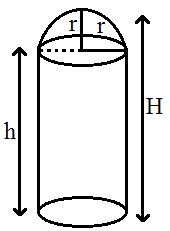
Let the radius of the dome be r.
Diameter be d.
Let the height of the building be H.
Given d $=\frac{2}{3}\text{H}$
$\Rightarrow2\text{r}=\frac{2}{3}\text{H}$
$\Rightarrow\text{r}=\frac{\text{H}}{3}$
$\Rightarrow3\text{r}=\text{H}$
Also, h + r = H
⇒ 3r = h + r
⇒ 2r = h
$\Rightarrow\text{r}=\frac{\text{h}}{2}$
Volume of air = Volume of air in the cylinder + Volume of air int he hemispherical dome
$\Rightarrow\pi\text{r}^2\text{h}+\frac{2}{3}\pi\text{r}^3=67\frac{1}{21}$
$\Rightarrow\pi\Big(\frac{\text{h}}{2}\Big)^2\text{h}+\frac{2}{3}\pi\Big(\frac{\text{h}}{2}\Big)^3=\frac{1408}{21}$
$\Rightarrow\text{h}^3=\frac{11264}{176}=64$
$\Rightarrow\text{h}=4\text{m}$
Hence, the radius will be r $=\frac{\text{h}}{2}=\frac{4}{2}=2\text{m}$
Height of the building, H $=3\text{r}=3\times2=6\text{m}$ View full question & answer→Question 165 Marks
In the middle of a rectangular field measuring 30m × 20m, a well of 7m diameter and 10m depth is dug. The earth so removed is evenly spread over the remaining part of the field. Find the height through which the level of the field is raised.
AnswerDiameter of well = 7m
$\therefore$ Radius (r) $=\Big(\frac{7}{2}\Big)\text{m}$
$\therefore$ Depth (h) = 10m
Volume of cylindrical $=\pi\text{r}^2\text{h}$
$=\frac{22}{7}\times\frac{7}{2}\times\frac{7}{2}\times10=385\text{m}^3$
Area of the mouth of well $=\pi\text{r}^2=\frac{22}{7}\times\frac{7}{2}$
$\times\frac{7}{2}=\frac{77}{2}\text{m}^2$
Length of field (l) = 30m
and width (b) = 20m
$\therefore$ Total area of the field = l × b = 30 × 20
$= 600m^2$
Area if the field excluding well $=600-\frac{77}{2}$
$= 600 - 38.5 = 561.5m^2$
Let h bethe height of earth spread over the ramaining part of the field
561.5 × h = 385
$\text{h}=\frac{385}{561.5}\text{m}=\frac{385\times100\times10}{5610}\text{cm}$
$=\frac{3500}{51}=68.6\text{cm}$
View full question & answer→Question 175 Marks
Two cylindrical vessels are filled with oil. Their radii are 15cm, 12cm and heights 20cm, 16cm respectively. Find the radius of a cylindrical vessel 21cm in height, which will just contain the oil of the two given vessels.
AnswerRadius of first cylinder $\left(r_1\right)=15 cm$ a
nd radius of second cylinder $\left( r _2\right)=12 cm$
Height of the first cylinder $\left(h_1\right)=20 cm$
and height of second cylinder $\left(h_2\right)=16 cm$ V
olume of both of cylinders
$=\pi\text{r}_1^2\text{h}_1+\pi\text{r}_2^2\text{h}_2$
$=\pi[\text{r}_1^2\text{h}_1+\text{r}_2^2\text{h}_2]=\pi[15^2\times20+12^2\times16]\text{cm}^3$
$=\pi\ [225\times20+144\times16]$
$=\pi\ [4500+2304]\text{cm}^3$
$=\pi\ [6804]\text{cm}^3$
$\therefore$ Volume of the required cylinder $=\pi\ (6804)\text{cm}^3$
Let Radius be = r
and height h = 21cm
$\therefore$ volume $=\pi\text{r}^2\text{h}$
$6804\pi=\pi\text{r}_1^2\times21$
$\Rightarrow\text{r}^2=\frac{6804\pi}{21\pi}=324=(18)^2\Rightarrow\text{r}=18$
$\therefore$ Radius of the required cylinder = 18cm
View full question & answer→Question 185 Marks
A cylindrical tube of radius 12cm contains water to a depth of 20cm. A spherical ball dropped into the tub and the level of the water is raised by 6.75cm. Find the radius of the ball.
AnswerGiven that radius of a cylindrical tube (r) = 12cm
Level of water raised in tube (h) = 6.75cm
Volume of cylinder $\pi\text{r}^2\text{h}$
$=\pi(12)^2\times6.75\text{cm}^3$
$=\frac{22}{7}(12)^2\ 6.25\text{cm}^3\ ...(1)$
let 'r' be radius of a spherical ball
Volume of sphere $=\frac{4}{3}\pi\text{r}^3\ ...(2)$
To find radius of spherical balls
Equating(1) and (2)
$\pi\times(12)^2\times6.75=\frac{4}{3}\pi\text{r}^3$
$\text{r}^3=\frac{\pi\times(12)^2\times6.75}{\frac{4}{3}\times\pi}$
$r^3= 729$
$r^3= 9^3$
$r = 9cm$
$\therefore$ Radius f spherical ball (r) = 9cm
View full question & answer→Question 195 Marks
Two cones with same base radius 8cm and height 15cm are joined together along their bases. Find the surface area of the shape formed.
AnswerIf two cones with same base and height are joined together along their bases, then the shape so formed is look like as figure shown.
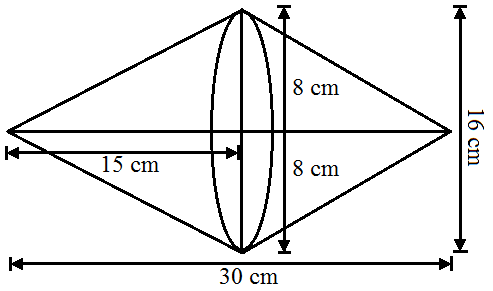
Given that, radius of cone, r = 8cm and height o cone, h = 15cm
So, surface area of the shape so formed
= curved area of first cone × Curved surface area of secound cone
= 2 surface area of cone
$=2\times\pi\text{rl}=2\times\pi\times\text{r}\times\sqrt{\text{r}^2+\text{h}^2}$
$=2\times\frac{22}{7}\times8\times\sqrt{(8)^2+(15)^2}$
$=\frac{2\times22\times8\times\sqrt{64+225}}{7}$
$=\frac{44\times8\times\sqrt{289}}{7}=\frac{44\times8\times17}{7}$
$=\frac{5984}{7}=854.85\text{cm}^2$
$=855\text{cm}^2$
Hence, the surface areaq of the shape so formed is $855cm^2.$ View full question & answer→Question 205 Marks
A conical hole is drilled in a circular cylinder of height 12cm and base radius 5cm. The height and the base radius of the cone are also the same. Find the whole surface and volume of the remaining cylinder.
Answer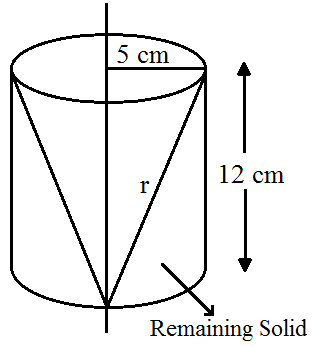
Given base radius of cylinder (r) = 5cm
Height of cylindet (h) = 12cm
Let 'l' be slant height of cone
$\text{l}=\sqrt{\text{r}^2+\text{h}^2}$
$=\sqrt{5^2+12^2}$
$\text{l}=13\text{cm}$
$\therefore$ Height and base radius of cone and cylinder are same
Total surface area of remaining part (s) $=2\pi\text{rh}+\pi\text{r}^2+\pi\text{rl}$
$=2\times\pi\times5\times12+\pi\times5^2+\pi\times5\times13$
T.S.A $=210\pi\text{cm}^2$
Volume of remaining part = Volume of cylinder - Volume of Cone
$\Rightarrow\text{V}=\pi\text{r}^2\text{h}-\frac{1}{3}\pi\text{r}^2\text{h}$
$\Rightarrow\text{V}=\pi(5)^2(12)-\frac{1}{3}\pi(5)^2(12)$
$\Rightarrow\text{V}=200\pi\text{cm}^3$
$\therefore$ Volume of remaining part (v) $=200\pi\text{cm}^3$ View full question & answer→Question 215 Marks
A path 2m wide surrounds a circular pond of diameter 40m. How many cubic metres of gravel are required to grave the path to a depth of 20cm?
AnswerDiameter of circular pond = 40m
Radius of pond (r) = 20m
Thickness = 2m
Depth = 20cm = 0.2m
Since it is viewed as a hollow cylinder
Thickness (t) = R - r
2 = R - r
2 = R - 20
R = 22m
$\therefore\text{Volume of hollow cylinder}=\pi(\text{R}^2-\text{r}^2)$
$=\pi(22^2-20^2)\text{h}$
$=\pi(22^2-20^2)\times0.2$
$=\pi(84)\times0.2$
View full question & answer→Question 225 Marks
A rocket is in the form of a circular cylinder closed at the lower end with a cone of the same radius attached to the top. The cylinder is of radius 2.5m and height 21m and the cone has the slant height 8m. Calculate the total surface area and the volume of the rocket.
AnswerGiven:
Radius of the cylinder r = 2.5m, height of the cylinder, h = 21m slant height of the cone l = 8m.
.We have to find total surface area and volume of the rocket
Let us assume that the area of the cone is $S_1$.
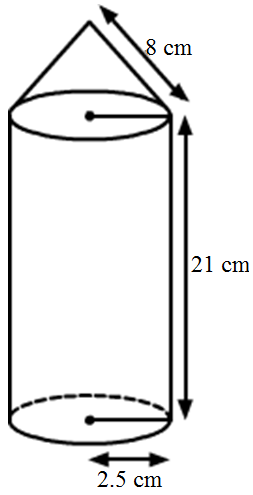
$\text{S}_1=\pi\text{rl}$
$= 3.14 \times 2.5 \times 8$
$= 62.8m^2$
The area of the cylinder $S_2$is given by
$\text{S}_2=2\pi\text{rh}+\pi\text{r}^2$
$= 3.14 \times 2.5 (2 \times 21 + 2.5)$
$= 349.33m^2$
Total area S is
$S = S_1 + S_2$
$= 62.8 + 349.33$
$= 412.13m^2$
Now, we are going to find the volume of the rocket V.
Volume of the cone is given by
$\text{V}_1=\frac{1}{3}\pi\text{r}^2\text{h}$
$=\frac{1}{3}\times3.14\times2.5^2\sqrt{8^2-2.5^2}$
$= 49.71m^3$ View full question & answer→Question 235 Marks
When the triangle is revolved about the side BC, then the base-radius, height and slant height of the produced cone becomes AB, BC and AC respectively. Therefore, the volume of the produced cone is
AnswerDiameter of base of conical tent = 14m
Radius (r) $=\Big(\frac{14}{3}\Big)=7\text{cm}$
Height (h) = 24 m
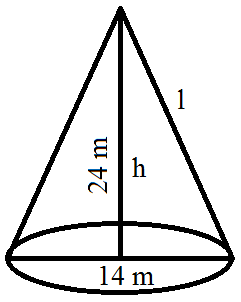
$\therefore$ slant height (l) $=\sqrt{\text{r}^2+\text{h}^2}=\sqrt{7^2+24^2}$
$=\sqrt{49+576}=\sqrt{625}=25\text{m}$
$\therefore$ Surface area $=\pi\text{rl}=\frac{22}{7}\times7\times25\text{m}^2$
$= 550m^2$
Width of cloth used = 5m
$\therefore$ Length of cloth used $=\frac{550}{5}=110\text{m}$
Rate of cloth = ₹ 25 per metre
$\therefore$ Total cost = ₹ 110 × 25 = ₹ 2750 View full question & answer→Question 245 Marks
If a cone of radius 10cm is divided into two parts by drawing a plane through the mid-point of its axis, parallel to its base. Compare the volumes of the two parts.
AnswerRadius of the cone ($r_1$) = 10cm
Cone is divided into 2 parts Such that PQ || AB
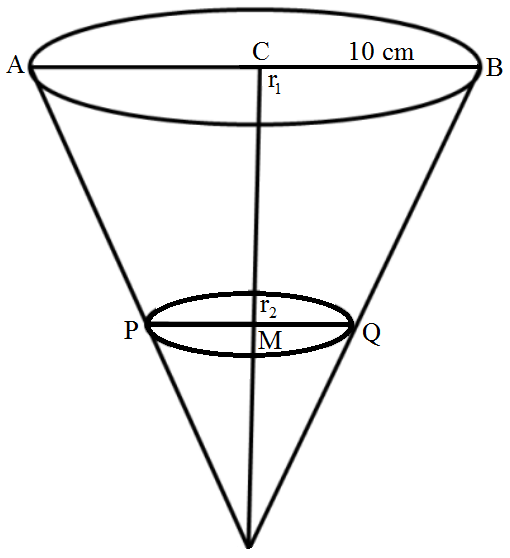
$\because$ Radius of the smaller cone
$(\text{r}_2)=\frac{10}{2}=5\text{cm}$
Let h be height of bigger cone
Then height of the smaller cone $=\frac{\text{h}}{2}$
$\therefore$ Volume of the cone $=\frac{1}{3}\pi\text{r}_1^2\text{h}=\frac{1}{3}\pi(10)^2\text{h}$
$=\frac{100}{3}\pi\text{h}...(1)$
And volume of smaller cone $=\frac{1}{3}\pi(5)^2\frac{\text{h}}{2}$
$=\frac{25}{6}\pi\text{h}...(2)$
Volume of the frustum so formed $=\frac{100}{3}\pi\text{h}$
$=\frac{25}{6}\pi\text{h}$
$=\frac{200-25}{6}\pi\text{h}$
$=\frac{175}{6}\pi\text{h}$
Now ratio of the volume of the smaller cone and frustum $=\frac{25}{6}\pi\text{h}:\frac{175}{6}\pi\text{h}$
$=1:7$ View full question & answer→Question 255 Marks
A solid is in the form of a right circular cylinder, with a hemisphere at one end and a cone at the other end. The radius of the common base is 3.5cm and the heights of the cylindrical and conical portions are 10cm. and 6cm, respectively. Find the total surface area of the solid. $\Big(\text{use}\ \pi=\frac{22}{7}\Big)$
AnswerWe have the following diagram
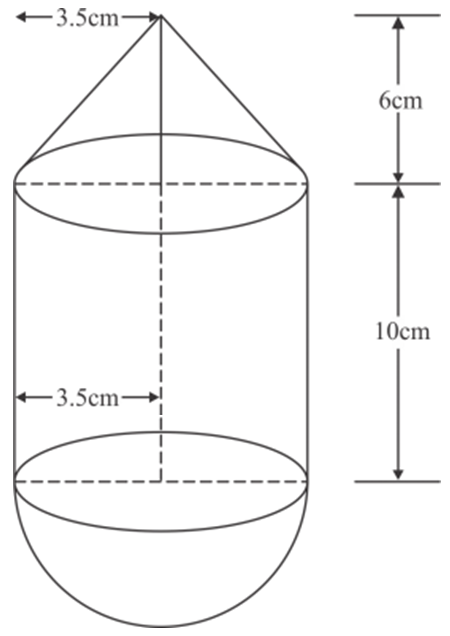
For cone, we have
r = 3.5cm
h = 6cm
$\text{l}=\sqrt{\text{r}^2+\text{h}^2}$
$=\sqrt{3.5^2+6^2}$
$=6.95\text{cm}$
Curved surface area of the cone is given as
$\text{S}_1=\pi\text{rl}$
$=\frac{22}{7}\times3.5\times6.946$
$=76.408\text{cm}^2$
For cylindrical part, we have
r = 3.5cm
h = 10cm
Curved surface area of the cylinder is
$\text{S}_2=2\pi\text{rh}$
$=2\times\frac{22}{7}\times3.5\times10$
$=220\text{cm}^2$
The surface area of the hemisphere is
$\text{S}_3=2\pi\text{r}^2$
$=2\times\frac{22}{7}\times3.5^2$
$77\text{cm}^2$
Total surface area of the solid is given by
$S = S_1 + S_2 + S_3$
$= 76.408 + 220 + 77$
$= 373.408cm^2$
Hence the total surface area of the solid is $S = 373.408cm^2$ View full question & answer→Question 265 Marks
Water flows at the rate of 10m/ minutes through a cylindrical pipe 5mm in diameter. How long would it take to fill a conical vessel whose diameter at the base is 40cm and depth 24cm?
AnswerGiven, speed of water flow =$ 10 m min^{-1}$ = 1000 cm/min
$\therefore$ Radius of the pipe
$=\frac{5}{10\times2}=0.25\text{cm}$
$\therefore$ Area of the face of pipe
$=\pi\text{r}^2=\frac{22}{7}\times(0.25)^2=0.1964\text{cm}^2$
Also, given diameter of the conical vessel = 40cm
$\therefore$ Volume of conical vessel
$=\frac{1}{3}\pi\text{r}^2\text{h}$
$=\frac{1}{3}\times\frac{22}{7}\times(20)^2\times24$
$=\frac{11200}{21}=10057.14\text{cm}^3$
$\therefore$ Required time
$=\frac{\text{Volume of the conical vessel}}{\text{Area of the face of pipe}\times\text{speed of water}}$
$=\frac{10057.14}{0.1964\times10\times100}$
$=51.20\ \text{min}=51\text{min}\frac{20}{100}\times60\text{s}$
$= 51\ \text{min}\ 12\text{s}$
View full question & answer→Question 275 Marks
A pen stand made of wood is in the shape of a cuboid with four conical depressions and a cubical depression to hold the pens and pins, respectively. The dimension of the cuboid are 10cm × 5cm × 4cm. The radius of each of the conical depression is 0.5cm and the depth is 2.1cm. The edge of the cubical depression is 3cm. Find the volume of the wood in the entire stand.
AnswerGiven that, length of cuboid pen stand (l) = 10cm
Breadth of cuboid pen stand (b) = 5cm
and height of cuboid pen stand (h) = 4cm
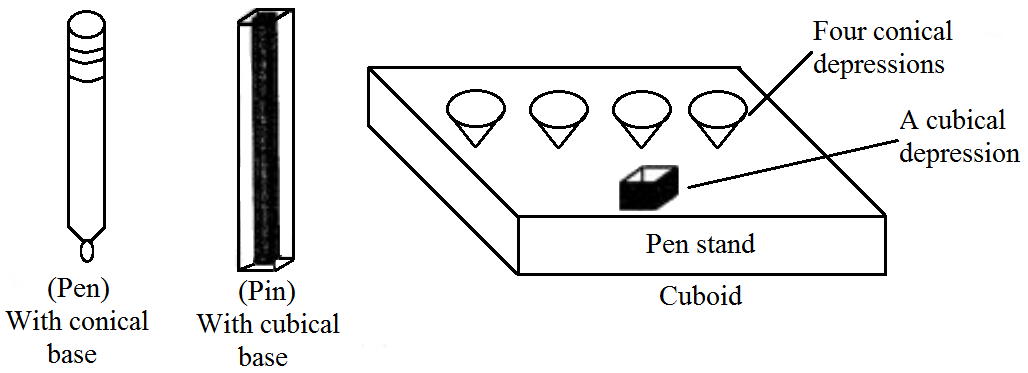
$\therefore$ Volume of cuboid pend stand $= l \times b \times h= 10 \times 5 \times 4 = 200cm^3$
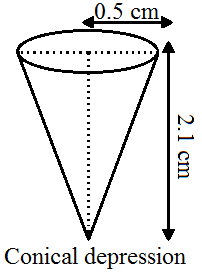
Also, radius of conical depression (r) = 0.5cm
and height (depth) of a conical depression $(h_1)$ = 2.1cm
$\therefore$ Volume of a conical depression $=\pi\text{rh}_1$
$=\frac{1}{3}\times\frac{22}{7}\times0.5\times0.5\times2.1$
$=\frac{22\times5\times5}{1000}=\frac{22}{40}=\frac{11}{20}=0.55\text{cm}^3$
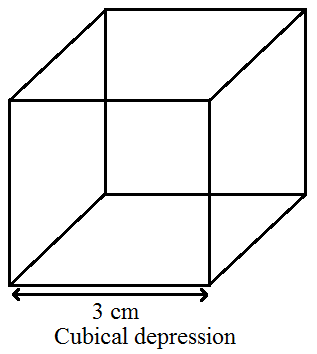
Also, given Edge of cubical depression (a) = 3cm
$\therefore$ Volume of cubical depression $= (a)^3 = (3)^3= 27cm^3$
So, volume of 4 conical depressions
= 4 × Volume of a conical depression
$=4\times\frac{11}{20}=\frac{11}{5}\text{cm}^3$
Hence, the volume of wood in the entire pen stand = volume of cuboid pen stand - volume of 4 conical depressions - Volume of a cubical depressions
$=200-\frac{11}{5}27=200-\frac{146}{5}$
$=200-29.2=170.8\text{cm}^3$
So, the required Volume of the wood in the entire stand is $170.8cm^3.$ View full question & answer→Question 285 Marks
The diameters of internal and external surfaces of a hollow spherical shell are 10cm and 6cm respectively. If it is melted and recast into a solid cylinder of length of 2cm, find the diameter of the cylinder.
AnswerDiameter of external surface of a sphere = 10cmand internal diameter = 6cm
$\therefore$ External radius (R) $\frac{10}{2}=5\text{cm}$
and internal radius (r) $=\frac{6}{2}=3\text{cm}$
$\therefore$ Volume of the metal used $=\frac{4}{3}\pi[\text{R}^3-\text{r}^3]$
$=\frac{4}{3}\pi[5^3-3^3]=\frac{4}{3}\pi(125-27)\text{cm}^3$
$=\frac{4}{3}\pi\times98=\frac{392\pi}{3}\text{cm}^3$
$\therefore$ Volume of solid cylinder so formed $=\frac{392}{3}\pi\text{cm}^3$
length (hieght) of cylinder (h) $=2\frac{2}{3}\text{cm}$
$=\frac{8}{3}\text{cm}$
Let r be its radius, then
$\pi\text{r}^2\text{h}=\frac{392}{3}\pi\Rightarrow\pi\text{r}^2\times\frac{8}{3}=\frac{392}{3}\pi$
$\Rightarrow\text{r}^2=\frac{392}{3}\times\frac{3}{8}=49$
$\therefore\text{r}=\sqrt{49}=7$
$\therefore\text{Diameter}=2\text{r}=2\times7=14\text{cm}$
View full question & answer→Question 295 Marks
A solid is composed of a cylinder with hemispherical ends. If the length of the whole solid is 108cm and the diameter of the cylinder is 36cm, find the cost of polishing the surface at the rate of 7 paise per $cm^2$.
AnswerTotal height of the solid = 108cm
Each diameter of base of hemispherical part = 36cm
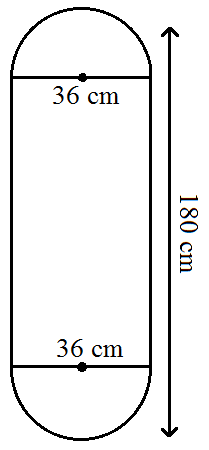
$\therefore$ Radius (r) $=\frac{36}{2}=18\text{cm}$
height of cylindrical part (h)
= 108 - 2 × 18cm
= 180 - 36 = 72cm
Now total surface area of the solid = surface area of two hemispherical parts + curved surface area of cylindrical part
$=2\times2\pi\text{r}^2+2\pi\text{rh}=4\pi\text{r}^2+2\pi\text{rh}$
$=2\pi\text{r}(2\text{r}+\text{h})$
$= 2 \times 3.1416 \times 18 [2 \times 18 + 72]cm^2$
$= 36 \times 3.1416 [36 + 72]cm^2$
$= 36 \times 3.1416 \times 108cm^2$
$= 36 \times 3.1416cm = 12214.5480cm^2$
Cost $1cm^2$ for polishing the surface = 7paise
$\therefore$ Total cost = Rs. 12214.5408 × $\frac{7}{100}$
= Rs. 855.017856 = Rs. 855.02 View full question & answer→Question 305 Marks
A solid toy is in the form of a hemisphere surmounted by a right circular cone. The height of cone is 4cm and the diameter of the base is 8cm. Determine the volume of the toy. If a cube circumscribes the toy, then find the difference of the volumes of cube and the toy. Also, find the total surface area of the toy.
AnswerLet r be the radius of the hemisphere and the cone and h be the height of the cone.
Volume of the toy=Volume of the hemisphere + Volume of the cone
$=\frac{2}{3}\pi\text{r}^3+\frac{1}{3}\pi\text{r}^2\text{h}$
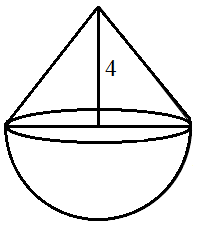
$=\Big(\frac{2}{3}\times\frac{22}{7}\times4^3+\frac{1}{3}\times\frac{22}{7}\times4^2\times4\Big)\text{cm}^3$
$=\Big(\frac{1408}{7}\Big)\text{cm}^3$
A cube circumsrcibes the given solid. Therefore, edge of the cube should be 8cm. Volume of the cube = 83cm3 = 512cm3 Difference in the volume of the cube and
The toy $=\Big(512-\frac{1408}{7}\Big)\text{cm}^3=310.86\text{cm}^3$
Total surface area of the toy = curved surface area of cone + curved surface area of hemisphere
$=\pi\text{rl}+2\pi\text{r}^2,\text{where}\ \text{l}=\sqrt{\text{h}^2+\text{r}^2}$
$=\pi\text{r}(\text{l}+2\text{r})$
$=\frac{22}{7}\times4\times\Big(\sqrt{4^2+4^2}+2\times4\Big)$
$=\frac{22}{7}\times4\times\Big(4\sqrt{2}+8\Big)$
$=\frac{22}{7}\times4\times(13.65)$
$=171.68\text{cm}^2$ View full question & answer→Question 315 Marks
A solid wooden toy is in the form of a hemisphere surmounted by a Cone of same radius. The radius of hemisphere is 3.5cm and the total wood used in the making of toy is $166\Big(\frac{5}{6}\Big)\text{cm}^3.$ Find the height of the toy. Also, find the cost of painting the hemispherical part of the toy at the rate of ₹10 per $cm^2.$
Answer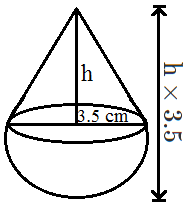
Volume of toy $=166\frac{5}{6}\text{cm}^3=\frac{1001}{6}\text{cm}^3$
Radius of the hemisphere = 3.5cm
Let h be the height of cone
then volume of wood used
$=\frac{1}{3}\pi\text{r}^2\text{h}+\frac{2}{3}\pi\text{r}^3$
$=\frac{1}{3}\times\frac{22}{7}\times(3.5)^2\times\text{h}+\frac{2}{3}\times\frac{22}{7}\times(3.5)^3$
$=\frac{22}{21}(3.5)^2[\text{h}+2\times3.5]$
$=\frac{22}{21}\times\frac{1225}{100}(\text{h}+7)=\frac{1001}{6}$
$\text{h}+7=\frac{1001}{6}\times\frac{21\times100}{22\times1225}=13\text{cm}$
$\therefore\text{h}=13-7=6\text{cm}$
and total height of the toy = 6 + 3.5 = 9.5cm
Surface area of hemisphere part $=2\pi\text{r}^2$
$=2\times\frac{22}{7}\times3.5\times3.5\text{cm}^2$
$=\frac{2\times22}{7}\times\frac{7}{2}\times\frac{7}2{}\text{cm}^2=77\text{cm}^2$
rate of painting the surface are = ₹ $10cm^2$
Total cost = ₹ 77 × ₹ 10 = ₹ 770 View full question & answer→Question 325 Marks
What length of a solid cylinder 2cm in diameter must be taken to recast into a hollow cylinder of length 16cm, external diameter 20 cm and thickness 2.5mm?
AnswerWe are given a solid cylinder of, diameter = 2cmWe have to recast it into a hollow cylinder of length = 16cm
External Diameter = 20cm and thickness = 2.5mm=0.25cm
We have to find the height of the solid cylinder that can be used to get a hollow cylinder of the desired dimensions.
Volume of a solid cylinder $=\pi\text{r}^2\text{h}$
So,
The volume of the given solid cylinder $=\pi(1)^2\text{h}\ ...\text({a})$
Here, height h has to be found.
Volume of a hollow cylinder $=\pi\text{h}(\text{R}^2-\text{r}^2)$
Where R is the external radius and r is the internal radius.
External radius is given. Thickness of the hollow cylinder is also given. So, we can find the internal radius of the hollow cylinder.
⇒ Thickness = R−r
⇒ 0.25 = 10 - r
⇒ r = 9.75cm
So, the volume of the hollow cylinder $=\pi\times16\times(100-95.0.625)\ ...(\text{b})$
From (a) and (b) we get,
$\pi(1)^2\text{h}=\pi\times16\times(100-95.0625)$
$\pi\text{h}=\pi\times16\times(100-95.0625)$
$\text{h}=16\times(4.9375)$
$\text{h}=79\text{cm}$
Hence, the required height of the solid cylinder is h = 79cm
View full question & answer→Question 335 Marks
A frustum of a right circular cone has a diameter of base 20cm, of top 12cm, and height 3cm. Find the area of its whole surface and volume.
AnswerThe radii of the bottom and top circles are $r_1=10 cm$ and $r_2=6 cm$ respectively. The height of the frustum cone is $h =3 cm$. Therefore, the volume of the bucket is
$\text{V}=\frac{1}{3}\pi \big(\text{r}^2_1+\text{r}_1\text{r}_2+\text{r}^2_2\big)\times\text{h}$
$=\frac{1}{3}\pi \big(10^2+10\times6+6^2\big)\times3$
$=\frac{1}{3}\times\frac{22}{7}\times196\times3$
$=616\text{cm}^3$
Hence volume $= 616cm^3$
The slant height of the bucket is
$\text{l}=\sqrt{(\text{r}_1-\text{r}_2)^2+\text{h}^2}$
$=\sqrt{(10-6)^2+3^2}$
$=\sqrt{25}$
$= 5\text{cm}$
The total surface area of the frustum cone is
$=\pi (\text{r}_1+\text{r}_2)\times\text{l}+\pi\text{r}^2_1+\times\pi\text{r}^2_2$
$=\frac{22}{7}\times(10+6)\times5+\frac{22}{7}\times10^2+\frac{22}{7}\times6^2$
$=\frac{4752}{7}$Square cm
= 678.85 Square cm
Hence, Total surface area = 678.85
View full question & answer→Question 345 Marks
A tent consists of a frustum of a cone capped by a cone. If the radii of the ends of the frustum be 13m and 7m, the height of the frustum be 8m and the slant height of the conical cap be 12m, find the canvas required for the tent.$\Big(\text{use}\ \pi=\frac{22}{7}\Big)$
AnswerRadius of the bottom of the tent $\left(r_1\right)=13 m$
and radius of the top $\left( r _2\right)=7 m$
Height of frustum portion $\left(h_1\right)=8 m$
Slant height of the conical cap $\left(I_2\right)=12 m$
Let $l_1$ be the slant height of the frustum portion, then
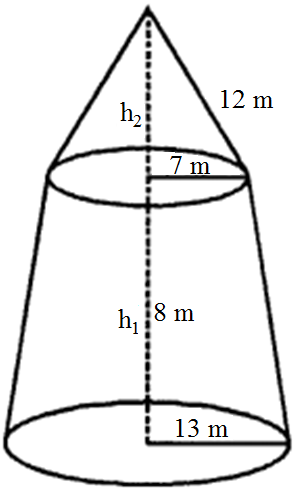
$\text{l}_1=\sqrt{(\text{h})^2+(\text{r}_1-\text{r}_2)^2}$
$=\sqrt{(8)^2+(13-7)^2}=\sqrt{(8)^2+(6)^2}$
$=\sqrt{(8)^2+(13-7)^2}=\sqrt{(8)^2+(6)^2}$
Now surface area of the whole tent
$=\pi(\text{r}_1+\text{r}_2)\text{l}_1+\pi\text{r}_2\text{l}_2 $
$=\pi \big[(13+7)\times10\big]+\pi (7)(12)$
$=\pi \big[20\times10\big]+\pi (84)$
$=200\pi+84\pi=287\pi\text{m}^2$
$=284\times\frac{22}{7}=\frac{6284}{7}=892.57\text{m}^2$ View full question & answer→Question 355 Marks
A right angled triangle with sides 3cm and 4cm is revolved around its hypotenuse. Find the volume of the double cone thus generated.
AnswerIn right angled $\triangle\text{ABC}$ ,$ \angle\text{B}=90°$
AB = 3cm and BC = 4cm
$\therefore$ Diagonal CA $=\sqrt{\text{AB}^2+\text{BC}^2}$ (pythagoras theorem)
$=\sqrt{(3)^2+(4)^2}=\sqrt{9+16}=\sqrt{25}=5\text{cm}$
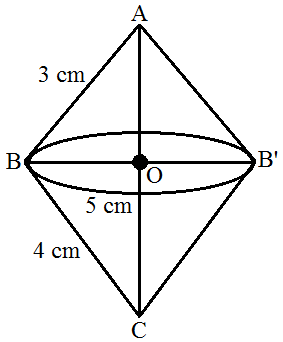
We get double cones as shown in the figure BB' is joined which bisects by AC ar O at right angles
In $\triangle\text{ABC},\angle\text{B}=90^\circ$
$\therefore$ area $(\triangle\text{ABC})=\frac{3\times4}{2}=6\text{cm}^2$
and area $(\triangle\text{ABC})=\frac{1}{2}\text{AC}\times\text{BO}$
$\Rightarrow6=\frac{1}{2}\times5\times\text{BO}$
$\Rightarrow\text{BO}=\frac{6\times2}{5}=\frac{12}{5}=2.4\text{cm}$
$\therefore$ Radius of cone along AO is BO which iscm and Also along CO is BO which is 2.4cm Now volumes of two cones so formes
$=\frac{1}{3}\pi\text{r}^2\times\text{AO}+\frac{1}{3}\pi\text{r}^2\times\text{CO}$
$=\frac{1}{3}\pi\text{r}^2(\text{AO}+\text{CO})=\frac{1}{3}\pi\text{r}^2\times\text{AC}$
$=\frac{1}{3}\times\frac{22}{7}\times(2.4)^2\times5\text{cm}^3$
$=\frac{22}{21}\times5.76\times5\times\text{cm}^3=\frac{110\times1.92}{7}\text{cm}^2$
$=\frac{211.20}{7}\text{cm}^3$
$=\frac{211.20}{7}\text{cm}^3$
$=\frac{21120}{7\times100}=\frac{1056}{35}\text{cm}^3$
$=30\frac{6}{35}\text{cm}^3$ View full question & answer→Question 365 Marks
The volume of a hemi-sphere is 2425cm$^3$. Find its curved surface area. $\Big(\text{use}\ \pi=\frac{22}{7}\Big)$
AnswerGiven that volume of a hemisphere $=2424\frac{1}{2}\text{cm}^3$
Volume of a hemisphere $=\frac{2}{3}\pi\text{r}^3$
$\Rightarrow\frac{2}{3}\pi\text{r}^3=2425\frac{1}{2}$
$\Rightarrow\frac{2}{3}\pi\text{r}^3=\frac{4851}{2}$
$\Rightarrow\text{r}^3=\frac{4851\times3}{2\times2\times\pi}$
$\Rightarrow\text{r}^3=\frac{4851\times3}{4\pi}$
$\text{r}^3=157.625$
$\text{r}=10.50\text{cm}$
$\therefore$ Radius of hemisphere = 10.5cm
Curved surface area of hemisphere $=2\pi\text{r}^2$
$=2\pi(10.5)^2$
$= 692.72$
$\Rightarrow 693cm^2$
$\therefore$ curved surface area of hemisphere = 693cm$^2$
View full question & answer→Question 375 Marks
A cylindrical road roller made of iron is 1 m long, Its internal diameter is 54 cm and the thickness of the iron sheet used in making the roller is 9 cm . Find the mass of the roller, if $1 cm^3$ of iron has 7.8 gm mass. (use $\pi=3.14$ )
Answer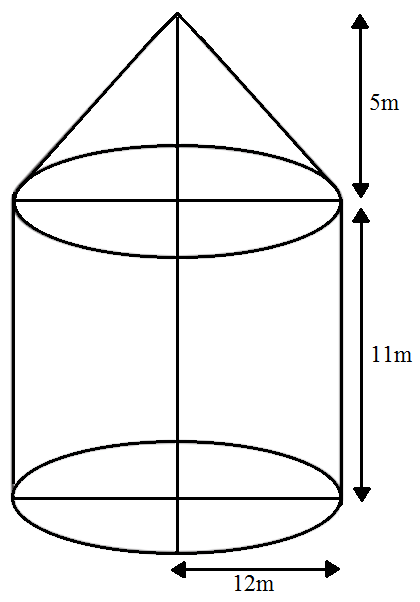
Given internal radius of cylinder road roller $(r_1)$ $=\frac{54}{2}=27\text{cm}$
Given thickness of road roller $\Big(\frac{1}{\text{b}}\Big)=9\text{cm}$
Let order radii of cylinderical road roller be R.
$\Rightarrow t = R - r$
$\Rightarrow 9 = R - 27$
$\Rightarrow R = 9 + 27 = 36cm$
$\Rightarrow R = 36cm$
Given height of cylindrical road roller (h) = 1m
h = 100cm
Volume of iron $=\pi\text{h}(\text{R}^2-\text{r}^2)$
$\pi(36^2-27^2)\times100$
$=1780.38\text{cm}^3$
Volume of iron = 1780.38cm$^3$
Mass of 1cm$^3$ of iron = 7.8gm
Mass of 1780.38cm$^3$of iron = 1780.38 × 7.8
= 1388696.4gm
= 1388.7kg
$\therefore$ Mass of roller (m) = 1388.7kg View full question & answer→Question 385 Marks
2.2 cubic dm of brass is to be drawn into a cylindrical wire 0.25cm in diameter. Find the length of the wire.
AnswerGiven that 2 × 2dm$^3$ of grass is to be drawn into a cylindrical wire 0.25cm in diameter.
Given diameter of cylindrical wire = 0.25cm
$\text{Radius of wire}(\text{r})=\frac{\text{d}}{2}=\frac{0.25}{2}=0.125\text{cm}$
$=0.125\times10^{-2}\text{m}$
we have to find length of wire?
Volume of brass of 2.2dm$^3$ is equal to volume of cylindrical wire.
$\frac{22}{7}(0.125\times10^{-2})\text{h}=2.2\times10^{-3}$
$\Rightarrow\text{h}=\frac{2.2\times10^{^3}\times7}{2(0.125\times10^{-2})^2}$
$\therefore$ Length of cylindrical wire = 448m
View full question & answer→Question 395 Marks
A well with inner radius 4m is dug 14m deep. Earth taken out of it has been spread evenly all around a width of 3m it to form an embankment. Find the height of the embankment.
AnswerGiven that inner radius of a well (a) = 4m
Depth of a well (h) = 14m
Volume of a cylinder $=\pi\text{r}^2\text{h}$
$\text{V}_1=\pi(4)^2\times14\text{m}^3\ ...(1)$
Given well is spread evenly to form an embankment
Width of an embankment = 3m
Outer radii of a well (R) = 4 + 3 = 7m
Volume of hollow cylinder$=\pi(\text{R}^2-\text{r}^2)\times\text{hm}^3$
$\text{V}_2=\pi(7^2-4^2)\times\text{h m}^3$
Equating (1) and (2)
$V_1 = V_2$
$\Rightarrow\pi(4)^2\times14=\pi(49-16)\times\text{h}$
$\Rightarrow\text{h}=\frac{\pi(4)^2\times14}{\pi(33)}$
$\text{h}=6.78\text{m}$
View full question & answer→Question 405 Marks
The radii of the circular bases of a frustum of a right circular cone are 12cm and 3cm and the height is 12cm. Find the total surface area and the volume of the frustum.
AnswerThe height of the frustum cone is h = 12cm. The radii of the bottom and top circles are $r_1$ = 12cm and $r_2$ = 3cm respectively.
The slant height of the frustum cone is
$\text{l}=\sqrt{\big(\text{r}_1-\text{r}_2\big)^2+\text{h}^2}$
$=\sqrt{\big(12-3\big)^2+12^2}$
$=\sqrt{225}$
$=15\text{cm}$
The total surface area of the frustum cone is
$=\pi\big(\text{r}_1+\text{r}_2\big)\times\text{l}+\pi\text{r}^2_2+\pi\text{r}^2_2$
$ =\pi\times\big(12+3\big)\times15+\pi\times12^2+\pi\times3^2$
$ =\pi\times225\times26+144\pi\times9\pi$
$=378\pi\text{cm}^2$
Hence, Tolal surface area $ =378\pi\ \text{cm}^2$
The volume of the frustum cone is
$\text{V} =\frac{1}{3}\pi \big(\text{r}^2_1+\text{r}_1\text{r}_2+\text{r}^2_2\big)\times\text{h}$
$ =\frac{1}{3}\pi \big({12}^2+12\times3+3^2\big)\times12$
$ =\frac{1}{3}\pi\times189\times12$
$=756\pi\text{cm}^3$
Hence, Volume of frustum $=756\pi \ \text{cm}^3$
View full question & answer→Question 415 Marks
A tent of height 77dm is in the form of a right circular cylinder of diameter 36m and height 44dm surmounted by a right circular cone. Find the cost of the canvas at Rs. 3.50 per m$^2$ $\Big(\text{use}\ \pi=\frac{22}{7}\Big)$
AnswerTotal height of the tent = 77dm
Height of cylindrical part $(h_1)$ = 44dm
= 4.4m
Height of conical part $(h_2)$ = 7.7 – 4.4 = 3.3m
Diameter of the base of the tent = 36m
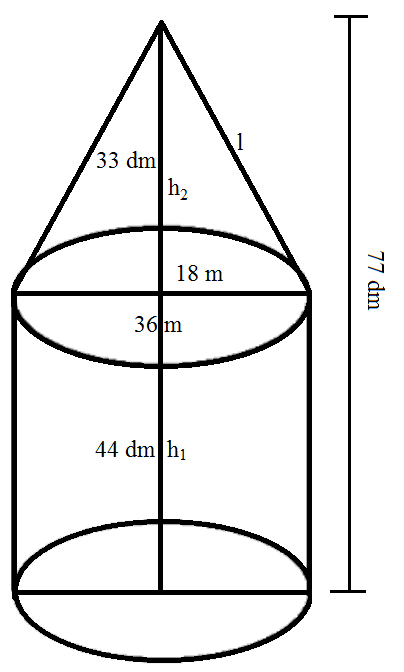
$\therefore$ Radius (r) $=\frac{36}{2}=18\text{m}$
Slant height on the conical part (l)
$=\sqrt{\text{r}^2+\text{h}^2_2}$
$=\sqrt{(18)^2+(3.3)^2}=\sqrt{324+10.89}$
$=\sqrt{334.89}=18.3\text{m}$
Now surface area of the tent = curved surface area of the cylindrical part and curved surface are of the conical part
$=2\pi\text{r}\text{h}_1=\pi\text{r}\text{l}$
$=2\times\frac{22}{7}\times18\times4.4+\frac{22}{7}\times18\times18.3\text{m}^2$
$=\frac{22}{7}\times18[2\times4.4+18.3]$
$=\frac{396}{7}(8.8+18.3)\text{m}^2$
$=\frac{396}{7}\times27.1\text{m}^2=1533.085\text{m}^2$
Rate of canvas = Rs. 3.50 per $m^2$
$\therefore$ Total cost = Rs. 1533.085 × 3.50
= Rs. 5365.7975 = Rs. 5365.80. View full question & answer→Question 425 Marks
The diameters of the internal and external surfaces of a hollow spherical shell are 6cm and 10cm respectively. If it is melted and recast into a solid cylinder of diameter 14cm. find the height of the cylinder.
AnswerOuter diameter of hollow spherical shell = 10cm
and inner diameter = 6cm
Outer radius (R) $=\frac{10}{2}$ = 5cm 6
and inner radius (r) $=\frac{6}{2}$ = 3cm
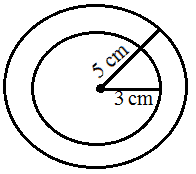
$\therefore\text{volume of metal used}=\frac{4}{3}\pi(\text{R}^3-\text{r}^3$
$=\frac{4}{3}\pi[5^3-3^3]$
$=\frac{4}{3}\pi[125-27]=\frac{4}{3}\pi\times98\text{cm}^3$
Now volume of solid cylinder $=\frac{4}{3}\pi\times98\text{cm}^3$
Diameter = 14cm
$\therefore\text{radius}(\text{r}_1)=\frac{14}{2}=7\text{cm}$
let h beits height then $\pi\text{r}^2_1\text{h}=\frac{4}{3}\pi\times98$
$\Rightarrow\pi{7}^2\text{h}=\frac{4}{3}\pi\times98$
$\Rightarrow49\pi\text{h}=\frac{98\times4}{3}\pi$
$\Rightarrow\text{h}=\frac{98\times4\pi}{3\times49\times\pi}=\frac{8}{3}$
$\therefore$ Hieght of solid cylinder $=\frac{8}{3}\text{cm}$ View full question & answer→Question 435 Marks
A heap of rice in the form of a cone of diameter 9m and height 3.5m. Find the volume of rice. How much canvas cloth is required to cover the heap?
AnswerThe heap of rice is in the form of a cone. Diameter, d = 9m radius, $\text{r}=\frac{9}{2}\text{m}$$\text{height},=3.5\text{m}$
Volume, $\text{V}=\frac{1}{3}\pi\text{r}^2\text{h}$ $\frac{1}{3}\pi\Big(\frac{9}{2}\Big)^2\times3.5$$=74.25\text{m}^3$
Thus, volume of rice = 74.25m$^3$ The canvas cloth required to cover the heap will be the curved surface area of the cone. $\text{l}=\sqrt{\text{h}^2+\text{r}^2}$ $\text{l}=\sqrt{3.5^2+\Big(\frac{9}{2}\Big)^2}$ $\text{l}=\sqrt{12.25+20.25}$$\text{l}=5.7\text{m}$
$\text{CSA}=\pi\text{rl}$ $=\pi\times\Big(\frac{9}{2}\Big)\times5.7$$=80.62\text{m}^2$
Hence, the canvas cloth required to cover the heap will be $80.62m^2$
View full question & answer→Question 445 Marks
A right circular cylinder and aright circular cone have equal bases and equal heights. If their curved surfaces are in the ratio 8 : 5, determine the ratio of the radius of the base to the height of either of them.
AnswerLet r and h be the radius and height of a cylinder and a cone respectively
$\therefore$ Slant height of cone $=\sqrt{\text{r}^2+\text{h}^2}$
Now curved surface area of cylinder $=2\pi\text{rh}$
and cureved surface area of cone $=\pi\text{rl}$
$=\pi\text{r}\sqrt{\text{r}^2+\text{h}^2}$
$\because$ their ratio is 8 : 5
$\therefore\frac{2\pi\text{rh}}{\pi\text{r}\sqrt{r^2+\text{h}^2}}=\frac{8}{5}\Rightarrow\frac{2\text{h}}{\sqrt{r^2+\text{h}^2}}=\frac{8}{5}$
$\Rightarrow\frac{4\text{h}^2}{\text{r}^2+\text{h}^2}=\frac{64}{25}$ (squaring both side)
$\Rightarrow\frac{\text{h}^2}{\text{r}^2+\text{h}^2}=\frac{16}{25}$ (Dividing by 4)
$\Rightarrow25\text{h}^2=16\text{r}^2+16\text{h}^2$
$\Rightarrow25\text{h}^2-16\text{h}^2=16\text{r}^2\Rightarrow9\text{h}^2=16\text{r}^2$
$\Rightarrow\frac{\text{r}^2}{\text{h}^2}=\frac{9}{16}\Rightarrow\Big(\frac{\text{r}}{\text{h}}\Big)^2=\Big(\frac{3}{4}\Big)^2$
$\therefore\frac{\text{r}}{\text{h}}=\frac{3}{4}\Rightarrow\text{r}:\text{h}=3:4$
$\therefore$ Ratio of r and h = 3 : 4
View full question & answer→Question 455 Marks
A right circular cylinder and a right circular cone have equal bases and equal heights. If their curved surfaces are in the ratio 8 : 5, determine the ratio of the radius of the base to the height of either of them.
AnswerLet r and h be the radius and height of a circular cylinder and also of a cone, then curved
surface area of the cylinder $=2\pi\text{rh}$
and curved surface area of cone
$=\pi\text{rl}=\pi\text{r}\sqrt{\text{h}^2+\text{r}^2}$
but they are in the ratio 8 : 5
$\frac{2\pi\text{rh}}{\pi\text{r}\sqrt{\text{h}^2+\text{r}^2}}=\frac{8}{5}\Rightarrow\frac{2\text{h}}{\sqrt{\text{h}^2+\text{r}^2}}=\frac{8}{5}$
$\frac{4\text{h}^2}{\text{h}^2+\text{r}^2}=\frac{64}{25}$ (squaring on both sides)
$\frac{\text{h}_2}{\text{h}^2+\text{r}^2}=\frac{16}{25}$
$\Rightarrow25\text{h}^2=16\text{h}^2+16\text{r}^2$
$\Rightarrow25\text{h}^2-16\text{h}^2=16\text{r}^2$
$\Rightarrow9\text{h}^2=16\text{r}^2$
$\Rightarrow\frac{\text{r}^2}{\text{h}^2}=\frac{9}{16}=\Big(\frac{3}{4}\Big)^2$
$\Rightarrow\frac{\text{r}}{\text{h}}=\frac{3}{4}$
$\therefore$ Ratio of r and h = 3 : 4
Hence ratio of radius and height = 3 : 4.
View full question & answer→Question 465 Marks
A cylindrical bucket, 32cm high and 18cm of radius of the base, is filled with sand. This bucket is emptied on the ground and a conical heap of sand is formed. If the height of the conical heap is 24cm, find the radius and slant height of the heap.
AnswerGiven that Height of cylinder bucket (h) = 32cm
Radius (r) = 18cm
Volume of cylinder $=\pi\text{r}^2\text{h}$
$=\frac{22}{7}(18)^2\times32\text{cm}^2\ ...(1)$
Given height of conical heap = 24cm
Let radius of conical heap be $r_1$
Slant height of conical heap be $l_1$
$\Rightarrow\text{l}^2_1=\text{r}^2_1+\text{h}^2_1$
$\Rightarrow\text{r}^2_1=\text{l}^2_1+\text{h}^2_1$
$\Rightarrow\text{r}^2_1=\text{l}^2_1-(24)^2\ ...(2)$
Volume of cone $=\frac{1}{3}\pi\text{r}^2\text{h}$
So its volume $=\frac{1}{3}\pi\text{r}^2_1\text{h}_1$
$=\frac{1}{3}\times\frac{22}{7}\times\text{r}^2_1\times24$
$=\frac{22}{7}\times\text{r}^2_1\times8\text{cm}^3\ ...(3)$
So equating (1) and (3)
(1) = (3)
$\Rightarrow\frac{22}{7}(18)^2\times32=\frac{22}{7}\times\text{r}^2_1\times8$
$\Rightarrow\frac{(18)^2\times32}{8}=\text{r}^2_1$
$\Rightarrow\text{r}^2_1=1296$
$\Rightarrow\text{r}_1=36\text{cm}$
Radius of conical heap is 36cm
substituting $r_1$ in (2)
$\Rightarrow\text{r}^2_1=\text{l}^2_1-(24)^2$
$\Rightarrow1296=\text{l}^2_1-576$
$\Rightarrow1296+576=\text{l}^2_1$
$\Rightarrow1872=\text{l}^2_1$
$\Rightarrow\text{l}_1=43.26\text{cm}$
$\therefore$ Slant height of conical heap = 43.26cm.
View full question & answer→Question 475 Marks
A well of diameter 2m is dug 14m deep. The earth taken out of it is spread evenly all around it to form an embankment of height 40cm. Find the width of the embankment.
AnswerDiameter of well = 2m
$\therefore\text{Radius(r)}=\frac{2}{2}=1\text{m}$
$\text{Depth(h)}=14\text{m}$
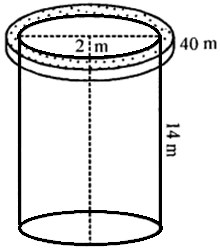
$\therefore$ Volume of earth dug out $=\pi\text{r}^2\text{h}$
$\frac{22}{7}\times1\times1\times14=44\text{m}^3$
Now height of embankment = 40cm
$=\frac{40}{100}=\frac{2}{5}\text{m}$
Let width of embankment = x m
$\therefore$ outer radius (R) = (1+ x) m
$\therefore$ Volume of earth used in embankment
$=\pi(\text{R}^2-\text{r}^2)\times\text{h}$
$\therefore\pi\text{h}(\text{R}^2-\text{r}^2)=44$
$\Rightarrow\frac{22}{7}\times\frac{2}{5}[(1+\text{x})^2-(1)^2]=44$
$\Rightarrow1+\text{x}^2+2\text{x}=1=44\times\frac{7\times5}{22\times2}=35$
$\Rightarrow\text{x}^2+2\text{x}-35=0\Rightarrow\text{x}^2+7\text{x}=5\text{x}-35=0$
$\Rightarrow\text{x}(\text{x}+7)-5(\text{x}+7)=0\Rightarrow(\text{x}+7)(\text{x}-5)=0$
Either x + 7 = 0, then x = -7 which is not possible being negative or x - 5 = 0, then x = 5
$\therefore$ Width of embankment = 5m. View full question & answer→Question 485 Marks
A toy is in the form of a hemisphere surmounted by a right circular cone of the same base radius as that of the hemisphere. If the radius of the base of the cone is 21cm and its volume is $\frac{2}{3}$ of the volume of hemisphere, calculate the height of the cone and the surface area of the toy.
AnswerLet the height of the conical part be h.
Radius of the cone = Radius of the hemisphere = r = 21cm
The toy can be diagrammatically represented as
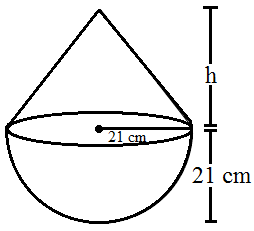
Volume of the cone $=\frac{1}{3}\pi\text{r}^2\text{h}$
Volume of the hemisphere $=\frac{2}{3}\pi\text{r}^3$
According to given information:
Volume of the cone $=\frac{2}{3}.$ Volume of the hemisphere
$\therefore\frac{1}{3}\pi\text{r}^2\text{h}=\frac{2}{3}\times\frac{2}{3}\pi\text{r}^3$
$\Rightarrow\text{h}=\frac{\frac{2}{3}\times\frac{2}{3}\pi\text{r}^3}{\frac{1}{3}\pi\text{r}^2}$
$\Rightarrow\text{h}=\frac{4}{3}\text{r}$
$\therefore\text{h}=\frac{4}{3}\times21\text{cm}=28\text{cm}$
Thus, surface area of the toy = Curved surface area of cone + Curved surface area of hemisphere
$=\pi\text{rl}+2\pi\text{r}^2$
$=\pi\text{r}\sqrt{\text{h}^2+\text{r}^2}+2\pi\text{r}^2$
$=\pi\text{r}(\sqrt{\text{h}^2+\text{r}^2}+2\text{r}$
$=\frac{22}{7}\times21\text{cm}(\sqrt{(28\text{cm})^2+(21\text{cm})^2}+2\times21\text{cm})$
$=66(\sqrt{784+441}+42)\text{cm}^2$
$=66(\sqrt{1225}+42)\text{cm}^2$
$=66(35+42)\text{cm}^2$
$=66\times77\text{cm}^2$
$=5082\text{cm}^2$ View full question & answer→Question 495 Marks
The difference between the outer and inner curved surface areas of a hollow right circular cylinder 14 cm long is $88 cm^2$. If the volume of metal used in making the cylinder is $176 cm^3$, find the outer and inner diameters of the cylinder. (use $\pi=\frac{22}{7}$ )
AnswerThe height of the hollow cylinder is 14cm. Let the inner and outer radii of the hollow cylinder are r cm and R cm respectively. The difference between the outer and inner surface area of the hollow cylinder is $=2\pi\text{R}\times14-2\pi\text{r}\times14$ $=28\pi(\text{R}-\text{r})\text{cm}^2$ By the given condition, this difference is 88 square cm. Hence, we have $=28\pi\Big(\text{R}-\text{r}\Big)=88$ $\Rightarrow\text{R}-\text{r}=\frac{44\times7}{14\times22}$ $\Rightarrow\text{R}-\text{r}=\frac{44\times7}{14\times22}$ $\Rightarrow\text{R}-\text{r}=1$ The volume of the metal used in making the cylinder is $\text{V}_1=\pi\{(\text{R})^2-(\text{r})^2\}\times14\text{cm}^3$ By the given condition, the volume of the metal is 176 cubic cm. Hence, we have $\pi\{(\text{R})^2-(\text{r}^2)\}\times14=176$ $\Rightarrow\text{R}^2-\text{r}^2=\frac{176\times7}{14\times22}$ $\Rightarrow\text{R}^2-\text{r}^2=4$ $\Rightarrow(\text{R}-\text{r})(\text{R}+\text{r})=4$$\Rightarrow1\times(\text{R}+\text{r})= 4$
$\Rightarrow\text{R}+\text{r}=4$
Hence, we have two equations with unknowns R and r R - r = 1 R + r = 4 Adding the two equations, we have (R - r) + (R + r) = 1 + 4 ⇒ 2R = 5 ⇒ R = 2.5 Then from the second equation, we have r = 4 - 2.5 = 1.5 Therefore, the outer and inner diameters of the hollow cylinder are 5cm and 3cm respectively.
View full question & answer→Question 505 Marks
The radius of the base of a right circular cone of semi-vertical angle α is r. Show that its volume is $\pi\text{r}^2 \cot\ \text{a}$ and curved surface area is $\pi\text{r}^2\text{cosec a}.$
AnswerRadius of circular cone = r and semi vertical angle = α Let AO = h and slant height AC = l In $\triangle\text{AOC},\text{AO}\bot\text{BC}$ 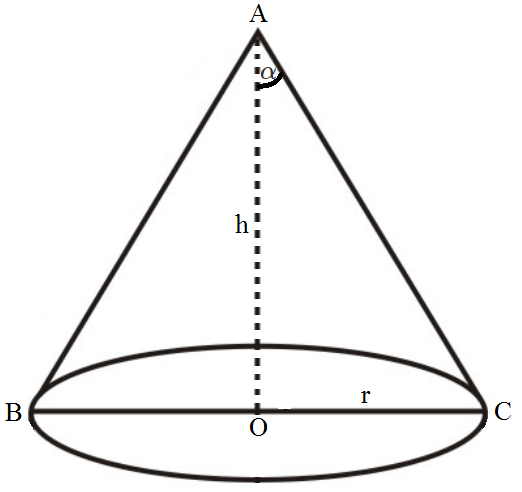
$\cot\text{a}=\frac{\text{AO}}{\text{OC}}$ $\Rightarrow\cot\text{a}=\frac{\text{h}}{\text{r}}\Rightarrow\text{h}=\text{r}\cot\text{a}$ Now volume $=\frac{1}{3}\pi\text{r}^2\text{h}=\frac{1}{3}\pi\text{r}^2\times\text{r}\cot\text{a}$ $=\frac{1}{3}\pi\text{r}^3\times\text{r}\cot\text{a}$ Now $\sin\text{a}=\frac{\text{OC}}{\text{AC}}\Rightarrow\sin\text{a}=\frac{\text{r}}{\text{l}}$ $\Rightarrow\text{l}=\frac{\text{r}}{\sin\text{a}}=\text{r}\ \text{cosec}\ \text{a}$ Curved surface area $=\pi\text{rl}=\pi\text{r}\times\text{r}\ \text{cosec}\ \text{a}$$=\pi\text{r}^2\ \text{cosec}\ \text{a}$ View full question & answer→Question 515 Marks
How many coins 1.75cm in diameter and 2mm thick must be melted to form a cuboid 11cm × 10cm × 7cm?
AnswerGiven that dimension of a cuboid 11cm × 10cm × 7cm
So its volume $({V}_1)$ = 11cm × 10cm × 7cm
$=11 \times 10 \times 7cm^3 ...(i)$
Given diameter (d) = 1.75cm
$\text{radius}(\text{r})=\frac{\text{d}}{2}=\frac{1.75}{2}=0.875\text{cm}$
Thickness (h) = 2mm = 0.2cm
$\text{volume of a cylinder}=\pi\text{r}^2\text{h}$
$\text{V}_2=\pi(0.875)^2(0.2)\text{cm}^3 $
$\text{V}_1=\text{V}_2\times\text{n}$
Since volume of a cuboide is equal to sum of n volume of 'n' coins
$\text{n}=\frac{\text{V}_1}{\text{V}_2}$
n = no of coins
$\text{n}=\frac{11\times10\times7}{\pi(0.875)^2(0.2)}$
n = 1600
$\therefore$ No of coins (n) = 1600.
View full question & answer→Question 525 Marks
A cylindrical bucket of height 32cm and base radius 18cm is filled with sand. This bucket is emptied on the ground and a conical heap of sand is formed. If the height of the concial heap is 24cm, find the radius and slant height of the heap.
AnswerGiven, radius of the base of the bucket = 18cm
Height of the bucket = 32cm
So, volume of the sand in cylindrical bucket
$=\pi\text{r}^2\text{h}=\pi(18)^2\times32=10368\pi$
Also, given height of the conical heap (h) = 24cm
Let radius of heap be r cm
Then, volume of the sand in the heap $=\frac{1}{3}\pi\text{r}^2\text{h}$
$=\frac{1}{3}\pi\text{r}^2\times24=8\pi\text{r}^2$
According to the condition, Volume of the sand in cylindrical bucket = Volume of the sand in conical heap
$\Rightarrow10368\pi=8\pi\text{r}^2$
$\Rightarrow10368 = 8\text{r}^2$
$\Rightarrow\text{r}^2=\frac{10368}{8}=1296$
$\Rightarrow\text{r}=36\text{cm}$
Again, let the slant height of the conical heap = l
Now,$ l^2 = h^2 + r^2 = (24)^2 + (36)^2$
$l^2$ = 576 + 1296 = 1872
$\text{l}=\sqrt{1872}$
$\therefore$ l = 43.267cm
Hence, radius of conical heap of sand = 36cm
and slant height of conical heap = 43.267cm
View full question & answer→Question 535 Marks
Two solid cones A and B are placed in a cylindrical tube as shown in the figure. The ratio of their capacitites are 2 : 1. Find the heights and capacities of the cones. Also, find the volume of the remaining portion of the cylinder.
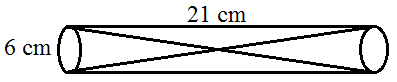
Answer$V_1 : V_2 = 2 : 1$
Diameter of the cylinder = 6cm
Radius, r = 3cm
Height of the cylinder = 21cm
let the height of one cone be H.
So, the height of the other cone will be 21 - H
$\frac{\text{V}_1}{\text{V}_2}=\frac{\pi(3)^2\text{H}}{\pi(3)^2(21-\text{H})}$
$\Rightarrow\frac{2}{1}=\frac{\text{H}}{21-\text{H}}$
$\Rightarrow42-2\text{H}=\text{H}$
$\Rightarrow\text{H}=14\text{cm}$
Height of one of the cones will be 14cm and of the other will be 21 - H = 21 - 14 = 7cm
Volume of cone with height 14cm $=\text{V}_1=\pi(3)^2\times14=396\text{cm}^3$
Volume of cone with height 7cm $=\text{V}_2=\frac{1}{3}\pi(3)^2\times7=66\text{cm}^3$
Volume of the remaining portion of the cylinder = Volume of the cylinder - Volume of cone 1 - Volume of cone 2
$\Rightarrow\text{V}=\pi(3)^2\times21-396-66$
$=594-396-66$
$=132\text{cm}^3$
View full question & answer→Question 545 Marks
A cylindrical bucket, 32cm high and with radius of base 18cm, is filled with sand. This bucket is emptied out on the ground and a conical heap of sand is formed. If the height of the conical heap is 24cm, find the radius and slant height of the heap.
AnswerRadius of cylinderical bucket (r) = 18cm
and height (h) = 32cm
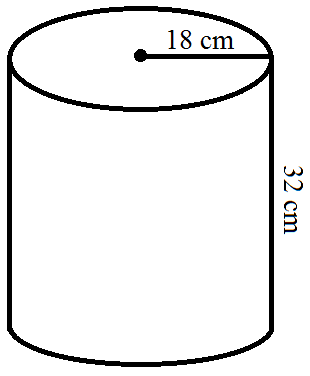
$\therefore$ Volume of sand in it $=\pi\text{r}^2\text{h}$
$=\pi(18)^2\times32$
$=\pi\times324\times32=1036\pi\text{cm}^3$
$\therefore$ conical shape of sand $=10368\pi\text{cm}^3$
Hieght of heap = 24cm
Let radius be r, then
Volume $=\frac{1}{3}\pi\text{r}^2\text{h}$
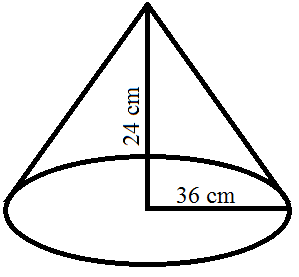
$\Rightarrow10368\pi=\frac{1}{3}\times\pi\text{r}^2\times24$
$\Rightarrow\text{r}^2=\frac{10368\pi\times3}{\pi\times24}=1296=(36)^2$
$\therefore$ r = 36cm
$\therefore$ Radius = 36cm
and slant hieght (l) = $\sqrt{\text{r}^2+\text{h}^2}$
$=\sqrt{(36)^2+(24)^2}$
$\sqrt{1296+576}=\sqrt{1872}$
$\begin{array}{c|c} 2 & 1872 \\ \hline 2 & 936\\ \hline 2 & 468\\ \hline 2&234\\ \hline3 & 117\\ \hline 3 & 39\\ \hline &13 \end{array}$
$=\sqrt{144\times13}=12\sqrt{13}\text{cm}$ View full question & answer→Question 555 Marks
A spherical ball of radius 3cm is melted and recast into three spherical balls. The radii of two of the balls are 1.5cm and 2cm. Find the diameter of the third ball.
AnswerRadius of big spherical ball (R) = 3cm
$\therefore\text{volume}=\frac{4}{3}\pi\text{R}^3=\frac{4}{3}\pi\times(3)^3\text{cm}^3$
$=\frac{4}{3}\pi\times27=36\pi\text{cm}^3$
Similarly volume of ball of radius $(r_1)$ = 1.5cm
$\therefore\text{volume}=\frac{4}{3}\pi(1.5)^3$
$=\frac{4}{3}\pi\Big(\frac{3}{2}\Big)^3\text{cm}^3$
$=\frac{4}{3}\pi\times\frac{27}{8}=\frac{9\pi}{2}\text{cm}^3$
And Volume of ball of radius $(r_2)$ = 2cm
$=\frac{4}{3}\pi\times\pi(2)^3$
$=\frac{4}{3}\pi\times8=\frac{32}{3}\pi\text{cm}^3$
$\therefore\text{Volume of third ball}=36\pi-\Big(\frac{9}{2}\pi+\frac{32}{3}\pi\Big)$
$=36\pi-\Big(\frac{27+64}{6}\pi\Big)$
$=36\pi-\frac{91}{6}\pi$
$=\frac{216\pi-91\pi}{6}=\frac{125}{6}\pi\text{cm}^3$
$\therefore$ radius of the third ball
$=3\sqrt{\frac{125}{6}\pi\times\frac{3}{4\pi}}=3\sqrt{\frac{125}{8}}$
$=3\sqrt{\Big(\frac{5}{2}\Big)^3}=\frac{5}{2}\text{cm}=2.5\text{cm}$
$\therefore\text{diameter}=2\times\text{radius}$
$=2\times2.5=5\text{cm}$
View full question & answer→Question 565 Marks
A tent is of the shape of a right circular cylinder upto a height of 3m and then becomes a right circular cone with a maximum height of 13.5m above the ground. Calculate the cost of painting the inner side of the tent at the rate of Rs. 2 per square metre, if the radius of the base is 14m.
Answer
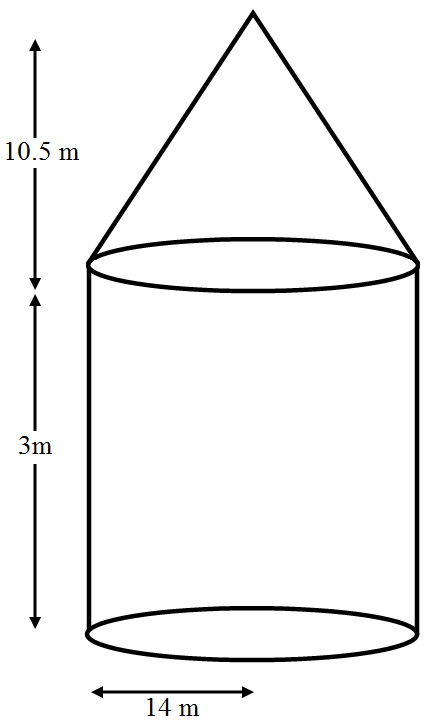
Let r m be the radius of cylindrical base of cylinder of height by m
r = 14m and $h_1$ = 3m
Curved surface area of cylinder
$=2\pi\text{r}\text{h}_1\text{m}^2$
$=2\times\frac{22}{7}\times14\times3\text{ m}^2$
$=264\text{m}^2$
The radius of cylindrical box of cylinder is also equal to the radius of right circular cones.
Let $h_2$ be the height of cone and l be the slant height of cone.
$\text{r}=14\text{m}$ and $\text{h}_2=(13.5-3)$
$=10.5\text{m}$
$\text{l}^2=\text{r}^2+\text{h}^2_2$
$\text{l}^2=(14)^2+(10.5)^2$
$\text{l}^2=(14)^2+(10.5)^2$
$\text{l}=\sqrt{196+110.25}$
$\sqrt{306.25}=17.5\text{m}$
Curved surface area of the cone
$=\pi\text{rl}$
$=\frac{22}{7}\times14\times17.5$
Curved surface of area of cone
$=\pi\text{rl}$
$=\frac{22}{7}\times14\times17.5$
$=770\text{m}^2$
Therefore,
Total area of tent which is to be painted
$=\text { curved surface area of cylinder }+ \text { curved surface area of cone }$
$=(264+770) m^2$
$=1034 m^2$
Now cost of painting $1 m^2$ of inner side of tent = Rs. 2
Cost of painting $1034 m^2$ inner side of tent
$=2 \times 1034$
$=\text { Rs. } 2068$ View full question & answer→Question 575 Marks
The height of a cone is 20cm. A small cone is cut off from the top by a plane parallel to the base. If its volume be $\frac{1}{125}$ of the volume of the original cone, determine at what height above the base the section is made.
AnswerTotal height of the cone ($h_1$) = 20cm
Let a cone whose height is $h_2$ is cut off Then height of the remaining portion (frustum)
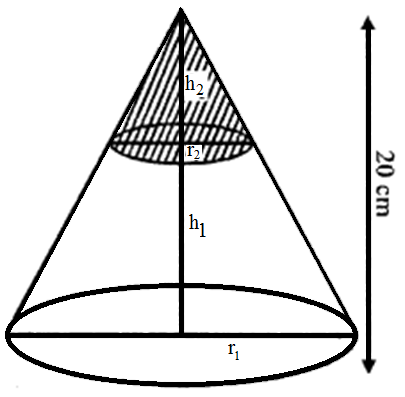
$h_1=\left(20-h_2\right) cm$
Let $r_1$ and $r_2$ be the radii of the bigger cone and smaller cone respectively.
$\therefore$ Volume of bigger cone $=\frac{1}{3}\pi \text{r}_1^2\text{h}_1$
and of smaller cone $=\frac{1}{3}\pi\text{r}^2_2\text{h}_2$
$\therefore\frac{\frac{1}{3}\pi\text{r}^2_2\text{h}_2}{\frac{1}{3}\pi\text{r}^2_1\text{h}}=\frac{1}{125}$
$\Rightarrow\frac{\text{r}^2_2\times\text{h}_2}{\text{r}^2_1\times\text{h}}=\frac{1}{125}=\frac{1}{5}\times\frac{1}{25}$
$\Rightarrow\frac{\text{r}^2_2}{\text{r}^2_1}\times\frac{\text{h}_2}{\text{h}}=\bigg(\frac{1}{2}\bigg)^2\times\frac{1}{5}$
$\Rightarrow\bigg(\frac{\text{r}_2}{\text{r}_1}\bigg)^2\bigg(\frac{\text{h}_2}{\text{h}}\bigg)$
$\Rightarrow\bigg(\frac{1}{5}\bigg)^2\times\frac{1}{5}$
$\Rightarrow\bigg(\frac{\text{r}_2}{\text{r}_1}\bigg)^2=\bigg(\frac{1}{5}\bigg)^2$ by comparing
and $\frac{\text{h}_2}{\text{h}}=\frac{1}{5}$
$\Rightarrow5{\text{h}_2}={\text{h}}\Rightarrow5{\text{h}_2}=20$ $(\therefore\text{h}=20\text{cm})$
$\Rightarrow{\text{h}_2}=\frac{20}{5}=4\text{cm}$
$\therefore$$ h_1= h - h_2= 20 - 4 = 16cm$
$\therefore$ Height from the base of the section = 16cm View full question & answer→Question 585 Marks
A bucket is in the form of a frustum of a cone with a capacity of $12308.8 cm^3$ of water. The radii of the top and bottom circular ends are 20 cm and 12 cm respectively. Find the height of the bucket and the area of the metal sheet used in its making.(use $\pi=3.14$ )
AnswerVolume of frustum (bucket) $=12308.8 cm^3$
Upper radius $\left(r_1\right)=20 cm$
and lower radius $\left(r_2\right)=12 cm$
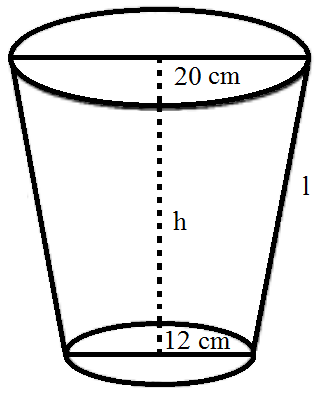
Let h be the height of the bucket, the
Volume $=\frac{\pi}{3}\big[\text{r}^2_1+\text{r}_1\text{r}_2+\text{r}^2_2\big] \times\text{h}$
$\Rightarrow 12308.8=\frac{3.14}{3}\big[20^2+20\times12+12^2\big]\times\text{h}$
$\Rightarrow 12308.8=\frac{3.14}{3}\big[400+240+144\big]\times\text{h}$
$\Rightarrow \frac{12308.8\times3}{3.14}=784\ \text{h}$
$\text{h}= \frac{12308.8\times3}{3.14 \times784}=15$
$\therefore$ Height of the bucket = 15cm
Now slant height $\text{l}= \sqrt{(\text{h)}^2+(\text{r}_1-\text{r}_2)}^2$
$=\sqrt{(15)^2+(20-12)^2}=\sqrt{(15)^2+(8)^2}$
$=\sqrt{225+64}=\sqrt{289}=17\text{cm}$
$\therefore$ Surface area $=\pi (\text{r}_1+\text{r}_2)\ \text{l}+\pi \text{r}_1^2$
$=\pi\big[ (\text{r}_1+\text{r}_2) \ \text{l}+ \text{r}_1^2$
$=3.14\big[ (20+12)\times15+(12)^2\big]\text{cm}^2$
$=3.14\big[ (32\times15+(12)^2\big]\text{cm}^2$
$=3.14 (480+144)\text{cm}^2$
$=3.14\times624\text{cm}^2$
$=1959.36\text{cm}^2$
$\therefore$ Area of metal sheet used = 1959.36cm$^2$ View full question & answer→Question 595 Marks
An iron spherical ball has been melted and recast into smaller balls of equal size. If the radius of each of the smaller balls is $\frac{1}{4}$ of the radius of the original ball, how many such balls are made? Compare the surface area, of all the smaller balls combined together with that of the original ball.
AnswerLet R be the radius of the original ball, then
Radius of each smaller ball (r) $=\frac{1}{2}$ of the original ball $=\frac{1}{4}\text{R}$
Now volume of original ball $=\frac{4}{3}\pi\text{r}^3$
$=\frac{4}{3}\pi\Big(\frac{1}{4}\text{R}\Big)^3$
$=\frac{1}{64}\times\frac{4}{3}\pi\text{R}^3$
- $\therefore\text{No. of smaller balls}=\frac{4}{3}\pi\text{R}^3\div\frac{1}{64}\times\frac{4}{3}\pi\text{R}^3$
$=\frac{4\pi}{3}\text{R}^3\times\frac{64\times3}{4\pi\text{R}^3}=64$
- Surface area of original ball = $4\pi\text{R}^2$
and surface area of 64 smaller balls $=64\times4(\pi\text{r}^2)$
$=256\pi\Big(\frac{1}{4}\text{R}\Big)^2=256\pi\times\frac{1}{16}\text{R}^2$
$=16\pi\text{R}^2$
$\therefore\text{Ratio}=16\pi\text{R}^2\Rightarrow16:4=4:1$ View full question & answer→Question 605 Marks
The radii of the ends of a bucket 30cm high are 21cm and 7cm. Find its capacity in litres and the amount of sheet required to make this bucket.
AnswerHeight of the bucket (frustum) $( h )=30 cm$
Upper radius $\left( r _1\right)=21 cm$
and lower radius $\left(r_2\right)=7 cm$
Slant height (l) $=\sqrt{\text{h}^2+(\text{r}_1-\text{r}_2)^2}$
$=\sqrt{(30)^2+(21-7)^2}=\sqrt{30^2+14^2}$
$=\sqrt{900+196}=\sqrt{1096}\text{cm}=33.106\text{cm}$
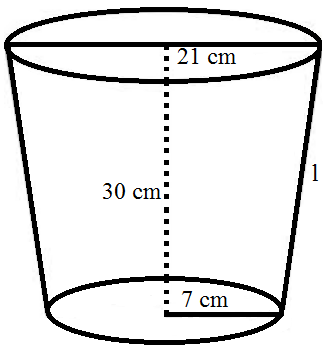
Volume $=\frac{\pi}{3}[\text{r}_1^2+\text{r}_1\text{r}_2+\text{r}_2^2]\times\text{h}$
$=\frac{22}{3\times7}[21^2+21\times7+7^2]\times30\text{cm}^3$
$=\frac{22}{21}\times30[637]=20020\text{cm}^3$
$\therefore$ Capacity $= 20020\text{cm}^3$
$=\frac{20020}{1000}=20.2\ \text{l}$
Total surface area $=\pi(\text{r}_1+\text{r}_2)\ \text{l}+\pi\text{r}_2^2$
$=\frac{22}{7}[21+7]\times33.106+\frac{22}{7}(7)^2\text{cm}^2$
$=\frac{22}{7}\times28\times33.106+\frac{22}{7}\times49\text{cm}^2$
$=2913.328+154\text{cm}^2$
$=3067.328\text{cm}^2$ View full question & answer→Question 615 Marks
How many spherical lead shots each of diameter 4.2cm can be obtained from a solid rectangular lead piece with dimensions 66cm × 42cm × 21cm.
AnswerGiven that, lots of spherical lead of shots made from a solid rectangular lead piece.
$\therefore$ Number of spherical lead shots
$=\frac{\text{volume of solid rectangular lead piece}}{\text{volume of a spherical lead shot}}\ ...(\text{i})$
Also, given that diameter of a spherical lead shot i.e. sphere = 4.2cm
$\therefore$ Radius of a spherical lead shot,
$\text{r}=\frac{4.2}{2}=2.1\text{cm}[\therefore\text{radius}=\frac{1}{2}\text{diameter}]$
So, volume of a spherical lead shot i.e.
$\text{sphere}=\frac{4}{3}\pi\text{r}^3$
$=\frac{4}{3}\times\frac{22}{7}\times(2.1)^3$
$=\frac{4}{3}\times\frac{22}{7}\times2.1\times2.1\times2.1$
$=\frac{4\times22\times21\times21\times21}{3\times7\times1000}$
Now, length of rectangular lead piece, l = 66cm
Breadth of rectangular lead piece, b = 42cm
Hieght of rectangular lead piece, h = 21cm
$\therefore$ Volume of a solid rectangular lead piece i.e.
cuboid = l × b × h = 66 × 42 × 21
From Eq. (i), Number of spherical lead, shots
$\frac{66\times42\times21}{4\times22\times21\times21\times21}\times3\times7\times1000$
$=\frac{3\times22\times21\times2\times21\times21\times1000}{4\times22\times21\times21\times21}$
$=3\times2\times250$
$=6\times250=1500$
Hence, the required number of spherical lead shots is 1500.
View full question & answer→Question 625 Marks
The perimeters of the ends of a frustum of a right circular cone are 44cm and 33cm. If the height of the frustum be 16cm, find its volume, the slant surface and the total surface.
AnswerGiven perimeters of ends of frustum right circular cone are 44cm an 33cm Height of frustum cone = 16cm
Perimeter $=2\pi\text{r}$
$2\pi\text{r}_1=44$
$\text{r}_1=7\text{cm}$
$2\pi \text{r}_2=33$
$\text{r}_2=\frac{21}{4}=5.25\text{cm}$
Let slant heightof frustum right circular cone be 1.
$\text{l}=\sqrt{(\text{r}_1-\text{r}_2)^2+\text{h}^2}$
$\text{l}=\sqrt{(7-5.25)^2+16^2\text{cm}}$
$\text{l}=16.1\text{cm}$
$\therefore$ slant height of frustum cone = 16.1cm curved surface area of frustum cone $= \pi (\text{r}_1+\text{r}_2)\text{l}$
$=\pi (7+5.25)16.1$
C.S.A. of a cone $= 619.65cm^2$
Voume of a cone $=\frac{1}{3}\pi \Big(\text{r}^2_1+\text{r}^2_2+\text{r}_1\text{r}_2\Big)\times\text{h}$
$=\frac{1}{3}\big(7^2+(5.25)^2+7(5.25)\times16$
$=1898.56\text{cm}^3$
$\therefore$ Volume of a cone $= 1898.56cm^3$
Total surface area of frustum cone $=\pi\big(\text{r}_1+\text{r}_2\big)\text{l}+\pi\text{r}^2_1+\pi\text{r}^2_2$
$=\pi (7+5.25)16.1+\pi(7^2+5.25^2)$
$=860.27\text{cm}^2$
$\therefore$ Total surface area of frustum cone $= 860.27cm^2$
View full question & answer→Question 635 Marks
A reservoir in the form of the frustum of a right circular cone contains $44 \times 10^7$ litres of water which fills it completely. The radii of the bottom and top of the reservoir are 50 metres and 100 metres respectively. Find the depth of water and the lateral surface area of the reservoir.
AnswerA reservoir in the form of the frustum of a right circular cone contains $44 \times 10^7$ litres of water which fills it completely. The radii of the bottom and top of the reservoir are 50 metres and 100 metres respectively. Find the depth of water and the lateral surface area of the reservoir.
$\text{V}=\frac{1}{3}\pi(\text{r}_1^2+\text{r}_1\text{r}_2+\text{r}_2^2)\times\text{h}$
$\frac{1}{3}\pi(100^2+100\times50+50^2)\times\text{h}$
$=\frac{1}{3}\times\frac{22}{7}\times17500\times\text{h}$
$=\frac{1}{3}\times22\times2500\times\text{h}\ \text{cm}^3$
$=\frac{1}{3}\times22\times2500\times\text{h}\times10^6\text{m}^3$
$=\frac{1}{3}\times22\times2500\times\text{h}\times10^3\ \text{liters}$
Given that the volume of the reservoir is $44 \times 10^7$. Thus, we have
$=\frac{1}{3}\times22\times2500\times\text{h}\times10^3=44\times10^7$
$\Rightarrow\text{h}=\frac{3\times44\times10^7}{22\times2500\times10^3}$
$\Rightarrow\text{h}=24$
Hence, the depth of water in the reservoir is 24m
The slant height of the reservoir is
$\text{l}=\sqrt{(\text{r}_1-\text{r}_2)^2+\text{h}^2}$
$=\sqrt{(100-50)^2+24^2}$
$=\sqrt{3076}$
= 55.46169 meter
The lateral surface area of the reservoir is
$\text{S}_1=\pi(\text{r}_1+\text{r}_2)\times\text{l}$
$=\pi\times(100+50)\times55.46169$
$=\pi\times150\times55.46169$
$=26145.225\text{m}^2$
Hence, the lateral surface area is $= 26145.225m^2$
View full question & answer→Question 645 Marks
A bucket has top and bottom diameter of 40cm and 20cm respectively. Find the volume of the bucket if its depth is 12cm. Also, find the cost of tin sheet used for making the bucket at the rate of Rs. 1.20 per $dm^2$. $(\text{use}\ \pi=3.14)$
AnswerGiven diameter to top of bucket = 40cm
Radius $(\text{r}_1)=\frac{40}{2}=20\text{cm}$
Depth of a bucket $(\text{h})=12\text{cm}$
Volume of a buket $=\frac{1}{3}\pi\Big(\text{r}^2_1+\text{r}^2_2+\text{r}_1\text{r}_1\Big)\text{h}$
$=\frac{3}{1}\pi \Big(20^2+10^2+20\times10\Big){12}$
$ =8800\text{cm}^3.$
Let '1' be slant height of bucket
$\Rightarrow \text{l}=\sqrt{(\text{r}_1-\text{r}_2)^2+\text{h}^2}$
$\Rightarrow \text{l}=\sqrt{(20-10)^2+12^2}$
$\Rightarrow \text{l}=2\sqrt{61}=15.620\text{cm}$
Total surface area of buket $=\pi (\text{r}_1+\text{r}_2)\times\text{l}+\pi\text{r}^2_2$
$=\pi (20+10)\times15.620+\pi (10)^2$
$=\frac{1320\sqrt{61}+2200}{7}\text{cm}^2$
$=\frac{1320\sqrt{61}+2200}{7\times100}\text{dm}^2=17.87\text{dm}^2$
Given that cost of tin sheet used for making buket per $dm ^2=$ Rs. 1.20 So total cost for $17.87 dm ^2=1.20 \times 17.87 dm ^2$ $=21.40 Rs$.
$\therefore$ cost of tin sheet $17.87 dm ^2=$ Rs. 2140 Ps
View full question & answer→Question 655 Marks
A frustum of a cone is 9cm thick and the diameters of its circular ends are 28cm and 4cm. Find the volume and lateral surface area of the frustum.$(\text{Take}\ \pi=\frac{22}{7})$
AnswerUpper diameter = 28cm
and lower diameter = 4cm
Height (h) = 9cm
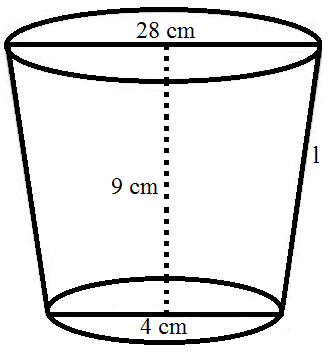
Upper radius $\left( r _1\right)=\frac{28}{2}=14 cm$ and lower radius $\left( r _2\right)=\frac{4}{2}=2 cm$
$\therefore$ Lateral height (l) $=\sqrt{\text{h}^2+(\text{r}_1-\text{r}_2)^2}$
$=\sqrt{(9)^2+(14-2)^2}=\sqrt{(9)^2+(12)^2}$
$=\sqrt{81+144}=\sqrt{225}=15\text{cm}$
Volume $=\frac{\pi}{3}[\text{r}_1^2+\text{r}_1\text{r}_2+\text{r}_2^2]\times\text{h}$
$=\frac{\pi}{3}[(14)^2+14\times2+(2)^2]\times9\text{cm}^3$
$=\frac{\pi}{3}[196+28+4]\times9\text{cm}$
$=\frac{\pi}{3}\times228\times9=\frac{2052}{3}\pi\ \text{cm}^3$
$=684\pi\ \text{cm}^3$
So lateral surface area
$=\pi(\text{r}_1+\text{r}_2)\ \text{l}=\pi(14+2)\times15\text{cm}^2$
$\pi\times16\times15=240\pi\ \text{cm}^2$ View full question & answer→Question 665 Marks
A tent is in the form of a cylinder of diameter 20m and height 2.5m, surmounted by a cone of equal base and height 7.5m. Find the capacity of the tent and the cost of the canvas at Rs 100 per square metre.
AnswerGiven that:
Radius of the base $\text{r}=\frac{\text{d}}{2}=\frac{20}{2}=10\text{m}$
Height of the cylinder $\text{h}_1=2.5\text{m}$
Height of the cone $\text{h}_2=7.5\text{m}$
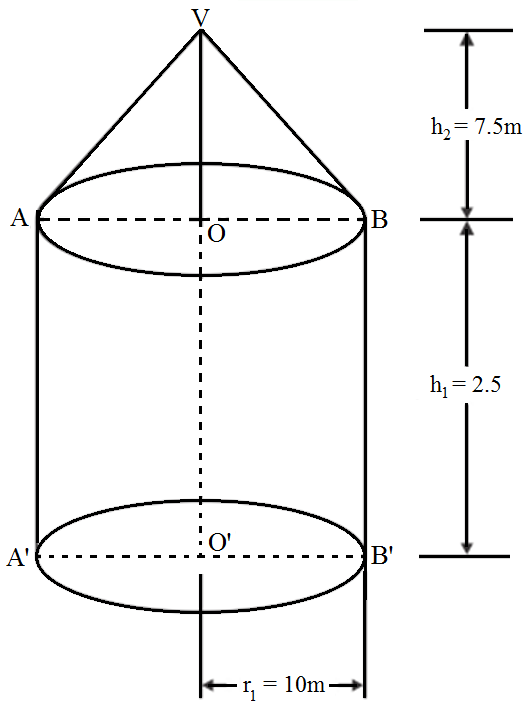
Slant height of the cone
$\text{l}=\sqrt{\text{r}^2+\text{h}^2}$
$=\sqrt{10^2+7.5^2}$
$=12.5\text{m}$
The total capacity of the tent is given by
$\text{V}=\pi\text{r}^2\text{h}_1+\frac{1}{3}\pi\text{r}^2\text{h}_2$
$=\pi\times10^2\times2.5+\frac{1}{3}\times\pi\times10^2\times7.5$
$=\pi\times250+\pi\times250$
$=500\pi\ \text{m}^3$
The total area of canvas required for the tent is
$\text{S}=2\pi\text{rh}_1+\pi\text{rl}$
= 2 × 3.14 × 10 × 2.5 + 3.14 × 10 × 12.5
$=\pi(2\times10\times2.5+10\times12.5)$
$=\pi(50+125)$
$=\frac{22}{7}\times175$
$=550\text{m}^2$
Therefore, the total cost of the canvas is
= 100 × 550
= Rs. 55000
Hence, the total capacity and cost is $\text{V}=500\pi\text{m}^3,\text{and}\ \text{Rs.}55000$ View full question & answer→Question 675 Marks
A bucket made of a aluminium sheet is of height 20cm and its upper and lower ends are of radius 25cm and 10cm respectively. Find the cost of making the bucket if the aluminium sheet costs Rs 70 per $100cm^2$. $(\text{use}\ \pi=3.14)$
AnswerGiven height of bucket $( h )=20 cm$
Upper radius of bucket $\left( r _1\right)=25 cm$
Lower radius of bucket $\left(r_2\right)=10 cm$
Let ' 1 ' be slant height of busket
$\text{l}=\sqrt{(\text{r}_1-\text{r}_2)^2+\text{h}^2}$
$\text{l}=\sqrt{(25-10)^2+20^2}=\sqrt{225+400}$
$\text{l}=25\text{m}$ $\therefore$ Slant height of bucket (1) = 25cm
Curved surface area of bucket $=\pi \big(\text{r}_1+\text{r}_2\big)\text{l}+\pi\text{r}^2_2$
$=\pi \big(25+10)25+\pi(10)^2$
$=\pi(35)25+\pi(100)=975\pi$
C. S. $A=3061.5 cm^2$
Curved surface area $=3061.5 cm^2$
Cost of marking bucket per $100 cm^2=$ Rs 70
Cost of marking per $3016.5 cm^2=\frac{3061.5}{100} \times 70$
= Rs 2143.05
$\therefore$ Total cost for $3016.5 cm^2=$ Rs 2143.05 per
View full question & answer→Question 685 Marks
A right angled triangle whose sides are 3cm, 4cm and 5cm is revolved about the sides containing the right angle in two ways. Find the difference in volumes of the two cones so formed. Also, find their curved surfaces.
AnswerWe consider the following figure as follows
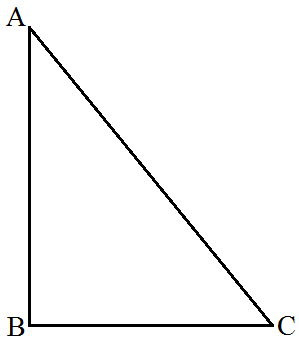
Let the angle B is right angle and the sides of the triangle are AB = 4cm, BC = 3cm,
AC = 5cm.
When the triangle is revolved about the side AB, then the base-radius, height and slant height of the produced cone becomes BC, AB and AC respectively. Therefore, the volume of the produced cone is
$\text{V}_1=\frac{1}{3}\pi\times\text{BC}^2\times\text{AB}$
$=\frac{1}{3}\pi\times(3)^2\times4$
$=12\pi$ cubic cm
In this case, the curved surface area of the cone is
$\text{S}_1=\pi\times\text{BC}\times\text{AC}$
$=\pi\times3\times5$
$=15\pi$ square cm
When the triangle is revolved about the side BC, then the base-radius, height and slant height of the produced cone becomes AB, BC and AC respectively. Therefore, the volume of the produced cone is
$\text{V}_2=\frac{1}{3}\pi\times\text{AB}^2\times\text{BC}$
$=\frac{1}{3}\pi\times(4)^2\times3$
$=16\pi$ cubic cm View full question & answer→Question 695 Marks
A solid is in the shape of a frustum of a cone. The diameters of the two circular ends are 60cm and 36cm and the height is 9cm. Find the area of its whole surface and the volume.
AnswerGiven height of a fristum cone $=9 cm$ Lower end radius $\left(r_1\right)=\frac{60}{2} cm=30 cm$ Upper end radius $\left( r _2\right)=\frac{36}{2} cm=18 cm$
Let slant height of frustum cone be l
$\text{l}=\sqrt{(\text{r}_1-\text{r}_2)^2+\text{h}^2}$
$\text{l}=\sqrt{(30-18)^2+9^2}$
$\text{l}=\sqrt{144+81}$
$\text{l}=15\text{cm}$
Volume of frustum cone $=\frac{1}{3}\pi(\text{r}^2_1+\text{r}^2_2+\text{r}_1\text{r}_2)\text{h}$
$=\frac{1}{3}\pi(30^2+18^2+30(18))9$
$=5292\pi\text{cm}^3$
Total surface area of frustum cone =
$\pi(\text{r}_1+\text{r}_2)\times\text{l}+\pi\text{r}^2_1+\pi\text{r}^2_2$
$=\pi(30+18)15+\pi(30)^2+\pi(18)^2$
$=\pi(48(15)+(30)^2+(18)^2)$
$=\pi(720+900+324)$
$=1944\pi\text{cm}^2$
$\therefore$ Total surface area $=1944\pi\text{cm}^2$
View full question & answer→Question 705 Marks
A tent of height 77 dm is in the form a right circular cylinder of diameter 36 m and height 44 dm surmounted by a right circular cone. Find the cost of the canvas at Rs. 3.50 per $m ^2$. [use $\left.\pi=\frac{22}{7}\right]$
AnswerTotal height of the tent $=77 dm$ Height of the cylindrical part $\left( h _1\right)=44 dm =4.4 m$ Height of conical part $\left( h _2\right)=77-$ $44=33 dm =3.3 m$ Diameter of the base of the tent $=36 m$
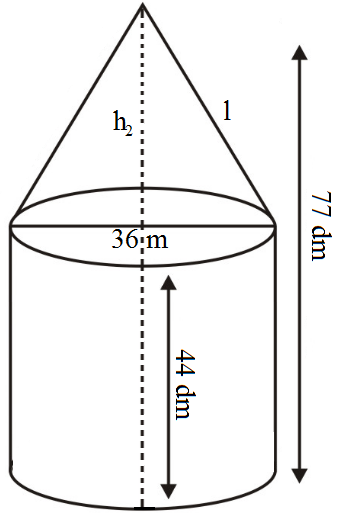
$\therefore$ Radius (r) $=\frac{36}{2}=18\text{m}$ $\therefore$ Slant height of the conical part $=\sqrt{\text{r}^2+{\text{h}_2}^2}$ $\text{l}=\sqrt{18^2+(3.3)^2}=\sqrt{324+11}=\sqrt{335}=18.30\text{m}$C.S.A of cylinder $=2\pi\text{r}\text{h}$
$=2\times\frac{22}{7}\times18\times4.4$ $=\frac{3484.8}{7}$ $=497.82$ $=498\text{m}^2$ S.A of cone $=\pi\text{r}\text{l}$ $=\frac{22}{7}\times18\times18.30$ $=1035.25$ Total area = Area of cylinder + Area of cone $=498+1035.25$ $=1533.25\text{m}^2$ Cost of canvas $=1533.25\times3.50$ $=5366.4$ View full question & answer→Question 715 Marks
A milk container is made of metal sheet in the shape of frustum of cone whose volume is $10459 cm^3$. The radii of its lower and upper circular ends are 8 cm and 20 cm respectively. Find the cost of metal sheet used in making the container at the rate of Rs. 1.40 per $cm ^2$. (use $\pi=\frac{22}{7}$ )
AnswerLet the depth of the container is h cm . The radii of the top and bottom circles of the container are $r_1=20 cm$ and $r_2$ $=8 cm$ respectively.
The volume/ capacity of the container is
$\text{V}=\frac{1}{3}\pi(\text{r}_1^2+\text{r}_1\text{r}_2+\text{r}^2_2)\times\text{h}$
$=\frac{1}{3}\pi(20^2+20\times8+8^2)\times\text{h}$
$=\frac{1}{3}\times\frac{22}{7}\times624\times\text{h}$
$=\frac{22}{7}\times208\times\text{h}\ \text{cm}^3$
Given that the capacity of the bucket is $10459\frac{3}{7}\text{cm}^3.$ Thus, we have
$\Rightarrow\frac{22}{7}\times208\times\text{h}=10459\frac{3}{7}$
$\Rightarrow\text{h}=\frac{73216}{22\times208}$
$\Rightarrow\text{h}=16\text{cm}$
Hence, the height of the container is 16cm.
The slant height of the container is
$\text{l}=\sqrt{(\text{r}_1-\text{r}_2)^2+\text{h}^2}$
$=\sqrt{(20-8)^2+16^2}$
$=\sqrt{400}$
$=20\text{cm}$
The surface area of the used metal sheet to make the container is
$\text{S}_1=\pi(\text{r}_1+\text{r}_2)\times\text{l}+\pi\text{r}^2_2$
$=\pi\times(20+8)\times20+\pi\times8^2$
$\pi\times28\times20+64\pi$
$=624\pi\ \text{cm}^2$
The cost to make the container is $=624\pi\times1.4=624\times\frac{22}{7}\times1.4=\text{Rs}.\ 2745.6$
View full question & answer→Question 725 Marks
A bucket made up of a metal sheet is in the form of a frustum of a cone of height 16cm with diameters of its lower and upper ends as 16cm and 40cm respectively. Find the volume of the bucket. Also, find the cost of the bucket if the cost of metal sheet used in Rs. 20 per $100cm^2$. $(\text{use}\ \pi=3.14)$
AnswerLower radius of bucket $\text{(r)}=\big(\frac{16}{2}\big)=8\text{cm}$
and upper radius $\text{(r)}=\big(\frac{40}{2}\big)=20\text{cm}$
Height $\text{(h)}=16\text{cm}$
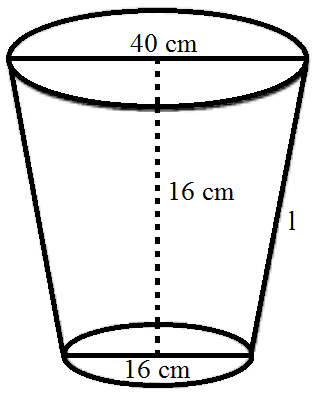
$\therefore$ Slant height $\text{(l)}=\sqrt{\text{h}^2+(\text{R}-\text{r})^2}$
$=\sqrt{16^2+(20-8)^2}=\sqrt{16^2+12^2}$
$=\sqrt{256+144}=\sqrt{400}=20\text{cm}$
Volume of the bucket $=\frac{1}{3}\pi\big(\text{R}^2+\text{r}^2+\text{Rr})\text{h}$
$=\frac{1}{3}\times 3.14\big[20^2+8^2+20\times8\big]\times16$
$=\frac{1}{3}\times 3.14\big[400+64+160\big]\times16$
$=\frac{3.14}{3}\times624\times16=3.14\times208\times16\text{cm}^3$
$=10449.92\text{cm}^3$
Tolat surface area of the bucket
$=\pi(\text{R}+\text{r})\text{l}+\pi\text{r}^2=\pi\big[(\text{R}+\text{r})\text{l}+\text{r}^2\big]$
$=3.14\big[(20+8)20+(8)^2\big] \text{cm}^2=1959.3\text{cm}^2$
Now cost of metal sheet at the rate of
$Rs. 20 per 100cm^2$
$=1959.36\times\frac{20}{100}=\text{Rs}\ 391.87 \ \text{(approx)}$ View full question & answer→Question 735 Marks
The height of a cone is 10cm. The cone is divided into two parts using a plane parallel to its base at the middle of its height. Find the ratio of the volumes of the two parts.
AnswerWe have,
Radius of the solid cone, R = CP
Height of the solid cone, AP = H
Radius of the smaller cone, QD = r
Height of the smaller cone, AQ = h
Also, $\text{AQ}=\frac{\text{AP}}{2}\text{ i.e. }\text{h}=\frac{\text{H}}{2}\ \text{or}\ \text{H}=2\text{h}\ ...(\text{i})$
Now, in $\triangle\text{AQD}\ \text{and}\ \triangle\text{APC},$
$\angle\text{QAD}=\angle\text{PAC}$ (common angles)
$\angle\text{AQD}=\angle\text{APC}=90^\circ$
So, bt AA criteria
$\triangle\text{AQD}\sim\text{APC}$
$\Rightarrow\frac{\text{AQ}}{\text{AP}}=\frac{\text{QD}}{\text{PC}}$
$\Rightarrow\frac{\text{h}}{\text{H}}=\frac{\text{r}}{\text{R}}$
$\Rightarrow\frac{\text{h}}{\text{2h}}=\frac{\text{r}}{\text{R}}\ [\text{using (i)]}$
$\Rightarrow\frac{1}{2}=\frac{\text{r}}{\text{R}}$
$\Rightarrow\text{R}=2\text{r}\ ....(\text{ii})$
As, Volume of smaller cone $=\frac{1}{3}\pi\text{r}^2\text{h}$
And, Volume of solid cone $=\frac{1}{3}\pi\text{R}^2\text{H}$
$=\frac{1}{3}\pi(2\text{r})^2\times(2\text{h})\ \ [\text{Using (i) and (ii)]}$
$=\frac{8}{3}\pi\text{r}^2\text{h}$
So,
Volume of frustum = Volume of solid cone - Volume of smaller cone
$=\frac{8}{3}\pi\text{r}^2\text{h}-\frac{1}{3}\pi\text{r}^2\text{h}$
$=\frac{7}{3}\pi\text{r}^2\text{h}$
Now, the ratio of the volumes of the two parts $=\frac{\text{Volume of the smaller cone}}{\text{Volume of the frustum}}$
$=\frac{\Big(\frac{1}{3}\pi\text{r}^2\text{h}\Big)}{\Big(\frac{7}{3}\pi\text{r}^2\text{h}\Big)}$
$=\frac{1}{7}$
$=1:7$
So, the ratio of the volume of the two parts of the cone is 1 : 7.
View full question & answer→