Questions

1 Marks Question

Take a timed test

29 questions · self-marked practice — reveal the answer and mark yourself.

Question 11 Mark
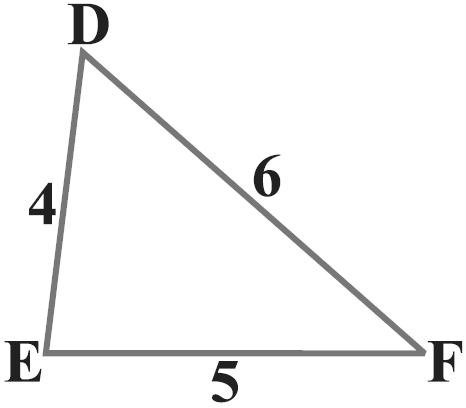
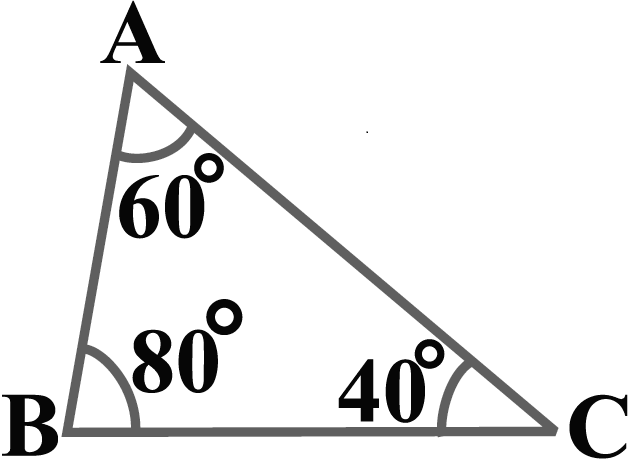
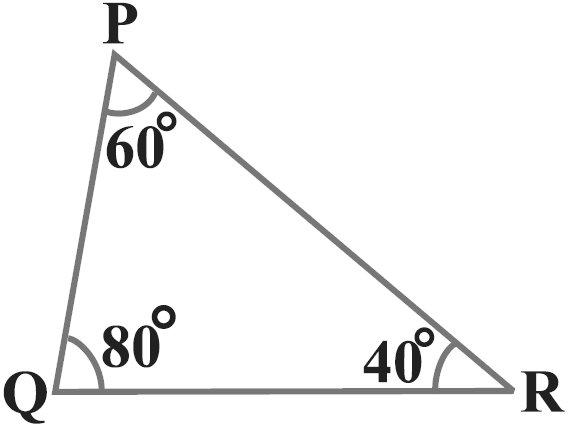
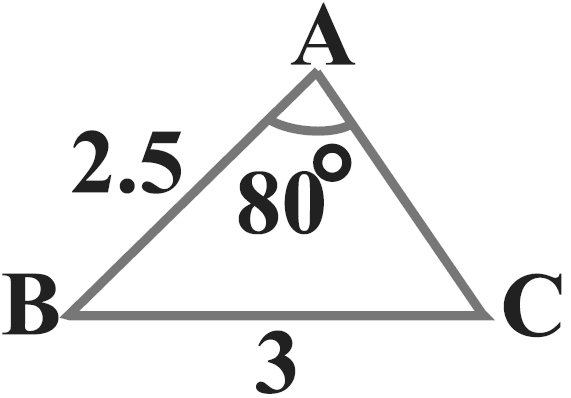
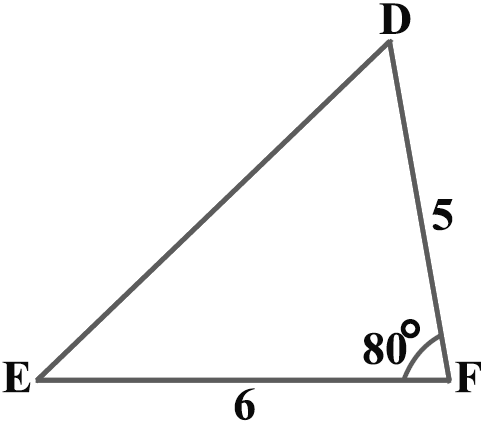
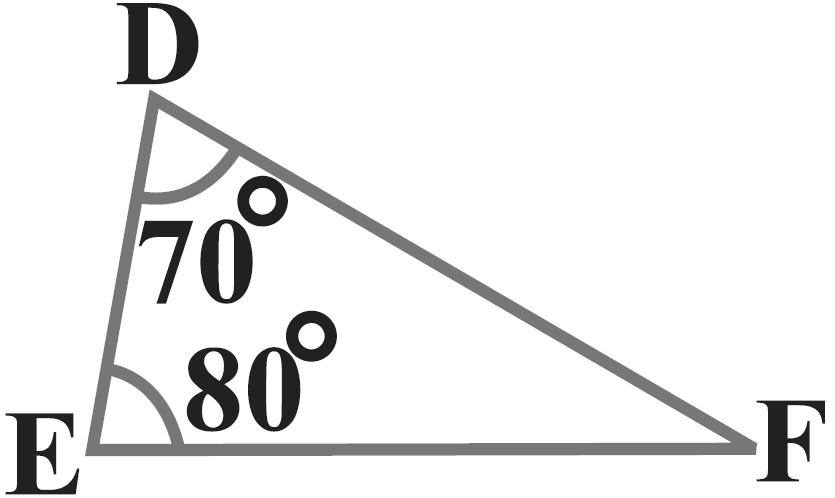
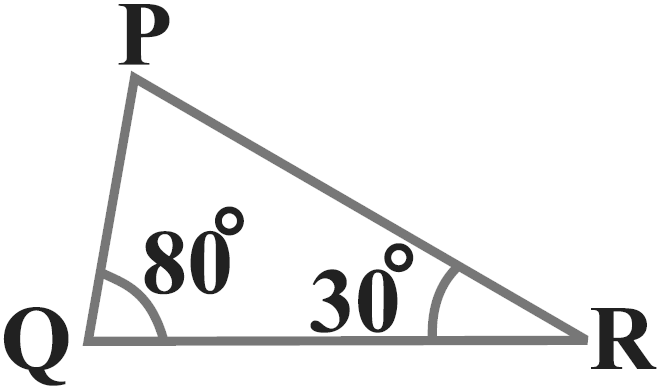
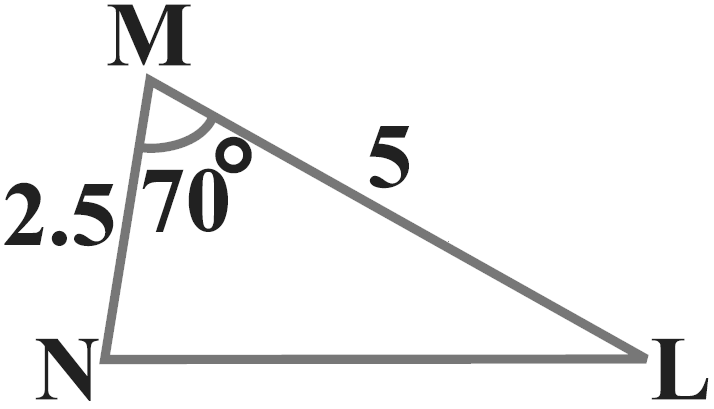
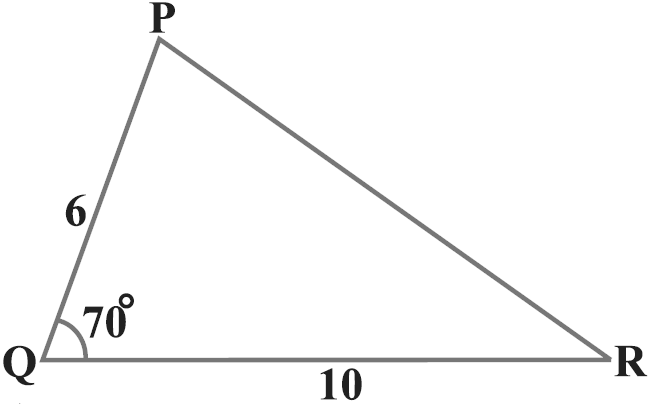
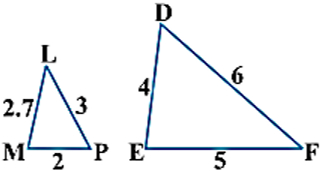
State the pair of triangles in the figure below are similar. Write the similarity criterion used by you for answering the question and also write the pair of similar triangles in the symbolic form:
Image
Answer
The given triangles are not similar because the corresponding sides are not proportional.
View full question & answer
Question 21 Mark
Two polygons of the same number of sides are similar, if (a) their corresponding angles are ________ and (b) their corresponding sides are ________. (equal, proportional)
Answer
Equal, Proportional
View full question & answer
Question 61 Mark
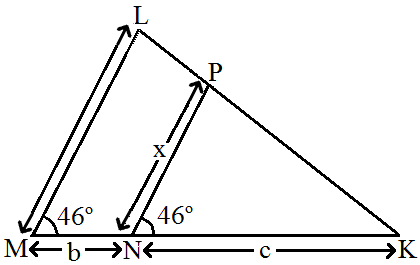
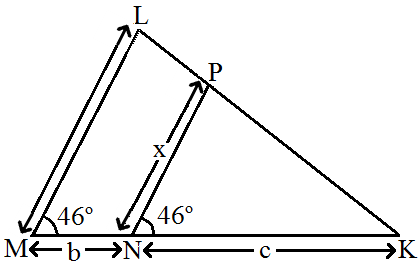
In Fig., $\angle\text{M}=\angle\text{N}=46^\circ.$ Express x in terms of a, b and c are lengths of LM, MN and NK respectively.
Answer
In the given fig., express x in terms of a, b, c.
In $\triangle\text{KPN}$ and $\triangle\text{KLM},$ we have$\angle\text{KNP}=\angle\text{KML}=46^\circ$ [Given]
$\angle\text{K}=\angle\text{K}$ [Common]
$\therefore\triangle\text{KNP}\sim\triangle\text{KML}$ [Using AA similar condition]
$\Rightarrow\frac{\text{KN}}{\text{KM}}=\frac{\text{NP}}{\text{ML}}$
$[\because$ Corresponding sides of similar triangles are proportional$]$
$\Rightarrow\frac{\text{c}}{\text{b}+\text{c}}=\frac{\text{x}}{\text{a}}$
$\Rightarrow\text{x}=\frac{\text{ac}}{\text{b}+\text{C}}$
View full question & answer
Question 81 Mark
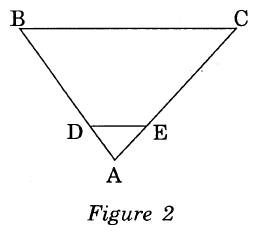
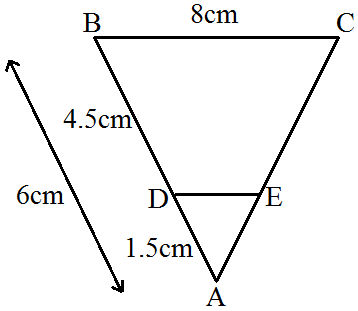
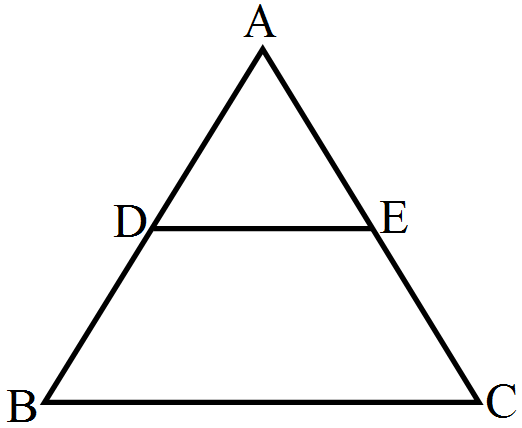
In Figure 2, DE||BC in $\triangle\text{ABC}$ such that BC = 8cm, AB = 6cm and DA = 1.5cm. Find DE.
Answer

In $\triangle\text{ABC}$ BC||DE, AD = 1.5cm, DB = 4.5cm BC = 8cm
According to mid point theorem
$\text{DE}=\frac{1}{2}\text{BC}$
$\text{DE}=\frac{1}{2}(8)$
$=4\text{cm}$
View full question & answer
Question 91 Mark
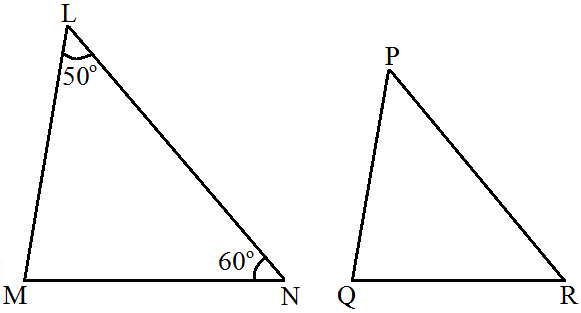
In $\triangle\text{LMN},\angle\text{L}=50^\circ$ and $\angle\text{L}=60^\circ.$ If $\triangle\text{LMN}\sim\triangle\text{PQR},$ then find $\angle\text{Q}.$
Answer

$\angle\text{L}+\angle\text{M}+\angle\text{N}=180^\circ$ (Angle sum property)
Substituting $\angle\text{L}=50^\circ$ and $\angle\text{N}=60^\circ$ in this equation:
$50^\circ+\angle\text{M}+60^\circ=180^\circ$
$\angle\text{M}=70^\circ$
It is given that $\triangle\text{LMN}\sim\triangle\text{PQR}.$
We know that corresponding angle in similar triangles are of equal measures.
$\therefore\ \angle\text{M}=\angle\text{Q}=70^\circ$
Thus, the measure of $\angle\text{Q}$ is 70º
View full question & answer
Question 101 Mark
D, E and F are the mid-points of the sides AB, BC and CA respectively of ΔABC.
Find $\frac{\text{ar}(\Delta\text{DEF})}{\text{ar}(\Delta\text{ABC})}$
Answer
Given in ΔABC, D, E and F are midpoints of sides AB, BC and CA respectively. BC = EC Recall that the line joining the midpoints of two sides of traingle is parallel to third side and half of it. Hence, $\text{DF}=\Big(\frac{1}{2}\Big)\text{BC}$$\Rightarrow\Big(\frac{\text{DF}}{\text{BC}}\Big)=\Big(\frac{1}{2}\Big)....(1)$
Simillarly, $\Big(\frac{\text{DE}}{\text{AC}}\Big)=\Big(\frac{1}{2}\Big)....(2)$$\Big(\frac{\text{EF}}{\text{AB}}\Big)=\Big(\frac{1}{2}\Big)....(3)$
From (1), (2) and (3) we have,
But if the two traingles, sides of one traingle are proportional to the sides of the other traingles, then their corresponding angles are equal and hence the two traingles are simillar. Hence, $\triangle\text{ABC}\sim\triangle\text{EDF}$ [By SSS simillarity theorem] Hence, area of $\triangle\text{BDF}:$ area of $\triangle\text{ABC}=1:4$
View full question & answer
Question 111 Mark
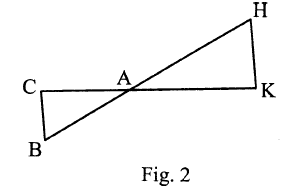
In Fig. 2, $\triangle\text{AHK}$ is similar to $\triangle\text{ABC}.$ If AK = 10cm, BC = 3.5cm and HK = 7cm, find AC.
Answer
It is given that $\triangle\text{AHK}$ is similar to $\triangle\text{ABC}.$It is given that the corresponding sides of similar triangles are in proportion.
Thus, the length of AC is 5cm.
View full question & answer
Question 121 Mark
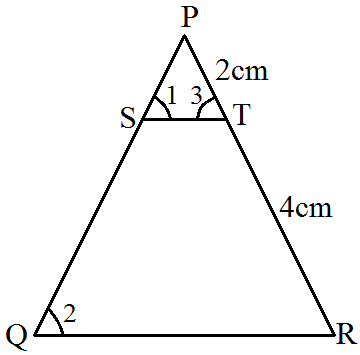
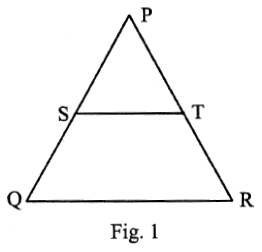
In Fig. 1, S and T are points on the sides PQ and PR, respectively of $\triangle\text{PQR},$ such that PT = 2cm, TR = 4cm and ST is parallel to QR. Find the ratio of the areas of $\triangle\text{PST}$ and $\triangle\text{PQR}.$
Answer

In $\triangle\text{PST}$ & $\triangle\text{PQR}$
$\angle1=\angle2$ (Corresponding angle)
$\angle3=\angle2$ (Alternate angle)
$\therefore\ \triangle\text{PST}\sim\triangle\text{PQR}$ (By AA)
$\therefore\ \frac{\text{ar}(\triangle\text{PST})}{\text{ar}(\triangle\text{PQR})}=\frac{\text{PT}^2}{\text{PR}^2}$
(Ratio of area of two similar triangles is equal to the square of ratio of corresponding sides)
$\frac{\text{ar}(\triangle\text{PST})}{\text{ar}(\triangle\text{PQR})}=\frac{2^2}{6^2}$
$\frac{\text{ar}(\triangle\text{PST})}{\text{ar}(\triangle\text{PQR})}=\frac{4}{36}$ (Since, PR = 4 + 2 = 6)
1 : 9
View full question & answer
Question 131 Mark
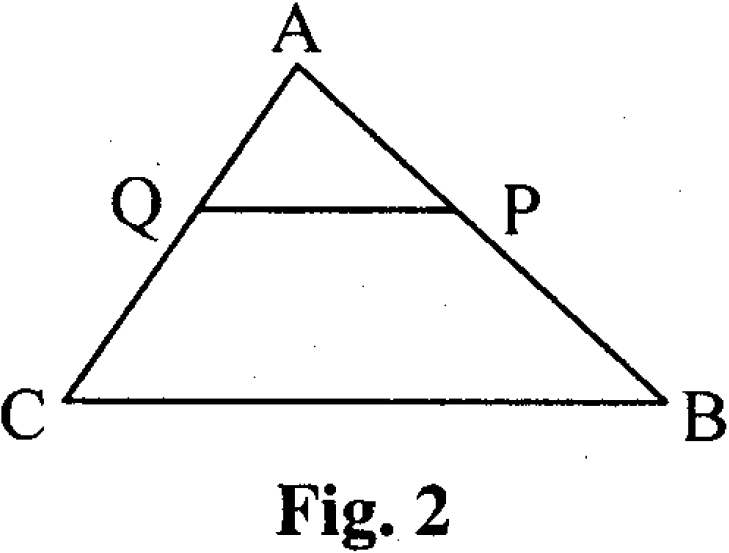
In Fig. 2, P and Q are points on the sides AB and AC respectively of $\triangle\text{ABC}$ such that AP = 3.5cm, PB = 7cm, AQ= 3cm and QC = 6cm. If PQ = 4.5cm, find BC.
Answer
$\frac{\text{AP}}{\text{AB}}=\frac{3.5}{10.5}=\frac{1}{3}$or, $\frac{\text{AQ}}{\text{AC}}=\frac{3}{9}=\frac{1}{3}$
In $\triangle\text{ABC},\frac{\text{AP}}{\text{AB}}=\frac{\text{AQ}}{\text{AC}}$ and $\angle\text{A}$ is common
or, $\triangle\text{APQ}\sim\triangle\text{ABC}$ (By SAS)
$\therefore\ \frac{\text{AP}}{\text{AB}}=\frac{\text{PQ}}{\text{BC}}$
or, $\frac{1}{3}=\frac{4.5}{\text{BC}}$
or, $\text{BC}=13.5\text{cm}$
View full question & answer
Question 141 Mark
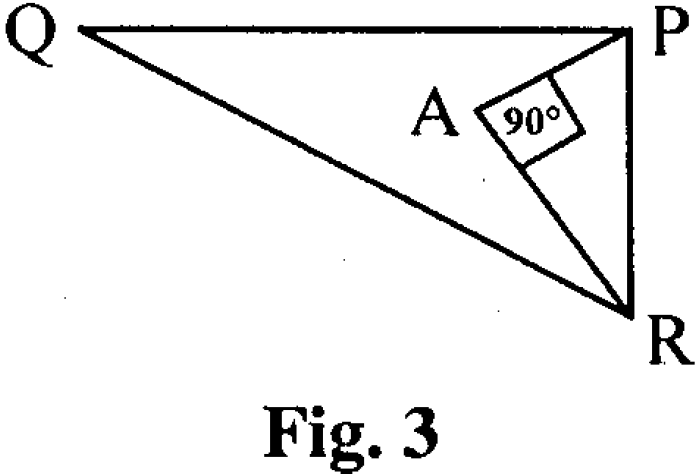
In Fig. 3, PQ = 24cm, QR = 26cm, $\angle\text{PAR}=90^\circ,$ PA = 6cm and AR = 8cm. Find $\angle\text{QPR}=90^\circ.$
Answer
In right triangle APR, we have AP = 6cm, AR = 8cm and $\angle\text{A}=90^\circ$$\therefore$ By using Converse of Pythagoras Theorem, we have
$PR^2 = AR^2 + AP^2$
$\Rightarrow PR^2= 8^2 + 6^2$
$= 64 + 36 = 100$
$PR = 10cm$
Now, in triangle PQR, we have
PQ = 24cm, QR = 26cm and PR = 10cm
Here, we have
$PQ^2 + PR^2= (24)^2 + (10)^2$
$= 576 + 100 = 676 = QR^2$
Hence,
By Converse of Pythagoras Theorem $\angle\text{QPR}=90^\circ.$
View full question & answer
Question 151 Mark
Given $\triangle\text{ABC}\sim\triangle\text{PQR},\ \text{if}\ \frac{\text{AB}}{\text{PQ}}=\frac{1}{3},$ then find $\frac{\text{ar }\triangle\text{ABC}}{\text{ar}\ \triangle\text{PQR}}.$
Answer
$\frac{\text{A}(\triangle\text{ABC})}{\text{A}(\triangle\text{PQR})}=\frac{\text{AB}^2}{\text{PQ}^2}$ (Ratio of area of similar triangle is equal to square of their proportional sides)$\frac{\text{A}(\triangle\text{ABC})}{\text{A}(\triangle\text{PQR})}=\Big(\frac{1}{3}\Big)^2=\frac{1}{9}$
View full question & answer
Question 161 Mark
The area of two similar triangles are 25sq. cm and 121sq. cm. Find the ratio of their corresponding sides.
Answer
Let, 'a' cm and 'b' cm be the lengths of the corresponding sides of the two triangles with area 25 sq. cm and 121 sq. cm respectively. Then, we must have$\frac{25}{121}=\frac{\text{a}^2}{\text{b}^2}$
$\Rightarrow\big(\frac{\text{a}}{\text{b}}\big)^2=\big(\frac{5}{11}\big)^2$
$\Rightarrow\frac{\text{a}}{\text{b}}=\frac{5}{11}$
$\Rightarrow\text{a}:\text{b}=5:11.$
Thus, the required ratio of the corresponding sides is 5 : 11.
View full question & answer
Question 171 Mark
Let $\triangle ABC \sim \triangle DEF$ and their areas be respectively, $64 cm^2$ and $121 cm^2$. If $EF =15 \cdot 4 cm$, find BC .
Answer
Given: $\triangle\text{ABC}\sim\triangle\text{DEF}$ We know ratio of the areas of two similar triangles is equal to the square of the ratio of their corresponding sides,$\frac{\text{ar}\triangle\text{ABC}}{\text{ar}\triangle\text{DEF}}=\Big(\frac{\text{BC}}{\text{EF}}\Big)^2$
$\Rightarrow\frac{64}{121}=\Big(\frac{\text{BC}}{15.4}\Big)^2$
$\Rightarrow\Big(\frac{8}{11}\Big)^2=\Big(\frac{\text{BC}}{15.4}\Big)^2$
$\Rightarrow\frac{8}{11}=\frac{\text{BC}}{15.4}$
$\Rightarrow\text{BC}=\frac{8\times15.4}{11}=11.2\text{cm}$
Thus, $\text{BC}=11.2\text{cm}$
View full question & answer
Question 181 Mark
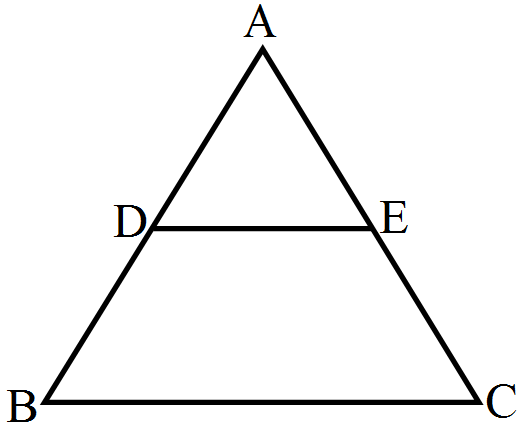
In fig., DE || BC, AD = 1cm and BD = 2cm. what is the ratio of the ar $(\triangle\text{ABC})$ to the ar $(\triangle\text{ADE})?$
Answer
It is given that AD = 1cm, BD = 2cm and DE || BC In $\triangle\text{ADE}$ and $\triangle\text{ABC}$$\angle\text{ADE}=\angle\text{ABC}$ (corresponding angles)
$\angle\text{A}=\angle\text{A}$ (common angle)
By AA similarity$\triangle\text{ADE}\sim\triangle\text{ABC}$
Ratio of area of similar triangles is equal to the square of the ratio of corresponding sides.$\therefore\frac{\text{ar}(\triangle\text{ABC})}{\text{ar}(\triangle\text{ADE})}=\frac{\text{AB}^2}{\text{AD}^2}$
$\Rightarrow\frac{\text{ar}(\triangle\text{ABC})}{\text{ar}(\triangle\text{ADE})}=\frac{3^2}{1^2}$
$\Rightarrow\frac{\text{ar}(\triangle\text{ABC})}{\text{ar}(\triangle\text{ADE})}=\frac{9}{1}$
Therefore, the ratio of the $\text{ar}(\triangle\text{ABC}):\text{ar}(\triangle\text{ADE})$ is 9 : 1.
View full question & answer
Question 191 Mark
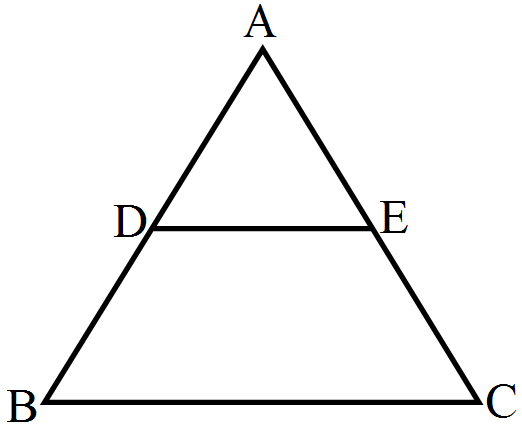
In fig., DE || BC, AD = 1cm and BD = 2cm. what is the ratio of the ar $(\triangle\text{ABC})$ to the ar $(\triangle\text{ADE})?$
Answer
It is given that AD = 1cm, BD = 2cm and DE || BC In $\triangle\text{ADE}$ and $\triangle\text{ABC}$$\angle\text{ADE}=\angle\text{ABC}$ (corresponding angles)
$\angle\text{A}=\angle\text{A}$ (common angle)
By AA similarity$\triangle\text{ADE}\sim\triangle\text{ABC}$
Ratio of area of similar triangles is equal to the square of the ratio of corresponding sides.$\therefore\frac{\text{ar}(\triangle\text{ABC})}{\text{ar}(\triangle\text{ADE})}=\frac{\text{AB}^2}{\text{AD}^2}$
$\Rightarrow\frac{\text{ar}(\triangle\text{ABC})}{\text{ar}(\triangle\text{ADE})}=\frac{3^2}{1^2}$
$\Rightarrow\frac{\text{ar}(\triangle\text{ABC})}{\text{ar}(\triangle\text{ADE})}=\frac{9}{1}$
Therefore, the ratio of the $\text{ar}(\triangle\text{ABC}):\text{ar}(\triangle\text{ADE})$ is 9 : 1.
View full question & answer
Question 201 Mark
In fig., DE || BC, AD = 1cm and BD = 2cm. what is the ratio of the ar $\triangle\text{ABC}$ to the ar $(\triangle\text{ADE})?$
Answer
It is given that AD = 1cm, BD = 2cm and DE || BC In $\triangle\text{ADE}$ and $\triangle\text{ABC}$$\angle\text{ADE}=\angle\text{ABC}$ (corresponding angles)
$\angle\text{A}=\angle\text{A}$ (common angle)
By AA similarity$\triangle\text{ADE}\sim\triangle\text{ABC}$
Ratio of area of similar triangles is equal to the square of the ratio of corresponding sides.$\therefore\frac{\text{ar}(\triangle\text{ABC})}{\text{ar}(\triangle\text{ADE})}=\frac{\text{AB}^2}{\text{AD}^2}$
$\Rightarrow\frac{\text{ar}(\triangle\text{ABC})}{\text{ar}(\triangle\text{ADE})}=\frac{3^2}{1^2}$
$\Rightarrow\frac{\text{ar}(\triangle\text{ABC})}{\text{ar}(\triangle\text{ADE})}=\frac{9}{1}$
Therefore, the ratio of the $\text{ar}(\triangle\text{ABC}):\text{ar}(\triangle\text{ADE})$ is 9 : 1.
View full question & answer
Question 211 Mark
State AAA similarity criterion.
Answer
If in two triangles, corresponding angles are respectively equal then the triangles are similar.
View full question & answer
Question 221 Mark
State which pairs of triangles in Fig. are similar. Write the similarity criterion used by you for answering the question and also write the pairs of similar triangles in the symbolic form:
Answer
Not similar
View full question & answer
Question 231 Mark
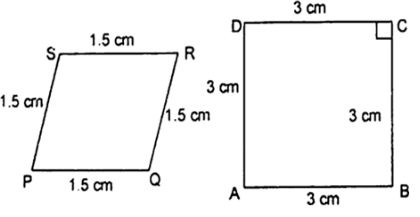
State whether the following quadrilaterals are similar or not:
Answer
No, because corresponding angles are not equal.
View full question & answer
Question 241 Mark
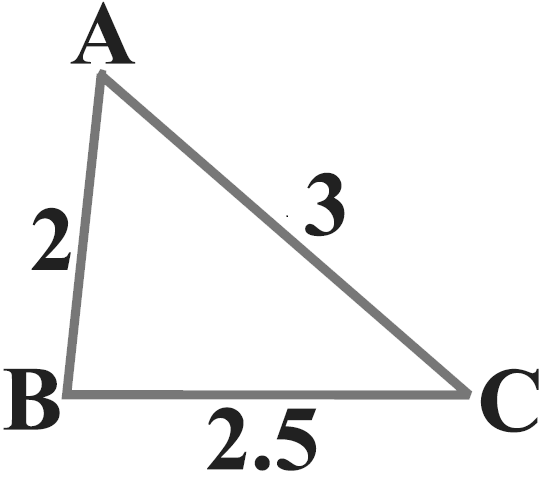
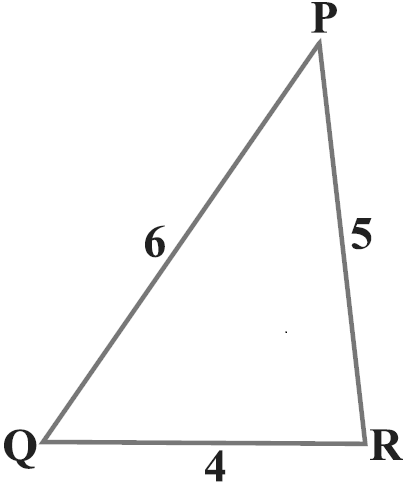
State which pairs of triangles in Fig. are similar. Write the similarity criterion used by you for answering the question and also write the pairs of similar triangles in the symbolic form:
Answer
Similar$\text{SSS},\ \triangle\text{ABC}\sim\triangle\text{QRP}$
View full question & answer
Question 251 Mark
State which pairs of triangles in Fig. are similar. Write the similarity criterion used by you for answering the question and also write the pairs of similar triangles in the symbolic form:

Answer
Similar$\text{AAA}\ \triangle\text{ABC}\sim\triangle\text{PQR}$
View full question & answer
Question 261 Mark
State which pairs of triangles in Fig. are similar. Write the similarity criterion used by you for answering the question and also write the pairs of similar triangles in the symbolic form:

Answer
Similar$\text{SAS}\ \triangle\text{ABC}\sim\triangle\text{FGE}$
View full question & answer
Question 271 Mark
State which pairs of triangles in Fig. are similar. Write the similarity criterion used by you for answering the question and also write the pairs of similar triangles in the symbolic form:
Answer
$\text{similar}. \text{AAA}\ \triangle\text{DEF}\sim\triangle\text{PQR}$
View full question & answer
Question 281 Mark
Give two different examples of pair of:
  1. Similar figures.
  2. Non-similar figures.
Answer
  1. Two hundred rupee notes.
  2. Two five-rupee coins.
View full question & answer
Question 291 Mark
State which pairs of triangles in Fig. are similar. Write the similarity criterion used by you for answering the question and also write the pairs of similar triangles in the symbolic form:
Answer
Not similar
View full question & answer