Question 13 Marks
If in two triangles, corresponding angles are equal, then their corresponding sides are in the same ratio (or proportion) and hence the two triangles are similar:
Answer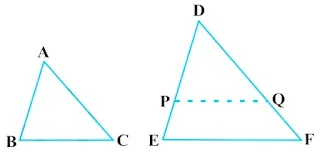
This criterion is referred to as the AAA
(Angle-Angle-Angle) criterion of similarity of two triangles.
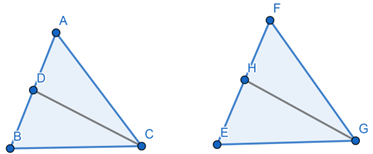
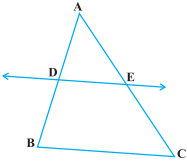
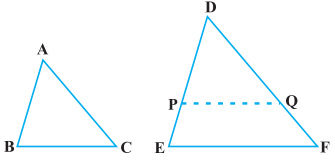
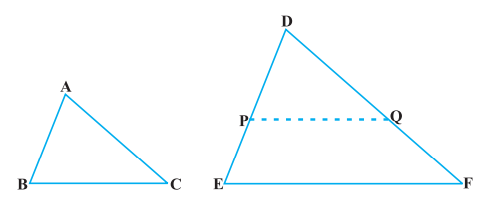
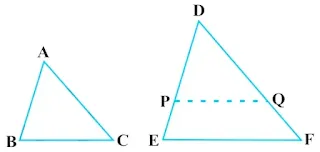
This theorem can be proved by taking two triangles $ABC$ and $DEF$ such that $\angle A =\angle D , \angle B =\angle E$ and $\angle C =\angle F$ (see Fig. 6.24)
Cut $DP = AB$ and $DQ = AC$ and join $PQ$.
So,
$\Delta ABC \cong \Delta DPQ$
(Why ?)
This gives
$\angle B =\angle P =\angle E \text { and } PQ \| EF$ .....(How?)
Therefore,
$\frac{ DP }{ PE }=\frac{ DQ }{ QF }$ .....(Why?)
i.e.,
$\frac{ AB }{ DE }=\frac{ AC }{ DF }$ .....(Why?)
Similarly,
$\frac{ AB }{ DE }=\frac{ BC }{ EF } \text { and so } \frac{ AB }{ DE }=\frac{ BC }{ EF }=\frac{ AC }{ DF } \text {. }$
View full question & answer→This criterion is referred to as the AAA
(Angle-Angle-Angle) criterion of similarity of two triangles.
This theorem can be proved by taking two triangles $ABC$ and $DEF$ such that $\angle A =\angle D , \angle B =\angle E$ and $\angle C =\angle F$ (see Fig. 6.24)
Cut $DP = AB$ and $DQ = AC$ and join $PQ$.
So,
$\Delta ABC \cong \Delta DPQ$
(Why ?)
This gives
$\angle B =\angle P =\angle E \text { and } PQ \| EF$ .....(How?)
Therefore,
$\frac{ DP }{ PE }=\frac{ DQ }{ QF }$ .....(Why?)
i.e.,
$\frac{ AB }{ DE }=\frac{ AC }{ DF }$ .....(Why?)
Similarly,
$\frac{ AB }{ DE }=\frac{ BC }{ EF } \text { and so } \frac{ AB }{ DE }=\frac{ BC }{ EF }=\frac{ AC }{ DF } \text {. }$