Questions

5 Marks Questions

Take a timed test

7 questions · self-marked practice — reveal the answer and mark yourself.

Question 15 Marks
If a line is drawn parallel to one side of a triangle to intersect the other two sides in distinct points, the other two sides are divided in the same ratio.
Answer
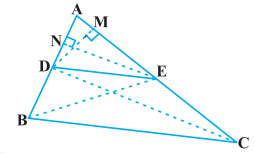
Image
Proof: We are given a triangle $A B C$ in which a line parallel to side $BC$ intersects other two sides $AB$ and $AC$ at $D$ and $E$ respectively (see Fig. 6.10).
We need to prove that $\frac{ AD }{ DB }=\frac{ AE }{ EC }$.
Let us join $BE$ and $CD$ and then draw $DM \perp AC$ and $EN \perp AB$.
Now, area of $\triangle ADE \left(=\frac{1}{2}\right.$ base $\times$ height $)=\frac{1}{2} AD \times EN$.
Recall from Class IX, that area of $\triangle ADE$ is denoted as $\operatorname{ar}( ADE )$.
So,
$\operatorname{ar}( ADE )=\frac{1}{2} AD \times EN$
Similarly,
$\operatorname{ar}( BDE )=\frac{1}{2} DB \times EN ,$
$\operatorname{ar}( ADE )=\frac{1}{2} AE \times DM \text { and } \operatorname{ar}( DEC )=\frac{1}{2} EC \times DM .$
Therefore,
$\frac{\operatorname{ar}( ADE )}{\operatorname{ar}( BDE )}=\frac{\frac{1}{2} AD \times EN }{\frac{1}{2} DB \times EN }=\frac{ AD }{ DB }$
and
$\frac{\operatorname{ar}( ADE )}{\operatorname{ar}( DEC )}=\frac{\frac{1}{2} AE \times DM }{\frac{1}{2} EC \times DM }=\frac{ AE }{ EC }$
Note that $\triangle BDE$ and $DEC$ are on the same base $DE$ and between the same parallels $BC$ and $DE$.
So,
$\operatorname{ar}( BDE )=\operatorname{ar}( DEC )$
Therefore, from (1), (2) and (3), we have :
$\frac{ AD }{ DB }=\frac{ AE }{ EC }$
Is the converse of this theorem also true (For the meaning of converse, see Appendix 1)? To examine this, let us perform the following activity:
View full question & answer
Question 25 Marks
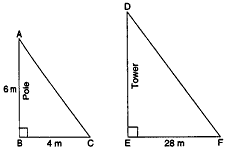
A vertical pole of length 6 m casts a shadow 4 m long on the ground and at the same time a tower casts a shadow 28 m long. Find the height of the tower.
Answer
Let AB denoted the vertical pole of length 6m.BC is the shadow of the pole on the ground BC = 4m.
Let DE denote the tower.
EF is shadow of the tower on the ground.
EF = 28 m.
Let the height of the tower be h m.

In $\triangle $ABC and $\triangle $DEF,
$\angle$ B = $\angle$E ......[Each equal to $90^o$​​​​​​​​​​​​​​ because pole and tower are standing vertical to the ground]
$\angle$ C = $\angle$ F .....[Same elevation]
$\angle$ A = $\angle$ D $\because $ shadows are cast at the same time
$\therefore $ $\triangle $ABC and $\triangle $DEF,
$\angle$ B= $\angle$ E ............[Each equal to $90^o​​​​​​​$ because pole and tower are standing vertical to the ground.]
$\angle$A=$\angle$D ( $\because $shadows are cast at the same time)
$\therefore $ $\vartriangle $ ABC ~ $\vartriangle $DEF ......(AA similarity criterion)
$\therefore $ $\frac{{AB}}{{DE}} = \frac{{BC}}{{EF}}$ ...........[ $\because $ corresponding sides of two similar triangles are proportional]
$\Rightarrow $ $\frac{6}{h} = \frac{4}{{28}}$
$\Rightarrow $ $h = \frac{{6 \times 28}}{4} \Rightarrow h = 42$
Hence, the height of the tower is 42 m
View full question & answer
Question 35 Marks
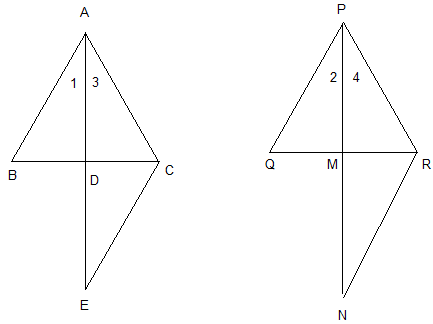
Sides AB and AC and median AD of a triangle ABC are respectively proportional to sides PQ and PR and median PM of another triangle PQR. Show that $\Delta A B C \sim \Delta P Q R$.
Answer


Given : In $\Delta A B C \text { and } \Delta P Q R$ The AD and PM are their medians,
such that $\frac { A B } { P Q } = \frac { A D } { P M } = \frac { A C } { P R }$
To prove : $\Delta A B C \sim \Delta P Q R$
Construction : Produce AD to E such that AD = DE and produce PM to N such that PM = MN. Join CE and RN.
Proof : In $\Delta A B D \text { and } \Delta E D C$
$AD=DE$
$\angle A D B = \angle E D C$ (vertically opposite angles)
$BD=DC\text{(as AD is a median)}$
$\therefore \quad \Delta A B D \equiv \Delta E D C$ (By SAS congruency)
or, $AB=CE$ (By CPCT)
Similarly, PQ = RN $$
$\frac { A B } { P Q } = \frac { A D } { P M } = \frac { A C } { P R }$ (Given)
or, $\frac { C E } { R N } = \frac { 2 A D } { 2 P M } = \frac { A C } { P R }$
or $\frac{CE}{RN}=\frac{AE}{PN}=\frac{AC}{PR}$
So $∆ACE \sim ∆PRN$
$\angle 3=\angle 4$
Similarly $\angle 1=\angle 2$
$\angle 1+\angle3=\angle2+\angle4$
So $\angle A=\angle P\text{ and}$
$\frac{AB}{PQ}=\frac{AC}{PR}\text{(given)} $
Hence $∆ABC\sim ∆PQR$
View full question & answer
Question 45 Marks
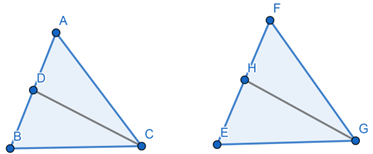
CD and GH are respectively the bisectors of $\angle$ACB and $\angle$EGF such that D and H lie on sides AB and FE of $\triangle$ABC and $\triangle$EFG respectively. If $\triangle$ABC $\sim\triangle$FEG, show that:
  1. $\frac{C D}{G H}=\frac{A C}{F G}$
  2. $\triangle$DCB $\sim\triangle$HGE
  3. $\triangle$DCA $\sim\triangle$HGF
Answer


Given, $\triangle$ABC $\sim\triangle$FEG ….(1)
(i) Corresponding angles of similar triangles
$\Rightarrow$ $\angle$BAC = $\angle$EFG ….(2)
And $\angle$ABC = $\angle$FEG …(3)
$\Rightarrow$ $\angle$ACB = $\angle$FGE
$\Rightarrow \frac{1}{2}\angle ACB = \frac{1}{2}\angle FGE$
$\Rightarrow$ $\angle$ACD = $\angle$FGH and $\angle$BCD = $\angle$EGH ……(4)
Consider $\triangle$ACD and $\triangle$FGH
$\Rightarrow$ From (2) we have
$\Rightarrow$$\angle$DAC = $\angle$HFG
From (4) we have
$\Rightarrow$ $\angle$ACD = $\angle$EGH
Also, $\angle$ADC = $\angle$FGH
If the $\angle A=\angle F$, then by angle sum property of triangle $3^{rd}$​​​​​​​ angle will also be equal.
By AAA similarity, in two triangles, if the angles are equal, then sides opposite to the equal angles are in the same ratio (or proportional) and hence the triangles are similar.
$\therefore\triangle$ADC $\sim\triangle$FHG
(ii) By Converse proportionality theorem
$\Rightarrow \frac{C D}{G H}=\frac{A C}{F G}$
(iii) Consider $\triangle$DCB and $\triangle$HGE
From eq(3) we have
$\Rightarrow$ $\angle$DBC = $\angle$HEG
From (4) we have
$\Rightarrow$ $\angle$BCD = $\angle$FGH
Also, $\angle$BDC = $\angle$EHG
$\therefore\triangle$DCB $\sim\triangle$HGE
Hence proved.
View full question & answer
Question 55 Marks

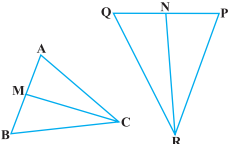
In Fig. CM and RN are respectively the medians of $\triangle$ABC and $\triangle$PQR. If $\triangle$ABC $\sim\triangle$PQR, prove that:

  1. $\triangle$AMC $\sim\triangle$PNR
  2. $\frac{C M}{R N}=\frac{A B}{P Q}$
  3. $\triangle$CMB $\sim\triangle$RNQ

Answer
  1. $\triangle$ABC $\sim\triangle$PQR (Given)
    So, $\frac{A B}{P Q}=\frac{B C}{Q R}=\frac{C A}{R P}$ ...(1) (corresponding sides of similar triangles are proportional)
    and $\angle$A = $\angle$P, $\angle$B = $\angle$Q and $\angle$C = $\angle$R ...(2)
    But AB = 2 AM and PQ = 2 PN (As CM and RN are medians)
    So, from (1),
    i.e., $\frac{A M}{P N}=\frac{C A}{R P}$ ...(3)
    Also, ∠ MAC = ∠ NPR [From (2)] ...(4)
    So, from (3) and (4),
    $\triangle$AMC $\sim\triangle$PNR (SAS similarity criterion) ...(5)
  2. From (5), $\frac{\mathrm{CM}}{\mathrm{RN}}=\frac{\mathrm{CA}}{\mathrm{RP}}$ ...(6) (corresponding sides of similar triangles are proportional)
    But $\frac{C A}{R P}=\frac{A B}{P Q}$ [From (1)] ...(7)
    Therefore,$\frac{C M}{R N}=\frac{A B}{P Q}$ [From (6) and (7)] ...(8)
  3. Again,$\frac{A B}{P Q}=\frac{B C}{Q R}$ [From (1)]
    Therefore $\frac{\mathrm{CM}}{\mathrm{RN}}=\frac{\mathrm{BC}}{\mathrm{QR}}$ [From (8)] ...(9)
    Also, $\frac{C M}{R N}=\frac{A B}{P Q}=\frac{2 B M}{2 Q N}$
    i.e., $\frac{\mathrm{CM}}{\mathrm{RN}}=\frac{\mathrm{BM}}{\mathrm{QN}}$ ...(10)
    i.e.,$\frac{\mathrm{CM}}{\mathrm{RN}}=\frac{\mathrm{BC}}{\mathrm{QR}}=\frac{\mathrm{BM}}{\mathrm{QN}}$ [From (9) and (10)]
    Therefore, $\triangle$CMB $\sim\triangle$RNQ (SSS similarity criterion)
View full question & answer
Question 65 Marks
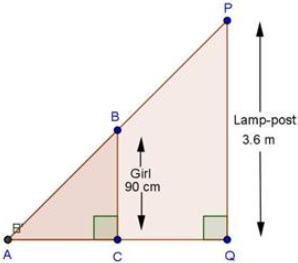
A girl of height 90 cm is walking away from the base of a lamp-post at a speed of 1.2 m/sec. If the lamp is 3.6 m above the ground, find the length of her shadow after 4 seconds.
Answer

We have,
Image
Height of girl = 90 cm = 0.9 m
Height of lamp-post = 3.6 m
Speed of girl = 1.2 m/sec
Time taken = 4 sec.
$\therefore$ Distance moved by girl (CQ) = Speed $\times$ Time
= 1.2 $\times$ 4
= 4.8 m
Let length of shadow (AC) = x cm
In $\Delta$ABC and $\Delta$APQ
$\angle ACB = \angle AQP$ [Each 90°]
$\angle BAC = \angle PAQ$ [Common]
Then, $\Delta$ABC ~ $\Delta$APQ [By AA similarity]
$\therefore \frac{{AC}}{{AQ}} = \frac{{BC}}{{PQ}}$ [Corresponding parts of similar $\Delta$ are proportional]
$ \Rightarrow \frac{x}{{x + 4.8}} = \frac{{0.9}}{{3.6}}$
$\Rightarrow \frac{x}{{x + 4.8}} = \frac{1}{4}$
$\Rightarrow$ 4x = x + 4.8
$\Rightarrow$ 4x - x = 4.8
$\Rightarrow$ 3x = 4.8
$\Rightarrow x = \frac{{4.8}}{3} = 1.6m$
$\therefore$ Length of shadow = 1.6 m
View full question & answer