Questions

3 Marks Question

Take a timed test

13 questions · self-marked practice — reveal the answer and mark yourself.
Question 13 Marks
If $\triangle\text{ABC}\sim\triangle\text{DEF},$ AB = 4cm, DE = 6cm, EF = 9cm and FD = 12cm, find the perimeter of $\triangle\text{ABC}.$
View full question & answer
Question 23 Marks
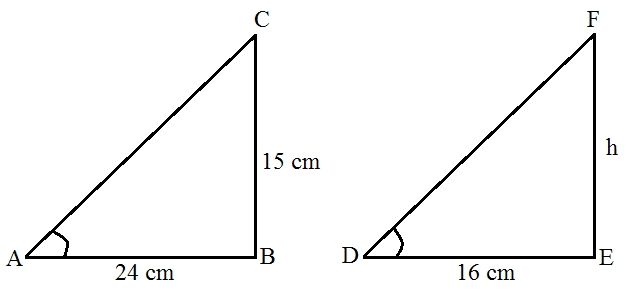
A 15 metres high tower casts a shadow 24 metres long at a certain time and at the same time, a telephone pole casts a shadow 16 metres long. Find the height of the telephone pole.
Answer
Let BC = 15m be the tower and its shadow AB is 24m. AT that time $\angle\text{CAB}=8,$ agine let EF = h be a telephone poie and shadow DE = 16m. AT the same time $\angle\text{EDF}=8.$ Here $\triangle\text{ASC}$ and $\triangle\text{DEF}$ both are right angles triangles.

In $\triangle\text{ABC}$ and $\triangle\text{DEF},$
$\angle\text{CAB}=\angle\text{EDF}=\theta$ [each 90°]
$\angle\text{B}=\angle\text{E}$
$\therefore\triangle\text{ABC}\sim\triangle\text{DEF}$ [by AAA similiarity criterion]
Then, $\frac{\text{AB}}{\text{DE}}=\frac{\text{BC}}{\text{EF}}$
$\Rightarrow\frac{24}{16}=\frac{15}{\text{h}}$
$\therefore\text{h}=\frac{15\times16}{24}$
$\text{h}=10$
Hence, the height of the telephone pole is 10m.
View full question & answer
Question 33 Marks
Corresponding sides of two similar triangles are in the ratio of $2 : 3$. If the area of the smaller triangle is $48cm^2$​​​​​​​, find the area of the larger triangle.
Answer
Given, ratio of corresponding sides of two similar triangles $= 2 : 3$
Area of smaller triangles $= 48cm^2$
By the proporty of area of two similar triangle
Ratio of area of both riangles = (Ratio of their corresponding sides)$^2$
$\frac{\text{ar}(\text{smaller triangle})}{\text{ar}(\text{larger triangle})}=\Big(\frac{2}{3}\Big)^2$
$\Rightarrow\frac{48}{\text{ar}(\text{larger triangle})}=\frac{4}{9}$
$\Rightarrow\text{ar}(\text{larger triangle})=\frac{48\times9}{4}$
$\Rightarrow\text{ar}(\text{larger triangle})=12\times9=108\text{cm}^2$
View full question & answer
Question 43 Marks
Areas of two similar triangles are $36 cm^2$ and $100 cm^2$. If the length of a side of the larger triangle is $20$ cm , find the length of the corresponding side of the smaller triangle.
Answer
Given, area of smaller triangle $=36 cm^2$ and area of larger triangle $=100 cm^2$
Also, length of a side of the larger triangle $=20 cm$
Let length of the corresponding side of the smaller triangle $= x cm$
By property of area of similar triangle,
$\frac{\text{ar}(\text{larger triangle})}{\text{ar}(\text{smaller triangle})}=\frac{(\text{side of larger triangle})^2}{(\text{side of smaller triangle})^2 }$
$\Rightarrow\frac{100}{3}=\frac{(20)^2}{\text{x}^2}$
$\Rightarrow\text{x}^2=\frac{(20)^2\times36}{100}$
$\Rightarrow\text{x}^2=\frac{400\times36}{100}$
$\Rightarrow\text{x}^2=144$
$\therefore\text{x}=\sqrt{144}$
$\text{x}=12\text{cm}$
Hence, the length of corresponding side of the smaller triangle is $12cm.$
View full question & answer
Question 53 Marks
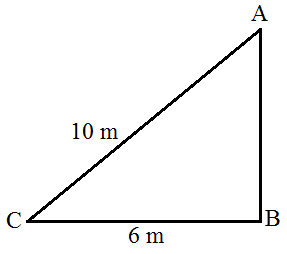
Foot of a $10m$ long ladder leaning against a vertical wall is $6m$ away from the base of the wall. Find the height of the point on the wall where the top of the ladder reaches.
Answer
Let AB be a vertical wall and $AC = 10m$ is a ladder. The top of the reaches to A and disrance of ladder from the base of the wall $BC$ is 6m.

In right angled $\triangle\text{ABC},$
$AC^2 = AB^2 + BC^2$ [by Pythagoras theorem]
$\Rightarrow (10)^2 = AB^2 + (6)^2$
$\Rightarrow 100 = AB^2 + 36$
$\Rightarrow AB^2 = 100 - 36$
$\Rightarrow AB^2 = 64$
$\therefore\text{AB}=\sqrt{64}$
$AB = 8cm$
Hence, the height of the point on the wall where the top of the ladder reaches is $8cm.$
View full question & answer
Question 63 Marks
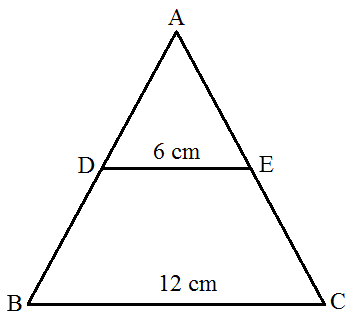
If DE || BC, find the ratio of ar (ADE) and ar (DECB).
Answer
Given, DE || BC, = 6cm and BC = 12cm
In $\triangle\text{ABC}$ and $\triangle\text{ADE},$
$\angle\text{ABC}=\angle\text{ADE}$ [Corresponding angles]
$\angle\text{ACB}=\angle\text{AED}$ [Corresponding angle]
and $\angle\text{A}=\angle\text{A}$ [common side]
$\therefore\triangle\text{ABC}\sim\triangle\text{AED}$ [by AAA similarity criterion]
Then, $\frac{\text{ar}(\triangle\text{ADE})}{{\text{ar}(\triangle\text{ABC})}}=\frac{(\text{DE})^2}{(\text{BC})^2}$
$\Rightarrow\frac{\text{ar}(\triangle\text{ADE})}{{\text{ar}(\triangle\text{ABC})}}=\frac{(6)^2}{(12)^2}$
$\Rightarrow\frac{\text{ar}(\triangle\text{ADE})}{{\text{ar}(\triangle\text{ABC})}}=\bigg(\frac{1}{2}\bigg)^2$
$\Rightarrow\frac{\text{ar}(\triangle\text{ADE})}{{\text{ar}(\triangle\text{ABC})}}=\frac{1}{4}$
Let ${\text{ar}(\triangle\text{ADE})}=\text{K},$ then ${\text{ar}(\triangle\text{ABC})}=4\text{K}$
Now, ar(DECB) = ar(ABC) - ar(ADE) = 4k - k = 3k
$\therefore$ Required ratio = ar(ADE) : ar(DECB) = k : 3k = 1 : 3
View full question & answer
Question 73 Marks
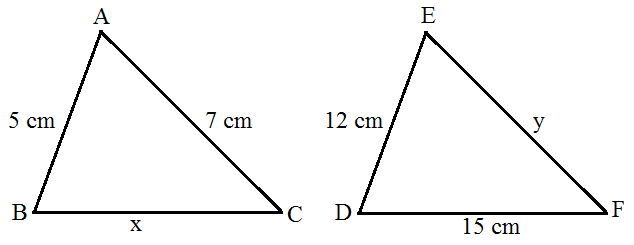
It is given that $\triangle\text{ABC}\sim\triangle\text{EDF}$ such that AB = 5cm, AC = 7cm, DF= 15cm and DE = 12cm. Find the lengths of the remaining sides of the triangles.
Answer

$\triangle\text{ABC}\sim\triangle\text{EDF}$ [Given]
$\therefore\frac{\text{AB}}{\text{ED}}=\frac{\text{AC}}{\text{EF}}=\frac{\text{BC}}{\text{DF}}$
$\Rightarrow\frac{5}{12}=\frac{7}{\text{y}}=\frac{\text{x}}{15}$
$\Rightarrow\frac{5}{12}=\frac{7}{\text{y}}$
$\Rightarrow\text{y}=\frac{7\times12}{5}$
$\Rightarrow\text{y}=\frac{84}{5}$
$\Rightarrow\text{y}=16.8\text{cm}$
$\Rightarrow\text{x}=\frac{5\times15}{12}$
$\Rightarrow\text{x}=\frac{25}{4}$
$\Rightarrow\text{x}=6.25\text{cm}$
Hence, the length of BC = 6.25cm and EF = 16.8cm.
View full question & answer
Question 83 Marks
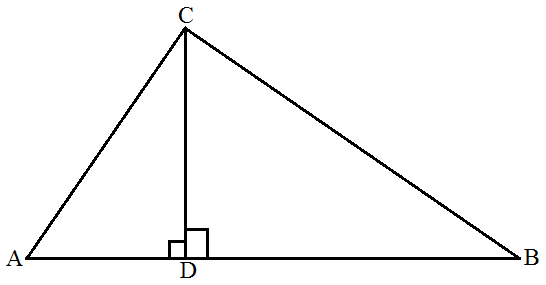
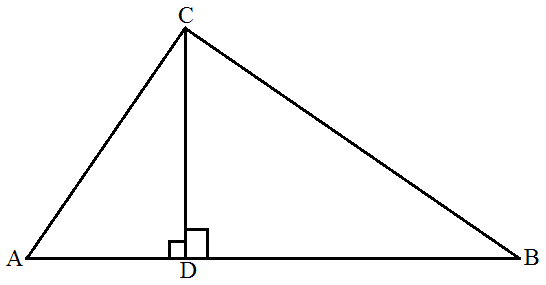
If $\angle\text{ACB}=\angle\text{CDA},$ $AC = 8cm$ and $AD = 3cm$, find $BD.$

 
Answer
Given, $AC = 8cm, AD = 3cm$ and $\angle\text{ACB}=\angle\text{CDA}$
From figure, $\angle\text{CDA}=90^\circ$

In right angles $\triangle\text{ADC},$
$AC^2= AD^2 + CD^2$
$\Rightarrow (8)^2 = (3)^2 + (CD)^2$
$\Rightarrow 64 - 9 = CD^2$
$\Rightarrow\text{CD}=\sqrt{55}\text{cm}$
In $\triangle\text{CDA}$ and $\triangle\text{ADC},$
$\angle\text{BDC}=\angle\text{ADC}$ [each 90°]
$\angle\text{DBC}=\angle\text{DCA}$ $[\text{each equal to }90^\circ-\angle\text{A}]$
$\therefore\triangle\text{CDB}\sim\triangle\text{ADC}$
Then $\frac{\text{CD}}{\text{BD}}=\frac{\text{AD}}{\text{CD}}$
$\Rightarrow\text{CD}^2=\text{AD}\times\text{BD}$
$\therefore\text{BD}=\frac{(\text{CD})^2}{\text{AD}}$
$\text{BD}=\frac{\big(\sqrt{55}\big)^2}{3}$
$\text{BD}=\frac{55}{3}\text{cm}$
View full question & answer
Question 93 Marks
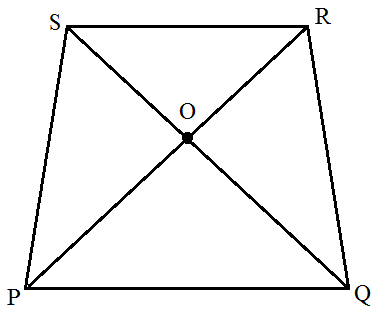
Diagonals of a trapezium PQRS intersect each other at the point O, PQ || RS and PQ = 3 RS. Find the ratio of the areas of triangles POQ and ROS.
Answer
Given PQRS is a trapezium in which PQ || PS and PQ = 3 RS
$\Rightarrow\frac{\text{PQ}}{\text{RS}}=\frac{3}{1}\ ......(\text{i})$

In $\triangle\text{POQ}$ and $\triangle\text{ROS},$ [vertically opposite angles]
$\angle\text{SRP}=\angle\text{RPQ}$ [alternate angles]
$\therefore\triangle\text{POQ}\sim\triangle\text{ROS}$ [by AAA similarity criterion]
By property of area of similar triangle,
$\frac{\text{ar}(\triangle\text{POQ})}{{\text{ar}(\triangle\text{SOR})}}=\frac{(\text{PQ})^2}{(\text{RS})^2}$
$\bigg(\frac{\text{PQ}}{\text{RS}}\bigg)^2=\bigg(\frac{3}{1}\bigg)^2$ [from Eq. (i)]
$\Rightarrow\frac{\text{ar}(\triangle\text{POQ})}{{\text{ar}(\triangle\text{SOR})}}=\frac{9}{1}$
Hence, the required ratio is 9 : 1
View full question & answer
Question 103 Marks
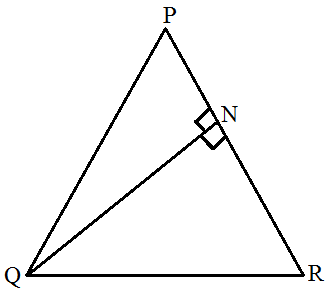
In a triangle $PQR, N$ is a point on PR such that $\text{QN}\perp\text{PR}$ . If $PN \times NR = QN^2,$ prove that $\angle\text{PQR}=90^\circ.$
Answer

Given $\triangle\text{PQR},$ N is a point on PR, such that $\text{QN}\perp\text{PR}.$
and $\text{PN}\times\text{NR}=\text{QN}^2$
To prove $\angle\text{PQR}=90^\circ$
Proof we have, $\text{PN}\times\text{NR}=\text{QN}^2$
$\Rightarrow\text{PN}\times\text{NR}=\text{QN}\times\text{QN}$
$\Rightarrow\frac{\text{PN}}{\text{QN}}=\frac{\text{QN}}{\text{NR}}\ .....(\text{i})$
and $\angle\text{PQN}=\angle\text{RNQ}$
$\therefore\triangle\text{QNP}\sim\triangle\text{RNQ}$
Then $\triangle\text{QNP}$ and $\triangle\text{RNQ}$ are equiangulars.
$\text{i.e,}\ \angle\text{PQN}=\angle\text{QRN}$
$ \angle\text{RQN}=\angle\text{QPN}$
on adding both sides, we get
$\angle\text{PQN}+\angle\text{RNQ} =\angle\text{RQN}+\angle\text{QPN}$
$\angle\text{PQN} =\angle\text{RQN}+\angle\text{QPN}$
We know that, sum of angles of a triangle = 180°
$\text{In }\triangle\text{PQR},$ $\angle\text{PQR}+\angle\text{QPR}+\angle\text{QRP}=180^\circ$
$\Rightarrow\angle\text{PQR}+\angle\text{QPN}+\angle\text{QRN}=180^\circ$
$[\because\angle\text{QPR}=\angle\text{QPN}\text{ and }\angle\text{QRP}=\angle\text{QRN}]$
$\Rightarrow\angle\text{PQR}+\angle\text{PQR}=180^\circ$ [Using Eq. (ii)]
$\Rightarrow2\angle\text{PQR}=180^\circ$
$\Rightarrow\angle\text{PQR}=\frac{180^\circ}{2}=90^\circ$
$\therefore\angle\text{PQR}=90^\circ$ Hence proved.
View full question & answer
Question 113 Marks
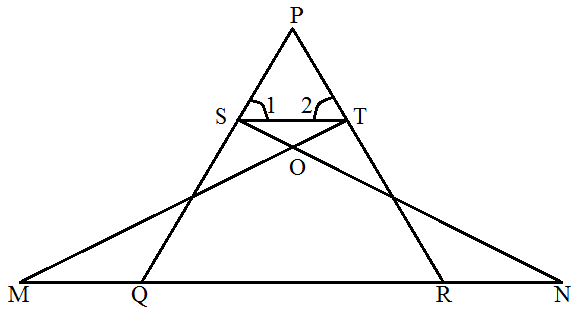
If $\angle1=\angle2$ and $\triangle\text{NSQ}\cong\triangle\text{MTR},$ then prove that $\triangle\text{PTS}\sim\triangle\text{PRQ}.$
Answer
Given $\triangle\text{NSQ}\cong\triangle\text{MTR},$
and $\angle1=\angle2$
To prove $\triangle\text{PTS}\sim\triangle\text{PRQ}$
Proof since, $\triangle\text{NSQ}\cong\triangle\text{MTR}$
So, $\text{SQ}=\text{TR}\ ......(\text{i})$
Also, $\angle1=\angle2\Rightarrow\text{PT}=\text{PS}\ ......(\text{ii})$
[Since, sides opposite to equal angles are also equal]
From Eq. (i) and (ii),
$\frac{\text{PS}}{\text{SQ}}=\frac{\text{PT}}{\text{TR}}$
$\Rightarrow\text{ST}\parallel\text{QR}$ [by convense of basic proportionality therom]
$\therefore\angle1=\angle\text{PQR}$
and $\therefore\angle2=\angle\text{PRQ}$ [common angles]
In $\triangle\text{PTS}$ and $\triangle\text{PRQ},$
$\angle{\text{P}}=\angle{\text{P}}$
$\angle1=\angle{\text{PQR}}$
$\angle2=\angle{\text{PRQ}}$
$\therefore\triangle{\text{PTS}}\sim\triangle{\text{PRQ}}$ [by AAA similarity criterion]
Hence proved.
View full question & answer
Question 123 Marks
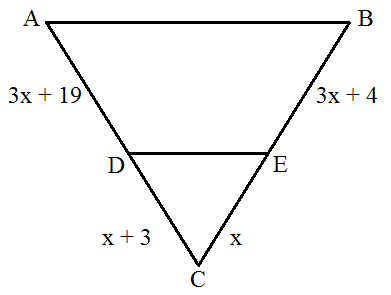
Find the value of x for which $DE || AB$ in:
Answer

Given $DE || AB$
$\therefore\frac{\text{CD}}{\text{AD}}=\frac{\text{CE}}{\text{BE}}$ [by basic proportionality theorem]
$\Rightarrow\frac{\text{x}+3}{3\text{x}+4}=\frac{\text{x}}{3\text{x}+4}$
$\Rightarrow (x + 3)(3x +4) = x(3x + 19)$
$\Rightarrow 3x^2 + 4x + 9x + 12 = 3x^2 + 19x$
$\Rightarrow 19x - 13x = 12$
$\Rightarrow 6x = 12$
$\therefore\text{x}=\frac{12}{6}=2$
Hence, the required value of x is 2.
View full question & answer
Question 133 Marks
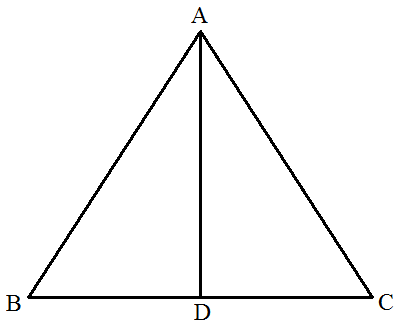
Find the altitude of an equilateral triangle of side $8cm$.
Answer
Let $ABC$ be an equilateral triangle of side 8cm i.e.,$ AB = BC = CA = 8cm$. Draw altitude $AD$ which is perpendicular to BC. Then, $D$ is the mid-point of $BC.$
$\therefore\text{BD}=\text{CD}=\frac{1}{2}\text{BC}=\frac{8}{2}=4\text{cm}$

Now, $AB^2 = AD^2 + BD^2$​​​​​​​ [by Pythagoras theorem]
$(8)^2 = AD^2 + (4)2$
$64 = AD^2 + 16$
$AD^2 = 64 - 16$
$AD^2= 48$
$\Rightarrow\text{AD}=\sqrt{48}$
$\Rightarrow\text{AD}=4\sqrt{3}\text{cm}$
Hence, altitude of an equilateral triangle is $4\sqrt{3}\text{cm}.$
View full question & answer