Question types

Triangles question types

57 questions across 4 question groups — pick any mix to generate a Maths paper with step-by-step answer keys.

57
Questions
4
Question groups
5
Question types
Sample Questions

Triangles questions

One sample from each question group in this chapter. Select any group above to see the full set with answer keys.

Choose the correct answer from the given four options: $\text{In }\angle\text{BAC}=90^\circ\text{ and}\text{ AD}\perp\text{BC}.\text{Then,}$Traingles
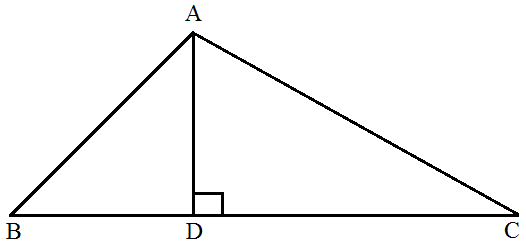
  • A
    $B D \times C D=B C^2$
  • B
    $A B \times A C=B C^2$
  • $B D \times C D=A D^2$
  • D
    $A B \times A C=A D^2$

Answer: C.

View full solution
Choose the correct answer from the given four options:
If in two traingles ABC and PQR, $\frac{\text{AB}}{\text{QR}}=\frac{\text{BC}}{\text{PR}}=\frac{\text{CA}}{\text{PQ}},$ then:
  • A
    $\triangle\text{PQR}\sim\triangle\text{CAB}$
  • B
    $\triangle\text{PQR}\sim\triangle\text{ABC}$
  • $\triangle\text{CBA}\sim\triangle\text{PQR}$
  • D
    $\triangle\text{BCA}\sim\triangle\text{PQR}$

Answer: C.

View full solution
Choose the correct answer from the given four options:
The lengths of the diagonals of a rhombus are $16\ cm$ and $12\ cm$. Then, the length of the side of the rhombus is:
  • A
    $ 9\ cm$
  • $ 10\ cm$
  • C
    $ 8\ cm$
  • D
    $20\ cm$

Answer: B.

View full solution
Choose the correct answer from the given four options:
It $S$ is a point on side $PQ$ of a $\triangle\text{PQR}$ such that $PS = QS = RS$, then:
  • A
    $PR \times QR=RS^2$
  • B
    $QS+RS=QR^2$
  • $PR+QR=PQ^2$
  • D
    $PS+RS=PR^2$

Answer: C.

View full solution
Choose the correct answer from the given four options:
$\text{If}\ \triangle\text{ABC}\sim\triangle\text{EDF}\text{ and}\ \triangle\text{ABC}$ is not similar to $\triangle\text{DEF},$ then which of the following is not true?
  • A
    BC × EF = AC × FD
  • AB × EF = AC × DE
  • C
    BC × DE = AB × EF
  • D
    BC × DE = AB × FD

Answer: B.

View full solution
A and B are respectively the points on the sides PQ and PR of a triangle PQR such that PQ = 12.5cm, PA = 5cm, BR= 6cm and PB = 4cm. Is AB || QR? Give reasons for your answer.
View full solution
If in two right triangles, one of the acute angles of one triangle is equal to an acute angle of the other triangle, can you say that the two triangles will be similar? Why?
View full solution
Two sides and the perimeter of one triangle are respectively three times the corresponding sides and the perimeter of the other triangle. Are the two triangles similar? Why?
View full solution
Q 123 Marks Question3 Marks
A 15 metres high tower casts a shadow 24 metres long at a certain time and at the same time, a telephone pole casts a shadow 16 metres long. Find the height of the telephone pole.
View full solution
Q 133 Marks Question3 Marks
Corresponding sides of two similar triangles are in the ratio of $2 : 3$. If the area of the smaller triangle is $48cm^2$​​​​​​​, find the area of the larger triangle.
View full solution
Q 143 Marks Question3 Marks
Areas of two similar triangles are $36 cm^2$ and $100 cm^2$. If the length of a side of the larger triangle is $20$ cm , find the length of the corresponding side of the smaller triangle.
View full solution
Q 153 Marks Question3 Marks
Foot of a $10m$ long ladder leaning against a vertical wall is $6m$ away from the base of the wall. Find the height of the point on the wall where the top of the ladder reaches.
View full solution
For going to a city B from city A, there is a route via city C such that $\text{AC}\perp\text{CB},$ AC = 2x km and CB = 2(x + 7)km. It is proposed to construct a 26km highway which directly connects the two cities A and B. Find how much distance will be saved in reaching city B from city A after the construction of the highway.
View full solution
In a quadrilateral ABCD, $\angle\text{A}+\angle\text{D}=90^\circ.$ Prove that $AC^2 + BD^2 = AD^2 + BC^2.$
[Hint: Produce AB and DC to meet at E]
View full solution
$\text{l}\parallel\text{m}$ and line segments AB, CD and EF are concurrent at point P. Proved that $\frac{\text{AE}}{\text{BF}}=\frac{\text{AC}}{\text{BD}}=\frac{\text{CE}}{\text{FD}}.$
View full solution
Prove that if a line is drawn parallel to one side of a triangle to intersect the other two sides, then the two sides are divided in the same ratio.
View full solution

Generate a Triangles paper free

Pick question groups from the list above, set marks and difficulty, and export a branded PDF with step-by-step answer keys. First 3 chapters free — no signup.

Download App