Question 12 Marks
In the adjoining figure, find AC.
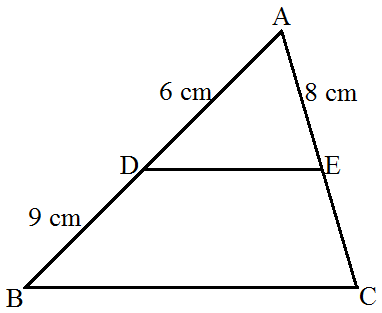
AnswerGiven: In the figure we are given AD = 6cm, BD = 9cm, AE = 8cm
To Find: AC
According to Basic Proportionality Theorem, if a line is drawn parallel to one side of a triangle intersecting the other two sides, then it divides the two sides in the same ratio.
In $\triangle\text{ABC}, \text{DE}||\text{BC}$
So,
$\frac{\text{AD}}{\text{DB}}=\frac{\text{AE}}{\text{EC}}$
$\frac{6}{9}=\frac{8}{\text{EC}}$
$\text{EC}=\frac{8\times9}{6}$
EC = 12cm
Now,
AC = AE + EC
AC = 8 + 12
AC = 20cm.
View full question & answer→Question 22 Marks
In the given figure, $\triangle\text{AHK}$ is similar to $\triangle\text{ABC}.$ If AK = 10cm, BC = 3.5cm and HK = 7cm, find AC.
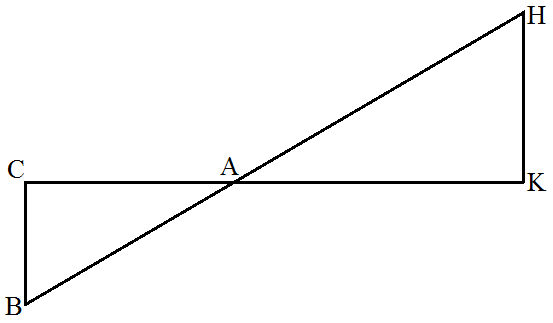
AnswerGiven: $\triangle\text{AHK}\sim\triangle\text{ABC}$
AK = 10cm, BC = 3.5cm, HK = 7cm
To find: AC
Since $\triangle\text{AHK}\sim\triangle\text{ABC},$ so their corresponding sides are proportional.
$\frac{\text{AC}}{\text{AK}}=\frac{\text{BC}}{\text{HK}}$
$\frac{\text{AC}}{10}=\frac{3.5}{7}$
AC = 5cm.
View full question & answer→Question 32 Marks
Triangle ABC and DEF are similar.
If area $\big(\triangle\text{ABC}\big) =16\text{cm}^2,$ area $\big(\triangle\text{DEF}\big) =25\text{cm}^2 $ and BC = 2.3cm, find EF.
Answer$\because\triangle\text{ABC}\sim\triangle\text{DEF},$
$\therefore\frac{\text{area}(\triangle\text{ABC)}}{\text{area}(\triangle\text{DEF)}}=\frac{\text{BC}^2}{\text{EF}^2}$
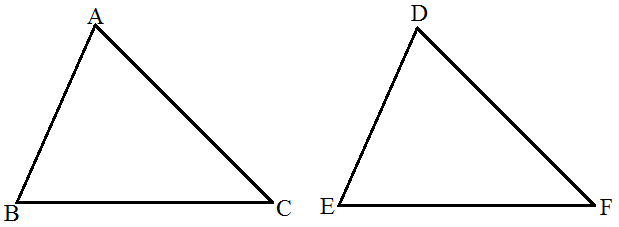
$\Rightarrow\frac{16}{25}=\frac{(2.3)^2}{\text{EF}^2}\Rightarrow\frac{(4)^2}{(5)^2}=\frac{(2.3)^2}{\text{EF}^2}$
$\Rightarrow\frac{4}{5}=\frac{2.3}{\text{EF}}\Rightarrow\text{EF}=\frac{2.3\times5}{4}$
$\therefore\text{EF}=\frac{11.5}{4}=2.875\text{cm}$ View full question & answer→Question 42 Marks
In a $\triangle\text{ABC,D}\ \text{and E}$ are points on the sides AB and AC respectively such that DE || BC.
If AD = 4cm, DB = 4.5cm and AE = 8cm, find AC.
AnswerIt is given that AD = 4cm, DB = 4.5cm and AE = 8cm.
We have to find AC.
$\frac{\text{AD}}{\text{DB}}=\frac{\text{AE}}{\text{CE}}$ (by thales theorem)
Then $\frac{4}{4.5}=\frac{8}{\text{AC}}$
$\text{AC}=\frac{4.5\times8}{4}\text{cm}$
$=9\text{cm}$
Hence AC = 9cm.
View full question & answer→Question 52 Marks
In the given figure, LM = LN = 46°. Express x in terms of a, b and c where a, b, c are lengths of LM, MN and NK respectively.
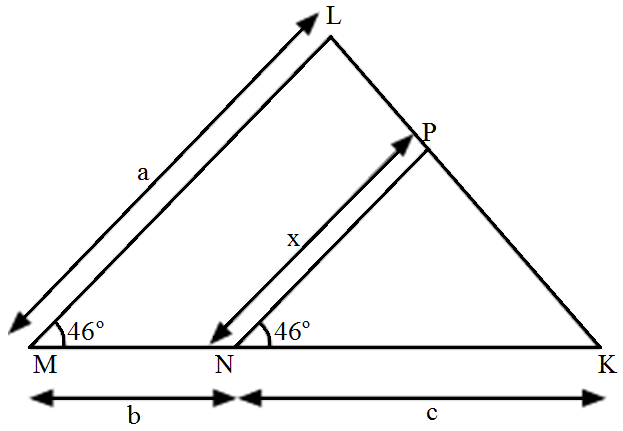
AnswerGiven: In the given figure $\angle\text{LMN}=\angle\text{PNK}=46^\circ$
To express: x in terms of a, b, c where a, b and c are the lengths of LM, MN and NK respectively.
Here we can see that $\angle\text{LMN}=\angle\text{PNK}=46^\circ.$ It forms a pair of corresponding angle.
Hence, LM || PN
In $\triangle\text{LMK}$ and $\triangle\text{PNK,}$
$\angle\text{LMK}=\angle\text{PNK}$ (Corresponding angles)
$\angle\text{LKM}=\angle\text{PKN}$ (Common)
$\therefore\triangle\text{LMK}\sim\triangle\text{PNK}$ (AA Similarity)
$\frac{\text{ML}}{\text{NP}}=\frac{\text{MK}}{\text{NK}}$
$\frac{\text{a}}{\text{x}}=\frac{\text{b}+\text{c}}{\text{c}}$
$\text{x}=\frac{\text{ac}}{\text{b}+\text{c}}$
Hence we got the result as $\text{x}=\frac{\text{ac}}{\text{b}+\text{c}}$
View full question & answer→Question 62 Marks
In FIg. check whether AD is the bisector of $\angle\text{A}$ of $\triangle\text{ABC}$ in the following.
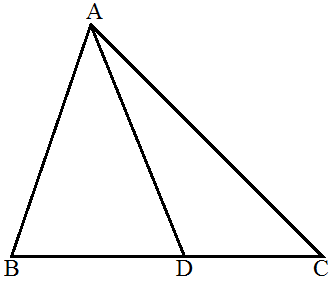
AB = 5cm, AC = 12cm, BD = 2.5cm and BC = 9cm. AnswerWe have,
AB = 5cm, AC = 12cm, BD = 2.5cm and BC = 9cm.
Now, $\frac{\text{AB}}{\text{BD}}=\frac{5}{2.5}=\frac{50}{25}=\frac{2}{1}$
and, $\frac{\text{AC}}{\text{CD}}=\frac{12}{\text{BC}-\text{BD}}=\frac{12}{9-2.5}=\frac{12}{6.5}=\frac{120}{65}=\frac{24}{13}$
$\therefore\frac{\text{AB}}{\text{BD}}\neq\frac{\text{AC}}{\text{CD}}$
Hence, AD is not bisector of $\angle\text{A}$.
View full question & answer→Question 72 Marks
The lengths of the diagonals of a rhombus are 30cm and 40cm. Find the side of the rhombus.
AnswerGiven: The lengths of the diagonals of a rhombus are 30cm and $40\ cm.$
To find: Side of the rhombus.
Let the diagonals AC and CD of the rhombus ABCD meet at point O.
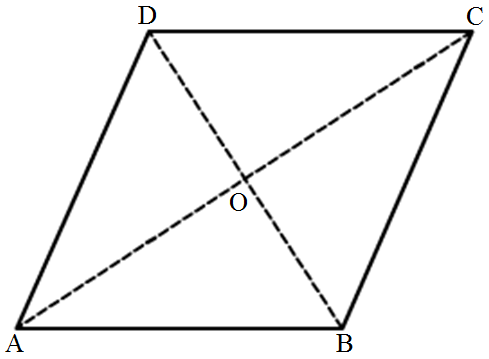
We know that the diagonals of the rhombus bisect each other perpendicularly.
Hence in right triangle AOD, by Pythagoras theorem
hypotenuse$^2$ = perpendicular$^2$ + base$^2$
$= 15^2 + 20^2$
$= 225 + 400$
$= 625$
hypotenuse $= 25\ cm$
Hence the side of the rhombus is $= 25\ cm.$ View full question & answer→Question 82 Marks
In the following figures, you find who triangles. Indicate whether the triangles are similar. Give reasons in support of your answer.
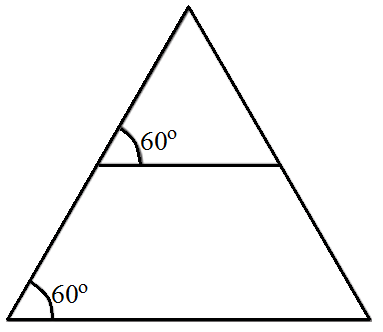
Answer
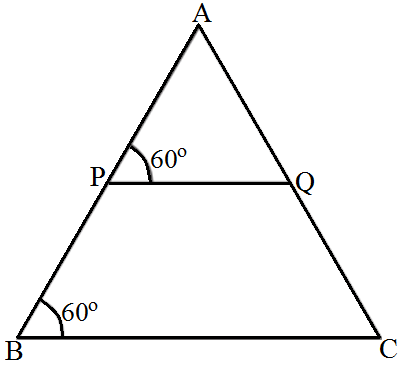 PQ || BC (Corresponding angles foemed are equal
In $\triangle\text{APQ}$ and $\triangle\text{ABC},$
$\angle\text{APQ}=\angle\text{B}$ (Corresponding angles)
$\angle\text{PAQ}=\angle\text{BAC}$ (Common)
So $\triangle\text{APQ}\sim\triangle\text{ABC}$ (AA similarity)
yes two triangles are similar. View full question & answer→Question 92 Marks
In a $\triangle\text{ABC, D}$ and E are points on the sides AB and AC respectively. For the following cases show that DE || BC:
AB = 5.6cm, AD = 1.4cm, AC = 7.2 and AE = 1.8cm.
AnswerGiven AB = 5.6cm, AD = 1.4cm, AC = 7.2cm and AE = 1.8cm
Now, $\frac{\text{AD}}{\text{AB}}=\frac{1.4}{5.6}=\frac{1}{4}$
And, $\frac{\text{AE}}{\text{AC}}=\frac{1.8}{7.2}=\frac{1}{4}$
$\therefore\frac{\text{AD}}{\text{AB}}=\frac{\text{AE}}{\text{AC}}$
Thus, DE divides sides AB and AC of $\triangle\text{ABC}$ in the same ratio. Therefore, by converse of basic proportionality theorem, we have DE || BC.
View full question & answer→Question 102 Marks
If a $\triangle\text{ABC},$ AD is the bisector of $\angle\text{A},$ Meeting side BC at D.
If BD = 2cm, AB = 5cm and DC = 3cm, find AC.
AnswerIt is given that BD = 2cm, AB = 5cm and DC = 3cm.
In $\triangle\text{ABC},$ AD is the bisector of $\angle\text{A},$ meeting side BC at D.
We have to find AC.
Since AD is $\angle\text{A}$ bisector
So $\frac{\text{AB}}{\text{AC}}=\frac{\text{BD}}{\text{DC}}$ (AD is bisector of $\angle\text{A}$ and side BC)
Then
$\frac{5}{\text{AC}}=\frac{2}{3}$
⇒ 2AC = 5 × 3
$\Rightarrow\text{AC}=\frac{15}{2}$
= 7.5
Hence AC = 7.5cm
View full question & answer→Question 112 Marks
In the adjoining figure, if AD is the bisector of $\angle\text{A},$ what is AC?
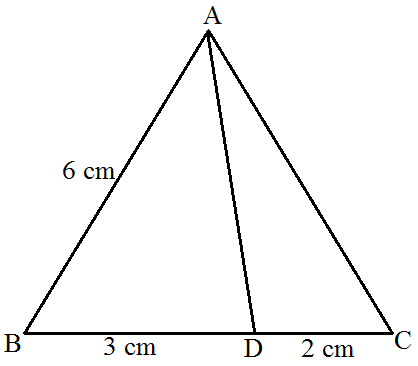
AnswerIn the figure, AD is the angle bisector of $\angle\text{A}$ of $\triangle\text{ABC}$
AB = 6cm, BC = 3cm, DC = 2cm
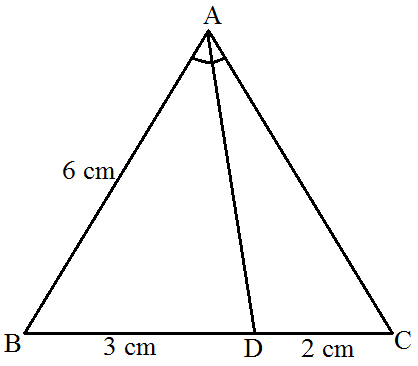
Let AC = x
$\therefore \frac{\text{AB}}{\text{AC}}=\frac{\text{BD}}{\text{DC}}\Rightarrow\frac{6}{\text{x}}=\frac{3}{2}$
$\Rightarrow\text{x}=\frac{6\times2}{3}=4$
$\therefore\text{AC}=4\text{cm}$ View full question & answer→Question 122 Marks
If a $\triangle\text{ABC},$ AD is the bisector of $\angle\text{A},$ Meeting side BC at D.
If BD = 2.5cm, AB = 5cm and AC = 4.2cm, find DC.
AnswerIn a $\triangle\text{ABC}, \text{AD}$ is bisector of $\angle\text{A}$
We have,
BD = 2.5cm, AB = 5cm and AC = 4.2cm
Now, $\frac{\text{BD}}{\text{AB}}=\frac{\text{DC}}{\text{AC}}$
$\Rightarrow\frac{2.5}{5}=\frac{\text{DC}}{4.2}$
$\Rightarrow\text{DC}=\frac{2.5\times4.2}{5}$
$\Rightarrow\text{DC}=2.1\text{cm}$
View full question & answer→Question 132 Marks
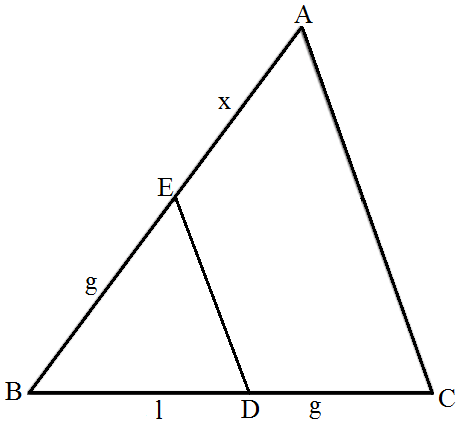
In the figure given below, a line segment is drawn parallel to one side of the triangle and the lengths of certain line-segment are marked. Find the value of x in the following:
Answer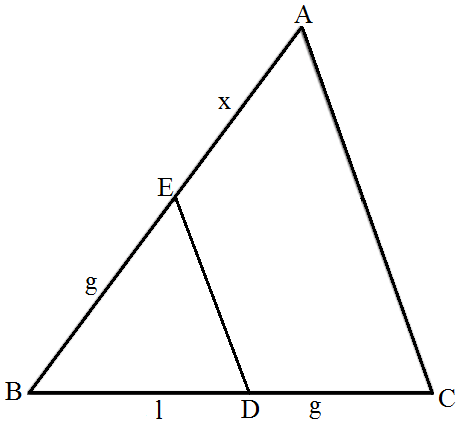
In the figure
DE || CA
$\therefore\frac{\text{BD}}{\text{DC}}=\frac{\text{BE}}{\text{EA}}$
$\Rightarrow\frac{1}{\text{g}}=\frac{\text{g}}{\text{x}}\Rightarrow\text{x}=\text{g}^2$
Hence $x = g^2$ View full question & answer→Question 142 Marks
The sides of certain triangles are given below. Determine which of them are right triangles.
$a = 7cm, b = 24cm$ and $c = 25cm$
AnswerWe have,
$a = 7cm, b = 24cm$ and $c = 25cm$
$\therefore$ $a^2 + b^2 = (7)^2 + (24)^2 = 49 + 576 = 625$
$c^2 = (25)^2 = 625$
thus, $a^2 + b^2 = c^2$
Hence, it is a right-triangle.
View full question & answer→Question 152 Marks
State SSS similarity criterion.
AnswerSSS Similarity Criterion: If the corresponding sides of two triangles are proportional, then they are similar.
In $\triangle\text{ABC}$ and $\triangle\text{DEF},$ if
$\frac{\text{AB}}{\text{DE}}=\frac{\text{BC}}{\text{EF}}=\frac{\text{AC}}{\text{DF}}$
Then, $\triangle\text{ABC}\sim\triangle\text{DEF}$
View full question & answer→Question 162 Marks
State basic proportionality theorem and its converse.
AnswerBasic Proportionality Theorem: If a line is drawn parallel to one side of a triangle intersects the other two sides in distinct points, then the other two sides are divided in the same ratio.
Conversely: In a line divides any two sides of a triangle in the same ratio, then the line is parallel to the third side of the triangle.
View full question & answer→Question 172 Marks
In FIg. check whether AD is the bisector of $\angle\text{A}$ of $\triangle\text{ABC}$ in the following.
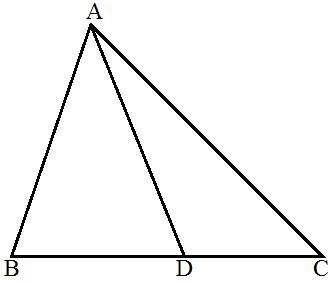
AB = 8cm, AC = 24cm, BD = 6cm and BC = 24cm. AnswerAB = 8cm, AC = 24cm, BD = 6cm and BC = 24cm.
Now $\frac{\text{AB}}{\text{BD}}=\frac{8}{6}=\frac{4}{3}$
and, $\frac{\text{AC}}{\text{CD}}=\frac{\text{AC}}{\text{BC}-\text{BD}}=\frac{24}{24-6}=\frac{24}{18}=\frac{4}{3}$
$\therefore\frac{\text{AB}}{\text{BD}}=\frac{\text{AC}}{\text{CD}}$
Hence, AD is bisector of $\angle\text{A}$.
View full question & answer→Question 182 Marks
Triangle ABC and DEF are similar.If AB = 1.2cm and DE = 1.4cm, find the retio of the areas of $\triangle\text{ABC}$ and $\triangle\text{DEF}.$
Answer$\because\triangle\text{ABC}\sim\triangle\text{DEF},$
$\therefore\frac{\text{area}(\triangle\text{ABC)}}{\text{area}(\triangle\text{DEF)}}=\frac{\text{AB}^2}{\text{DE}^2}$
$=\frac{(1.2)^2}{(1.4)^2}=\frac{1.44}{1.96}=\frac{144}{196}=\frac{36}{49}$
$\therefore\text{area}\ \triangle\text{ABC}:\triangle\text{DEF}=36:49$
View full question & answer→Question 192 Marks
In the following figures, you find who triangles. Indicate whether the triangles are similar. Give reasons in support of your answer.
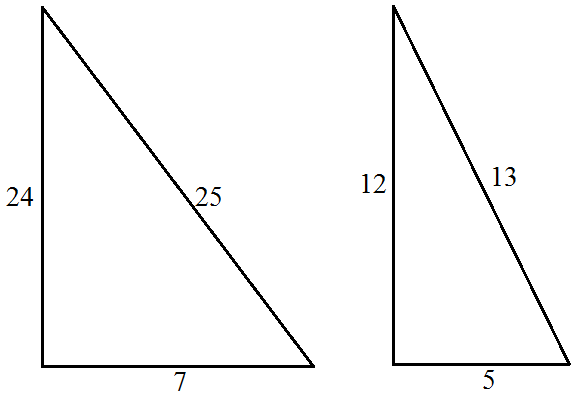
AnswerIn two triangle, we observe that
$\frac{24}{12}\neq\frac{25}{13}\neq\frac{7}{5}$
In two triangles corresponding sides are not proportional to each other.
No two triangles are not similar. View full question & answer→Question 202 Marks
In the following figures, you find who triangles. Indicate whether the triangles are similar. Give reasons in support of your answer.
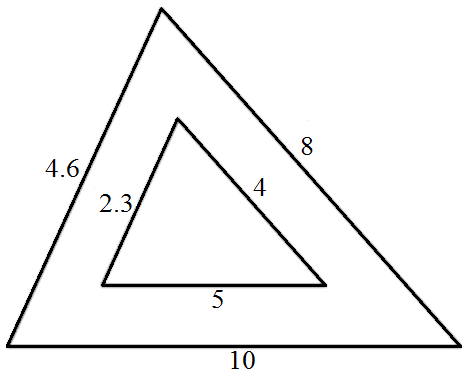
AnswerIn two triangle, we observe that
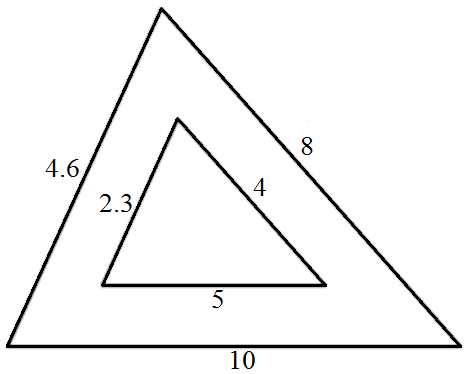
$\frac{2.3}{4.6}=\frac{4}{8}=\frac{5}{10}=\frac{1}{2}$
In similar triangle corresponding sides are proportional to each other.
Therefore, by SSS-criterion of similarity,
yes two triangles are similar. View full question & answer→Question 212 Marks
In the following figures, you find who triangles. Indicate whether the triangles are similar. Give reasons in support of your answer.
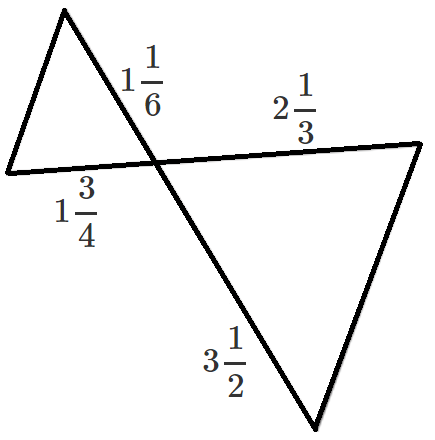
AnswerIn two triangle, we observe that
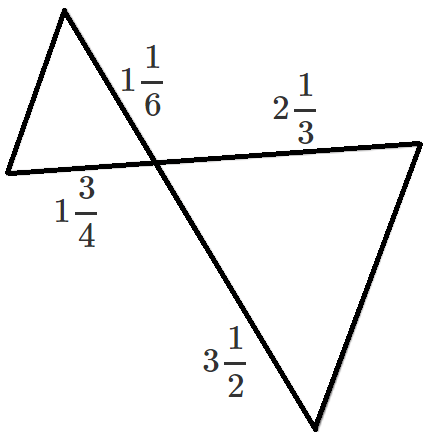
$\frac{3\frac{1}{2}}{1\frac{1}{6}}=\frac{2\frac{1}{3}}{1\frac{3}{4}}$
$\frac{\frac{7}{2}}{\frac{7}{6}}=\frac{\frac{7}{3}}{\frac{7}{4}}$
$\frac{7}{2}\times\frac{6}{7}=\frac{7}{3}\times\frac{4}{7}$
$\frac{6}{2}=\frac{4}{3}$
$\frac{3}{1}=\frac{4}{3}$
$3=\frac{4}{3}$
In two triangles corresponding sides are not proportional to each other.
No two triangles are not similar. View full question & answer→Question 222 Marks
In the figure given below DE || BC. If AD = 2.4cm, DB = 3.6cm, AC = 5cm. Find AE.
AnswerGiven: AD = 2.4cm, BD = 3.6cm and AC = 5cm.
To find: AE
According to basic proportionality theorem If a line is drawn parallel to one side of a triangle intersecting the other two sides, then it divides the two sides in the same ratio.
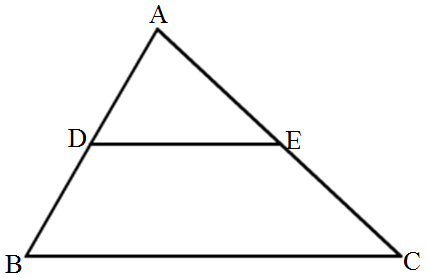
In $\triangle\text{ABC},\ \text{DE}||\text{BC}.$
$\frac{\text{AD}}{\text{AB}}=\frac{\text{AE}}{\text{AC}}$
$\frac{2.4}{2.4+3.6}=\frac{\text{AE}}{\text{AC}}$
$\frac{2.4}{6}=\frac{\text{AE}}{5}$
$\text{AE} = 2$
$\text{AE} = 2\text{cm.}$ View full question & answer→Question 232 Marks
Two isosceles triangles have equal vertical angles and their areas are in the ratio $36 : 25$. Find the ratio of their corresponding heights.
AnswerWe know that
(Ratio of corresponding height)$^2$ = Ratio of their areas
(Ratio of corresponding height)$^2$ $=\frac{36}{25}$
$=\frac{6}{5}$
Thus, ratio of their corresponding height is 6 : 5.
View full question & answer→Question 242 Marks
$\triangle\text{ABD}$ is a right triangle right-angled at A and $\text{AC}\perp\text{BD}.$ Show that
$AD^2 = BD \times CD$
Answer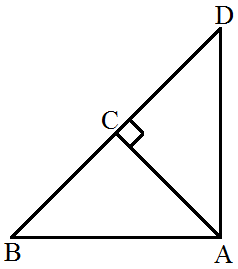
In $\triangle\text{DCA}\ \&\ \triangle\text{DAB}$
$\angle\text{DCA}=\angle\text{DAB}$ (Both are equal to 90°)
$\angle\text{CDA}=\angle\text{ADB}$ (Common angle)
$\angle\text{DAC}=\angle\text{DBA}$ (Remaining angle)
$\triangle\text{DCA}\sim\triangle\text{DAB}$ (AAA property)
Therefore $\frac{\text{DC}}{\text{DA}}=\frac{\text{DA}}{\text{DB}}$
$\Rightarrow\text{AD}^2=\text{BD}\times\text{CD}$ View full question & answer→Question 252 Marks
In the figure, $\triangle\text{AMB}\sim\triangle\text{CMD};$ determine MD in terms of x, y and z.
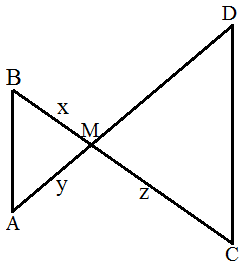
AnswerIn the figure, BM = x, AM = y, CM = z
$\triangle\text{AMD}\sim\triangle\text{CMD}$
$\therefore\frac{\text{AM}}{\text{CM}}=\frac{\text{BM}}{\text{DM}}$
$\frac{\text{y}}{\text{z}}=\frac{\text{x}}{\text{MD}}\Rightarrow\text{MD}=\frac{\text{xz}}{\text{y}}$
$\therefore\text{MD}=\frac{\text{xz}}{\text{y}}$
View full question & answer→Question 262 Marks
The sides of certain triangles are given below. Determine which of them are right triangles. $a =16 cm, b =3.8 cm$ and $c =4 cm$.
AnswerSides of the triangle are $a=1.6 cm, b =3.8 cm, c =4 cm$ $\left(\right.$ Longest side) ${ }^2=(4)^2=16$
Sum of squares of shorter two sides $+(1.6)^2+(3.8)^2=2.56+14.44=17.00$
$16 \neq 17$
It is not a right triangle.
View full question & answer→Question 272 Marks
In $\triangle\text{ABC},$ ray AD bisects $\angle\text{A}$ and intersects BC in D. If BC = a, AC = b and AB = c, prove that
$\text{DC}=\frac{\text{ab}}{\text{b}+\text{c}}$
AnswerGiven: In $\triangle\text{ABC}$ ray AD bisects angle A and intersects BC in D,
If BC = a, AC = b and AB = c
$\text{DC}=\frac{\text{ab}}{\text{b}+\text{c}}$
The corresponding figure is as follows
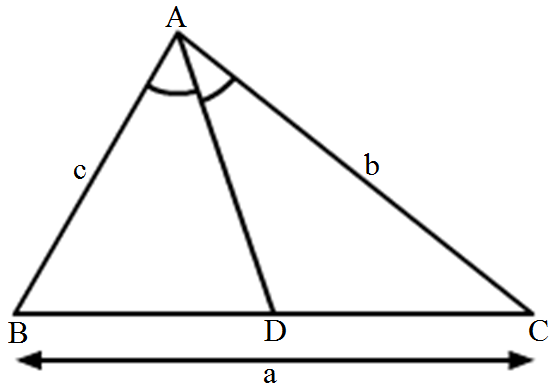
Proof: In triangle ABC, AD is the bisector of $\angle\text{A}$
Since BC = CD + BD
⇒ CD = BC - BD
$\text{CD}=\text{a}-\frac{\text{ac}}{\text{b}+\text{c}}$
$=\frac{\text{ab}}{\text{b}+\text{c}}$ View full question & answer→Question 282 Marks
If the areas of two similar triangles ABC and PQR are in the ratio 9 : 16 and BC = 4.5cm, what is the length of QR?
AnswerGiven: $\triangle\text{ABC}\sim\triangle\text{PQR}$
BC = 4.5cm
$\frac{\text{Area}(\triangle\text{ABC})}{\text{Area}(\triangle\text{PQR})}=\Big(\frac{\text{BC}}{\text{QR}}\Big)^2$
$\Rightarrow\frac{9}{16}=\Big(\frac{4.5}{\text{QR}}\Big)^2$
$\Rightarrow\text{QR}^2=\frac{(4.5)^2\times16}{9}$
$\Rightarrow\text{QR}=\sqrt{\frac{(4.5)^2\times16}{9}}$
$\Rightarrow\text{QR}=\frac{4.5\times4}{3}$
$\Rightarrow\text{QR}=1.5\times4$
$\Rightarrow\text{QR}=6\text{cm}$
View full question & answer→Question 292 Marks
Corresponding sides of two similar triangles are in the ratio $1 : 3$. If the area of the smaller triangle in $40cm^2$, find the area of the larger triangle.
AnswerSince the ratio of areas of two similar triangles is equal to the ratio of the squares of any two corresponding sides.
$\frac{\text{Area of smaller triangle}}{\text{Area of larger triangle}}$ $=\frac{(\text{Corresponding side of smaller triangle})^2}{(\text{Corresponding side of larger triangle})^2}$
$\frac{\text{Area of smaller triangle}}{\text{Area of larger triangle}}=\frac{1^2}{3^2}$
$\frac{40}{\text{Area of larger triangle}}=\frac{1}{9}$
Area of larger triangle $=\frac{40\times9}{1}=360\text{cm}^2$
Hence the area of the larger triangle is $360cm^2$
View full question & answer→Question 302 Marks
$\triangle\text{ABD}$ is a right triangle right-angled at A and $\text{AC}\perp\text{BD}.$ Show that
$AB^2 = BC \times BD$
Answer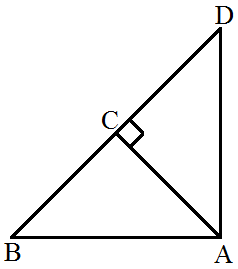
In $\triangle\text{ADB}$ and $\triangle\text{CAB}$
$\angle\text{DAB}=\angle\text{ACB}=90^\circ$
$\angle\text{ABD}=\angle\text{CBA}$ (Common angle)
$\angle\text{ADB}=\angle\text{CAB}$ (remaining angle)
So, $\triangle\text{ADB}\sim\triangle\text{CAB}$ (by AAA similarity)
Therefore $\frac{\text{AB}}{\text{CB}}=\frac{\text{BD}}{\text{AB}}$
$\Rightarrow\text{AB}^2=\text{CB}\times\text{BD}$ View full question & answer→Question 312 Marks
In the figure given below, a line segment is drawn parallel to one side of the triangle and the lengths of certain line-segment are marked. Find the value of x in the following:
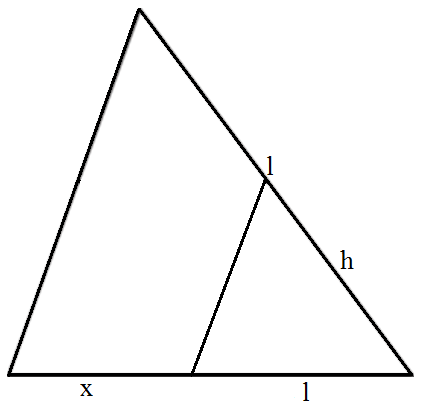
Answer
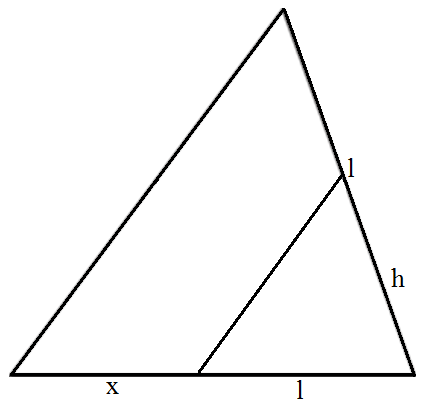 $\frac{1}{1+\text{h}}=\frac{\text{x}}{\text{x}+1}$
By cross multiplication on both sides, we get
$1\times(\text{x}+1)=\text{x}\times(1+\text{h})$
$\text{x}+1=\text{x}+\text{hx}$
$\text{x}+1-\text{x}=\text{hx}$
$1=\text{xh}$
$\frac{1}{\text{h}}=\text{x}$
Hence the value of x is $\frac{1}{\text{h}}.$ View full question & answer→Question 322 Marks
In a $\triangle\text{ABC},$ AB = BC = CA = 2a and $\text{AD}\perp\text{BC}.$ Prove that
Area $(\triangle\text{ABC})=\sqrt{3}\text{ a}^2$
Answer$\triangle\text{ABC},$ AB = BC = AC = 2a
$\text{AD}\perp\text{BC}$
AD bisects BC at D
$\text{BD}=\text{DC}=\frac{1}{2}\text{BC}=\text{a}$
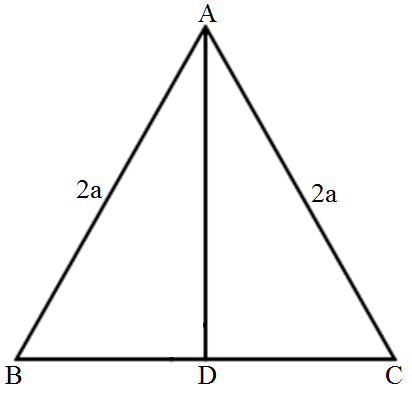
Area of $\triangle\text{ABC}$
$=\frac{1}{2}\text{BC}\times\text{AD}$
$=\frac{1}{2}\times2\text{a}\times\sqrt{3}\text{ a}=\sqrt{3}\text{ a}^2$
Hence proved. View full question & answer→Question 332 Marks
If a $\triangle\text{ABC},$ AD is the bisector of $\angle\text{A},$ Meeting side BC at D.
If AD = 5.6cm, BC = 6cm and BD = 3.2cm, find AC.
AnswerWe have,
AB = 5.6cm, BC = 6cm and BD = 3.2cm CD = BC - BD = 6 - 3.2 = 2.8cm.
$\frac{\text{AC}}{\text{CD}}=\frac{\text{AB}}{\text{BD}}$
$\Rightarrow\frac{\text{AC}}{2.8}=\frac{5.6}{3.2}$
$\Rightarrow\text{AC}=\frac{5.6\times2.8}{3.2}$
$\Rightarrow\text{AC}=0.7\times7=4.9\text{cm}$
View full question & answer→Question 342 Marks
The sides of certain triangles are given below. Determine which of them are right triangles.
$a = 9\ cm, b = 16\ cm$ and $c = 18\ cm.$
AnswerWe have,
a = 9cm, b = 16cm and c = 18cm
$\therefore a^2 = 81, b^2 = 256 $and $c^2 = 324$
Since,$ a^2 + b^2 = 81 + 256 = 337$
$\neq\text{c}^2$
Then, by converse of Pythagoras theorem, given triangle is not a right triangle.
View full question & answer→Question 352 Marks
The sides of certain triangles are given below. Determine which of them are right triangles.
$a = 8\ cm, b = 10\ cm$ and $c = 6\ cm.$
AnswerWe have,
a = 8cm, b = 10cm and c = 6cm
$\therefore$ $a^2 + c^2 = (8)^2 + (6)^2 = 64 + 36 = 100$
$b^2 = (10)^2 = 100$
Thus, $a^2 + c^2 = b^2$
Hence, it is a right triangle.
View full question & answer→Question 362 Marks
Triangle ABC and DEF are similar.
If area $\big(\triangle\text{ABC}\big) = 36\text{cm}^2,$ area $\big(\triangle\text{DEF}\big) = 64\text{cm}^2$ and DE = 6.2cm, find AB.
Answer$\because\triangle\text{ABC}\sim\triangle\text{DEF},$
$\therefore\frac{\text{area}(\triangle\text{ABC)}}{\text{area}(\triangle\text{DEF)}}=\frac{\text{AB}^2}{\text{DE}^2}$
$\Rightarrow\frac{36}{64}=\frac{\text{AB}^2}{(6.2)^2}\Rightarrow\frac{(6)^2}{(8)^2}=\frac{\text{AB}^2}{(6.2)^2}$
$\Rightarrow\frac{\text{AB}}{6.2}=\frac{6}{8}\Rightarrow\text{AB}=\frac{6\times6.2}{8}=\frac{37.2}{8}$
$\Rightarrow\text{AB}=4.65$
Hence AB = 4.65.
View full question & answer→Question 372 Marks
In the given figure,
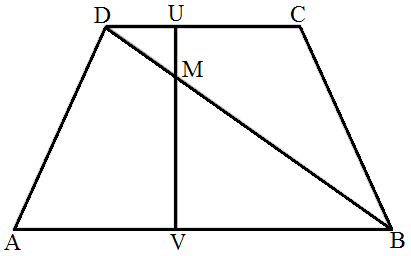
AB || DC prove that
$\triangle\text{DMU}\sim\triangle\text{BMV}$ AnswerGiven, AB || DC 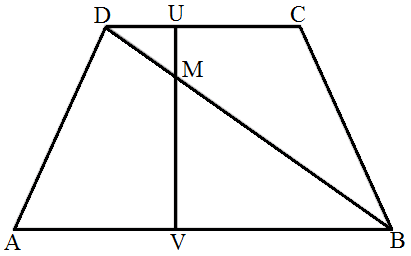 In triangle DMU and BMV, we have $\angle\text{MUD}=\angle\text{MVB}$ Each angle is equal to 90° $\angle\text{UMD}=\angle\text{VMB}$ Each are vertically opposite angles. Therefore, by AA-criterion of similarity $\triangle\text{DMU}\sim\triangle\text{BMV}$
 View full question & answer→Question 382 Marks
What values of x will make $DE || AB$ in the given figure?
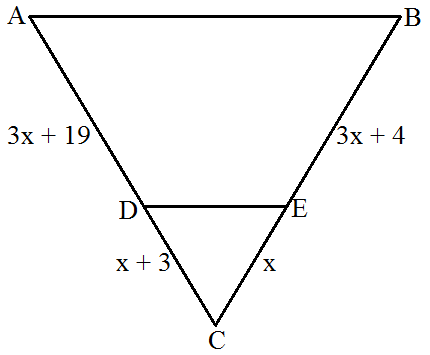
Answer$In the figure, in $\triangle\text{ABC},$$
$DE || AB$
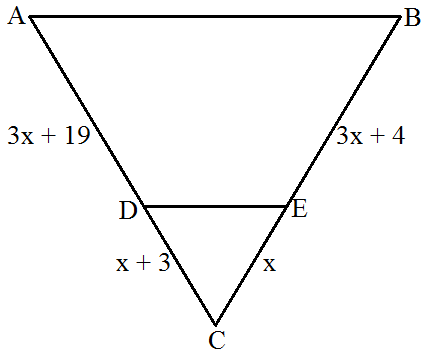
$\therefore\frac{\text{AD}}{\text{DC}}=\frac{\text{BE}}{\text{EC}}$
$\Rightarrow\frac{3\text{x}+19}{\text{x}+3}=\frac{3\text{x}+4}{\text{x} }$
$\Rightarrow x(3x + 19) = (x + 3)(3x + 4)$
$\Rightarrow 3x^2 + 19x = 3x^2 + 4x + 9x + 12$
$\Rightarrow 3x^2 + 19x - 3x^2 - 4x - 9x = 12$
$\Rightarrow6\text{x}=12\Rightarrow\text{x}=\frac{12}{6}=2$
$\therefore$ $x = 2$ View full question & answer→Question 392 Marks
In a $\triangle\text{ABC,D}\ \text{and E}$ are points on the sides AB and AC respectively such that DE || BC.If AD = 2.5cm, BD = 3.0cm, and AE = 3.75cm, find the length of AC.
AnswerIt is given that AD = 2.5cm, AE = 3.75cm and BD = 3cm.
$\frac{\text{AD}}{\text{DB}}=\frac{\text{AE}}{\text{CE}}$ (by thales theorem)
Then $\frac{2.5}{3}=\frac{3.75}{\text{CE}}$
$2.5\text{CE}=3.75\times3$
$\text{CE}=\frac{3.75\times3}{2.5}$
$=\frac{11.25}{2.5}$
$=4.50$
Now
$\text{AC}=3.75\text{cm}+4.50\text{cm}$
$=8.25\text{cm}$
View full question & answer→Question 402 Marks
Triangle ABC and DEF are similar.If AC = 19cm and DF = 8cm, find the ratio of the area of two triangles.
Answer$\because\triangle\text{ABC}\sim\triangle\text{DEF},$
$\therefore\frac{\text{area}(\triangle\text{ABC)}}{\text{area}(\triangle\text{DEF)}}=\frac{\text{AC}^2}{\text{DF}^2}$
$\frac{(19)^2}{(8)^2}=\frac{361}{64}$
$\therefore\text{area }\triangle\text{ABC}:\text{area }\triangle\text{DEF}=361:64$
View full question & answer→Question 412 Marks
Triangle ABC and DEF are similar.
If area $\big(\triangle\text{ABC}\big) = 9\text{cm}^2,$ area $\big(\triangle\text{DEF}\big) = 64\text{cm}^2$ and DE = 5.1cm, find AB.
Answer$\because\triangle\text{ABC}\sim\triangle\text{DEF},$
$\therefore\frac{\text{area}(\triangle\text{ABC)}}{\text{area}(\triangle\text{DEF)}}=\frac{\text{AB}^2}{\text{DE}^2}$
$\Rightarrow\frac{9}{64}=\frac{\text{AB}^2}{(5.1)^2}\Rightarrow\frac{(3)^2}{(8)^2}=\frac{\text{AB}^2}{(5.1)^2)}$
$\Rightarrow\frac{3}{8}=\frac{\text{AB}}{5.1}\Rightarrow\text{AB}=\frac{3\times5.1}{8}=\frac{15.3}{8}$
$\therefore\text{AB}=1.9125$
View full question & answer→Question 422 Marks
In the figure given below, a line segment is drawn parallel to one side of the triangle and the lengths of certain line-segment are marked. Find the value of x in the following:
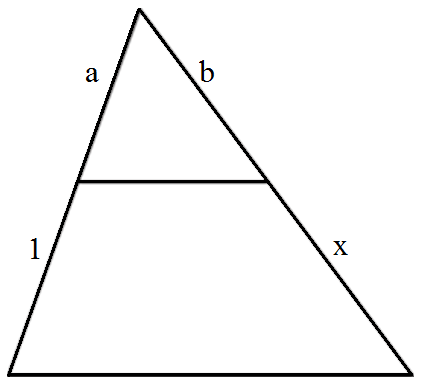
Answer
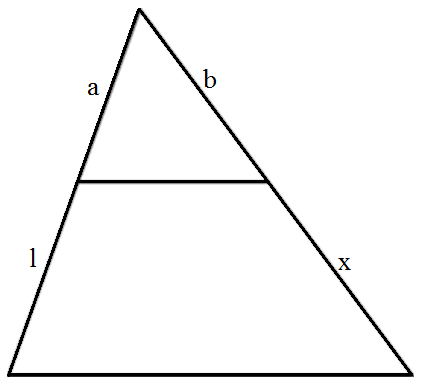 $\frac{\text{a}}{\text{a}+1}=\frac{\text{b}}{\text{b}+\text{x}}$
By cross multiplication on both sides, we get
$\text{a}\times(\text{b}+\text{x})=\text{b}\times(\text{a}+1)$
$\text{ab}+\text{ax}=\text{ab}+\text{b}$
$\text{ax}=\text{ab}+\text{b}-\text{ab}$
$\text{ax}=\text{ab}+\text{b}-\text{ab}$
$\text{ax}=\text{b}$
$\text{x}=\frac{\text{b}}{\text{a}}$
Hence the value of x is $\frac{\text{b}}{\text{a}}.$ View full question & answer→Question 432 Marks
In the given figure, S and T are points on the sides PQ and PR respectively of $\triangle\text{PQR}$ such that PT = 2cm, TR = 4cm and ST is parallel to QR. Find the ratio of the areas of $\triangle\text{PST}$ and $\triangle\text{PQR}.$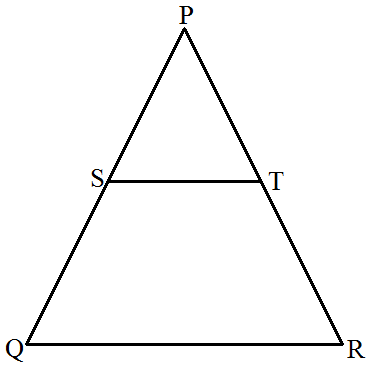
Answer
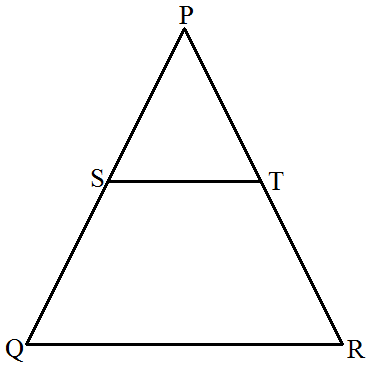 We have, ST || QR
PT = 2cm, TR = 4cm
In $\triangle\text{PST}$ and $\triangle\text{PQR,}$
$\angle\text{P}=\angle\text{P}$
$\angle\text{PST}=\angle\text{PQR}$ (corresponding angles)
$\triangle\text{PST}\sim\triangle\text{PQR}$
$\therefore\frac{\text{area}(\triangle\text{PST})}{\text{area}(\triangle\text{PQR})}=\Big(\frac{\text{PT}}{\text{PR}}\Big)^2$
$\Rightarrow\frac{\text{area}(\triangle\text{PST})}{\text{area}(\triangle\text{PQR})}=\Big(\frac{\text{PT}}{\text{PT}+\text{TR}}\Big)^2$
$\Rightarrow\frac{\text{area}(\triangle\text{PST})}{\text{area}(\triangle\text{PQR})}=\Big(\frac{2}{2+4}\Big)^2$
$\Rightarrow\frac{\text{area}(\triangle\text{PST})}{\text{area}(\triangle\text{PQR})}=\Big(\frac{2}{6}\Big)^2$
$\Rightarrow\frac{\text{area}(\triangle\text{PST})}{\text{area}(\triangle\text{PQR})}=\frac{1}{9}$
Thus, the tatio of the area of $\triangle\text{PST}$ and $\triangle\text{PQR}$ is 1 : 9. View full question & answer→Question 442 Marks
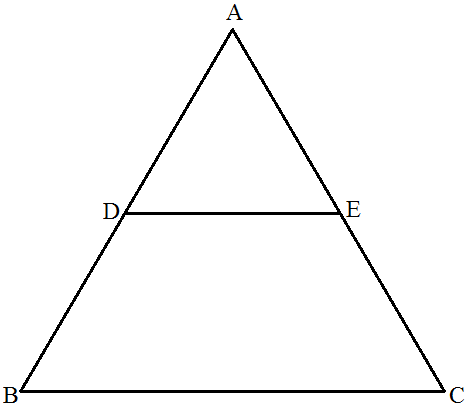
In the given figure, DE || BC
If DE = 4cm, BC = 6cm and Area $(\triangle\text{ADE})=16\text{cm}^2$, find the area of $\triangle\text{ABC}.$
AnswerWe have,
BC = 6cm, DE = 4cm and area of $\triangle\text{ADE}=16\text{cm}^2$
We know that
$\frac{\text{Area of }\triangle\text{ABC}}{\text{Area of }\triangle\text{ADE}}=\Big(\frac{\text{BC}}{\text{DE}}\Big)^2$
$\Rightarrow\frac{\text{Area of }\triangle\text{ABC}}{16}=\Big(\frac{6}{4}\Big)^2$
$\Rightarrow\text{Area of }\triangle\text{ABC}=\frac{36}{16}\times16$
$\Rightarrow\text{Area of }\triangle\text{ABC}=36\text{cm}^2$
View full question & answer→Question 452 Marks
In the figure given below, a line segment is drawn parallel to one side of the triangle and the lengths of certain line-segment are marked. Find the value of x in the following:
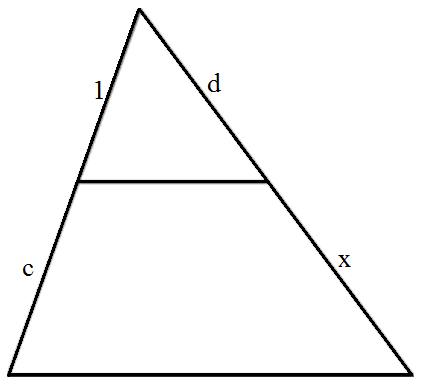
Answer
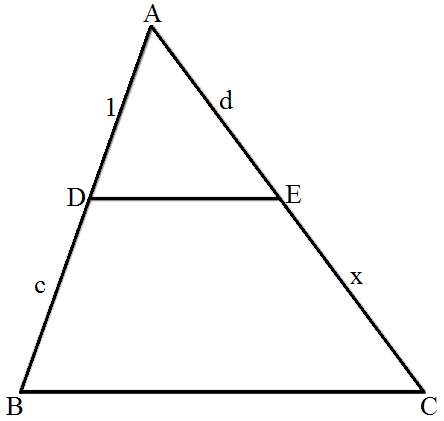 In figure (i)
DE || BC
$\therefore\frac{\text{AD}}{\text{DB}}=\frac{\text{AE}}{\text{EC}}$
$\Rightarrow\frac{1}{\text{c}}=\frac{\text{d}}{\text{x}}$
$\therefore\text{x}=\text{cd}$ View full question & answer→Question 462 Marks
In figure, AD bisects $\angle\text{A},$ AB = 12cm, AC = 20cm, and BD = 5cm. Determine CD.
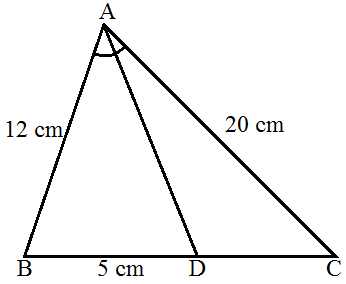
AnswerIn the $\triangle\text{ABC},$
AD is the bisector of $\angle\text{A}$
$\therefore\frac{\text{AB}}{\text{AC}}=\frac{\text{BD}}{\text{CD}}$
$\Rightarrow\frac{12}{20}=\frac{5}{\text{CD}}\Rightarrow\text{CD}=\frac{20\times5}{12}$
$\Rightarrow\text{CD}=\frac{25}{3}=8.33$
$\therefore\text{CD}=8.33$
View full question & answer→Question 472 Marks
In $\triangle\text{ABC},$ points P and Q are on CA and CB, respectively such that CA = 16cm, CP = 10cm, CB = 30cm and CQ = 25cm. Is PQ || AB?
AnswerGiven: AC = 16cm, CP = 10cm, CB = 30cm and CQ = 25cm, we get
We will check whether $\frac{\text{CP}}{\text{AC}}=\frac{\text{CQ}}{\text{BC}}$ or not to conclude whether PQ || AB.
$\frac{\text{CP}}{\text{AC}}=\frac{10\text{cm}}{16\text{cm}}=\frac{5}{8}$
$\frac{\text{CQ}}{\text{CB}}=\frac{25\text{cm}}{30\text{cm}}=\frac{5}{6}$
$\therefore\frac{\text{CP}}{\text{AC}}\neq\frac{\text{CQ}}{\text{CB}}$
Hence, PQ is not parallel to AB.
View full question & answer→Question 482 Marks
ABCD is a trapezium in which AB || CD. The diagonals AC and BD intersect at O. Prove that: (i) $\triangle\text{AOB}\sim\triangle\text{COB}$ (ii) If OA = 6cm, OC = 8cm,
- $\frac{\text{Area}(\triangle\text{AOB)}}{\text{Area}(\triangle\text{COD})}$
- $\frac{\text{Area}(\triangle\text{AOD)}}{\text{Area}(\triangle\text{COD})}$
Answer
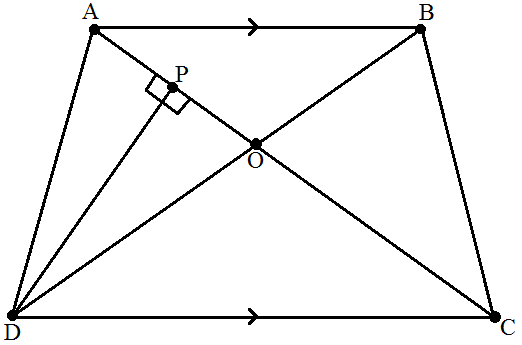 We have,
AB || DC
In $\triangle\text{AOB}$ and $\triangle\text{COD}$
$\angle\text{AOB}=\angle\text{COD}$ [Vertically opposite angles]
$\angle\text{OAB}=\angle\text{OCD}$ [Alternate interior angles]
Then, $\triangle\text{AOB}\sim\triangle\text{COD}$ [By AA similarity]
- By area of similar triangle theorem
$\frac{\text{ar}(\triangle\text{AOB)}}{\text{ar}(\triangle\text{COD})}=\frac{\text{OA}^2}{\text{OC}^2}=\frac{6^2}{8^2}=\frac{36}{64}=\frac{9}{16}$
- Draw $\text{DP}\perp\text{AC}$
$\frac{\text{area}(\triangle\text{AOD)}}{\text{area}(\triangle\text{COD})}=\frac{\frac{1}{2}\times\text{AO}\times\text{DP}}{\frac{1}{2}\times\text{CO}\times\text{DP}}$
$=\frac{\text{AO}}{\text{CO}}$
$=\frac{6}{8}$
$=\frac{3}{4}$ View full question & answer→Question 492 Marks
$\triangle\text{ABD}$ is a right triangle right-angled at A and $\text{AC}\perp\text{BD}.$ Show that
$\frac{\text{AB}^2}{\text{AC}^2}=\frac{\text{BD}}{\text{DC}}$
Answer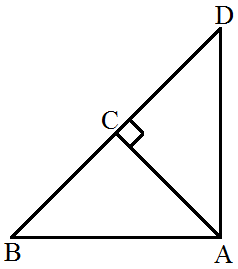
From part (i) $AB^2 = CB \times BD$
From part (ii) $AC^2 = DC \times BC$
Hence $\frac{\text{AB}^2}{\text{AC}^2}=\frac{\text{CB}\times\text{BD}}{\text{DC}\times\text{BC}}$
$\frac{\text{AB}^2}{\text{AC}^2}=\frac{\text{BD}}{\text{DC}}$
Hence proved. View full question & answer→Question 502 Marks
In $\triangle\text{ABC},$ ray AD bisects $\angle\text{A}$ and intersects BC in D. If BC = a, AC = b and AB = c, prove that
$\text{BD}=\frac{\text{ac}}{\text{b}+\text{c}}$
AnswerGiven: In $\triangle\text{ABC}$ ray AD bisects angle A and intersects BC in D,
If BC = a, AC = b and AB = c
$\text{BD}=\frac{\text{ac}}{\text{b}+\text{c}}$
The corresponding figure is as follows
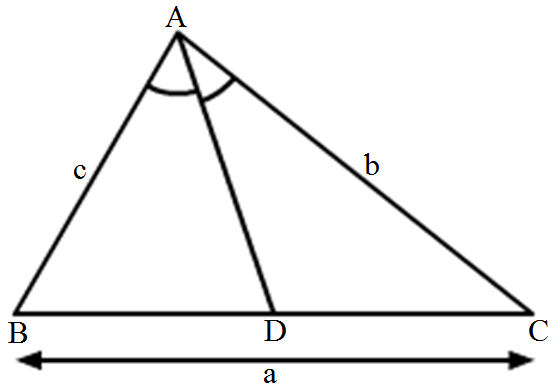
Proof: In triangle ABC, AD is the bisector of $\angle\text{A}$
Therefore $\frac{\text{AB}}{\text{AC}}=\frac{\text{BD}}{\text{CD}}$
Substitute BC = a, AC = b and AB = c we get,
$\frac{\text{c}}{\text{b}}=\frac{\text{BD}}{\text{BC}-\text{BD}}$
$\frac{\text{c}}{\text{b}}=\frac{\text{BD}}{\text{a}-\text{BD}}$
By cross multiplication we get.
$\text{c(a}-\text{BD})=\text{b}\times\text{BD}$
$\text{ac}-\text{cBD}=\text{bBD}$
$\text{ac}=\text{bBD}+\text{cBD}$
$\text{ac}=(\text{b}+\text{c})\text{BD}$
$\frac{\text{ac}}{\text{b}+\text{c}}=\text{BD}$
We proved that $\text{BD}=\frac{\text{ac}}{\text{b}+\text{c}}$ View full question & answer→Question 512 Marks
If a $\triangle\text{ABC},$ AD is the bisector of $\angle\text{A},$ Meeting side BC at D.
If AB = 10cm, AC = 14cm and BC = 6cm, find BD and DC
AnswerWe have,
AB = 10cm, AC = 14cm and BC = 6cm
Now, $\frac{\text{BD}}{\text{AB}}=\frac{\text{CD}}{\text{AC}}$
⇒ BD × AC = CD × AB
⇒ (BC - CD) AC = CD × AB ($\because$ BD = BC - CD)
⇒ (6 - CD) 14 = CD × 10
⇒ 84 - 14CD = 10CD
⇒ 24CD = 84
$\Rightarrow \text{CD} =\frac{84}{24}$
⇒ CD = 3.5
$\because$ BD = BC - CD
⇒ BD = 6 - 3.5
⇒ BD = 2.5cm
View full question & answer→Question 522 Marks
The area of two similar triangles are $36 cm^2$ and $100 cm^2$. If the length of a side of the smaller triangle in 3 cm , find the length of the corresponding side of the larger triangle.
AnswerArea of smaller triangle $= 36cm^2$
and area of larger triangle $= 100cm^2$
One side of smaller triangle = 3cm
Let the corresponding side of larger triangle = x
$\triangle\text{s}$ are similar
$\therefore\frac{\text{area of smaller triangle}}{\text{area of larger triangle}}=\frac{(3)^2}{\text{x}^2}$
$\Rightarrow\frac{36}{100}=\frac{9}{\text{x}^2}\Rightarrow\text{x}^2=\frac{9\times100}{36}=25=(5)^2$
$\therefore\text{x}=5$
$\therefore$ Corresponding side of larger triangle = 5cm.
View full question & answer→Question 532 Marks
If ABC and DEF are similar triangles such that $\angle\text{A}=57^\circ$ and $\angle\text{E}=73^\circ,$ what is the measure of $\angle\text{C}?$
AnswerWe have,
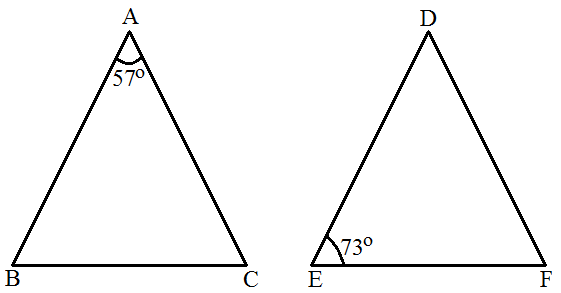
$\triangle\text{ABC}\sim\triangle\text{DEF}$
we know that corresponding angle of similar triangle are equal.
$\angle\text{A}=\angle\text{D}=57^\circ$ and $\angle\text{B}=\angle\text{E}=73^\circ$
$\angle\text{C}=\angle\text{F}=?$
$\angle\text{A}+\angle\text{B}+\angle\text{C}=180^\circ$ (Angle sum property)
$\Rightarrow57^\circ+73^\circ+\angle\text{C}=180^\circ$
$\Rightarrow130^\circ+\angle\text{C}=180^\circ$
$\Rightarrow\angle\text{C}=180^\circ-130^\circ$
$\Rightarrow\angle\text{C}=50^\circ$
Thus, $\angle\text{C}=50^\circ$ View full question & answer→Question 542 Marks
In the given figure,
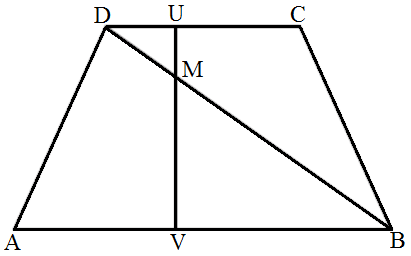
AB || DC prove that
DM × BV = BM × DU
Answer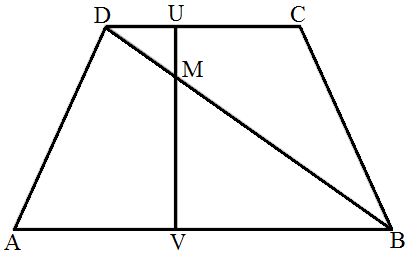
Since $\triangle\text{DMU}\sim\triangle\text{BMV}$
$\frac{\text{DM}}{\text{BM}}=\frac{\text{MU}}{\text{MV}}=\frac{\text{DU}}{\text{BV}}$
$\frac{\text{DM}}{\text{BM}}=\frac{\text{DU}}{\text{BV}}$
By cross multiplication, we get,
DM × BV = DU × BM
Hence proved that DM × BV = DU × BM. View full question & answer→Question 552 Marks
In the given figure, DE || BC and $\text{AD}=\frac{1}{2}\text{BD}.$ If BC = 4.5cm, find DE.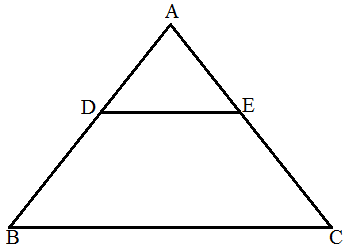
AnswerGiven: In $\triangle\text{ABC},\ \text{DE}||\text{BC}.\ \text{AD}=\frac{1}{2}\text{BD}$ and BC = 4.5cm.
To find: DE
In $\triangle\text{ABC}$ and $\triangle\text{ADE}$
$\angle\text{B}=\angle\text{ADE}$ (Corresponding angles)
$\angle\text{A}=\angle\text{A}$ (Common)
$\therefore\triangle\text{ABC}\sim\triangle\text{ADE}$ (AA Similarity)
$\frac{\text{AD}}{\text{AB}}=\frac{\text{DE}}{\text{BC}}$
$\frac{\text{AD}}{\text{AD}+\text{BD}}=\frac{\text{DE}}{\text{BC}}$
$\frac{\frac{1}{2}\text{BD}}{\frac{1}{2}\text{BD}+\text{BD}}=\frac{\text{DE}}{\text{BC}}$
$\frac{1}{3}=\frac{\text{DE}}{\text{BC}}$
$\frac{1}{3}=\frac{\text{DE}}{4.5}$
$\text{DE} = 1.5\text{cm.}$
View full question & answer→Question 562 Marks
In FIg. check whether AD is the bisector of $\angle\text{A}$ of $\triangle\text{ABC}$ in the following.
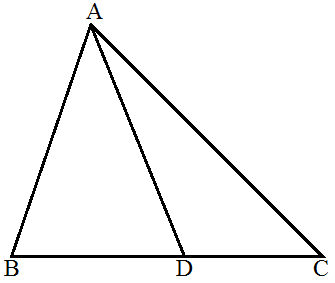
AB = 6cm, AC = 8cm, BD = 1.5cm and CD = 2cm. AnswerIt is given that, AB = 6cm, AC = 8cm, BD = 1.5cm and CD = 2cm.
We have to check whether AD is bisector of $\angle\text{A}$.
First we will check proportional retio between sides.
So $\frac{\text{AB}}{\text{AC}}=\frac{\text{BD}}{\text{DC}}$
$\Rightarrow\frac{6}{8}=\frac{1.5}{2}$
$\Rightarrow\frac{3}{4}=\frac{3}{4}$
(It is proportional)
Hence, AD is bisector of $\angle\text{A}$.
View full question & answer→Question 572 Marks
The lengths of the diagonals of a rhombus are $24\ cm$ and 10cm. Find each side of the rhombus.
Answer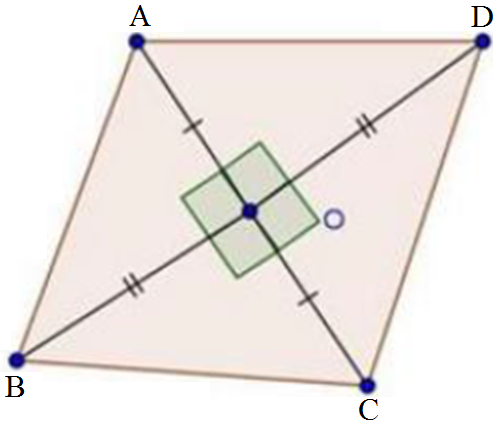
We have,
$ABCD$ is a rhombus with diagonals$ AC = 10cm$ and $BD = 24cm$
We know that diagonal of a rhombus bisect each other at $90^\circ$
$\therefore AO = OC = 5cm$ and $BO = OD = 12cm$
In $\triangle\text{AOB},$ by Pythagoras theorem
$AB^2 = AO^2 + BO^2$
$\Rightarrow AB^2 = 5^2 + 12^2$
$\Rightarrow AB^2 = 25 + 144 = 169$
$\Rightarrow\text{AB}=\sqrt{169}=13\text{cm}$ View full question & answer→Question 582 Marks
In the following figures, you find who triangles. Indicate whether the triangles are similar. Give reasons in support of your answer.
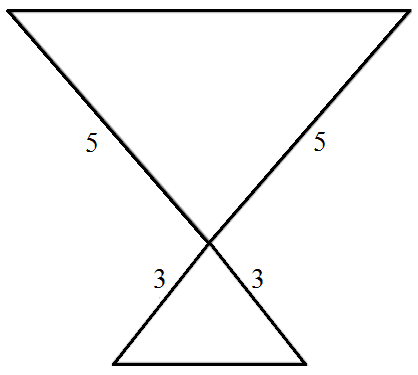
AnswerIn two triangle, we observe that
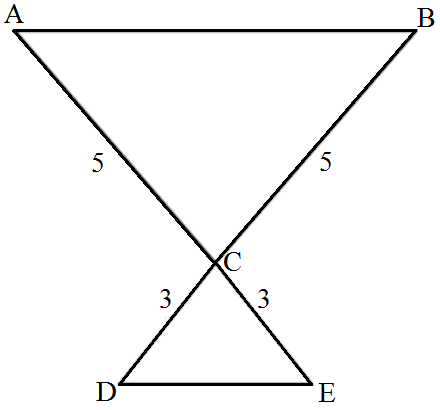
In $\triangle\text{ABC}$ and $\triangle\text{CDE}$
$\frac{\text{CD}}{\text{CE}}=\frac{\text{CB}}{\text{CA}}$
$\angle\text{ACB}=\angle\text{DCE}$ (Vertically opposite angles)
$\triangle\text{ABC}\sim\triangle\text{CDE}$ (SAS Similarity)
yes two triangles are similar. View full question & answer→Question 592 Marks
In the adjoining figure, DE is parallel to BC and AD = 1cm, BD = 2cm. What is the ratio of the area of $\triangle\text{ABC}$ to the area of $\triangle\text{ADE}?$
AnswerIn $\triangle\text{ABC},\ \text{DE}||\text{BC}$
$\therefore\triangle\text{ADE}\sim\triangle\text{ABC}$
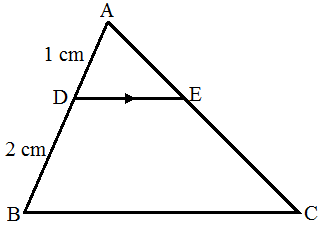
$\therefore\frac{\text{area}\triangle\text{ABC}}{\text{area}\triangle\text{ADE}}=\frac{\text{AB}^2}{\text{AD}^2}=\frac{(\text{AD}+\text{DB})^2}{\text{AD}^2}$
$=\frac{(1+2)^2}{(1)^2}=\frac{3^2}{1}=\frac{9}{1}$
$\therefore$ Ratio = 9 : 1 View full question & answer→Question 602 Marks
In the figure, DE || BC in $\triangle\text{ABC}$ such that BC = 8cm, AB = 6cm and DA = 1.5cm. Find DE.
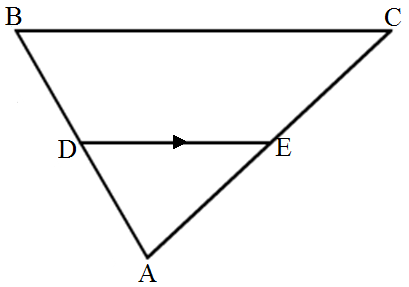
AnswerIn the given figure,
DE || BC
BC = 8cm, AB = 6cm and DA = 1.5cm.
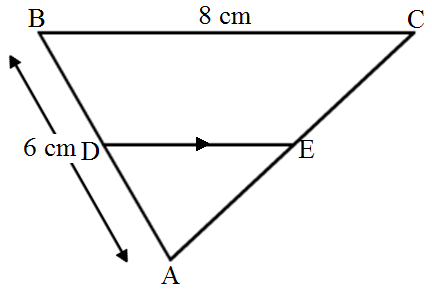
In $\triangle\text{ABC}$ and $\triangle\text{ADE},$
$\angle\text{A}=\angle\text{A}$ (Common)
$\angle\text{B}=\angle\text{ADE}$ (Corresponding angles)
$\therefore\triangle\text{ABC}\sim\triangle\text{ADE}$ (AA axiom)
$\therefore\frac{\text{AB}}{\text{AD}}=\frac{\text{BC}}{\text{DE}}\Rightarrow\frac{6}{1.5}=\frac{8}{\text{DE}}$
$\Rightarrow\text{DE}=\frac{8\times1.5}{6}=\frac{12}{6}=2\text{cm}.$ View full question & answer→Question 612 Marks
In a $\triangle\text{ABC}, AB = BC = CA = 2a$ and $\text{AD}\perp\text{BC}.$ Prove that
$\text{AD}=\text{a}\sqrt{3}$
Answer$\triangle\text{ABC},$ AB = BC = AC = 2a
$\triangle\text{AD}\perp\text{BC}$
AD bisects BC at D
$\text{BD}=\text{DC}=\frac{1}{2}\text{BC}=\text{a}$
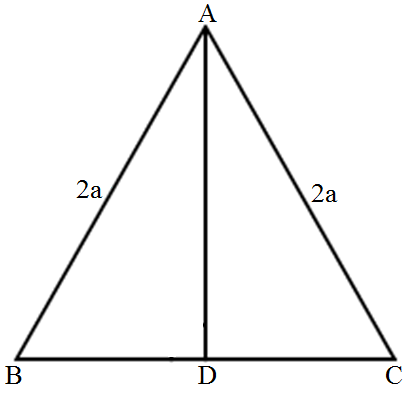
Now in $\triangle\text{ABD}$
$AB^2 = AD^2 + BD^2$
$\Rightarrow (2a)^2 = AD^2 + a^2 \Rightarrow 4a^2 = AD^2 + a^2$
$\Rightarrow AD^2 = 4a^2 - a^2 = 3a^2$ $=(\sqrt3\text{a})^2$
$\therefore\text{AD}=\sqrt{3}\text{a}$ View full question & answer→Question 622 Marks
state SAS similarity criterion.
AnswerIf in two triangles, one pair of coresponding sides are proportional and the included angle are equal then the two triangles are similar.
View full question & answer→