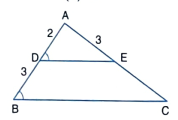
MCQ 511 Mark
In $\triangle\text{ABC},$ a line XY parallel to BC cuts AB at X and AC at Y. If BY bisects $\angle\text{XYC},$ then:
AnswerCorrect option: A. $\text{BC} = \text{CY}$
Given: XY || BC and BY is bisector of $\angle\text{XYC}.$
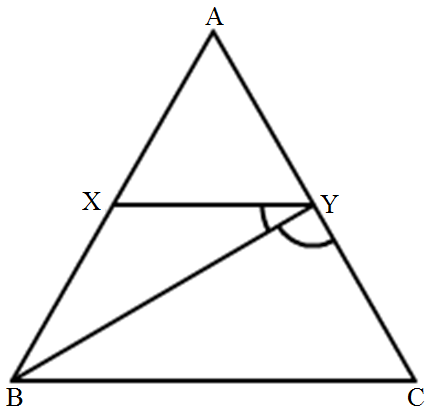
Since XY || BC
So, $\angle\text{YBC}=\angle\text{BYC}$ (Alternate angles)
Now, in triangle BYC two angles are equal. Therefore, the two corresponding sides will be equal.
Hence, BC = CY
Hence option (a) is correct. View full question & answer→MCQ 521 Mark
In Fig, two line segments $A C$ and $B D$ intersect each other at the point $P$ such that $P A=6 cm, P B=3 cm, P C=2.5 cm, P D=5 cm, \angle A P B=50^{\circ}$ and $\angle C D P=30^{\circ}$. Then $\angle P B A$ is equal to
- A
(a) $50^{\circ}$
- B
$30^{\circ}$
- C
$60^{\circ}$
- ✓
$100^{\circ}$
AnswerCorrect option: D. $100^{\circ}$
(D)$100^{\circ}$
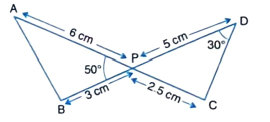
In triangles $P A B$ and $P D C$, we have
$
\frac{P A}{P D}=\frac{P B}{P C} \text { and } \angle A P B=\angle C P D \qquad[Vertically$ $opposite$ $angles]$
So, by using SAS-criterion of similarity, we obtain
$
\triangle P B A \sim \triangle P D C \Rightarrow \angle D=\angle A \Rightarrow \angle A=30^{\circ}
$
Applying angle sum property in $\triangle P A B$, we obtain
$
\angle P+\angle A+\angle B=180^{\circ} \Rightarrow 50^{\circ}+30^{\circ}+\angle B=180^{\circ} \Rightarrow \angle B=100^{\circ}
$ View full question & answer→MCQ 531 Mark
If $\triangle A B C \sim \triangle E D F$ and $\triangle A B C$ is not similar to $\triangle D E F$, then which of the following is not true?
- A
$B C \times E F=A C \times F D$
- B
$A B \times E F=A C \times D E$
- ✓
$B C \times D E=A B \times E F$
- D
$B C \times D E=A B \times F D$
AnswerCorrect option: C. $B C \times D E=A B \times E F$
(C)$B C \times D E=A B \times E F$
Given that $\triangle A B C \sim \triangle E D F$ and $\triangle A B C$ is not similar to $\triangle D E F$.
$
\begin{array}{ll}
\therefore \frac{A B}{E D}=\frac{B C}{D F}=\frac{A C}{E F} \text { and either } \frac{A B}{D E} \neq \frac{B C}{E F} \text { or, } \frac{B C}{E F} \neq \frac{A C}{D F} \text { or, } \frac{A B}{D E} \neq \frac{A C}{D F} \\
\Rightarrow \frac{A B}{E D}=\frac{B C}{D F}, \frac{A B}{E D}=\frac{A C}{E F} \text { and } \frac{B C}{D F}=\frac{A C}{E F} \\
\Rightarrow \quad A B \times D F=B C \times E D, A B \times E F=A C \times E D, B C \times E F=A C \times D F \\
\Rightarrow \quad \text { Options (d), (b) and (a) are true. }
\end{array}
$
View full question & answer→MCQ 541 Mark
If in two Iriangles $D E F$ and $P Q R, \angle D=\angle Q$ and $\angle R=\angle E$, then which of the following is not true?
- A
$\frac{L F}{P R}=\frac{D F}{P Q}$
- ✓
$\frac{D E}{P Q}=\frac{E F}{R P}$
- C
$\frac{D E}{Q R}=\frac{D F}{P Q}$
- D
$\frac{E F}{R P}=\frac{D E}{Q R}$
AnswerCorrect option: B. $\frac{D E}{P Q}=\frac{E F}{R P}$
(B)$\frac{D E}{P Q}=\frac{E F}{R P}$
It is given that $\angle D=\angle Q$ and $\angle R=\angle E$. So, by using $\Lambda A$-criterion of similarity, we obtain
$
\Delta D E F-\triangle Q R P \Rightarrow \frac{D E}{Q R}=\frac{E F}{P R}=\frac{D F}{P Q} \Rightarrow \frac{E F}{P R}=\frac{D F}{P Q}, \frac{D E}{Q R}=\frac{E F}{P R}, \frac{D E}{Q R}=\frac{D F}{P Q}
$
Hence, option (a), (c) and (d) are true but option (b) is not true.
View full question & answer→MCQ 551 Mark
In $\triangle A B C, D E \| A B$. If $A B=a, D E=x, B E=b$ and $E C=c$. Then, $x=$
- A
$\frac{a c}{b}$
- ✓
$\frac{a c}{b+c}$
- C
$\frac{a b}{c}$
- D
$\frac{a b}{b+c}$
AnswerCorrect option: B. $\frac{a c}{b+c}$
(B)$\frac{a c}{b+c}$
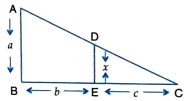
Given that $D E \| A B$
$
\begin{array}{ll}
\therefore & \frac{A B}{D E}=\frac{B C}{E C} \\
\Rightarrow & \frac{a}{x}=\frac{b+c}{c} \Rightarrow x=\frac{a c}{b+c}
\end{array}
$ View full question & answer→MCQ 561 Mark
If in $\triangle A B C$ and $\triangle D E F, \frac{A B}{D E}=\frac{B C}{F D}$, then they will be similar, when
- A
$\angle B=\angle E$
- B
$\angle A=\angle D$
- ✓
$\angle B=\angle D$
- D
$\angle A=\angle F$
AnswerCorrect option: C. $\angle B=\angle D$
(C)$\angle B=\angle D$
We have,
$
\frac{A B}{D E}=\frac{B C}{F D} \Rightarrow \frac{A B}{E D}=\frac{B C}{D F} \Rightarrow A \leftrightarrow E, B \leftrightarrow D \text { and } C \leftrightarrow F
$
Thus, $\triangle A B C \sim \triangle E D F$ and hence $\angle A=\angle E, \angle B=\angle D$ and $\angle C=\angle F$.
View full question & answer→MCQ 571 Mark
In triangles $A B C$ and $D E F, \angle B=\angle E, \angle F=\angle C$ and $A B=3 D E$. Then, the two triangles are
- A
congruent but not similar
- ✓
similar but not congruent
- C
neither congruent nor similar
- D
congruent as well as similar
AnswerCorrect option: B. similar but not congruent
(B)similar but not congruent
In triangles $A C B$ and $D E F$, it is given that $\angle B=\angle E, \angle F=\angle C$. So by $A A$-criterion of similarity $\triangle A B C \sim \triangle D E F$. It is also given that $A B=3 D E$. So, $\triangle A B C$ is not congruent to $\triangle D E F$ as $A B \neq D E$. Thus $\triangle A B C \sim \triangle D E F$ but $\triangle A B C$ is not congruent to $\triangle D E F$.
View full question & answer→MCQ 581 Mark
It is given that $\triangle A B C \sim \triangle D F E, \angle A=30^{\circ}, \angle C=50^{\circ}, A B=5 cm, A C=8 cm$ and $D F=7.5 cm$. Then, which of the following is true?
- A
$D E=12 cm, \angle F=50^{\circ}$
- ✓
$D E=12 cm, \angle F=100^{\circ}$
- C
$E F=12 cm, \angle D=100^{\circ}$
- D
$E F=12 cm, \angle D=30^{\circ}$
AnswerCorrect option: B. $D E=12 cm, \angle F=100^{\circ}$
(B)$D E=12 cm, \angle F=100^{\circ}$
It is given that $\triangle A B C \sim \triangle D F E$.
$
\begin{array}{ll}
\therefore & \angle A=\angle D, \angle B=\angle F, \angle C=\angle E \text { and } \frac{A B}{D F}=\frac{B C}{E F}=\frac{A C}{D E} \\
\Rightarrow & \angle D=30^{\circ}, \angle F=100^{\circ}, \angle E=50^{\circ} \text { and } \frac{5}{7.5}=\frac{B C}{E F}=\frac{8}{D E} \quad\left[\because \angle A=30^{\circ}, \angle C=50^{\circ} \therefore \angle B=100^{\circ}\right] \\
\Rightarrow & \angle F=100^{\circ} \text { and } D E=12 cm .
\end{array}
$
View full question & answer→MCQ 591 Mark
24 In Fig, if $D E \| B C, A D=3 cm, B D=4 cm$ and $B C=14 cm$, then $D E$ equals
Answer(B)6 cm
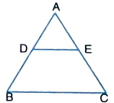
It is given that $D E \| B C$. Therefore,
$
\triangle A D E \sim \triangle A B C \Rightarrow \frac{A D}{A B}=\frac{D E}{B C} \Rightarrow \frac{3}{3+4}=\frac{D E}{14} \Rightarrow D E=6 cm
$ View full question & answer→MCQ 601 Mark
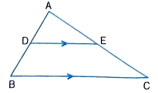
In Fig. if in $\triangle A B C, D E \| B C$, then which of the following equality holds?
- A
$\frac{A D}{A B}=\frac{A E}{C E}$
- ✓
$\frac{A D}{A B}=\frac{A E}{A C}$
- C
$\frac{A D}{B D}=\frac{A E}{A C}$
- D
$\frac{A D}{A B}=\frac{A C}{A E}$
AnswerCorrect option: B. $\frac{A D}{A B}=\frac{A E}{A C}$
View full question & answer→MCQ 611 Mark
If the diagonals of a quadrilateral divide each other proportionally, then it is a
MCQ 621 Mark
In $\triangle A B C, D E \| B C$. If $A D=2 cm, B D=3 cm$, $B C=7.5 cm$, then the length of $D E($ in cm $)$ is
View full question & answer→MCQ 631 Mark
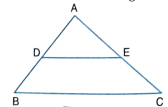
In $\triangle A B C, D E \| B C$ (See Fig. 7.30). If $A D=4 cm, A B=9 cm$ and $A C=13.5 cm$, then the length of $E C$ is
View full question & answer→MCQ 641 Mark
The perimeters of two similar triangles $A B C$ and $P Q R$ are 56 cm and 48 cm respectively. $\frac{P Q}{A B}$ is equal to
- A
$7 / 8$
- ✓
$6 / 7$
- C
$7 / 6$
- D
$8 / 7$
AnswerCorrect option: B. $6 / 7$
View full question & answer→MCQ 651 Mark
In $\triangle A B C, P Q \| B C$. If $P B=6 cm, A P=4 cm, A Q=8 cm$, then the length of $A C$ is
Answer(B)20 cm
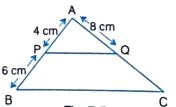
$
\begin{array}{ll}
\text { SOLUTION } & P Q \| B C \\
\Rightarrow & \frac{A P}{P B}=\frac{A Q}{Q C} \\
\Rightarrow & \frac{4}{6}=\frac{8}{Q C} \Rightarrow Q C=12 cm \\
\therefore & A C=A Q+Q C=(8+12) cm=20 cm
\end{array}
$ View full question & answer→MCQ 661 Mark
In Fig, $A B \| P Q$. If $A B=6 cm, P Q=2 cm$ and $O B=3 cm$, then the length of $O P$ is
Answer(D)1 cm
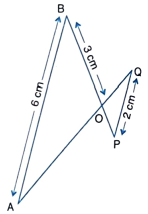
In $\triangle O A B$ and $O Q P$, we have
$
\angle A O B=\angle Q O P, \angle O A B=\angle O Q P \text { and } \angle O B A=\angle O P Q
$
So, by AAA criterion of similarity, we obtain
$
\begin{array}{l}
\Rightarrow \quad \triangle O A B \sim \triangle O Q P \\
\Rightarrow \quad \frac{A B}{Q P}=\frac{O B}{O P} \Rightarrow \frac{6}{2}=\frac{3}{O P} \Rightarrow O P=1 cm
\end{array}
$ View full question & answer→MCQ 671 Mark
If $\triangle A B C$ and $\triangle D E F, \frac{A B}{D E}=\frac{B C}{F D}$. Which of the following makes the two triangles similar?
- A
$\angle A=\angle D$
- ✓
$\angle B=\angle D$
- C
$\angle B=\angle E$
- D
$\angle A=\angle F$
AnswerCorrect option: B. $\angle B=\angle D$
(B)$\angle B=\angle D$
We have,
$
\frac{A B}{D E}=\frac{B C}{F D} \Rightarrow \frac{A B}{B C}=\frac{E D}{D F} \therefore \triangle A B C \sim \triangle E D F \text { if } \angle B=\angle D
$
View full question & answer→MCQ 681 Mark
If $\triangle P Q R \sim \triangle A B C ; P Q=6 cm, A B=8 cm$ and the perimeter of $\triangle A B C$ is 36 cm , then perimeter of $\triangle P Q R$ is
Answer(B)27 cm
$
\begin{array}{l}
\text { } \triangle P Q R \sim \triangle A B C \\
\Rightarrow \frac{P Q}{A B}=\frac{\text { Perimeter of } \triangle P Q R}{\text { Perimeter of } \triangle A B C} \Rightarrow \frac{6}{8}=\frac{\text { Perimeter of } \triangle P Q R}{36} \Rightarrow \text { Perimeter of } \triangle P Q R=\frac{36 \times 6}{8} cm=27 cm
\end{array}
$
View full question & answer→MCQ 691 Mark
If $\triangle A B C \sim \triangle P Q R$ with $\angle A=32^{\circ}$ and $\angle R=65^{\circ}$, then the measure of $\angle B$ is
- A
$32^{\circ}$
- B
$65^{\circ}$
- ✓
$83^{\circ}$
- D
$97^{\circ}$
AnswerCorrect option: C. $83^{\circ}$
(C)$83^{\circ}$
$\triangle A B C \sim \triangle P Q R$
$
\Rightarrow \quad \angle A=\angle P, \angle B=\angle Q \text { and } \angle C=\angle R \Rightarrow \angle A=32^{\circ} \text { and } \angle C=65^{\circ}
$
Using angle sum property in $\triangle A B C$, we obtain
$
\angle A+\angle B+\angle C=180^{\circ} \Rightarrow 32^{\circ}+\angle B+65^{\circ}=180^{\circ} \Rightarrow \angle B=83^{\circ}
$
View full question & answer→MCQ 701 Mark
In Fig, if $D E \| B C$, then the value of $x$ is
Answer(A)6
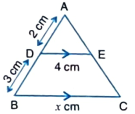
Given that $D E \| B C$
$
\begin{array}{ll}
\therefore & \frac{A D}{D B}=\frac{D E}{B C} \\
\Rightarrow & \frac{2}{3}=\frac{4}{x} \Rightarrow 2 x=12 \Rightarrow x=6
\end{array}
$ View full question & answer→MCQ 711 Mark
In Fig, $\triangle A B C \sim \triangle Q P R$. If $A C=6 cm, B C=5 cm, Q R=3 cm$ and $P R=x cm$, then the value of $x$ is
Answer(B)2.5cm
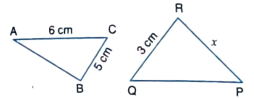
$
\begin{array}{l}
\text { SOLUTION } \quad \triangle A B C \sim \triangle Q P R \\
\Rightarrow \quad \frac{A B}{Q P}=\frac{B C}{P R}=\frac{A C}{Q R} \\
\Rightarrow \quad \frac{B C}{P R}=\frac{A C}{Q R} \Rightarrow \frac{5}{x}=\frac{6}{3} \Rightarrow x=\frac{5}{2} cm=2.5 cm
\end{array}
$ View full question & answer→MCQ 721 Mark
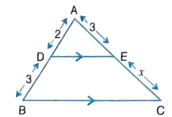
AnswerCorrect option: D. $9 / 2$
(D)$9 / 2$
Given that $D E \| B C$
$
\frac{A D}{D B}=\frac{A E}{E C} \Rightarrow \frac{2}{3}=\frac{3}{x} \Rightarrow x=\frac{9}{2}
$
View full question & answer→MCQ 731 Mark
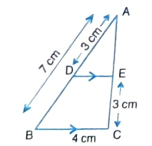
In Fig, $D E \| B C$. If $A D=3 cm, A B=7 cm$ and $E C=3 cm$, then the length of $A E$ is
View full question & answer→MCQ 741 Mark
If $A M$ and $P N$ are altitudes of $\triangle A B C$ and $\triangle P Q R$ respectively. If $\triangle A B C \sim \triangle P Q R$ and $A B^2: P Q^2=4: 9$, then $A M: P N=$
- A
$16: 81$
- B
$4: 9$
- C
$3: 2$
- ✓
$2: 3$
AnswerCorrect option: D. $2: 3$
(D)$2: 3$
Given that $\triangle A B C \sim \triangle P Q R \Rightarrow \frac{A B}{P Q}=\frac{A M}{P N} \Rightarrow \frac{A M}{P N}=\frac{2}{3}$
View full question & answer→MCQ 751 Mark
In Fig, DE \| BC. Which of the following is true?
AnswerCorrect option: C. $x=\frac{a y}{a+b}$
(C)$x=\frac{a y}{a+b}$
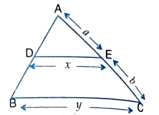
It is given that $D E \| B C$. Therefore,
$
\begin{array}{l}
\quad \triangle A D E \sim \triangle A B C \Rightarrow \frac{A E}{A C}=\frac{D F}{B C} \Rightarrow \frac{a}{a+b}=\frac{x}{y} \\
\Rightarrow \quad x=\frac{a y}{a+b} \text { and } y=\frac{(a+b) x}{a}
\end{array}
$ View full question & answer→MCQ 761 Mark
$\triangle A B C$ is such that $A B=3 cm, B C=2 cm, C A=2.5 cm$. If $\triangle A B C \sim \triangle D E F$ and $E F=4 cm$, then perimeter of $\triangle D E F$ is
Answer(B)15 cm
Given that $\triangle A B C \sim \triangle D E F$.
$
\therefore \quad \frac{A B}{D E}=\frac{B C}{E F}=\frac{A C}{D F}=\frac{A B+B C+C A}{D E+E F+D F} \Rightarrow \frac{2}{4}=\frac{3+2+2.5}{\text { Perimeter of } \triangle D E F} \Rightarrow \text { Perimeter of } \triangle D E F=15 cm
$
View full question & answer→MCQ 771 Mark
Sides $A B$ and $B E$ of a right triangle, right angled at $B$ are of lengths 16 cm and 8 cm respectively. The length of the side of largest square FDGB that can be inscribed in the triangle $A B E$ is
- A
$\frac{32}{3} cm$
- ✓
$\frac{16}{3} cm$
- C
$\frac{8}{3} cm$
- D
$\frac{4}{3} cm$
AnswerCorrect option: B. $\frac{16}{3} cm$
(B)$\frac{16}{3} cm$
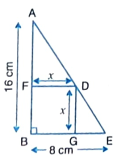
Let the length of a side of the square be $x cm$. In triangles $A F D$ and $D G L$, we find that
$
\begin{aligned}
& \angle A F D=\angle E G D \qquad [Each equal to 90^{\circ} ]\\
\text { and, } & \qquad\angle A D F=\angle D E G
\end{aligned}
$
So, by using $A A$-similarity criterion, we obtain
$\Rightarrow \quad \triangle A F D \sim \triangle D G E \Rightarrow \frac{A F}{D G}=\frac{F D}{G E} \Rightarrow \frac{16-x}{x}=\frac{x}{8-x} \Rightarrow 128-24 x+x^2=x^2 \Rightarrow x=\frac{16}{3} cm$ View full question & answer→MCQ 781 Mark
In $\triangle A B C, \angle B=90^{\circ}, B D \perp A C$. If $A C=9 cm$ and $A D=3 cm$, then $B D$ is equal to
- A
$2 \sqrt{2} cm$
- ✓
$3 \sqrt{2} cm$
- C
$2 \sqrt{3} cm$
- D
$3 \sqrt{3} cm$
AnswerCorrect option: B. $3 \sqrt{2} cm$
(B)$3 \sqrt{2} cm$
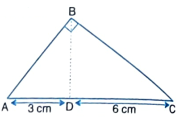
By using the result given in the above example, we obtain
$
B D^2=A D \times C D=3 \times 6=18 \Rightarrow B D=3 \sqrt{2} cm
$ View full question & answer→MCQ 791 Mark
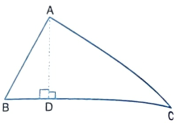
If in Fig, $\angle B A C=90^{\circ}$ and $A D \perp B C$, then
- A
$B D \times C D=B C^2$
- B
$A B \times A C=B C^2$
- C
$B D \times C D=A D^2$
- D
$A B \times A C=A D^2$
View full question & answer→MCQ 801 Mark
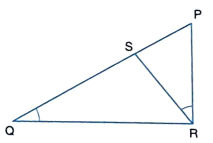
In Fig, $\angle A C B=\angle C D A, A C=8 cm, A D=3 cm$, then $B D=$
- A
$\frac{22}{3} cm$
- B
$\frac{26}{3} cm$
- ✓
$\frac{55}{3} cm$
- D
$\frac{64}{3} cm$
AnswerCorrect option: C. $\frac{55}{3} cm$
(C)$\frac{55}{3} cm$
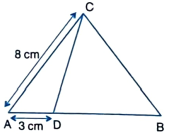
In triangles $A C B$ and CDA, we find that
$
\angle A C B=\angle C D A\qquad[Given]
$
and
$
\angle C A B=\angle C A D
$
So, by using $A A$-criterion of similarity, we obtain
$\triangle A C B \sim \triangle A D C \Rightarrow \frac{A C}{A D}=\frac{A B}{A C} \Rightarrow \frac{8}{3}=\frac{A D+D B}{8} \Rightarrow \frac{64}{3}=3+D B \Rightarrow D B=\frac{55}{3} cm$ View full question & answer→MCQ 811 Mark
$\triangle A B C$ is such that $A B=3 cm, B C=2 cm, C A=2.5 cm$. If $\triangle A B C \sim \triangle D E F$ and $E F=4 cm$, then perimeter of $\triangle D E F$ is
Answer(B)15
It is given that
$\begin{array}{l}\Delta A B C \sim \triangle D E F \\ \Rightarrow \quad \frac{A B}{D E}=\frac{B C}{E F}=\frac{A C}{D F}=\frac{A B+B C+C A}{D E+E F+D F} \\ \Rightarrow \quad \frac{B C}{F E}=\frac{3+2+2.5}{\text { Perimeter of } \triangle D E F} \Rightarrow \frac{4}{2}=\frac{7.5}{\text { Perimeter of } \triangle D E F} \Rightarrow \text { Perimeter of } \triangle D E F=15 cm .\end{array}$
View full question & answer→MCQ 821 Mark
In $\triangle A B C$ and $\triangle P Q R$, we have $A B=4.5 cm B C=5 cm, C A=6 \sqrt{2} cm, P Q=10 cm$, $Q R=9 cm, P R=12 \sqrt{2} cm$. If $\angle A=75^{\circ}$ and $\angle B=55^{\circ}$, then $\angle P=$
- A
$75^{\circ}$
- B
$55^{\circ}$
- ✓
$50^{\circ}$
- D
$130^{\circ}$
AnswerCorrect option: C. $50^{\circ}$
(C)$50^{\circ}$
In $\triangle A B C$ and $\triangle P Q R$, we find that
$
\frac{A B}{Q R}=\frac{B C}{Q P}=\frac{C A}{P R} \Rightarrow \triangle A B C \sim \triangle R Q P \Rightarrow \angle A=\angle R, \angle B=\angle Q \text { and } \angle C=\angle P \Rightarrow \angle R=75^{\circ}, \angle Q=55^{\circ}
$
Using angle sum property in $\triangle P Q R$, we obtain
$
\angle P+\angle Q+\angle R=180^{\circ} \Rightarrow \angle P+55^{\circ}+75^{\circ}=180^{\circ} \Rightarrow \angle P=50^{\circ}
$
View full question & answer→MCQ 831 Mark
If in two triangles $A B C$ and $P Q R, \frac{A B}{Q R}=\frac{B C}{P R}=\frac{C A}{P Q}$, then
- ✓
$\triangle P Q R \sim \triangle C A B$
- B
$\triangle P Q R \sim \triangle A B C$
- C
$\triangle C B A \sim \triangle P Q R$
- D
$\triangle B C A \sim \triangle P Q R$
AnswerCorrect option: A. $\triangle P Q R \sim \triangle C A B$
(A)$\triangle P Q R \sim \triangle C A B$
It is given that
$
\frac{A B}{Q R}=\frac{B C}{R P}=\frac{C A}{P Q} \Rightarrow A \leftrightarrow Q, B \leftrightarrow R, C \leftrightarrow P \Rightarrow \triangle P Q R \sim C A B
$
View full question & answer→MCQ 841 Mark
Which of the following statements help in proving that $\triangle A B O$ is similar to $\triangle D O C$ ?
Statement-1: $\angle B=70^{\circ}$,
Statement-2: $\angle C =70^{\circ}$
AnswerCorrect option: C. Each statement alone is sufficient.
View full question & answer→MCQ 851 Mark
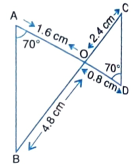
Which of the following statements is correct about the triangles in the following figure?
- A
$\triangle A O B \sim \triangle D O C$ because $\frac{A O}{D O}=\frac{B O}{C O}$.
- B
$\triangle A O B \sim \triangle D O C$ because $\angle A O B=\angle D O C$.
- C
$\triangle A O B-\triangle D O C$ because $\frac{A O}{D O}=\frac{B O}{C O}$ and $\angle B A O=\angle C D O$.
- ✓
$\triangle A O B-\triangle D O C$ because $\frac{A O}{D O}=\frac{B O}{C O}$ and $\angle A O B=\angle D O C$.
AnswerCorrect option: D. $\triangle A O B-\triangle D O C$ because $\frac{A O}{D O}=\frac{B O}{C O}$ and $\angle A O B=\angle D O C$.
View full question & answer→MCQ 861 Mark
Consider the following three statements about a triangle $A B C$ with side lengths $m, n$ and $r$.
S-1 $A B C$ is a right triangle provided $n^2-m^2=r^2$.
S-2 Triangle with side lengths $m+2, n+2$ and $r+2$ is a right angle triangle.
S-3 Triangle with sides $2 m, 2 n$ and $2 r$ is a right-angle triangle.
Which of the following is correct?
- A
Statement $S$-1 would be correct if $n>m, n>r$ and statement $S$-2 would be correct if $\triangle A B C$ is a right triangle.
- B
Statement S-1 would be correct if $r>m, r>n$ and statement S-2 would be correct if $\triangle A B C$ is a right triangle.
- ✓
Statement S -1 would be correct if $n>m, n>r$ and statement $S$ - 3 would be correct if $\triangle A B C$ is a right triangle.
- D
Statement S-1 would be correct if $r>m, r>n$ and statement S-3 would be correct if $\triangle A B C$ is a right triangle.
AnswerCorrect option: C. Statement S -1 would be correct if $n>m, n>r$ and statement $S$ - 3 would be correct if $\triangle A B C$ is a right triangle.
View full question & answer→MCQ 871 Mark
If $\triangle P Q R \sim \triangle X Y Z$ and $X Y=4 cm, Y Z=4.5 cm, Z X=6.5 cm$ and $P Q=8 cm$, then perimeter of $\triangle P Q R$ is
View full question & answer→MCQ 881 Mark
View full question & answer→MCQ 891 Mark
View full question & answer→MCQ 901 Mark
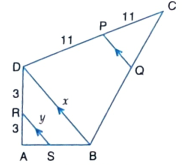
- A
$x=4, y=5$
- B
$x=2, y=3$
- C
$x=1, y=2$
- ✓
$x=3, y=4$
AnswerCorrect option: D. $x=3, y=4$
View full question & answer→MCQ 911 Mark
In $\triangle P Q R, \angle Q=90^{\circ}, P Q=5 cm, Q R=12 cm$. If $Q S \perp P R$, then $Q S$ is equal to
- A
$\frac{80}{13} cm$
- B
$\frac{13}{5} cm$
- ✓
$\frac{60}{13} cm$
- D
$\frac{12}{5} cm$
AnswerCorrect option: C. $\frac{60}{13} cm$
View full question & answer→MCQ 921 Mark
In an isosceles triangle $A B C$, if $A B=A C=25 cm$ and $B C=14 cm$, then the measure of altitude from $A$ on $B C$ is
View full question & answer→MCQ 931 Mark
If $\triangle A B C \sim \triangle D E F$ such that $A B=9.1 cm$ and $D E=6.5 cm$. If the perimeter of $\triangle D E F$ is 25 cm , then the perimeter of $\triangle A B C$ is
View full question & answer→MCQ 941 Mark
If $\triangle A B C \sim \triangle D E F$ such that $D E=3 cm, E F=2 cm, D F=2.5 cm, B C=4 cm$, then perimeter of $\triangle A B C$ is
View full question & answer→MCQ 951 Mark
In a $\triangle A B C$, perpendicular $A D$ from $A$ on $B C$ meets $B C$ at $D$. If $B D=8 cm, D C=2 cm$ and $A D=4 cm$, then
- A
$\triangle A B C$ is isosceles
- B
$\triangle A B C$ is equilateral
- C
$A C=2 A B$
- ✓
$\triangle A B C$ is right-angled at $A$.
AnswerCorrect option: D. $\triangle A B C$ is right-angled at $A$.
View full question & answer→MCQ 961 Mark
In $\triangle A B C$, a line $X Y$ parallel to $B C$ cuts $A B$ at $X$ and $A C$ at $Y$. If $B Y$ bisects $\angle X Y C$, then
- ✓
$B C=C Y$
- B
$B C=B Y$
- C
$BC \neq CY$
- D
$B C \neq B Y$
AnswerCorrect option: A. $B C=C Y$
View full question & answer→MCQ 971 Mark
$\triangle A B C$ is such that $A B=3 cm, B C=2 cm$ and $C A=2.5 cm$. If $\triangle D E F \sim \triangle A B C$ and $E F=4 cm$, then perimeter of $\triangle D E F$ is
View full question & answer→MCQ 981 Mark
- A
$\frac{3}{4}$
- ✓
$\frac{1}{3}$
- C
$\frac{1}{4}$
- D
$\frac{2}{3}$
AnswerCorrect option: B. $\frac{1}{3}$
View full question & answer→MCQ 991 Mark
View full question & answer→MCQ 1001 Mark
AnswerCorrect option: C. $9 / 2$
View full question & answer→