MCQ 11 Mark
$\triangle\text{ABC}$ is a right triangle right-angled at A and $\text{AD}\perp\text{BC}.$ Then, $\frac{\text{BD}}{\text{DC}}=$
- ✓
$\Big(\frac{\text{AB}}{\text{AC}}\Big)^2$
- B
$\frac{\text{AB}}{\text{AC}}$
- C
$\Big(\frac{\text{AB}}{\text{AD}}\Big)^2$
- D
$\frac{\text{AB}}{\text{AD}}$
AnswerCorrect option: A. $\Big(\frac{\text{AB}}{\text{AC}}\Big)^2$
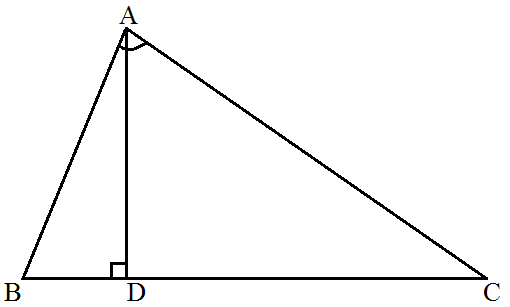
In right angled $\triangle\text{ABC},\ \angle\text{A}=90^\circ$
$\text{AD}\perp\text{BC}$
$\therefore\triangle\text{ABD}\sim\triangle\text{ABC}$
$\therefore\frac{\text{AB}}{\text{BC}}=\frac{\text{BD}}{\text{AB}}\Rightarrow\text{AB}^2=\text{BD}\times\text{BC}\ \ ...(\text{i})$
Similarly $\triangle\text{ACD}\sim\triangle\text{ABC}$
$\therefore\frac{\text{AC}}{\text{BC}}=\frac{\text{DC}}{\text{AC}}\Rightarrow\text{AC}^2=\text{DC}\times\text{BC}\ \ ...(\text{ii})$
Dividing (ii) by (i)
$\frac{\text{BD}\times\text{BC}}{\text{DC}\times{\text{BC}}}=\frac{\text{AB}^2}{\text{AC}^2}\Rightarrow\frac{\text{BD}}{\text{DC}}=\frac{\text{AB}^2}{\text{AC}^2}$
Hence $\frac{\text{BD}}{\text{DC}}=\frac{\text{AB}^2}{\text{AC}^2}$ View full question & answer→MCQ 21 Mark
If $\triangle\text{ABC}\sim\triangle\text{DEF}$ such that DE = 3cm, EF = 2cm, DF = 2.5cm, BC = 4cm, then perimeter of $\triangle\text{ABC}$ is:
Answer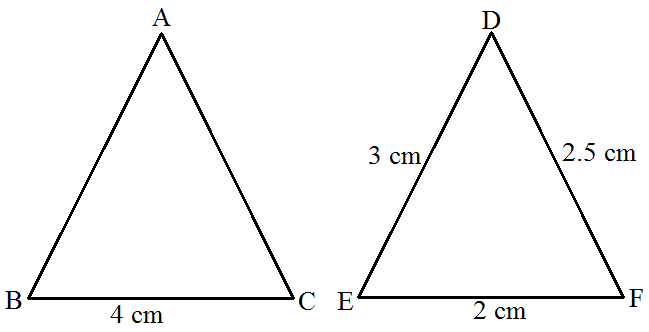
$\triangle\text{ABC}\sim\triangle\text{DEF}$
DE = 3cm, EF = 2cm, DF = 2.5cm, BC = 4cm
$\because\triangle\text{ABC}\sim\triangle\text{DEF}$
$\therefore$ Perimeter of $\triangle\text{DEF}$
= DE + EF + DF
= 3 + 2 + 2.5 = 7.5cm
Now $\frac{\text{AB}}{\text{DE}}=\frac{\text{BC}}{\text{EF}}=\frac{\text{AC}}{\text{DF}}=\frac{\text{AB}+\text{BC}+\text{CA}}{\text{DE}+\text{EF}+\text{DF}}$
$=\frac{4}{2}=\frac{\text{AB}+\text{BC}+\text{CA}}{7.5}$
$\Rightarrow\text{AB}+\text{BC}+\text{CA}=\frac{4\times7.5}{2}=15$
$\therefore$ Perimeter of $\triangle\text{ABC}=15\text{cm}.$ View full question & answer→MCQ 31 Mark
$\triangle\text{ABC}$ is such that AB = 3cm, BC = 2cm and CA = 2.5cm. If $\triangle\text{DEF}\sim\triangle\text{ABC}$ and EF = 4cm, then perimeter of $\triangle\text{DEF}$ is:
Answer$\triangle\text{DEF}\sim\triangle\text{ABC}$
AB = 3cm, BC = 2cm, CA = 2.5cm, EF = 4cm.
$\triangle\text{s}$ are similar
$\frac{\text{DE}}{\text{AB}}=\frac{\text{EF}}{\text{BC}}=\frac{\text{FD}}{\text{CA}}$
$\Rightarrow\frac{\text{DE}}{3}=\frac{4}{2}=\frac{\text{FD}}{2.5}$
Now $\frac{\text{DE}}{3}=\frac{4}{2}$
$\Rightarrow\text{DE}=\frac{3\times4}{2}=6\text{cm}$
and $\text{FD}=\frac{4}{2}\Rightarrow\text{FD}=\frac{4\times2.5}{2}=5\text{cm}$
$\therefore$ Perimeter of $\triangle\text{DEF}$
$=6+4+5=15\text{cm}.$
View full question & answer→MCQ 41 Mark
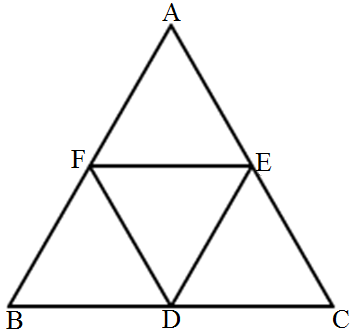
If $D, E, F $ are the mid-points of sides $BC, CA$ and $AB$ respectively of $\triangle\text{ABC},$ then the ratio of the areas of triangles $\text{DEF}$ and $\text{ABC}$ is:
- ✓
$1 : 4$
- B
$1 : 2$
- C
$2 : 3$
- D
$4 : 5$
AnswerCorrect option: A. $1 : 4$
Given: In $\triangle\text{ABC}, D, E$ and $F$ are the midpoints of $BC, CA,$ and $AB$ respectively.
To find: Ratio of the areas of $\triangle\text{DEF}$ and $\triangle\text{ABC}$
Since it is given that $D$ and, $E$ are the midpoints of $BC,$ and $AC$ respectively.
Therefore $DE \| AB, DE\| FA ….(1)$
Again it is given that $D$ and, $F$ are the midpoints of $BC,$ and, $AB$ respectively.
Therefore $, DF \| CA, DF \| AE …(2)$
From $(1)$ and $(2)$ we get $\text{AFDE}$ is a parallelogram.
Similarly we can prove that $\text{BDEF}$ is a parallelogram.
Now, in $\triangle\text{ADE}$ and $\triangle\text{ABC}$
$\angle\text{FDE}=\angle\text{A} \ ($Opposite angles of $\|^{gm} \text{ AFDE)}$
$\angle\text{DEF}=\angle\text{B} \ ($Opposite angles of $ \|^{gm} \text{ BDEF)}$
We know that the ratio of areas of two similar triangles is equal to the ratio of squares of their corresponding sides.
$\frac{\text{ar}(\triangle\text{DEF})}{\text{ar}(\triangle\text{ABC})}=\Big(\frac{\text{DE}}{\text{AB}}\Big)^2$
$\frac{\text{ar}(\triangle\text{DEF})}{\text{ar}(\triangle\text{ABC})}=\bigg(\frac{\frac{1}{2}\text{AB}}{\text{AB}}\bigg)^2\Big(\text{Since DE}=\frac{1}{2}\text{AB}\Big)$
$\frac{\text{ar}(\triangle\text{DEF})}{\text{ar}(\triangle\text{ABC})}=\Big(\frac{1}{4}\Big)$
Hence the correct option is $A$. View full question & answer→MCQ 51 Mark
In a $\triangle\text{ABC},$ point D is on side AB and point E is on side AC, such that BCED is a trapezium. If DE : BC = 3 : 5, then $\text{Area}(\triangle\text{ADE}):\text{Area}(\Box\text{BCED})=$
Answer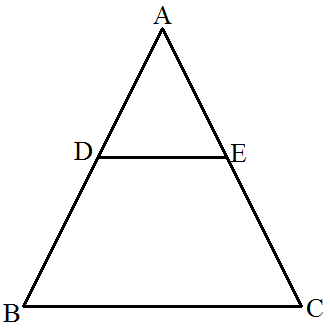
Given: In $\triangle\text{ABC},$ D is on side AB and point E is on side AC, such that BCED is a trapezium. DE : BC = 3 : 5.
To find: Calculate the ratio of the areas of $\triangle\text{ADE}$ and the trapezium BCED.
In $\triangle\text{ADE}$ and $\triangle\text{ABC},$
$\angle\text{ADE}=\angle\text{B}$ (Corresponding angles)
$\angle\text{A}=\angle\text{A}$ (Common)
$\therefore\triangle\text{ADE}\sim\triangle\text{ABC}$ (AA similarity)
We know that
$\frac{\text{Ar}(\triangle\text{ADE})}{\text{Ar}(\triangle\text{ABC})}=\frac{\text{DE}^2}{\text{BC}^2}$
$\frac{\text{Ar}(\triangle\text{ADE})}{\text{Ar}(\triangle\text{ABC})}=\frac{3^2}{5^2}$
$\frac{\text{Ar}(\triangle\text{ADE})}{\text{Ar}(\triangle\text{ABC})}=\frac{9}{25}$
Let area of $\triangle\text{ADE}=9\text{x}\text{ sq}.$ units and area of $\triangle\text{ABC}=25\text{x}\text{ sq}.$ units
$\text{Ar[trap BCED]}=\text{Ar}(\triangle\text{ABC})-\text{Ar}(\triangle\text{ADE})$
$=25\text{x}-9\text{x}$
$=16\text{x sq. units}$
Now,
$\frac{\text{Ar}(\triangle\text{ADE})}{\text{Ar}(\text{trap BCED})}=\frac{9\text{x}}{16\text{x}}$
$\frac{\text{Ar}(\triangle\text{ADE})}{\text{Ar}(\text{trap BCED})}=\frac{9}{16}$
Hence the correct answer is B. View full question & answer→MCQ 61 Mark
If $\triangle\text{ABC}$ is an equilateral triangle such that $\text{AD}\perp\text{BC},$ then $AD^2 =$
- A
$\frac{3}{2}\text{DC}^2$
- B
$\text{2DC}^2$
- ✓
$3\text{CD}^2$
- D
$4\text{DC}^2$
AnswerCorrect option: C. $3\text{CD}^2$
In equilateral $\triangle\text{ABC},\ \text{AD}\perp\text{BC}$
$AD$ bisects $BC$ at $D$
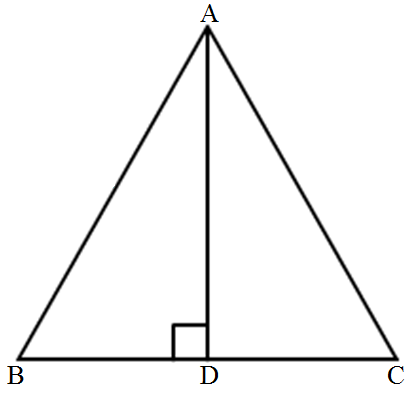
$\therefore B D=D C$
Now in right $ \triangle A D C,$
$A C^2=A D^2+D C^2(\text { Pythagoras Theorem })$
$A D^2=A C^2-D C^2$
$=B C^2-D C^2(\because A C=B C=A B)$
$=(2 D C)^2-D C^2(\because D \text { is mid point of } B C)$
$=4 D C^2-D C^2=3 D C^2$
$=3 C D^2$ View full question & answer→MCQ 71 Mark
If $\triangle\text{ABC}$ and $\triangle\text{DEF}$ are similar such that 2AB = DE and BC = 8cm, then EF =
AnswerGiven, $\triangle\text{ABC}\sim\triangle\text{DEF}$
$\therefore\frac{\text{AB}}{\text{DE}}=\frac{\text{BC}}{\text{EF}}$
$\Rightarrow\frac{\text{AB}}{2\text{AB}}=\frac{8}{\text{EF}}$
$\Rightarrow\text{EF}=8\times2$
$\Rightarrow\text{EF}=16\text{cm}$
View full question & answer→MCQ 81 Mark
A man goes $24\ m$ due west and then $7\ m$ due north. How far is he from the starting point?
- A
$31m.$
- B
$17m.$
- ✓
$25m.$
- D
$26m.$
AnswerCorrect option: C. $25m.$
Het a man be at $O$ and goes to $24m$ due west and then $7m$ due north.
Distance of man from starting point be $OB$
So,
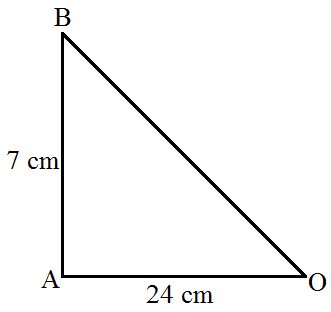
In right $\triangle\text{ABO},$
$OB^2=AB+AO^2$
$\Rightarrow OB^2=(7)^2+(24)^2$
$\Rightarrow OB^2=49+576$
$\Rightarrow OB^2=625$
$\Rightarrow OB=25 m$
Thus, the distance of man from starting point is $25m$. View full question & answer→MCQ 91 Mark
If $\text{ABC}$ is an isosceles triangle and $D$ is a point on $BC$ such that $\text{AD}\perp\text{BC},$ then:
- ✓
$AB^2-AD^2=BD \times DC$
- B
$AB^2-AD^2=BD^2-DC^2$
- C
$AB^2+AD^2=BD \times DC$
- D
$AB^2+AD^2=BD^2-DC^2$
AnswerCorrect option: A. $AB^2-AD^2=BD \times DC$
If $\triangle\text{ABC}, AB = AC$
$D$ is a point on $BC$ such that
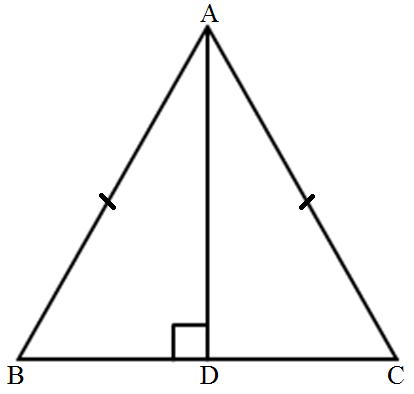
$\text{AD}\perp\text{BC}$
$AD$ bisects $BC$ at $D$
In right $\triangle\text{ABD},$
$A B^2=A D^2+B D^2$
$A B^2-A D^2=B D^2=B D \times B D=B D \times D C(B D=D C)$
View full question & answer→MCQ 101 Mark
Two isosceles triangles have equal angles and their areas are in the ratio 16 : 25. The ratio of their corresponding heights is:
AnswerGiven: two isosceles triangles have equal vertical angles and their areas are in the ratio of 16 : 25.
To find: Ratio of their corresponding heights.
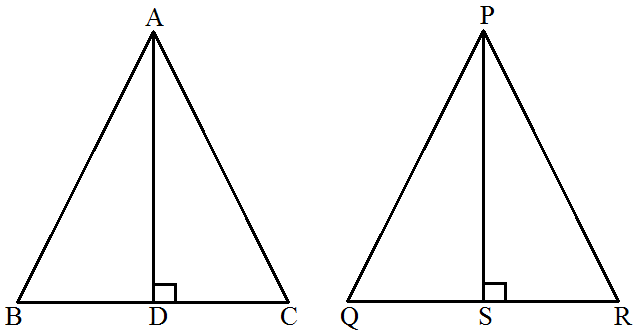
Let $\triangle\text{ABC}$ and $\triangle\text{PQR}$ be two isosceles triangles such that $\angle\text{A}=\angle\text{P}.$ Suppose $\text{AD}\perp\text{BC}$ and $\text{PS}\perp\text{QR}.$
In $\triangle\text{ABC}$ and $\triangle\text{PQR},$
$\frac{\text{AB}}{\text{PQ}}=\frac{\text{AC}}{\text{PR}}$
$\angle\text{A}=\angle\text{P}$
$\therefore\triangle\text{ABC}\sim\triangle\text{PQR}$ (SAS similarity)
We know that the ratio of areas of two similar triangles is equal to the squares of their corresponding altitudes.
Hence,
$\frac{\text{Ar}(\triangle\text{ABC})}{\text{Ar}(\triangle\text{PQR})}=\Big(\frac{\text{AD}}{\text{PS}}\Big)^2$
$\Rightarrow\frac{16}{25}=\Big(\frac{\text{AD}}{\text{PS}}\Big)^2$
$\Rightarrow\frac{\text{AD}}{\text{PS}}=\frac{4}{5}$
Hence we got the result as A. View full question & answer→MCQ 111 Mark
In a $\triangle\text{ABC},\ \angle\text{A}=90^\circ,$ AB = 5cm and AC = 12cm. If $\text{AD}\perp\text{BC},$ then AD =
- A
$\frac{13}{2}\text{cm}.$
- ✓
$\frac{60}{13}\text{cm}.$
- C
$\frac{13}{60}\text{cm}.$
- D
$\frac{2\sqrt{15}}{13}\text{cm}.$
AnswerCorrect option: B. $\frac{60}{13}\text{cm}.$
In$\triangle\text{ABC},$
$\angle\text{A}=90^\circ,$ AB = 5cm, AC = 12cm
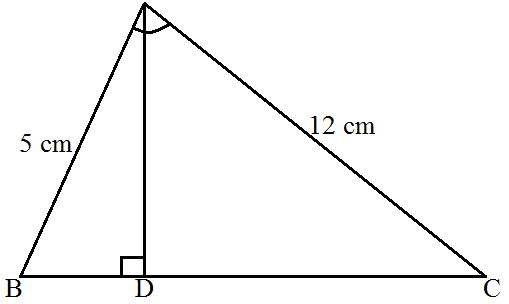
$\text{AD}\perp\text{BC}$
$\text{BC}^2=\text{AB}^2+\text{AC}^2$ (Pythagoras Theorem)
$=(5)^2+(12)^2$
$=25+144=169=(13)^2$
$\therefore\text{BC}=13\text{cm}$
Now area of $\triangle\text{ABC}=\frac{1}{2}\text{AB}\times\text{AC}$
$=\frac{1}{2}\times5\times12=30\text{cm}^2$
and also area of $\triangle\text{ABC}=\frac{1}{2}\text{BC}\times\text{AD}$
$\Rightarrow30=\frac{1}{2}\times13\times\text{AD}$
$\Rightarrow\text{AD}=\frac{30\times2}{13}=\frac{60}{13}\text{cm}.$ View full question & answer→MCQ 121 Mark
If in two triangle ABC and DEF, $\angle\text{A}=\angle\text{E},\ \angle\text{B}=\angle\text{F},$ then which of the following is not true?
- A
$\frac{\text{BC}}{\text{DF}}=\frac{\text{AC}}{\text{DE}}$
- ✓
$\frac{\text{AB}}{\text{DE}}=\frac{\text{BC}}{\text{DF}}$
- C
$\frac{\text{AB}}{\text{EF}}=\frac{\text{AC}}{\text{DE}}$
- D
$\frac{\text{BC}}{\text{DF}}=\frac{\text{AB}}{\text{EF}}$
AnswerCorrect option: B. $\frac{\text{AB}}{\text{DE}}=\frac{\text{BC}}{\text{DF}}$
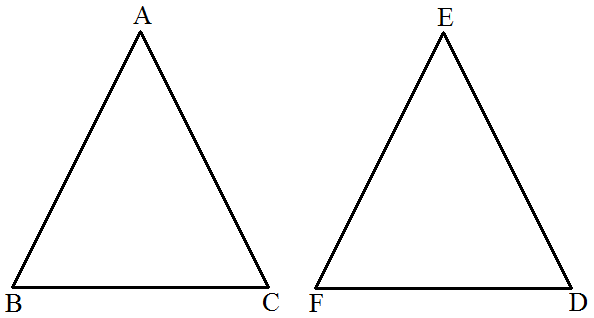
In $\triangle\text{ABC}$ and $\triangle\text{DEF}$
$\angle\text{A}=\angle\text{E}$
$\angle\text{B}=\angle\text{F}$
$\therefore\triangle\text{ABC}$ and $\triangle\text{DEF}$ are similar triangles
Hence $\frac{\text{AB}}{\text{EF}}=\frac{\text{BC}}{\text{FD}}=\frac{\text{CA}}{\text{DE}}$
Hence the correct answer is B. View full question & answer→MCQ 131 Mark
Two poles of height $6m$ and $11m$ stand vertically upright on a plane ground. If the distance between their foot is $12m,$ the distance between their tops is:
- A
$12m.$
- B
$14m.$
- ✓
$13m.$
- D
$11m$.
AnswerCorrect option: C. $13m.$
Het $AB$ and $CD$ be two poles and distance blw their root is $12m$.
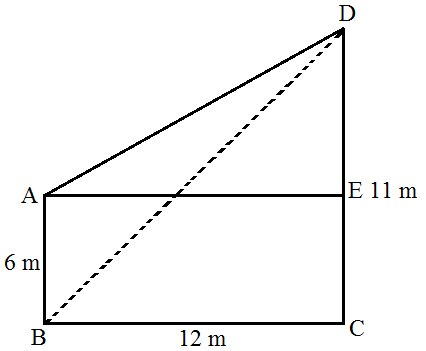
$E D=C D-C E=11-6=5 cm$
In right $\triangle ADE$,
$A D^2=A E^2+D E^2$
$\Rightarrow A D^2=(12)^2+(5)^2$
$\Rightarrow A D^2=144+25$
$\Rightarrow A D^2=169$
$\Rightarrow A D=13 m$
Thus distance blw their tops is $13 m$ . View full question & answer→MCQ 141 Mark
In triangles ABC and DEF, $\angle\text{A}=\angle\text{E}=40^\circ,$ AB : ED = AC : EF and $\angle\text{F}=65^\circ,$ then $\angle\text{B}=$
AnswerIn $\triangle\text{ABC}$ and $\triangle\text{DEF},$
$\angle\text{A}=\angle\text{E}=40^\circ$
AB : ED = AC : EF, $\angle\text{F}=65^\circ$
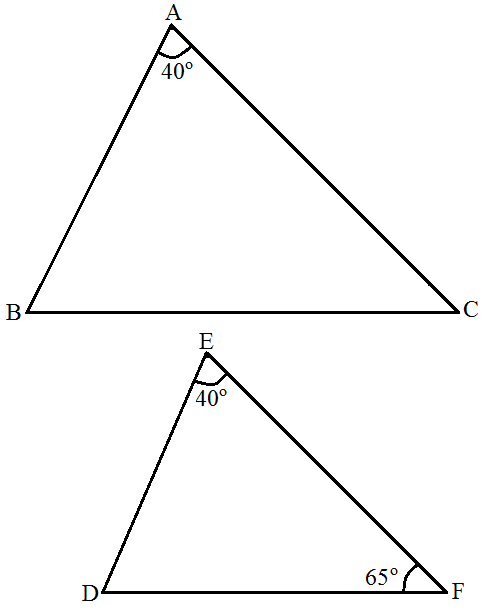
$\Rightarrow\frac{\text{AB}}{\text{ED}}=\frac{\text{AC}}{\text{EF}}$
$\because$ In $\triangle\text{ABC}$ and $\triangle\text{EDF},$
$\angle\text{A}=\angle\text{E}$ (each = 40°)
$\frac{\text{AB}}{\text{ED}}=\frac{\text{AC}}{\text{EF}}$ (given)
$\therefore\triangle\text{ABC}\sim\triangle\text{EDF}$ (SAS criterion)
$\therefore\angle\text{C}=\angle\text{F}=65^\circ$
and $\angle\text{B}=\angle\text{D}$
But $\angle\text{A}+\angle\text{B}+\angle\text{C}=180^\circ$ (Sum of angles of a triangle)
$\Rightarrow40^\circ+65^\circ+\angle\text{C}=180^\circ$
$\Rightarrow105^\circ+\angle\text{C}=180^\circ$
$\therefore\angle\text{C}=180^\circ-105^\circ=75^\circ$ View full question & answer→MCQ 151 Mark
In a $\triangle\text{ABC},\ \angle\text{A}=90^\circ,$ AB = 5cm and AC = 12cm. If $\text{AD}\perp\text{BC},$ then AD =
- A
$\frac{13}{2}\text{cm}.$
- ✓
$\frac{60}{13}\text{cm}.$
- C
$\frac{13}{60}\text{cm}.$
- D
$\frac{2\sqrt{15}}{13}\text{cm}.$
AnswerCorrect option: B. $\frac{60}{13}\text{cm}.$
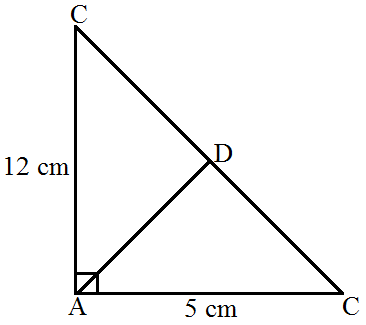
In $\triangle\text{ABC}$ and $\triangle\text{BDA}$
$\angle\text{BAC}=\angle\text{ADC}=90^\circ$
$\angle\text{B}=\angle\text{B}$ (Common)
$\triangle\text{ABC}\sim\triangle\text{BDA}$
$\frac{\text{AC}}{\text{AD}}=\frac{\text{BC}}{\text{AB}}\ ....(1)$
Using Pythagoras theorem in $\triangle\text{ABC}$ we get
$\text{BC}=\sqrt{(12)^2+(5)^2}$
$\Rightarrow\text{BC}=\sqrt{144+25}$
$\Rightarrow\text{BC}=\sqrt{169}$
$\Rightarrow\text{BC}={13}\text{cm}$
From (1)
$\Rightarrow\frac{12}{\text{AD}}=\frac{13}{5}$
$\Rightarrow\text{AD}=\frac{12\times5}{13}$
$\Rightarrow\text{AD}=\frac{60}{13}\text{cm}.$ View full question & answer→MCQ 161 Mark
Sides of two similar triangles are in the ratio $4 : 9.$ Areas of these triangles are in the ratio.
- A
$2 : 3$
- B
$4 : 9$
- C
$81 : 16$
- ✓
$16 : 81$
AnswerCorrect option: D. $16 : 81$
Triangles are similar and the ratio of their sides is $4 : 9$
The ratio of the areas of two similar triangles are proportion to the square ot their corresponding sides
Ratio in their areas $=(4)^2:(9)^2=16: 81$
View full question & answer→MCQ 171 Mark
The areas of two similar triangles are in respectively $9 \ cm^2$ and $16 \ cm^2$. The ratio of their corresponding sides is:
- ✓
$3 : 4$
- B
$4 : 3$
- C
$2 : 3$
- D
$4 : 5$
AnswerCorrect option: A. $3 : 4$
Given, two similar $\triangle\text{s}$
Ratio of areas $= ($Ratio corresponding sides$)^2$
$\Rightarrow\frac{9}{16}=(\text{Ratio of corresponding sides})^2$
$\Rightarrow$ Ratio corresponding sides$=\frac{3}{4}$
View full question & answer→MCQ 181 Mark
In $\triangle\text{ABC},$ D and E are points on side AB and AC respectively such that DE || BC and AD : DB = 3 : 1. If EA = 3.3cm, then AC =
AnswerGiven: In $\triangle\text{ABC},$ D and E are points on the side AB and AC respectively such that DE || BC and AD : DB = 3 : 1. Also, EA = 3.3cm.
To find: AC
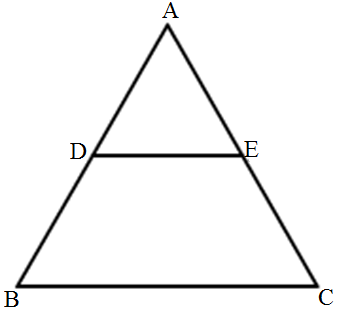
In $\triangle\text{ABC},$ DE || BC.
Using corollory of basic proportionality theorem, we have,
$\frac{\text{AD}}{\text{AB}}=\frac{\text{EA}}{\text{AC}}$
$\frac{\text{AD}}{\text{AD}+\text{BD}}=\frac{3.3}{\text{AC}}$
$\frac{\text{AD}}{\text{AD}+\frac{1}{3}\text{AD}}=\frac{3.3}{\text{AC}}$
$\text{EC}=4.4\text{cm}$
Hence the correct answer is C. View full question & answer→MCQ 191 Mark
$\triangle\text{ABC}$ and $\triangle\text{BDE}$ are two equilateral triangles such that D is the mid-point of BC. The ratio of the areas of triangle ABC and BDE is:
Answer$\triangle\text{ABC}$ and $\triangle\text{BDE}$ are equilateral triangles and D is the mid-point of PC.
$\triangle\text{ABC}$ and $\triangle\text{BDE}$ are both equilateral triangles
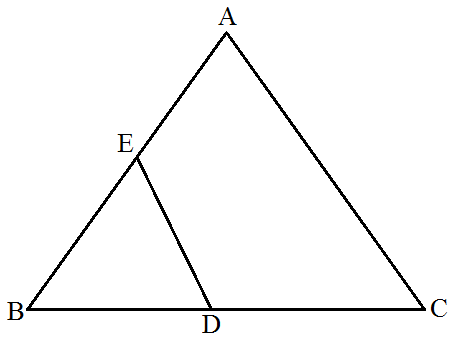
$\therefore$ They are similar also
$\therefore\frac{\text{area of }\triangle\text{ABC}}{\text{area of }\triangle\text{BDE}}=\frac{\text{BC}^2}{\text{BD}^2}=\frac{\text{BC}^2}{\big(\frac{1}{2}\text{BC}^2\big)}$ {D is mid point of BC}
$=\frac{\text{BC}^2}{\frac{1}{4}\text{BC}^2}=\frac{\text{4BC}^2}{\text{BC}^2}=\frac{4}{1}$
$\therefore$ Ratio is 4 : 1 View full question & answer→MCQ 201 Mark
In an isosceles triangle $\text{ABC},$ if $AB = AC = 25\ cm$ and $BC = 14\ cm,$ then the measure of altitude from $A$ on $BC$ is:
- A
$20\ cm.$
- B
$22\ cm.$
- C
$18\ cm.$
- ✓
$24\ cm.$
AnswerCorrect option: D. $24\ cm.$
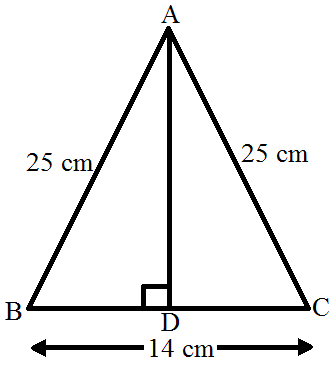
$\triangle\text{ABC}$ is an isosceles triangle in which $AB = AC = 25\ cm, BC = 14\ cm$
$\triangle ABC$ is an isosceles triangle in which $AB = AC =25 \ cm, BC =14 \ cm$
From $A$ , draw $AD \perp BC$
$D$ is mid $-$ point of $B C$
$BD=\frac{1}{2} BC=\frac{1}{2} \times 14=7 \ cm$
Now in right $\triangle ABD$
$A D^2=A B^2-B D^2$
$=(25)^2-(7)^2=625-49=576=(24)^2$
$A D=24 \ cm$ View full question & answer→MCQ 211 Mark
In an equilateral triangle $\ce{ABC}$ if $\text{AD}\perp\text{BC},$ then:
- A
$5 A B^2=4 A D^2$
- ✓
$3 A B^2=4 A D^2$
- C
$4 A B^2=3 A D^2$
- D
$2 A B^2=3 A D^2$
AnswerCorrect option: B. $3 A B^2=4 A D^2$
$\triangle\text{ABC}$ is an equilateral triangle and $\text{AD}\perp\text{BC}.$
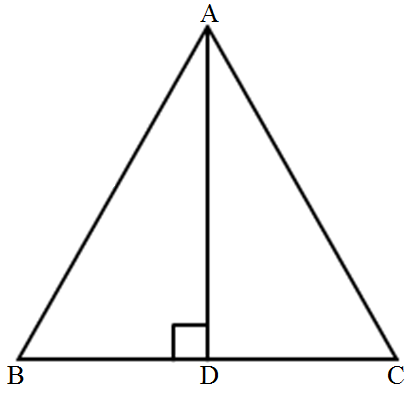
In $\triangle\text{ABD},$ applying Pythagoras theorem, we get,
$\text{AB}^2=\text{AD}^2+\text{BD}^2$
$\text{AB}^2=\text{AD}^2+\Big(\frac{1}{2}\text{BC}\Big)^2\Big(\because\text{BD}=\frac{1}{2}\text{BC}\Big)$
$\text{AB}^2=\text{AD}^2+\Big(\frac{1}{2}\text{AB}\Big)^2\Big(\because\text{AB}=\text{BC}\Big)$
$\text{AB}^2=\text{AD}^2+\frac{1}{4}\text{AB}^2$
$3\text{AB}^2=4\text{AD}^2$
We got the result as $B.$ View full question & answer→MCQ 221 Mark
In the figure, RS || DB || PQ. If CP = PD = 11cm and DR = RA = 3cm. Then the values of x and y are respectively:
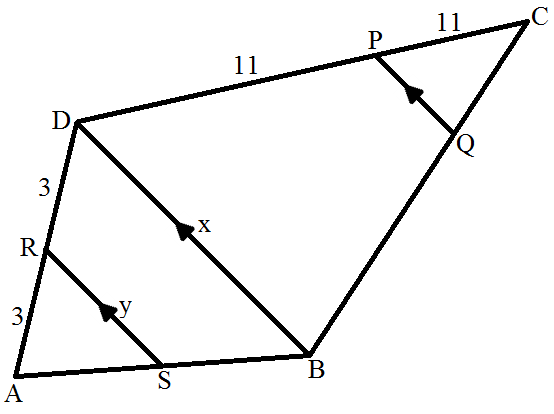
Answerthe figure RS || DB || PQ
CP = PD = 11cm DR = RA = 3cm
In $\triangle\text{ABD}$
RS || BD and AR = RD
$\text{RS}=\frac{1}{2}\text{BD}$
$\text{y}=\frac{1}{2}\text{x or x}=2\text{y}$
Only 16, 8 is possible.
View full question & answer→MCQ 231 Mark
In a $\triangle\text{ABC},$ perpendicular $AD$ from $A$ on $BC$ meets $BC$ at $D$. If $BD = 8\ cm, DC = 2\ cm$ and $AD = 4\ cm,$ then:
- A
$\triangle\text{ABC}$ is isosceles.
- B
$\triangle\text{ABC}$ is equilateral.
- C
$\text{AC} = 2\text{AB.}$
- ✓
$\triangle\text{ABC}$ is right $-$ angled at $A$.
AnswerCorrect option: D. $\triangle\text{ABC}$ is right $-$ angled at $A$.
in $\triangle\text{ABC},\ \text{AD}\perp\text{BC}$
$BD = 8\ cm, DC = 2\ cm, AD = 4\ cm$
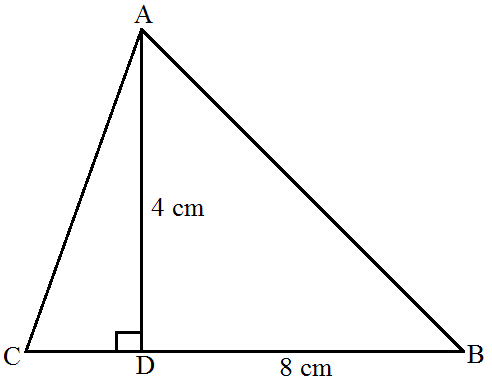
In right $\triangle ACD$,
$A C^2=A D^2+C D^2 \text { (Pythagoras Theorem) }$
$=(4)^2+(2)^2=16+4=20$
and in right $\triangle ABD$,
$A B^2=A D^2+D B^2$
$=(4)^2+(8)^2=16+64=80$
and $B C^2=(B D+D C)^2$
$=(8+2)^2=(10)^2=100$
$A B^2+A C^2=80+20=100=B C^2$
$\triangle ABC$ is a right triangle whose $\angle A =90^{\circ}$ View full question & answer→MCQ 241 Mark
The areas of two similar triangles are $121 \ cm^2$ and $64 \ cm^2$ respectively. If the median of the first triangle is $12.1 \ cm$ , then the corresponding median of the other triangle is:
- A
$11\ cm.$
- ✓
$8.8\ cm.$
- C
$11.1\ cm.$
- D
$8.1\ cm.$
AnswerCorrect option: B. $8.8\ cm.$
Given: The area of two similar triangles is $121 \ cm^2$ and $64 \ cm^2$ respectively.
The median of the first triangle is $12.1 \ cm .$
To find: Corresponding medians of the other triangle.
We know that the ratio of areas of two similar triangles is equal to the ratio of squares of their medians.
$\frac{\text{ar}(\text{triangle 1})}{\text{ar}(\text{triangle 2})}=\Big(\frac{\text{median 1}}{\text{median 2}}\Big)^2$
$\frac{121}{64}=\Big(\frac{12.1}{\text{median 2}}\Big)^2$
Taking square root on both side, we get,
$\frac{11}{8}=\frac{12.1\text{cm}}{\text{median 2}}$
$\Rightarrow $ median2 $= 8.8\ cm$
Hence the correct answer is $B.$
View full question & answer→MCQ 251 Mark
A chord of a circle of radius 10cm subtends a right angle at the centre. The length of the chord (in cm) is:
- A
$5\sqrt{2}$
- ✓
$10\sqrt{2}$
- C
$\frac{5}{\sqrt{2}}$
- D
$10\sqrt{3}$
AnswerCorrect option: B. $10\sqrt{2}$
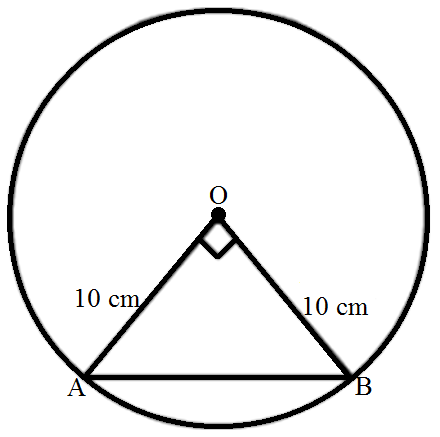
In right $\triangle\text{OAB},$
$A B^2=O A^2+O B^2$ (Pythagoras Theorem)
$\Rightarrow A B^2=(10)^2+(10)^2(OA=OB=10 cm)$
$\Rightarrow AB^2=100+100=200$
$\Rightarrow\text{AB}=\sqrt{200}=10\sqrt{2}\text{cm}$
Thus, the length of the chord is $10\sqrt{2}\text{cm}.$
Hence, the correct answer is option B. View full question & answer→MCQ 261 Mark
The areas of two similar triangles $\triangle\text{ABC}$ and $\triangle\text{DEF}$ are 1$44 \ cm^2$ and $81 \ cm^2$ respectively. If the longest side of larger $\triangle\text{ABC}$ be 36\ cm, then the longest side of the smaller triangle $\triangle\text{DEF}$ is:
- A
$ 20\ cm.$
- B
$ 26\ cm.$
- ✓
$ 27\ cm.$
- D
$30\ cm.$
AnswerCorrect option: C. $ 27\ cm.$
Given: Areas of two similar triangles $\triangle\text{ABC}$ and $\triangle\text{DEF}$ are $114 \ cm^2$ and $81 \ cm^2$.
If the longest side of larger $\triangle\text{ABC}$ is $36\ cm$
To find: the longest side of the smaller triangle $\triangle\text{DEF}$
We know that the ratio of areas of two similar triangles is equal to the ratio of squares of their corresponding sides.
$\frac{\text{ar}(\triangle\text{ABC})}{\text{ar}(\triangle\text{DEF})}=\Big(\frac{\text{longest side of larger }\triangle\text{ABC}}{\text{longest side of smaller }\triangle\text{DEF}}\Big)^2$
$\frac{144}{81}=\Big(\frac{36}{\text{longest side of smaller}\ \triangle\text{DEF}}\Big)^2$
Taking aquare root on both sides, we get
$\frac{12}{9}=\frac{36}{\text{longest side of smaller}\ \triangle\text{DEF}}$
longest side of smaller $\triangle\text{DEF}=\frac{36\times9}{12}=27\text{cm}$
Hence the correct answer is $C.$
View full question & answer→MCQ 271 Mark
A vertical stick 20m long casts a shadow 10m long on the ground. At the same time, a tower casts a shadow 50m long on the ground. The height of the tower is:
AnswerHeight of a stick = 20m
and length of its shadow = 10m
At the same time
Let height of tower = x m
and its shadow = 50m
20 : x = 10 : 50
x × 10 = 20 × 50
$\Rightarrow\text{x}=\frac{20\times50}{10}=100$
Height of tower = 100m.
View full question & answer→MCQ 281 Mark
In a $\triangle\text{ABC},$ AD is the bisector of $\angle\text{BAC}.$ If AB = 8cm, BD = 6cm and DC = 3cm. Find AC:
AnswerGiven: In a $\triangle\text{ABC},$ AD is the bisector of angle BAC. AB = 8cm, and DC = 3cm and BD = 6cm.
To find: AC
We know that the internal bisector of angle of a triangle divides the opposite side internally in the ratio of the sides containing the angle.
Hence,
$\frac{\text{AB}}{\text{AC}}=\frac{\text{BD}}{\text{DC}}$
$\frac{8}{\text{AC}}=\frac{6}{3}$
$\text{AC}=\frac{8\times3}{6}$
$\text{AC}=4\text{cm}$
Hence we got the result A.
View full question & answer→MCQ 291 Mark
$\triangle\text{ABC}\sim\triangle\text{DEF}.$ If $BC = 3\ cm, EF = 4\ cm$ and $\text{ar}(\triangle\text{ABC})=54\text{ cm}^2,$ then $\text{ar}(\triangle\text{DEF}):$
- A
$108\ cm^2$
- ✓
$96\ cm^2$
- C
$48\ cm^2$
- D
$100\ cm^2$
AnswerCorrect option: B. $96\ cm^2$
$\triangle\text{ABC}\sim\triangle\text{DEF}$
$\text{BC}=3\text{ cm},\ \text{EF}=4\text{ cm}$
$\text{ar}(\triangle\text{ABC})=54\text{ cm}^2$
$\because\triangle\text{ABC}\sim\triangle\text{DEF}$
$\therefore\frac{\text{ar}(\triangle\text{ABC})}{\text{ar}(\triangle\text{DEF})}=\frac{\text{BC}^2}{\text{EF}^2}$
$\Rightarrow\frac{54}{\text{ar}(\triangle\text{DEF})}=\frac{3^2}{4^2}=\frac{9}{16}$
$\therefore\text{ar}(\triangle\text{DEF})=\frac{16\times54}{9}=96\text{ cm}^2$
View full question & answer→MCQ 301 Mark
The lenght of the hypotenuse of an isosceles right triangle whose one side is $4\sqrt{2}\text{cm}$ is:
- A
$12\text{cm}.$
- ✓
$8\text{cm}.$
- C
$8\sqrt{2}\text{ cm}.$
- D
$12\sqrt{2}\text{ cm}.$
AnswerCorrect option: B. $8\text{cm}.$
Het ABC be an isosceles right triangle.
We have,
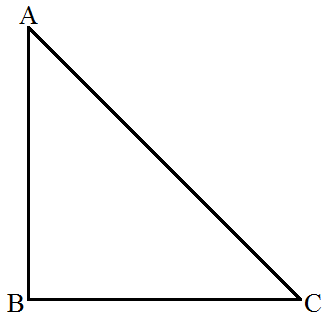
$\text{AB}=\text{BC}=4\sqrt{2}\text{ cm}$
$\Rightarrow\text{AC}^2=\text{AB}^2+\text{BC}^2$
$\Rightarrow\text{AC}^2=(4\sqrt{2})^2+(4\sqrt{2})^2$
$\Rightarrow\text{AC}^2=32+32$
$\Rightarrow\text{AC}^2=64$
$\Rightarrow\text{AC}=8\text{cm}$
Thus, the length of hypotenuse is 8cm. View full question & answer→MCQ 311 Mark
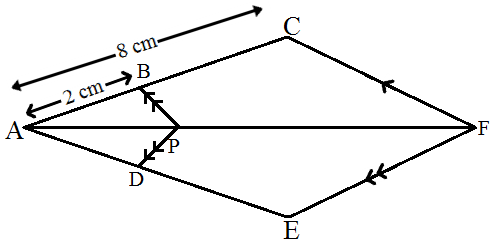
In the figure, if PB || CF and DP || EF, then $\frac{\text{AD}}{\text{DE}}=$
- A
$\frac{3}{4}.$
- ✓
$\frac{1}{3}.$
- C
$\frac{1}{4}.$
- D
$\frac{2}{3}.$
AnswerCorrect option: B. $\frac{1}{3}.$
In the figure, PB || CF, DP || EF
AB = 2cm, AC = 8cm
BC = AC - AB = 8 - 2 = 6cm
In $\triangle\text{ACF},\ \text{BP} || \text{CF}$
$\therefore\frac{\text{AB}}{\text{BC}}=\frac{\text{AP}}{\text{PF}}=\frac{2}{6}=\frac{1}{3}\ ....(1)$
In $\triangle\text{AEF},\ \text{DP}||\text{EF}$
$\therefore\frac{\text{AD}}{\text{DE}}=\frac{\text{AP}}{\text{PF}}=\frac{1}{3}\ \ [\text{From}\ (2)]$
$\frac{\text{AD}}{\text{DE}}=\frac{1}{3}.$
View full question & answer→MCQ 321 Mark
In the figure, the value of x for which DE || AB is:
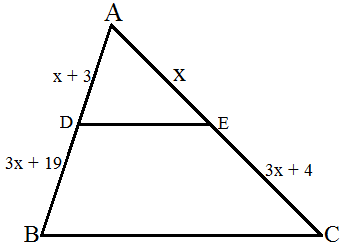
AnswerIn $\triangle\text{ABC},\ \text{DE}||\text{BC}$
$\therefore\frac{\text{AD}}{\text{DB}}=\frac{\text{AE}}{\text{EC}}$
$\Rightarrow\frac{\text{x}+3}{3\text{x}+19}=\frac{\text{x}}{3\text{x}+4}$
$\Rightarrow(\text{x}+3)(3\text{x}+4)=\text{x}(3\text{x}+19)$
$\Rightarrow3\text{x}^2+4\text{x}+9\text{x}+12=3\text{x}^2+19\text{x}$
$\Rightarrow3\text{x}^2+13\text{x}+12=3\text{x}^2+19\text{x}$
$\Rightarrow12=3\text{x}^2+19\text{x}-3\text{x}^2-13\text{x}$
$\Rightarrow12=6\text{x}\Rightarrow\text{x}=\frac{12}{6}=2$
$\therefore\text{x}=2$
View full question & answer→MCQ 331 Mark
If in two triangles ABC and DEF, $\frac{\text{AB}}{\text{DE}}=\frac{\text{BC}}{\text{FE}}=\frac{\text{CA}}{\text{FD}},$ then:
- ✓
$\triangle\text{FDE}\sim\triangle\text{CAB}$
- B
$\triangle\text{FDE}\sim\triangle\text{ABC}$
- C
$\triangle\text{CBA}\sim\triangle\text{FDE}$
- D
$\triangle\text{BCA}\sim\triangle\text{FDE}$
AnswerCorrect option: A. $\triangle\text{FDE}\sim\triangle\text{CAB}$
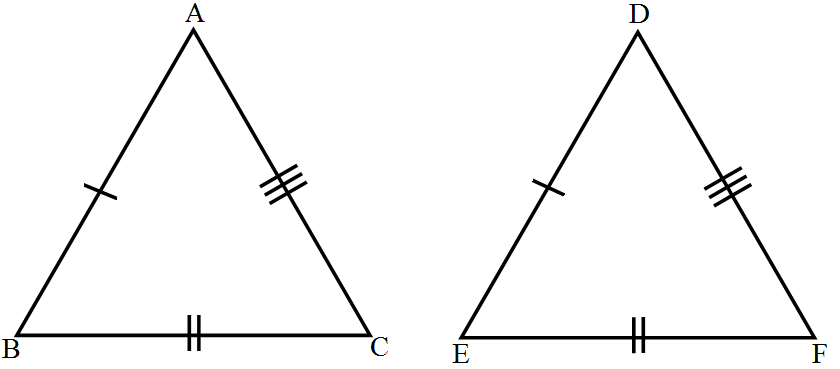
In $\triangle\text{ABC}$ and $\triangle\text{DEF,}$
$\frac{\text{AB}}{\text{DE}}=\frac{\text{BC}}{\text{FE}}=\frac{\text{CA}}{\text{FD}}$ (By SSS axiom)
$\therefore\triangle\text{FDE}=\triangle\text{CAB}$ View full question & answer→MCQ 341 Mark
If $\triangle\text{ABC}$ and $\triangle\text{DEF}$ are two triangles such that $\frac{\text{AB}}{\text{DE}}=\frac{\text{BC}}{\text{EF}}=\frac{\text{CA}}{\text{FD}}=\frac{2}{5},$ then area $\text{Area }(\triangle\text{ABC}):\text{Area}(\triangle\text{DEF})=$
AnswerGiven: $\triangle\text{ABC}$ and $\triangle\text{DEF}$ are two triangles such that $\frac{\text{AB}}{\text{DE}}=\frac{\text{BC}}{\text{EF}}=\frac{\text{CA}}{\text{FD}}=\frac{2}{5}$
To find: $\text{Ar}(\triangle\text{ABC}):\text{Ar}(\triangle\text{DEF})$
We know that if the sides of two triangles are proportional, then the two triangles are similar.
Since $\frac{\text{AB}}{\text{DE}}=\frac{\text{BC}}{\text{EF}}=\frac{\text{CA}}{\text{FD}}=\frac{2}{5},$ therefore, $\triangle\text{ABC}$ and $\triangle\text{DEF}$ are similar.
We know that the ratio of areas of two similar triangles is equal to the ratio of squares of their corresponding sides.
$\frac{\text{Ar}(\triangle\text{ABC})}{\text{Ar}(\triangle\text{DEF})}=\frac{\text{AB}^2}{\text{DE}^2}$
$\frac{\text{Ar}(\triangle\text{ABC})}{\text{Ar}(\triangle\text{DEF})}=\frac{2^2}{5^2}$
$\frac{\text{Ar}(\triangle\text{ABC})}{\text{Ar}(\triangle\text{DEF})}=\frac{4}{25}$
Hence the correct answer is b.
View full question & answer→MCQ 351 Mark
If $E$ is a point on side $CA$ of an equilateral triangle $\text{ABC}$ such that $\text{BE}\perp\text{CA},$ then $A B^2+B C^2+C A^2=$
- A
$2BE^2$
- B
$3BE^2$
- ✓
$4BE^2$
- D
$6BE^2$
AnswerCorrect option: C. $4BE^2$
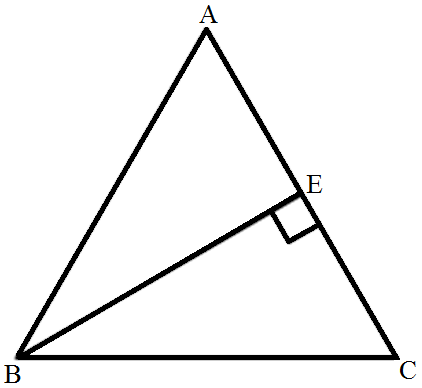
In triangle $\text{ABC}, E$ is a point on $AC$ such that $\text{BE}\perp\text{AC}.$
We need to find $A B^2+B C^2+A C^2$
Since $BE \perp AC , CE = AE =\frac{ AC }{2}\ ($In a equilateral triangle, the perpendicular from the vertex bisects the base.$)$
In triangle $\text{ABE} ,$ we have,
$A B^2=B E^2+A E^2$
Since $A B=B C=A C$
Therefore, $A B^2=B C^2=A C^2=B E^2+A E^2$
$\Rightarrow A B^2+B C^2+A C^2=3 B E^2+3 A E^2$
Since in triangle $BE$ is an altitude, so $\text{BE}=\frac{\sqrt{3}}{2}\text{AB}$
$\text{BE}=\frac{\sqrt{3}}{2}\text{AB}$
$=\frac{\sqrt{3}}{2}\times\text{AC}$
$=\frac{\sqrt{3}}{2}\times2\text{AE}=\sqrt{3}\text{AE}$
$\Rightarrow\text{AB}^2+\text{BC}^2+\text{AC}^2=3\text{BE}^2+3\Big(\frac{\text{BE}}{\sqrt{3}}\Big)^2$
$=3\text{BE}^2+\text{BE}^2=4\text{BE}^2$
Hence option $C$ is correct. View full question & answer→MCQ 361 Mark
If $\triangle\text{ABC}\sim\triangle\text{DEF}$ such that AB = 9.1cm and DE = 6.5cm. If the perimeter of $\triangle\text{DEF}$ is 25cm, then the perimeter of $\triangle\text{ABC}$ is:
AnswerGiven: $\triangle\text{ABC}$ is similar to $\triangle\text{DEF}$ such that AB= 9.1cm, DE = 6.5cm. Perimeter of $\triangle\text{DEF}$ is 25cm.
To find: Perimeter of $\triangle\text{ABC}.$
We know that the ratio of corresponding sides of similar triangles is equal to the ratio of their perimeters.
Hence,
$\frac{\text{AB}}{\text{DE}}=\frac{\text{BC}}{\text{EF}}=\frac{\text{AC}}{\text{DE}}=\frac{\text{P1}}{\text{P2}}$
$\frac{\text{AB}}{\text{DE}}=\frac{\text{P}(\triangle\text{ABC})}{\text{P}(\triangle\text{DEF})}$
$\frac{9.1}{6.5}=\frac{\text{P}(\triangle\text{ABC})}{25}$
$\text{P}(\triangle\text{ABC})=\frac{9.1\times25}{6.5}$
$\text{P}(\triangle\text{ABC})=35\text{cm}$
Hence the correct answer is D.
View full question & answer→MCQ 371 Mark
$\triangle\text{ABC}\sim\triangle\text{PQR}$ such that $\text{ar}(\triangle\text{ABC})=4\ \text{ar}(\triangle\text{PQR}).$ If BC = 12cm, then QR =
AnswerGiven: $\triangle\text{ABC}\sim\triangle\text{PQR}$ and BC = 12cm
$\text{ar}(\triangle\text{ABC})=4\ \text{ar}(\triangle\text{PQR})$
Now, $\frac{\text{ar}(\triangle\text{ABC})}{\text{ar}(\triangle\text{PQR})}=\Big(\frac{\text{BC}}{\text{QR}}\Big)^2$
$\Rightarrow\frac{4\text{ar}(\triangle\text{PQR})}{\text{ar}(\triangle\text{PQR})}=\frac{(12)^2}{\text{QR}^2}$
$\Rightarrow\text{QR}^2=\frac{144}{4}$
$\Rightarrow\text{QR}=\frac{12}{2}$
$\Rightarrow\text{QR}=6\text{cm}.$
View full question & answer→MCQ 381 Mark
$\triangle\text{ABC}\sim\triangle\text{DEF},$ $\text{ar}(\triangle\text{ABC})=9\text{cm}^2,\ \text{ar}(\triangle\text{DEF})=16\text{cm}^2.$ If BC = 2.1cm, then the measure of EF is:
AnswerGiven: $\text{Ar}(\triangle\text{ABC})=9\text{cm}^2,$ $\text{Ar}(\triangle\text{DEF})=16\text{cm}^2,\ \text{and BC}=2.1\text{cm}$
To find: measure of EF
We know that the ratio of areas of two similar triangles is equal to the ratio of squares of their corresponding sides.
$\frac{\text{Ar}(\triangle\text{ABC})}{\text{Ar}(\triangle\text{DEF})}=\frac{\text{BC}^2}{\text{EF}^2}$
$\frac{9}{16}=\frac{2.1^2}{\text{EF}^2}$
$\frac{3}{4}=\frac{2.1}{\text{EF}}$
$\text{EF}=2.8\text{cm}$
Hence the correct answer is A.
View full question & answer→MCQ 391 Mark
In an equilateral triangle $\text{ABC}$ if $\text{AD}\perp\text{BC},$ then $AD^2 =$
- A
$CD^2$
- B
$2CD^2$
- ✓
$3CD^2$
- D
$4CD^2$
AnswerCorrect option: C. $3CD^2$
In an equilateral $\triangle\text{ABC},\ \text{AD}\perp\text{BC}$
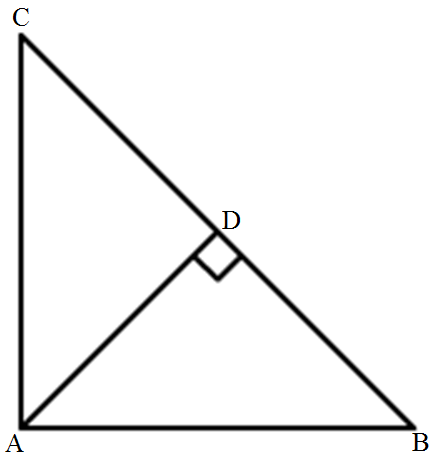
In $\triangle ADC$, applying Pythagoras theorem, we get,
$A C^2=A D^2+D C^2$
$B C^2=A D^2+D C^2(\because A C=B C)$
$(2 D C)^2=A D^2+D C^2(\because B C=2 D C)$
$4 D C^2=A D^2+D C^2$
$3 D C^2=A D^2$
$3 C D^2=A D^2$
Hence, the correct option is $C.$ View full question & answer→MCQ 401 Mark
In a right triangle ABC right-angled at B, if P and Q are points on the sides AB and AC respectively, then:
- A
$\text{AQ}^2+\text{CP}^2=2(\text{AC}^2+\text{PQ}^2)$
- B
$2(\text{AQ}^2+\text{CP}^2)=\text{AC}^2+\text{PQ}^2$
- ✓
$\text{AQ}^2+\text{CP}^2=\text{AC}^2+\text{PQ}^2$
- D
$\text{AQ}+\text{CP}=\frac{1}{2}(\text{AC}+\text{PQ})$
AnswerCorrect option: C. $\text{AQ}^2+\text{CP}^2=\text{AC}^2+\text{PQ}^2$
Disclaimer: There is mistake in the problem. The question should be "In a right triangle ABC right-angle at B, if P and Q are points on the sides AB and BC respectively, then"
Given: In the right $\triangle\text{ABC},$ right angled at B. P and Q are points on the sides AB and BC respectivelt.
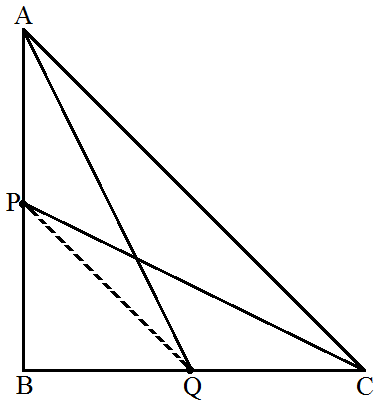
Applying Pythagoras theorem,
In $\triangle\text{AQB},$
$\text{AQ}^2=\text{AB}^2+\text{BQ}^2\ ....(1)$
In $\triangle\text{PBC}$
$\text{CP}^2=\text{PB}^2+\text{BC}^2\ ....(2)$
Adding (1) and (2), we get
$\text{AQ}^2+\text{CP}^2=\text{AB}^2+\text{BQ}^2+\text{PB}^2+\text{BC}^2\ \ ...(3)$
In $\triangle\text{ABC},$
$\text{AC}^2=\text{AB}^2+\text{BC}^2\ ....(4)$
In $\triangle\text{PBQ},$
$\text{PQ}^2=\text{PB}^2+\text{BQ}^2\ ....(5)$
From (3), (4) and (5), we get
$\text{AQ}^2+\text{CP}^2=\text{AC}^2+\text{PQ}^2$
We got the result as C. View full question & answer→MCQ 411 Mark
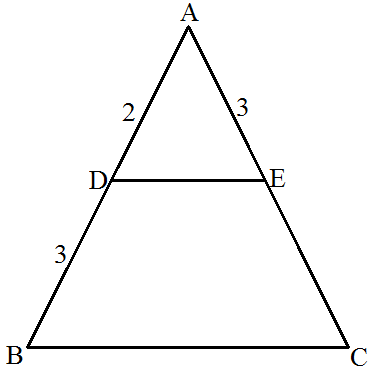
In the given figure, if $\angle\text{ADE}=\angle\text{ABC},$ then CE =
- A
$2$
- B
$5$
- ✓
$\frac{9}{2}$
- D
$3$
AnswerCorrect option: C. $\frac{9}{2}$
Given: $\angle\text{ADE}=\angle\text{ABC}$
To find: The value of CE
Since $\angle\text{ADE}=\angle\text{ABC}$
$\therefore\text{DE}||\text{BC}$ (Two lines are parallel if the corresponding angles formed are equal)
According to basic proportionality theorem if a line is parallel to one side of a triangle intersecting the other two sides, then it divides the two sides in the same ratio.
In $\triangle\text{ABC},\ \text{DE}||\text{BC}$
$\frac{\text{AD}}{\text{DB}}=\frac{\text{AE}}{\text{EC}}$
$\frac{2}{3}=\frac{3}{\text{EC}}$
$\text{EC}=\frac{3\times3}{2 }$
$\text{EC}=\frac{9}{2}$
Hence we got the result C.
View full question & answer→MCQ 421 Mark
If in $\triangle\text{ABC}$ and $\triangle\text{DEF},$ $\frac{\text{AB}}{\text{DE}}=\frac{\text{BC}}{\text{FD}},$ then $\triangle\text{ABC}\sim\triangle\text{DEF}$ when:
- A
$\angle\text{A}=\angle\text{F}$
- B
$\angle\text{A}=\angle\text{D}$
- ✓
$\angle\text{B}=\angle\text{D}$
- D
$\angle\text{B}=\angle\text{E}$
AnswerCorrect option: C. $\angle\text{B}=\angle\text{D}$
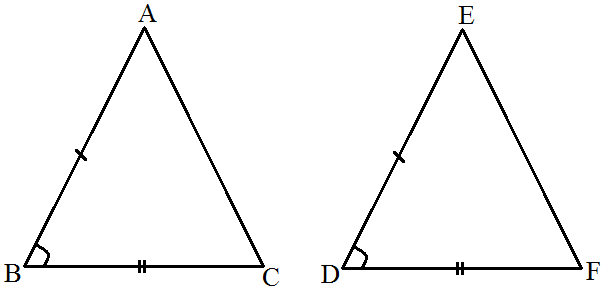
$\triangle\text{ABC}\sim\triangle\text{DEF}$
In $\triangle\text{ABC}$ and $\triangle\text{DEF},$
$\frac{\text{AB}}{\text{DE}}=\frac{\text{BC}}{\text{FD}}$
Then $\angle\text{B}=\angle\text{D}$ (included angle SAS axiom). View full question & answer→MCQ 431 Mark
In a $\triangle\text{ABC}$ AD is the bisector of $\angle\text{BAC}.$ If AB = 6cm, AC = 5cm and BD = 3cm, then DC =
AnswerIn $\triangle\text{ABC},$ AD is the bisector of $\angle\text{BAC}$
AB = 6cm, AC = 5cm, BD = 3cm
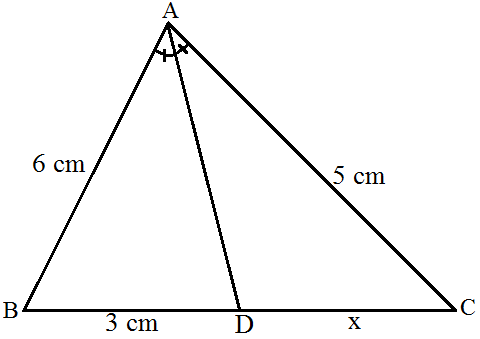
Let DC = x
In $\triangle\text{ABC}$
$\because$ AD is the bisector of $\angle\text{A}$
$\therefore\frac{\text{AB}}{\text{AC}}=\frac{\text{BD}}{\text{DC}}\Rightarrow\frac{6}{5}=\frac{3}{\text{x}}$
$\Rightarrow\text{x}=\frac{3\times5}{6}=\frac{5}{2}=2.5$
$\therefore$ DC = 2.5cm. View full question & answer→MCQ 441 Mark
In an isosceles triangle $ABC$ if $A C=B C$ and $A B^2=2 A C^2$, then $\angle C=$
- A
$30^{\circ}$
- B
$45^{\circ}$
- ✓
$90^{\circ}$
- D
$60^{\circ}$
AnswerCorrect option: C. $90^{\circ}$
In isosceles $\triangle\text{ABC},\ \text{AC}=\text{BC}$
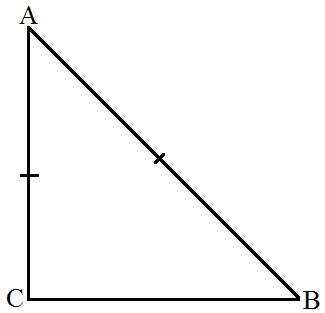
and $A B^2=A C^2+A C^2=2 A C^2$
$=A C^2+B C^2(A C=B C)$
By converse of Pythagoras Theorem,
$\angle\text{C}=90^\circ$ View full question & answer→MCQ 451 Mark
If ABC and DEF are similar triangles such that $\angle\text{A}=47^\circ$and $\angle\text{E}=83^\circ,$ then $\angle\text{C}=$
AnswerWe have,
$\triangle\text{ABC}\sim\triangle\text{DEF}$
$\angle\text{A}=\angle\text{D}=47^\circ,\ \angle\text{B}=\angle\text{E}=83^\circ$ and $\angle\text{C}=\angle\text{F}=?$
$\angle\text{A}+\angle\text{B}+\angle\text{C}=180^\circ$ (angle sum property)
$\Rightarrow47^\circ+83^\circ+\angle\text{C}=180^\circ$
$\Rightarrow130^\circ+\angle\text{C}=180^\circ$
$\Rightarrow\angle\text{C}=180^\circ-130^\circ$
$\Rightarrow\angle\text{C}=50^\circ$
View full question & answer→MCQ 461 Mark
ABCD is a trapezium such that BC || AD and AD = 4cm. If the diagonals AC and BD intersect at O such that $\frac{\text{AO}}{\text{OC}}=\frac{\text{DO}}{\text{OB}}=\frac{1}{2},$ then BC =
AnswerWe have,
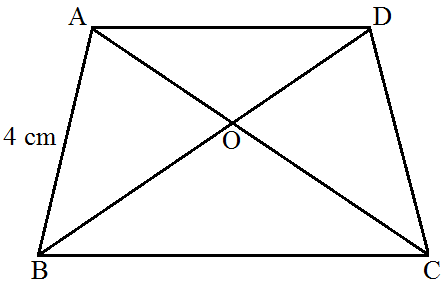
$\frac{\text{AO}}{\text{OC}}=\frac{\text{DO}}{\text{OB}}=\frac{1}{2}$
In $\triangle\text{AOB}$ and $\triangle\text{DOC}$
$\angle\text{AOB}=\angle\text{DOC}$ (Vertically oposite angle)
$\angle\text{OAB}=\angle\text{OCD}$ (Alternate angle)
$\therefore\triangle\text{AOB}\sim\triangle\text{DOC}$
$\frac{\text{AO}}{\text{OC}}=\frac{\text{AB}}{\text{DC}}$
$\Rightarrow\frac{1}{2}=\frac{4}{\text{DC}}$
$\Rightarrow\text{DC}=4\times2$
$\Rightarrow\text{DC}=8\text{cm}.$ View full question & answer→MCQ 471 Mark
XY is drawn parallel to the base BC of a $\triangle\text{ABC}$ cutting AB at X and AC at Y. If AB = 4 BX and YC = 2cm, then AY =
AnswerIn $\triangle\text{ABC},$ XY || BC
AB = 4BX, YC = 2cm
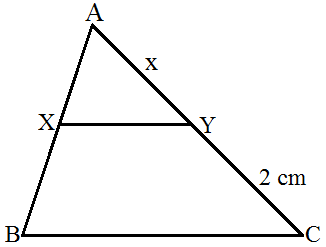
$\therefore$ AB = 4BX ⇒ AX + BX = 4BX
⇒ AX = 4BX - BX = 3BX
Let AY = x
$\because$ In $\triangle\text{ABC},$ XY || BC
$\frac{\text{AX}}{\text{BX}}=\frac{\text{AY}}{\text{CY}}\Rightarrow\frac{\text{3BX}}{\text{BX}}=\frac{\text{x}}{2}$
$\Rightarrow\frac{3}{1}=\frac{\text{x}}{2}\Rightarrow\text{x}=3\times2=6$
$\therefore$ AY = 6cm. View full question & answer→MCQ 481 Mark
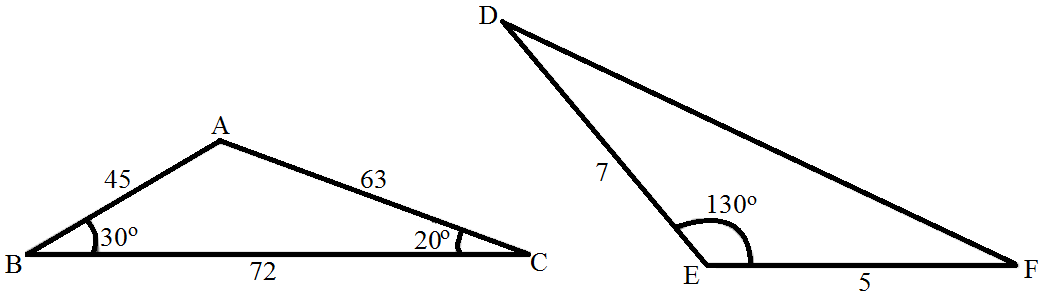
In the given figure the measure of $\angle\text{D}$ and $\angle\text{F}$ are respectively:
Answer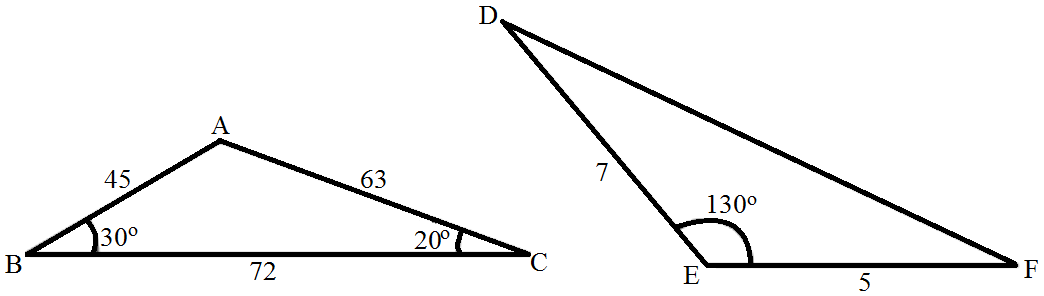
$\triangle\text{ABC}$ and $\triangle\text{DEF,}$
$\frac{\text{AB}}{\text{AC}}=\frac{\text{EF}}{\text{ED}}$
$\angle\text{A}=\angle\text{E}=130^\circ$
$\triangle\text{ABC}\sim\triangle\text{EFD}$ (SAS Similarity)
$\therefore\angle\text{F}=\angle\text{B}=30^\circ$
$\angle\text{D}=\angle\text{C}=20^\circ$
Hence the correct answer is B. View full question & answer→MCQ 491 Mark
If $\ce{ABC}$ is a right triangle right-angled at $B$ and $M, N$ are the mid$-$points of $A B$ and $B C$ respectively, then $4\left(A N^2+C M^2\right)=$
- A
$4\text{AC}^2$
- ✓
$5\text{AC}^2$
- C
$\frac{5}{4}\text{AC}^2$
- D
$6\text{AC}^2$
AnswerCorrect option: B. $5\text{AC}^2$
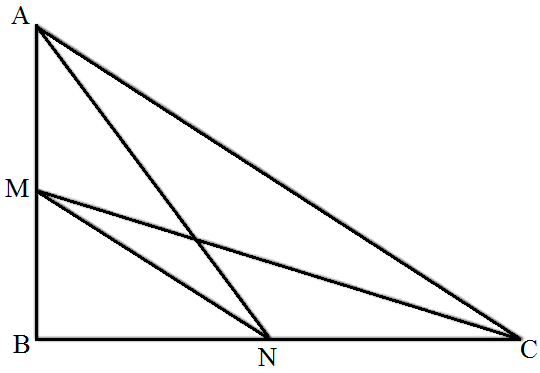
$M$ is the mid$-$point of $AB.$
$\therefore\text{BM}=\frac{\text{AB}}{2}$
$N$ is the mid$-$point of $BC.$
$\therefore\text{BN}=\frac{\text{BC}}{2}$
Now,
$\text{AN}^2+\text{CM}^2=\bigg(\text{AB}^2+\Big(\frac{1}{2}\text{BC}\Big)^2\bigg)+\bigg(\Big(\frac{1}{2}\text{AB}\Big)^2+\text{BC}^2\bigg)$
$=\text{AB}^2+\frac{1}{4}\text{BC}^2+\frac{1}{4}\text{AB}^2+\text{BC}^2$
$=\frac{5}{4}\Big(\text{AB}^2+\text{BC}^2\Big)$
$\Rightarrow4\Big(\text{AN}^2+\text{CM}^2\Big)$
$=5\text{AC}^2$
Hence option $B$ is correct. View full question & answer→MCQ 501 Mark
$\triangle\text{ABC}$ is an isosceles triangle in which $\angle\text{C}=90^\circ$ If $AC = 6\ cm,$ then $AB =$
- ✓
$6\sqrt{2}\text{ cm}.$
- B
$6\text{ cm}.$
- C
$2\sqrt{6}\text{ cm}.$
- D
$4\sqrt{2}\text{ cm}.$
AnswerCorrect option: A. $6\sqrt{2}\text{ cm}.$
$\triangle\text{ABC}$ is an isosceles with $\angle\text{C}=90^\circ$
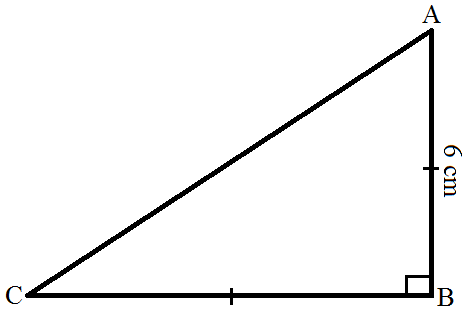
$AC=BC$
$AC=6 \ cm$
$AB^2=AC^2+BC^2 \ ($Pythagoras Theorem$)$
$(6)^2+(6)^2=36+36=72(AC=BC)$
$\text{AB}=\sqrt{72}=\sqrt{(36\times2}=6\sqrt{2}\text{ cm}.$ View full question & answer→