Questions

case /data -based (4 Marks)

Take a timed test

11 questions · self-marked practice — reveal the answer and mark yourself.

Question 14 Marks
Read the following and answer any three questions from (i) to (iv). A series of organic compounds having same functional group, with similar or almost identical chemical characteristics in which all the members can be represented by the same general formula and the two consecutive members of the series differ by- $CH _2$ group or 14 mass unit in their molecular formulae is called a homologous series. For example, all the members of alcohol family can be represented by the general formula, $C _n H _{2 n+1} OH$ where, $n$ may have the values $1,2,3$, etc. The various members of a particular homologous series are called homologous. The physical properties such as density, melting point, boiling point, solubility, etc. of the members of a homologous series show almost regular variation in ascending or descending the series.
i. What are the characteristic of members of a homologous series?
ii. Write the general formula of all the members of homologous series of alkynes.
iii. What is a homologous series? Write example.
OR
iv. What are the 3 types of homologous series and define each.
Answer
i. (a) They possess varying chemical properties.

Explanation:

All the members of homologous series show similar chemical properties.
ii. (C) $C _{ n } H _{2 n -2}$

Explanation:

Alkynes have the general formula $C _n H _{2 n-2}$. e.g., Ethyne $\left( C _2 H _2\right)$, Propyne $\left( C _3 H _4\right)$, Butyne $\left( C _4 H _6\right)$.
iii. (b) Two consecutive members of a homologous series differ by a- $CH _3$ group.

Explanation:

Two consecutive members of a homologous series differ by a- $CH _2$ group.
iv. (C) (I), (III) and (IV)

Explanation:

The melting and boiling points increase with increasing molecular mass.
v. (b) $C _n H _{2 n+2} O$

Explanation:

Molecular formula of first member: $C _2 H _6 O$ Molecular formula of second member: $C _3 H _8 O$ Molecular formula of third member: $C _4 H _{10} O$ Thus, the general formula of the homologous series is $C _2 H _{2 n+2} O$.
View full question & answer
Question 24 Marks
Read the following and answer any three questions from (i) to (iv).Two allotropic forms of carbon which are crystalline in nature, are diamond and graphite. They differ physically but chemically they are similar. Diamond is the hardest crystalline form of carbon. In diamond, each carbon atom is linked to four other carbon atoms by covalent bonds. In graphite, each carbon atom is linked to three other carbon atoms by covalent bond. Graphite is relatively soft and greasy. It is also a good conductor of electricity. The C-C bond length in graphite is 141.5 pm while in diamond it is 154 pm.
  1. Which are a good conductor of heat and electricity?
     
  2. Why Graphite is a good conductor of electricity?
     
  3. A) Which types of binding forces is present in the structure of diamond?

    B) Why Diamond is not a good conductor of electricity?

    OR
  4. Write two allotropic forms of carbon in brief.
Answer
  1. (d) Graphite.
  1. (a) It has free electrons.
  1. (c) Covalent.
  1. (d) It has no free electron.
Explanation:
In diamond, one carbon is attached to four other carbon atoms hence it has no free electron.
  1. (a)

Explanation:
$\text{CH}_3\text{CH}_2\text{CH}_2\text{CH}_3,\text{CH}_3\text{CH}\text{CH}_3\\\ \ \ \ \ \ \ \ \ \ \ \ \ \ \ \ \ \ \ \ \ \ \ \ \ \ \ \ \ \ \ \ \ \ \ \ \ \ \ \ \ |\\ \ \ \ \ \ \ \ \ \ \ \ \ \ \ \ \ \ \ \ \ \ \ \ \ \ \ \ \ \ \ \ \ \ \ \ \ \ \ \ \ \text{CH}_3$
View full question & answer
Question 34 Marks
Read the following and answer any three questions from (i) to (iv).As neutral atom carbon has electronic configuration $\text{K}\ \ \ \text{L}\\2\ \ \ \ 4$ To gain inert gas configuration carbon can either donate 4 valence electrons (helium gas configuration) or gain 4 electrons (neon gas configuration), but it cannot do so. To acquire inert gas configuration carbon can only share its 4 valence electrons with other atoms forming covalent bonds. A covalent bond can be defined as a chemical bond formed between two atoms by mutual sharing of valence electrons so that each atom acquires the stable electronic configuration of the nearest noble gas. The concept of covalent bonds was given by Langmuir and Lewis to explain bonding in non-ionic compounds. The covalent bonds are of three types. If each atom contributes one electron, the covalent bond formed is called a single covalent bond and is represented by a single line (-) and if each atom contributes two electrons, the covalent bond formed is called a double bond and is represented by a double line (=) and if each atom contributes three electrons, the covalent bond formed is called a triple bond and is represented by a triple line $(\equiv).$
  1. Which compounds do not contain a double bond?
     
  2. Write compounds which contains a triple bond?
     
  3. Which molecules has all its atoms joined together by double covalent bond? Give two example.

    OR
  4. A) Langmuir and Lewis has given which concept?

    B) Explain three types of covalent bonds?
Answer
  1. (b) II and III only
Explanation:
Both $NH_3$ and HCI have single bonds.
  1. (a) $N_2$
Explanation:
$\text{N}\equiv\text{N}$
  1. (a) Single.
  1. (c) Carbon dioxide.
  1. (c)

Explanation:
In chlorine molecule, both chlorine atoms contribute one electron and thus share single electron pair to form single covalent bond. As shared pair is shared by both atoms, they acquire inert gas configuration of argon atom in valence shell.
View full question & answer
Question 44 Marks
Read the following and answer any three questions from (i) to (iv).The compounds which have the same molecular formula but differ from each other in physical or chemical properties are called isomers and the phenomenon is called isomerism. When the isomerism is due to difference in the arrangement of atoms within the molecule, without any reference to space, the phenomenon is called structural isomerism. ln other words, structural isomers are compounds that have the same molecular formula but different structural formulas, i.e., they are different in the order in which different atoms are linked. In these compounds, carbon atoms can be linked together in the form of straight chains, branched chains or even rings.
i. Which sets of compounds have same molecular formula?
ii. How many an organic compound is their, In order to form branching?

iii. what is an isomers?

OR
A)Name three different types of chain?

B)The number of isomers of pentane are?
Answer
  1. (d) All of these.
Explanation:
$\text{CH}_3\text{CH}_2\text{CH}_2\text{CH}_3,\text{CH}_3\text{CH}\text{CH}_3\\\ \ \ \ \ \ \ \ \ \ \ \ \ \ \ \ \ \ \ \ \ \ \ \ \ \ \ \ \ \ \ \ \ \ \ \ \ \ \ \ \ |\\ \ \ \ \ \ \ \ \ \ \ \ \ \ \ \ \ \ \ \ \ \ \ \ \ \ \ \ \ \ \ \ \ \ \ \ \ \ \ \ \ \text{CH}_3$
(Butane and iso-Butane-$\left.- C _4 H _{10}\right)$

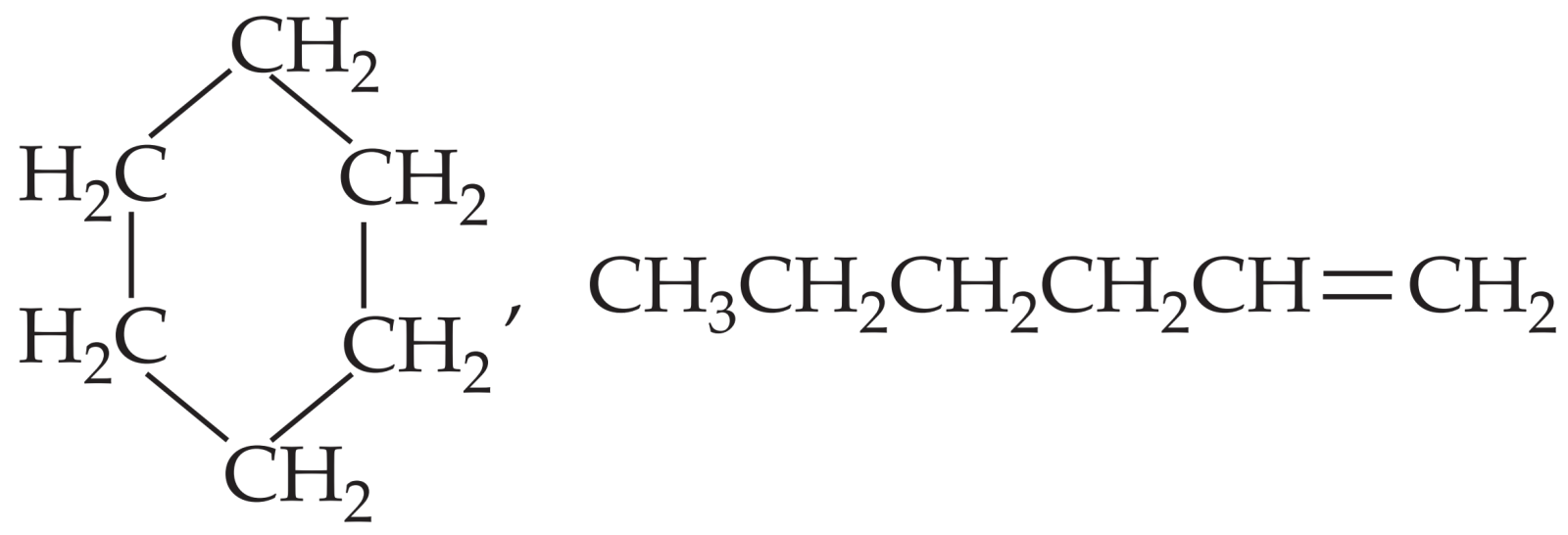
(Cyclohexane and hexene- $C _6 H _{12}$ )
$CH_3 CH_2 CHO, CH_3 COCH_3$
(Propanal and propanone- $C _3 H _6 O$ )
  1. (a) Four carbon atoms.
  1. (d) Butane and 2-methylpropane.
Explanation:
$\text{CH}_3\text{CH}_2\text{CH}_2\text{CH}_3\ \text{and}\ \text{CH}_3\text{CHCH}_3\ \text{have}\\ \ \ \ \ \ \ \ \ \ \ \ \ \ \ \ \ \ \ \ \ \ \ \ \ \ \ \ \ \ \ \ \ \ \ \ \ \ \ \ \ \ \ \ \ \ \ \ \ |\\\ \ \ \ \ \ \ \ \ \ \ \ \ \ \ \ \ \ \ \ \ \ \ \ \ \ \ \ \ \ \ \ \ \ \ \ \ \ \ \ \ \ \ \ \ \ \ \text{CH}_3$
Different structural formulas and same molecular formula.
  1. (c) 2-methylpentane.
Explanation:
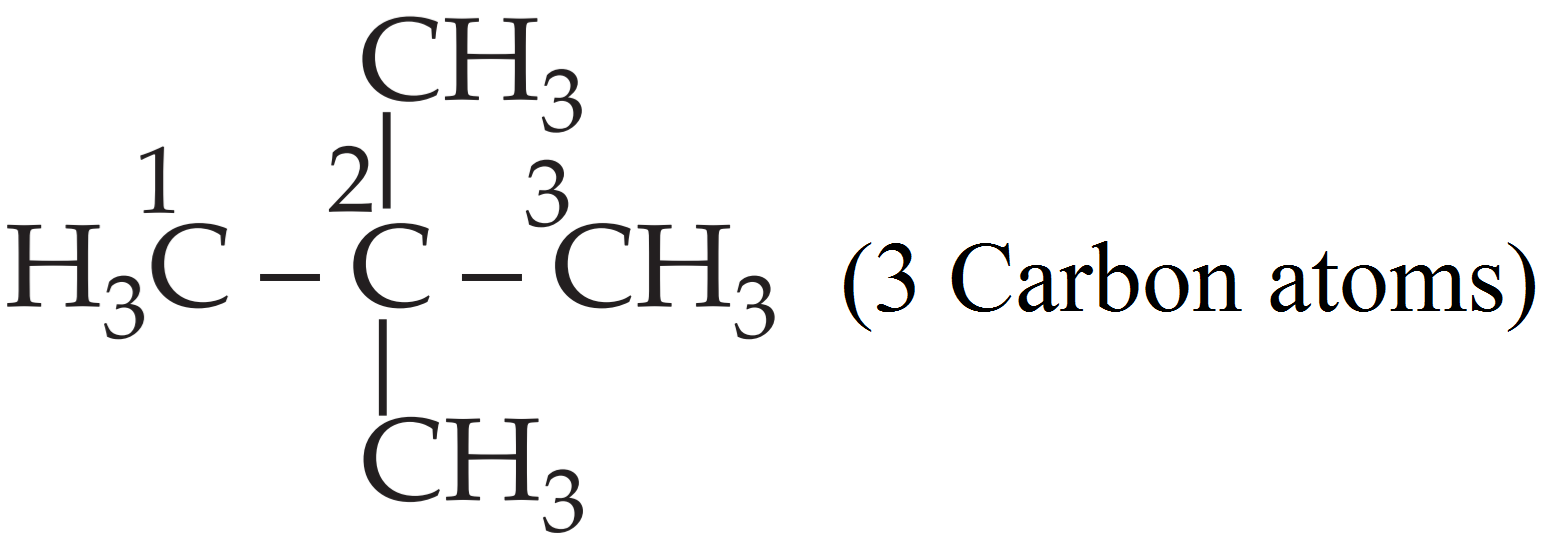
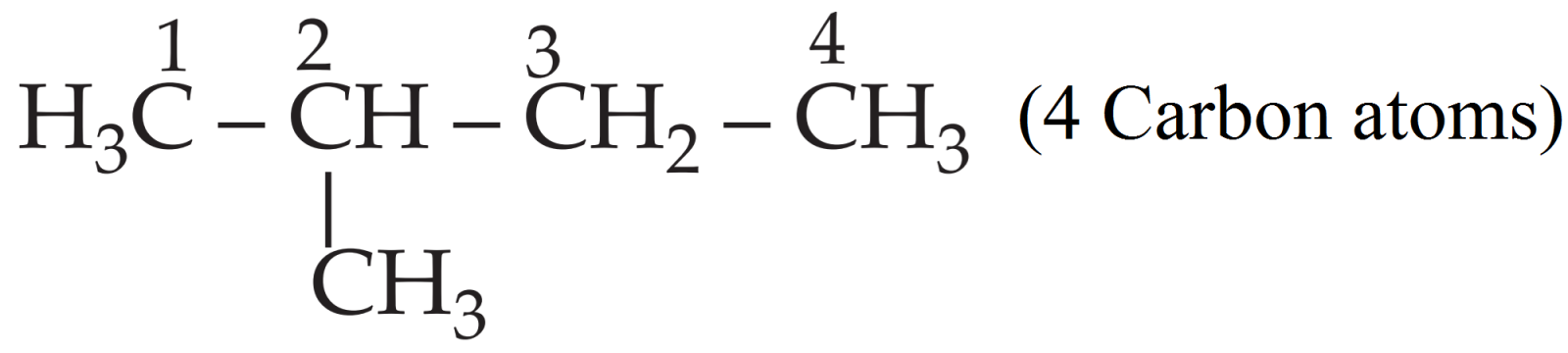
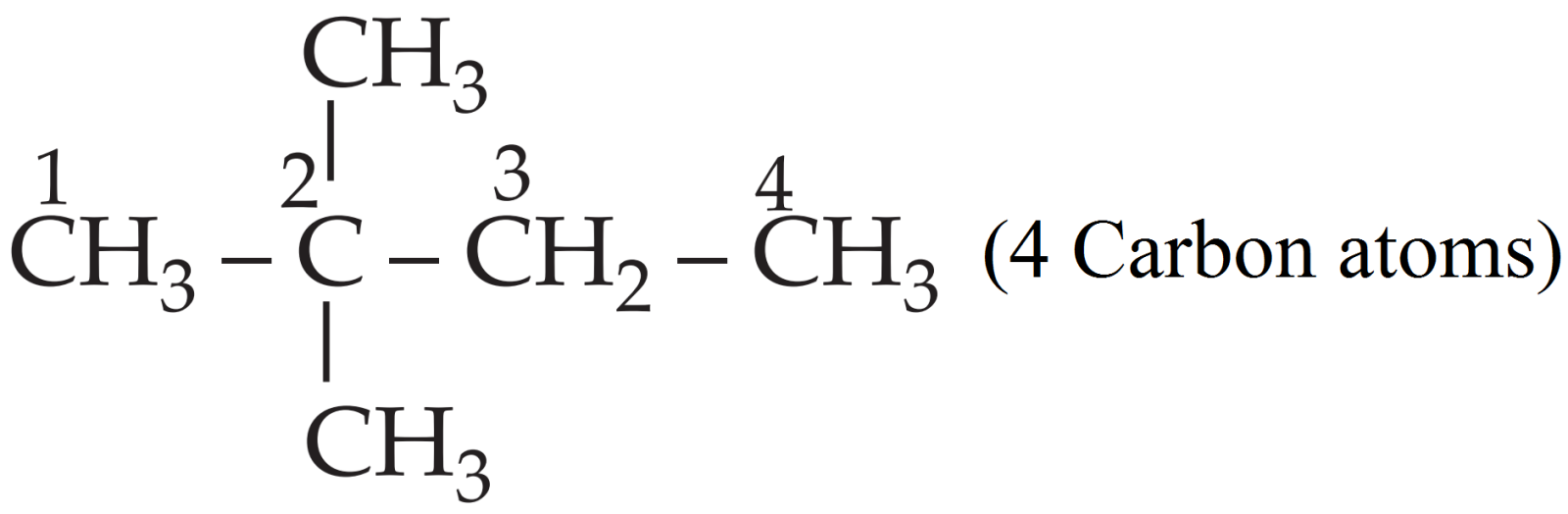
neo-Pentane:

iso-Pentane:

2-Methylpentane:

2,2-Dimethylbutane:

Hence, 2-methylpentane has the longest carbon chain.
  1. (b) 3
Explanation:
Pentane ($C_5H_{12}$) has three structural isomers:
$\text{CH}_3-\text{CH}_2-\text{CH}_2-\text{CH}_2-\text{CH}_3$
n-pentent
$\text{CH}_3-\text{CH}-\text{CH}_2-\text{CH}_3\\\ \ \ \ \ \ \ \ \ \ \ \ \ \ |\\\ \ \ \ \ \ \ \ \ \ \ \ \ \text{CH}_3$
iso-pentent
$\ \ \ \ \ \ \ \ \ \ \ \ \text{CH}_3\\\ \ \ \ \ \ \ \ \ \ \ \ \ |\\\text{CH}_3-\text{C}-\text{CH}_3\\\ \ \ \ \ \ \ \ \ \ \ \ \ |\\\ \ \ \ \ \ \ \ \ \ \ \ \text{CH}_3$
neo-pentent
View full question & answer
MCQ 54 Marks
Read the following and answer any three questions from (i) to (iv).The table given below shows six organic compounds A, B, C, D, E and F having different molecular formula:
Organic compound
Molecular formula
A
$C _7 H _{16}$
B
$C _8 H _{16}$  
C
$C _4 H _6$  
D
$C _6 H _{10}$  
E
$C _5 H _{10}$  
F
$C _9 H _{20}$
  1. Write compounds belonging to the same homologous series?
     
  2. Write the member of the same homologous series as E with the help of the table?
     
  3. Identify Compound B from a given table.

    OR
     
  4. A) Write the general formula of Compound (F).
    B) Explain Different between organic and molecular compounds.
  • A

     
Answer
  1. (d) C and D
Explanation:

A and Fare alkanes; B and E are alkenes; C and Dare alkynes.
  1. (d) B
Explanation:

B is an alkene having general formula $C _n H _{2 n}$ the homologous series to which E belongs.
iii. (a) A and Fare saturated hydrocarbons while all others are unsaturated hydrocarbons.

Explanation:
$C$ and $D$ belong to a homologous series having general formula $C_n H _{2 n-2} B$ and $E$ are alkenes. All the compounds have different physical and chemical properties.
iv. (b) An alkene. Explanation:

(B) is alkene.
  1. (d) $C _n H _{2 n+2}$
Explanation:

(F) is an alkane.
View full question & answer
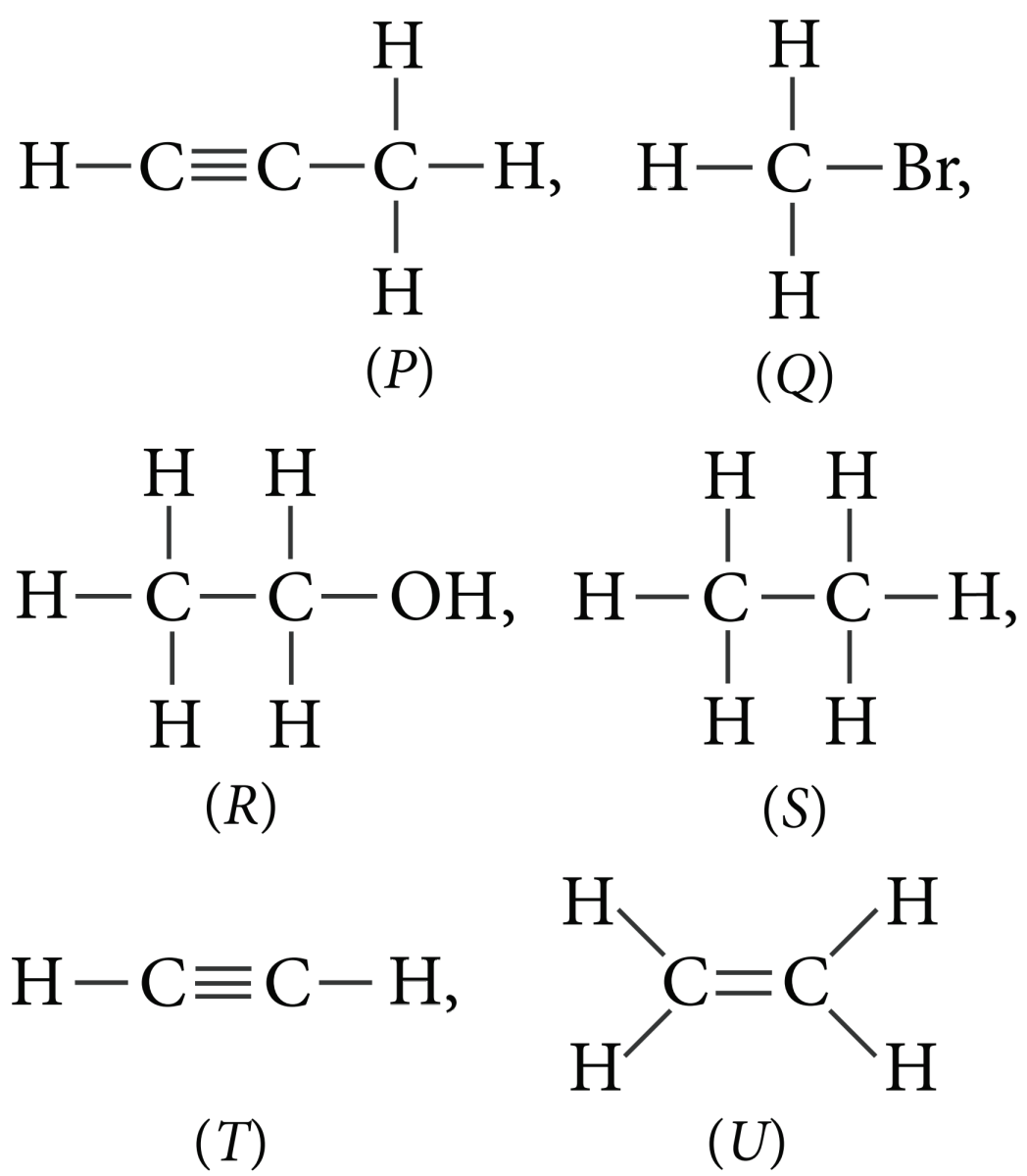
Question 64 Marks

Read the following and answer any three questions from (i) to (iv).
  1. Which compounds belong to same homologous series from given image?
     
  2. what indicate the functional group of compound (R)?
     
  3. Compound (T) belongs to which homologous series and why?

    OR
  4. A) Which compounds are unsaturated hydrocarbon from given image?

    B) Which compounds are belongs to alkane series from given image?
Answer
  1. (d) P and T
Explanation:
(P) and (T) are alkynes.
  1. (a) alcohol.
Explanation:
Alcohol (-OH).
  1. (a) alkynes.
Explanation:
(T) is an alkyne having general formula of $C _n H _{2 n-2}$
  1. (c) U
Explanation:
(U) is an alkene.
  1. (b) S
View full question & answer
Question 74 Marks
The table given below shows the hints given by the quiz master in a quiz.
S.NO HINT
(i) Substance 'C' is used as a preservative.
(ii) 'C' has two carbon atoms; 'C' is obtained by the reaction of 'A' in presence of alkaline Potassium permanganate followed by acidification.
(iii) Misuse of 'A' in industries is prevented by adding Methanol, Benzene, and pyridine to 'A'.
(iv) 'F' is formed on heating 'A' in presence of conc Sulphuric acid.
(v) 'F' reacts with Hydrogen gas in presence of Nickel and Palladium catalyst.
Based on the above hints answer the following questions
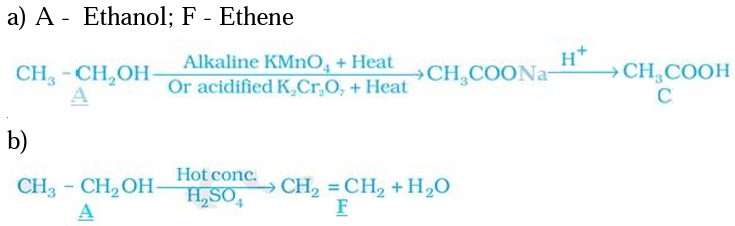
a) Give the IUPAC names of $A$ and $F$
b) Illustrate with the help of chemical equations the changes taking place. ( $A \rightarrow C$ and $A \rightarrow F$ )
OR
Name the chemical reactions which occur in steps 2 and 5 . Identify the compounds formed in these steps if ' $A$ ' is replaced with its next homologue.
Answer
Image
OR
Oxidation, Addition/ Hydrogenation
Propanol, Propene
View full question & answer
Question 84 Marks
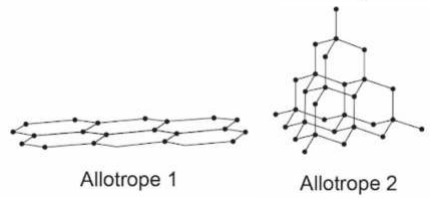
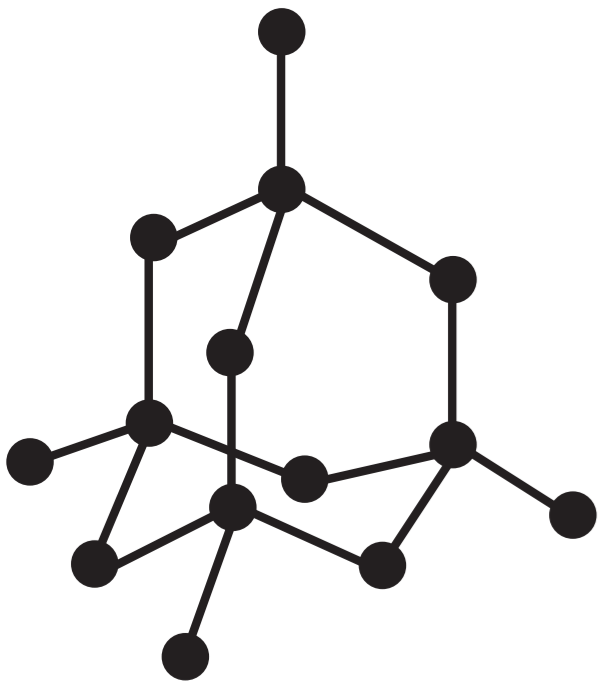
The picture shows the bonds between atoms in two allotropes of carbon.

Image
10. Which allotrope is harder? Explain your answer.

Answer
10. Mentions that allotrope 2 is harder as each of its atoms has a greater
number of bonds than that of allotrope 1.
For example,
● Allotrope 2. Its atoms have a greater number of bonds than that of
allotrope 1.
View full question & answer
Question 94 Marks
Four combustion reactions of carbon compounds are shown below.
(i) CH₄+ O₂→ CO₂+ H₂O + heat
(ii) CH₃CHO + O₂→ CO₂+ H₂O + heat
(iii) CH₃CH₂CH₂OH + O₂→ CO₂+ H₂O + heat
(iv) C₆H₆+ O₂→ CO₂+ H₂O + heat
8. What can be concluded from the four reactions?
Circle ‘Yes’ or ‘No’ for the correct response.

Can this be concluded from the reactions?

Yes or No

All carbon compounds release oxygen on combustion.

Yes/No

All carbon compounds release water on reacting with oxygen.

Yes/No

All carbon compounds produce carbon dioxide on reacting with oxygen.

Yes/No

9. Which reaction shows the combustion of a type of alcohol?
A. Reaction i
B. Reaction ii
C. Reaction iii
D. Reaction iv

Answer
8. No
Yes
Yes
9. C. Reaction iii
View full question & answer
Question 104 Marks
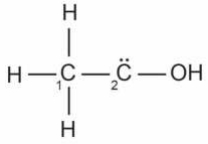
The picture shows the incomplete chain structure of a carbon compound.
The second carbon atom has two free electrons.

Image
5. How many oxygen atoms can combine with the second carbon atom to complete the structure?
A. One
B. Two
C. Three
D. Fou
6. Which of these molecules contains a double bond?
A. CH₄
B. C₂H₄
C. C₃H₈
D. C₄H₁₀
A part of a homologous series is shown below.
C₃H₄, C₄H₆, C₅H₈
7. Which of these compounds is a part of the series shown above?
A. C₂H₂
B. C₂H₄
C. C₈H₆
D. C₆H₁₄

Answer
5. A. One
6. B. C₂H₄
7. A. C₂H₂
View full question & answer
Question 114 Marks
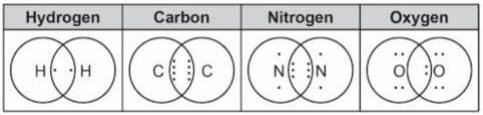
The pictures show the bonds formed by the sharing of electrons by the atoms of four different
molecules.

Image
1. Which molecule has the strongest bond between its atoms?
A. Hydrogen
B. Carbon
C. Nitrogen
D. Oxygen
2. What is this type of bond between atoms known as?
3. Which of these is another way of representing the bonds between the atoms of a nitrogen molecule?
A. $N 0 N$
C. $N \equiv N$
B. $N \times N$
D. $N - N$
4. Which of these statements is true about carbon compounds?
Circle ‘Yes’ or ‘No’ for the correct response.

Is this true about carbon compounds?

Yes or No

They are good conductors of electricity.

Yes/No

They exist in either saturated or unsaturated form

Yes/No

They have lower boiling points than ionic compounds.

Yes/No

Answer
1. B. Carbon
2. Mentions covalent bond as the response.
3. C. $N \equiv N$
4. No
Yes
Yes
View full question & answer
case /data -based (4 Marks) - Science STD 10 Questions - Vidyadip